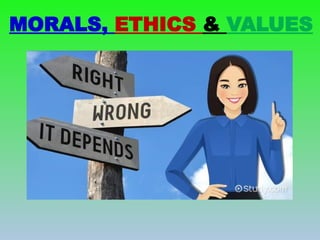
Principles ofArmed Forces
Propagated “A clean way of life”
Based on values evolved over centuries
Judged most admired profession
Scrupulous (imandari) adherence to high
ethical std
Formula for victory in battle-field
Force multiplier for battle winning factor
Not empty rhetoric has been ack
INTRODUCTION
3.
ETERNAL THE INDIANVALUE
SYSTEM
Based on Doctrine of Karma.
In Hinduism – Doctrine of three GunnasTri-gunas are prevailing in all living things in universe :-
Tamas- Darkness, Ignorance, inertia, dull ness, laziness &
weakness, Stability etc),
Rajas - (A state of Energy, action, change, movement,
passion activity etc),
Sattva (A state of harmony goodness, calmness, purity,
balance, Consciousness etc).
4.
ETERNAL THE INDIANVALUE
SYSTEM
Truthfulness.
Non- Violence.
Selflessness.
Contentment.
Spirituality.
Purity & Charity.
Control Over Senses.
Justice & Fair Play.
Balance & Harmony.
Compassion
Austerity
Endurance
Continence/ Self Control
Prayer
Avoid Mundane Activity
Contemplation/ Meditation
Reward people as per their
worth
Shun Discrimination
Straight Forward
Inquiry of the Self
5.
Morals aredefined to mean the DOCTRINE or
practice of the duties of life. It is based on the
belief that certain actions are inherently right or
wrong regardless of time & age.
Morality - Principles concerning what is good &
bad. Therefore, a correct way of leading one’s
life.
MORALS
6.
7
ETHICS
The word,derived from ancient Greece, means
character, and its study was the study of
excellence or the virtues of character. Its study
encompasses:-
At its simplest, ethics is a system/set of
moral principles.
They affect how people make decisions and
lead their lives.
Ethics is concerned with what is good for
individuals and society and is also described
as moral philosophy.
9
ETHICS
Ethics &Morals are inter-changeably used
as they carry same meaning. Both denote an
ideal way of life one should strive to lead.
Virtues of Character.
It denotes a life based on Right Conduct,
The kind of Life People Ought to Live.
It includes best practices in various
professions.
9.
10
Rule ofConduct in particular culture/ Group
recognised by an external social sys
It denotes the study of the good life; the kind
of life people ought to live.
It has further broadened to include the best
practices in various professions, among them
the military, medicine and the law.
ETHICS
10.
11
SOCIAL EVOLUTION :
THEORYOF ETHICS
The well being of society in general
automatically ensures the well beings of
individuals in particular.
Certain general rules promote long term
happiness by preserving social cooperation.
These are moral rules and is indicative of a
desirable condition, the way things ought to
be, the ideal.
11.
12
It isdesirable to follow established general rules
rather than attempt to take ad-hoc decisions on a
case-to-case basis as :-
It promotes consistency.
Others can depend on our actions.
We can depend on others’ actions.
Ethical rules are in a state of constant evolution.
ETHIC AREN’T SITUTIONAL
12.
SITUATIONAL ETHICS
• Thosewho believe that ethics can’t be
generalised but vary with every situation,
come up with justification & keep changing
their ethics from situation to situation. This is
called Situational Ethics. This is ethics of
convenience rather than conviction & attempts
to take adhoc decisions. It lacks consistency
& is abused of double standard.
13.
14
ETHICS IN THEARMED FORCES
IS IT A FAD ?
The Armed Forces is the last instrument of appeal
available with the people and the nation and must
not fail. This can only happen when there is a
strong belief in the Armed Forces that the way of
living is worth defending. Such a belief can only
come if the ideologies are on firm ethical roots.
14.
VALUES
In ethics& social science, Values denotes the
degree of importance of something.
In ethics, values are fundamental beliefs about
what is good, important, or desirable.
It is an enduring belief of a person, a gp of
persons, an org or a country that a specific
way of conduct is personally or socially
preferable to a converse way of conduct.
15.
They guideour actions and decisions, influencing
our choices about what is right or wrong.
Values can be personal, cultural, or
organizational, and they shape our understanding
of morality and ethical principles.
VALUES
(Ahamiyat/ Manyata)
16.
Your valuesare the things that you believe are
important in the way you live and work.
They (should) determine your priorities, and,
deep down, they're probably the measures you
use to tell if your life is turning out the way you
want it to.
VALUES
(Ahamiyat/ Manyata)
17.
18
VALUES :
How doesit affect you ?
o Guides Actions.
Determines attitudes towards objects and
situations.
o Chooses Your Ideology.
Is instrumental in influencing evaluations,
judgments, justifications.
It is the core of culture.
18.
HOW TO NURTURE
VALUES?
• Self example.
• Watch.
• A role model.
• Demonstrative action than lip service.
• Selfless service.
• Transparency & impartiality.
19.
HOW TO JUDGEOUR VALUES ?
Whenever you are in doubt and self becomes
predominant, recall the face of the poorest & the
weakest & ask yourself if the step you contemplate is
going to be of any use to him. Then you will find your
doubts and your self melting away.
- Mahatma Gandhi
20.
Morals providethe personal perspective
While ethics provide the universal standards.
Ethics are a set of rules or standards that guide
behavior
While values are the beliefs and ideals that
individuals hold dear.
The relationship between morals and ethics is
complex and intertwined, as one's morals can
influence their ethical decisions and vice versa
DIFFERENCES OF M-E-V
• INTERNAL CAUSES
The zero error syndrome.
Poor standards of welfare.
Favoritism.
Lack of faith in subordinates.
Lack of commitment by leaders.
Mixed up loyalties.
FACTORS EFFECTING VALUES
DECLINATION
23.
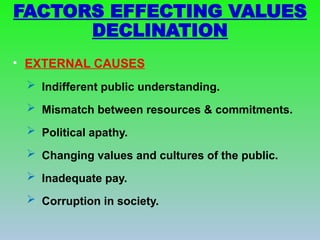
• EXTERNAL CAUSES
Indifferent public understanding.
Mismatch between resources & commitments.
Political apathy.
Changing values and cultures of the public.
Inadequate pay.
Corruption in society.
FACTORS EFFECTING VALUES
DECLINATION
24.
MORAL COMPASS
Morals,Ethics and Values provide us the
Moral Compass to guide us to the right path
during the period of darkness, indecision and
at cross roads of life journey.
MORAL
ETHICS
VALUE
25.
MILITARY CULTURE :
Whatis it ?
It is the bedrock of military effectiveness.
Comprises of the values, philosophies, and
traditions that animate the force.
The prevailing civil culture may be reflected
in it to a certain extent.
The most significant contribution to
organizational climate and military culture is
from the offr corps.
26.
ARMED FORCES VALUE
SYSTEM
Honour.
Courage.
Commitment.
Justice.
Loyalty.
Integrity.
Work is worship.
Service before self.
Professional competence.
Responsibility.
Self discipline.
27.
CORE VALUES OFTHE
ARMED FORCES
HONOUR
RESPONSIBILITY
LOYALTY
COURAGE
PROFESSIONAL
COMPETENCE
WILL POWER
JUSTICE
SELF DISCIPLINE
28.
HONOUR
An HonourablePerson is :-
• Bold but not a bully.
• Humble but not apologetic.
• Confident but not conceited.
• Proud but not arrogant.
• Tender but not weak.
• Strong but not rude.
• Firm but not stubborn.
• Cool but not cold.
• In love with life but ready to die.
• Content but not complacent.
• Detached but not indifferent.
29.
CHARACTER
Is asubstance over form.
Is not something we are born with but is a learned
behaviour.
It is knowing who we are, while reputation is what other
people think of us.
It is the truth, while reputation is a camouflage.
A complete trg of the head and the heart is needed to
build a sound character.
A person of sound character would not do wrong even if
he knows he would not get caught.
• When wealth is lost, nothing is lost;
• when health is lost, something is lost;
• when character is lost, everything is lost.
30.
COURAGE
• Only cowardsneed crowds, a courageous person
always walks alone.
• Courage is another name for the ability to listen
criticism & face confrontation.
• Courage to dream & face reality.
• Courage to say ‘No’ & accept ‘No’.
• Courage to challenge our self-limiting beliefs, face
cynicism, false convictions, inflated egos and
excuses.
• Courage to call a spade a spade.
• Courage to admit mistakes.
• Courage to forgive others.
• Courage to bounce back.
Professional ethicsare set of rules,
regulations and a code of conduct that
governs how a professional deals with each
other and others outside of the profession. It
will be different from moral code and legal
code.
PROFESSIONAL ETHICS
34.
ETHICAL V/S UNETHICAL
LEADERSHIP
TheEthical Leader The Unethical Leader
Possesses humility Is arrogant and self-serving
Maintains concern for the greater
good
Excessively promotes self-interest
Is honest and straightforward Practices deception
Fulfills commitments Breaches agreements
Strives for fairness Deals unfairly
Takes responsibility Shifts blame to others
Shows respect for each individual Diminishes others’ dignity
Encourages and develops others Neglects follower development
Serves others With holds help and support
Shows courage to stand up for what is
right
Lacks courage to confront unjust acts
RESPONSIBILITY
An officeris always responsible for
everything that happens or does not
happen in his command.
37.
In 1965war, in the Chauki Chaura sector, north of
Akhnoor in J & K, a rifleman was trapped in an enemy
minefield, badly wounded. He was given up as missing,
believed killed. The rifleman rolled down a ‘Khund’ at
night & could not be traced due to heavy shelling &
automatic fire of the enemy. Two days later, the wounded
rifleman dragged himself back to the unit location
through Khunds & goat paths, with a smashed foot.
The wonder, however, lay in fact that he had dragged his
rifle also along. His code reminded him not to leave his
weapon behind. This act sent a wave of silent pride in
the hearts of all soldiers of the unit. It was an apt
example of the code of discipline, combining with a
sense of duty.
SELF DISCIPLINE
38.
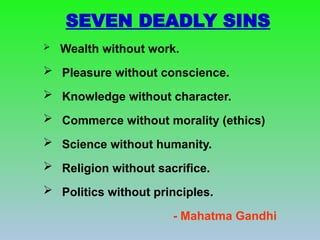
SEVEN DEADLY SINS
Wealth without work.
Pleasure without conscience.
Knowledge without character.
Commerce without morality (ethics)
Science without humanity.
Religion without sacrifice.
Politics without principles.
- Mahatma Gandhi
39.
WHAT MONEY CAN’TBUY ?
Foods but not appetite.
A bed but not sleep.
A house but not a home.
Medicine but not health.
Books but not wisdom
A clock but not time.
Companions but not friends.
Amusement but not happiness.
A ring but not a marriage.
40.
ARE MORALS, ETHICS&
VALUES STILL RELEVANT ?
Asim Premji, the Wipro chairman, has been strictly
following in his company not to deal with any agency,
which demands under hand payment.
Bill Gates, the Microsoft CEO and the richest man of the
world, spends millions of us $ on aids awareness &
vaccine devp. Recently he has decided to spend Rs 150
crores yearly for 5 years on eradication of kalaazar in
Bihar.
LN Mittal, the Steel Magnate and the third wealthiest man
of the world, spends lakhs of Rs in his native village of
Rajasthan on running of free schools and hospitals.
41.
Several PSUs& private firms adopt neighboring
villages for their development as part of company’s
policy.
Many educational institutes and schools of repute
provide free education to slum children.
General J J Singh, former COAS, has adopted two
children, one from J&K and other from North East, for
bringing up & their study as his own children.
ARE MORALS, ETHICS &
VALUES STILL RELEVANT ?
42.
The CO onhis weekly visit to the langer was told the
troops were having brinjals for lunch. He immediately
turned to his SM and gave a long & loud lecture on the
uselessness of brinjals, being tasteless & of no nutritive
value whatsoever. the SM could not seem to agree more
with his CO, in fact his hatred of brinjals – judging from his
speech – was much greater than the CO’s.
MISPLACED LOYALTY
43.
A month later,the CO was again on his inspection round;
and that day too the vegetable being served was brinjals,
but this time, the CO was all praise for the vegetable. He
waxed eloquent on the virtues of brinjals: taste was
unrivalled, it filled stomach w/o adding calories besides
adding unusual colour to table. this time too the SM was in
total agreement with the CO. After the CO left, the Langer
Cdr- who was present on both occasions, asked the SM
reason for his turn around. the SM smiled & replied’
“Bewakoof, mein baigan ka naukri kar rahan hoon ya co
sahab ka?”
MISPLACED LOYALTY
44.
THE RAT TRAP
•At first one starts overlooking small infractions that
would have been corrected on spot.
• Soon one becomes party to this saying everybody
does it.
• Next one becomes trapped to it as no longer stand
on principle.
• Finding no way out, one starts rationalising it as
being hooked.
• Ethics & morals go for a six.
45.
If an officershould receive from his superior an
order which he deems at variance with his obedience to
any article in these or other regulations, or with any
particular order that may have been issued by the
Government of India or other superior officer, he is to
represent orally or in writing if it does not require
immediate obedience - such contrariety to the officer from
whom he receives it. If after such representation, that
officer shall still direct him to obey the order, he is to do
so; but if he thinks it necessary, he may report the
circumstances as the case may require, through his
commanding officer to the COAS or to the government to
which every officer has the right of ultimate appeal
through the proper channel.
DEF SERVICE
REGULATIONS (RA) PART- I
46.
Sow a thought,
Reapan act.
Sow an act,
Reap a habit.
Sow a habit,
Reap a lifestyle.
Sow a lifestyle,
Reap a destiny.
AS YOU SOW, SO YOU REAP
47.
CHETWOOD CREDO
TheSafety, Honour & Welfare of your Country comes
First, Always & Every Time ;
The Honour, Welfare & Comfort of the men you
command come next ;
your own ease, comfort and safety come last always
and every time.
1932,Fd Marshal Sir Philip during his address at inauguration of IMA
48.
Advocate Sunilcelebrates his only son, Anil’s birthday in
a five star hotel, orders a six feet cake, invites all VVIPs of
the city.
At the end of the party he calls his son and hands him
overs the key of a Maruti Swift car. He embraces him and
tells, “ son, your dad loves you. My dad could not do this
for me but I will make it upto you. You will not be deprived
of all the luxuries that I did not have. Take this car and go
with your friends. Have a great time.
GIVE VALUES & NOT
MONEY
49.
Here is amobile phone too. If you run into a
problem, just call daddy. I have lots of powerful contacts
and even if i did not have, i have enough money to buy
them all .
The result ?
Either he kills innocent people by his rash driving
or behaviour like Salman Khan or Vikas Sharma or
himself go upstairs.
The reason ?
He needed your values, you gave him money.
GIVE VALUES & NOT
MONEY
50.
STAFF
I shallshun all parochial tendencies based on Regt,
Corps, Caste, Religion etc.
I shall be totally impartial, fair and just to all students in
assessment.
I shall encourage honest dissent and new ideas in
discussions.
I shall never be inadequately prepared for class/
discussion.
I shall not give wrong or misleading answers to
students.
I shall clarify them after consulting others.
HONOUR CODE AT TRG EST
51.
I shallnot part with (inadvertently or otherwise) any mtrl /
papers which i have access to for instructional purposes.
I shall not use offensive, insinuating or sarcastic remarks
I shall be mature and tactful.
I shall develop mutual trust with students.
I shall not indulge in cheap popularity.
I shall maintain highest standards of social graces.
I shall bring to the notice of my superiors any un officer
like conduct of my students/colleagues that may bring
disrepute to my institution.
STAFF (Contd..)
HONOUR CODE AT TRG EST
52.
HONOUR CODE ATTRG EST
STUDENTS
I shall uphold the honour & image of my institution at all
times.
I shall shun all parochial tendencies based on Corps,
Regt, Caste, Creed & Religion etc.
I shall not hesitate to give my views/new ideas freely.
I shall never use any unfair means, or involve in
plagiarism.
I shall always come well-prepared for class/discussion.
I shall display selflessness, team spirit and cooperation
with colleagues.
I shall be honest and truthful in all dealings.
I shall avoid sycophancy and manipulation.
I shall be respectful to instr staff.
I shall maintain highest standards of social graces at all
times.
53.
MORAL LEADERSHIP
Itwill provide a values or meaning for
people to live by, inspiration to act and
motivation to hold oneself accountable. When
you don’t see someone stepping up to provide
purpose and doing what is best for the greater
good, step up.
54.
MORAL LEADER
Moralleader - is someone who leads to serve. He
or she could be someone who leads through
persuasion, motivation, self-awareness, and the
most important of all: serving people
They take action by choosing the moral and the
most ethical decision to solve an issue
They have higher level of integrity and these
leaders prioritize other people's need.
They can't afford to make the false decision
55.
OBJECTIVE OF MORAL
LEADERSHIP
Combine a rational approach to leadership with a
concern for people and ethics.
Recognize your own stage of moral development and
ways to accelerate your moral maturation.
Apply the principles of stewardship and servant
leadership.
Know and use mechanisms that enhance an ethical
organizational culture.
Recognize courage in others and unlock your own
potential to live and act courageously.
56.
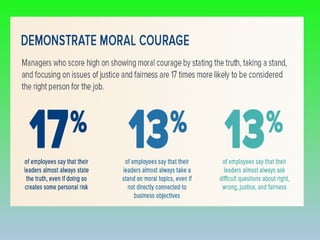
It isimportant to have a Moral leader in
the government because moral leaders
have the power to change the heart of the
people.
EFFECTS OF MORAL
LEADERSHIP
58.
Honour/ SelfRespect
Courage
Character
Self Discp
Responsibility
MORAL LEADERS
59.
HOW TO ACTLIKE A MORAL LEADER
1. Develop, articulate & uphold high moral
principles.
2. Focus on what is right for the organization as
well as all the people involved.
3. Set the example you want others to live by.
4. Be honest with yourself and others.
5. Drive out fear and eliminate undiscussables.
60.
6. Develop abackbone – show zero tolerance for
ethical violations.
7. Reward ethical conduct.
8. Treat everyone with fairness, dignity, and respect,
from the lowest to the highest level of the
organization.
9. Do the right thing in both your private and
professional life – even when no one is looking.
HOW TO ACT LIKE A MORAL LEADER
Driven byPurpose
Inspire & Elevate others
Animated by both courage & patience
Keep building moral muscle
FOUR PILLARS OF MORAL
LEADERSHIP
64.
Level 1:
Preconventional
Follows rulesto avoid
punishment. Acts in
own interest. Blind
obedience to authority
for its own sake.
Level 2:
Conventional
Lives up to
expectations of
others. Fulfills
duties and
obligations of
social system.
Upholds laws.
Level 3:
Postconventional
Follows internalized
universal principles of
justice and right.
Balances concern for
self with concern for
others and the
common good. Acts
in an independent and
ethical manner
regardless of
expectations of
others.
THREE LEVELS OF PERSONAL
MORAL DEVELOPMENT
66.
• Nelson Mandela- example of a great moral leader and
a most respected leader around the world
• He is capable of reaching to the mind of the people .
• He persuade people inside and outside the country.
• He was able to save South Africa from civil war and
he was awarded Nobel Peace prize in 1993.
• He wipe out the racial discrimination in South Africa.
• He struggled and became a symbol for racial equality.
REAL TIME EXAMPLE
67.
Few Jawansat Mhow were attending the a course. Most
of them were having accounts in banks with ATM facility.
Cfn Vishal also had an a/c with ICICI Bank.
One day one of his course mates Cfn dost requested him
for some money, which he did not have as ready cash.
Since he also had a reqmt to purchase a greeting card
from the city, he gave his ATM card to cfn dost along with
pin to draw money, buy the card & take the amount reqd
for his expenditure. Just to give his friend an easy way of
remembering the pin, he gave date of birth of the person
for whom the card was to be purchased. The transaction
was completed & the ATM card returned.
CASE STUDY : MISUSE OF ATM
68.
About amonth later when Cfn Vishal went to withdraw
cash, he realised that the balance shown was short of Rs
14000/- than what it should be. On seeing the bank
statement, it was observed that the amount was
withdrawn on previous two consecutive dates.
He went about getting details without bringing it to the
notice of his mates & was finally able to short list two of
them as suspects. But without adequate proof, he did not
want to put them up. Incidentally both of these suspects
happened to be his line mates & both of them used to turn
up late for classes. One of them happened to be Cfn dost
to whom he had given his ATM card for withdrawing
money, while the other was Cfn desire.
CASE STUDY : MISUSE OF ATM
69.
When thetwo individuals were confronted, Cfn desire
owned up as having withdrawn the money. He admitted to
have developed a liking for movies for which he would skip
some classes. But he did not have the required amount &
decided to manage it. He took the ATM card from Cfn
Vishal’s wallet & withdrew the money. The matter came to
light when he had gone to deposit a part of money back.
In the court martial that followed, he pleaded guilty to the
charges & was dismissed from the service.
CASE STUDY : MISUSE OF ATM
70.
Questions :-
1. Doyou agree that cfn desire is involved in an immoral
practice & lacks values ?
2. Do you think that cfn dost had any role to play in this
case ?
3. Was cfn Vishal also guilty of some act of commission ?
4. What effect this incident will have on the personality of
cfn desire ?
5. What moral lessons do you draw from this incident ?
CASE STUDY : MISUSE OF ATM
71.
CONCLUSION
To practice moralleadership you must be:
True concern with people
Practice Stewardship
Provide Equality and Justice to all
Self Understanding
#18 1. Guides action when you see a thief stealing from your neighbour.
2. Your attitude towards ladies working in your organisation.
3. Is it OK to steal from the rich?
4. Any culture is the sum total of its value system.