Concrete Construction (CoTM 6022)
MSc Program in Construction Technology and Management
College of Engineering & Technology
Department of Construction Technology & Management,
Wachemo University
Behailu Z. (Ph.D. Candidate)
December, 2023
COURSE CONTENTS
2
Behailu Z. (Ph.D. Cand.)
1 Methods of Specifying Concrete
2 Non Destructive Tests on Concrete
3 Cold & Hot Weather Concreting
4 High-performance Concrete
5 Special Types of Concrete
1. Methods of Specifying Concrete
Concrete Construction (CoTM 6022)
MSc Program in Construction Technology and Management
College of Engineering and Technology, Wachemo University
Department of Construction Technology & Management
Behailu Z., (Ph.D. Candidate, BiT, BDU)
June, 2023
Engineers and Architects are Experts in Design
Natchez Trace Bridge, Franklin, TN
Milwaukee Art Museum, Wisconsin, USA
NBC Tower, Chicago, USA
Behailu Z. (Ph.D. Cand.) 4
Methods of Specifying Concrete
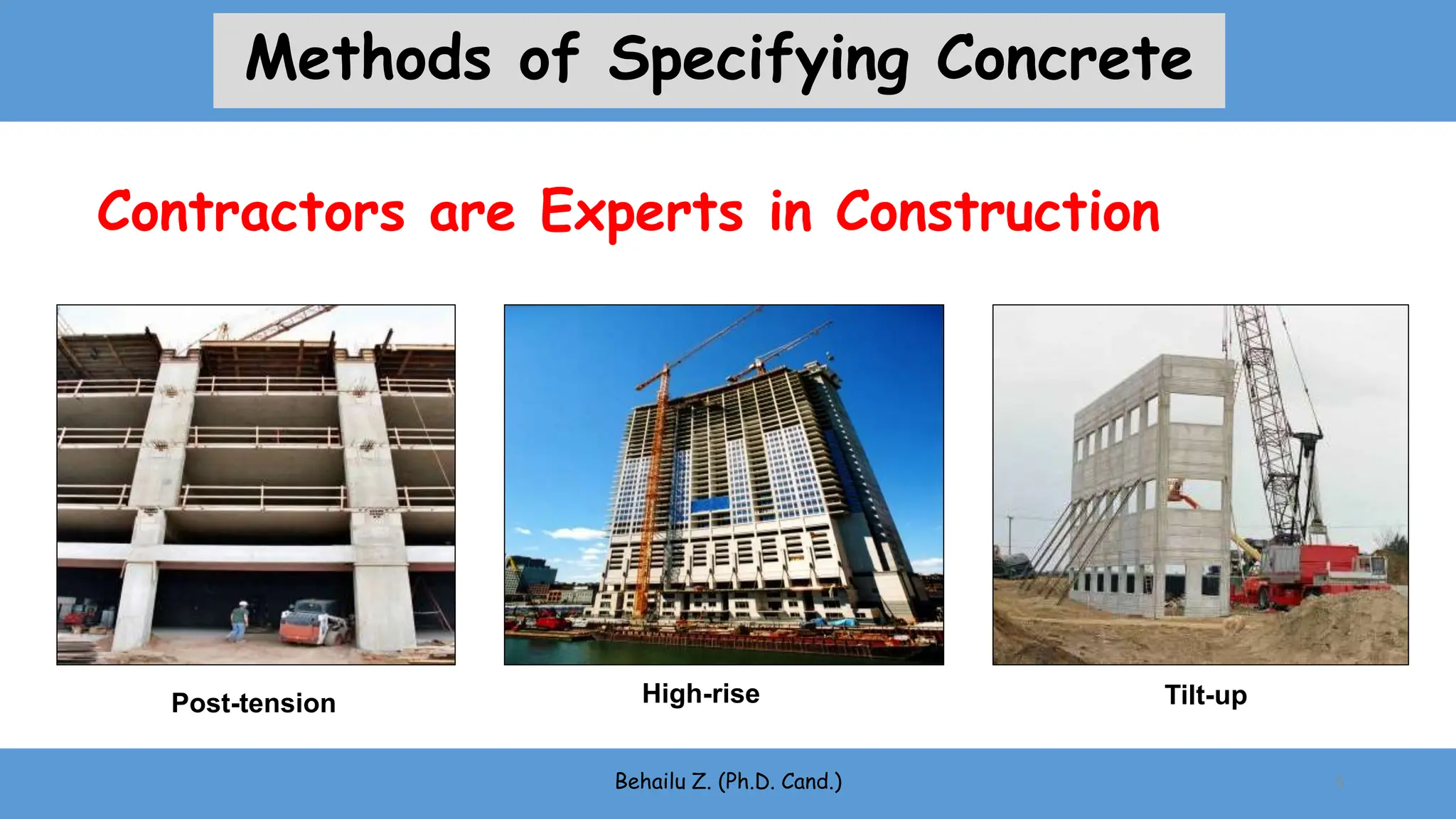
Contractors are Experts in Construction
High-rise Tilt-up
Post-tension
Behailu Z. (Ph.D. Cand.) 5
Methods of Specifying Concrete
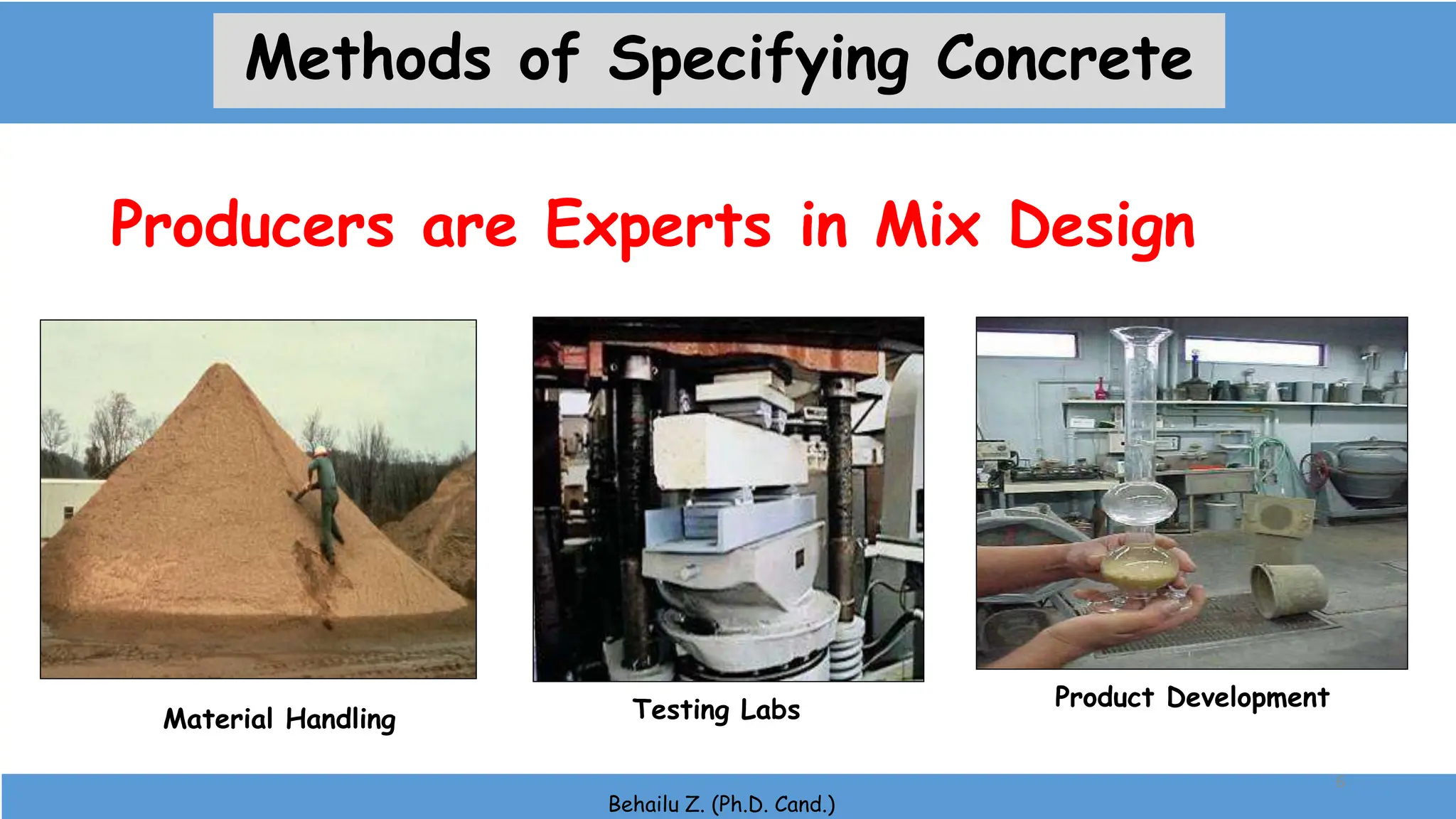
Producers are Experts in Mix Design
Product Development
Testing Labs
Material Handling
Behailu Z. (Ph.D. Cand.)
6
Methods of Specifying Concrete
Types of Specification
Behailu Z. (Ph.D. Cand.)
1) Performance – based Specification
2) Prescription Specification
3) Mixed Specification
4) Proprietary Specification
7
Methods of Specifying Concrete
• states requirements in terms of the required results with criteria
for verifying compliance, but without stating the methods for
achieving the required results to the contractor.
• the designer to describe what they need and the contractor to
determine the best way to get there.
Behailu Z. (Ph.D. Cand.) 8
1. Performance – Based Specifications
Methods of Specifying Concrete
 It focuses on the outcome and shifts the selection of materials and
methods, as well as a portion of the design work, onto the shoulders of the
contractor.
 For example,
 if you're writing performance specifications for an office building, you
may include the intended height and width of the building, the expected
locations for utility connections and the materials you plan to use.
Behailu Z. (Ph.D. Cand.) 9
1. Performance – Based Specifications
Methods of Specifying Concrete
1. Performance – Based Specifications
 Focus on performance and function
 Assignment of responsibility
 Flexibility to adjust mixture ingredients and proportions
to achieve consistent performance
 Measurable and enforceable
Behailu Z. (Ph.D. Cand.) 10
Methods of Specifying Concrete
Advantages
Innovative construction means and methods
Improved construction schedules
More efficient structural designs
Simplified specifications and submittal process
Optimized mix designs
Behailu Z. (Ph.D. Cand.) 11
1. Performance – Based Specifications
Methods of Specifying Concrete
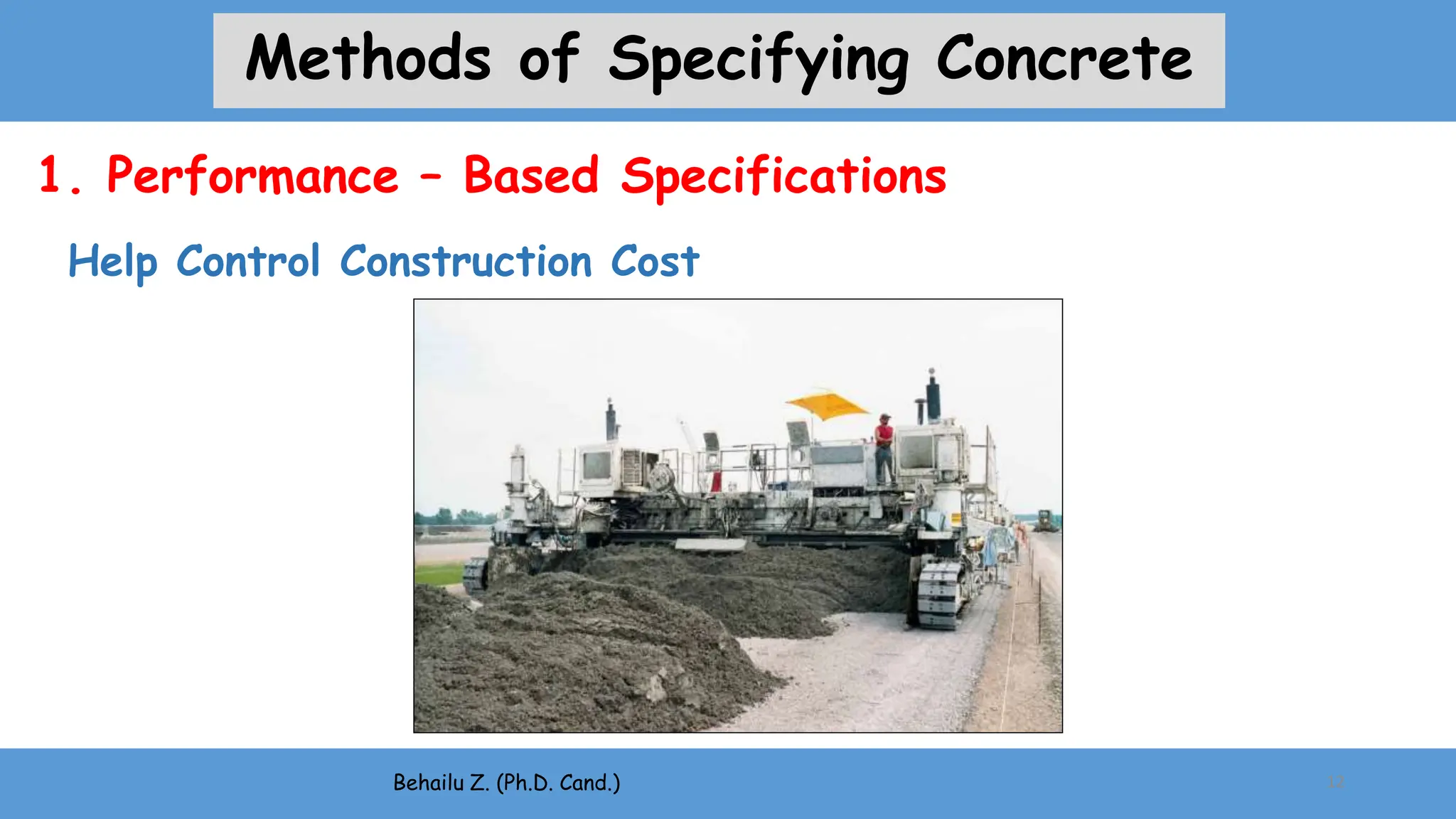
Help Control Construction Cost
Behailu Z. (Ph.D. Cand.) 12
1. Performance – Based Specifications
Methods of Specifying Concrete
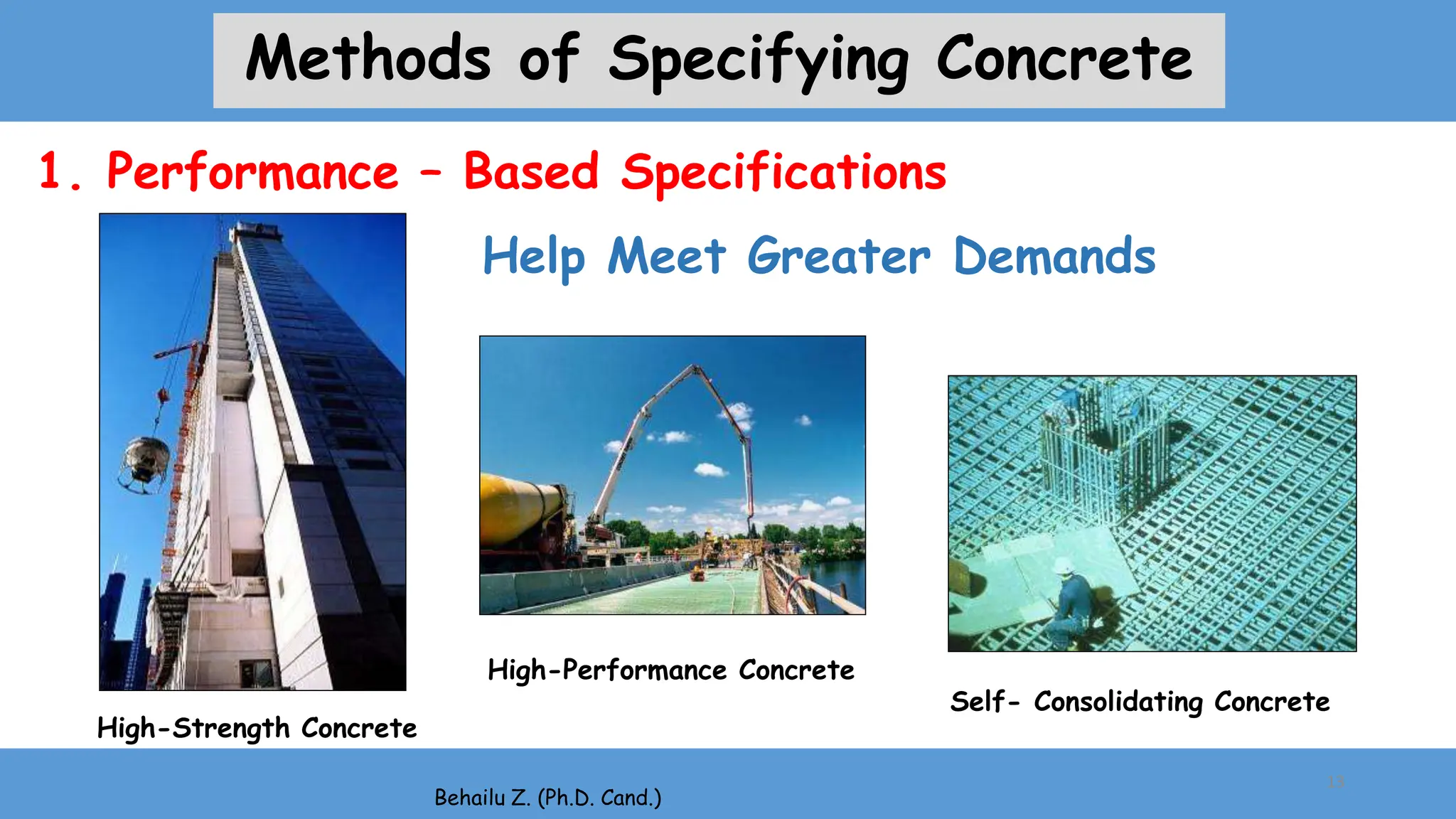
High-Strength Concrete
High-Performance Concrete
Self- Consolidating Concrete
Behailu Z. (Ph.D. Cand.)
Help Meet Greater Demands
13
1. Performance – Based Specifications
Methods of Specifying Concrete
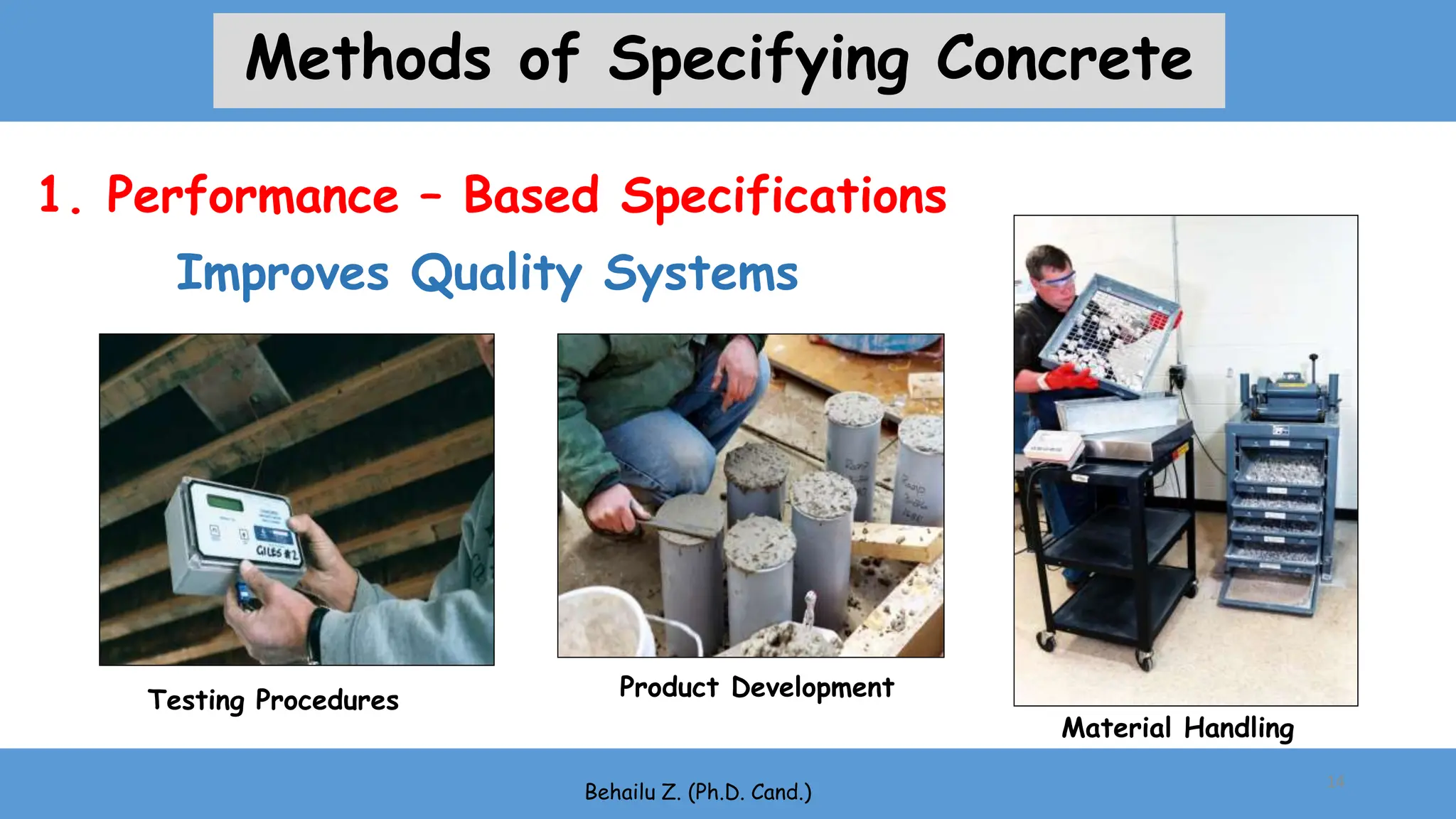
Product Development
Testing Procedures
Material Handling
Behailu Z. (Ph.D. Cand.)
Improves Quality Systems
14
1. Performance – Based Specifications
Methods of Specifying Concrete
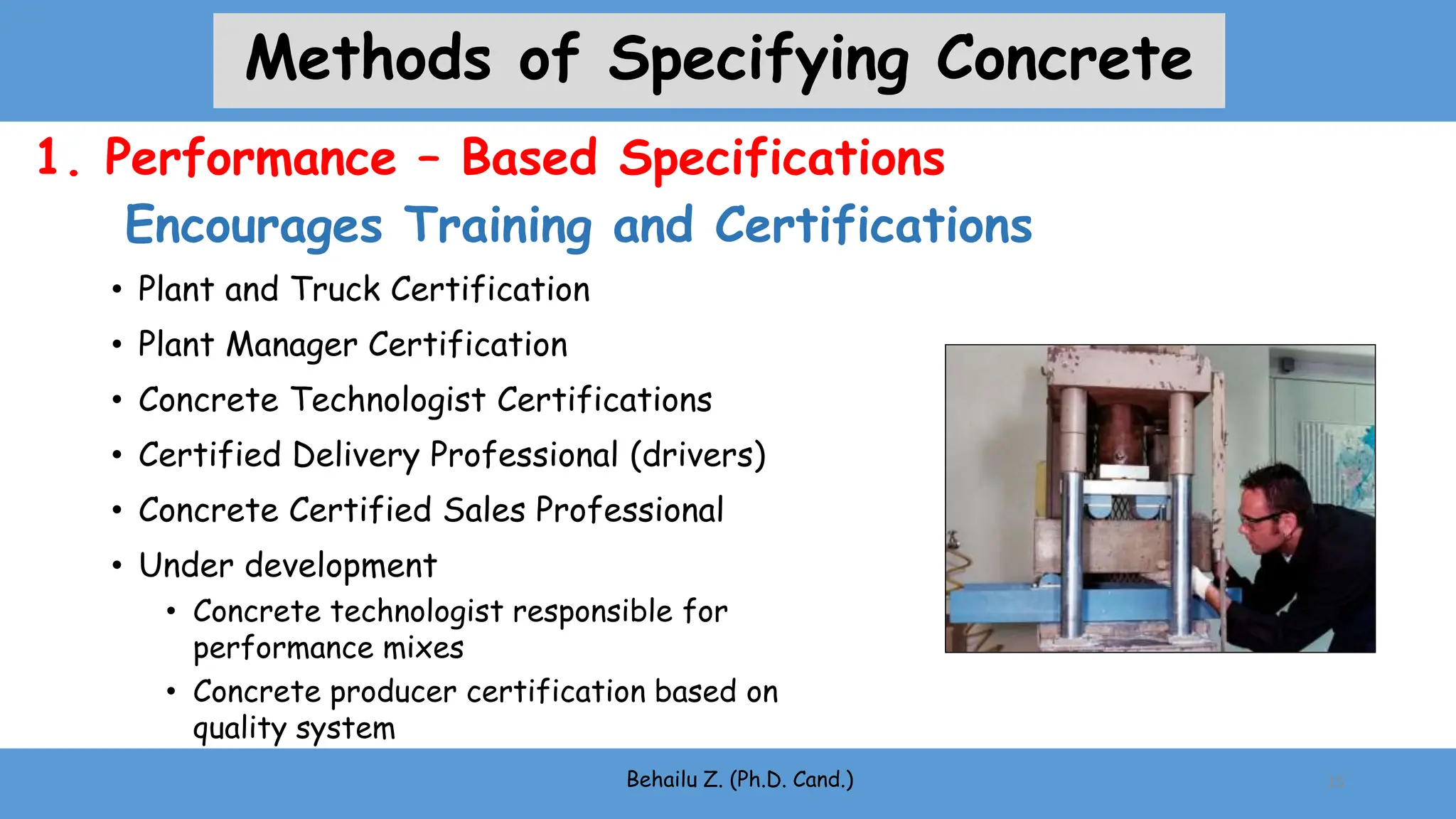
• Plant and Truck Certification
• Plant Manager Certification
• Concrete Technologist Certifications
• Certified Delivery Professional (drivers)
• Concrete Certified Sales Professional
• Under development
• Concrete technologist responsible for
performance mixes
• Concrete producer certification based on
quality system
Behailu Z. (Ph.D. Cand.)
Encourages Training and Certifications
15
1. Performance – Based Specifications
Methods of Specifying Concrete
Behailu Z. (Ph.D. Cand.) 16
2. Prescription (Detailed – Design) Specifications
Types of Specification
 written documents that give details about the project's
materials and instructions for their installation.
 Architects and engineers usually determine prescriptive
specifications. Therefore, they are responsible for the
proper installation of materials, not the contractor.
Prescriptive specs put a greater burden on the
Engineer or Architect (as opposed to the
general contractor) to ensure proper
installation.
Behailu Z. (Ph.D. Cand.) 17
2. Prescription (Detailed – Design) Specifications
Methods of Specifying Concrete
It usually involves three key components:
i. General provisions: requirements surrounding codes and standards
ii. Required products: the type of products required based on
performance and structural stipulations of each product
iii. Execution procedures: how to do the install and measure its
effectiveness
Behailu Z. (Ph.D. Cand.) 18
2. Prescription (Detailed – Design) Specifications
Methods of Specifying Concrete
Prescriptive specifications are just recipes/guidelines/instructions: do
this, then do this, then do this, etc.
Behailu Z. (Ph.D. Cand.) 19
2. Prescription (Detailed – Design) Specifications
 Limit the cost, types and quantities of ingredients
 Identify mixture proportions
 Detail construction means and methods
 Example,
 specifying 40 MPa as compressive strength for substructures in a salty
soil, perhaps in accordance with a ASTM or ACI.
Methods of Specifying Concrete
 Do not always cover intended performance, & may conflict with it.
Example: Low w/c for durability could increase thermal and shrinkage
cracking
 Requirements are generally not directly enforceable
 Producer held responsible for performance and defects, even though he lacks
the freedom to make changes
 Prevents mixture optimization for performance
 No incentive for quality control / batch uniformity
Behailu Z. (Ph.D. Cand.)
20
2. Prescription (Detailed – Design) Specifications
Methods of Specifying Concrete
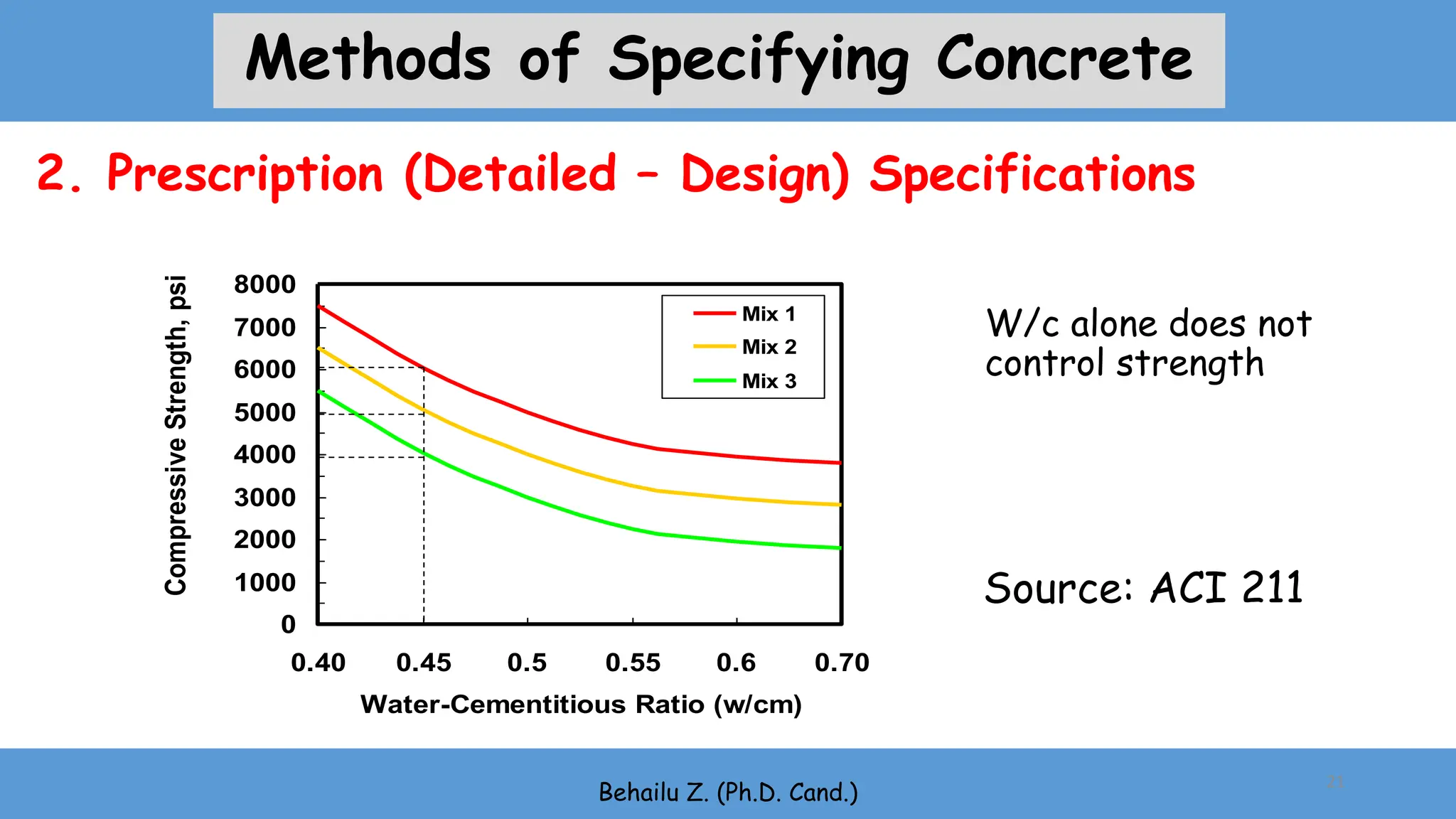
W/c alone does not
control strength
0
1000
2000
3000
4000
5000
6000
7000
8000
0.40 0.45 0.5 0.55 0.6 0.70
Water-Cementitious Ratio (w/cm)
Compressive
Strength,
psi
Mix 1
Mix 2
Mix 3
Source: ACI 211
Behailu Z. (Ph.D. Cand.)
21
2. Prescription (Detailed – Design) Specifications
Methods of Specifying Concrete
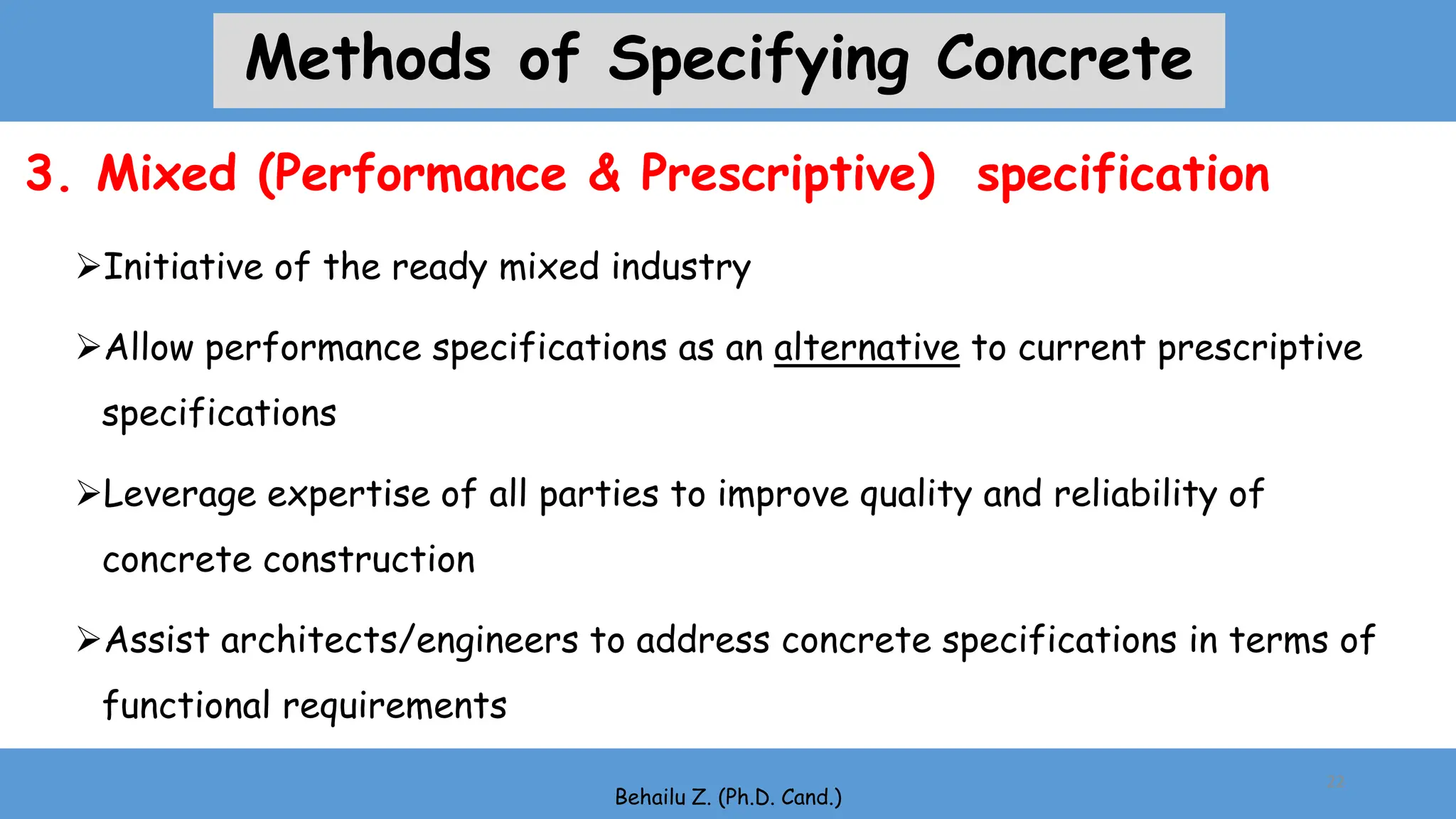
Initiative of the ready mixed industry
Allow performance specifications as an alternative to current prescriptive
specifications
Leverage expertise of all parties to improve quality and reliability of
concrete construction
Assist architects/engineers to address concrete specifications in terms of
functional requirements
Behailu Z. (Ph.D. Cand.)
22
3. Mixed (Performance & Prescriptive) specification
Methods of Specifying Concrete
3. Mixed (Performance & Prescriptive) specification
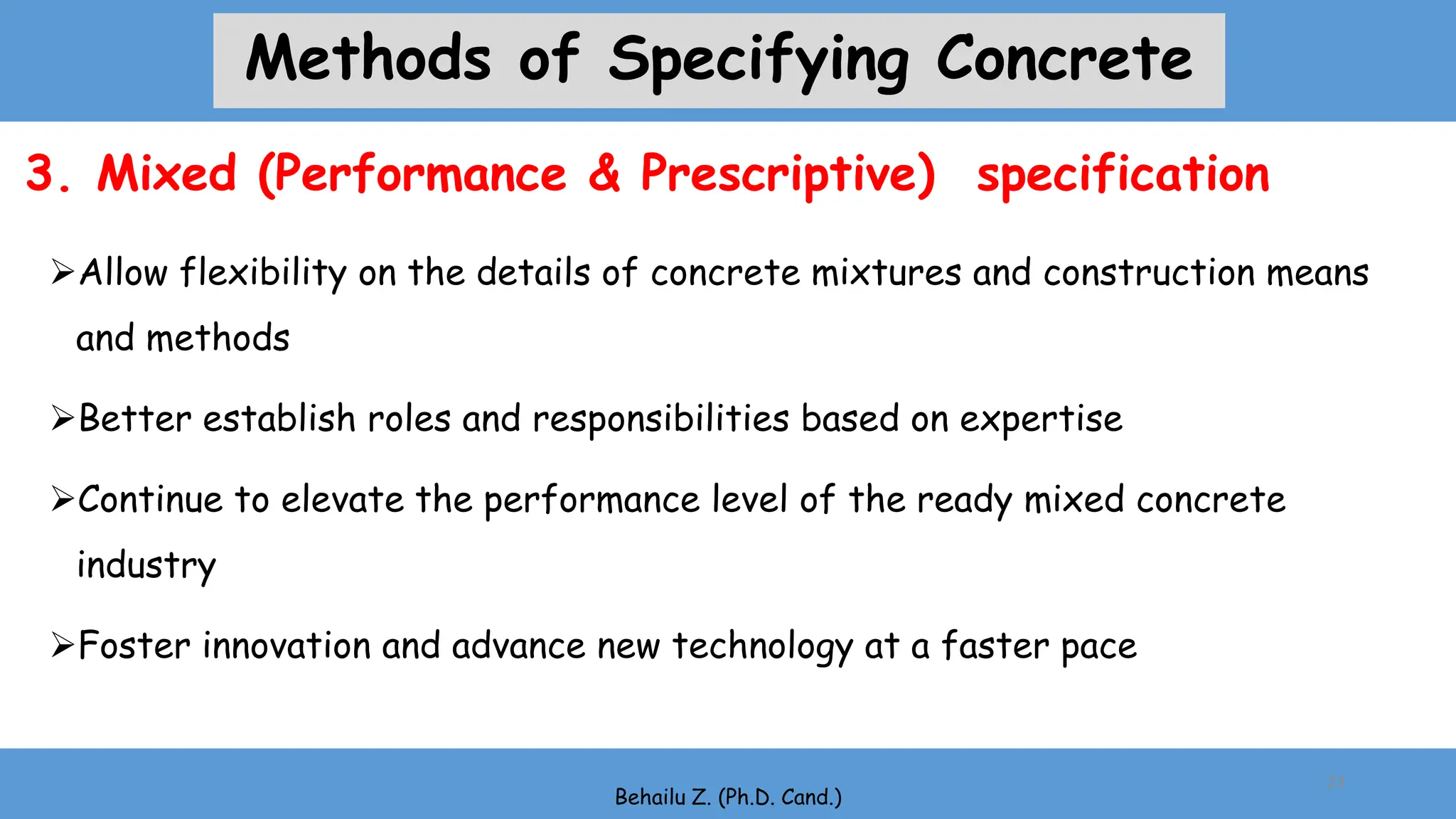
Allow flexibility on the details of concrete mixtures and construction means
and methods
Better establish roles and responsibilities based on expertise
Continue to elevate the performance level of the ready mixed concrete
industry
Foster innovation and advance new technology at a faster pace
Behailu Z. (Ph.D. Cand.)
23
Methods of Specifying Concrete
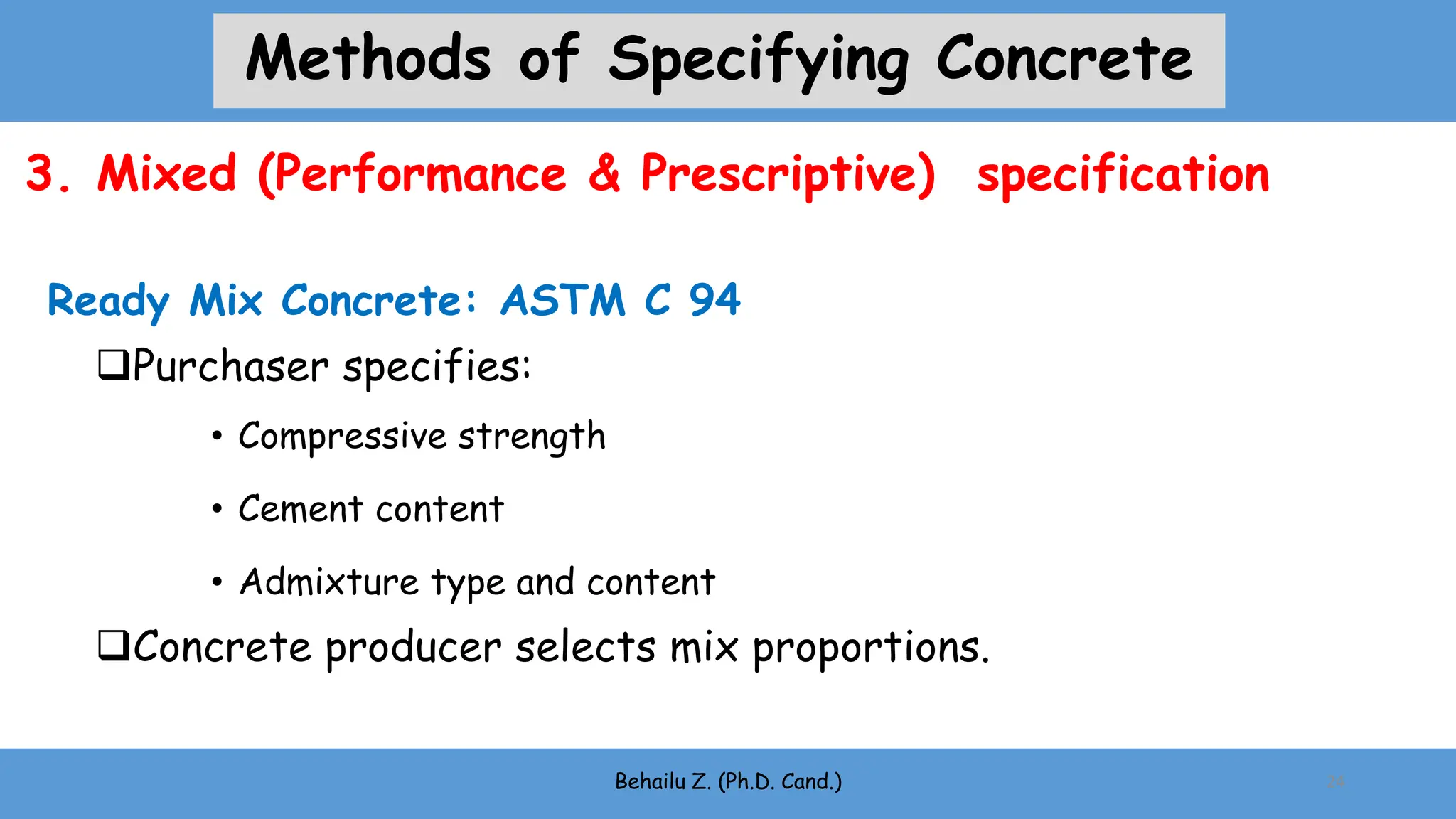
Purchaser specifies:
• Compressive strength
• Cement content
• Admixture type and content
Concrete producer selects mix proportions.
Ready Mix Concrete: ASTM C 94
Behailu Z. (Ph.D. Cand.) 24
3. Mixed (Performance & Prescriptive) specification
Methods of Specifying Concrete
4. Proprietary specification
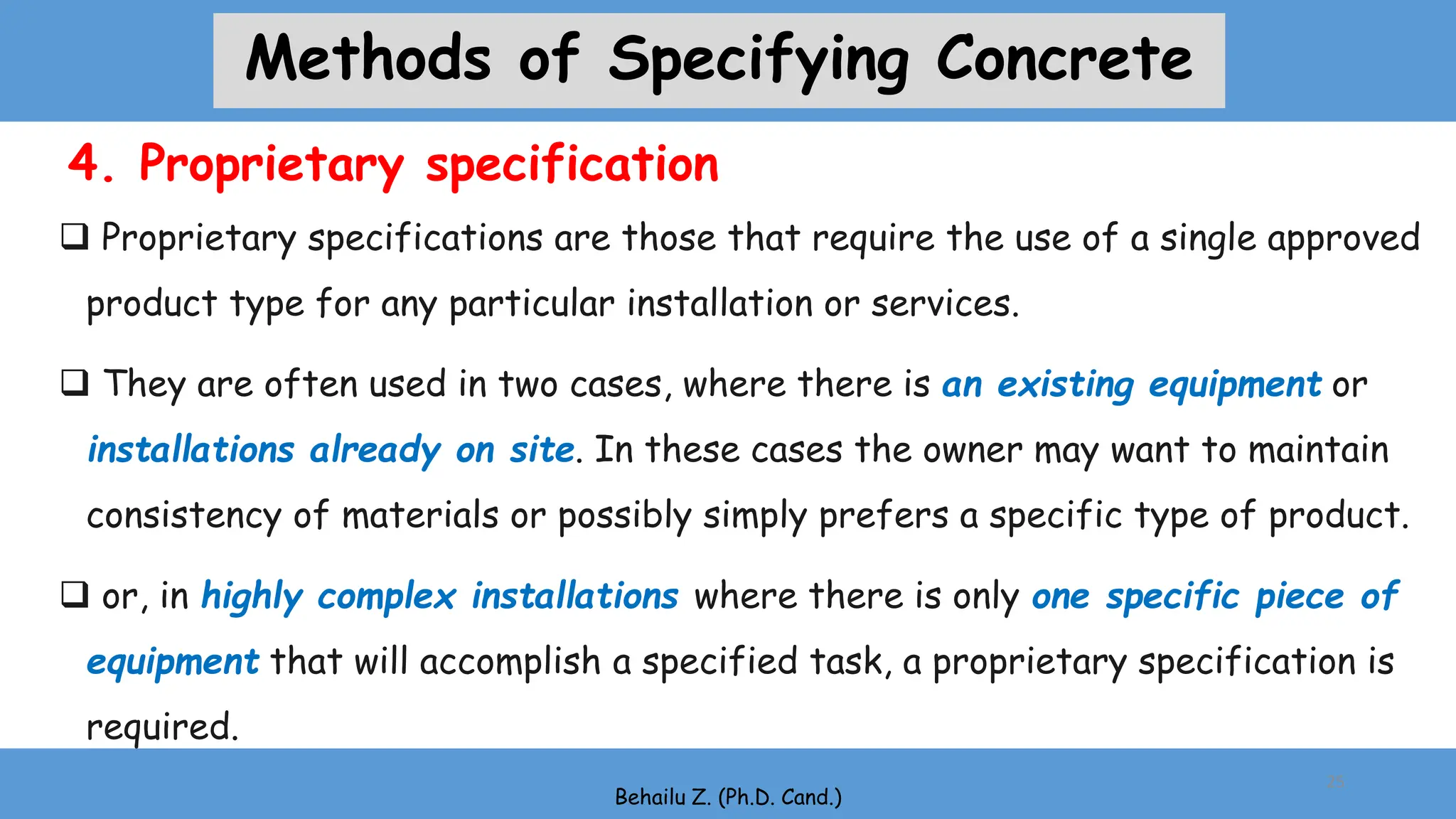
 Proprietary specifications are those that require the use of a single approved
product type for any particular installation or services.
 They are often used in two cases, where there is an existing equipment or
installations already on site. In these cases the owner may want to maintain
consistency of materials or possibly simply prefers a specific type of product.
 or, in highly complex installations where there is only one specific piece of
equipment that will accomplish a specified task, a proprietary specification is
required.
Behailu Z. (Ph.D. Cand.)
25
Methods of Specifying Concrete
4. Proprietary specification
Architects and engineers typically try to avoid utilizing proprietary
specifications except when absolutely necessary, and will usually allow the
contractor to select from a list of approved suppliers.
Requiring the use of one specific product type can lead to the perception of
favoritism towards a certain manufacturer and may eliminate competition
during the bid phase, which may increase the project cost.
A common example would be a specification by brand name, or for a patented
product, which excludes consideration of proposed “equals” or “equivalents”.
Behailu Z. (Ph.D. Cand.)
26
Methods of Specifying Concrete
THANK YOU!
Behailu Z. (Ph.D. Cand.) 27

1. Methods of Specifications in Concrete.pptx

  • 1.
    Concrete Construction (CoTM6022) MSc Program in Construction Technology and Management College of Engineering & Technology Department of Construction Technology & Management, Wachemo University Behailu Z. (Ph.D. Candidate) December, 2023
  • 2.
    COURSE CONTENTS 2 Behailu Z.(Ph.D. Cand.) 1 Methods of Specifying Concrete 2 Non Destructive Tests on Concrete 3 Cold & Hot Weather Concreting 4 High-performance Concrete 5 Special Types of Concrete
  • 3.
    1. Methods ofSpecifying Concrete Concrete Construction (CoTM 6022) MSc Program in Construction Technology and Management College of Engineering and Technology, Wachemo University Department of Construction Technology & Management Behailu Z., (Ph.D. Candidate, BiT, BDU) June, 2023
  • 4.
    Engineers and Architectsare Experts in Design Natchez Trace Bridge, Franklin, TN Milwaukee Art Museum, Wisconsin, USA NBC Tower, Chicago, USA Behailu Z. (Ph.D. Cand.) 4 Methods of Specifying Concrete
  • 5.
    Contractors are Expertsin Construction High-rise Tilt-up Post-tension Behailu Z. (Ph.D. Cand.) 5 Methods of Specifying Concrete
  • 6.
    Producers are Expertsin Mix Design Product Development Testing Labs Material Handling Behailu Z. (Ph.D. Cand.) 6 Methods of Specifying Concrete
  • 7.
    Types of Specification BehailuZ. (Ph.D. Cand.) 1) Performance – based Specification 2) Prescription Specification 3) Mixed Specification 4) Proprietary Specification 7 Methods of Specifying Concrete
  • 8.
    • states requirementsin terms of the required results with criteria for verifying compliance, but without stating the methods for achieving the required results to the contractor. • the designer to describe what they need and the contractor to determine the best way to get there. Behailu Z. (Ph.D. Cand.) 8 1. Performance – Based Specifications Methods of Specifying Concrete
  • 9.
     It focuseson the outcome and shifts the selection of materials and methods, as well as a portion of the design work, onto the shoulders of the contractor.  For example,  if you're writing performance specifications for an office building, you may include the intended height and width of the building, the expected locations for utility connections and the materials you plan to use. Behailu Z. (Ph.D. Cand.) 9 1. Performance – Based Specifications Methods of Specifying Concrete
  • 10.
    1. Performance –Based Specifications  Focus on performance and function  Assignment of responsibility  Flexibility to adjust mixture ingredients and proportions to achieve consistent performance  Measurable and enforceable Behailu Z. (Ph.D. Cand.) 10 Methods of Specifying Concrete
  • 11.
    Advantages Innovative construction meansand methods Improved construction schedules More efficient structural designs Simplified specifications and submittal process Optimized mix designs Behailu Z. (Ph.D. Cand.) 11 1. Performance – Based Specifications Methods of Specifying Concrete
  • 12.
    Help Control ConstructionCost Behailu Z. (Ph.D. Cand.) 12 1. Performance – Based Specifications Methods of Specifying Concrete
  • 13.
    High-Strength Concrete High-Performance Concrete Self-Consolidating Concrete Behailu Z. (Ph.D. Cand.) Help Meet Greater Demands 13 1. Performance – Based Specifications Methods of Specifying Concrete
  • 14.
    Product Development Testing Procedures MaterialHandling Behailu Z. (Ph.D. Cand.) Improves Quality Systems 14 1. Performance – Based Specifications Methods of Specifying Concrete
  • 15.
    • Plant andTruck Certification • Plant Manager Certification • Concrete Technologist Certifications • Certified Delivery Professional (drivers) • Concrete Certified Sales Professional • Under development • Concrete technologist responsible for performance mixes • Concrete producer certification based on quality system Behailu Z. (Ph.D. Cand.) Encourages Training and Certifications 15 1. Performance – Based Specifications Methods of Specifying Concrete
  • 16.
    Behailu Z. (Ph.D.Cand.) 16 2. Prescription (Detailed – Design) Specifications Types of Specification  written documents that give details about the project's materials and instructions for their installation.  Architects and engineers usually determine prescriptive specifications. Therefore, they are responsible for the proper installation of materials, not the contractor.
  • 17.
    Prescriptive specs puta greater burden on the Engineer or Architect (as opposed to the general contractor) to ensure proper installation. Behailu Z. (Ph.D. Cand.) 17 2. Prescription (Detailed – Design) Specifications Methods of Specifying Concrete
  • 18.
    It usually involvesthree key components: i. General provisions: requirements surrounding codes and standards ii. Required products: the type of products required based on performance and structural stipulations of each product iii. Execution procedures: how to do the install and measure its effectiveness Behailu Z. (Ph.D. Cand.) 18 2. Prescription (Detailed – Design) Specifications Methods of Specifying Concrete
  • 19.
    Prescriptive specifications arejust recipes/guidelines/instructions: do this, then do this, then do this, etc. Behailu Z. (Ph.D. Cand.) 19 2. Prescription (Detailed – Design) Specifications  Limit the cost, types and quantities of ingredients  Identify mixture proportions  Detail construction means and methods  Example,  specifying 40 MPa as compressive strength for substructures in a salty soil, perhaps in accordance with a ASTM or ACI. Methods of Specifying Concrete
  • 20.
     Do notalways cover intended performance, & may conflict with it. Example: Low w/c for durability could increase thermal and shrinkage cracking  Requirements are generally not directly enforceable  Producer held responsible for performance and defects, even though he lacks the freedom to make changes  Prevents mixture optimization for performance  No incentive for quality control / batch uniformity Behailu Z. (Ph.D. Cand.) 20 2. Prescription (Detailed – Design) Specifications Methods of Specifying Concrete
  • 21.
    W/c alone doesnot control strength 0 1000 2000 3000 4000 5000 6000 7000 8000 0.40 0.45 0.5 0.55 0.6 0.70 Water-Cementitious Ratio (w/cm) Compressive Strength, psi Mix 1 Mix 2 Mix 3 Source: ACI 211 Behailu Z. (Ph.D. Cand.) 21 2. Prescription (Detailed – Design) Specifications Methods of Specifying Concrete
  • 22.
    Initiative of theready mixed industry Allow performance specifications as an alternative to current prescriptive specifications Leverage expertise of all parties to improve quality and reliability of concrete construction Assist architects/engineers to address concrete specifications in terms of functional requirements Behailu Z. (Ph.D. Cand.) 22 3. Mixed (Performance & Prescriptive) specification Methods of Specifying Concrete
  • 23.
    3. Mixed (Performance& Prescriptive) specification Allow flexibility on the details of concrete mixtures and construction means and methods Better establish roles and responsibilities based on expertise Continue to elevate the performance level of the ready mixed concrete industry Foster innovation and advance new technology at a faster pace Behailu Z. (Ph.D. Cand.) 23 Methods of Specifying Concrete
  • 24.
    Purchaser specifies: • Compressivestrength • Cement content • Admixture type and content Concrete producer selects mix proportions. Ready Mix Concrete: ASTM C 94 Behailu Z. (Ph.D. Cand.) 24 3. Mixed (Performance & Prescriptive) specification Methods of Specifying Concrete
  • 25.
    4. Proprietary specification Proprietary specifications are those that require the use of a single approved product type for any particular installation or services.  They are often used in two cases, where there is an existing equipment or installations already on site. In these cases the owner may want to maintain consistency of materials or possibly simply prefers a specific type of product.  or, in highly complex installations where there is only one specific piece of equipment that will accomplish a specified task, a proprietary specification is required. Behailu Z. (Ph.D. Cand.) 25 Methods of Specifying Concrete
  • 26.
    4. Proprietary specification Architectsand engineers typically try to avoid utilizing proprietary specifications except when absolutely necessary, and will usually allow the contractor to select from a list of approved suppliers. Requiring the use of one specific product type can lead to the perception of favoritism towards a certain manufacturer and may eliminate competition during the bid phase, which may increase the project cost. A common example would be a specification by brand name, or for a patented product, which excludes consideration of proposed “equals” or “equivalents”. Behailu Z. (Ph.D. Cand.) 26 Methods of Specifying Concrete
  • 27.
    THANK YOU! Behailu Z.(Ph.D. Cand.) 27