1
LARGE SIGNAL AMPLIFIERS
2
A practical amplifier always consists of a number of stages that
amplify a weak signal until sufficient power is available to operate a
loudspeaker or other output device.
The first few stages in this multistage amplifier have the function of
only voltage amplification. However, the last stage is designed to
provide maximum power. This final stage is known as power stage.
The early stages build up the voltage level of the signal while the last
stage builds up power to a level sufficient to operate the loudspeaker.
In this chapter, we shall talk about the final stage in a multistage
amplifier—the power amplifier.
Introduction to Power Amplifiers
3
The input signal to a multistage amplifier is generally small (a few mV
from a cassette or CD or a few μV from an antenna). Therefore, the
first few stages of a multistage amplifier handle small signals and have
the function of only voltage amplification. However, the last stage
handles a large signal and its job is to produce a large amount of
power in order to operate the output device (e.g. speaker).
Introduction to Power Amplifiers
4
Small-signal amplifiers:
•Those amplifiers which handle small input a.c. signals (a few μV or a
few mV) are called small-signal amplifiers.
•Voltage amplifiers generally fall in this class. The small-signal amplifiers
are designed to operate over the linear portion of the output
characteristics.
•Therefore, the transistor parameters such as current gain, input
impedance, output impedance etc. do not change as the amplitude of
the signal changes. Such amplifiers amplify the signal with little or no
distortion.
Power Amplifiers
5
Large-signal amplifiers:
•Those amplifiers which handle large input a.c. signals (a few volts)
are called large-signal amplifiers.
•Power amplifiers fall in this class. The large-signal amplifiers are
designed to provide a large amount of a.c. power output so that they
can operate the output device e.g. a speaker.
•The main features of a large-signal amplifier or power amplifier are
the circuit’s power efficiency, the maximum amount of power that
the circuit is capable of handling and the impedance matching to the
output device. In general, where amount of power involved is 1W or
more, the amplifier is termed as power amplifier.
Power Amplifiers
6
In small-signal amplifiers the main factors are:
• Amplification
• Linearity
• Gain
Since large-signal, or power, amplifiers handle relatively large
voltage signals and current levels, the main factors are:
• Efficiency
• Maximum power capability
• Impedance matching to the output device
Power Amplifiers
7
Class A:
The amplifier conducts through the full 3600 of the input. The Q-point
is set near the middle of the load line.
Class B:
The amplifier conducts through 1800 of the input. The Q-point is set at
the cutoff point.
Class AB:
This is a compromise between the class A and B amplifiers. The
amplifier conducts somewhere between 1800 and 3600 . The Q-point is
located between the mid-point and cutoff.
Class C:
The amplifier conducts less than 1800 of the input. The Q-point is
located below the cutoff level.
Class D:
This is an amplifier that is biased especially for digital signals.
Classification of Power amplifiers
8
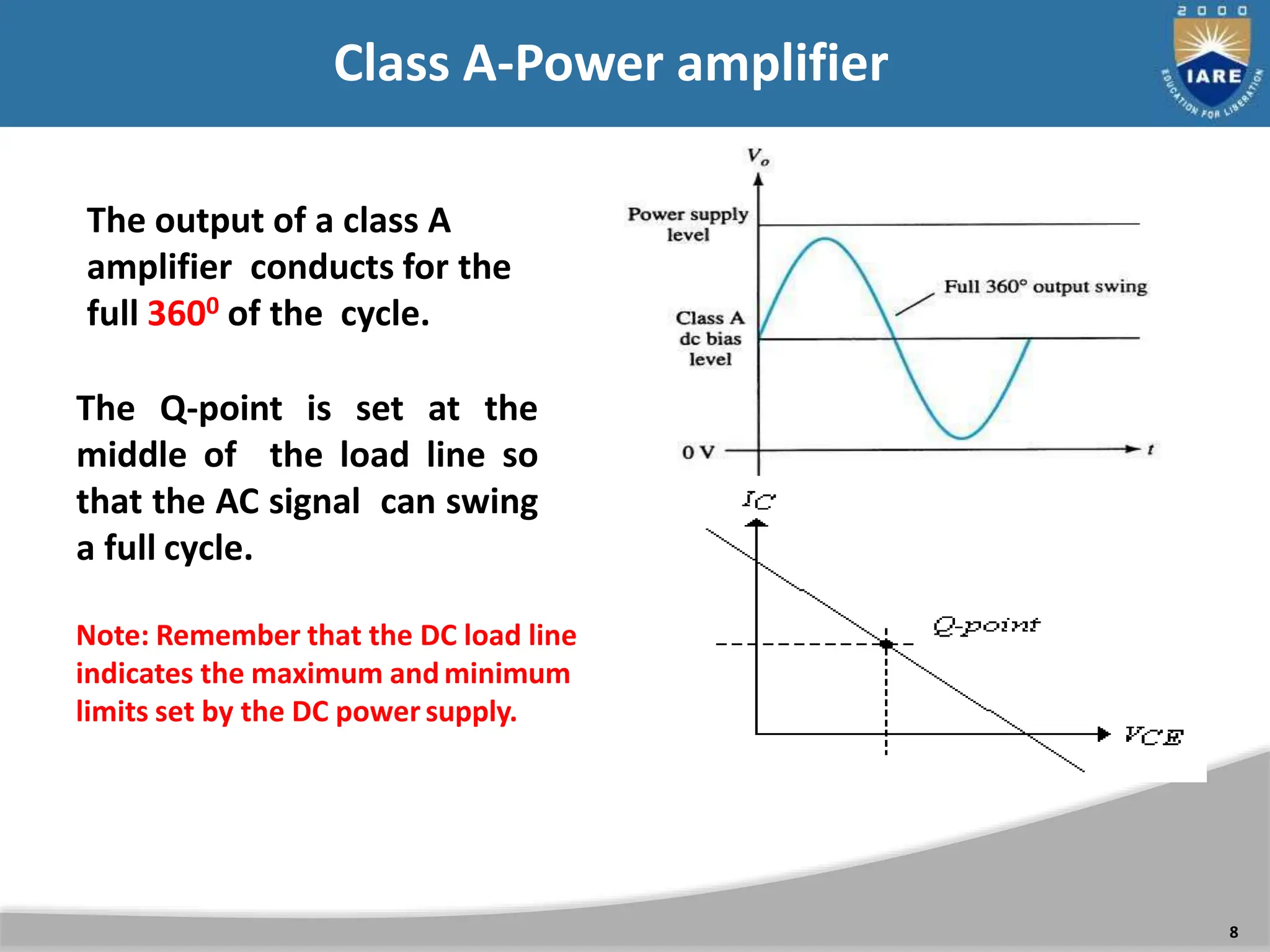
Class A-Power amplifier
The output of a class A
amplifier conducts for the
full 3600 of the cycle.
The Q-point is set at the
middle of the load line so
that the AC signal can swing
a full cycle.
Note: Remember that the DC load line
indicates the maximum andminimum
limits set by the DC power supply.
9
A class B amplifieroutput only
conducts for 1800 or one-half
of the AC input signal.
The Q-point is at 0V on the load
line, so that the AC signal can only
swing for one-half cycle.
Class B-Power amplifier
10
This amplifier is a compromise between
the class A and class B amplifier—the
Q-point is above that of the Class B but
below the class A.
The output conducts between 1800 and
3600 of the AC input signal.
Class AB-Power amplifier
11
Class C-Power amplifier
The output of the class C conducts
for less than 1800 of the AC cycle.
The Q-point is below cutoff.
12
Amplifier Efficiency
Comparison of Amplifier classes
Class A Class AB Class B Class C Class D
Operating
Cycle
3600 1800 to 3600 1800 Less than
1800
Pulse
operation
Power
Efficiency
25% to 50% Between
25% (50%)
and 78.5%
78.5% Typically
over 90%
Efficiency refers to the ratio of output to input power. The lower the amount
of conduction of the amplifier the higher the efficiency.

1.Large signal amplifiers introduction.pptx

  • 1.
  • 2.
    2 A practical amplifieralways consists of a number of stages that amplify a weak signal until sufficient power is available to operate a loudspeaker or other output device. The first few stages in this multistage amplifier have the function of only voltage amplification. However, the last stage is designed to provide maximum power. This final stage is known as power stage. The early stages build up the voltage level of the signal while the last stage builds up power to a level sufficient to operate the loudspeaker. In this chapter, we shall talk about the final stage in a multistage amplifier—the power amplifier. Introduction to Power Amplifiers
  • 3.
    3 The input signalto a multistage amplifier is generally small (a few mV from a cassette or CD or a few μV from an antenna). Therefore, the first few stages of a multistage amplifier handle small signals and have the function of only voltage amplification. However, the last stage handles a large signal and its job is to produce a large amount of power in order to operate the output device (e.g. speaker). Introduction to Power Amplifiers
  • 4.
    4 Small-signal amplifiers: •Those amplifierswhich handle small input a.c. signals (a few μV or a few mV) are called small-signal amplifiers. •Voltage amplifiers generally fall in this class. The small-signal amplifiers are designed to operate over the linear portion of the output characteristics. •Therefore, the transistor parameters such as current gain, input impedance, output impedance etc. do not change as the amplitude of the signal changes. Such amplifiers amplify the signal with little or no distortion. Power Amplifiers
  • 5.
    5 Large-signal amplifiers: •Those amplifierswhich handle large input a.c. signals (a few volts) are called large-signal amplifiers. •Power amplifiers fall in this class. The large-signal amplifiers are designed to provide a large amount of a.c. power output so that they can operate the output device e.g. a speaker. •The main features of a large-signal amplifier or power amplifier are the circuit’s power efficiency, the maximum amount of power that the circuit is capable of handling and the impedance matching to the output device. In general, where amount of power involved is 1W or more, the amplifier is termed as power amplifier. Power Amplifiers
  • 6.
    6 In small-signal amplifiersthe main factors are: • Amplification • Linearity • Gain Since large-signal, or power, amplifiers handle relatively large voltage signals and current levels, the main factors are: • Efficiency • Maximum power capability • Impedance matching to the output device Power Amplifiers
  • 7.
    7 Class A: The amplifierconducts through the full 3600 of the input. The Q-point is set near the middle of the load line. Class B: The amplifier conducts through 1800 of the input. The Q-point is set at the cutoff point. Class AB: This is a compromise between the class A and B amplifiers. The amplifier conducts somewhere between 1800 and 3600 . The Q-point is located between the mid-point and cutoff. Class C: The amplifier conducts less than 1800 of the input. The Q-point is located below the cutoff level. Class D: This is an amplifier that is biased especially for digital signals. Classification of Power amplifiers
  • 8.
    8 Class A-Power amplifier Theoutput of a class A amplifier conducts for the full 3600 of the cycle. The Q-point is set at the middle of the load line so that the AC signal can swing a full cycle. Note: Remember that the DC load line indicates the maximum andminimum limits set by the DC power supply.
  • 9.
    9 A class Bamplifieroutput only conducts for 1800 or one-half of the AC input signal. The Q-point is at 0V on the load line, so that the AC signal can only swing for one-half cycle. Class B-Power amplifier
  • 10.
    10 This amplifier isa compromise between the class A and class B amplifier—the Q-point is above that of the Class B but below the class A. The output conducts between 1800 and 3600 of the AC input signal. Class AB-Power amplifier
  • 11.
    11 Class C-Power amplifier Theoutput of the class C conducts for less than 1800 of the AC cycle. The Q-point is below cutoff.
  • 12.
    12 Amplifier Efficiency Comparison ofAmplifier classes Class A Class AB Class B Class C Class D Operating Cycle 3600 1800 to 3600 1800 Less than 1800 Pulse operation Power Efficiency 25% to 50% Between 25% (50%) and 78.5% 78.5% Typically over 90% Efficiency refers to the ratio of output to input power. The lower the amount of conduction of the amplifier the higher the efficiency.