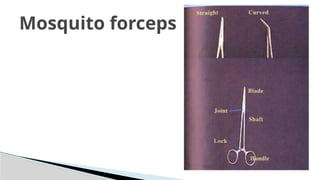
Used forhaemostasis –
1. Catching small subcutaneous vessels during
skin incision
2. Sub mucosal vessels in resection anastomosis
of the intestine.
3. Traction on the skin.
4. Neonates and pediatric surgery
Mosquito forceps
Larger than Mosquitoforceps.
- Used for haemostasis.
1. Catching of medium sized vessels as
subcutaneous vessels during spleenectomy before
their ligation.
2. Elevation of the partial peritoneum before its
opening in all abdominal operations.
Artery forceps
8.
3. Placed onthe fundus & Hartmans pouch of the gall
bladder, first retracted upwards and laterally and
the second downward and laterally open the
Calot’s triangle .
9.
4. Ligation ofperforators entering the breast its bed
during mastectomy.
5. Ligation of spermatic veins during
varicocelectomy.
6. Grasping the pedicles of piles in
haemorrhoidectomy.
The above indications arc just examples
Artery forceps
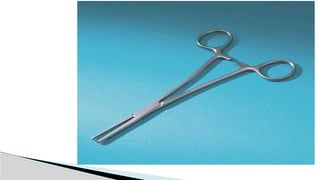
- Larger thanartery forceps
- used for catching or large-size
vessels before their ligation-
1. Spleenic vessels during
spleencctomy
2. Renal vessels for nephrectomy
Clamp forceps –
13.
3. Inferior mesentericvessels during left
hemicolectomy.
4. Main vessels of the lower limbs during
amputations (Femoral, Popliteal, Tibial),
The above indications arc just examples
Clamp forceps –
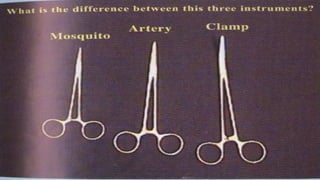
What arethe differences between Mosquito Artery
and Clamp Instrument?
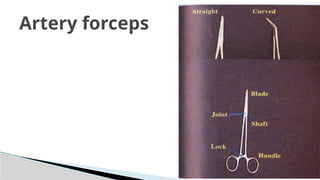
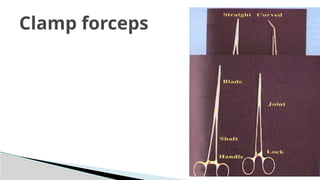
All these instruments consist of -
1. Handle
2. Shaft
3. Blade
4. Joint between blade and shaft
5. Lock between handle and shaft.
16.
These instrumentssometimes called
haemostatic instruments.
Q. what is the importance of the lock in
surgical instruments?
Answer- It maintains closure of the
instruments after tissue grasping.
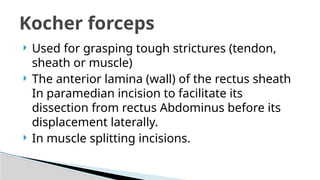
Used forgrasping tough strictures (tendon,
sheath or muscle)
The anterior lamina (wall) of the rectus sheath
In paramedian incision to facilitate its
dissection from rectus Abdominus before its
displacement laterally.
In muscle splitting incisions.
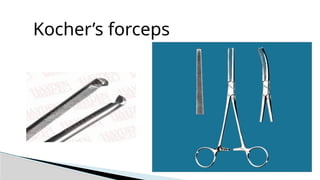
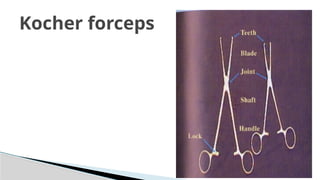
Kocher forceps
21.
2. Crushing thebase of the appendix in
appendectomy. We do 3 crushes. One at the
base to prevent slipping of ligature, the second
we through push pus from the site of cut and
the third keep Kocher to prevent spillage of
the Pus.
Kocher forceps
22.
3. Part ofskin must be removed during
operation as old scar.
4. Closure of intestinal lumen for the specimen
which will be removed during resection
anastomosis.
Kocher forceps
Q. whatare the differences between Kochcr and artery
forceps ?
- both consists handle ,shaft, blade,lock and joint.
1. The length of the blade in relation to the shaft –
in the artery forceps the blade measure about ½ the
shaft but in Kocher the blade about 2/3 rd of the shaft.
2. The teeth present ( 1x2 ) at the tip of kocher blades.
25.
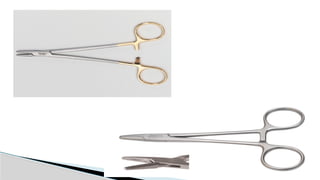
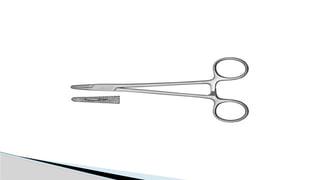
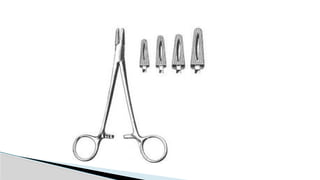
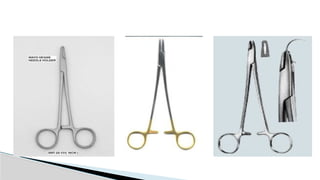
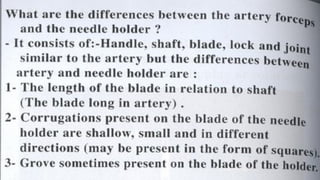
Grasp the needleduring making a stitch,
The pattern of corrugation to give a good grebe to
the needle and prevent its slipping or rotation.
There are different sizes of needle holder, the one to
enable the surgeon to take stitches in the depth. There
some needle holder with slight curve on its shaft.
Needle holder
for grasping thecystic vessels and cyctic duct
before their ligation during cholecystectomy
operation – Also used for encircling any deep
vessels with-a ligature.
Moynihan Artery(Cholecystectomy forceps)
used for graspthe intestinal loop to prevent
spilling out of its content during resection
anastomosis.
The blades are to long in relation to the shaft
to avoid a heavy crushing and devitalization to
the intestinal segment.
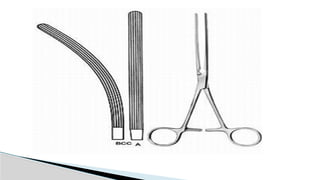
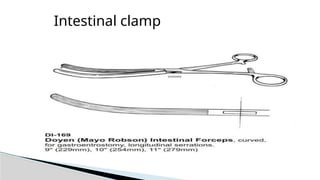
Intestinal clamp:
37.
Types ofintestinal clamp –
1. Non crushing type with flat and thin
blade put for the side of the intestine where
the anastomosis will takes place.
2. Crushing type with flat and heavy blade
for the side of the intestine will be removed.
Intestinal clamp
Used fortraction of the skin as in -
1. Scalp Incision and evertion of the scalp to control
bleeding.
2. Thyroid surgery to help in dissection of upper and
lower skin flaps.
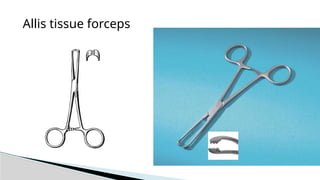
We prefer to apply the Allis is on the under surface of
the skin.
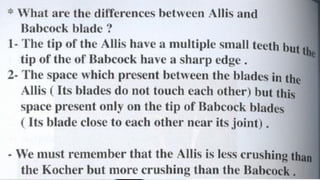
Allis forceps
41.
3. Traction onthe skin of the anal margin at 3,7,11
O’clock before picking up the hemorrhoids
during operation.
Catch the meso-appendix In appendectomy
Operation.
Catch the edge of the bowel in bowel
anastomosis.
Allis forceps
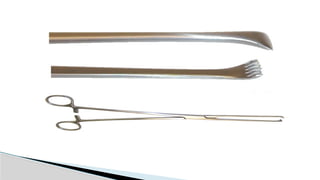
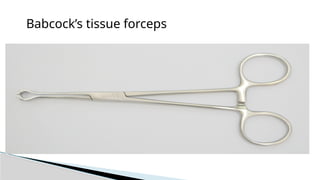
1. Encircling structuresas:
- The spermatic cord during hernia operations ( Can he replaced by
piece of gauze)
– The ureter to avoid its injury (as a landmark)
2. Catch structures as :
- Appendix during appendectomy.
-Bowel wall in resection anastomosis.
– Elevate the anterior wall of the stomach to make incision during
gastrostomy.
Babcock’s tissue forceps
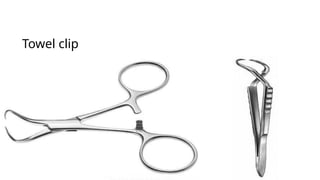
There is differentshape Of towel clips.
Help In draping the area of the surgical incision by
clip the towels with each others in accordance with
the planned operative Incision.
In the operating theaters antiseptic solutions usually
of an alcohol based as povidone iodine (betadin) used
for skin preparation of the operation sites, then we
apply towel which hold with towel clips.
Towel clips (clamp)