BASIC SURGICAL
INSTRUMENTS
Fundamentals of Primary Health
Care B
BASIC SURGICAL
INSTRUMENTS
• Basic laparotomy instruments are essential to
accomplish most types of general surgery. Each
instrument can be placed into one of the four following
basic categories:
– Retracting and Exposing Instruments
– Cutting and Dissecting Instruments
– Clamping and Occluding Instruments
– Grasping and Holding Instruments
Retracting and Exposing
Instruments
• Used to hold back or retract organs or tissue to gain
exposure to the operative site. They are either "self-
retaining" (stay open on their own) or "manual" (held by
hand). When identifying retractors, look at the blade, not
the handle.
Retracting and Exposing
Instruments
• A Deaver retractor (manual) is used to retract deep
abdominal or chest incisions. Available in various
widths.
• A Richardson retractor (manual) is used to retract deep
abdominal or chest incisions
Retracting and Exposing
Instruments
Retracting and Exposing
Instruments
• An Army-Navy retractor (manual) is used to retract
shallow or superficial incisions. Other names: USA, US
Army.
Retracting and Exposing
Instruments
• A goulet (manual) is used to retract shallow or
superficial incisions.
• A malleable or ribbon retractor (manual) is used to
retract deep wounds. May be bent to various shapes.
Retracting and Exposing
Instruments
• A Weitlaner retractor (self-retaining) is used to retract
shallow incisions.
Retracting and Exposing
Instruments
• A Gelpi retractor (self-retaining) is used to retract
shallow incisions.
Retracting and Exposing
Instruments
• A Balfour with bladder blade (self-retaining) is used to
retract wound edges during deep abdominal procedures.
Retracting and Exposing
Instruments
Cutting and Dissecting
Instruments
• are sharp and are used to cut body tissue or surgical
sutures.
Knife Handle, Scissors
(left to right)
Cutting and Dissecting
Instruments
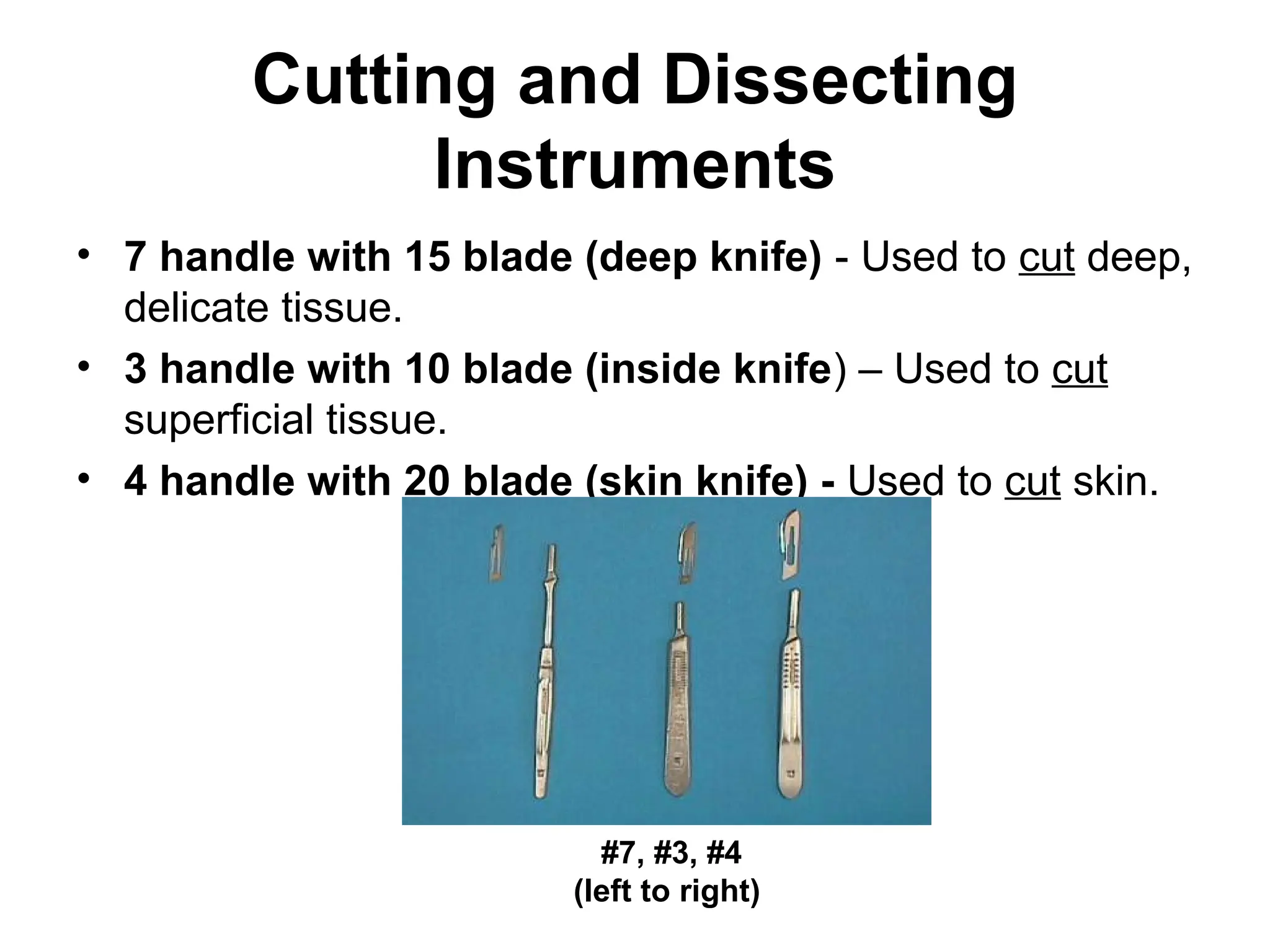
• 7 handle with 15 blade (deep knife) - Used to cut deep,
delicate tissue.
• 3 handle with 10 blade (inside knife) – Used to cut
superficial tissue.
• 4 handle with 20 blade (skin knife) - Used to cut skin.
#7, #3, #4
(left to right)
• Straight Mayo scissors - Used to cut suture and
supplies. Also known as: Suture scissors.
EX: Straight Mayo scissors being used to cut suture.
Cutting and Dissecting
Instruments
• Curved Mayo scissors - Used to cut heavy tissue
(fascia, muscle, uterus, breast). Available in regular and
long sizes.
Cutting and Dissecting
Instruments
• Metzenbaum scissors - Used to cut delicate tissue.
Available in regular and long sizes.
Cutting and Dissecting
Instruments
• are used to compress blood vessels or hollow organs for
hemostasis or to prevent spillage of contents.
Clamping and Occluding
Instruments
• A hemostat is used to clamp blood vessels or tag
sutures. Its jaws may be straight or curved. Other
names: crile, snap or stat.
Clamping and Occluding
Instruments
Clamping and Occluding
Instruments
• A mosquito is used to clamp small blood vessels. Its
jaws may be straight or curved.
hemostat, mosquito (left to right)
• A Kelly is used to clamp larger vessels and tissue.
Available in short and long sizes. Other names:
Rochester Pean.
Kelly, hemostat, mosquito (left to right)
Clamping and Occluding
Instruments
• A burlisher is used to clamp deep blood vessels.
Burlishers have two closed finger rings. Burlishers with
an open finger ring are called tonsil hemostats. Other
names: Schnidt tonsil forcep, Adson forcep.
Clamping and Occluding
Instruments
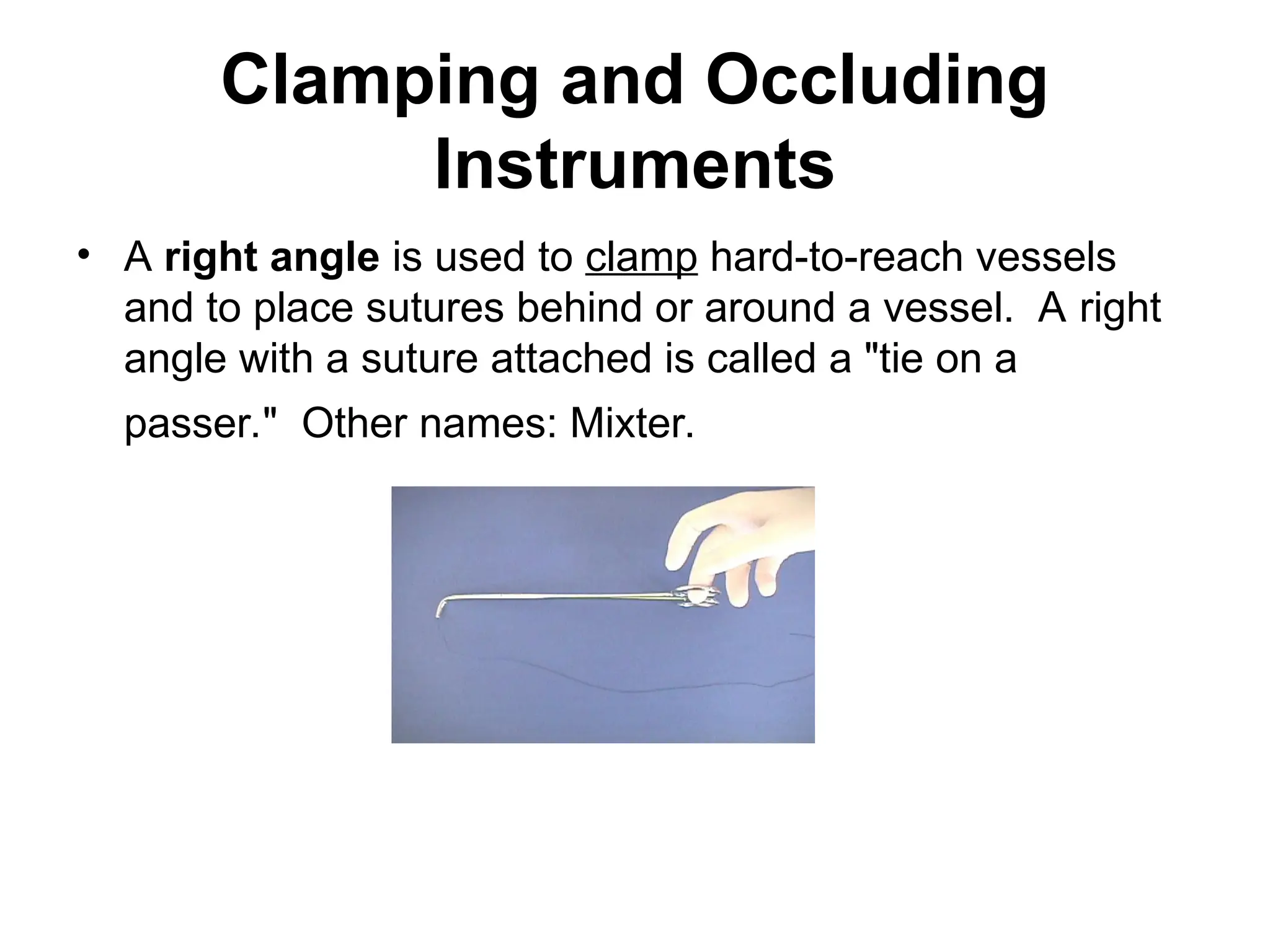
• A right angle is used to clamp hard-to-reach vessels
and to place sutures behind or around a vessel. A right
angle with a suture attached is called a "tie on a
passer." Other names: Mixter.
Clamping and Occluding
Instruments
• A hemoclip applier with hemoclips applies metal clips
onto blood vessels and ducts which will remain occluded.
hemoclip applier with hemoclips
Clamping and Occluding
Instruments
Grasping and Holding
Instruments
• are used to hold tissue, drapes or sponges.
• An Allis is used to grasp tissue. Available in short and
long sizes. A "Judd-Allis" holds intestinal tissue; a
"heavy allis" holds breast tissue.
Grasping and Holding
Instruments
Grasping and Holding
Instruments
• A Babcock is used to grasp delicate tissue (intestine,
fallopian tube, ovary). Available in short and long sizes.
• A Kocher is used to grasp heavy tissue. May also be
used as a clamp. The jaws may be straight or curved.
Other names: Ochsner.
Grasping and Holding
Instruments
• A Foerster sponge stick is used to grasp sponges.
Other names: sponge forcep.
Foerster sponge stick EX: Sponge sticks holding a 4 X 4
and probang.
Grasping and Holding
Instruments
• A dissector is used to hold a peanut.
Grasping and Holding
Instruments
dissector
EX: Dissector holding a peanut.
• A Backhaus towel clip is used to hold towels and
drapes in place. Other name: towel clip.
Backhaus towel clip Large & small towel clips
Grasping and Holding
Instruments
• Pick ups, thumb forceps and tissue forceps are
available in various lengths, with or without teeth, and
smooth or serrated jaws.
Grasping and Holding
Instruments
• Russian tissue forceps are used to grasp tissue.
Grasping and Holding
Instruments
• Adson pick ups are either smooth: used to grasp
delicate tissue; or with teeth: used to grasp the skin.
Other names: Dura forceps.
Grasping and Holding
Instruments
Grasping and Holding
Instruments
• Long smooth pick-ups are called dressing forceps.
Short smooth pick-ups are used to grasp delicate tissue.
• DeBakey forceps are used to grasp delicate tissue,
particularly in cardiovascular surgery.
Grasping and Holding
Instruments
Grasping and Holding
Instruments
• Thumb forceps are used to grasp tough tissue (fascia,
breast). Forceps may either have many teeth or a
single tooth. Single tooth forceps are also called "rat
tooth forceps."
single tooth forceps, many teeth forceps
(top to bottom)
• Mayo-Hegar needle holders are used to hold needles
when suturing. They may also be placed in the sewing
category.
Grasping and Holding
Instruments
short, medium & long
(top to bottom)
EX: Needle holder with suture.

BASIC SURGICAL INSTRUMENTS by Akugizibwe Solomon(MBChB IV).ppt

  • 1.
  • 2.
    BASIC SURGICAL INSTRUMENTS • Basiclaparotomy instruments are essential to accomplish most types of general surgery. Each instrument can be placed into one of the four following basic categories: – Retracting and Exposing Instruments – Cutting and Dissecting Instruments – Clamping and Occluding Instruments – Grasping and Holding Instruments
  • 3.
    Retracting and Exposing Instruments •Used to hold back or retract organs or tissue to gain exposure to the operative site. They are either "self- retaining" (stay open on their own) or "manual" (held by hand). When identifying retractors, look at the blade, not the handle.
  • 4.
    Retracting and Exposing Instruments •A Deaver retractor (manual) is used to retract deep abdominal or chest incisions. Available in various widths.
  • 5.
    • A Richardsonretractor (manual) is used to retract deep abdominal or chest incisions Retracting and Exposing Instruments
  • 6.
    Retracting and Exposing Instruments •An Army-Navy retractor (manual) is used to retract shallow or superficial incisions. Other names: USA, US Army.
  • 7.
    Retracting and Exposing Instruments •A goulet (manual) is used to retract shallow or superficial incisions.
  • 8.
    • A malleableor ribbon retractor (manual) is used to retract deep wounds. May be bent to various shapes. Retracting and Exposing Instruments
  • 9.
    • A Weitlanerretractor (self-retaining) is used to retract shallow incisions. Retracting and Exposing Instruments
  • 10.
    • A Gelpiretractor (self-retaining) is used to retract shallow incisions. Retracting and Exposing Instruments
  • 11.
    • A Balfourwith bladder blade (self-retaining) is used to retract wound edges during deep abdominal procedures. Retracting and Exposing Instruments
  • 12.
    Cutting and Dissecting Instruments •are sharp and are used to cut body tissue or surgical sutures. Knife Handle, Scissors (left to right)
  • 13.
    Cutting and Dissecting Instruments •7 handle with 15 blade (deep knife) - Used to cut deep, delicate tissue. • 3 handle with 10 blade (inside knife) – Used to cut superficial tissue. • 4 handle with 20 blade (skin knife) - Used to cut skin. #7, #3, #4 (left to right)
  • 14.
    • Straight Mayoscissors - Used to cut suture and supplies. Also known as: Suture scissors. EX: Straight Mayo scissors being used to cut suture. Cutting and Dissecting Instruments
  • 15.
    • Curved Mayoscissors - Used to cut heavy tissue (fascia, muscle, uterus, breast). Available in regular and long sizes. Cutting and Dissecting Instruments
  • 16.
    • Metzenbaum scissors- Used to cut delicate tissue. Available in regular and long sizes. Cutting and Dissecting Instruments
  • 17.
    • are usedto compress blood vessels or hollow organs for hemostasis or to prevent spillage of contents. Clamping and Occluding Instruments
  • 18.
    • A hemostatis used to clamp blood vessels or tag sutures. Its jaws may be straight or curved. Other names: crile, snap or stat. Clamping and Occluding Instruments
  • 19.
    Clamping and Occluding Instruments •A mosquito is used to clamp small blood vessels. Its jaws may be straight or curved. hemostat, mosquito (left to right)
  • 20.
    • A Kellyis used to clamp larger vessels and tissue. Available in short and long sizes. Other names: Rochester Pean. Kelly, hemostat, mosquito (left to right) Clamping and Occluding Instruments
  • 21.
    • A burlisheris used to clamp deep blood vessels. Burlishers have two closed finger rings. Burlishers with an open finger ring are called tonsil hemostats. Other names: Schnidt tonsil forcep, Adson forcep. Clamping and Occluding Instruments
  • 22.
    • A rightangle is used to clamp hard-to-reach vessels and to place sutures behind or around a vessel. A right angle with a suture attached is called a "tie on a passer." Other names: Mixter. Clamping and Occluding Instruments
  • 23.
    • A hemoclipapplier with hemoclips applies metal clips onto blood vessels and ducts which will remain occluded. hemoclip applier with hemoclips Clamping and Occluding Instruments
  • 24.
    Grasping and Holding Instruments •are used to hold tissue, drapes or sponges.
  • 25.
    • An Allisis used to grasp tissue. Available in short and long sizes. A "Judd-Allis" holds intestinal tissue; a "heavy allis" holds breast tissue. Grasping and Holding Instruments
  • 26.
    Grasping and Holding Instruments •A Babcock is used to grasp delicate tissue (intestine, fallopian tube, ovary). Available in short and long sizes.
  • 27.
    • A Kocheris used to grasp heavy tissue. May also be used as a clamp. The jaws may be straight or curved. Other names: Ochsner. Grasping and Holding Instruments
  • 28.
    • A Foerstersponge stick is used to grasp sponges. Other names: sponge forcep. Foerster sponge stick EX: Sponge sticks holding a 4 X 4 and probang. Grasping and Holding Instruments
  • 29.
    • A dissectoris used to hold a peanut. Grasping and Holding Instruments dissector EX: Dissector holding a peanut.
  • 30.
    • A Backhaustowel clip is used to hold towels and drapes in place. Other name: towel clip. Backhaus towel clip Large & small towel clips Grasping and Holding Instruments
  • 31.
    • Pick ups,thumb forceps and tissue forceps are available in various lengths, with or without teeth, and smooth or serrated jaws. Grasping and Holding Instruments
  • 32.
    • Russian tissueforceps are used to grasp tissue. Grasping and Holding Instruments
  • 33.
    • Adson pickups are either smooth: used to grasp delicate tissue; or with teeth: used to grasp the skin. Other names: Dura forceps. Grasping and Holding Instruments
  • 34.
    Grasping and Holding Instruments •Long smooth pick-ups are called dressing forceps. Short smooth pick-ups are used to grasp delicate tissue.
  • 35.
    • DeBakey forcepsare used to grasp delicate tissue, particularly in cardiovascular surgery. Grasping and Holding Instruments
  • 36.
    Grasping and Holding Instruments •Thumb forceps are used to grasp tough tissue (fascia, breast). Forceps may either have many teeth or a single tooth. Single tooth forceps are also called "rat tooth forceps." single tooth forceps, many teeth forceps (top to bottom)
  • 37.
    • Mayo-Hegar needleholders are used to hold needles when suturing. They may also be placed in the sewing category. Grasping and Holding Instruments short, medium & long (top to bottom) EX: Needle holder with suture.

Editor's Notes

  • #13 The numerals depict sizes/gauge of the instrument.