1º ESO INGLÉS. PAST SIMPLE PAST CONTINUOUS
PAST SIMPLE AND PAST CONTINUOUS
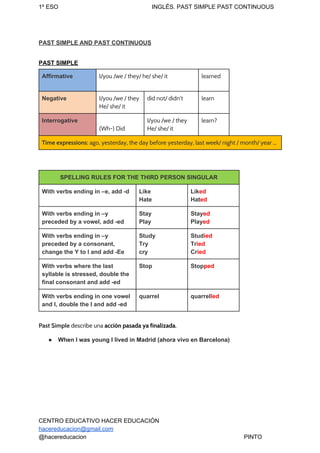
PAST SIMPLE
Affirmative I/you /we / they/ he/ she/ it learned
Negative I/you /we / they
He/ she/ it
did not/ didn’t learn
Interrogative
(Wh-) Did
I/you /we / they
He/ she/ it
learn?
Time expressions​: ago, yesterday, the day before yesterday, last week/ night / month/ year …
SPELLING RULES FOR THE THIRD PERSON SINGULAR
With verbs ending in –e, add -d Like
Hate
Lik​ed
Hat​ed
With verbs ending in –y
preceded by a vowel, add -ed
Stay
Play
Stay​ed
Play​ed
With verbs ending in –y
preceded by a consonant,
change the Y to I and add -Ee
Study
Try
cry
Stud​ied
Tr​ied
Cr​ied
With verbs where the last
syllable is stressed, double the
final consonant and add -ed
Stop Stop​ped
With verbs ending in one vowel
and l, double the l and add -ed
quarrel quarrel​led
Past Simple​ describe una ​acción pasada ya finalizada​.
● When I was young I lived in Madrid (ahora vivo en Barcelona)
CENTRO EDUCATIVO HACER EDUCACIÓN
hacereducacion@gmail.com
@hacereducacion PINTO
1º ESO INGLÉS. PAST SIMPLE PAST CONTINUOUS
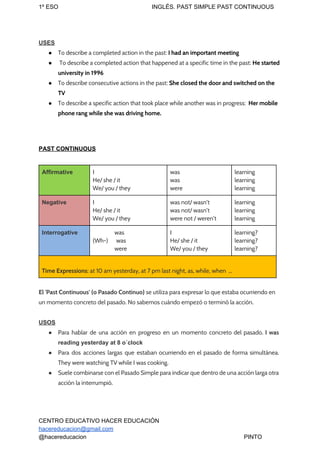
USES
● To describe a completed action in the past: ​I had an important meeting
● To describe a completed action that happened at a specific time in the past:​ ​He started
university in 1996
● To describe consecutive actions in the past: ​She closed the door and switched on the
TV
● To describe a specific action that took place while another was in progress: ​Her mobile
phone rang while she was driving home.
PAST CONTINUOUS
Affirmative I
He/ she / it
We/ you / they
was
was
were
learning
learning
learning
Negative I
He/ she / it
We/ you / they
was not/ wasn’t
was not/ wasn’t
were not / weren’t
learning
learning
learning
Interrogative was
(Wh-) was
were
I
He/ she / it
We/ you / they
learning?
learning?
learning?
Time Expressions​: at 10 am yesterday, at 7 pm last night, as, while, when …
El 'Past Continuous' (o Pasado Continuo)​ se utiliza para expresar lo que estaba ocurriendo en
un momento concreto del pasado. No sabemos cuándo empezó o terminó la acción.
USOS
● Para hablar de una acción en progreso en un momento concreto del pasado. ​I was
reading yesterday at 8 o´clock
● Para dos acciones largas que estaban ocurriendo en el pasado de forma simultánea.
They were watching TV while I was cooking.
● Suele combinarse con el Pasado Simple para indicar que dentro de una acción larga otra
acción la interrumpió.
CENTRO EDUCATIVO HACER EDUCACIÓN
hacereducacion@gmail.com
@hacereducacion PINTO
1º ESO INGLÉS. PAST SIMPLE PAST CONTINUOUS
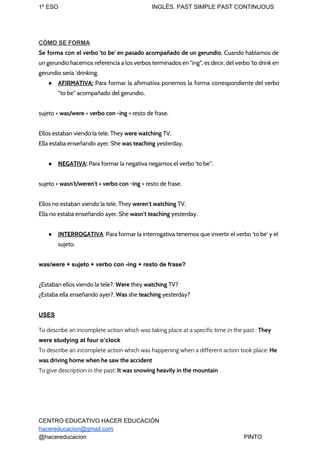
CÓMO SE FORMA
Se forma con el verbo 'to be' en pasado acompañado de un gerundio​. Cuando hablamos de
un gerundio hacemos referencia a los verbos terminados en "ing", es decir, del verbo 'to drink en
gerundio sería 'drinking.
● AFIRMATIVA: Para formar la afirmativa ponemos la forma correspondiente del verbo
“to be” acompañado del gerundio.
sujeto + ​was/were ​+ ​verbo con -ing​ + resto de frase.
Ellos estaban viendo la tele. They ​were watching ​TV.
Ella estaba enseñando ayer. She ​was teaching​ yesterday.
● NEGATIVA​: ​Para formar la negativa negamos el verbo 'to be''.
sujeto + ​wasn't/weren't + verbo con -ing​ + resto de frase.
Ellos no estaban viendo la tele. They ​weren't watching​ TV.
Ella no estaba enseñando ayer. She ​wasn't teaching​ yesterday.
● INTERROGATIVA​:​ Para formar la interrogativa tenemos que invertir el verbo 'to be' y el
sujeto.
was/were + sujeto + verbo con -ing + resto de frase?
¿Estaban ellos viendo la tele?. ​Were​ ​they ​watching​ TV?
¿Estaba ella enseñando ayer?. ​Was​ ​she ​teaching​ yesterday?
USES
To describe an incomplete action which was taking place at a specific time in the past : ​They
were studying at four o’clock
To describe an incomplete action which was happening when a different action took place: ​He
was driving home when he saw the accident
To give description in the past: ​It was snowing heavily in the mountain
CENTRO EDUCATIVO HACER EDUCACIÓN
hacereducacion@gmail.com
@hacereducacion PINTO
1º ESO INGLÉS. PAST SIMPLE PAST CONTINUOUS
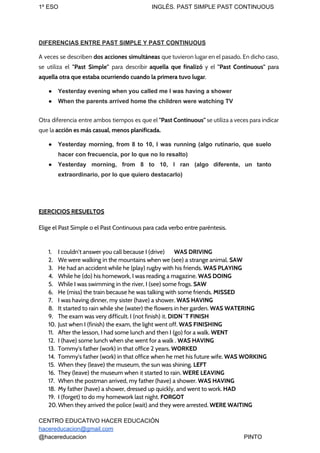
DIFERENCIAS ENTRE PAST SIMPLE Y PAST CONTINUOUS
A veces se describen ​dos acciones simultáneas ​que tuvieron lugar en el pasado. En dicho caso,
se utiliza el ​"Past Simple" ​para describir ​aquella que finalizó y el ​"Past Continuous" ​para
aquella otra que estaba ocurriendo cuando la primera tuvo lugar​.
● Yesterday evening when you called me I was having a shower
● When the parents arrived home the children were watching TV
Otra diferencia entre ambos tiempos es que el ​"Past Continuous" ​se utiliza a veces para indicar
que la ​acción es más casual, menos planificada.
● Yesterday morning, from 8 to 10, I was running (algo rutinario, que suelo
hacer con frecuencia, por lo que no lo resalto)
● Yesterday morning, from 8 to 10, I ran (algo diferente, un tanto
extraordinario, por lo que quiero destacarlo)
EJERCICIOS RESUELTOS
Elige el Past Simple o el Past Continuous para cada verbo entre paréntesis.
1. I couldn’t answer you call because I (drive) WAS DRIVING
2. We were walking in the mountains when we (see) a strange animal. ​SAW
3. He had an accident while he (play) rugby with his friends. ​WAS PLAYING
4. While he (do) his homework, I was reading a magazine. ​WAS DOING
5. While I was swimming in the river, I (see) some frogs. ​SAW
6. He (miss) the train because he was talking with some friends. ​MISSED
7. I was having dinner, my sister (have) a shower. ​WAS HAVING
8. It started to rain while she (water) the flowers in her garden. ​WAS WATERING
9. The exam was very difficult. I (not finish) it.​ DIDN´T FINISH
10. Just when I (finish) the exam, the light went off. ​WAS FINISHING
11. After the lesson, I had some lunch and then I (go) for a walk. ​WENT
12. I (have) some lunch when she went for a walk . ​WAS HAVING
13. Tommy's father (work) in that office 2 years. ​WORKED
14. Tommy's father (work) in that office when he met his future wife. ​WAS WORKING
15. When they (leave) the museum, the sun was shining. ​LEFT
16. They (leave) the museum when it started to rain. ​WERE LEAVING
17. When the postman arrived, my father (have) a shower. ​WAS HAVING
18. My father (have) a shower, dressed up quickly, and went to work. ​HAD
19. I (forget) to do my homework last night. ​FORGOT
20. When they arrived the police (wait) and they were arrested. ​WERE WAITING
CENTRO EDUCATIVO HACER EDUCACIÓN
hacereducacion@gmail.com
@hacereducacion PINTO
1º ESO INGLÉS. PAST SIMPLE PAST CONTINUOUS
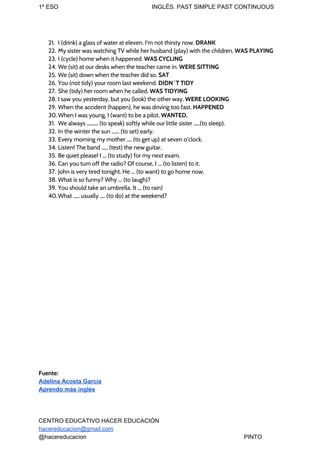
21. I (drink) a glass of water at eleven. I'm not thirsty now. ​DRANK
22. My sister was watching TV while her husband (play) with the children. ​WAS PLAYING
23. I (cycle) home when it happened. ​WAS CYCLING
24. We (sit) at our desks when the teacher came in. ​WERE SITTING
25. We (sit) down when the teacher did so. ​SAT
26. You (not tidy) your room last weekend. ​DIDN´T TIDY
27. She (tidy) her room when he called. ​WAS TIDYING
28. I saw you yesterday, but you (look) the other way. ​WERE LOOKING
29. When the accident (happen), he was driving too fast. ​HAPPENED
30. When I was young, I (want) to be a pilot. ​WANTED.
31. We always ......... (to speak) softly while our little sister .....(to sleep).
32. In the winter the sun ...... (to set) early.
33. Every morning my mother .... (to get up) at seven o’clock.
34. Listen! The band ..... (test) the new guitar.
35. Be quiet please! I ... (to study) for my next exam.
36. Can you turn off the radio? Of course, I ... (to listen) to it.
37. John is very tired tonight. He ... (to want) to go home now.
38. What is so funny? Why ... (to laugh)?
39. You should take an umbrella. It ... (to rain)
40.What ..... usually .... (to do) at the weekend?
Fuente:
Adelina Acosta García
Aprendo más inglés
CENTRO EDUCATIVO HACER EDUCACIÓN
hacereducacion@gmail.com
@hacereducacion PINTO

1º ESO: Past Simple and Past Continuous

  • 1.
    1º ESO INGLÉS.PAST SIMPLE PAST CONTINUOUS PAST SIMPLE AND PAST CONTINUOUS PAST SIMPLE Affirmative I/you /we / they/ he/ she/ it learned Negative I/you /we / they He/ she/ it did not/ didn’t learn Interrogative (Wh-) Did I/you /we / they He/ she/ it learn? Time expressions​: ago, yesterday, the day before yesterday, last week/ night / month/ year … SPELLING RULES FOR THE THIRD PERSON SINGULAR With verbs ending in –e, add -d Like Hate Lik​ed Hat​ed With verbs ending in –y preceded by a vowel, add -ed Stay Play Stay​ed Play​ed With verbs ending in –y preceded by a consonant, change the Y to I and add -Ee Study Try cry Stud​ied Tr​ied Cr​ied With verbs where the last syllable is stressed, double the final consonant and add -ed Stop Stop​ped With verbs ending in one vowel and l, double the l and add -ed quarrel quarrel​led Past Simple​ describe una ​acción pasada ya finalizada​. ● When I was young I lived in Madrid (ahora vivo en Barcelona) CENTRO EDUCATIVO HACER EDUCACIÓN hacereducacion@gmail.com @hacereducacion PINTO
  • 2.
    1º ESO INGLÉS.PAST SIMPLE PAST CONTINUOUS USES ● To describe a completed action in the past: ​I had an important meeting ● To describe a completed action that happened at a specific time in the past:​ ​He started university in 1996 ● To describe consecutive actions in the past: ​She closed the door and switched on the TV ● To describe a specific action that took place while another was in progress: ​Her mobile phone rang while she was driving home. PAST CONTINUOUS Affirmative I He/ she / it We/ you / they was was were learning learning learning Negative I He/ she / it We/ you / they was not/ wasn’t was not/ wasn’t were not / weren’t learning learning learning Interrogative was (Wh-) was were I He/ she / it We/ you / they learning? learning? learning? Time Expressions​: at 10 am yesterday, at 7 pm last night, as, while, when … El 'Past Continuous' (o Pasado Continuo)​ se utiliza para expresar lo que estaba ocurriendo en un momento concreto del pasado. No sabemos cuándo empezó o terminó la acción. USOS ● Para hablar de una acción en progreso en un momento concreto del pasado. ​I was reading yesterday at 8 o´clock ● Para dos acciones largas que estaban ocurriendo en el pasado de forma simultánea. They were watching TV while I was cooking. ● Suele combinarse con el Pasado Simple para indicar que dentro de una acción larga otra acción la interrumpió. CENTRO EDUCATIVO HACER EDUCACIÓN hacereducacion@gmail.com @hacereducacion PINTO
  • 3.
    1º ESO INGLÉS.PAST SIMPLE PAST CONTINUOUS CÓMO SE FORMA Se forma con el verbo 'to be' en pasado acompañado de un gerundio​. Cuando hablamos de un gerundio hacemos referencia a los verbos terminados en "ing", es decir, del verbo 'to drink en gerundio sería 'drinking. ● AFIRMATIVA: Para formar la afirmativa ponemos la forma correspondiente del verbo “to be” acompañado del gerundio. sujeto + ​was/were ​+ ​verbo con -ing​ + resto de frase. Ellos estaban viendo la tele. They ​were watching ​TV. Ella estaba enseñando ayer. She ​was teaching​ yesterday. ● NEGATIVA​: ​Para formar la negativa negamos el verbo 'to be''. sujeto + ​wasn't/weren't + verbo con -ing​ + resto de frase. Ellos no estaban viendo la tele. They ​weren't watching​ TV. Ella no estaba enseñando ayer. She ​wasn't teaching​ yesterday. ● INTERROGATIVA​:​ Para formar la interrogativa tenemos que invertir el verbo 'to be' y el sujeto. was/were + sujeto + verbo con -ing + resto de frase? ¿Estaban ellos viendo la tele?. ​Were​ ​they ​watching​ TV? ¿Estaba ella enseñando ayer?. ​Was​ ​she ​teaching​ yesterday? USES To describe an incomplete action which was taking place at a specific time in the past : ​They were studying at four o’clock To describe an incomplete action which was happening when a different action took place: ​He was driving home when he saw the accident To give description in the past: ​It was snowing heavily in the mountain CENTRO EDUCATIVO HACER EDUCACIÓN hacereducacion@gmail.com @hacereducacion PINTO
  • 4.
    1º ESO INGLÉS.PAST SIMPLE PAST CONTINUOUS DIFERENCIAS ENTRE PAST SIMPLE Y PAST CONTINUOUS A veces se describen ​dos acciones simultáneas ​que tuvieron lugar en el pasado. En dicho caso, se utiliza el ​"Past Simple" ​para describir ​aquella que finalizó y el ​"Past Continuous" ​para aquella otra que estaba ocurriendo cuando la primera tuvo lugar​. ● Yesterday evening when you called me I was having a shower ● When the parents arrived home the children were watching TV Otra diferencia entre ambos tiempos es que el ​"Past Continuous" ​se utiliza a veces para indicar que la ​acción es más casual, menos planificada. ● Yesterday morning, from 8 to 10, I was running (algo rutinario, que suelo hacer con frecuencia, por lo que no lo resalto) ● Yesterday morning, from 8 to 10, I ran (algo diferente, un tanto extraordinario, por lo que quiero destacarlo) EJERCICIOS RESUELTOS Elige el Past Simple o el Past Continuous para cada verbo entre paréntesis. 1. I couldn’t answer you call because I (drive) WAS DRIVING 2. We were walking in the mountains when we (see) a strange animal. ​SAW 3. He had an accident while he (play) rugby with his friends. ​WAS PLAYING 4. While he (do) his homework, I was reading a magazine. ​WAS DOING 5. While I was swimming in the river, I (see) some frogs. ​SAW 6. He (miss) the train because he was talking with some friends. ​MISSED 7. I was having dinner, my sister (have) a shower. ​WAS HAVING 8. It started to rain while she (water) the flowers in her garden. ​WAS WATERING 9. The exam was very difficult. I (not finish) it.​ DIDN´T FINISH 10. Just when I (finish) the exam, the light went off. ​WAS FINISHING 11. After the lesson, I had some lunch and then I (go) for a walk. ​WENT 12. I (have) some lunch when she went for a walk . ​WAS HAVING 13. Tommy's father (work) in that office 2 years. ​WORKED 14. Tommy's father (work) in that office when he met his future wife. ​WAS WORKING 15. When they (leave) the museum, the sun was shining. ​LEFT 16. They (leave) the museum when it started to rain. ​WERE LEAVING 17. When the postman arrived, my father (have) a shower. ​WAS HAVING 18. My father (have) a shower, dressed up quickly, and went to work. ​HAD 19. I (forget) to do my homework last night. ​FORGOT 20. When they arrived the police (wait) and they were arrested. ​WERE WAITING CENTRO EDUCATIVO HACER EDUCACIÓN hacereducacion@gmail.com @hacereducacion PINTO
  • 5.
    1º ESO INGLÉS.PAST SIMPLE PAST CONTINUOUS 21. I (drink) a glass of water at eleven. I'm not thirsty now. ​DRANK 22. My sister was watching TV while her husband (play) with the children. ​WAS PLAYING 23. I (cycle) home when it happened. ​WAS CYCLING 24. We (sit) at our desks when the teacher came in. ​WERE SITTING 25. We (sit) down when the teacher did so. ​SAT 26. You (not tidy) your room last weekend. ​DIDN´T TIDY 27. She (tidy) her room when he called. ​WAS TIDYING 28. I saw you yesterday, but you (look) the other way. ​WERE LOOKING 29. When the accident (happen), he was driving too fast. ​HAPPENED 30. When I was young, I (want) to be a pilot. ​WANTED. 31. We always ......... (to speak) softly while our little sister .....(to sleep). 32. In the winter the sun ...... (to set) early. 33. Every morning my mother .... (to get up) at seven o’clock. 34. Listen! The band ..... (test) the new guitar. 35. Be quiet please! I ... (to study) for my next exam. 36. Can you turn off the radio? Of course, I ... (to listen) to it. 37. John is very tired tonight. He ... (to want) to go home now. 38. What is so funny? Why ... (to laugh)? 39. You should take an umbrella. It ... (to rain) 40.What ..... usually .... (to do) at the weekend? Fuente: Adelina Acosta García Aprendo más inglés CENTRO EDUCATIVO HACER EDUCACIÓN hacereducacion@gmail.com @hacereducacion PINTO