WEEK 2
ENGLISH 7
OBJECTIVES:
At the end of the lesson, you are expected to:
Share specific thoughts or insights on Filipino
values discussed in class.
OBJECTIVES:
At the end of the lesson, you are expected to:
Share specific thoughts or insights on Filipino
values discussed in class.
Write a short prayer showing the elements of
poetry.
OBJECTIVES:
At the end of the lesson, you are expected to:
Analyze the given poem according to the
assigned concept.
At the end of the lesson, you are expected to:
Analyze the given poem according to the
assigned concept.
Share their ideas and thoughts about
significant concepts from the poem and relate it
to your specific local identity or Filipino identity
in general.
OBJECTIVES:
REVIEW
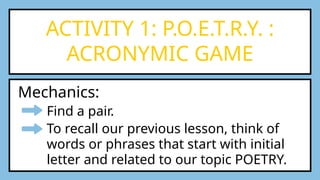
ACTIVITY 1: P.O.E.T.R.Y. :
ACRONYMIC GAME
Mechanics:
Find a pair.
To recall our previous lesson, think of
words or phrases that start with initial
letter and related to our topic POETRY.
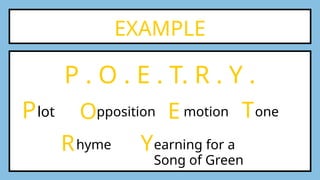
EXAMPLE
Plot Opposition
P . O . E . T. R . Y .
E motion Tone
Rhyme Yearning for a
Song of Green
YOUR TURN
P . O . E . T. R . Y .
START
SHARING TIME
P . O . E . T. R . Y .
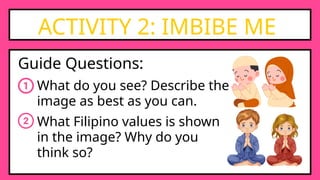
ACTIVITY 2: IMBIBE ME
Guide Questions:
What do you see? Describe the
image as best as you can.
What Filipino values is shown
in the image? Why do you
think so?
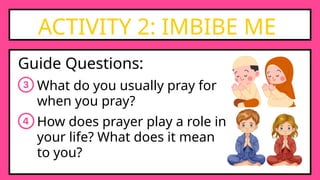
ACTIVITY 2: IMBIBE ME
Guide Questions:
What do you usually pray for
when you pray?
How does prayer play a role in
your life? What does it mean
to you?
Find a pair.
ACTIVITY 3: THINK, PAIR, AND SHARE
Mechanics:
Write a prayer using the
elements of poetry. It can be
either free verse or a rhyming
poem as prayer.
Share your work in the class.
How did you feel about writing a poem using
the elements of poetry? Describe your
experience.
GUIDE QUESTIONS
Do you think there is a connection between
writing poetry and writing a prayer?
Did you face any challenges while writing your
prayer poem?
ACTIVITY 4: GUESS THE
WORD
Series of pictures will be shown, and its
definition will serve as a clue. Within 60
seconds, guess the word.
Instruction:
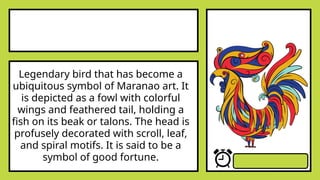
Legendary bird that has become a
ubiquitous symbol of Maranao art. It
is depicted as a fowl with colorful
wings and feathered tail, holding a
fish on its beak or talons. The head is
profusely decorated with scroll, leaf,
and spiral motifs. It is said to be a
symbol of good fortune.
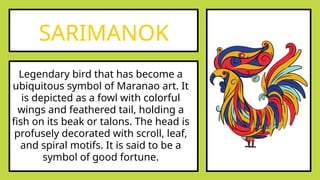
SARIMANOK
Legendary bird that has become a
ubiquitous symbol of Maranao art. It
is depicted as a fowl with colorful
wings and feathered tail, holding a
fish on its beak or talons. The head is
profusely decorated with scroll, leaf,
and spiral motifs. It is said to be a
symbol of good fortune.
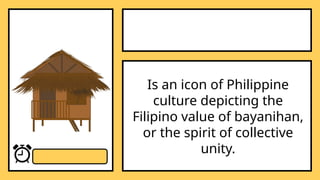
Is an icon of Philippine
culture depicting the
Filipino value of bayanihan,
or the spirit of collective
unity.
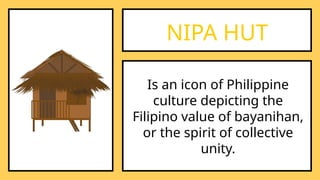
NIPA HUT
Is an icon of Philippine
culture depicting the
Filipino value of bayanihan,
or the spirit of collective
unity.
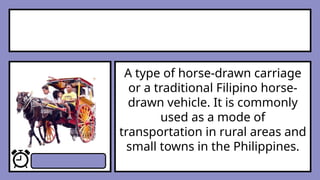
A type of horse-drawn carriage
or a traditional Filipino horse-
drawn vehicle. It is commonly
used as a mode of
transportation in rural areas and
small towns in the Philippines.
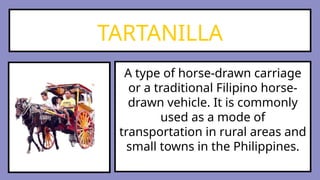
TARTANILLA
A type of horse-drawn carriage
or a traditional Filipino horse-
drawn vehicle. It is commonly
used as a mode of
transportation in rural areas and
small towns in the Philippines.
GUIDE QUESTIONS
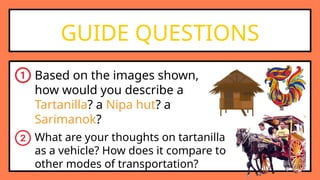
Based on the images shown,
how would you describe a
Tartanilla? a Nipa hut? a
Sarimanok?
What are your thoughts on tartanilla
as a vehicle? How does it compare to
other modes of transportation?
GUIDE QUESTIONS
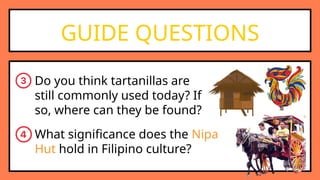
Do you think tartanillas are
still commonly used today? If
so, where can they be found?
What significance does the Nipa
Hut hold in Filipino culture?
ACTIVITY 5:
BRAIN BLOSSOMS:
CULTIVATING IDEAS AND
THOUGHTS
Instructions:
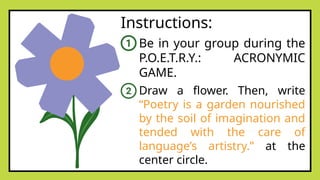
Be in your group during the
P.O.E.T.R.Y.: ACRONYMIC
GAME.
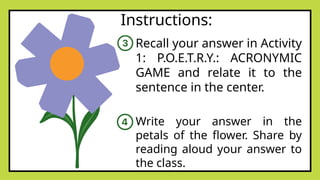
Draw a flower. Then, write
“Poetry is a garden nourished
by the soil of imagination and
tended with the care of
language’s artistry.” at the
center circle.
Instructions:
Recall your answer in Activity
1: P.O.E.T.R.Y.: ACRONYMIC
GAME and relate it to the
sentence in the center.
Write your answer in the
petals of the flower. Share by
reading aloud your answer to
the class.
PROCESSING QUESTIONS
How did creating the flower concept map
help you better understand the concept of
poetry?
What did you learn about your own
experiences with reading, writing, and
understanding poetry while making the
concept map?
WEEK 2
DAY 2 - 3
DAY 2
BASIC ELEMENTS
OF POETRY
FORM
Refers to how the poem is put together, like its
structure and design.
how it rhymes
how lines are
grouped into
stanzas
how it looks
like on a page
FORM - RHYME
Is the repetition of sounds in the line of a
poem.
End Rhyme
Internal Rhyme
Exact Rhyme
FORM - RHYME
Is the repetition of sounds in the line of a
poem.
End Rhyme
Internal Rhyme
Exact Rhyme
Focus
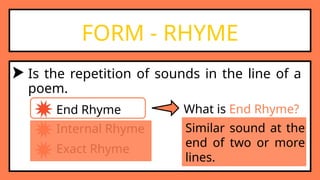
FORM - RHYME
End Rhyme
Internal Rhyme
Exact Rhyme
What is End Rhyme?
Similar sound at the
end of two or more
lines.
Is the repetition of sounds in the line of a
poem.
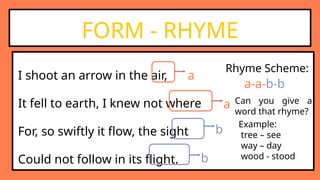
I shoot an arrow in the air,
It fell to earth, I knew not where
For, so swiftly it flow, the sight
Could not follow in its flight.
FORM - RHYME
a
a
b
b
Can you give a
word that rhyme?
Example:
tree – see
way – day
wood - stood
Rhyme Scheme:
a-a-b-b
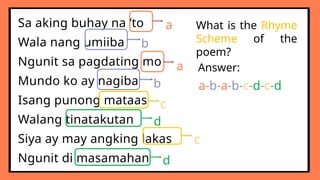
Sa aking buhay na ‘to
Wala nang umiiba
Ngunit sa pagdating mo
Mundo ko ay nagiba
Isang punong mataas
Walang tinatakutan
Siya ay may angking lakas
Ngunit di masamahan
a
a
b
b
c
c
d
d
What is the Rhyme
Scheme of the
poem?
a-b-a-b-c-d-c-d
Answer:
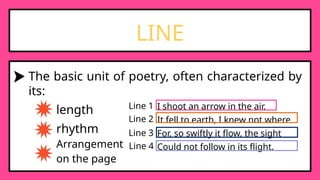
Well, son, I’ll tell you:
Life for me ain’t been no crystal stair.
It’s had tacks in it,
And splinters,
And boards torn up,
And places with no carpet on the floor—
What words that
rhyme together?
Answer: NONE
Free Verse is any form of
poetry that does not rely
on consistent patterns of
rhyme and meter.
LINE
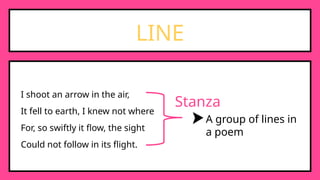
The basic unit of poetry, often characterized by
its:
length
rhythm
Arrangement
on the page
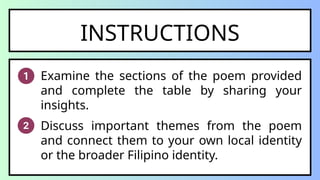
I shoot an arrow in the air,
It fell to earth, I knew not where
For, so swiftly it flow, the sight
Could not follow in its flight.
Line 1
Line 2
Line 3
Line 4
LINE
I shoot an arrow in the air,
It fell to earth, I knew not where
For, so swiftly it flow, the sight
Could not follow in its flight.
Stanza
A group of lines in
a poem
LINE
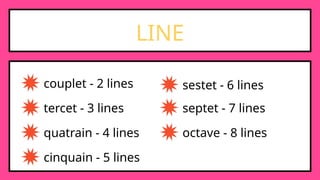
couplet - 2 lines
tercet - 3 lines
quatrain - 4 lines
cinquain - 5 lines
sestet - 6 lines
septet - 7 lines
octave - 8 lines
EXAMPLE OF COUPLET
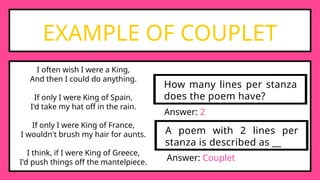
I often wish I were a King,
And then I could do anything.
If only I were King of Spain,
I'd take my hat off in the rain.
If only I were King of France,
I wouldn't brush my hair for aunts.
I think, if I were King of Greece,
I'd push things off the mantelpiece.
How many lines per stanza
does the poem have?
Answer: 2
A poem with 2 lines per
stanza is described as __
Answer: Couplet
QUATRAIN
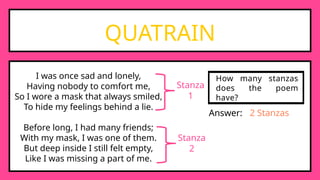
I was once sad and lonely,
Having nobody to comfort me,
So I wore a mask that always smiled,
To hide my feelings behind a lie.
Before long, I had many friends;
With my mask, I was one of them.
But deep inside I still felt empty,
Like I was missing a part of me.
Stanza
1
Stanza
2
How many stanzas
does the poem
have?
Answer: 2 Stanzas
QUATRAIN
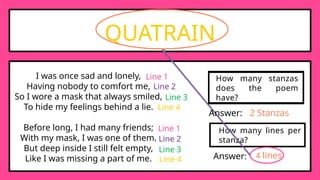
I was once sad and lonely,
Having nobody to comfort me,
So I wore a mask that always smiled,
To hide my feelings behind a lie.
Before long, I had many friends;
With my mask, I was one of them.
But deep inside I still felt empty,
Like I was missing a part of me.
How many lines per
stanza?
4 lines
Line 1
Line 2
Line 3
Line 4
Line 1
Line 2
Line 3
Line 4
How many stanzas
does the poem
have?
Answer: 2 Stanzas
Answer:
IMAGERY
Descriptive language that appeals to the
senses, creating vivid mental pictures and
sensory experiences for the reader.
What are your
five senses?
IMAGERY
This means the writer chooses words that help
you imagine how things :
look sound smell taste touch
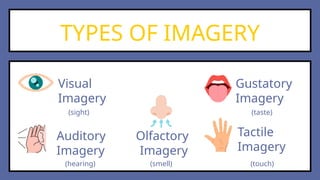
TYPES OF IMAGERY
Visual
Imagery
Auditory
Imagery
Olfactory
Imagery
Gustatory
Imagery
Tactile
Imagery
(sight)
(hearing) (smell)
(taste)
(touch)
EXAMPLE OF IMAGERY
The silence was
broken by the
screech of tires and
scraping of metal?
WHAT TYPE OF IMAGERY
WAS USED?
Visual
Imagery
Auditory
Imagery
Olfactory
Imagery
Gustatory
Imagery
Tactile Imagery
EXAMPLE OF IMAGERY
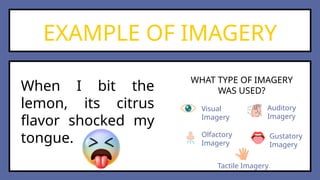
When I bit the
lemon, its citrus
flavor shocked my
tongue.
Visual
Imagery
Auditory
Imagery
Olfactory
Imagery
Gustatory
Imagery
Tactile Imagery
WHAT TYPE OF IMAGERY
WAS USED?
EXAMPLE OF IMAGERY
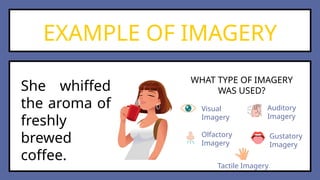
She whiffed
the aroma of
freshly
brewed
coffee.
Visual
Imagery
Auditory
Imagery
Olfactory
Imagery
Gustatory
Imagery
Tactile Imagery
WHAT TYPE OF IMAGERY
WAS USED?
EXAMPLE OF IMAGERY
Visual
Imagery
Auditory
Imagery
Olfactory
Imagery
Gustatory
Imagery
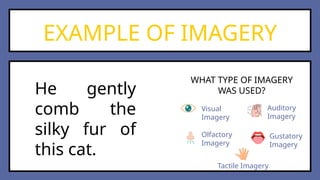
Tactile Imagery
WHAT TYPE OF IMAGERY
WAS USED?
He gently
comb the
silky fur of
this cat.
EXAMPLE OF IMAGERY
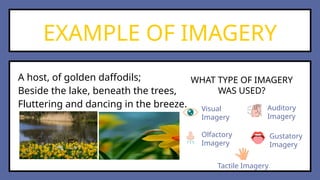
A host, of golden daffodils;
Beside the lake, beneath the trees,
Fluttering and dancing in the breeze. Visual
Imagery
Auditory
Imagery
Olfactory
Imagery
Gustatory
Imagery
Tactile Imagery
WHAT TYPE OF IMAGERY
WAS USED?
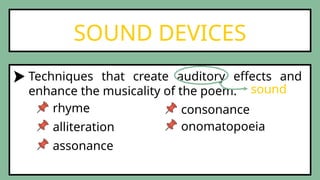
SOUND DEVICES
Techniques that create auditory effects and
enhance the musicality of the poem.
rhyme
alliteration
assonance
consonance
onomatopoeia
sound
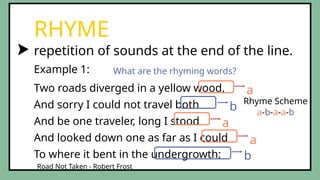
repetition of sounds at the end of the line.
RHYME
Two roads diverged in a yellow wood,
And sorry I could not travel both
And be one traveler, long I stood
And looked down one as far as I could
To where it bent in the undergrowth;
Example 1:
Road Not Taken - Robert Frost
a
a
a
b
b
What are the rhyming words?
Rhyme Scheme
a-b-a-a-b
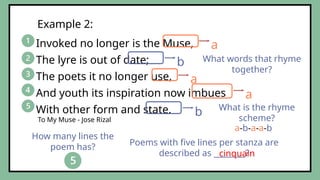
Invoked no longer is the Muse,
The lyre is out of date;
The poets it no longer use,
And youth its inspiration now imbues
With other form and state.
Example 2:
To My Muse - Jose Rizal
What words that rhyme
together?
a
a
a
b
b
How many lines the
poem has?
Poems with five lines per stanza are
described as ________?
cinquain
What is the rhyme
scheme?
a-b-a-a-b
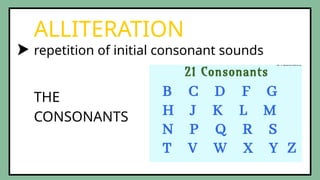
repetition of initial consonant sounds
ALLITERATION
THE
CONSONANTS
repetition of initial consonant sounds
ALLITERATION
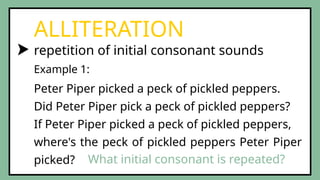
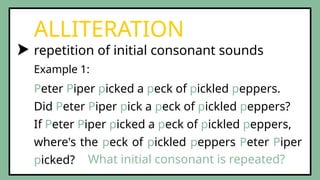
Peter Piper picked a peck of pickled peppers.
Did Peter Piper pick a peck of pickled peppers?
If Peter Piper picked a peck of pickled peppers,
where's the peck of pickled peppers Peter Piper
picked?
Example 1:
What initial consonant is repeated?
repetition of initial consonant sounds
ALLITERATION
Peter Piper picked a peck of pickled peppers.
Did Peter Piper pick a peck of pickled peppers?
If Peter Piper picked a peck of pickled peppers,
where's the peck of pickled peppers Peter Piper
picked?
Example 1:
What initial consonant is repeated?
repetition of initial consonant sounds
ALLITERATION
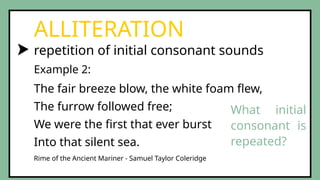
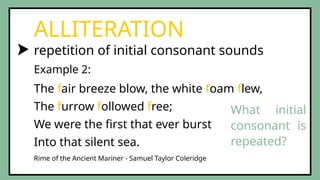
The fair breeze blow, the white foam flew,
The furrow followed free;
We were the first that ever burst
Into that silent sea.
Example 2:
Rime of the Ancient Mariner - Samuel Taylor Coleridge
What initial
consonant is
repeated?
repetition of initial consonant sounds
ALLITERATION
The fair breeze blow, the white foam flew,
The furrow followed free;
We were the first that ever burst
Into that silent sea.
Example 2:
Rime of the Ancient Mariner - Samuel Taylor Coleridge
What initial
consonant is
repeated?
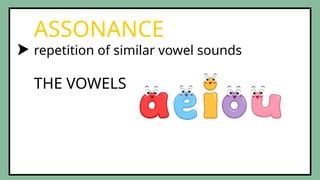
repetition of similar vowel sounds
ASSONANCE
THE VOWELS
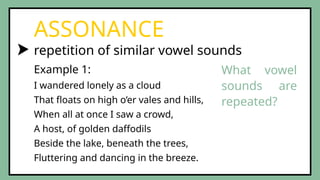
repetition of similar vowel sounds
ASSONANCE
Example 1:
I wandered lonely as a cloud
That floats on high o’er vales and hills,
When all at once I saw a crowd,
A host, of golden daffodils
Beside the lake, beneath the trees,
Fluttering and dancing in the breeze.
What vowel
sounds are
repeated?
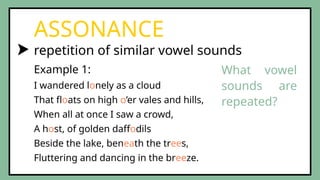
repetition of similar vowel sounds
ASSONANCE
Example 1:
I wandered lonely as a cloud
That floats on high o’er vales and hills,
When all at once I saw a crowd,
A host, of golden daffodils
Beside the lake, beneath the trees,
Fluttering and dancing in the breeze.
What vowel
sounds are
repeated?
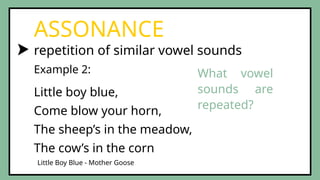
repetition of similar vowel sounds
ASSONANCE
Example 2:
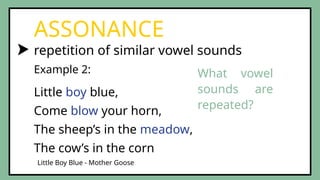
Little Boy Blue - Mother Goose
Little boy blue,
Come blow your horn,
The sheep’s in the meadow,
The cow’s in the corn
What vowel
sounds are
repeated?
repetition of similar vowel sounds
ASSONANCE
Example 2:
Little Boy Blue - Mother Goose
Little boy blue,
Come blow your horn,
The sheep’s in the meadow,
The cow’s in the corn
What vowel
sounds are
repeated?
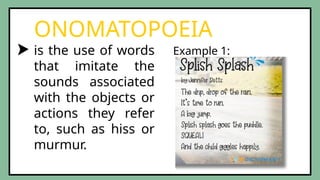
is the use of words
that imitate the
sounds associated
with the objects or
actions they refer
to, such as hiss or
murmur.
ONOMATOPOEIA
Example 1:
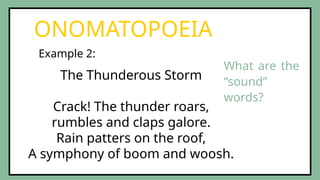
The Thunderous Storm
Crack! The thunder roars,
rumbles and claps galore.
Rain patters on the roof,
A symphony of boom and woosh.
ONOMATOPOEIA
Example 2:
What are the
“sound”
words?
FIGURATIVE LANGAUGE
Figurative language adds depth, nuance, and
emotion to poetry by going beyond literal
meanings and inviting readers to interpret and
experience the text in different ways
Methaphor
Similes
Personification
Hyperbole
METAPHOR
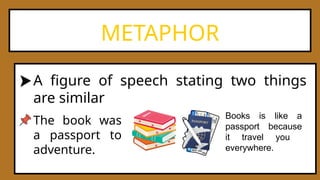
A figure of speech stating two things
are similar
The book was
a passport to
adventure.
Books is like a
passport because
it travel you
everywhere.
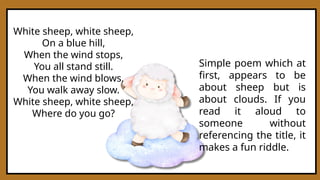
White sheep, white sheep,
On a blue hill,
When the wind stops,
You all stand still.
When the wind blows,
You walk away slow.
White sheep, white sheep,
Where do you go?
Simple poem which at
first, appears to be
about sheep but is
about clouds. If you
read it aloud to
someone without
referencing the title, it
makes a fun riddle.
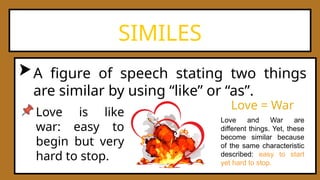
SIMILES
A figure of speech stating two things
are similar by using “like” or “as”.
Love is like
war: easy to
begin but very
hard to stop.
Love and War are
different things. Yet, these
become similar because
of the same characteristic
described: easy to start
yet hard to stop.
Love = War
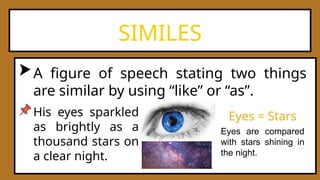
SIMILES
A figure of speech stating two things
are similar by using “like” or “as”.
His eyes sparkled
as brightly as a
thousand stars on
a clear night.
Eyes are compared
with stars shining in
the night.
Eyes = Stars
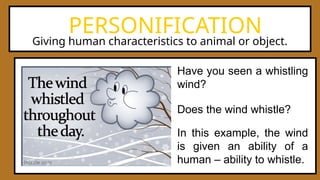
PERSONIFICATION
Have you seen a whistling
wind?
In this example, the wind
is given an ability of a
human – ability to whistle.
Does the wind whistle?
Giving human characteristics to animal or object.
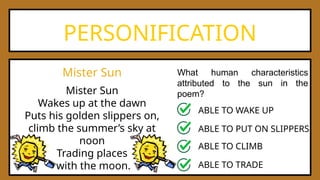
PERSONIFICATION
What human characteristics
attributed to the sun in the
poem?
Mister Sun
Mister Sun
Wakes up at the dawn
Puts his golden slippers on,
climb the summer’s sky at
noon
Trading places
with the moon.
ABLE TO WAKE UP
ABLE TO PUT ON SLIPPERS
ABLE TO CLIMB
ABLE TO TRADE
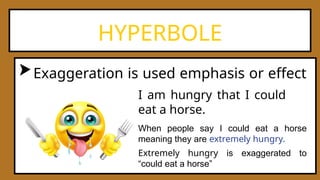
HYPERBOLE
Exaggeration is used emphasis or effect
I am hungry that I could
eat a horse.
When people say I could eat a horse
meaning they are extremely hungry.
Extremely hungry is exaggerated to
“could eat a horse”
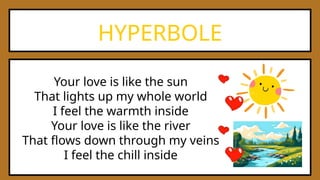
HYPERBOLE
Your love is like the sun
That lights up my whole world
I feel the warmth inside
Your love is like the river
That flows down through my veins
I feel the chill inside
THEME
The central idea, message, or underlying
meaning of a poem, often expressed through
recurring images, symbols, or motifs.
Love
Death
Nature
War
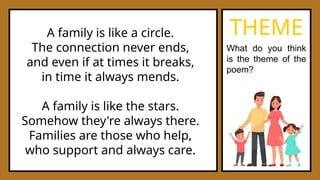
A family is like a circle.
The connection never ends,
and even if at times it breaks,
in time it always mends.
A family is like the stars.
Somehow they're always there.
Families are those who help,
who support and always care.
THEME
What do you think
is the theme of the
poem?
Poems often have
biographical, historical,
and socio-cultural
contexts because these
contexts greatly
influence the themes,
styles, and messages of
the poems.
CONTEXTS
BIOGRAPHICAL
CONTEXT
HISTORICAL
CONTEXT
SOCIOCULTURAL
CONTEXT
Includes the life experiences,
background, beliefs, and
personal history of the writer.
CONTEXTS
BIOGRAPHICAL
CONTEXT
HISTORICAL
CONTEXT
SOCIOCULTURAL
CONTEXT
Understanding the writer's
biography can provide
insights into the motivations,
emotions, and perspectives
behind their poems.
This context may influence the
theme, subject, and style of the
writer.
CONTEXTS
BIOGRAPHICAL
CONTEXT
HISTORICAL
CONTEXT
SOCIOCULTURAL
CONTEXT
Personal experiences often
shape the themes and emotions
explored in poetry, making
biographical context crucial for
understanding the writer's
perspective and creative
process.
Refers to the time period,
events, social conditions, and
cultural movements in which the
poem was written.
CONTEXTS
BIOGRAPHICAL
CONTEXT
HISTORICAL
CONTEXT
SOCIOCULTURAL
CONTEXT
Examining historical context
helps readers understand how
societal changes, political
events, or cultural shifts may
have influenced the poet's
perspective and message.
Refers to the social, cultural,
and ideological environment in
which the poem is produced
and received.
CONTEXTS
BIOGRAPHICAL
CONTEXT
HISTORICAL
CONTEXT
SOCIOCULTURAL
CONTEXT
Socio-cultural context includes
factors such as societal
norms, values, beliefs,
traditions, and cultural
identities.
PRACTICE
TASK
Filipino Heritage
By Francisco Balagtas
Our heritage, a tapestry rich and grand,
Woven with stories of our native land.
From Luzon's mountains to Mindanao's shores,
Filipino identity, forever soars.
How would you describe the form and structure
of the poem?
Filipino Heritage
By Francisco Balagtas
Our heritage, a tapestry rich and grand,
Woven with stories of our native land.
From Luzon's mountains to Mindanao's shores,
Filipino identity, forever soars.
What do you notice about the length and
arrangement of the lines?
Filipino Heritage
By Francisco Balagtas
Our heritage, a tapestry rich and grand,
Woven with stories of our native land.
From Luzon's mountains to Mindanao's shores,
Filipino identity, forever soars.
Did the author use any imagery, sound devices (like
rhyme or alliteration), or figurative language (like
metaphors or similes)? Provide examples from the
poem.
Filipino Heritage
By Francisco Balagtas
Our heritage, a tapestry rich and grand,
Woven with stories of our native land.
From Luzon's mountains to Mindanao's shores,
Filipino identity, forever soars.
What do you think is the main message or theme
of the poem? How well did the author convey this
theme through their choice of words?
Filipino Heritage
By Francisco Balagtas
Our heritage, a tapestry rich and grand,
Woven with stories of our native land.
From Luzon's mountains to Mindanao's shores,
Filipino identity, forever soars.
What can you tell about the background of the poem?
Consider the author's life, the historical period, or the
cultural setting when the poem was written.
LESSON
ACTIVITY
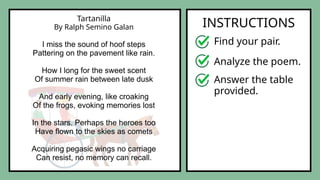
Tartanilla
By Ralph Semino Galan
I miss the sound of hoof steps
Pattering on the pavement like rain.
How I long for the sweet scent
Of summer rain between late dusk
And early evening, like croaking
Of the frogs, evoking memories lost
In the stars. Perhaps the heroes too
Have flown to the skies as comets
Acquiring pegasic wings no carriage
Can resist, no memory can recall.
INSTRUCTIONS
Find your pair.
Analyze the poem.
Answer the table
provided.
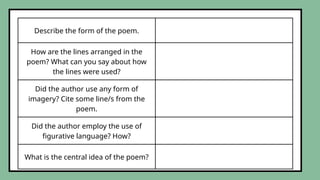
Describe the form of the poem.
How are the lines arranged in the
poem? What can you say about how
the lines were used?
Did the author use any form of
imagery? Cite some line/s from the
poem.
Did the author employ the use of
figurative language? How?
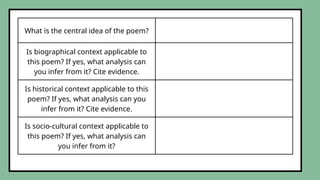
What is the central idea of the poem?
Is biographical context applicable to
this poem? If yes, what analysis can
you infer from it? Cite evidence.
Is historical context applicable to this
poem? If yes, what analysis can you
infer from it? Cite evidence.
Is socio-cultural context applicable to
this poem? If yes, what analysis can
you infer from it?
DAY
4
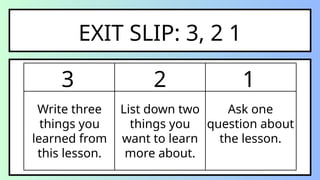
EXIT SLIP: 3, 2 1
3 2 1
Write three
things you
learned from
this lesson.
List down two
things you
want to learn
more about.
Ask one
question about
the lesson.
FORMATIVE
ASSESSMENT
INSTRUCTIONS
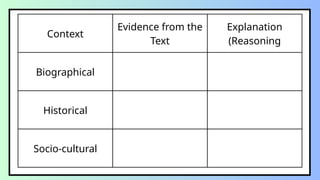
Examine the sections of the poem provided
and complete the table by sharing your
insights.
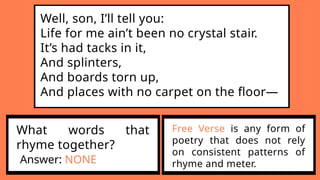
Discuss important themes from the poem
and connect them to your own local identity
or the broader Filipino identity.
Context
Evidence from the
Text
Explanation
(Reasoning
Biographical
Historical
Socio-cultural
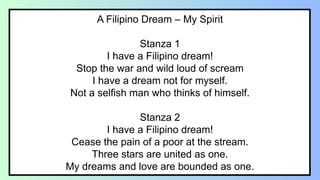
A Filipino Dream – My Spirit
Stanza 1
I have a Filipino dream!
Stop the war and wild loud of scream
I have a dream not for myself.
Not a selfish man who thinks of himself.
Stanza 2
I have a Filipino dream!
Cease the pain of a poor at the stream.
Three stars are united as one.
My dreams and love are bounded as one.
YOU DID A
GREAT JOB!

1. ENG 7-WEEK 2.pptxpoetry,figurative language

  • 1.
  • 2.
    OBJECTIVES: At the endof the lesson, you are expected to: Share specific thoughts or insights on Filipino values discussed in class.
  • 3.
    OBJECTIVES: At the endof the lesson, you are expected to: Share specific thoughts or insights on Filipino values discussed in class. Write a short prayer showing the elements of poetry.
  • 4.
    OBJECTIVES: At the endof the lesson, you are expected to: Analyze the given poem according to the assigned concept.
  • 5.
    At the endof the lesson, you are expected to: Analyze the given poem according to the assigned concept. Share their ideas and thoughts about significant concepts from the poem and relate it to your specific local identity or Filipino identity in general. OBJECTIVES:
  • 6.
  • 7.
    ACTIVITY 1: P.O.E.T.R.Y.: ACRONYMIC GAME Mechanics: Find a pair. To recall our previous lesson, think of words or phrases that start with initial letter and related to our topic POETRY.
  • 8.
    EXAMPLE Plot Opposition P .O . E . T. R . Y . E motion Tone Rhyme Yearning for a Song of Green
  • 9.
    YOUR TURN P .O . E . T. R . Y . START
  • 10.
    SHARING TIME P .O . E . T. R . Y .
  • 11.
    ACTIVITY 2: IMBIBEME Guide Questions: What do you see? Describe the image as best as you can. What Filipino values is shown in the image? Why do you think so?
  • 12.
    ACTIVITY 2: IMBIBEME Guide Questions: What do you usually pray for when you pray? How does prayer play a role in your life? What does it mean to you?
  • 13.
    Find a pair. ACTIVITY3: THINK, PAIR, AND SHARE Mechanics: Write a prayer using the elements of poetry. It can be either free verse or a rhyming poem as prayer. Share your work in the class.
  • 14.
    How did youfeel about writing a poem using the elements of poetry? Describe your experience. GUIDE QUESTIONS Do you think there is a connection between writing poetry and writing a prayer? Did you face any challenges while writing your prayer poem?
  • 15.
    ACTIVITY 4: GUESSTHE WORD Series of pictures will be shown, and its definition will serve as a clue. Within 60 seconds, guess the word. Instruction:
  • 16.
    Legendary bird thathas become a ubiquitous symbol of Maranao art. It is depicted as a fowl with colorful wings and feathered tail, holding a fish on its beak or talons. The head is profusely decorated with scroll, leaf, and spiral motifs. It is said to be a symbol of good fortune.
  • 17.
    SARIMANOK Legendary bird thathas become a ubiquitous symbol of Maranao art. It is depicted as a fowl with colorful wings and feathered tail, holding a fish on its beak or talons. The head is profusely decorated with scroll, leaf, and spiral motifs. It is said to be a symbol of good fortune.
  • 18.
    Is an iconof Philippine culture depicting the Filipino value of bayanihan, or the spirit of collective unity.
  • 19.
    NIPA HUT Is anicon of Philippine culture depicting the Filipino value of bayanihan, or the spirit of collective unity.
  • 20.
    A type ofhorse-drawn carriage or a traditional Filipino horse- drawn vehicle. It is commonly used as a mode of transportation in rural areas and small towns in the Philippines.
  • 21.
    TARTANILLA A type ofhorse-drawn carriage or a traditional Filipino horse- drawn vehicle. It is commonly used as a mode of transportation in rural areas and small towns in the Philippines.
  • 22.
    GUIDE QUESTIONS Based onthe images shown, how would you describe a Tartanilla? a Nipa hut? a Sarimanok? What are your thoughts on tartanilla as a vehicle? How does it compare to other modes of transportation?
  • 23.
    GUIDE QUESTIONS Do youthink tartanillas are still commonly used today? If so, where can they be found? What significance does the Nipa Hut hold in Filipino culture?
  • 24.
  • 25.
    Instructions: Be in yourgroup during the P.O.E.T.R.Y.: ACRONYMIC GAME. Draw a flower. Then, write “Poetry is a garden nourished by the soil of imagination and tended with the care of language’s artistry.” at the center circle.
  • 26.
    Instructions: Recall your answerin Activity 1: P.O.E.T.R.Y.: ACRONYMIC GAME and relate it to the sentence in the center. Write your answer in the petals of the flower. Share by reading aloud your answer to the class.
  • 27.
    PROCESSING QUESTIONS How didcreating the flower concept map help you better understand the concept of poetry? What did you learn about your own experiences with reading, writing, and understanding poetry while making the concept map?
  • 28.
  • 29.
  • 30.
    FORM Refers to howthe poem is put together, like its structure and design. how it rhymes how lines are grouped into stanzas how it looks like on a page
  • 31.
    FORM - RHYME Isthe repetition of sounds in the line of a poem. End Rhyme Internal Rhyme Exact Rhyme
  • 32.
    FORM - RHYME Isthe repetition of sounds in the line of a poem. End Rhyme Internal Rhyme Exact Rhyme Focus
  • 33.
    FORM - RHYME EndRhyme Internal Rhyme Exact Rhyme What is End Rhyme? Similar sound at the end of two or more lines. Is the repetition of sounds in the line of a poem.
  • 34.
    I shoot anarrow in the air, It fell to earth, I knew not where For, so swiftly it flow, the sight Could not follow in its flight. FORM - RHYME a a b b Can you give a word that rhyme? Example: tree – see way – day wood - stood Rhyme Scheme: a-a-b-b
  • 35.
    Sa aking buhayna ‘to Wala nang umiiba Ngunit sa pagdating mo Mundo ko ay nagiba Isang punong mataas Walang tinatakutan Siya ay may angking lakas Ngunit di masamahan a a b b c c d d What is the Rhyme Scheme of the poem? a-b-a-b-c-d-c-d Answer:
  • 36.
    Well, son, I’lltell you: Life for me ain’t been no crystal stair. It’s had tacks in it, And splinters, And boards torn up, And places with no carpet on the floor— What words that rhyme together? Answer: NONE Free Verse is any form of poetry that does not rely on consistent patterns of rhyme and meter.
  • 37.
    LINE The basic unitof poetry, often characterized by its: length rhythm Arrangement on the page I shoot an arrow in the air, It fell to earth, I knew not where For, so swiftly it flow, the sight Could not follow in its flight. Line 1 Line 2 Line 3 Line 4
  • 38.
    LINE I shoot anarrow in the air, It fell to earth, I knew not where For, so swiftly it flow, the sight Could not follow in its flight. Stanza A group of lines in a poem
  • 39.
    LINE couplet - 2lines tercet - 3 lines quatrain - 4 lines cinquain - 5 lines sestet - 6 lines septet - 7 lines octave - 8 lines
  • 40.
    EXAMPLE OF COUPLET Ioften wish I were a King, And then I could do anything. If only I were King of Spain, I'd take my hat off in the rain. If only I were King of France, I wouldn't brush my hair for aunts. I think, if I were King of Greece, I'd push things off the mantelpiece. How many lines per stanza does the poem have? Answer: 2 A poem with 2 lines per stanza is described as __ Answer: Couplet
  • 41.
    QUATRAIN I was oncesad and lonely, Having nobody to comfort me, So I wore a mask that always smiled, To hide my feelings behind a lie. Before long, I had many friends; With my mask, I was one of them. But deep inside I still felt empty, Like I was missing a part of me. Stanza 1 Stanza 2 How many stanzas does the poem have? Answer: 2 Stanzas
  • 42.
    QUATRAIN I was oncesad and lonely, Having nobody to comfort me, So I wore a mask that always smiled, To hide my feelings behind a lie. Before long, I had many friends; With my mask, I was one of them. But deep inside I still felt empty, Like I was missing a part of me. How many lines per stanza? 4 lines Line 1 Line 2 Line 3 Line 4 Line 1 Line 2 Line 3 Line 4 How many stanzas does the poem have? Answer: 2 Stanzas Answer:
  • 43.
    IMAGERY Descriptive language thatappeals to the senses, creating vivid mental pictures and sensory experiences for the reader. What are your five senses?
  • 44.
    IMAGERY This means thewriter chooses words that help you imagine how things : look sound smell taste touch
  • 45.
  • 46.
    EXAMPLE OF IMAGERY Thesilence was broken by the screech of tires and scraping of metal? WHAT TYPE OF IMAGERY WAS USED? Visual Imagery Auditory Imagery Olfactory Imagery Gustatory Imagery Tactile Imagery
  • 47.
    EXAMPLE OF IMAGERY WhenI bit the lemon, its citrus flavor shocked my tongue. Visual Imagery Auditory Imagery Olfactory Imagery Gustatory Imagery Tactile Imagery WHAT TYPE OF IMAGERY WAS USED?
  • 48.
    EXAMPLE OF IMAGERY Shewhiffed the aroma of freshly brewed coffee. Visual Imagery Auditory Imagery Olfactory Imagery Gustatory Imagery Tactile Imagery WHAT TYPE OF IMAGERY WAS USED?
  • 49.
    EXAMPLE OF IMAGERY Visual Imagery Auditory Imagery Olfactory Imagery Gustatory Imagery TactileImagery WHAT TYPE OF IMAGERY WAS USED? He gently comb the silky fur of this cat.
  • 50.
    EXAMPLE OF IMAGERY Ahost, of golden daffodils; Beside the lake, beneath the trees, Fluttering and dancing in the breeze. Visual Imagery Auditory Imagery Olfactory Imagery Gustatory Imagery Tactile Imagery WHAT TYPE OF IMAGERY WAS USED?
  • 51.
    SOUND DEVICES Techniques thatcreate auditory effects and enhance the musicality of the poem. rhyme alliteration assonance consonance onomatopoeia sound
  • 52.
    repetition of soundsat the end of the line. RHYME Two roads diverged in a yellow wood, And sorry I could not travel both And be one traveler, long I stood And looked down one as far as I could To where it bent in the undergrowth; Example 1: Road Not Taken - Robert Frost a a a b b What are the rhyming words? Rhyme Scheme a-b-a-a-b
  • 53.
    Invoked no longeris the Muse, The lyre is out of date; The poets it no longer use, And youth its inspiration now imbues With other form and state. Example 2: To My Muse - Jose Rizal What words that rhyme together? a a a b b How many lines the poem has? Poems with five lines per stanza are described as ________? cinquain What is the rhyme scheme? a-b-a-a-b
  • 54.
    repetition of initialconsonant sounds ALLITERATION THE CONSONANTS
  • 55.
    repetition of initialconsonant sounds ALLITERATION Peter Piper picked a peck of pickled peppers. Did Peter Piper pick a peck of pickled peppers? If Peter Piper picked a peck of pickled peppers, where's the peck of pickled peppers Peter Piper picked? Example 1: What initial consonant is repeated?
  • 56.
    repetition of initialconsonant sounds ALLITERATION Peter Piper picked a peck of pickled peppers. Did Peter Piper pick a peck of pickled peppers? If Peter Piper picked a peck of pickled peppers, where's the peck of pickled peppers Peter Piper picked? Example 1: What initial consonant is repeated?
  • 57.
    repetition of initialconsonant sounds ALLITERATION The fair breeze blow, the white foam flew, The furrow followed free; We were the first that ever burst Into that silent sea. Example 2: Rime of the Ancient Mariner - Samuel Taylor Coleridge What initial consonant is repeated?
  • 58.
    repetition of initialconsonant sounds ALLITERATION The fair breeze blow, the white foam flew, The furrow followed free; We were the first that ever burst Into that silent sea. Example 2: Rime of the Ancient Mariner - Samuel Taylor Coleridge What initial consonant is repeated?
  • 59.
    repetition of similarvowel sounds ASSONANCE THE VOWELS
  • 60.
    repetition of similarvowel sounds ASSONANCE Example 1: I wandered lonely as a cloud That floats on high o’er vales and hills, When all at once I saw a crowd, A host, of golden daffodils Beside the lake, beneath the trees, Fluttering and dancing in the breeze. What vowel sounds are repeated?
  • 61.
    repetition of similarvowel sounds ASSONANCE Example 1: I wandered lonely as a cloud That floats on high o’er vales and hills, When all at once I saw a crowd, A host, of golden daffodils Beside the lake, beneath the trees, Fluttering and dancing in the breeze. What vowel sounds are repeated?
  • 62.
    repetition of similarvowel sounds ASSONANCE Example 2: Little Boy Blue - Mother Goose Little boy blue, Come blow your horn, The sheep’s in the meadow, The cow’s in the corn What vowel sounds are repeated?
  • 63.
    repetition of similarvowel sounds ASSONANCE Example 2: Little Boy Blue - Mother Goose Little boy blue, Come blow your horn, The sheep’s in the meadow, The cow’s in the corn What vowel sounds are repeated?
  • 64.
    is the useof words that imitate the sounds associated with the objects or actions they refer to, such as hiss or murmur. ONOMATOPOEIA Example 1:
  • 65.
    The Thunderous Storm Crack!The thunder roars, rumbles and claps galore. Rain patters on the roof, A symphony of boom and woosh. ONOMATOPOEIA Example 2: What are the “sound” words?
  • 66.
    FIGURATIVE LANGAUGE Figurative languageadds depth, nuance, and emotion to poetry by going beyond literal meanings and inviting readers to interpret and experience the text in different ways Methaphor Similes Personification Hyperbole
  • 67.
    METAPHOR A figure ofspeech stating two things are similar The book was a passport to adventure. Books is like a passport because it travel you everywhere.
  • 68.
    White sheep, whitesheep, On a blue hill, When the wind stops, You all stand still. When the wind blows, You walk away slow. White sheep, white sheep, Where do you go? Simple poem which at first, appears to be about sheep but is about clouds. If you read it aloud to someone without referencing the title, it makes a fun riddle.
  • 69.
    SIMILES A figure ofspeech stating two things are similar by using “like” or “as”. Love is like war: easy to begin but very hard to stop. Love and War are different things. Yet, these become similar because of the same characteristic described: easy to start yet hard to stop. Love = War
  • 70.
    SIMILES A figure ofspeech stating two things are similar by using “like” or “as”. His eyes sparkled as brightly as a thousand stars on a clear night. Eyes are compared with stars shining in the night. Eyes = Stars
  • 71.
    PERSONIFICATION Have you seena whistling wind? In this example, the wind is given an ability of a human – ability to whistle. Does the wind whistle? Giving human characteristics to animal or object.
  • 72.
    PERSONIFICATION What human characteristics attributedto the sun in the poem? Mister Sun Mister Sun Wakes up at the dawn Puts his golden slippers on, climb the summer’s sky at noon Trading places with the moon. ABLE TO WAKE UP ABLE TO PUT ON SLIPPERS ABLE TO CLIMB ABLE TO TRADE
  • 73.
    HYPERBOLE Exaggeration is usedemphasis or effect I am hungry that I could eat a horse. When people say I could eat a horse meaning they are extremely hungry. Extremely hungry is exaggerated to “could eat a horse”
  • 74.
    HYPERBOLE Your love islike the sun That lights up my whole world I feel the warmth inside Your love is like the river That flows down through my veins I feel the chill inside
  • 75.
    THEME The central idea,message, or underlying meaning of a poem, often expressed through recurring images, symbols, or motifs. Love Death Nature War
  • 76.
    A family islike a circle. The connection never ends, and even if at times it breaks, in time it always mends. A family is like the stars. Somehow they're always there. Families are those who help, who support and always care. THEME What do you think is the theme of the poem?
  • 77.
    Poems often have biographical,historical, and socio-cultural contexts because these contexts greatly influence the themes, styles, and messages of the poems. CONTEXTS BIOGRAPHICAL CONTEXT HISTORICAL CONTEXT SOCIOCULTURAL CONTEXT
  • 78.
    Includes the lifeexperiences, background, beliefs, and personal history of the writer. CONTEXTS BIOGRAPHICAL CONTEXT HISTORICAL CONTEXT SOCIOCULTURAL CONTEXT Understanding the writer's biography can provide insights into the motivations, emotions, and perspectives behind their poems.
  • 79.
    This context mayinfluence the theme, subject, and style of the writer. CONTEXTS BIOGRAPHICAL CONTEXT HISTORICAL CONTEXT SOCIOCULTURAL CONTEXT Personal experiences often shape the themes and emotions explored in poetry, making biographical context crucial for understanding the writer's perspective and creative process.
  • 80.
    Refers to thetime period, events, social conditions, and cultural movements in which the poem was written. CONTEXTS BIOGRAPHICAL CONTEXT HISTORICAL CONTEXT SOCIOCULTURAL CONTEXT Examining historical context helps readers understand how societal changes, political events, or cultural shifts may have influenced the poet's perspective and message.
  • 81.
    Refers to thesocial, cultural, and ideological environment in which the poem is produced and received. CONTEXTS BIOGRAPHICAL CONTEXT HISTORICAL CONTEXT SOCIOCULTURAL CONTEXT Socio-cultural context includes factors such as societal norms, values, beliefs, traditions, and cultural identities.
  • 82.
  • 83.
    Filipino Heritage By FranciscoBalagtas Our heritage, a tapestry rich and grand, Woven with stories of our native land. From Luzon's mountains to Mindanao's shores, Filipino identity, forever soars. How would you describe the form and structure of the poem?
  • 84.
    Filipino Heritage By FranciscoBalagtas Our heritage, a tapestry rich and grand, Woven with stories of our native land. From Luzon's mountains to Mindanao's shores, Filipino identity, forever soars. What do you notice about the length and arrangement of the lines?
  • 85.
    Filipino Heritage By FranciscoBalagtas Our heritage, a tapestry rich and grand, Woven with stories of our native land. From Luzon's mountains to Mindanao's shores, Filipino identity, forever soars. Did the author use any imagery, sound devices (like rhyme or alliteration), or figurative language (like metaphors or similes)? Provide examples from the poem.
  • 86.
    Filipino Heritage By FranciscoBalagtas Our heritage, a tapestry rich and grand, Woven with stories of our native land. From Luzon's mountains to Mindanao's shores, Filipino identity, forever soars. What do you think is the main message or theme of the poem? How well did the author convey this theme through their choice of words?
  • 87.
    Filipino Heritage By FranciscoBalagtas Our heritage, a tapestry rich and grand, Woven with stories of our native land. From Luzon's mountains to Mindanao's shores, Filipino identity, forever soars. What can you tell about the background of the poem? Consider the author's life, the historical period, or the cultural setting when the poem was written.
  • 88.
  • 89.
    Tartanilla By Ralph SeminoGalan I miss the sound of hoof steps Pattering on the pavement like rain. How I long for the sweet scent Of summer rain between late dusk And early evening, like croaking Of the frogs, evoking memories lost In the stars. Perhaps the heroes too Have flown to the skies as comets Acquiring pegasic wings no carriage Can resist, no memory can recall. INSTRUCTIONS Find your pair. Analyze the poem. Answer the table provided.
  • 90.
    Describe the formof the poem. How are the lines arranged in the poem? What can you say about how the lines were used? Did the author use any form of imagery? Cite some line/s from the poem. Did the author employ the use of figurative language? How? What is the central idea of the poem?
  • 91.
    What is thecentral idea of the poem? Is biographical context applicable to this poem? If yes, what analysis can you infer from it? Cite evidence. Is historical context applicable to this poem? If yes, what analysis can you infer from it? Cite evidence. Is socio-cultural context applicable to this poem? If yes, what analysis can you infer from it?
  • 92.
  • 93.
    EXIT SLIP: 3,2 1 3 2 1 Write three things you learned from this lesson. List down two things you want to learn more about. Ask one question about the lesson.
  • 94.
  • 95.
    INSTRUCTIONS Examine the sectionsof the poem provided and complete the table by sharing your insights. Discuss important themes from the poem and connect them to your own local identity or the broader Filipino identity.

  • 96.
  • 97.
    A Filipino Dream– My Spirit Stanza 1 I have a Filipino dream! Stop the war and wild loud of scream I have a dream not for myself. Not a selfish man who thinks of himself. Stanza 2 I have a Filipino dream! Cease the pain of a poor at the stream. Three stars are united as one. My dreams and love are bounded as one.
  • 98.

Editor's Notes

  • #9 Instruction for Teachers: When all are set, click “START” to run the count down of the timer (5 minutes). After five minutes, timer will alarm and you can now proceed to “Sharing Activity”.