21st Century Literature from
the Philippines and the World
Compare and Contrast
Various 21st Century
Genres fromthe Earlier
Genres/ Periods
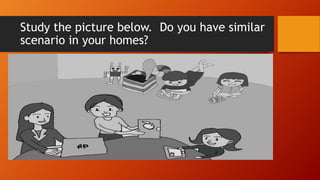
Study the picture below. Do you have similar
scenario in your homes?
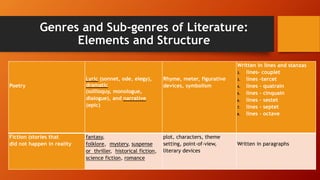
Genres and Sub-genres of Literature:
Elements and Structure
Poetry
Lyric (sonnet, ode, elegy),
dramatic
(soliloquy, monologue,
dialogue), and narrative
(epic)
Rhyme, meter, figurative
devices, symbolism
Written in lines and stanzas
2. lines- couplet
3. lines –tercet
4. lines – quatrain
5. lines - cinquain
6. lines – sestet
7. lines - septet
8. lines - octave
Fiction (stories that
did not happen in reality
fantasy,
folklore, mystery, suspense
or thriller, historical fiction,
science fiction, romance
plot, characters, theme
setting, point-of-view,
literary devices
Written in paragraphs
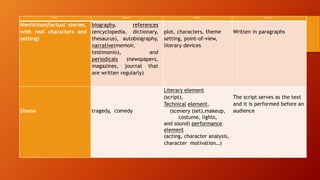
Genre Sub-genre Elements Structure
Nonfiction(factual stories,
with real characters and
setting)
biography, references
(encyclopedia, dictionary,
thesaurus), autobiography,
narrative(memoir,
testimonio), and
periodicals (newspapers,
magazines, journal that
are written regularly)
plot, characters, theme
setting, point-of-view,
literary devices
Written in paragraphs
Drama tragedy, comedy
Literary element
(script),
Technical element,
(scenery (set),makeup,
costume, lights,
and sound) performance
element
(acting, character analysis,
character motivation…)
The script serves as the text
and it is performed before an
audience
POETRY
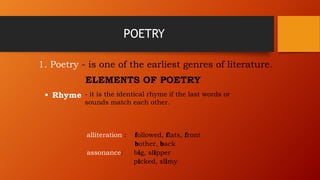
1. Poetry - is one of the earliest genres of literature.
ELEMENTS OF POETRY
 Rhyme - it is the identical rhyme if the last words or
sounds match each other.
alliteration : followed, flats, front
bother, back
assonance: big, slipper
picked, slimy
ELEMENTS OF POETRY
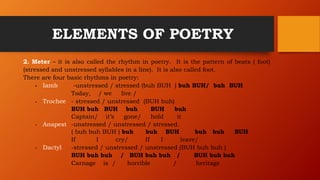
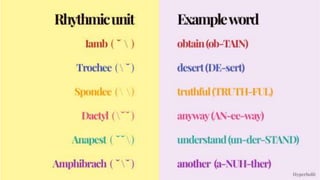
2. Meter – it is also called the rhythm in poetry. It is the pattern of beats ( foot)
(stressed and unstressed syllables in a line). It is also called foot.
There are four basic rhythms in poetry:
 Iamb -unstressed / stressed (buh BUH ) buh BUH/ buh BUH
Today, / we live /
• Trochee - stressed / unstressed (BUH buh)
BUH buh BUH buh BUH buh
Captain/ it’s gone/ hold it
• Anapest -unstressed / unstressed / stressed.
( buh buh BUH ) buh buh BUH buh buh BUH
If I cry/ If I leave/
• Dactyl -stressed / unstressed / unstressed (BUH buh buh )
BUH buh buh / BUH buh buh / BUH buh buh
Carnage is / horrible / heritage
ELEMENTS OF POETRY
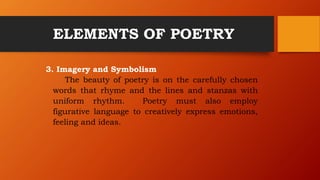
3. Imagery and Symbolism
The beauty of poetry is on the carefully chosen
words that rhyme and the lines and stanzas with
uniform rhythm. Poetry must also employ
figurative language to creatively express emotions,
feeling and ideas.
ELEMENTS OF POETRY
Here are the commonly used literary devices in poetry:
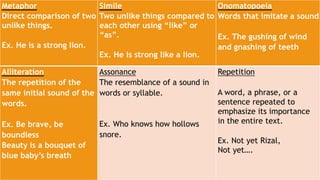
Metaphor
Direct comparison of two
unlike things.
Ex. He is a strong lion.
Simile
Two unlike things compared to
each other using “like” or
“as”.
Ex. He is strong like a lion.
Onomatopoeia
Words that imitate a sound
Ex. The gushing of wind
and gnashing of teeth
Alliteration
The repetition of the
same initial sound of the
words.
Ex. Be brave, be
boundless
Beauty is a bouquet of
blue baby’s breath
Assonance
The resemblance of a sound in
words or syllable.
Ex. Who knows how hollows
snore.
Repetition
A word, a phrase, or a
sentence repeated to
emphasize its importance
in the entire text.
Ex. Not yet Rizal,
Not yet….
Here are the commonly used literary devices in poetry:
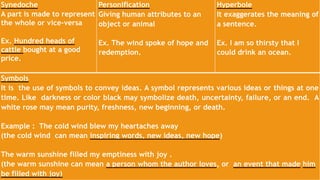
Synedoche
A part is made to represent
the whole or vice-versa
Ex. Hundred heads of
cattle bought at a good
price.
Personification
Giving human attributes to an
object or animal
Ex. The wind spoke of hope and
redemption.
Hyperbole
It exaggerates the meaning of
a sentence.
Ex. I am so thirsty that I
could drink an ocean.
Symbols
It is the use of symbols to convey ideas. A symbol represents various ideas or things at one
time. Like darkness or color black may symbolize death, uncertainty, failure, or an end. A
white rose may mean purity, freshness, new beginning, or death.
Example : The cold wind blew my heartaches away
(the cold wind can mean inspiring words, new ideas, new hope)
The warm sunshine filled my emptiness with joy .
(the warm sunshine can mean a person whom the author loves, or an event that made him
be filled with joy)
Couplet - 2 lines
Tercet - 3 lines
Quatrain - 4 lines
Cinquain - 5 lines
Sestet - 6 lines
Septet - 7 lines
Octave - 8 lines
To appreciate and write a good poem, it is also essential to know its
structure. Poems are written in lines that comprise a stanza. Thus,
each type of poem differs from each other because of its structure
To identify a poem’s structure is to
count the lines of every stanza:
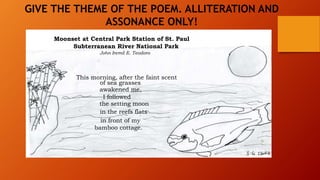
Moonset at Central Park Station of St. Paul
Subterranean River National Park
John Iremil E. Teodoro
This morning, after the faint scent
of sea grasses
awakened me,
I followed
the setting moon
in the reefs flats
in front of my
bamboo cottage.
GIVE THE THEME OF THE POEM. ALLITERATION AND
ASSONANCE ONLY!
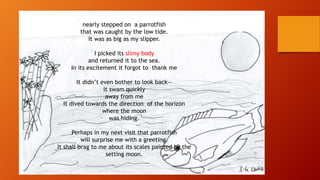
nearly stepped on a parrotfish
that was caught by the low tide.
It was as big as my slipper.
I picked its slimy body
and returned it to the sea.
In its excitement it forgot to thank me
It didn’t even bother to look back—
it swam quickly
away from me
It dived towards the direction of the horizon
where the moon
was hiding.
Perhaps in my next visit that parrotfish
will surprise me with a greeting.
It shall brag to me about its scales painted by the
setting moon.
Fiction
Fiction is a story of make believe. It is a story
made by the author’s creative imagination. It
has various sub-genres like mystery, fantasy,
suspense, historical fiction science fiction,
realistic fiction and folklore (myths, fables,
legends).
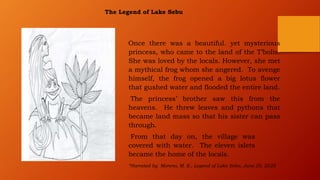
The Legend of Lake Sebu
Once there was a beautiful. yet mysterious
princess, who came to the land of the T’bolis.
She was loved by the locals. However, she met
a mythical frog whom she angered. To avenge
himself, the frog opened a big lotus flower
that gushed water and flooded the entire land.
The princess’ brother saw this from the
heavens. He threw leaves and pythons that
became land mass so that his sister can pass
through.
From that day on, the village was
covered with water. The eleven islets
became the home of the locals.
*Narrated by Moreno, M. E., Legend of Lake Sebu, June 20, 2020

WK-2-21ST Century.pptx

  • 1.
    21st Century Literaturefrom the Philippines and the World Compare and Contrast Various 21st Century Genres fromthe Earlier Genres/ Periods
  • 2.
    Study the picturebelow. Do you have similar scenario in your homes?
  • 3.
    Genres and Sub-genresof Literature: Elements and Structure Poetry Lyric (sonnet, ode, elegy), dramatic (soliloquy, monologue, dialogue), and narrative (epic) Rhyme, meter, figurative devices, symbolism Written in lines and stanzas 2. lines- couplet 3. lines –tercet 4. lines – quatrain 5. lines - cinquain 6. lines – sestet 7. lines - septet 8. lines - octave Fiction (stories that did not happen in reality fantasy, folklore, mystery, suspense or thriller, historical fiction, science fiction, romance plot, characters, theme setting, point-of-view, literary devices Written in paragraphs
  • 4.
    Genre Sub-genre ElementsStructure Nonfiction(factual stories, with real characters and setting) biography, references (encyclopedia, dictionary, thesaurus), autobiography, narrative(memoir, testimonio), and periodicals (newspapers, magazines, journal that are written regularly) plot, characters, theme setting, point-of-view, literary devices Written in paragraphs Drama tragedy, comedy Literary element (script), Technical element, (scenery (set),makeup, costume, lights, and sound) performance element (acting, character analysis, character motivation…) The script serves as the text and it is performed before an audience
  • 5.
    POETRY 1. Poetry -is one of the earliest genres of literature. ELEMENTS OF POETRY  Rhyme - it is the identical rhyme if the last words or sounds match each other. alliteration : followed, flats, front bother, back assonance: big, slipper picked, slimy
  • 6.
    ELEMENTS OF POETRY 2.Meter – it is also called the rhythm in poetry. It is the pattern of beats ( foot) (stressed and unstressed syllables in a line). It is also called foot. There are four basic rhythms in poetry:  Iamb -unstressed / stressed (buh BUH ) buh BUH/ buh BUH Today, / we live / • Trochee - stressed / unstressed (BUH buh) BUH buh BUH buh BUH buh Captain/ it’s gone/ hold it • Anapest -unstressed / unstressed / stressed. ( buh buh BUH ) buh buh BUH buh buh BUH If I cry/ If I leave/ • Dactyl -stressed / unstressed / unstressed (BUH buh buh ) BUH buh buh / BUH buh buh / BUH buh buh Carnage is / horrible / heritage
  • 7.
  • 8.
    3. Imagery andSymbolism The beauty of poetry is on the carefully chosen words that rhyme and the lines and stanzas with uniform rhythm. Poetry must also employ figurative language to creatively express emotions, feeling and ideas. ELEMENTS OF POETRY
  • 9.
    Here are thecommonly used literary devices in poetry: Metaphor Direct comparison of two unlike things. Ex. He is a strong lion. Simile Two unlike things compared to each other using “like” or “as”. Ex. He is strong like a lion. Onomatopoeia Words that imitate a sound Ex. The gushing of wind and gnashing of teeth Alliteration The repetition of the same initial sound of the words. Ex. Be brave, be boundless Beauty is a bouquet of blue baby’s breath Assonance The resemblance of a sound in words or syllable. Ex. Who knows how hollows snore. Repetition A word, a phrase, or a sentence repeated to emphasize its importance in the entire text. Ex. Not yet Rizal, Not yet….
  • 10.
    Here are thecommonly used literary devices in poetry: Synedoche A part is made to represent the whole or vice-versa Ex. Hundred heads of cattle bought at a good price. Personification Giving human attributes to an object or animal Ex. The wind spoke of hope and redemption. Hyperbole It exaggerates the meaning of a sentence. Ex. I am so thirsty that I could drink an ocean. Symbols It is the use of symbols to convey ideas. A symbol represents various ideas or things at one time. Like darkness or color black may symbolize death, uncertainty, failure, or an end. A white rose may mean purity, freshness, new beginning, or death. Example : The cold wind blew my heartaches away (the cold wind can mean inspiring words, new ideas, new hope) The warm sunshine filled my emptiness with joy . (the warm sunshine can mean a person whom the author loves, or an event that made him be filled with joy)
  • 11.
    Couplet - 2lines Tercet - 3 lines Quatrain - 4 lines Cinquain - 5 lines Sestet - 6 lines Septet - 7 lines Octave - 8 lines To appreciate and write a good poem, it is also essential to know its structure. Poems are written in lines that comprise a stanza. Thus, each type of poem differs from each other because of its structure To identify a poem’s structure is to count the lines of every stanza:
  • 12.
    Moonset at CentralPark Station of St. Paul Subterranean River National Park John Iremil E. Teodoro This morning, after the faint scent of sea grasses awakened me, I followed the setting moon in the reefs flats in front of my bamboo cottage. GIVE THE THEME OF THE POEM. ALLITERATION AND ASSONANCE ONLY!
  • 13.
    nearly stepped ona parrotfish that was caught by the low tide. It was as big as my slipper. I picked its slimy body and returned it to the sea. In its excitement it forgot to thank me It didn’t even bother to look back— it swam quickly away from me It dived towards the direction of the horizon where the moon was hiding. Perhaps in my next visit that parrotfish will surprise me with a greeting. It shall brag to me about its scales painted by the setting moon.
  • 14.
    Fiction Fiction is astory of make believe. It is a story made by the author’s creative imagination. It has various sub-genres like mystery, fantasy, suspense, historical fiction science fiction, realistic fiction and folklore (myths, fables, legends).
  • 15.
    The Legend ofLake Sebu Once there was a beautiful. yet mysterious princess, who came to the land of the T’bolis. She was loved by the locals. However, she met a mythical frog whom she angered. To avenge himself, the frog opened a big lotus flower that gushed water and flooded the entire land. The princess’ brother saw this from the heavens. He threw leaves and pythons that became land mass so that his sister can pass through. From that day on, the village was covered with water. The eleven islets became the home of the locals. *Narrated by Moreno, M. E., Legend of Lake Sebu, June 20, 2020

Editor's Notes

  • #10 Here are the commonly used literary devices in poetry:
  • #14 The given poem is free-verse and unmetered. It has no rhythm but it uses alliteration, assonance, repetition, and symbolism. alliteration : followed, flats, front bother, back dived, direction horizon, hiding perhaps, parrotfish assonance: big, slipper picked, slimy body, forgot, to symbols: moon - dreams to be fulfilled, fulfilled dreams, inspiration horizon - a place to find or to keep your dreams, a place which promises good fortune or good life parrotfish - a gay/ LGBTQ member because of its color an ungrateful person someone passive someone who has a very colourful life an experienced person a person who picks up someone else’s trash words/ lines used repeatedly: - sea, moon, parrotfish
  • #15 To understand fiction and to write a good fictional story, you must be able to identify and understand its elements that comprise the texts’ contents and message the story wanted to impart to its readers. Now, you will read a legend that tells how a great lake was formed. It was retold by one of the writer’s former senior high school student who lived a in village near Lake Sebu.