CURRENT ELECTRICITY
SS TWO
WEEK EIGHT AND NINE
Electric Current
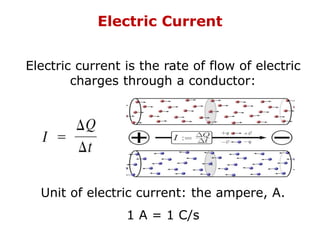
Electric current is the rate of flow of electric
charges through a conductor:
Unit of electric current: the ampere, A.
1 A = 1 C/s
Electric Current
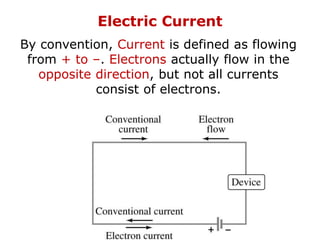
By convention, Current is defined as flowing
from + to –. Electrons actually flow in the
opposite direction, but not all currents
consist of electrons.
Production of Electric Current
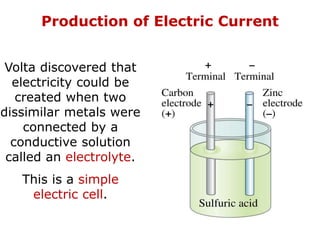
Volta discovered that
electricity could be
created when two
dissimilar metals were
connected by a
conductive solution
called an electrolyte.
This is a simple
electric cell.
Electrochemical Cells
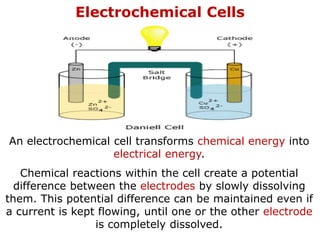
An electrochemical cell transforms chemical energy into
electrical energy.
Chemical reactions within the cell create a potential
difference between the electrodes by slowly dissolving
them. This potential difference can be maintained even if
a current is kept flowing, until one or the other electrode
is completely dissolved.
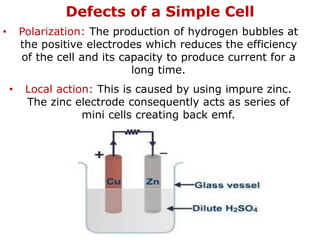
Defects of a Simple Cell
• Polarization: The production of hydrogen bubbles at
the positive electrodes which reduces the efficiency
of the cell and its capacity to produce current for a
long time.
• Local action: This is caused by using impure zinc.
The zinc electrode consequently acts as series of
mini cells creating back emf.
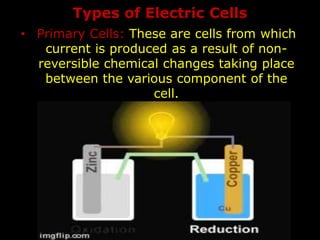
Types of Electric Cells
• Primary Cells: These are cells from which
current is produced as a result of non-
reversible chemical changes taking place
between the various component of the
cell.
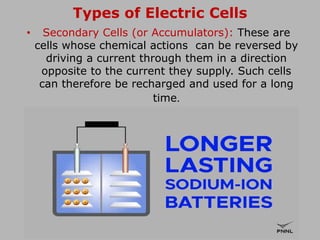
Types of Electric Cells
• Secondary Cells (or Accumulators): These are
cells whose chemical actions can be reversed by
driving a current through them in a direction
opposite to the current they supply. Such cells
can therefore be recharged and used for a long
time.
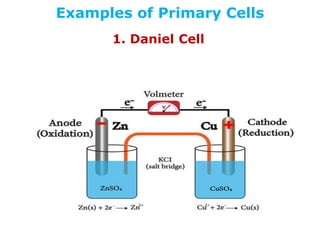
Examples of Primary Cells
1. Daniel Cell
Examples of Primary Cells
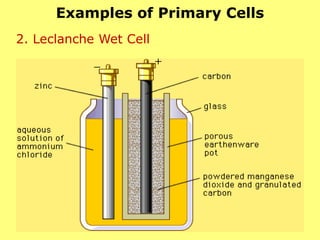
2. Leclanche Wet Cell
Examples of Primary Cells
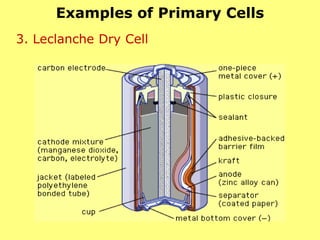
3. Leclanche Dry Cell
Examples of Secondary Cells
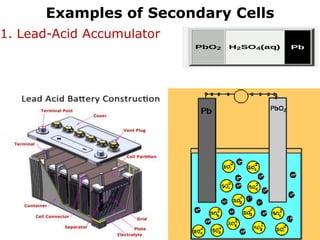
1. Lead-Acid Accumulator
Examples of Secondary Cells
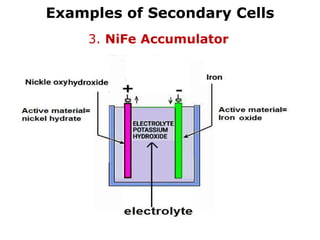
3. NiFe Accumulator
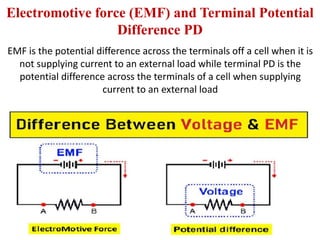
Electromotive force (EMF) and Terminal Potential
Difference PD
EMF is the potential difference across the terminals off a cell when it is
not supplying current to an external load while terminal PD is the
potential difference across the terminals of a cell when supplying
current to an external load
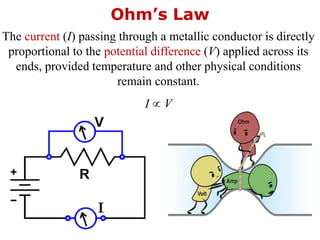
Ohm’s Law
The current (I) passing through a metallic conductor is directly
proportional to the potential difference (V) applied across its
ends, provided temperature and other physical conditions
remain constant.
I  V
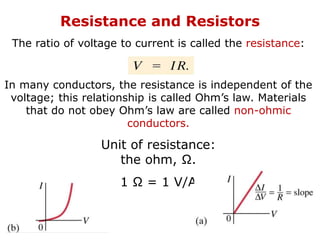
Resistance and Resistors
The ratio of voltage to current is called the resistance:
In many conductors, the resistance is independent of the
voltage; this relationship is called Ohm’s law. Materials
that do not obey Ohm’s law are called non-ohmic
conductors.
Unit of resistance:
the ohm, Ω.
1 Ω = 1 V/A
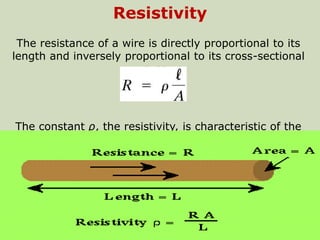
Resistivity
The resistance of a wire is directly proportional to its
length and inversely proportional to its cross-sectional
area:
The constant ρ, the resistivity, is characteristic of the
material.
Resistivity
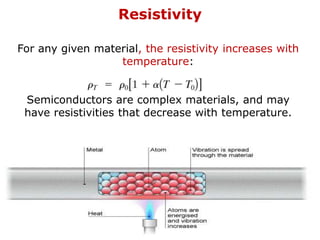
For any given material, the resistivity increases with
temperature:
Semiconductors are complex materials, and may
have resistivities that decrease with temperature.
EVALUATION
A wire of diameter 2 x 10⁻³cm is used to make a
resistor of resistance 3Ω. Determine the length of the
wire used if the resistivity of the material is 2 x
10−6Ωcm
Arrangement of Resistors
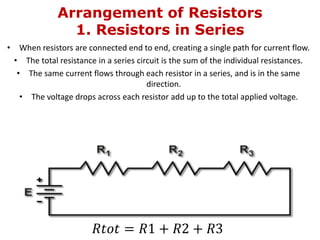
1. Resistors in Series
• When resistors are connected end to end, creating a single path for current flow.
• The total resistance in a series circuit is the sum of the individual resistances.
• The same current flows through each resistor in a series, and is in the same
direction.
• The voltage drops across each resistor add up to the total applied voltage.
𝑅𝑡𝑜𝑡 = 𝑅1 + 𝑅2 + 𝑅3
Arrangement of Resistors
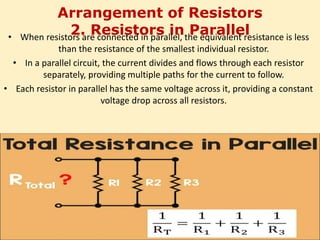
2. Resistors in Parallel
• When resistors are connected in parallel, the equivalent resistance is less
than the resistance of the smallest individual resistor.
• In a parallel circuit, the current divides and flows through each resistor
separately, providing multiple paths for the current to follow.
• Each resistor in parallel has the same voltage across it, providing a constant
voltage drop across all resistors.
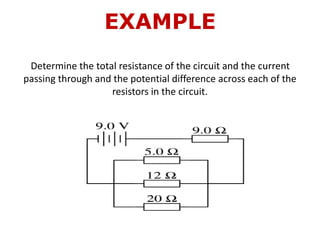
EXAMPLE
Determine the total resistance of the circuit and the current
passing through and the potential difference across each of the
resistors in the circuit.
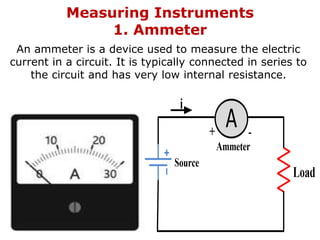
Measuring Instruments
1. Ammeter
An ammeter is a device used to measure the electric
current in a circuit. It is typically connected in series to
the circuit and has very low internal resistance.
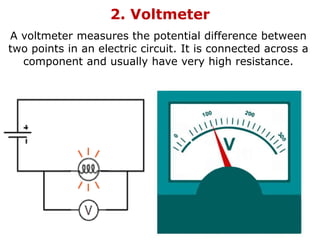
2. Voltmeter
A voltmeter measures the potential difference between
two points in an electric circuit. It is connected across a
component and usually have very high resistance.
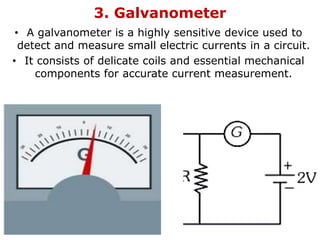
3. Galvanometer
• A galvanometer is a highly sensitive device used to
detect and measure small electric currents in a circuit.
• It consists of delicate coils and essential mechanical
components for accurate current measurement.
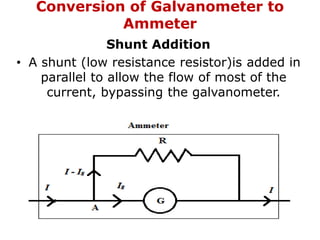
Conversion of Galvanometer to
Ammeter
Shunt Addition
• A shunt (low resistance resistor)is added in
parallel to allow the flow of most of the
current, bypassing the galvanometer.
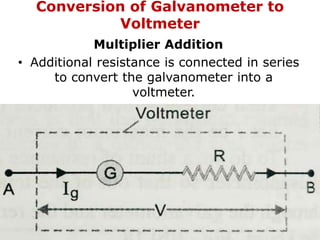
Conversion of Galvanometer to
Voltmeter
Multiplier Addition
• Additional resistance is connected in series
to convert the galvanometer into a
voltmeter.
EXAMPLE
Explain the conversion of a galvanometer of resistance 50Ω and
maximum deflection of 20 mA to a.) a voltmeter capable of
measuring 2 V b.) an ammeter measuring up to 2 A.
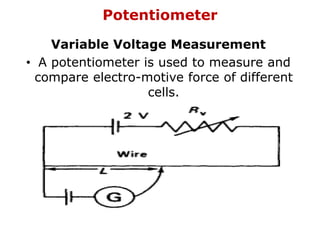
Potentiometer
Variable Voltage Measurement
• A potentiometer is used to measure and
compare electro-motive force of different
cells.
EXAMPLE
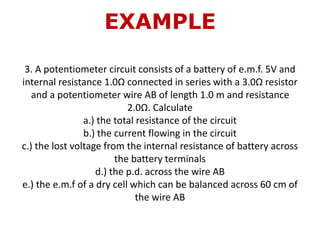
3. A potentiometer circuit consists of a battery of e.m.f. 5V and
internal resistance 1.0Ω connected in series with a 3.0Ω resistor
and a potentiometer wire AB of length 1.0 m and resistance
2.0Ω. Calculate
a.) the total resistance of the circuit
b.) the current flowing in the circuit
c.) the lost voltage from the internal resistance of battery across
the battery terminals
d.) the p.d. across the wire AB
e.) the e.m.f of a dry cell which can be balanced across 60 cm of
the wire AB
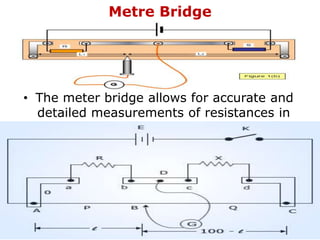
Metre Bridge
• The meter bridge allows for accurate and
detailed measurements of resistances in
electrical circuits.
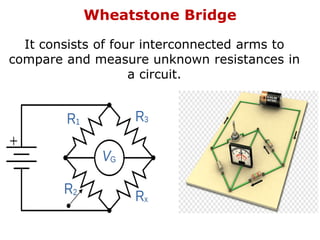
Wheatstone Bridge
It consists of four interconnected arms to
compare and measure unknown resistances in
a circuit.
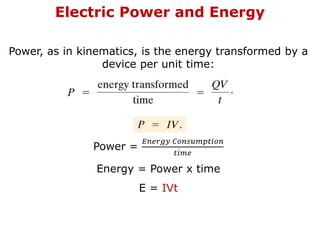
Electric Power and Energy
Power, as in kinematics, is the energy transformed by a
device per unit time:
Power =
𝐸𝑛𝑒𝑟𝑔𝑦 𝐶𝑜𝑛𝑠𝑢𝑚𝑝𝑡𝑖𝑜𝑛
𝑡𝑖𝑚𝑒
Energy = Power x time
E = IVt

Physics CECurrent Eletricity - Copy.pptx

  • 1.
  • 2.
    Electric Current Electric currentis the rate of flow of electric charges through a conductor: Unit of electric current: the ampere, A. 1 A = 1 C/s
  • 3.
    Electric Current By convention,Current is defined as flowing from + to –. Electrons actually flow in the opposite direction, but not all currents consist of electrons.
  • 4.
    Production of ElectricCurrent Volta discovered that electricity could be created when two dissimilar metals were connected by a conductive solution called an electrolyte. This is a simple electric cell.
  • 5.
    Electrochemical Cells An electrochemicalcell transforms chemical energy into electrical energy. Chemical reactions within the cell create a potential difference between the electrodes by slowly dissolving them. This potential difference can be maintained even if a current is kept flowing, until one or the other electrode is completely dissolved.
  • 6.
    Defects of aSimple Cell • Polarization: The production of hydrogen bubbles at the positive electrodes which reduces the efficiency of the cell and its capacity to produce current for a long time. • Local action: This is caused by using impure zinc. The zinc electrode consequently acts as series of mini cells creating back emf.
  • 7.
    Types of ElectricCells • Primary Cells: These are cells from which current is produced as a result of non- reversible chemical changes taking place between the various component of the cell.
  • 8.
    Types of ElectricCells • Secondary Cells (or Accumulators): These are cells whose chemical actions can be reversed by driving a current through them in a direction opposite to the current they supply. Such cells can therefore be recharged and used for a long time.
  • 9.
    Examples of PrimaryCells 1. Daniel Cell
  • 10.
    Examples of PrimaryCells 2. Leclanche Wet Cell
  • 11.
    Examples of PrimaryCells 3. Leclanche Dry Cell
  • 12.
    Examples of SecondaryCells 1. Lead-Acid Accumulator
  • 13.
    Examples of SecondaryCells 3. NiFe Accumulator
  • 14.
    Electromotive force (EMF)and Terminal Potential Difference PD EMF is the potential difference across the terminals off a cell when it is not supplying current to an external load while terminal PD is the potential difference across the terminals of a cell when supplying current to an external load
  • 15.
    Ohm’s Law The current(I) passing through a metallic conductor is directly proportional to the potential difference (V) applied across its ends, provided temperature and other physical conditions remain constant. I  V
  • 16.
    Resistance and Resistors Theratio of voltage to current is called the resistance: In many conductors, the resistance is independent of the voltage; this relationship is called Ohm’s law. Materials that do not obey Ohm’s law are called non-ohmic conductors. Unit of resistance: the ohm, Ω. 1 Ω = 1 V/A
  • 17.
    Resistivity The resistance ofa wire is directly proportional to its length and inversely proportional to its cross-sectional area: The constant ρ, the resistivity, is characteristic of the material.
  • 18.
    Resistivity For any givenmaterial, the resistivity increases with temperature: Semiconductors are complex materials, and may have resistivities that decrease with temperature.
  • 19.
    EVALUATION A wire ofdiameter 2 x 10⁻³cm is used to make a resistor of resistance 3Ω. Determine the length of the wire used if the resistivity of the material is 2 x 10⁻⁶Ωcm
  • 20.
    Arrangement of Resistors 1.Resistors in Series • When resistors are connected end to end, creating a single path for current flow. • The total resistance in a series circuit is the sum of the individual resistances. • The same current flows through each resistor in a series, and is in the same direction. • The voltage drops across each resistor add up to the total applied voltage. 𝑅𝑡𝑜𝑡 = 𝑅1 + 𝑅2 + 𝑅3
  • 21.
    Arrangement of Resistors 2.Resistors in Parallel • When resistors are connected in parallel, the equivalent resistance is less than the resistance of the smallest individual resistor. • In a parallel circuit, the current divides and flows through each resistor separately, providing multiple paths for the current to follow. • Each resistor in parallel has the same voltage across it, providing a constant voltage drop across all resistors.
  • 22.
    EXAMPLE Determine the totalresistance of the circuit and the current passing through and the potential difference across each of the resistors in the circuit.
  • 23.
    Measuring Instruments 1. Ammeter Anammeter is a device used to measure the electric current in a circuit. It is typically connected in series to the circuit and has very low internal resistance.
  • 24.
    2. Voltmeter A voltmetermeasures the potential difference between two points in an electric circuit. It is connected across a component and usually have very high resistance.
  • 25.
    3. Galvanometer • Agalvanometer is a highly sensitive device used to detect and measure small electric currents in a circuit. • It consists of delicate coils and essential mechanical components for accurate current measurement.
  • 26.
    Conversion of Galvanometerto Ammeter Shunt Addition • A shunt (low resistance resistor)is added in parallel to allow the flow of most of the current, bypassing the galvanometer.
  • 27.
    Conversion of Galvanometerto Voltmeter Multiplier Addition • Additional resistance is connected in series to convert the galvanometer into a voltmeter.
  • 28.
    EXAMPLE Explain the conversionof a galvanometer of resistance 50Ω and maximum deflection of 20 mA to a.) a voltmeter capable of measuring 2 V b.) an ammeter measuring up to 2 A.
  • 29.
    Potentiometer Variable Voltage Measurement •A potentiometer is used to measure and compare electro-motive force of different cells.
  • 30.
    EXAMPLE 3. A potentiometercircuit consists of a battery of e.m.f. 5V and internal resistance 1.0Ω connected in series with a 3.0Ω resistor and a potentiometer wire AB of length 1.0 m and resistance 2.0Ω. Calculate a.) the total resistance of the circuit b.) the current flowing in the circuit c.) the lost voltage from the internal resistance of battery across the battery terminals d.) the p.d. across the wire AB e.) the e.m.f of a dry cell which can be balanced across 60 cm of the wire AB
  • 31.
    Metre Bridge • Themeter bridge allows for accurate and detailed measurements of resistances in electrical circuits.
  • 32.
    Wheatstone Bridge It consistsof four interconnected arms to compare and measure unknown resistances in a circuit.
  • 33.
    Electric Power andEnergy Power, as in kinematics, is the energy transformed by a device per unit time: Power = 𝐸𝑛𝑒𝑟𝑔𝑦 𝐶𝑜𝑛𝑠𝑢𝑚𝑝𝑡𝑖𝑜𝑛 𝑡𝑖𝑚𝑒 Energy = Power x time E = IVt