Cryptography (1)
• Cryptographyis the science of secret writing.
• Cryptanalysis is the science of analyzing and breaking
ciphers.
• Cryptology encompasses both subjects.
• Historically domain of spies and secret agents.
• Now considered to be a mathematical discipline.
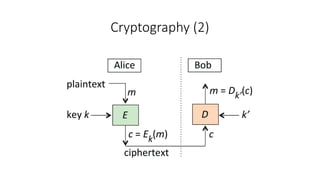
• In modern data communications, Cryptography gives
the means to construct a secure logical channel over an
insecure physical connection.
Cryptography (3)
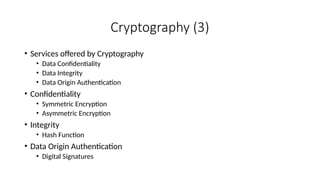
• Servicesoffered by Cryptography
• Data Confidentiality
• Data Integrity
• Data Origin Authentication
• Confidentiality
• Symmetric Encryption
• Asymmetric Encryption
• Integrity
• Hash Function
• Data Origin Authentication
• Digital Signatures
5.
Attacks on Cryptography
•Cryptanalysis: Attack on cryptography based on knowledge of
implementation of cryptographic algorithm or some plaintext-
ciphertext pairs.
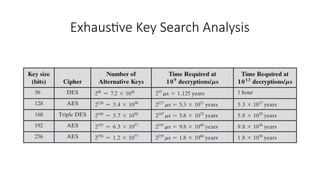
• Brute-force Attack: is to try every possible key on a piece of
ciphertext until an intelligible translation into plaintext is obtained.
Practical Security Issues
•Every Encryption Algorithm is prone to Brute Force Attack –
Computationally Secure Algorithm is required.
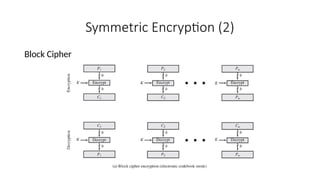
• Plaintext sources must be broken up into a series of fixed-length block
- Electronic Codebook (ECB) mode.
• If the last plaintext block has fewer bits than the blocklength, it is
padded with “filler” characters.
12.
Stream Cipher
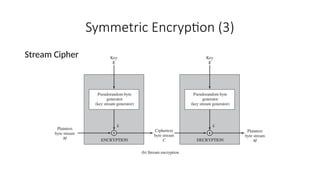
• Processesthe input elements continuously, producing output one element at a time.
• May be designed to operate on one bit at a time or on units larger than a byte at a
time.
• A key is input to a pseudorandom bit generator that produces a stream of 8-bit
numbers that are apparently random.
• A pseudorandom stream is one that is unpredictable without knowledge of the input
key and which has an apparently random character.
• The output of the generator, called a keystream, is combined one byte at a time with
the plaintext stream using the bitwise exclusive OR (XOR) operation.
• A stream cipher can be as secure as a block cipher of comparable key length.
• Advantage of a stream cipher is that stream ciphers are almost always faster and use
far less code than do block ciphers.
13.
Review
• How iscryptanalysis different from brute-force attack?
• What is the difference between block cipher encryption and stream
encryption?
• What are the two principal requirements for the secure use of
symmetric encryption?