The Influence Engine:

A rookie’s guide to
network science

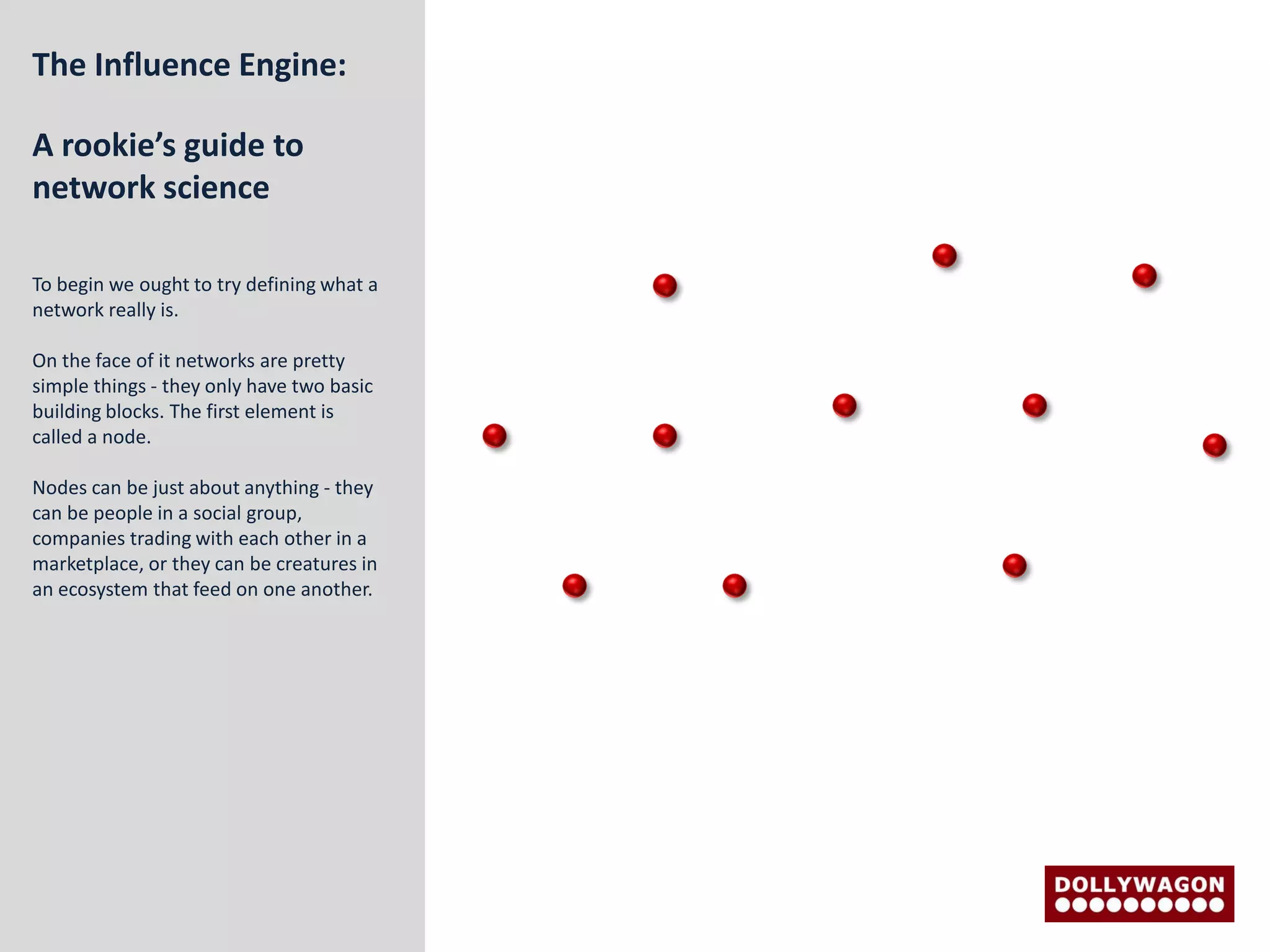
To begin we ought to try defining what a
network really is.

On the face of it networks are pretty
simple things - they only have two basic
building blocks. The first element is
called a node.

Nodes can be just about anything - they
can be people in a social group,
companies trading with each other in a
marketplace, or they can be creatures in
an ecosystem that feed on one another.
The Influence Engine:

A rookie’s introduction
to network science

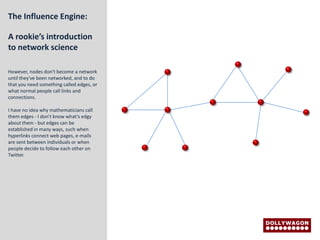
However, nodes don't become a network
until they've been networked, and to do
that you need something called edges, or
what normal people call links and
connections.

I have no idea why mathematicians call
them edges - I don't know what's edgy
about them - but edges can be
established in many ways, such when
hyperlinks connect web pages, e-mails
are sent between individuals or when
people decide to follow each other on
Twitter.
The Influence Engine:

A rookie’s introduction
to network science

This kind of information is very different
to what people in media are generally
familiar with. For instance, imagine a
young female aged 15 to 24, who lives in
London, is a heavy commercial TV viewer
and likes to shop at H+M.

This kind of demographic profile, media
usage and brand consumption data is
very familiar to anyone who works in
advertising. It's a great example of ‘drop-
down' data, which means any kind of
data specific to an individual person or
'node'.

But knowing these facts about a person
tells us absolutely nothing about this
girl's relationship with her friends and
how they influence her choice of mobile
phone or sense of personal style. This is
precisely where network analysis comes
into the picture.
The Influence Engine:

A rookie’s introduction
to network science

Network science doesn't study the drop-
down data associated with specific
people or nodes (although it does make
good use of such data), but instead
analyses the pattern of relationships that
exist between people throughout a
social network.

This pattern of relationships, or edges,
are collectively known as the 'topology'
of a network and this is what network
scientists study.

But why is topological data useful?

The answer is very simple - influence can
actually be a mathematically defined
property that emerges naturally from the
pattern of connections we have with our
friends, family and acquaintances.
The Influence Engine:

A rookie’s introduction
to network science

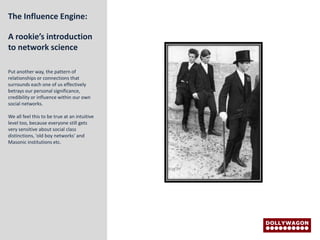
Put another way, the pattern of
relationships or connections that
surrounds each one of us effectively
betrays our personal significance,
credibility or influence within our own
social networks.

We all feel this to be true at an intuitive
level too, because everyone still gets
very sensitive about social class
distinctions, 'old boy networks' and
Masonic institutions etc.
The Influence Engine:

A rookie’s introduction
to network science

Until recently we never had the
capability to analyse the blizzard of
interactions on which social relationships
are built.

But the burgeoning field of network
science has brought together key
scientific concepts, mathematical
techniques and computational
horsepower to unravel the complex
interactions within social networks and
figure out who is influencing who.

This is what makes network science so
exciting - an entire 'lost continent' of
market information has suddenly been
revealed that offers new insights into
how social relationships between people
can influence consumer behaviour.

1 a rookie's guide to network science

  • 1.
    The Influence Engine: Arookie’s guide to network science To begin we ought to try defining what a network really is. On the face of it networks are pretty simple things - they only have two basic building blocks. The first element is called a node. Nodes can be just about anything - they can be people in a social group, companies trading with each other in a marketplace, or they can be creatures in an ecosystem that feed on one another.
  • 2.
    The Influence Engine: Arookie’s introduction to network science However, nodes don't become a network until they've been networked, and to do that you need something called edges, or what normal people call links and connections. I have no idea why mathematicians call them edges - I don't know what's edgy about them - but edges can be established in many ways, such when hyperlinks connect web pages, e-mails are sent between individuals or when people decide to follow each other on Twitter.
  • 3.
    The Influence Engine: Arookie’s introduction to network science This kind of information is very different to what people in media are generally familiar with. For instance, imagine a young female aged 15 to 24, who lives in London, is a heavy commercial TV viewer and likes to shop at H+M. This kind of demographic profile, media usage and brand consumption data is very familiar to anyone who works in advertising. It's a great example of ‘drop- down' data, which means any kind of data specific to an individual person or 'node'. But knowing these facts about a person tells us absolutely nothing about this girl's relationship with her friends and how they influence her choice of mobile phone or sense of personal style. This is precisely where network analysis comes into the picture.
  • 4.
    The Influence Engine: Arookie’s introduction to network science Network science doesn't study the drop- down data associated with specific people or nodes (although it does make good use of such data), but instead analyses the pattern of relationships that exist between people throughout a social network. This pattern of relationships, or edges, are collectively known as the 'topology' of a network and this is what network scientists study. But why is topological data useful? The answer is very simple - influence can actually be a mathematically defined property that emerges naturally from the pattern of connections we have with our friends, family and acquaintances.
  • 5.
    The Influence Engine: Arookie’s introduction to network science Put another way, the pattern of relationships or connections that surrounds each one of us effectively betrays our personal significance, credibility or influence within our own social networks. We all feel this to be true at an intuitive level too, because everyone still gets very sensitive about social class distinctions, 'old boy networks' and Masonic institutions etc.
  • 6.
    The Influence Engine: Arookie’s introduction to network science Until recently we never had the capability to analyse the blizzard of interactions on which social relationships are built. But the burgeoning field of network science has brought together key scientific concepts, mathematical techniques and computational horsepower to unravel the complex interactions within social networks and figure out who is influencing who. This is what makes network science so exciting - an entire 'lost continent' of market information has suddenly been revealed that offers new insights into how social relationships between people can influence consumer behaviour.