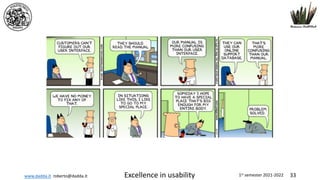
www.dadda.it roberto@dadda.it Excellence in usability 1st semester 2021-2022 1
ERGONOMICS APPLIED TO THE DESIGN OF USABLE WEB
PAGES AND APPS
Roberto DADDA and Paolo NEGRI
www.dadda.it roberto@dadda.it Excellence in usability 1st semester 2021-2022 2
Usability
Principles & guidelines
www.dadda.it roberto@dadda.it Excellence in usability 1st semester 2021-2022 3
… before breaking them!
Innovation comes from knoledge of past
www.dadda.it roberto@dadda.it Excellence in usability 1st semester 2021-2022 4
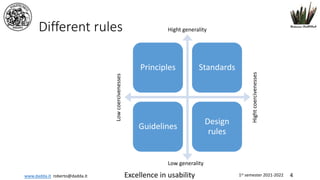
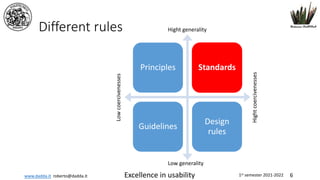
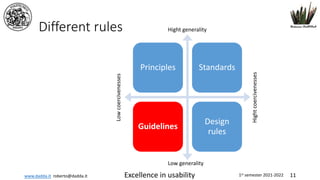
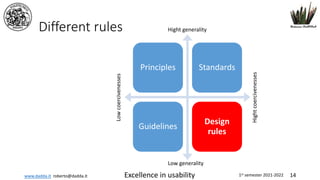
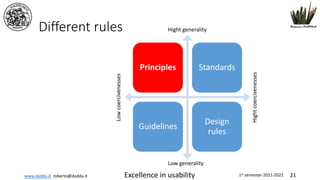
Different rules
Principles Standards
Guidelines
Design
rules
Hight generality
Low generality
Low
coercivenesses
Hight
coercivenesses
www.dadda.it roberto@dadda.it Excellence in usability 1st semester 2021-2022 5
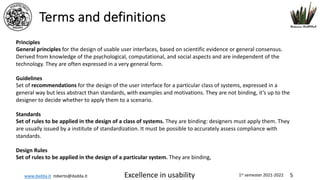
Terms and definitions
Principles
General principles for the design of usable user interfaces, based on scientific evidence or general consensus.
Derived from knowledge of the psychological, computational, and social aspects and are independent of the
technology. They are often expressed in a very general form.
Guidelines
Set of recommendations for the design of the user interface for a particular class of systems, expressed in a
general way but less abstract than standards, with examples and motivations. They are not binding, it’s up to the
designer to decide whether to apply them to a scenario.
Standards
Set of rules to be applied in the design of a class of systems. They are binding: designers must apply them. They
are usually issued by a institute of standardization. It must be possible to accurately assess compliance with
standards.
Design Rules
Set of rules to be applied in the design of a particular system. They are binding,
www.dadda.it roberto@dadda.it Excellence in usability 1st semester 2021-2022 6
Different rules
Principles Standards
Guidelines
Design
rules
Hight generality
Low generality
Low
coercivenesses
Hight
coercivenesses
www.dadda.it roberto@dadda.it Excellence in usability 1st semester 2021-2022 7
Usability Standards
• Complex situation: the standards are evolving continuously
(www.iso.org ; www.uninfo.it)
• The process is very slow, and passes through several stages
• There are standards of product and standards of process
www.dadda.it roberto@dadda.it Excellence in usability 1st semester 2021-2022 8
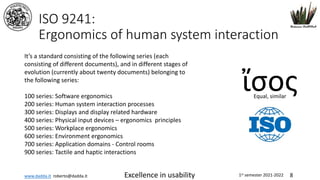
ISO 9241:
Ergonomics of human system interaction
It’s a standard consisting of the following series (each
consisting of different documents), and in different stages of
evolution (currently about twenty documents) belonging to
the following series:
100 series: Software ergonomics
200 series: Human system interaction processes
300 series: Displays and display related hardware
400 series: Physical input devices – ergonomics principles
500 series: Workplace ergonomics
600 series: Environment ergonomics
700 series: Application domains - Control rooms
900 series: Tactile and haptic interactions
ἴσος
Equal, similar
www.dadda.it roberto@dadda.it Excellence in usability 1st semester 2021-2022 9
ISO 9241 documents
Part 1: General introduction
Part 2: Guidance on task requirements
Part 4: Keyboard requirements
Part 5: Workstation layout and postural requirements
Part 6: Guidance on the work environment
Part 9: Requirements for non-keyboard input devices
Part 11: Guidance on usability
Part 12: Presentation of information
Part 13: User guidance
Part 14: Menu dialogues
Part 15: Command dialogues
Part 16: Direct manipulation dialogues
Part 17: Form filling dialogues
Part 20: Accessibility guidelines for ICT equipment and services
Part 100: Introduction to standards related to software ergonomics
Part 110: Dialogue principles
Part 129: (DIS) Guidance on software individualization
Part 151: Guidance on World Wide Web user interfaces
Part 171: Guidance on software accessibility
Part 210: Human-centred design for interactive systems
Part 300: Introduction to electronic visual display requirements
Part 302: Terminology for electronic visual displays
Part 303: Requirements for electronic visual displays
Part 304: User performance test methods for electronic visual displays
Part 305: Optical laboratory test methods for electronic visual displays
Part 306: Field assessment methods for electronic visual displays
Part 307: Analysis and compliance test methods for electronic visual
displays
Part 308: Surface-conduction electron-emitter displays (SED)
Part 309: Organic light-emitting diode (OLED) displays
Part 400: Principles and requirements for physical input devices
Part 410: Design criteria for physical input devices
Part 420: (DIS) Selection procedures for physical input devices
Part 910: (DIS) Framework for tactile and haptic interaction
Part 920: Guidance on tactile and haptic interactions
www.dadda.it roberto@dadda.it Excellence in usability 1st semester 2021-2022 10
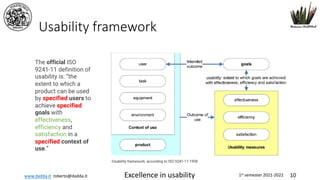
Usability framework
The official ISO
9241-11 definition of
usability is: “the
extent to which a
product can be used
by specified users to
achieve specified
goals with
effectiveness,
efficiency and
satisfaction in a
specified context of
use.”
www.dadda.it roberto@dadda.it Excellence in usability 1st semester 2021-2022 11
Different rules
Principles Standards
Guidelines
Design
rules
Hight generality
Low generality
Low
coercivenesses
Hight
coercivenesses
www.dadda.it roberto@dadda.it Excellence in usability 1st semester 2021-2022 12
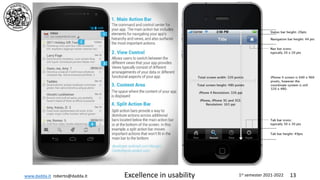
User interface design guidelines
Android:
http://developer.android.com/guide/topics/ui/index.html
iOS:
https://developer.apple.com/library/ios/documentation/use
rexperience/conceptual/MobileHIG/index.html
www.dadda.it roberto@dadda.it Excellence in usability 1st semester 2021-2022 13
www.dadda.it roberto@dadda.it Excellence in usability 1st semester 2021-2022 14
Different rules
Principles Standards
Guidelines
Design
rules
Hight generality
Low generality
Low
coercivenesses
Hight
coercivenesses
www.dadda.it roberto@dadda.it Excellence in usability 1st semester 2021-2022 15
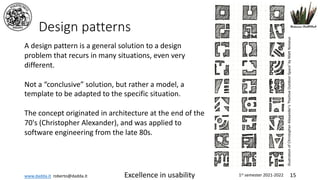
Design patterns
A design pattern is a general solution to a design
problem that recurs in many situations, even very
different.
Not a “conclusive” solution, but rather a model, a
template to be adapted to the specific situation.
The concept originated in architecture at the end of the
70's (Christopher Alexander), and was applied to
software engineering from the late 80s.
illustration
of
Christopher
Alexander's
'Positive
Outdoor
Space'
by
Matt
Noiseux
www.dadda.it roberto@dadda.it Excellence in usability 1st semester 2021-2022 16
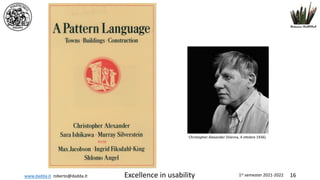
Christopher Alexander (Vienna, 4 ottobre 1936)
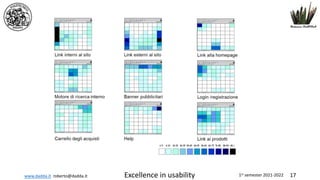
www.dadda.it roberto@dadda.it Excellence in usability 1st semester 2021-2022 17
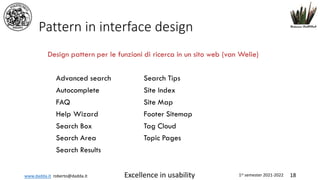
www.dadda.it roberto@dadda.it Excellence in usability 1st semester 2021-2022 18
Pattern in interface design
www.dadda.it roberto@dadda.it Excellence in usability 1st semester 2021-2022 19
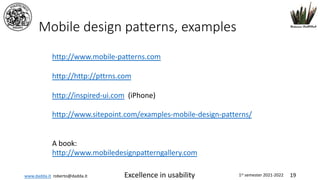
Mobile design patterns, examples
http://www.mobile-patterns.com
http://http://pttrns.com
http://inspired-ui.com (iPhone)
http://www.sitepoint.com/examples-mobile-design-patterns/
A book:
http://www.mobiledesignpatterngallery.com
www.dadda.it roberto@dadda.it Excellence in usability 1st semester 2021-2022 20
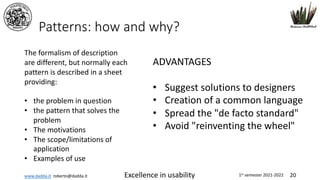
Patterns: how and why?
The formalism of description
are different, but normally each
pattern is described in a sheet
providing:
• the problem in question
• the pattern that solves the
problem
• The motivations
• The scope/limitations of
application
• Examples of use
ADVANTAGES
• Suggest solutions to designers
• Creation of a common language
• Spread the "de facto standard"
• Avoid "reinventing the wheel"
www.dadda.it roberto@dadda.it Excellence in usability 1st semester 2021-2022 21
Different rules
Principles Standards
Guidelines
Design
rules
Hight generality
Low generality
Low
coercivenesses
Hight
coercivenesses
www.dadda.it roberto@dadda.it Excellence in usability 1st semester 2021-2022 22
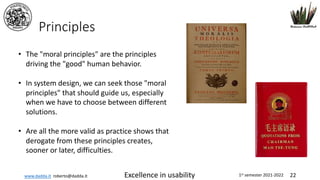
Principles
• The "moral principles" are the principles
driving the "good" human behavior.
• In system design, we can seek those "moral
principles" that should guide us, especially
when we have to choose between different
solutions.
• Are all the more valid as practice shows that
derogate from these principles creates,
sooner or later, difficulties.
www.dadda.it roberto@dadda.it Excellence in usability 1st semester 2021-2022 23
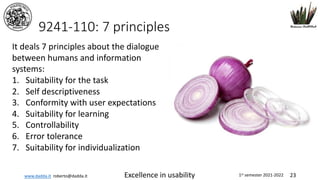
9241-110: 7 principles
It deals 7 principles about the dialogue
between humans and information
systems:
1. Suitability for the task
2. Self descriptiveness
3. Conformity with user expectations
4. Suitability for learning
5. Controllability
6. Error tolerance
7. Suitability for individualization
www.dadda.it roberto@dadda.it Excellence in usability 1st semester 2021-2022 24
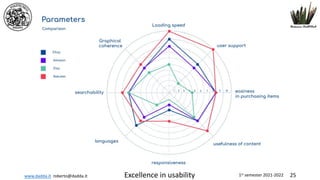
www.dadda.it roberto@dadda.it Excellence in usability 1st semester 2021-2022 25
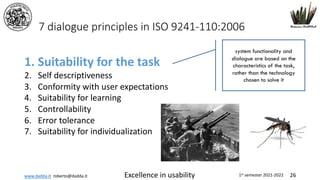
www.dadda.it roberto@dadda.it Excellence in usability 1st semester 2021-2022 26
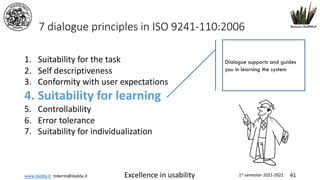
7 dialogue principles in ISO 9241-110:2006
1. Suitability for the task
2. Self descriptiveness
3. Conformity with user expectations
4. Suitability for learning
5. Controllability
6. Error tolerance
7. Suitability for individualization
system functionality and
dialogue are based on the
characteristics of the task,
rather than the technology
chosen to solve it
www.dadda.it roberto@dadda.it Excellence in usability 1st semester 2021-2022 27
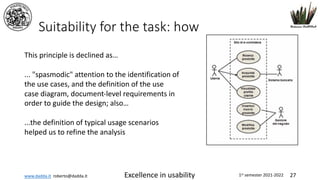
Suitability for the task: how
This principle is declined as…
... "spasmodic" attention to the identification of
the use cases, and the definition of the use
case diagram, document-level requirements in
order to guide the design; also…
...the definition of typical usage scenarios
helped us to refine the analysis
www.dadda.it roberto@dadda.it Excellence in usability 1st semester 2021-2022 28
Suitability for the task: aspects
Phases of interaction adequate to the task
Information and formats adequate to the task
I/O devices adequate to the task
Interaction techniques adequate to the task
Typical Defaults
But...
Essential dialogue (no unnecessary redundancy for the task)
www.dadda.it roberto@dadda.it Excellence in usability 1st semester 2021-2022 29
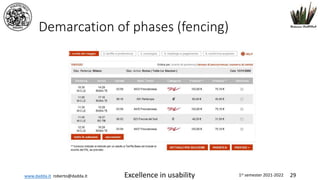
Demarcation of phases (fencing)
www.dadda.it roberto@dadda.it Excellence in usability 1st semester 2021-2022 30
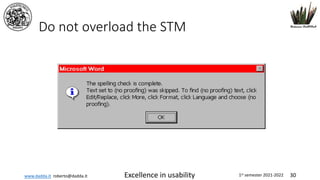
Do not overload the STM
www.dadda.it roberto@dadda.it Excellence in usability 1st semester 2021-2022 31
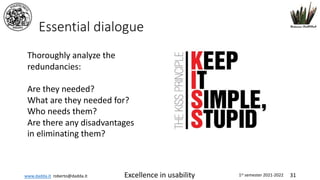
Essential dialogue
Thoroughly analyze the
redundancies:
Are they needed?
What are they needed for?
Who needs them?
Are there any disadvantages
in eliminating them?
www.dadda.it roberto@dadda.it Excellence in usability 1st semester 2021-2022 32
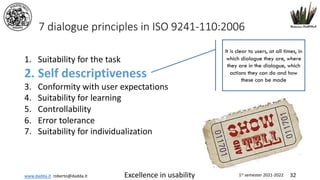
7 dialogue principles in ISO 9241-110:2006
1. Suitability for the task
2. Self descriptiveness
3. Conformity with user expectations
4. Suitability for learning
5. Controllability
6. Error tolerance
7. Suitability for individualization
It is clear to users, at all times, in
which dialogue they are, where
they are in the dialogue, which
actions they can do and how
these can be made
www.dadda.it roberto@dadda.it Excellence in usability 1st semester 2021-2022 33
www.dadda.it roberto@dadda.it Excellence in usability 1st semester 2021-2022 34
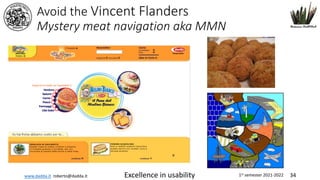
Avoid the Vincent Flanders
Mystery meat navigation aka MMN
www.dadda.it roberto@dadda.it Excellence in usability 1st semester 2021-2022 35
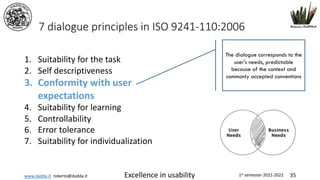
7 dialogue principles in ISO 9241-110:2006
1. Suitability for the task
2. Self descriptiveness
3. Conformity with user
expectations
4. Suitability for learning
5. Controllability
6. Error tolerance
7. Suitability for individualization
The dialogue corresponds to the
user's needs, predictable
because of the context and
commonly accepted conventions
www.dadda.it roberto@dadda.it Excellence in usability 1st semester 2021-2022 36
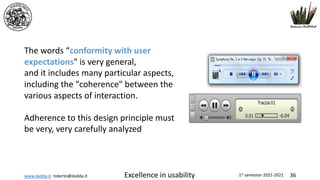
The words “conformity with user
expectations" is very general,
and it includes many particular aspects,
including the "coherence" between the
various aspects of interaction.
Adherence to this design principle must
be very, very carefully analyzed
www.dadda.it roberto@dadda.it Excellence in usability 1st semester 2021-2022 37
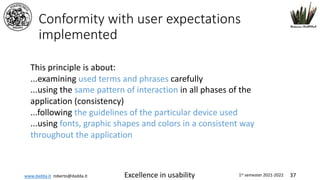
Conformity with user expectations
implemented
This principle is about:
...examining used terms and phrases carefully
...using the same pattern of interaction in all phases of the
application (consistency)
...following the guidelines of the particular device used
...using fonts, graphic shapes and colors in a consistent way
throughout the application
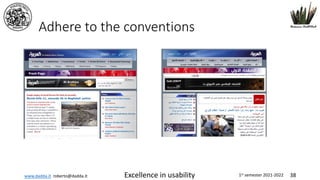
www.dadda.it roberto@dadda.it Excellence in usability 1st semester 2021-2022 38
Adhere to the conventions
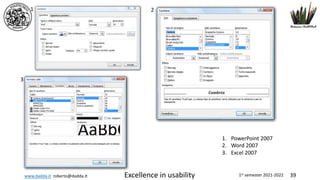
www.dadda.it roberto@dadda.it Excellence in usability 1st semester 2021-2022 39
1 2
3
1. PowerPoint 2007
2. Word 2007
3. Excel 2007
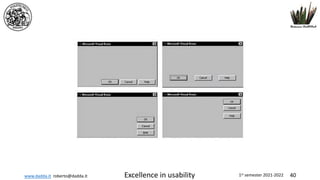
www.dadda.it roberto@dadda.it Excellence in usability 1st semester 2021-2022 40
www.dadda.it roberto@dadda.it Excellence in usability 1st semester 2021-2022 41
7 dialogue principles in ISO 9241-110:2006
1. Suitability for the task
2. Self descriptiveness
3. Conformity with user expectations
4. Suitability for learning
5. Controllability
6. Error tolerance
7. Suitability for individualization
Dialogue supports and guides
you in learning the system
www.dadda.it roberto@dadda.it Excellence in usability 1st semester 2021-2022 42
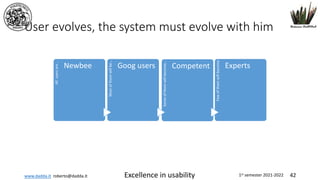
User evolves, the system must evolve with him
All
users
are
…
Newbee
Most
of
them
will
be…
Goog users
Some
of
them
will
become…
Competent
Few
of
them
will
become
Experts
www.dadda.it roberto@dadda.it Excellence in usability 1st semester 2021-2022 43
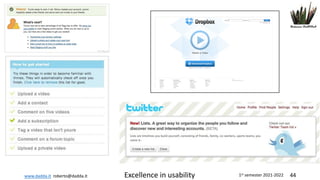
Suitability for learning: aspects
• Aided familiarization
• Low threshold of learning
• Intermediate feedback
• Guaranteed and secure test
• Evident conceptual model
• Facilitated re-learning
www.dadda.it roberto@dadda.it Excellence in usability 1st semester 2021-2022 44
www.dadda.it roberto@dadda.it Excellence in usability 1st semester 2021-2022 45
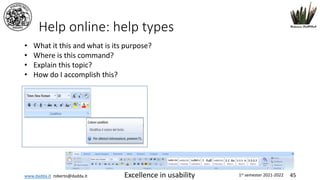
Help online: help types
• What it this and what is its purpose?
• Where is this command?
• Explain this topic?
• How do I accomplish this?
www.dadda.it roberto@dadda.it Excellence in usability 1st semester 2021-2022 46
7 dialogue principles in ISO 9241-110:2006
1. Suitability for the task
2. Self descriptiveness
3. Conformity with user expectations
4. Suitability for learning
5. Controllability
6. Error tolerance
7. Suitability for individualization
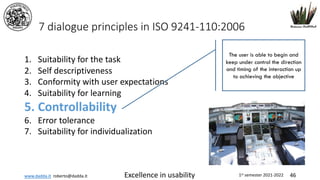
The user is able to begin and
keep under control the direction
and timing of the interaction up
to achieving the objective
www.dadda.it roberto@dadda.it Excellence in usability 1st semester 2021-2022 47
Controllability, implemented
This principle is about:
..."spasmodic" attention to navigation fluidity (back
command always present, home page as "safe haven")
...eliminating phases of dialogue that can be done only
once, at its beginning only (!)
...eliminating Q & A controlled by the system
www.dadda.it roberto@dadda.it Excellence in usability 1st semester 2021-2022 48
7 dialogue principles in ISO 9241-110:2006
1. Suitability for the task
2. Self descriptiveness
3. Conformity with user expectations
4. Suitability for learning
5. Controllability
6. Error tolerance
7. Suitability for individualization
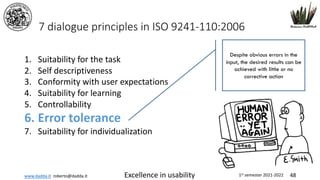
Despite obvious errors in the
input, the desired results can be
achieved with little or no
corrective action
www.dadda.it roberto@dadda.it Excellence in usability 1st semester 2021-2022 49
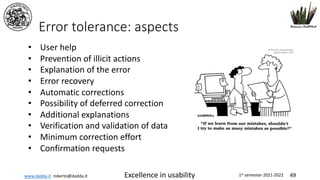
Error tolerance: aspects
• User help
• Prevention of illicit actions
• Explanation of the error
• Error recovery
• Automatic corrections
• Possibility of deferred correction
• Additional explanations
• Verification and validation of data
• Minimum correction effort
• Confirmation requests
www.dadda.it roberto@dadda.it Excellence in usability 1st semester 2021-2022 50
7 dialogue principles in ISO 9241-110:2006
1. Suitability for the task
2. Self descriptiveness
3. Conformity with user expectations
4. Suitability for learning
5. Controllability
6. Error tolerance
7. Suitability for
individualization
The user can change the
interaction and presentation of
information to suit his personal
needs and individual skills
www.dadda.it roberto@dadda.it Excellence in usability 1st semester 2021-2022 51
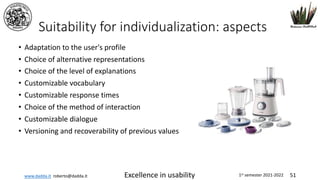
Suitability for individualization: aspects
• Adaptation to the user's profile
• Choice of alternative representations
• Choice of the level of explanations
• Customizable vocabulary
• Customizable response times
• Choice of the method of interaction
• Customizable dialogue
• Versioning and recoverability of previous values
www.dadda.it roberto@dadda.it Excellence in usability 1st semester 2021-2022 52
Meaning that users can adapt the product to their own
needs. For example, a beginner has different expectations
of a product than an expert.
www.dadda.it roberto@dadda.it Excellence in usability 1st semester 2021-2022 53
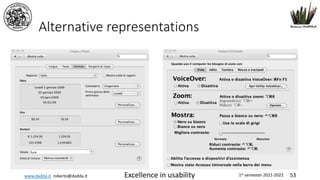
Alternative representations
www.dadda.it roberto@dadda.it Excellence in usability 1st semester 2021-2022 54
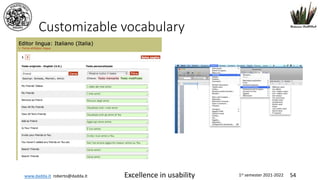
Customizable vocabulary
www.dadda.it roberto@dadda.it Excellence in usability 1st semester 2021-2022 55
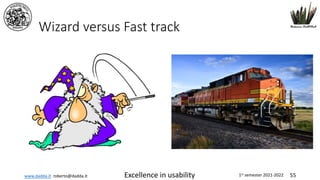
Wizard versus Fast track
www.dadda.it roberto@dadda.it Excellence in usability 1st semester 2021-2022 56
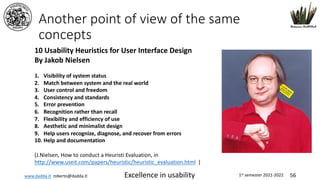
Another point of view of the same
concepts
10 Usability Heuristics for User Interface Design
By Jakob Nielsen
1. Visibility of system status
2. Match between system and the real world
3. User control and freedom
4. Consistency and standards
5. Error prevention
6. Recognition rather than recall
7. Flexibility and efficiency of use
8. Aesthetic and minimalist design
9. Help users recognize, diagnose, and recover from errors
10. Help and documentation
(J.Nielsen, How to conduct a Heuristi Evaluation, in
http://www.useit.com/papers/heuristic/heuristic_evaluation.html )
www.dadda.it roberto@dadda.it Excellence in usability 1st semester 2021-2022 57

07 norms and standards

  • 1.
    www.dadda.it roberto@dadda.it Excellencein usability 1st semester 2021-2022 1 ERGONOMICS APPLIED TO THE DESIGN OF USABLE WEB PAGES AND APPS Roberto DADDA and Paolo NEGRI
  • 2.
    www.dadda.it roberto@dadda.it Excellencein usability 1st semester 2021-2022 2 Usability Principles & guidelines
  • 3.
    www.dadda.it roberto@dadda.it Excellencein usability 1st semester 2021-2022 3 … before breaking them! Innovation comes from knoledge of past
  • 4.
    www.dadda.it roberto@dadda.it Excellencein usability 1st semester 2021-2022 4 Different rules Principles Standards Guidelines Design rules Hight generality Low generality Low coercivenesses Hight coercivenesses
  • 5.
    www.dadda.it roberto@dadda.it Excellencein usability 1st semester 2021-2022 5 Terms and definitions Principles General principles for the design of usable user interfaces, based on scientific evidence or general consensus. Derived from knowledge of the psychological, computational, and social aspects and are independent of the technology. They are often expressed in a very general form. Guidelines Set of recommendations for the design of the user interface for a particular class of systems, expressed in a general way but less abstract than standards, with examples and motivations. They are not binding, it’s up to the designer to decide whether to apply them to a scenario. Standards Set of rules to be applied in the design of a class of systems. They are binding: designers must apply them. They are usually issued by a institute of standardization. It must be possible to accurately assess compliance with standards. Design Rules Set of rules to be applied in the design of a particular system. They are binding,
  • 6.
    www.dadda.it roberto@dadda.it Excellencein usability 1st semester 2021-2022 6 Different rules Principles Standards Guidelines Design rules Hight generality Low generality Low coercivenesses Hight coercivenesses
  • 7.
    www.dadda.it roberto@dadda.it Excellencein usability 1st semester 2021-2022 7 Usability Standards • Complex situation: the standards are evolving continuously (www.iso.org ; www.uninfo.it) • The process is very slow, and passes through several stages • There are standards of product and standards of process
  • 8.
    www.dadda.it roberto@dadda.it Excellencein usability 1st semester 2021-2022 8 ISO 9241: Ergonomics of human system interaction It’s a standard consisting of the following series (each consisting of different documents), and in different stages of evolution (currently about twenty documents) belonging to the following series: 100 series: Software ergonomics 200 series: Human system interaction processes 300 series: Displays and display related hardware 400 series: Physical input devices – ergonomics principles 500 series: Workplace ergonomics 600 series: Environment ergonomics 700 series: Application domains - Control rooms 900 series: Tactile and haptic interactions ἴσος Equal, similar
  • 9.
    www.dadda.it roberto@dadda.it Excellencein usability 1st semester 2021-2022 9 ISO 9241 documents Part 1: General introduction Part 2: Guidance on task requirements Part 4: Keyboard requirements Part 5: Workstation layout and postural requirements Part 6: Guidance on the work environment Part 9: Requirements for non-keyboard input devices Part 11: Guidance on usability Part 12: Presentation of information Part 13: User guidance Part 14: Menu dialogues Part 15: Command dialogues Part 16: Direct manipulation dialogues Part 17: Form filling dialogues Part 20: Accessibility guidelines for ICT equipment and services Part 100: Introduction to standards related to software ergonomics Part 110: Dialogue principles Part 129: (DIS) Guidance on software individualization Part 151: Guidance on World Wide Web user interfaces Part 171: Guidance on software accessibility Part 210: Human-centred design for interactive systems Part 300: Introduction to electronic visual display requirements Part 302: Terminology for electronic visual displays Part 303: Requirements for electronic visual displays Part 304: User performance test methods for electronic visual displays Part 305: Optical laboratory test methods for electronic visual displays Part 306: Field assessment methods for electronic visual displays Part 307: Analysis and compliance test methods for electronic visual displays Part 308: Surface-conduction electron-emitter displays (SED) Part 309: Organic light-emitting diode (OLED) displays Part 400: Principles and requirements for physical input devices Part 410: Design criteria for physical input devices Part 420: (DIS) Selection procedures for physical input devices Part 910: (DIS) Framework for tactile and haptic interaction Part 920: Guidance on tactile and haptic interactions
  • 10.
    www.dadda.it roberto@dadda.it Excellencein usability 1st semester 2021-2022 10 Usability framework The official ISO 9241-11 definition of usability is: “the extent to which a product can be used by specified users to achieve specified goals with effectiveness, efficiency and satisfaction in a specified context of use.”
  • 11.
    www.dadda.it roberto@dadda.it Excellencein usability 1st semester 2021-2022 11 Different rules Principles Standards Guidelines Design rules Hight generality Low generality Low coercivenesses Hight coercivenesses
  • 12.
    www.dadda.it roberto@dadda.it Excellencein usability 1st semester 2021-2022 12 User interface design guidelines Android: http://developer.android.com/guide/topics/ui/index.html iOS: https://developer.apple.com/library/ios/documentation/use rexperience/conceptual/MobileHIG/index.html
  • 13.
    www.dadda.it roberto@dadda.it Excellencein usability 1st semester 2021-2022 13
  • 14.
    www.dadda.it roberto@dadda.it Excellencein usability 1st semester 2021-2022 14 Different rules Principles Standards Guidelines Design rules Hight generality Low generality Low coercivenesses Hight coercivenesses
  • 15.
    www.dadda.it roberto@dadda.it Excellencein usability 1st semester 2021-2022 15 Design patterns A design pattern is a general solution to a design problem that recurs in many situations, even very different. Not a “conclusive” solution, but rather a model, a template to be adapted to the specific situation. The concept originated in architecture at the end of the 70's (Christopher Alexander), and was applied to software engineering from the late 80s. illustration of Christopher Alexander's 'Positive Outdoor Space' by Matt Noiseux
  • 16.
    www.dadda.it roberto@dadda.it Excellencein usability 1st semester 2021-2022 16 Christopher Alexander (Vienna, 4 ottobre 1936)
  • 17.
    www.dadda.it roberto@dadda.it Excellencein usability 1st semester 2021-2022 17
  • 18.
    www.dadda.it roberto@dadda.it Excellencein usability 1st semester 2021-2022 18 Pattern in interface design
  • 19.
    www.dadda.it roberto@dadda.it Excellencein usability 1st semester 2021-2022 19 Mobile design patterns, examples http://www.mobile-patterns.com http://http://pttrns.com http://inspired-ui.com (iPhone) http://www.sitepoint.com/examples-mobile-design-patterns/ A book: http://www.mobiledesignpatterngallery.com
  • 20.
    www.dadda.it roberto@dadda.it Excellencein usability 1st semester 2021-2022 20 Patterns: how and why? The formalism of description are different, but normally each pattern is described in a sheet providing: • the problem in question • the pattern that solves the problem • The motivations • The scope/limitations of application • Examples of use ADVANTAGES • Suggest solutions to designers • Creation of a common language • Spread the "de facto standard" • Avoid "reinventing the wheel"
  • 21.
    www.dadda.it roberto@dadda.it Excellencein usability 1st semester 2021-2022 21 Different rules Principles Standards Guidelines Design rules Hight generality Low generality Low coercivenesses Hight coercivenesses
  • 22.
    www.dadda.it roberto@dadda.it Excellencein usability 1st semester 2021-2022 22 Principles • The "moral principles" are the principles driving the "good" human behavior. • In system design, we can seek those "moral principles" that should guide us, especially when we have to choose between different solutions. • Are all the more valid as practice shows that derogate from these principles creates, sooner or later, difficulties.
  • 23.
    www.dadda.it roberto@dadda.it Excellencein usability 1st semester 2021-2022 23 9241-110: 7 principles It deals 7 principles about the dialogue between humans and information systems: 1. Suitability for the task 2. Self descriptiveness 3. Conformity with user expectations 4. Suitability for learning 5. Controllability 6. Error tolerance 7. Suitability for individualization
  • 24.
    www.dadda.it roberto@dadda.it Excellencein usability 1st semester 2021-2022 24
  • 25.
    www.dadda.it roberto@dadda.it Excellencein usability 1st semester 2021-2022 25
  • 26.
    www.dadda.it roberto@dadda.it Excellencein usability 1st semester 2021-2022 26 7 dialogue principles in ISO 9241-110:2006 1. Suitability for the task 2. Self descriptiveness 3. Conformity with user expectations 4. Suitability for learning 5. Controllability 6. Error tolerance 7. Suitability for individualization system functionality and dialogue are based on the characteristics of the task, rather than the technology chosen to solve it
  • 27.
    www.dadda.it roberto@dadda.it Excellencein usability 1st semester 2021-2022 27 Suitability for the task: how This principle is declined as… ... "spasmodic" attention to the identification of the use cases, and the definition of the use case diagram, document-level requirements in order to guide the design; also… ...the definition of typical usage scenarios helped us to refine the analysis
  • 28.
    www.dadda.it roberto@dadda.it Excellencein usability 1st semester 2021-2022 28 Suitability for the task: aspects Phases of interaction adequate to the task Information and formats adequate to the task I/O devices adequate to the task Interaction techniques adequate to the task Typical Defaults But... Essential dialogue (no unnecessary redundancy for the task)
  • 29.
    www.dadda.it roberto@dadda.it Excellencein usability 1st semester 2021-2022 29 Demarcation of phases (fencing)
  • 30.
    www.dadda.it roberto@dadda.it Excellencein usability 1st semester 2021-2022 30 Do not overload the STM
  • 31.
    www.dadda.it roberto@dadda.it Excellencein usability 1st semester 2021-2022 31 Essential dialogue Thoroughly analyze the redundancies: Are they needed? What are they needed for? Who needs them? Are there any disadvantages in eliminating them?
  • 32.
    www.dadda.it roberto@dadda.it Excellencein usability 1st semester 2021-2022 32 7 dialogue principles in ISO 9241-110:2006 1. Suitability for the task 2. Self descriptiveness 3. Conformity with user expectations 4. Suitability for learning 5. Controllability 6. Error tolerance 7. Suitability for individualization It is clear to users, at all times, in which dialogue they are, where they are in the dialogue, which actions they can do and how these can be made
  • 33.
    www.dadda.it roberto@dadda.it Excellencein usability 1st semester 2021-2022 33
  • 34.
    www.dadda.it roberto@dadda.it Excellencein usability 1st semester 2021-2022 34 Avoid the Vincent Flanders Mystery meat navigation aka MMN
  • 35.
    www.dadda.it roberto@dadda.it Excellencein usability 1st semester 2021-2022 35 7 dialogue principles in ISO 9241-110:2006 1. Suitability for the task 2. Self descriptiveness 3. Conformity with user expectations 4. Suitability for learning 5. Controllability 6. Error tolerance 7. Suitability for individualization The dialogue corresponds to the user's needs, predictable because of the context and commonly accepted conventions
  • 36.
    www.dadda.it roberto@dadda.it Excellencein usability 1st semester 2021-2022 36 The words “conformity with user expectations" is very general, and it includes many particular aspects, including the "coherence" between the various aspects of interaction. Adherence to this design principle must be very, very carefully analyzed
  • 37.
    www.dadda.it roberto@dadda.it Excellencein usability 1st semester 2021-2022 37 Conformity with user expectations implemented This principle is about: ...examining used terms and phrases carefully ...using the same pattern of interaction in all phases of the application (consistency) ...following the guidelines of the particular device used ...using fonts, graphic shapes and colors in a consistent way throughout the application
  • 38.
    www.dadda.it roberto@dadda.it Excellencein usability 1st semester 2021-2022 38 Adhere to the conventions
  • 39.
    www.dadda.it roberto@dadda.it Excellencein usability 1st semester 2021-2022 39 1 2 3 1. PowerPoint 2007 2. Word 2007 3. Excel 2007
  • 40.
    www.dadda.it roberto@dadda.it Excellencein usability 1st semester 2021-2022 40
  • 41.
    www.dadda.it roberto@dadda.it Excellencein usability 1st semester 2021-2022 41 7 dialogue principles in ISO 9241-110:2006 1. Suitability for the task 2. Self descriptiveness 3. Conformity with user expectations 4. Suitability for learning 5. Controllability 6. Error tolerance 7. Suitability for individualization Dialogue supports and guides you in learning the system
  • 42.
    www.dadda.it roberto@dadda.it Excellencein usability 1st semester 2021-2022 42 User evolves, the system must evolve with him All users are … Newbee Most of them will be… Goog users Some of them will become… Competent Few of them will become Experts
  • 43.
    www.dadda.it roberto@dadda.it Excellencein usability 1st semester 2021-2022 43 Suitability for learning: aspects • Aided familiarization • Low threshold of learning • Intermediate feedback • Guaranteed and secure test • Evident conceptual model • Facilitated re-learning
  • 44.
    www.dadda.it roberto@dadda.it Excellencein usability 1st semester 2021-2022 44
  • 45.
    www.dadda.it roberto@dadda.it Excellencein usability 1st semester 2021-2022 45 Help online: help types • What it this and what is its purpose? • Where is this command? • Explain this topic? • How do I accomplish this?
  • 46.
    www.dadda.it roberto@dadda.it Excellencein usability 1st semester 2021-2022 46 7 dialogue principles in ISO 9241-110:2006 1. Suitability for the task 2. Self descriptiveness 3. Conformity with user expectations 4. Suitability for learning 5. Controllability 6. Error tolerance 7. Suitability for individualization The user is able to begin and keep under control the direction and timing of the interaction up to achieving the objective
  • 47.
    www.dadda.it roberto@dadda.it Excellencein usability 1st semester 2021-2022 47 Controllability, implemented This principle is about: ..."spasmodic" attention to navigation fluidity (back command always present, home page as "safe haven") ...eliminating phases of dialogue that can be done only once, at its beginning only (!) ...eliminating Q & A controlled by the system
  • 48.
    www.dadda.it roberto@dadda.it Excellencein usability 1st semester 2021-2022 48 7 dialogue principles in ISO 9241-110:2006 1. Suitability for the task 2. Self descriptiveness 3. Conformity with user expectations 4. Suitability for learning 5. Controllability 6. Error tolerance 7. Suitability for individualization Despite obvious errors in the input, the desired results can be achieved with little or no corrective action
  • 49.
    www.dadda.it roberto@dadda.it Excellencein usability 1st semester 2021-2022 49 Error tolerance: aspects • User help • Prevention of illicit actions • Explanation of the error • Error recovery • Automatic corrections • Possibility of deferred correction • Additional explanations • Verification and validation of data • Minimum correction effort • Confirmation requests
  • 50.
    www.dadda.it roberto@dadda.it Excellencein usability 1st semester 2021-2022 50 7 dialogue principles in ISO 9241-110:2006 1. Suitability for the task 2. Self descriptiveness 3. Conformity with user expectations 4. Suitability for learning 5. Controllability 6. Error tolerance 7. Suitability for individualization The user can change the interaction and presentation of information to suit his personal needs and individual skills
  • 51.
    www.dadda.it roberto@dadda.it Excellencein usability 1st semester 2021-2022 51 Suitability for individualization: aspects • Adaptation to the user's profile • Choice of alternative representations • Choice of the level of explanations • Customizable vocabulary • Customizable response times • Choice of the method of interaction • Customizable dialogue • Versioning and recoverability of previous values
  • 52.
    www.dadda.it roberto@dadda.it Excellencein usability 1st semester 2021-2022 52 Meaning that users can adapt the product to their own needs. For example, a beginner has different expectations of a product than an expert.
  • 53.
    www.dadda.it roberto@dadda.it Excellencein usability 1st semester 2021-2022 53 Alternative representations
  • 54.
    www.dadda.it roberto@dadda.it Excellencein usability 1st semester 2021-2022 54 Customizable vocabulary
  • 55.
    www.dadda.it roberto@dadda.it Excellencein usability 1st semester 2021-2022 55 Wizard versus Fast track
  • 56.
    www.dadda.it roberto@dadda.it Excellencein usability 1st semester 2021-2022 56 Another point of view of the same concepts 10 Usability Heuristics for User Interface Design By Jakob Nielsen 1. Visibility of system status 2. Match between system and the real world 3. User control and freedom 4. Consistency and standards 5. Error prevention 6. Recognition rather than recall 7. Flexibility and efficiency of use 8. Aesthetic and minimalist design 9. Help users recognize, diagnose, and recover from errors 10. Help and documentation (J.Nielsen, How to conduct a Heuristi Evaluation, in http://www.useit.com/papers/heuristic/heuristic_evaluation.html )
  • 57.
    www.dadda.it roberto@dadda.it Excellencein usability 1st semester 2021-2022 57