Downloaded 11 times
![READ THESE INSTRUCTIONS FIRST
Write your Centre number, candidate number and name on all the work you hand in.
Write in dark blue or black pen.
You may use a pencil for any diagrams, graphs or rough working.
Do not use staples, paper clips, highlighters, glue or correction fluid.
DO NOT WRITE IN ANY BARCODES.
Answer all questions.
At the end of the examination, fasten all your work securely together.
The number of marks is given in brackets [ ] at the end of each question or part
question.
CHEMISTRY 0620/62
Paper 6 Alternative to Practical May/June 2011
1 hour
Candidates answer on the Question Paper.
No Additional Materials are required.
UNIVERSITY OF CAMBRIDGE INTERNATIONAL EXAMINATIONS
International General Certificate of Secondary Education
This document consists of 13 printed pages and 3 blank pages.
[Turn over
IB11 06_0620_62/4RP
© UCLES 2011
*9988663665*
For Examiner’s Use
3
4
5
Total
6
1
2
w
w
w
.Xtrem
ePapers.com](https://image.slidesharecdn.com/0620s11qp62-140311123554-phpapp01/85/0620_s11_qp_62-1-320.jpg)

![3
0620/62/M/J/11© UCLES 2011 [Turn over
For
Examiner’s
Use
1 A student separated an aqueous solution of sodium chloride.
She measured out 70cm3
of the solution and then obtained pure water from the solution.
(a) Which of these pieces of apparatus is most suitable to measure 70cm3
of the solution?
Tick one box.
[1]
(b) (i) Complete the empty boxes to name the pieces of apparatus below.
heat heat
A B C
[3]
(ii) Which method of separation, A, B or C, would be most suitable to obtain pure water
from the solution?
apparatus .................... [1]
(c) Describe how crystals of sodium chloride could be quickly obtained from the solution.
...........................................................................................................................................
...........................................................................................................................................
..................................................................................................................................... [2]
[Total: 7]](https://image.slidesharecdn.com/0620s11qp62-140311123554-phpapp01/85/0620_s11_qp_62-3-320.jpg)
![4
0620/62/M/J/11© UCLES 2011
For
Examiner’s
Use
2 A student investigated the temperature changes when increasing amounts of zinc powder
were added to 25cm3
of aqueous copper(II) sulfate in a beaker. The equation for the reaction
is shown below.
Zn(s) + CuSO4
(aq) → Cu(s) + ZnSO4
(aq)
Five experiments were carried out. The initial temperature in each experiment was 22°C.
The thermometer diagrams in the table show the highest temperature reached after each
addition of zinc.
(a) Use the thermometer diagrams to record the highest temperatures and complete the
table.
mass of zinc
added/g
0.30
0.60
0.90
1.20
1.50
1
2
3
4
5
thermometer
diagram
experiment
highest
temperature/°C
temperature
rise/°C
30
25
20
30
25
20
40
35
30
40
35
30
45
40
35
[4]](https://image.slidesharecdn.com/0620s11qp62-140311123554-phpapp01/85/0620_s11_qp_62-4-320.jpg)
![5
0620/62/M/J/11© UCLES 2011 [Turn over
For
Examiner’s
Use
(b) Plot the results on the grid below and draw a straight line graph.
0.00 0.30 0.60 0.90 1.20 1.50 1.80
temperature
rise/°C
mass of zinc added/g
25
20
15
10
5
0
[3]
(c) Which result appears to be inaccurate?
..................................................................................................................................... [1]
(d) Use your graph to find the temperature rise produced by 1.80g of zinc. Show clearly on
the grid how you obtained your answer.
..................................................................................................................................... [3]
(e) State two observations, other than a rise in temperature, which would be made when
zinc reacted with the aqueous copper(II) sulfate.
1. .......................................................................................................................................
2. ................................................................................................................................. [2]
[Total: 13]](https://image.slidesharecdn.com/0620s11qp62-140311123554-phpapp01/85/0620_s11_qp_62-5-320.jpg)
![6
0620/62/M/J/11© UCLES 2011
For
Examiner’s
Use
3 Electricity was passed through a solution of concentrated hydrochloric acid using the
apparatus shown.
electrode electrode
concentrated
hydrochloric acid
(a) Give two expected observations.
1. .......................................................................................................................................
2. ................................................................................................................................. [2]
(b) Suggest a suitable material for the electrodes.
..................................................................................................................................... [1]
(c) A lighted splint placed in a test-tube of the gas collected at the negative electrode gave
a pop sound.
The identity of the gas was ......................................................................................... [1]
(d) State two safety precautions that must be followed when carrying out this experiment.
1. .......................................................................................................................................
2. ................................................................................................................................. [2]
[Total: 6]](https://image.slidesharecdn.com/0620s11qp62-140311123554-phpapp01/85/0620_s11_qp_62-6-320.jpg)
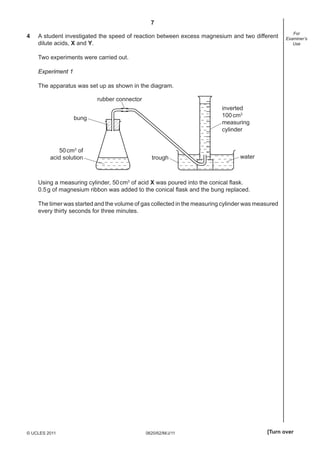
![8
0620/62/M/J/11© UCLES 2011
For
Examiner’s
Use
(a) Use the measuring cylinder diagrams to record the volumes of gas collected in the table
of results.
time/s
measuring cylinder
diagram
total volume of
gas collected/cm3
0
30
60
90
120
150
0
5
10
10
15
20
20
25
30
25
30
35
30
35
40
40
45
50
180
45
50
55
[3]](https://image.slidesharecdn.com/0620s11qp62-140311123554-phpapp01/85/0620_s11_qp_62-8-320.jpg)
![9
0620/62/M/J/11© UCLES 2011 [Turn over
For
Examiner’s
Use
Experiment 2
Experiment 1 was repeated using 50cm3
of acid Y.
(b) Use the measuring cylinder diagrams to record the volumes of gas collected in the table
of results.
time/s
measuring cylinder
diagram
total volume of
gas collected/cm3
0
30
60
90
120
150
0
5
10
0
5
10
5
10
15
10
15
20
10
15
20
15
20
25
180
15
20
25
[3]](https://image.slidesharecdn.com/0620s11qp62-140311123554-phpapp01/85/0620_s11_qp_62-9-320.jpg)
![10
0620/62/M/J/11© UCLES 2011
For
Examiner’s
Use
(c) Plot the results for both experiments on the grid below. For each set of results, draw a
smooth line graph. Indicate clearly which line represents Experiment 1 and which line
represents Experiment 2.
0 30 60 90 120 150 180
volume of
gas/cm3
time/s
60
50
40
30
20
10
0
[6]
(d) (i) In which experiment was the speed of reaction fastest?
.............................................................................................................................. [1]
(ii) Suggest why the speed was fastest in this experiment.
....................................................................................................................................
.............................................................................................................................. [1]
(e) Why, eventually, will no more gas be produced?
...........................................................................................................................................
..................................................................................................................................... [2]](https://image.slidesharecdn.com/0620s11qp62-140311123554-phpapp01/85/0620_s11_qp_62-10-320.jpg)
![11
0620/62/M/J/11© UCLES 2011 [Turn over
For
Examiner’s
Use
(f) From your graph, deduce the time required to collect 25cm3
of gas in Experiment 1.
Show clearly on the graph how you worked out your answer.
..................................................................................................................................... [2]
(g) Give one advantage and one disadvantage of using a measuring cylinder to add the
acids to the flask.
advantage .........................................................................................................................
disadvantage .............................................................................................................. [2]
[Total: 20]](https://image.slidesharecdn.com/0620s11qp62-140311123554-phpapp01/85/0620_s11_qp_62-11-320.jpg)
![12
0620/62/M/J/11© UCLES 2011
For
Examiner’s
Use
5 A mixture, Z, of two different solids was analysed. Z consisted of solid W, which was
water-soluble ammonium chloride, and solid V, which was insoluble.
The tests on the solids, and some of the observations, are in the following table.
Complete the observations in the table.
tests observations
tests on mixture Z
(a) Appearance of the mixture. white solid
Mixture Z was added to distilled water in a
boiling tube. The boiling tube and contents
were shaken and then filtered.
tests on the filtrate
The filtrate was divided into three test-tubes.
(b) (i) To the first test-tube of the filtrate, a few
drops of dilute nitric acid was added
followed by silver nitrate solution.
(ii) To the second test-tube of the filtrate,
aqueous sodium hydroxide was
added.
The mixture was heated. The gas given
off was tested with damp pH indicator
paper.
(iii) To the third test-tube of the filtrate,
dilute hydrochloric acid was added
followed by barium chloride solution.
............................................................ [2]
...................................................................
........................................................... [2]
........................................................... [1]](https://image.slidesharecdn.com/0620s11qp62-140311123554-phpapp01/85/0620_s11_qp_62-12-320.jpg)
![13
0620/62/M/J/11© UCLES 2011 [Turn over
For
Examiner’s
Use
tests observations
tests on the residue
(c) By using a spatula, some of the residue
was transferred from the filter paper into
a test-tube. Dilute hydrochloric acid was
added to the residue.
The gas given off was tested.
The solution in the test-tube was divided into
two portions.
rapid effervescence
limewater turned milky
(d) (i) To the first portion of the solution,
excess aqueous sodium hydroxide
was added.
(ii) To the second portion of the solution,
excess aqueous ammonia solution
was added.
white precipitate formed,
insoluble in excess
no precipitate formed
(e) Identify the gas given off in (c).
..................................................................................................................................... [1]
(f) What conclusions can you draw about solid V?
...........................................................................................................................................
...........................................................................................................................................
..................................................................................................................................... [2]
[Total: 8]](https://image.slidesharecdn.com/0620s11qp62-140311123554-phpapp01/85/0620_s11_qp_62-13-320.jpg)
![14
0620/62/M/J/11© UCLES 2011
For
Examiner’s
Use
6 Petrol is a liquid fuel obtained from petroleum (crude oil).
Bioethanol is a liquid fuel made by the fermentation of carbohydrates obtained from plants
such as sugar cane.
Using the apparatus below, plan an experiment to investigate which of these two fuels
produces more energy.
You may use the space below to draw a diagram to help you answer the question.
retort stand
spirit burner
balance
thermometer
copper can
water
..................................................................................................................................................
..................................................................................................................................................
..................................................................................................................................................
..................................................................................................................................................
..................................................................................................................................................
............................................................................................................................................ [6]
[Total: 6]](https://image.slidesharecdn.com/0620s11qp62-140311123554-phpapp01/85/0620_s11_qp_62-14-320.jpg)


This document provides instructions for students taking a chemistry exam. It states that students should write their identification details on all work submitted. Answers should be written in dark blue or black pen, with diagrams done in pencil. Staples, paper clips, etc. should not be used. The document contains 13 printed pages and 3 blank pages. It informs students to answer all questions and fasten their work together at the end. The number of marks for each question is provided in brackets.


