Raising the Participation Age –
Challenges and Responses

Peter Mucklow
National Director for Young People
Education Funding Agency
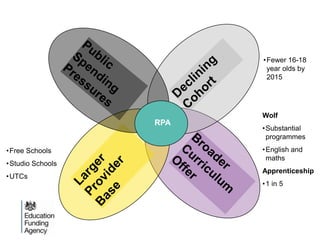
• Fewer 16-18
                           year olds by
                           2015


                         Wolf
                   RPA
                         • Substantial
                           programmes
• Free Schools           • English and
                           maths
• Studio Schools
                         Apprenticeship
• UTCs
                         • 1 in 5
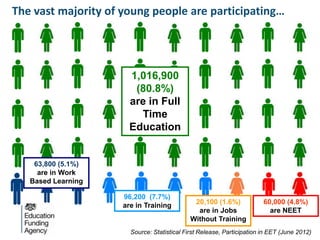
The vast majority of young people are participating…


                      1,016,900
                       (80.8%)
                      are in Full
                        Time
                      Education


    63,800 (5.1%)
     are in Work
   Based Learning

                     96,200 (7.7%)
                     are in Training          20,100 (1.6%)             60,000 (4.8%)
                                               are in Jobs                are NEET
                                             Without Training
                       Source: Statistical First Release, Participation in EET (June 2012)
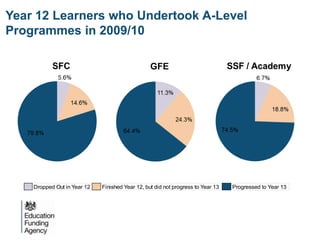
Year 12 Learners who Undertook A-Level
Programmes in 2009/10


    Dropped Out in Year 12   Finished Year 12, but did not progress to Year 13   Progressed to Year 13
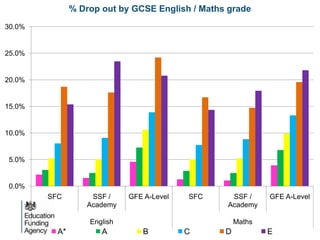
% Drop out by GCSE English / Maths grade
30.0%


25.0%


20.0%


15.0%


10.0%


5.0%


0.0%
        SFC        SSF /     GFE A-Level   SFC    SSF /      GFE A-Level
                  Academy                        Academy

                   English                           Maths
          A*          A         B          C     D           E
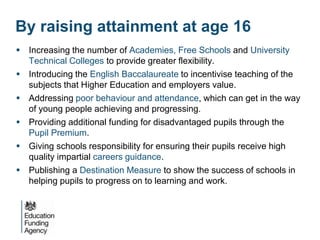
By raising attainment at age 16
 Increasing the number of Academies, Free Schools and University
  Technical Colleges to provide greater flexibility.
 Introducing the English Baccalaureate to incentivise teaching of the
  subjects that Higher Education and employers value.
 Addressing poor behaviour and attendance, which can get in the way
  of young people achieving and progressing.
 Providing additional funding for disadvantaged pupils through the
  Pupil Premium.
 Giving schools responsibility for ensuring their pupils receive high
  quality impartial careers guidance.
 Publishing a Destination Measure to show the success of schools in
  helping pupils to progress on to learning and work.
By supporting post-16 education and
training
 Spending a record £7.5 billion to fund education and training places
  for young people aged 16-18.
 Supporting high quality Apprenticeship opportunities, spending
  £833m to provide over 140,000 16-18 starts in 2012-13.
 Offering up to 40,000 incentives for small businesses to take on a
  young apprentice.
 Spending £4.5 million over the next two years to support the delivery
  of high quality work experience opportunities.
 Addressing financial barriers through the £180m 16-19 Bursary
  Fund.
By increasing the quality of vocational
education
 Incentivising only the best vocational qualifications pre-16 by counting
  these within the performance tables.
 Post-16, introducing new study programmes that will offer all 16-19
  year olds:
    – The opportunity to achieve at least one qualification of substantial
      size.
    – Work experience, where appropriate.
    – English and maths for those who do not have a GCSE at grade C
      or above.
  Study programmes will be in place from September 2013, together
    with new funding arrangements per learner.
Engagement – reaching 100%
What is the offer to a young person not ready to learn?

 Youth Contract – additional support for 16/17 year olds – the black
  box approach.

 Locally-led RPA delivery projects in 39 LA areas.

 European Social Fund programme – innovative and flexible.

 Funding for study programmes based on work experience – building
  on existing Foundation Learning programme.
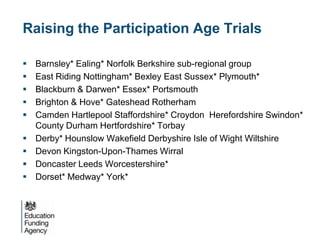
Raising the Participation Age Trials

   Barnsley* Ealing* Norfolk Berkshire sub-regional group
   East Riding Nottingham* Bexley East Sussex* Plymouth*
   Blackburn & Darwen* Essex* Portsmouth
   Brighton & Hove* Gateshead Rotherham
   Camden Hartlepool Staffordshire* Croydon Herefordshire Swindon*
    County Durham Hertfordshire* Torbay
   Derby* Hounslow Wakefield Derbyshire Isle of Wight Wiltshire
   Devon Kingston-Upon-Thames Wirral
   Doncaster Leeds Worcestershire*
   Dorset* Medway* York*
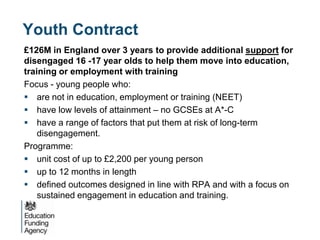
Youth Contract
£126M in England over 3 years to provide additional support for
disengaged 16 -17 year olds to help them move into education,
training or employment with training
Focus - young people who:
 are not in education, employment or training (NEET)
 have low levels of attainment – no GCSEs at A*-C
 have a range of factors that put them at risk of long-term
    disengagement.
Programme:
 unit cost of up to £2,200 per young person
 up to 12 months in length
 defined outcomes designed in line with RPA and with a focus on
    sustained engagement in education and training.
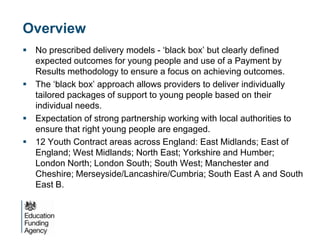
Overview
 No prescribed delivery models - ‘black box’ but clearly defined
  expected outcomes for young people and use of a Payment by
  Results methodology to ensure a focus on achieving outcomes.
 The ‘black box’ approach allows providers to deliver individually
  tailored packages of support to young people based on their
  individual needs.
 Expectation of strong partnership working with local authorities to
  ensure that right young people are engaged.
 12 Youth Contract areas across England: East Midlands; East of
  England; West Midlands; North East; Yorkshire and Humber;
  London North; London South; South West; Manchester and
  Cheshire; Merseyside/Lancashire/Cumbria; South East A and South
  East B.
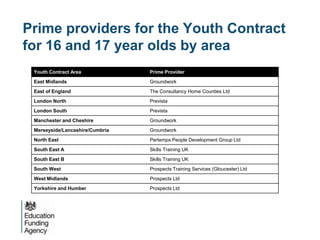
Prime providers for the Youth Contract
for 16 and 17 year olds by area
 Youth Contract Area             Prime Provider
 East Midlands                   Groundwork
 East of England                 The Consultancy Home Counties Ltd
 London North                    Prevista
 London South                    Prevista
 Manchester and Cheshire         Groundwork
 Merseyside/Lancashire/Cumbria   Groundwork
 North East                      Pertemps People Development Group Ltd
 South East A                    Skills Training UK
 South East B                    Skills Training UK
 South West                      Prospects Training Services (Gloucester) Ltd
 West Midlands                   Prospects Ltd
 Yorkshire and Humber            Prospects Ltd
Peter Mucklow
 National Director for Young People
     Education Funding Agency
peter.mucklow@education.gsi.gov.uk

05112012 chyps - peter mucklow

  • 1.
    Raising the ParticipationAge – Challenges and Responses Peter Mucklow National Director for Young People Education Funding Agency
  • 2.
    • Fewer 16-18 year olds by 2015 Wolf RPA • Substantial programmes • Free Schools • English and maths • Studio Schools Apprenticeship • UTCs • 1 in 5
  • 3.
    The vast majorityof young people are participating… 1,016,900 (80.8%) are in Full Time Education 63,800 (5.1%) are in Work Based Learning 96,200 (7.7%) are in Training 20,100 (1.6%) 60,000 (4.8%) are in Jobs are NEET Without Training Source: Statistical First Release, Participation in EET (June 2012)
  • 4.
    Year 12 Learnerswho Undertook A-Level Programmes in 2009/10 Dropped Out in Year 12 Finished Year 12, but did not progress to Year 13 Progressed to Year 13
  • 5.
    % Drop outby GCSE English / Maths grade 30.0% 25.0% 20.0% 15.0% 10.0% 5.0% 0.0% SFC SSF / GFE A-Level SFC SSF / GFE A-Level Academy Academy English Maths A* A B C D E
  • 6.
    By raising attainmentat age 16  Increasing the number of Academies, Free Schools and University Technical Colleges to provide greater flexibility.  Introducing the English Baccalaureate to incentivise teaching of the subjects that Higher Education and employers value.  Addressing poor behaviour and attendance, which can get in the way of young people achieving and progressing.  Providing additional funding for disadvantaged pupils through the Pupil Premium.  Giving schools responsibility for ensuring their pupils receive high quality impartial careers guidance.  Publishing a Destination Measure to show the success of schools in helping pupils to progress on to learning and work.
  • 7.
    By supporting post-16education and training  Spending a record £7.5 billion to fund education and training places for young people aged 16-18.  Supporting high quality Apprenticeship opportunities, spending £833m to provide over 140,000 16-18 starts in 2012-13.  Offering up to 40,000 incentives for small businesses to take on a young apprentice.  Spending £4.5 million over the next two years to support the delivery of high quality work experience opportunities.  Addressing financial barriers through the £180m 16-19 Bursary Fund.
  • 8.
    By increasing thequality of vocational education  Incentivising only the best vocational qualifications pre-16 by counting these within the performance tables.  Post-16, introducing new study programmes that will offer all 16-19 year olds: – The opportunity to achieve at least one qualification of substantial size. – Work experience, where appropriate. – English and maths for those who do not have a GCSE at grade C or above.  Study programmes will be in place from September 2013, together with new funding arrangements per learner.
  • 9.
    Engagement – reaching100% What is the offer to a young person not ready to learn?  Youth Contract – additional support for 16/17 year olds – the black box approach.  Locally-led RPA delivery projects in 39 LA areas.  European Social Fund programme – innovative and flexible.  Funding for study programmes based on work experience – building on existing Foundation Learning programme.
  • 10.
    Raising the ParticipationAge Trials  Barnsley* Ealing* Norfolk Berkshire sub-regional group  East Riding Nottingham* Bexley East Sussex* Plymouth*  Blackburn & Darwen* Essex* Portsmouth  Brighton & Hove* Gateshead Rotherham  Camden Hartlepool Staffordshire* Croydon Herefordshire Swindon* County Durham Hertfordshire* Torbay  Derby* Hounslow Wakefield Derbyshire Isle of Wight Wiltshire  Devon Kingston-Upon-Thames Wirral  Doncaster Leeds Worcestershire*  Dorset* Medway* York*
  • 11.
    Youth Contract £126M inEngland over 3 years to provide additional support for disengaged 16 -17 year olds to help them move into education, training or employment with training Focus - young people who:  are not in education, employment or training (NEET)  have low levels of attainment – no GCSEs at A*-C  have a range of factors that put them at risk of long-term disengagement. Programme:  unit cost of up to £2,200 per young person  up to 12 months in length  defined outcomes designed in line with RPA and with a focus on sustained engagement in education and training.
  • 12.
    Overview  No prescribeddelivery models - ‘black box’ but clearly defined expected outcomes for young people and use of a Payment by Results methodology to ensure a focus on achieving outcomes.  The ‘black box’ approach allows providers to deliver individually tailored packages of support to young people based on their individual needs.  Expectation of strong partnership working with local authorities to ensure that right young people are engaged.  12 Youth Contract areas across England: East Midlands; East of England; West Midlands; North East; Yorkshire and Humber; London North; London South; South West; Manchester and Cheshire; Merseyside/Lancashire/Cumbria; South East A and South East B.
  • 13.
    Prime providers forthe Youth Contract for 16 and 17 year olds by area Youth Contract Area Prime Provider East Midlands Groundwork East of England The Consultancy Home Counties Ltd London North Prevista London South Prevista Manchester and Cheshire Groundwork Merseyside/Lancashire/Cumbria Groundwork North East Pertemps People Development Group Ltd South East A Skills Training UK South East B Skills Training UK South West Prospects Training Services (Gloucester) Ltd West Midlands Prospects Ltd Yorkshire and Humber Prospects Ltd
  • 14.
    Peter Mucklow NationalDirector for Young People Education Funding Agency peter.mucklow@education.gsi.gov.uk

Editor's Notes

  • #5 We are making good progress in moving to full participation for 16 year olds – the big challenge is with 17 year olds Even amongst those pursuing A Levels, drop out of A/S Level and failure to progress to A2 are far too highThis slide shows the outcome of year 12 for those learners enrolled on AS Levels in 2009-10290, 000 young people enrolled on AS Levels in 2009-10 ( 70% in school/Academy sixth forms)20,000 or 7% dropped out of their AS programmes54,00 or 20% of those who completed their AS programmes did not progress through to A2Of the 60 + thousand young people who either dropped out in year of did not progress to A2 : over 20,00 became NEETMany of these young people would be attractive to employers and would be good candidates for Apprenticeships.
  • #6 This slide shows the percentage of learners who dropped out of an A-Level by GCSE grade in English & Maths. For example, the chart shows that of those who study in a SFC having achieved a grade C in English, 8% drop out in year 12. Key PointsThe increase in drop out between a C grade and a D grade is slightly greater for English than Maths, at all 3 types of institution – suggesting that English could be a greater influence over rates of drop out than Maths. Amongst GFE A-Level learners, nearly 5% of those who achieved an A* in English and / or Maths dropped out in year 12.Learners who achieved a grade C at GCSE (English or Maths) have the highest rates of retention at sixth form collegesThe lowest rates of drop out amongst A* (GCSE grade) learners are at sixth form collegesA Learner who achieved a grade C at GCSE is twice as likely to drop out of a GFE college A-Level than in a SFC or SSF / Academy. Anomalous data has been omitted from this slide
  • #10 A question we often get asked is how these different offers stack up and whether there clarity of purpose between themI will attempt to demonstrate how these funded approaches complement one another, but I concede there may be times when two or more of these funded approaches could suit the same learner and it is better to have more than one way to meet the needs of a learner than none at allTo summarise YC and ESF are additional funds, while FL is from our 16-18 learner responsive funding stream, but it is conceivable that the same provider could be a Prime contractor for YC (or part of the delivery chain), an ESF contractor and in receipt of mainstream EFA funding – we trust providers to utilise the flexibility of these funding streams to build effective engagement and progression pathways for individual young people
  • #11 25 providers running pilots across the country, now approaching the end of first phasepilot providers have been invited to London to share progress to date and innovative measures that have been put in placephase two starts in September and is envisaged to see more creative approaches to “work experience”; these will be expected to be demonstrated strongly for the  continuation of participation within pilot