Absolute Value
of Integers
Presented by: Mark Ian Nicolas Olivar
Teacher
“
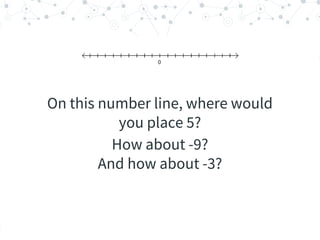
On this number line, where would
you place 5?
How about -9?
And how about -3?
Objectives
At the end of the Lesson, students will be able
to:
1. define the absolute value of a number;
2. illustrate the absolute value of a number
on the number line; and
3. appreciate the importance of knowing the
absolute value of a number.
What is an integer
anyway?
Basics of Integers
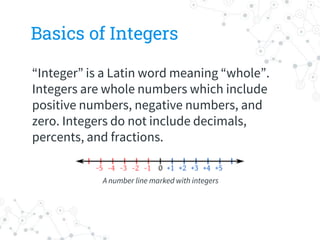
“Integer” is a Latin word meaning “whole”.
Integers are whole numbers which include
positive numbers, negative numbers, and
zero. Integers do not include decimals,
percents, and fractions.
A number line marked with integers
Basics of Integers
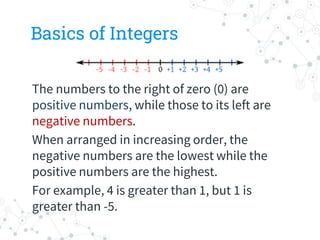
The numbers to the right of zero (0) are
positive numbers, while those to its left are
negative numbers.
When arranged in increasing order, the
negative numbers are the lowest while the
positive numbers are the highest.
For example, 4 is greater than 1, but 1 is
greater than -5.
Positive Numbers
Numbers which have plus signs on them are
called positive numbers. These numbers can
be found to the right side of zero.
As a general rule, numbers that don’t have a
sign are considered positive numbers.
All positive numbers are greater than their
negative counterpart and zero.
For example, 5 is greater than -5.
Negative Numbers
A negative number is the opposite of a
positive number. It is written with a “-” sign
before the number.
The larger the negative number, the less its
value becomes.
For example, -5 is less than -1.
Zero
Zero is a neutral number that is neither
negative nor positive.
It can be found at the center of the number
line, and is always less than any positive
number, but is always greater than any
negative number.
Absolute Value of
an Integer
Absolute Value of an Integer
The absolute value of an integer is its distance
from zero.
You write the absolute value of a number by
using 2 vertical bars.
|-5| is the absolute value of -5
Absolute Value of an Integer
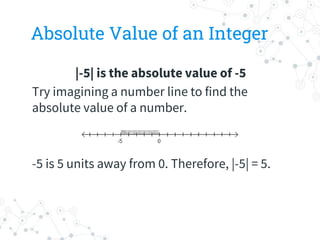
|-5| is the absolute value of -5
Try imagining a number line to find the
absolute value of a number.
-5 is 5 units away from 0. Therefore, |-5| = 5.
Absolute Value of an Integer
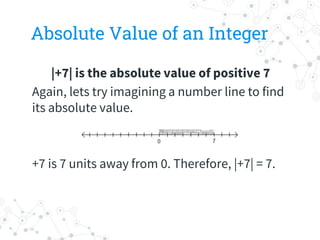
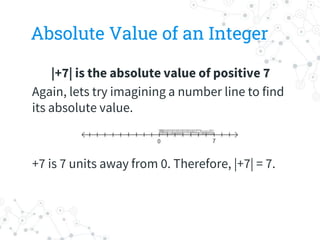
|+7| is the absolute value of positive 7
Again, lets try imagining a number line to find
its absolute value.
+7 is 7 units away from 0. Therefore, |+7| = 7.
Absolute Value of an Integer
|+7| is the absolute value of positive 7
Again, lets try imagining a number line to find
its absolute value.
+7 is 7 units away from 0. Therefore, |+7| = 7.
Which is
greater?
+8 or -19?
Answer:
+8 is greater than -19
Which is
greater?
|+8| or |-19|?
Answer:
The absolute value of +8 is 8
The absolute value of -19 is 19
19 is greater than 8
Therefore, |-19| is greater than |+8|
“
Even if the original value of the
number is greater than the other
number, that doesn’t always mean
that its absolute value will also be
greater than the other number’s.
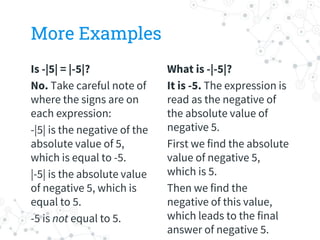
Is -|5| = |-5|?
No. Take careful note of
where the signs are on
each expression:
-|5| is the negative of the
absolute value of 5,
which is equal to -5.
|-5| is the absolute value
of negative 5, which is
equal to 5.
-5 is not equal to 5.
More Examples
What is -|-5|?
It is -5. The expression is
read as the negative of
the absolute value of
negative 5.
First we find the absolute
value of negative 5,
which is 5.
Then we find the
negative of this value,
which leads to the final
answer of negative 5.
“
Be careful when you look at where
the signs are placed on absolute
values. Absolute values of numbers
are always positive, but sometimes
operations outside of the absolute
value signs can change your final
answer to a negative value.
Is there a point to
knowing the absolute
value of a number?
Why or why not?
Question to ponder
You can check the following links to delve deeper into the
topic if you want
Basics of Integers | Toppr
◎https://www.toppr.com/guides/maths/integers/basics
-of-integers/
Absolute Value | Math Antics
◎https://youtu.be/BrYy1bgh3Y0
End of Lesson

04 Absolute Value of Integers.pptx

  • 1.
    Absolute Value of Integers Presentedby: Mark Ian Nicolas Olivar Teacher
  • 2.
    “ On this numberline, where would you place 5? How about -9? And how about -3?
  • 3.
    Objectives At the endof the Lesson, students will be able to: 1. define the absolute value of a number; 2. illustrate the absolute value of a number on the number line; and 3. appreciate the importance of knowing the absolute value of a number.
  • 4.
    What is aninteger anyway?
  • 5.
    Basics of Integers “Integer”is a Latin word meaning “whole”. Integers are whole numbers which include positive numbers, negative numbers, and zero. Integers do not include decimals, percents, and fractions. A number line marked with integers
  • 6.
    Basics of Integers Thenumbers to the right of zero (0) are positive numbers, while those to its left are negative numbers. When arranged in increasing order, the negative numbers are the lowest while the positive numbers are the highest. For example, 4 is greater than 1, but 1 is greater than -5.
  • 7.
    Positive Numbers Numbers whichhave plus signs on them are called positive numbers. These numbers can be found to the right side of zero. As a general rule, numbers that don’t have a sign are considered positive numbers. All positive numbers are greater than their negative counterpart and zero. For example, 5 is greater than -5.
  • 8.
    Negative Numbers A negativenumber is the opposite of a positive number. It is written with a “-” sign before the number. The larger the negative number, the less its value becomes. For example, -5 is less than -1.
  • 9.
    Zero Zero is aneutral number that is neither negative nor positive. It can be found at the center of the number line, and is always less than any positive number, but is always greater than any negative number.
  • 10.
  • 11.
    Absolute Value ofan Integer The absolute value of an integer is its distance from zero. You write the absolute value of a number by using 2 vertical bars. |-5| is the absolute value of -5
  • 12.
    Absolute Value ofan Integer |-5| is the absolute value of -5 Try imagining a number line to find the absolute value of a number. -5 is 5 units away from 0. Therefore, |-5| = 5.
  • 13.
    Absolute Value ofan Integer |+7| is the absolute value of positive 7 Again, lets try imagining a number line to find its absolute value. +7 is 7 units away from 0. Therefore, |+7| = 7.
  • 14.
    Absolute Value ofan Integer |+7| is the absolute value of positive 7 Again, lets try imagining a number line to find its absolute value. +7 is 7 units away from 0. Therefore, |+7| = 7.
  • 15.
    Which is greater? +8 or-19? Answer: +8 is greater than -19
  • 16.
    Which is greater? |+8| or|-19|? Answer: The absolute value of +8 is 8 The absolute value of -19 is 19 19 is greater than 8 Therefore, |-19| is greater than |+8|
  • 17.
    “ Even if theoriginal value of the number is greater than the other number, that doesn’t always mean that its absolute value will also be greater than the other number’s.
  • 18.
    Is -|5| =|-5|? No. Take careful note of where the signs are on each expression: -|5| is the negative of the absolute value of 5, which is equal to -5. |-5| is the absolute value of negative 5, which is equal to 5. -5 is not equal to 5. More Examples What is -|-5|? It is -5. The expression is read as the negative of the absolute value of negative 5. First we find the absolute value of negative 5, which is 5. Then we find the negative of this value, which leads to the final answer of negative 5.
  • 19.
    “ Be careful whenyou look at where the signs are placed on absolute values. Absolute values of numbers are always positive, but sometimes operations outside of the absolute value signs can change your final answer to a negative value.
  • 20.
    Is there apoint to knowing the absolute value of a number? Why or why not? Question to ponder
  • 21.
    You can checkthe following links to delve deeper into the topic if you want Basics of Integers | Toppr ◎https://www.toppr.com/guides/maths/integers/basics -of-integers/ Absolute Value | Math Antics ◎https://youtu.be/BrYy1bgh3Y0 End of Lesson