Data Access with Hibernate Persistent objects and persistence contexts
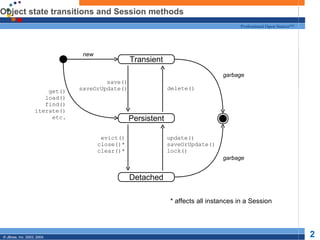
Object state transitions and Session methods Transient Persistent Detached new garbage garbage delete() save() saveOrUpdate() get() load() find() iterate() etc. evict() close()* clear()* update() saveOrUpdate() lock() * affects all instances in a Session
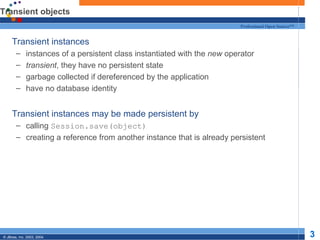
Transient objects Transient instances  instances of a persistent class instantiated with the  new  operator transient , they have no persistent state garbage collected if dereferenced by the application have no database identity Transient instances may be made persistent by calling  Session.save(object) creating a reference from another instance that is already persistent
Persistent objects Persistent instances include any instance retrieved with a query, lookup by identifier or navigation are  managed , changes are automatically flushed to the database are  transactional , changes can be rolled back  in the database only have database identity Persistent instances may be made transient by calling  Session.delete(object) “ orphan delete” (later)
Detached objects Detached instances are instances with database identity that are not associated with any open Session are no longer  managed  by Hibernate represent database state, that is potentially stale Persistent instances become detached by calling  Session.evict(object) clearing the Session  Session.clear() closing the Session  Session.close() Detached instances become persistent by calling  Session.lock(object, lockMode) calling  Session.update(object, lockMode) creating a reference from another instance that is already persistent
The scope of object identity It is extremely important to understand the differences between Java object identity:  a == b Database identity:  a.getId().equals(b.getId() The conditions when both are equivalent is called the  scope of object identity ! Hibernate implements session-scoped identity – the two notions of identity are equivalent for instances associated with a particular session.
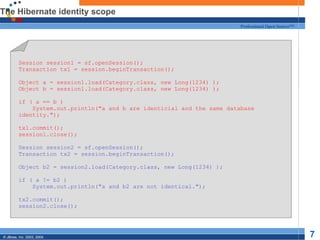
The Hibernate identity scope Session session1 = sf.openSession(); Transaction tx1 = session.beginTransaction(); Object a = session1.load(Category.class, new Long(1234) ); Object b = session1.load(Category.class, new Long(1234) ); if ( a == b ) System.out.println("a and b are identicial and the same database identity."); tx1.commit(); session1.close(); Session session2 = sf.openSession(); Transaction tx2 = session.beginTransaction(); Object b2 = session2.load(Category.class, new Long(1234) ); if ( a != b2 ) System.out.println("a and b2 are not identical."); tx2.commit(); session2.close();
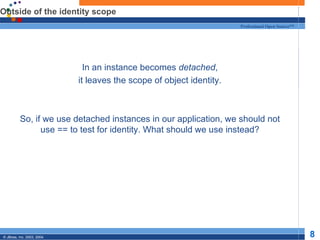
Outside of the identity scope In an instance becomes  detached , it leaves the scope of object identity. So, if we use detached instances in our application, we should not use == to test for identity. What should we use instead?
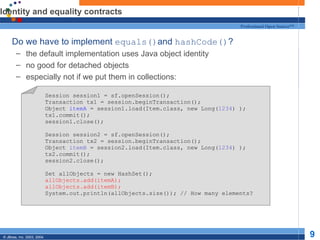
Identity and equality contracts Do we have to implement  equals() and  hashCode() ? the default implementation uses Java object identity no good for detached objects especially not if we put them in collections: Session session1 = sf.openSession(); Transaction tx1 = session.beginTransaction(); Object  itemA  = session1.load(Item.class, new Long( 1234 ) ); tx1.commit(); session1.close(); Session session2 = sf.openSession(); Transaction tx2 = session.beginTransaction(); Object  itemB  = session2.load(Item.class, new Long( 1234 ) ); tx2.commit(); session2.close(); Set allObjects = new HashSet(); allObjects.add(itemA); allObjects.add(itemB); System.out.println(allObjects.size()); // How many elements?
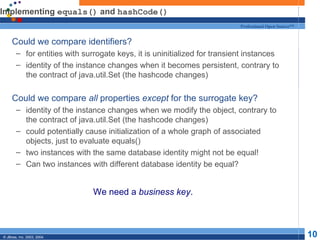
Implementing  equals()  and  hashCode() Could we compare identifiers? for entities with surrogate keys, it is uninitialized for transient instances identity of the instance changes when it becomes persistent, contrary to the contract of java.util.Set (the hashcode changes) Could we compare  all  properties  except  for the surrogate key? identity of the instance changes when we modify the object, contrary to the contract of java.util.Set (the hashcode changes) could potentially cause initialization of a whole graph of associated objects, just to evaluate equals() two instances with the same database identity might not be equal! Can two instances with different database identity be equal? We need a  business key .
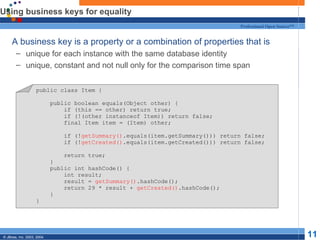
Using business keys for equality A business key is a property or a combination of properties that is unique for each instance with the same database identity unique, constant and not null only for the comparison time span public class Item { public boolean equals(Object other) { if (this == other) return true; if (!(other instanceof Item)) return false; final Item item = (Item) other; if (! getSummary() .equals(item.getSummary())) return false; if (! getCreated() .equals(item.getCreated())) return false; return true; } public int hashCode() { int result; result =  getSummary() .hashCode(); return 29 * result +  getCreated() .hashCode(); } }
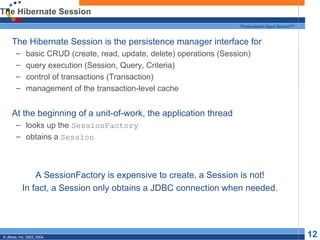
The Hibernate Session The Hibernate Session is the persistence manager interface for basic CRUD (create, read, update, delete) operations (Session) query execution (Session, Query, Criteria) control of transactions (Transaction) management of the transaction-level cache At the beginning of a unit-of-work, the application thread looks up the  SessionFactory obtains a  Session A SessionFactory is expensive to create, a Session is not! In fact, a Session only obtains a JDBC connection when needed.
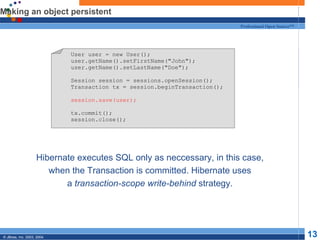
Making an object persistent Hibernate executes SQL only as neccessary, in this case, when the Transaction is committed. Hibernate uses a  transaction-scope write-behind  strategy. User user = new User(); user.getName().setFirstName("John"); user.getName().setLastName("Doe"); Session session = sessions.openSession(); Transaction tx = session.beginTransaction(); session.save(user); tx.commit(); session.close();
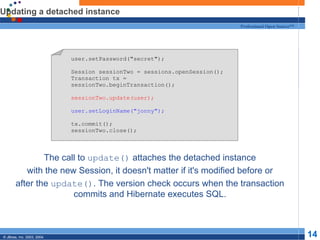
Updating a detached instance The call to  update()  attaches the detached instance with the new Session, it doesn't matter if it's modified before or after the  update() . The version check occurs when the transaction commits and Hibernate executes SQL. user.setPassword("secret"); Session sessionTwo = sessions.openSession(); Transaction tx = sessionTwo.beginTransaction(); sessionTwo.update(user); user.setLoginName("jonny"); tx.commit(); sessionTwo.close();
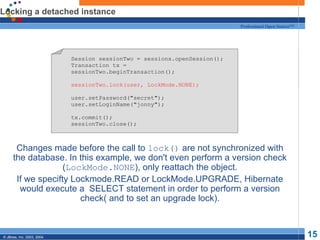
Locking a detached instance Changes made before the call to  lock()  are not synchronized with the database. In this example, we don't even perform a version check ( LockMode.NONE ), only reattach the object. If we specifty Lockmode.READ or LockMode.UPGRADE, Hibernate would execute a  SELECT statement in order to perform a version check( and to set an upgrade lock). Session sessionTwo = sessions.openSession(); Transaction tx = sessionTwo.beginTransaction(); sessionTwo.lock(user, LockMode.NONE); user.setPassword("secret"); user.setLoginName("jonny"); tx.commit(); sessionTwo.close();
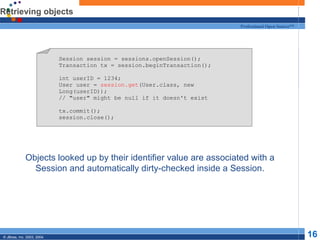
Retrieving objects Objects looked up by their identifier value are associated with a Session and automatically dirty-checked inside a Session. Session session = sessions.openSession(); Transaction tx = session.beginTransaction(); int userID = 1234; User user =  session.get (User.class, new Long(userID)); // "user" might be null if it doesn't exist tx.commit(); session.close();
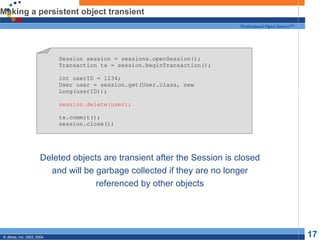
Making a persistent object transient Deleted objects are transient after the Session is closed and will be garbage collected if they are no longer referenced by other objects Session session = sessions.openSession(); Transaction tx = session.beginTransaction(); int userID = 1234; User user = session.get(User.class, new Long(userID)); session.delete(user); tx.commit(); session.close();
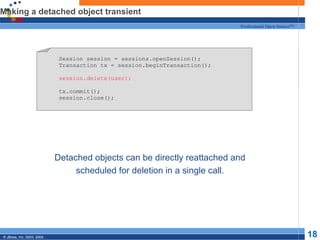
Making a detached object transient Detached objects can be directly reattached and scheduled for deletion in a single call. Session session = sessions.openSession(); Transaction tx = session.beginTransaction(); session.delete(user); tx.commit(); session.close();
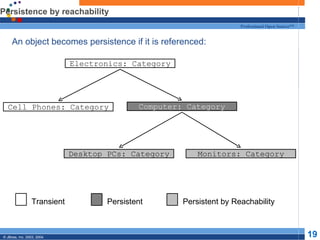
Persistence by reachability An object becomes persistence if it is referenced: Transient Persistent Persistent by Reachability Electronics: Category Cell Phones: Category Computer: Category Desktop PCs: Category Monitors: Category
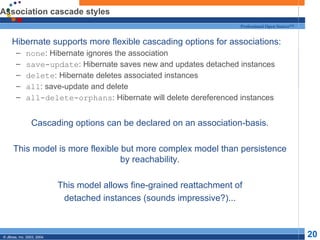
Association cascade styles Hibernate supports more flexible cascading options for associations: none : Hibernate ignores the association save-update : Hibernate saves new and updates detached instances delete : Hibernate deletes associated instances all : save-update and delete all-delete-orphans : Hibernate will delete dereferenced instances Cascading options can be declared on an association-basis. This model is more flexible but more complex model than persistence by reachability. This model allows fine-grained reattachment of detached instances (sounds impressive?)...
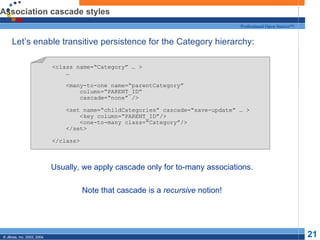
Association cascade styles Let’s enable transitive persistence for the Category hierarchy: Usually, we apply cascade only for to-many associations. Note that cascade is a  recursive  notion! <class name=“Category” … > … <many-to-one name=“parentCategory”  column=“PARENT_ID” cascade=“none” /> <set name=“childCategories” cascade=“save-update” … > <key column=“PARENT_ID”/> <one-to-many class=“Category”/> </set> </class>
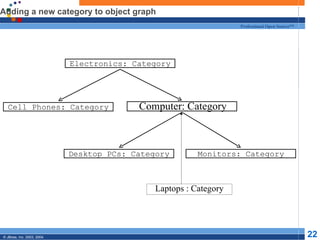
Adding a new category to object graph Computer: Category Laptops : Category Electronics: Category Cell Phones: Category Desktop PCs: Category Monitors: Category
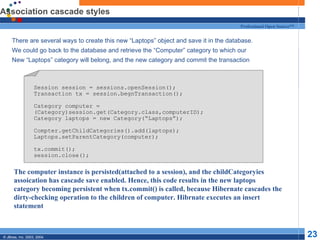
Association cascade styles There are several ways to create this new “Laptops” object and save it in the database. We could go back to the database and retrieve the “Computer” category to which our New “Laptops” category will belong, and the new category and commit the transaction Session session = sessions.openSession(); Transaction tx = session.begnTransaction(); Category computer = (Category)session.get(Category.class,computerID); Category laptops = new Category(“Laptops”); Compter.getChildCategories().add(laptops); Laptops.setParentCategory(computer); tx.commit(); session.close(); The computer instance is persisted(attached to a session), and the childCategoryies assoication has cascade save enabled. Hence, this code results in the new laptops category becoming persistent when tx.commit() is called, because Hibernate cascades the dirty-checking operation to the children of computer. Hibrnate executes an insert statement
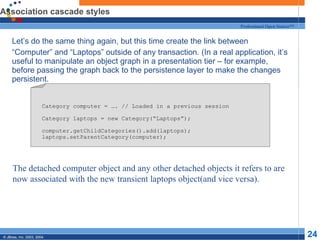
Association cascade styles Let’s do the same thing again, but this time create the link between “ Computer” and “Laptops” outside of any transaction. (In a real application, it’s useful to manipulate an object graph in a presentation tier – for example, before passing the graph back to the persistence layer to make the changes persistent. Category computer = …. // Loaded in a previous session Category laptops = new Category(“Laptops”); computer.getChildCategories().add(laptops); laptops.setParentCategory(computer); The detached computer object and any other detached objects it refers to are now associated with the new transient laptops object(and vice versa).
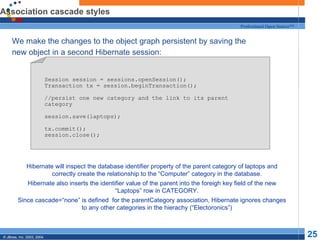
Association cascade styles We make the changes to the object graph persistent by saving the new object in a second Hibernate session: Hibernate will inspect the database identifier property of the parent category of laptops and correctly create the relationship to the “Computer” category in the database. Hibernate also inserts the identifier value of the parent into the foreigh key field of the new “Laptops” row in CATEGORY. Since cascade=“none” is defined  for the parentCategory association, Hibernate ignores changes to any other categories in the hierachy (“Electoronics”) Session session = sessions.openSession(); Transaction tx = session.beginTransaction(); //persist one new category and the link to its parent category session.save(laptops); tx.commit(); session.close();
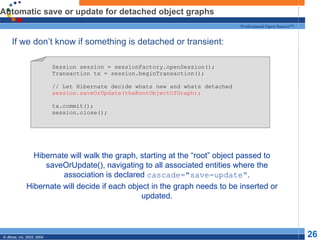
Automatic save or update for detached object graphs If we don’t know if something is detached or transient: Hibernate will walk the graph, starting at the “root” object passed to saveOrUpdate(), navigating to all associated entities where the association is declared  cascade=&quot;save-update“ . Hibernate will decide if each object in the graph needs to be inserted or updated. Session session = sessionFactory.openSession(); Transaction tx = session.beginTransaction(); // Let Hibernate decide whats new and whats detached session.saveOrUpdate(theRootObjectOfGraph); tx.commit(); session.close();
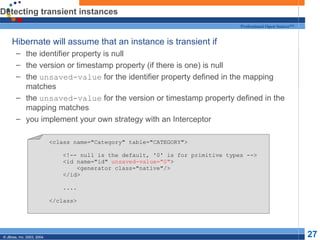
Detecting transient instances Hibernate will assume that an instance is transient if the identifier property is null the version or timestamp property (if there is one) is null the  unsaved-value  for the identifier property defined in the mapping matches the  unsaved-value  for the version or timestamp property defined in the mapping matches you implement your own strategy with an Interceptor <class name=&quot;Category&quot; table=&quot;CATEGORY&quot;> <!-- null is the default, '0' is for primitive types --> <id name=&quot;id&quot;  unsaved-value=&quot;0&quot; > <generator class=&quot;native&quot;/> </id> .... </class>

04 Data Access

  • 1.
    Data Access withHibernate Persistent objects and persistence contexts
  • 2.
    Object state transitionsand Session methods Transient Persistent Detached new garbage garbage delete() save() saveOrUpdate() get() load() find() iterate() etc. evict() close()* clear()* update() saveOrUpdate() lock() * affects all instances in a Session
  • 3.
    Transient objects Transientinstances instances of a persistent class instantiated with the new operator transient , they have no persistent state garbage collected if dereferenced by the application have no database identity Transient instances may be made persistent by calling Session.save(object) creating a reference from another instance that is already persistent
  • 4.
    Persistent objects Persistentinstances include any instance retrieved with a query, lookup by identifier or navigation are managed , changes are automatically flushed to the database are transactional , changes can be rolled back in the database only have database identity Persistent instances may be made transient by calling Session.delete(object) “ orphan delete” (later)
  • 5.
    Detached objects Detachedinstances are instances with database identity that are not associated with any open Session are no longer managed by Hibernate represent database state, that is potentially stale Persistent instances become detached by calling Session.evict(object) clearing the Session Session.clear() closing the Session Session.close() Detached instances become persistent by calling Session.lock(object, lockMode) calling Session.update(object, lockMode) creating a reference from another instance that is already persistent
  • 6.
    The scope ofobject identity It is extremely important to understand the differences between Java object identity: a == b Database identity: a.getId().equals(b.getId() The conditions when both are equivalent is called the scope of object identity ! Hibernate implements session-scoped identity – the two notions of identity are equivalent for instances associated with a particular session.
  • 7.
    The Hibernate identityscope Session session1 = sf.openSession(); Transaction tx1 = session.beginTransaction(); Object a = session1.load(Category.class, new Long(1234) ); Object b = session1.load(Category.class, new Long(1234) ); if ( a == b ) System.out.println(&quot;a and b are identicial and the same database identity.&quot;); tx1.commit(); session1.close(); Session session2 = sf.openSession(); Transaction tx2 = session.beginTransaction(); Object b2 = session2.load(Category.class, new Long(1234) ); if ( a != b2 ) System.out.println(&quot;a and b2 are not identical.&quot;); tx2.commit(); session2.close();
  • 8.
    Outside of theidentity scope In an instance becomes detached , it leaves the scope of object identity. So, if we use detached instances in our application, we should not use == to test for identity. What should we use instead?
  • 9.
    Identity and equalitycontracts Do we have to implement equals() and hashCode() ? the default implementation uses Java object identity no good for detached objects especially not if we put them in collections: Session session1 = sf.openSession(); Transaction tx1 = session.beginTransaction(); Object itemA = session1.load(Item.class, new Long( 1234 ) ); tx1.commit(); session1.close(); Session session2 = sf.openSession(); Transaction tx2 = session.beginTransaction(); Object itemB = session2.load(Item.class, new Long( 1234 ) ); tx2.commit(); session2.close(); Set allObjects = new HashSet(); allObjects.add(itemA); allObjects.add(itemB); System.out.println(allObjects.size()); // How many elements?
  • 10.
    Implementing equals() and hashCode() Could we compare identifiers? for entities with surrogate keys, it is uninitialized for transient instances identity of the instance changes when it becomes persistent, contrary to the contract of java.util.Set (the hashcode changes) Could we compare all properties except for the surrogate key? identity of the instance changes when we modify the object, contrary to the contract of java.util.Set (the hashcode changes) could potentially cause initialization of a whole graph of associated objects, just to evaluate equals() two instances with the same database identity might not be equal! Can two instances with different database identity be equal? We need a business key .
  • 11.
    Using business keysfor equality A business key is a property or a combination of properties that is unique for each instance with the same database identity unique, constant and not null only for the comparison time span public class Item { public boolean equals(Object other) { if (this == other) return true; if (!(other instanceof Item)) return false; final Item item = (Item) other; if (! getSummary() .equals(item.getSummary())) return false; if (! getCreated() .equals(item.getCreated())) return false; return true; } public int hashCode() { int result; result = getSummary() .hashCode(); return 29 * result + getCreated() .hashCode(); } }
  • 12.
    The Hibernate SessionThe Hibernate Session is the persistence manager interface for basic CRUD (create, read, update, delete) operations (Session) query execution (Session, Query, Criteria) control of transactions (Transaction) management of the transaction-level cache At the beginning of a unit-of-work, the application thread looks up the SessionFactory obtains a Session A SessionFactory is expensive to create, a Session is not! In fact, a Session only obtains a JDBC connection when needed.
  • 13.
    Making an objectpersistent Hibernate executes SQL only as neccessary, in this case, when the Transaction is committed. Hibernate uses a transaction-scope write-behind strategy. User user = new User(); user.getName().setFirstName(&quot;John&quot;); user.getName().setLastName(&quot;Doe&quot;); Session session = sessions.openSession(); Transaction tx = session.beginTransaction(); session.save(user); tx.commit(); session.close();
  • 14.
    Updating a detachedinstance The call to update() attaches the detached instance with the new Session, it doesn't matter if it's modified before or after the update() . The version check occurs when the transaction commits and Hibernate executes SQL. user.setPassword(&quot;secret&quot;); Session sessionTwo = sessions.openSession(); Transaction tx = sessionTwo.beginTransaction(); sessionTwo.update(user); user.setLoginName(&quot;jonny&quot;); tx.commit(); sessionTwo.close();
  • 15.
    Locking a detachedinstance Changes made before the call to lock() are not synchronized with the database. In this example, we don't even perform a version check ( LockMode.NONE ), only reattach the object. If we specifty Lockmode.READ or LockMode.UPGRADE, Hibernate would execute a SELECT statement in order to perform a version check( and to set an upgrade lock). Session sessionTwo = sessions.openSession(); Transaction tx = sessionTwo.beginTransaction(); sessionTwo.lock(user, LockMode.NONE); user.setPassword(&quot;secret&quot;); user.setLoginName(&quot;jonny&quot;); tx.commit(); sessionTwo.close();
  • 16.
    Retrieving objects Objectslooked up by their identifier value are associated with a Session and automatically dirty-checked inside a Session. Session session = sessions.openSession(); Transaction tx = session.beginTransaction(); int userID = 1234; User user = session.get (User.class, new Long(userID)); // &quot;user&quot; might be null if it doesn't exist tx.commit(); session.close();
  • 17.
    Making a persistentobject transient Deleted objects are transient after the Session is closed and will be garbage collected if they are no longer referenced by other objects Session session = sessions.openSession(); Transaction tx = session.beginTransaction(); int userID = 1234; User user = session.get(User.class, new Long(userID)); session.delete(user); tx.commit(); session.close();
  • 18.
    Making a detachedobject transient Detached objects can be directly reattached and scheduled for deletion in a single call. Session session = sessions.openSession(); Transaction tx = session.beginTransaction(); session.delete(user); tx.commit(); session.close();
  • 19.
    Persistence by reachabilityAn object becomes persistence if it is referenced: Transient Persistent Persistent by Reachability Electronics: Category Cell Phones: Category Computer: Category Desktop PCs: Category Monitors: Category
  • 20.
    Association cascade stylesHibernate supports more flexible cascading options for associations: none : Hibernate ignores the association save-update : Hibernate saves new and updates detached instances delete : Hibernate deletes associated instances all : save-update and delete all-delete-orphans : Hibernate will delete dereferenced instances Cascading options can be declared on an association-basis. This model is more flexible but more complex model than persistence by reachability. This model allows fine-grained reattachment of detached instances (sounds impressive?)...
  • 21.
    Association cascade stylesLet’s enable transitive persistence for the Category hierarchy: Usually, we apply cascade only for to-many associations. Note that cascade is a recursive notion! <class name=“Category” … > … <many-to-one name=“parentCategory” column=“PARENT_ID” cascade=“none” /> <set name=“childCategories” cascade=“save-update” … > <key column=“PARENT_ID”/> <one-to-many class=“Category”/> </set> </class>
  • 22.
    Adding a newcategory to object graph Computer: Category Laptops : Category Electronics: Category Cell Phones: Category Desktop PCs: Category Monitors: Category
  • 23.
    Association cascade stylesThere are several ways to create this new “Laptops” object and save it in the database. We could go back to the database and retrieve the “Computer” category to which our New “Laptops” category will belong, and the new category and commit the transaction Session session = sessions.openSession(); Transaction tx = session.begnTransaction(); Category computer = (Category)session.get(Category.class,computerID); Category laptops = new Category(“Laptops”); Compter.getChildCategories().add(laptops); Laptops.setParentCategory(computer); tx.commit(); session.close(); The computer instance is persisted(attached to a session), and the childCategoryies assoication has cascade save enabled. Hence, this code results in the new laptops category becoming persistent when tx.commit() is called, because Hibernate cascades the dirty-checking operation to the children of computer. Hibrnate executes an insert statement
  • 24.
    Association cascade stylesLet’s do the same thing again, but this time create the link between “ Computer” and “Laptops” outside of any transaction. (In a real application, it’s useful to manipulate an object graph in a presentation tier – for example, before passing the graph back to the persistence layer to make the changes persistent. Category computer = …. // Loaded in a previous session Category laptops = new Category(“Laptops”); computer.getChildCategories().add(laptops); laptops.setParentCategory(computer); The detached computer object and any other detached objects it refers to are now associated with the new transient laptops object(and vice versa).
  • 25.
    Association cascade stylesWe make the changes to the object graph persistent by saving the new object in a second Hibernate session: Hibernate will inspect the database identifier property of the parent category of laptops and correctly create the relationship to the “Computer” category in the database. Hibernate also inserts the identifier value of the parent into the foreigh key field of the new “Laptops” row in CATEGORY. Since cascade=“none” is defined for the parentCategory association, Hibernate ignores changes to any other categories in the hierachy (“Electoronics”) Session session = sessions.openSession(); Transaction tx = session.beginTransaction(); //persist one new category and the link to its parent category session.save(laptops); tx.commit(); session.close();
  • 26.
    Automatic save orupdate for detached object graphs If we don’t know if something is detached or transient: Hibernate will walk the graph, starting at the “root” object passed to saveOrUpdate(), navigating to all associated entities where the association is declared cascade=&quot;save-update“ . Hibernate will decide if each object in the graph needs to be inserted or updated. Session session = sessionFactory.openSession(); Transaction tx = session.beginTransaction(); // Let Hibernate decide whats new and whats detached session.saveOrUpdate(theRootObjectOfGraph); tx.commit(); session.close();
  • 27.
    Detecting transient instancesHibernate will assume that an instance is transient if the identifier property is null the version or timestamp property (if there is one) is null the unsaved-value for the identifier property defined in the mapping matches the unsaved-value for the version or timestamp property defined in the mapping matches you implement your own strategy with an Interceptor <class name=&quot;Category&quot; table=&quot;CATEGORY&quot;> <!-- null is the default, '0' is for primitive types --> <id name=&quot;id&quot; unsaved-value=&quot;0&quot; > <generator class=&quot;native&quot;/> </id> .... </class>