Transaction and Concurrency Session - III
TRANSACTION – FAST BRUSH UP Atomicity  – refers to the ability that, either all of the tasks of a transaction are performed or none of them are. Consistency  - refers to the database being in a legal state when the transaction begins and when it ends. Isolation  - refers to the ability of the application to make operations in a transaction appear isolated from all other operations. Durability  - refers to the guarantee that once the user has been notified of success, the transaction will persist, and not be undone.
Programmatic Transaction Demarcation java.sql.Connection  – To be avoid in Hibernate application as it binds to plain JDBC environment. javax.transaction.UserTransaction  –  should be used in  Java EE application/JTA supported environment. org.hibernate.Transaction  – Unified transaction demarcation for Hibernate application; works both in managed and non-managed.
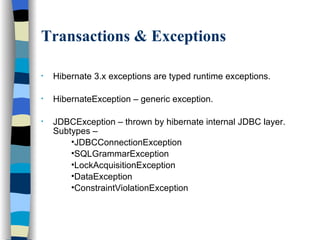
Transactions & Exceptions Hibernate 3.x exceptions are typed runtime exceptions. HibernateException – generic exception. JDBCException – thrown by hibernate internal JDBC layer. Subtypes – JDBCConnectionException SQLGrammarException LockAcquisitionException  DataException ConstraintViolationException
Hibernate typed exceptions All exceptions throws by Hibernate are RuntimeException and are fatal exceptions. It is the programmers responsibility in non-managed environment to  rollback the transaction in case of exceptions.
Concurrency Strategies Hibernate never changes the Isolation level of connections obtained from Application server. Optimistic   Versioning – Numeric Version Field   Timestamp based   Without an additional field (not recommended) Pessimistic   Achieved with LockMode.UPGRADE or LockMode.UPGRADE_NOWAIT
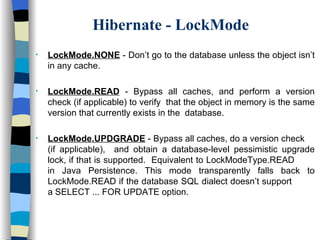
Hibernate - LockMode LockMode.NONE  - Don’t go to the database unless the object isn’t in any cache. LockMode.READ  - Bypass all caches, and perform a version check (if applicable) to verify  that the object in memory is the same version that currently exists in the  database. LockMode.UPDGRADE  - Bypass all caches, do a version check  (if applicable),  and obtain a database-level pessimistic upgrade lock, if that is supported.  Equivalent to LockModeType.READ  in Java Persistence. This mode transparently falls back to LockMode.READ if the database SQL dialect doesn’t support  a SELECT ... FOR UPDATE option.
LockMode.UPDGRADE_NOWAIT - The same as UPGRADE, but use a SELECT ...  FOR UPDATE NOWAIT, if supported. This disables waiting for concurrent lock  releases, thus throwing a locking exception immediately if the lock can’t be  obtained. LockMode.FORCE  - Force an increment of the objects version in the data-base, to indicate that it has been modified by the current transaction. Hibernate – Lock Mode (Cont..)

Hibernate Session 3

  • 1.
  • 2.
    TRANSACTION – FASTBRUSH UP Atomicity – refers to the ability that, either all of the tasks of a transaction are performed or none of them are. Consistency - refers to the database being in a legal state when the transaction begins and when it ends. Isolation - refers to the ability of the application to make operations in a transaction appear isolated from all other operations. Durability - refers to the guarantee that once the user has been notified of success, the transaction will persist, and not be undone.
  • 3.
    Programmatic Transaction Demarcationjava.sql.Connection – To be avoid in Hibernate application as it binds to plain JDBC environment. javax.transaction.UserTransaction – should be used in Java EE application/JTA supported environment. org.hibernate.Transaction – Unified transaction demarcation for Hibernate application; works both in managed and non-managed.
  • 4.
    Transactions & ExceptionsHibernate 3.x exceptions are typed runtime exceptions. HibernateException – generic exception. JDBCException – thrown by hibernate internal JDBC layer. Subtypes – JDBCConnectionException SQLGrammarException LockAcquisitionException DataException ConstraintViolationException
  • 5.
    Hibernate typed exceptionsAll exceptions throws by Hibernate are RuntimeException and are fatal exceptions. It is the programmers responsibility in non-managed environment to rollback the transaction in case of exceptions.
  • 6.
    Concurrency Strategies Hibernatenever changes the Isolation level of connections obtained from Application server. Optimistic Versioning – Numeric Version Field Timestamp based Without an additional field (not recommended) Pessimistic Achieved with LockMode.UPGRADE or LockMode.UPGRADE_NOWAIT
  • 7.
    Hibernate - LockModeLockMode.NONE - Don’t go to the database unless the object isn’t in any cache. LockMode.READ - Bypass all caches, and perform a version check (if applicable) to verify that the object in memory is the same version that currently exists in the database. LockMode.UPDGRADE - Bypass all caches, do a version check (if applicable), and obtain a database-level pessimistic upgrade lock, if that is supported. Equivalent to LockModeType.READ in Java Persistence. This mode transparently falls back to LockMode.READ if the database SQL dialect doesn’t support a SELECT ... FOR UPDATE option.
  • 8.
    LockMode.UPDGRADE_NOWAIT - Thesame as UPGRADE, but use a SELECT ... FOR UPDATE NOWAIT, if supported. This disables waiting for concurrent lock releases, thus throwing a locking exception immediately if the lock can’t be obtained. LockMode.FORCE - Force an increment of the objects version in the data-base, to indicate that it has been modified by the current transaction. Hibernate – Lock Mode (Cont..)