This project has received funding from European
Union’s Horizon 2020 Research and Innovation
Programme under Grant Agreement No 101007990.
Virtual health and Wellbeing Living Lab Infrastructure
Commercialization of
Innovation Pathway
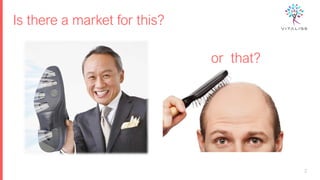
Is there a market for this?
2
or that?
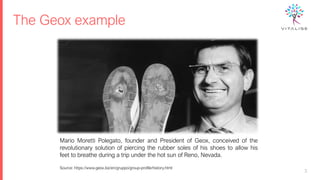
The Geox example
3
Mario Moretti Polegato, founder and President of Geox, conceived of the
revolutionary solution of piercing the rubber soles of his shoes to allow his
feet to breathe during a trip under the hot sun of Reno, Nevada.
Source: https://www.geox.biz/en/gruppo/group-profile/history.html
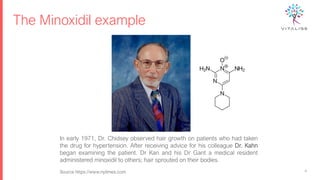
The Minoxidil example
4
In early 1971, Dr. Chidsey observed hair growth on patients who had taken
the drug for hypertension. After receiving advice for his colleague Dr. Kahn
began examining the patient. Dr Kan and his Dr Gant a medical resident
administered minoxidil to others; hair sprouted on their bodies.
Source https://www.nytimes.com
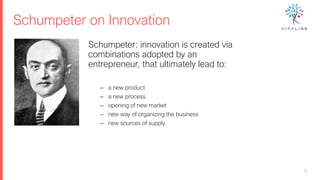
Schumpeter on Innovation
Schumpeter: innovation is created via
combinations adopted by an
entrepreneur, that ultimately lead to:
– a new product
– a new process
– opening of new market
– new way of organizing the business
– new sources of supply
5
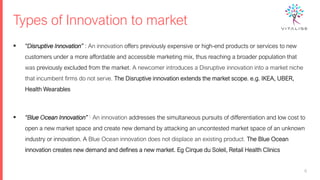
Types of Innovation to market
▪ “Disruptive Innovation” : An innovation offers previously expensive or high-end products or services to new
customers under a more affordable and accessible marketing mix, thus reaching a broader population that
was previously excluded from the market. A newcomer introduces a Disruptive innovation into a market niche
that incumbent firms do not serve. The Disruptive innovation extends the market scope. e.g. IKEA, UBER,
Health Wearables
▪ “Blue Ocean Innovation” : An innovation addresses the simultaneous pursuits of differentiation and low cost to
open a new market space and create new demand by attacking an uncontested market space of an unknown
industry or innovation. A Blue Ocean innovation does not displace an existing product. The Blue Ocean
innovation creates new demand and defines a new market. Eg Cirque du Soleil, Retail Health Clinics
6
7
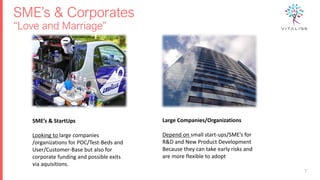
SME’s & StartUps
Looking to large companies
/organizations for POC/Test-Beds and
User/Customer-Base but also for
corporate funding and possible exits
via aquisitions.
Large Companies/Organizations
Depend on small start-ups/SME’s for
R&D and New Product Development
Because they can take early risks and
are more flexible to adopt
SME’s & Corporates
“Love and Marriage”
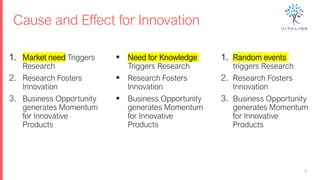
Cause and Effect for Innovation
▪ Need for Knowledge
Triggers Research
▪ Research Fosters
Innovation
▪ Business Opportunity
generates Momentum
for Innovative
Products
8
1. Market need Triggers
Research
2. Research Fosters
Innovation
3. Business Opportunity
generates Momentum
for Innovative
Products
1. Random events
triggers Research
2. Research Fosters
Innovation
3. Business Opportunity
generates Momentum
for Innovative
Products
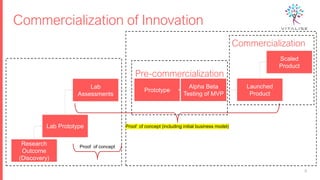
Commercialization of Innovation
9
Research
Outcome
(Discovery)
Lab Prototype
Lab
Assessments
Prototype
Alpha Beta
Testing of MVP
Launched
Product
Scaled
Product
Pre-commercialization
Commercialization
Proof of concept
Proof of concept (including initial business model)
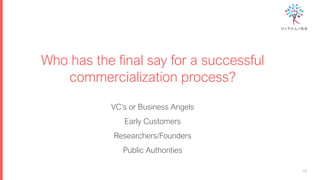
Who has the final say for a successful
commercialization process?
10
VC’s or Business Angels
Early Customers
Researchers/Founders
Public Authorities
11
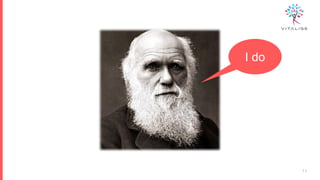
I do
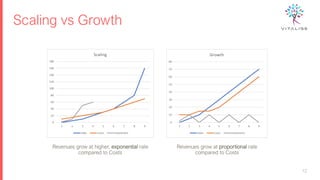
Scaling vs Growth
12
Revenues grow at higher, exponential rate
compared to Costs
Revenues grow at proportional rate
compared to Costs
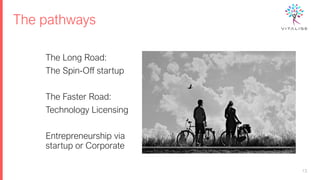
The pathways
13
The Long Road:
The Spin-Off startup
The Faster Road:
Technology Licensing
Entrepreneurship via
startup or Corporate
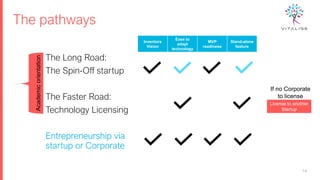
The pathways
14
The Long Road:
The Spin-Off startup
The Faster Road:
Technology Licensing
Entrepreneurship via
startup or Corporate
Academic
orientation Inventors
Vision
Ease to
adapt
technology
MVP
readiness
Stand-alone
feature
License to another
Startup
If no Corporate
to license
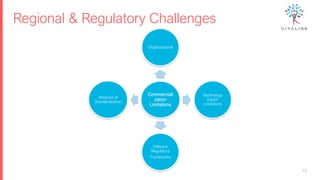
Regional & Regulatory Challenges
15
Commerciali
zation
Limitations
Organizational
Technology
Export
Limitations
Different
Regulatory
Frameworks
Absence of
Standardization
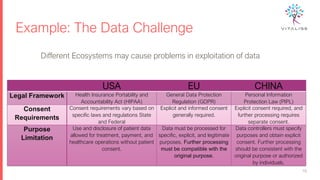
Example: The Data Challenge
16
USA EU CHINA
Legal Framework Health Insurance Portability and
Accountability Act (HIPAA)
General Data Protection
Regulation (GDPR)
Personal Information
Protection Law (PIPL)
Consent
Requirements
Consent requirements vary based on
specific laws and regulations State
and Federal
Explicit and informed consent
generally required.
Explicit consent required, and
further processing requires
separate consent.
Purpose
Limitation
Use and disclosure of patient data
allowed for treatment, payment, and
healthcare operations without patient
consent.
Data must be processed for
specific, explicit, and legitimate
purposes. Further processing
must be compatible with the
original purpose.
Data controllers must specify
purposes and obtain explicit
consent. Further processing
should be consistent with the
original purpose or authorized
by individuals.
Different Ecosystems may cause problems in exploitation of data
Startup = great idea - reality
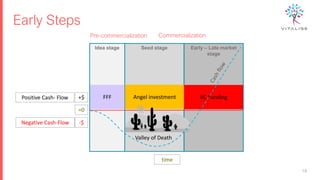
Early Steps
18
18
Pre-commercialization Commercialization
Idea stage Seed stage Early – Late market
stage
+$
time
-$
Angel investment
FFF VC Funding
Positive Cash- Flow
Negative Cash-Flow
Valley of Death
=0
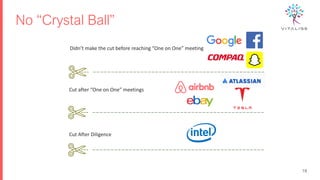
Cut after “One on One” meetings
Cut After Diligence
Didn’t make the cut before reaching “One on One” meeting
19
No “Crystal Ball”
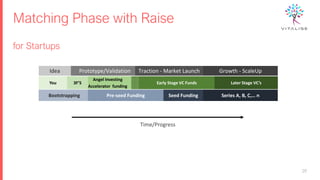
Matching Phase with Raise
for Startups
20
Bootstrapping
Angel Investing
Accelerator funding
3F’S Early Stage VC Funds Later Stage VC’s
Pre-seed Funding Seed Funding Series A, B, C,… n
You
Prototype/Validation
Idea Traction - Market Launch Growth - ScaleUp
Time/Progress
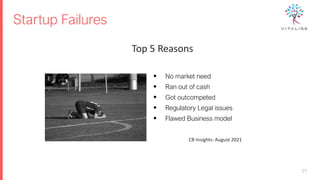
Startup Failures
21
▪ No market need
▪ Ran out of cash
▪ Got outcompeted
▪ Regulatory Legal issues
▪ Flawed Business model
Top 5 Reasons
CB Insights: August 2021
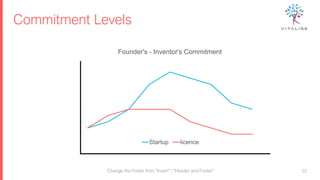
Commitment Levels
Change the Footer from "Insert" / "Header and Footer" 22
Founder's - Inventor's Commitment
Startup licence
An Alternate to Startup:
Licensing a service/Technology
23
▪ Cost Based (Costs associated to develop IP)
Not the greatest one
▪ Market Value (Comparables)
In the case you make changes in the technology since the signing of the contract
▪ Income Approach
“25% Rule” Royalties should be no more than ¼ of Net profit or
Apply DCF method
Tech Licensing Failures
Change the Footer from "Insert" / "Header and Footer" 24
▪ Absence of Minimum Performance Clause
In the case the Licensee does not do anything with the technology
▪ Unprotected Improvements of Technology
In the case you make changes in the technology since the signing of the contract
▪ Absence of Product Liability
Who’s liable when something goes wrong?
▪ Loss of IP control
Especially in remote areas difficult to check
▪ Creation of a Competitor
What if the Licensee turns to a formidable one?
▪ Sublicence Disagreements
Licensee company may need to cooperate with third parties, therefore ask for sublicence rights
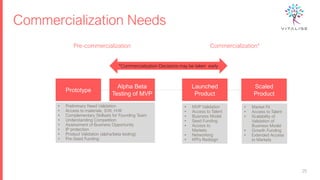
Commercialization Needs
25
25
Prototype
Alpha Beta
Testing of MVP
Launched
Product
Scaled
Product
Pre-commercialization Commercialization*
• Preliminary Need Validation
• Access to materials, S/W, H/W
• Complementary Skillsets for Founding Team
• Understanding Competition
• Assessment of Business Opportunity
• IP protection
• Product Validation (alpha/beta testing)
• Pre-Seed Funding
• MVP Validation
• Access to Talent
• Business Model
• Seed Funding
• Access to
Markets
• Networking
• KPI’s Redisign
• Market Fit
• Access to Talent
• Scalability of
Validation of
Business Model
• Growth Funding
• Extended Access
to Markets
*Commercialization Decisions may be taken early
Commercialization Strategy may start with abstract thoughts but applying
logic and market parameters early may save the inventors/researchers from a
lot of trouble or waste of time and other resources
26
26
Commercialization Ambitions < Reality
27
27
…sometimes though…
Dreams > Reality
28
28
This project has received funding from European Union’s Horizon 2020 Research and Innovation Programme under Grant Agreement No 101007990.
Contact us
Online presence
https://vitalise-project.eu
https://twitter.com/VITALISEproject
https://www.facebook.com/VITALISEproject/
https://www.linkedin.com/company/vitalise-project/
Subscribe to our newsletter:
European Network of Living Labs (ENoLL)
https://enoll.org/
https://openlivinglabdays.com/
info@vitalise-project.eu
Project coordinator:
Dr. Evdokimos Konstantinidis
Scientific coordinator:
Prof. Panos Bamidis
Argyrios Spyridis, Anthology Ventures
as@anthologyventures.com

VITALISE Bootcamp - Commercialization Pathway.pdf

  • 1.
    This project hasreceived funding from European Union’s Horizon 2020 Research and Innovation Programme under Grant Agreement No 101007990. Virtual health and Wellbeing Living Lab Infrastructure Commercialization of Innovation Pathway
  • 2.
    Is there amarket for this? 2 or that?
  • 3.
    The Geox example 3 MarioMoretti Polegato, founder and President of Geox, conceived of the revolutionary solution of piercing the rubber soles of his shoes to allow his feet to breathe during a trip under the hot sun of Reno, Nevada. Source: https://www.geox.biz/en/gruppo/group-profile/history.html
  • 4.
    The Minoxidil example 4 Inearly 1971, Dr. Chidsey observed hair growth on patients who had taken the drug for hypertension. After receiving advice for his colleague Dr. Kahn began examining the patient. Dr Kan and his Dr Gant a medical resident administered minoxidil to others; hair sprouted on their bodies. Source https://www.nytimes.com
  • 5.
    Schumpeter on Innovation Schumpeter:innovation is created via combinations adopted by an entrepreneur, that ultimately lead to: – a new product – a new process – opening of new market – new way of organizing the business – new sources of supply 5
  • 6.
    Types of Innovationto market ▪ “Disruptive Innovation” : An innovation offers previously expensive or high-end products or services to new customers under a more affordable and accessible marketing mix, thus reaching a broader population that was previously excluded from the market. A newcomer introduces a Disruptive innovation into a market niche that incumbent firms do not serve. The Disruptive innovation extends the market scope. e.g. IKEA, UBER, Health Wearables ▪ “Blue Ocean Innovation” : An innovation addresses the simultaneous pursuits of differentiation and low cost to open a new market space and create new demand by attacking an uncontested market space of an unknown industry or innovation. A Blue Ocean innovation does not displace an existing product. The Blue Ocean innovation creates new demand and defines a new market. Eg Cirque du Soleil, Retail Health Clinics 6
  • 7.
    7 SME’s & StartUps Lookingto large companies /organizations for POC/Test-Beds and User/Customer-Base but also for corporate funding and possible exits via aquisitions. Large Companies/Organizations Depend on small start-ups/SME’s for R&D and New Product Development Because they can take early risks and are more flexible to adopt SME’s & Corporates “Love and Marriage”
  • 8.
    Cause and Effectfor Innovation ▪ Need for Knowledge Triggers Research ▪ Research Fosters Innovation ▪ Business Opportunity generates Momentum for Innovative Products 8 1. Market need Triggers Research 2. Research Fosters Innovation 3. Business Opportunity generates Momentum for Innovative Products 1. Random events triggers Research 2. Research Fosters Innovation 3. Business Opportunity generates Momentum for Innovative Products
  • 9.
    Commercialization of Innovation 9 Research Outcome (Discovery) LabPrototype Lab Assessments Prototype Alpha Beta Testing of MVP Launched Product Scaled Product Pre-commercialization Commercialization Proof of concept Proof of concept (including initial business model)
  • 10.
    Who has thefinal say for a successful commercialization process? 10 VC’s or Business Angels Early Customers Researchers/Founders Public Authorities
  • 11.
  • 12.
    Scaling vs Growth 12 Revenuesgrow at higher, exponential rate compared to Costs Revenues grow at proportional rate compared to Costs
  • 13.
    The pathways 13 The LongRoad: The Spin-Off startup The Faster Road: Technology Licensing Entrepreneurship via startup or Corporate
  • 14.
    The pathways 14 The LongRoad: The Spin-Off startup The Faster Road: Technology Licensing Entrepreneurship via startup or Corporate Academic orientation Inventors Vision Ease to adapt technology MVP readiness Stand-alone feature License to another Startup If no Corporate to license
  • 15.
    Regional & RegulatoryChallenges 15 Commerciali zation Limitations Organizational Technology Export Limitations Different Regulatory Frameworks Absence of Standardization
  • 16.
    Example: The DataChallenge 16 USA EU CHINA Legal Framework Health Insurance Portability and Accountability Act (HIPAA) General Data Protection Regulation (GDPR) Personal Information Protection Law (PIPL) Consent Requirements Consent requirements vary based on specific laws and regulations State and Federal Explicit and informed consent generally required. Explicit consent required, and further processing requires separate consent. Purpose Limitation Use and disclosure of patient data allowed for treatment, payment, and healthcare operations without patient consent. Data must be processed for specific, explicit, and legitimate purposes. Further processing must be compatible with the original purpose. Data controllers must specify purposes and obtain explicit consent. Further processing should be consistent with the original purpose or authorized by individuals. Different Ecosystems may cause problems in exploitation of data
  • 17.
    Startup = greatidea - reality
  • 18.
    Early Steps 18 18 Pre-commercialization Commercialization Ideastage Seed stage Early – Late market stage +$ time -$ Angel investment FFF VC Funding Positive Cash- Flow Negative Cash-Flow Valley of Death =0
  • 19.
    Cut after “Oneon One” meetings Cut After Diligence Didn’t make the cut before reaching “One on One” meeting 19 No “Crystal Ball”
  • 20.
    Matching Phase withRaise for Startups 20 Bootstrapping Angel Investing Accelerator funding 3F’S Early Stage VC Funds Later Stage VC’s Pre-seed Funding Seed Funding Series A, B, C,… n You Prototype/Validation Idea Traction - Market Launch Growth - ScaleUp Time/Progress
  • 21.
    Startup Failures 21 ▪ Nomarket need ▪ Ran out of cash ▪ Got outcompeted ▪ Regulatory Legal issues ▪ Flawed Business model Top 5 Reasons CB Insights: August 2021
  • 22.
    Commitment Levels Change theFooter from "Insert" / "Header and Footer" 22 Founder's - Inventor's Commitment Startup licence
  • 23.
    An Alternate toStartup: Licensing a service/Technology 23 ▪ Cost Based (Costs associated to develop IP) Not the greatest one ▪ Market Value (Comparables) In the case you make changes in the technology since the signing of the contract ▪ Income Approach “25% Rule” Royalties should be no more than ¼ of Net profit or Apply DCF method
  • 24.
    Tech Licensing Failures Changethe Footer from "Insert" / "Header and Footer" 24 ▪ Absence of Minimum Performance Clause In the case the Licensee does not do anything with the technology ▪ Unprotected Improvements of Technology In the case you make changes in the technology since the signing of the contract ▪ Absence of Product Liability Who’s liable when something goes wrong? ▪ Loss of IP control Especially in remote areas difficult to check ▪ Creation of a Competitor What if the Licensee turns to a formidable one? ▪ Sublicence Disagreements Licensee company may need to cooperate with third parties, therefore ask for sublicence rights
  • 25.
    Commercialization Needs 25 25 Prototype Alpha Beta Testingof MVP Launched Product Scaled Product Pre-commercialization Commercialization* • Preliminary Need Validation • Access to materials, S/W, H/W • Complementary Skillsets for Founding Team • Understanding Competition • Assessment of Business Opportunity • IP protection • Product Validation (alpha/beta testing) • Pre-Seed Funding • MVP Validation • Access to Talent • Business Model • Seed Funding • Access to Markets • Networking • KPI’s Redisign • Market Fit • Access to Talent • Scalability of Validation of Business Model • Growth Funding • Extended Access to Markets *Commercialization Decisions may be taken early
  • 26.
    Commercialization Strategy maystart with abstract thoughts but applying logic and market parameters early may save the inventors/researchers from a lot of trouble or waste of time and other resources 26 26
  • 27.
  • 28.
  • 29.
    This project hasreceived funding from European Union’s Horizon 2020 Research and Innovation Programme under Grant Agreement No 101007990. Contact us Online presence https://vitalise-project.eu https://twitter.com/VITALISEproject https://www.facebook.com/VITALISEproject/ https://www.linkedin.com/company/vitalise-project/ Subscribe to our newsletter: European Network of Living Labs (ENoLL) https://enoll.org/ https://openlivinglabdays.com/ info@vitalise-project.eu Project coordinator: Dr. Evdokimos Konstantinidis Scientific coordinator: Prof. Panos Bamidis Argyrios Spyridis, Anthology Ventures as@anthologyventures.com