Potion, Choices, Action
Environment
Strategic Management
CourseTitle: Strategic Management Course No.: 501
Program: MBA 2.5 EveningSession: 2018-21
Teacher: Liaqat Javed Semester: III, Fall 2019
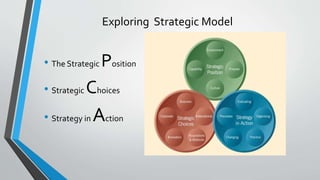
Exploring Strategic Model
• The Strategic Position
• Strategic Choices
• Strategy in Action
Position
• Environment
• Capability
• Purpose
• Culture
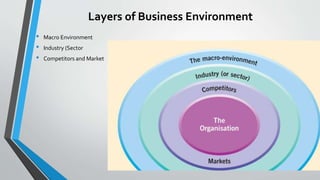
Layers of Business Environment
• Macro Environment
• Industry (Sector
• Competitors and Market
Macro Environment
• The PESTEL framework
• Porter’s Five Force Framework
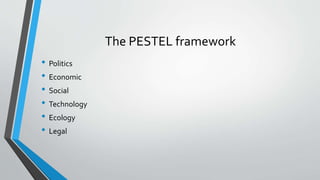
The PESTEL framework
• Politics
• Economic
• Social
• Technology
• Ecology
• Legal
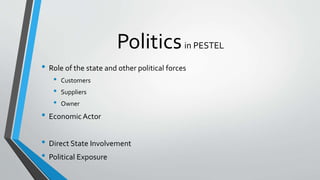
Politicsin PESTEL
• Role of the state and other political forces
• Customers
• Suppliers
• Owner
• EconomicActor
• Direct State Involvement
• Political Exposure
Economicsin PESTEL
• exchange rates, business cycles and
differential economic growth rates around the world
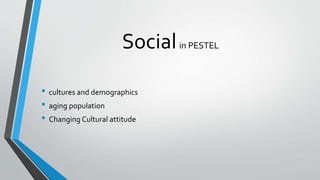
Socialin PESTEL
• cultures and demographics
• aging population
• Changing Cultural attitude
Technologyin PESTEL
• Innovations
• Products
• Process
• Marketing
• Scale
Ecologyin PESTEL
• Physical Environment issues
• Pollution
• Resources and Depletion
• Echo System Balance
Legalin PESTEL
• Laws and Regulations
• Taxes
• Labour and Regulatory Laws
• International Laws
Change Focus: MegaTrends
• large-scale social, economic, political, ecological or technological changes
that are typically slow to form, but which influence many other activities
and views.
• Influence over decades
• Shape other trends
Inflexion Points
• moments when trends shift in direction
• turning sharply upwards or downwards
• Shopping Malls, Branded Clothing, Fast Foods
Weak Signals
• advanced signs of future trends
• helpful in identifying inflexion points
Building Scenario
• Scenario analyses are carried out to allow for different possibilities and help
prevent managers from closing their minds to alternatives.
• plausible alternative views of future business environment development
•
Scenario Planning
• Define scenario Scope
• Identify key drivers for change
• Develop scenario stories
• Identify impacts
• Establishing early warning systems
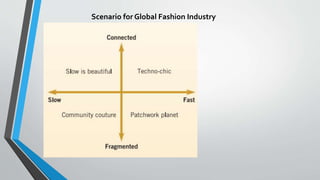
Scenario for Global Fashion Industry
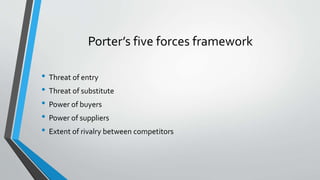
Porter’s five forces framework
• Threat of entry
• Threat of substitute
• Power of buyers
• Power of suppliers
• Extent of rivalry between competitors
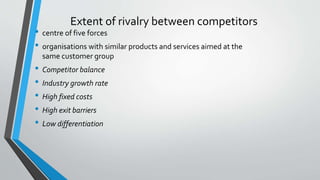
Extent of rivalry between competitors
• centre of five forces
• organisations with similar products and services aimed at the
same customer group
• Competitor balance
• Industry growth rate
• High fixed costs
• High exit barriers
• Low differentiation
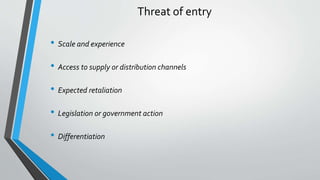
Threat of entry
• Scale and experience
• Access to supply or distribution channels
• Expected retaliation
• Legislation or government action
• Differentiation
Threat of substitute
• The price/performance ratio
• Extra-industry effects
Power of buyers
• Concentrated buyers
• Low switching costs
• Buyer competition threat
Power of suppliers
• Concentrated Suppliers
• Low switching costs
• Supplier competition threat
Types of Industries - Competition
• Monopolistic
• Oligopolistic
• Hypercompetitive
• Perfect Competition
Dynamics of Industry Structure
• Size
• No. of Players
• Proportions
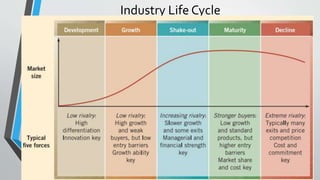
Industry Life Cycle

03. environment

Editor's Notes

  • #14 Ageing population, rapid economic growth, globalization