Enabling circular economy with software:
A multi-level approach to benefits,
requirements, and barriers
10th International Conference on Software Business
November 18.-20., 2019
Juha-Matti Väisänen, Valtteri Ranta, Leena Aarikka-Stenroos
Tampere University, Center for Innovation and Technology Research (CITER)
Agenda
• Introduction
• Background
• Circular Economy
• Digitalization in the Circular Economy
• Research design
• Results
• Implications
• Future Research Avenues
| 1
Introduction
• Firms are facing a growing need to become more environmentally sustainable.
• Climate Change
• Resource scarcity
• Biodiversity loss
• Circular Economy has been identified as an avenue towards more sustainable business
• Also as an opportunity with net economic benefit potential of €1.8 trillion by 2030 in Europe
(McKinsey&Co, 2015)
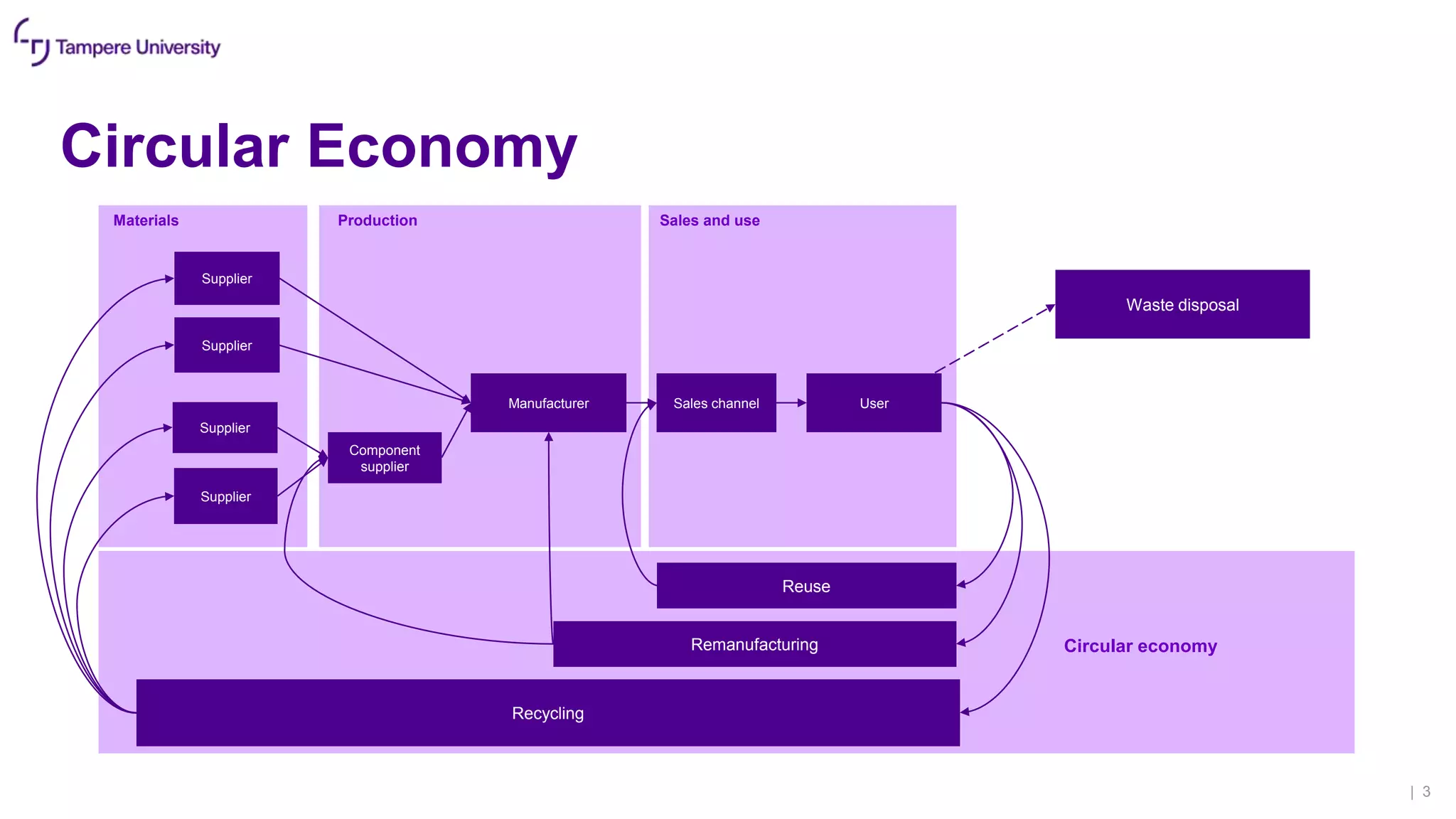
• Circular economy is a systemic change from linear supply chains towards circular supply
chains. New information is needed to implement the transformation
• Digital solutions play a key role in enabling new information flows.
| 2
Circular Economy
| 3
Supplier
Supplier
Supplier
Supplier
Component
supplier
Manufacturer Sales channel User
Materials Production Sales and use
Recycling
Reuse
Remanufacturing Circular economy
Waste disposal
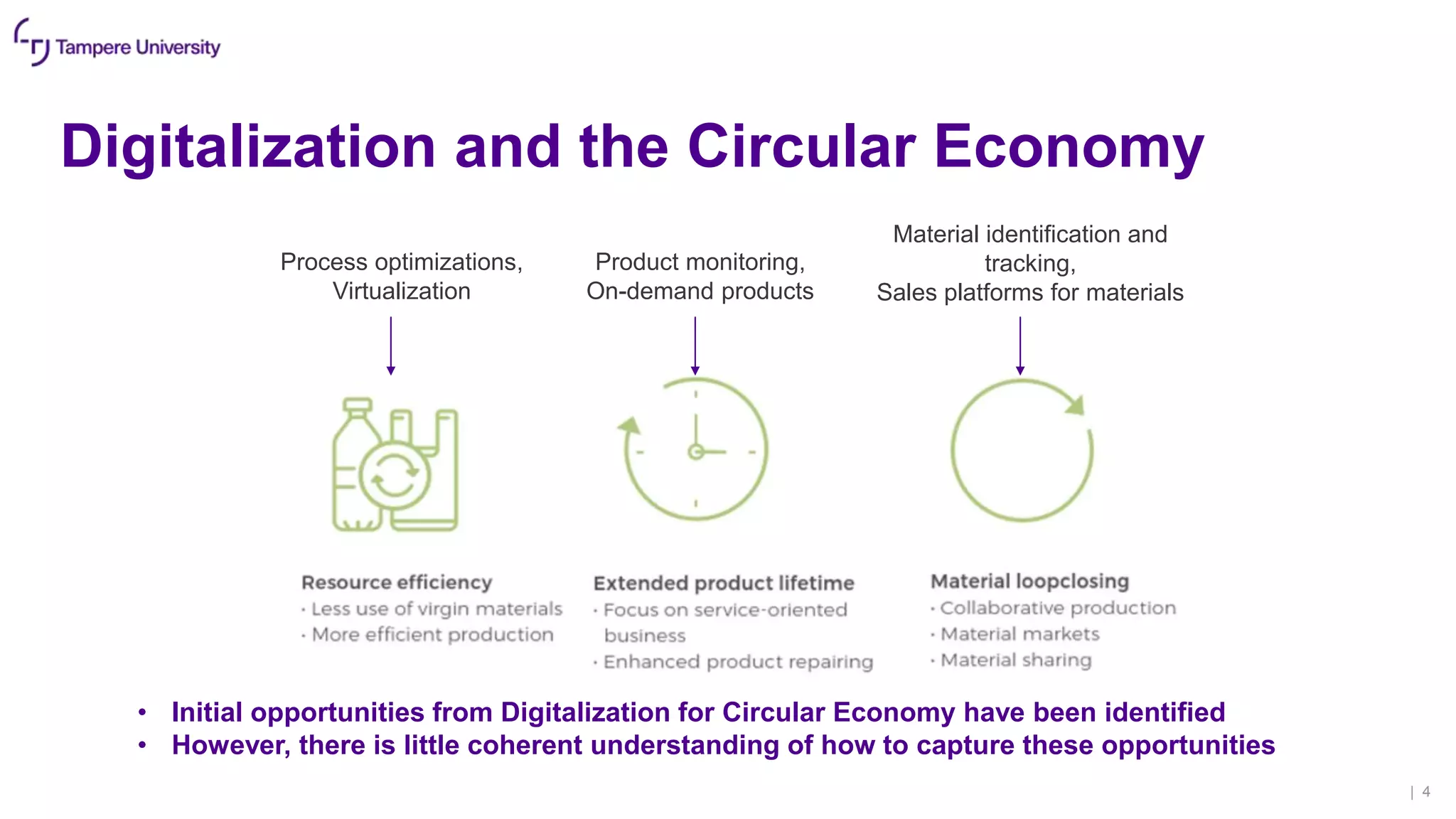
Digitalization and the Circular Economy
| 4
Process optimizations,
Virtualization
Product monitoring,
On-demand products
Material identification and
tracking,
Sales platforms for materials
• Initial opportunities from Digitalization for Circular Economy have been identified
• However, there is little coherent understanding of how to capture these opportunities
Research design
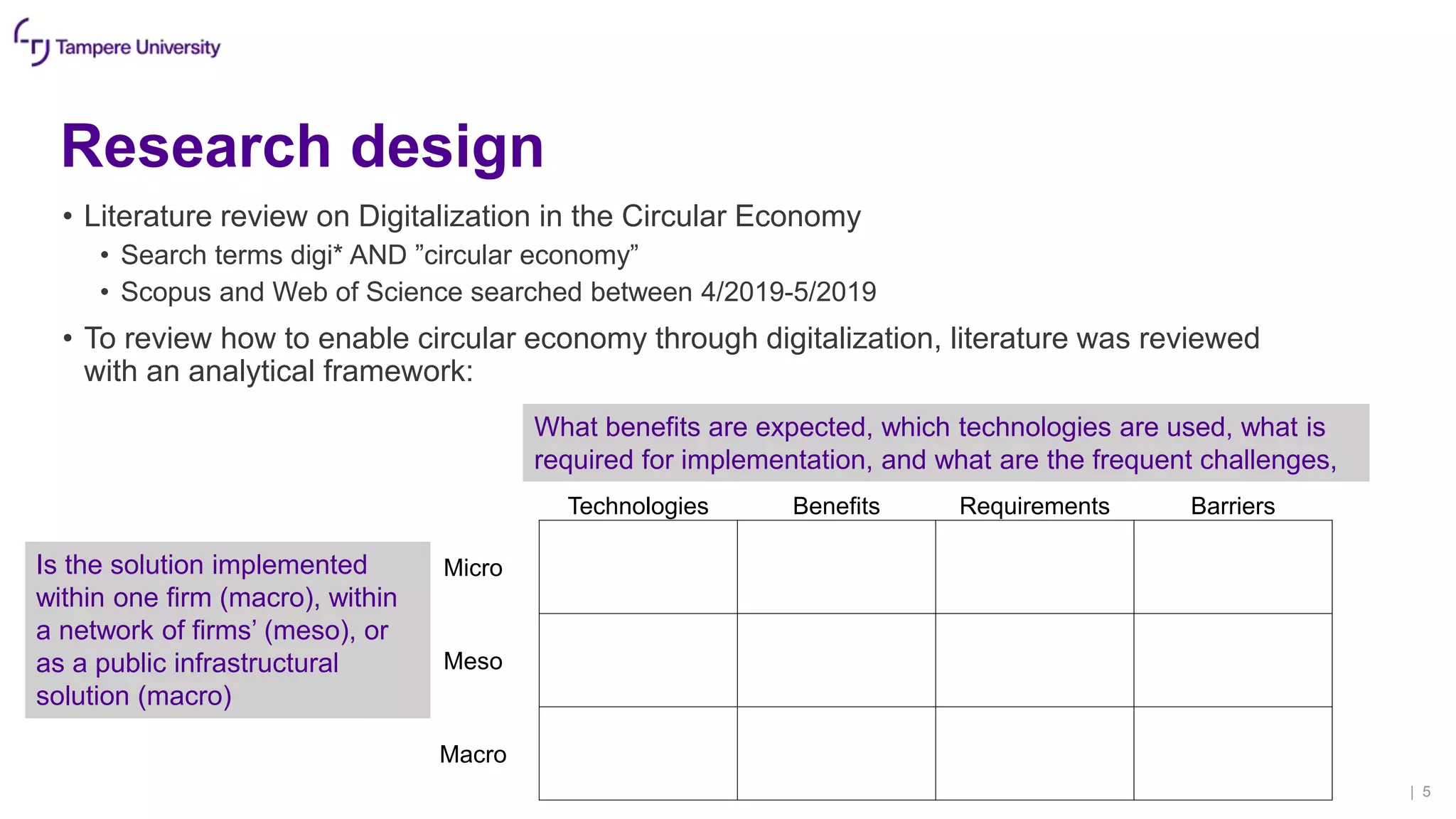
• Literature review on Digitalization in the Circular Economy
• Search terms digi* AND ”circular economy”
• Scopus and Web of Science searched between 4/2019-5/2019
• To review how to enable circular economy through digitalization, literature was reviewed
with an analytical framework:
| 5
Technologies Benefits Requirements Barriers
Micro
Meso
Macro
What benefits are expected, which technologies are used, what is
required for implementation, and what are the frequent challenges,
Is the solution implemented
within one firm (macro), within
a network of firms’ (meso), or
as a public infrastructural
solution (macro)
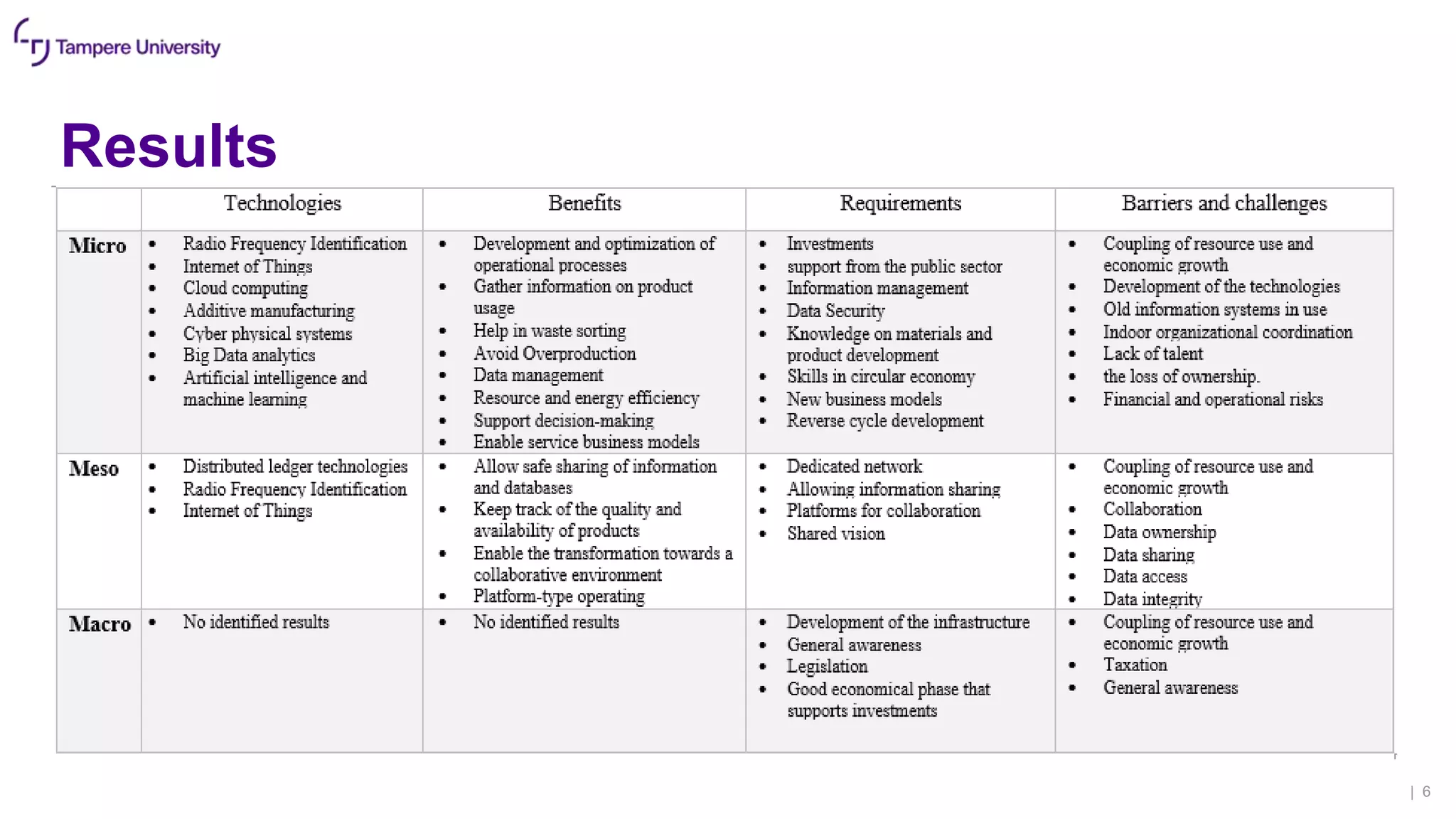
Results
| 6
Implications from the results
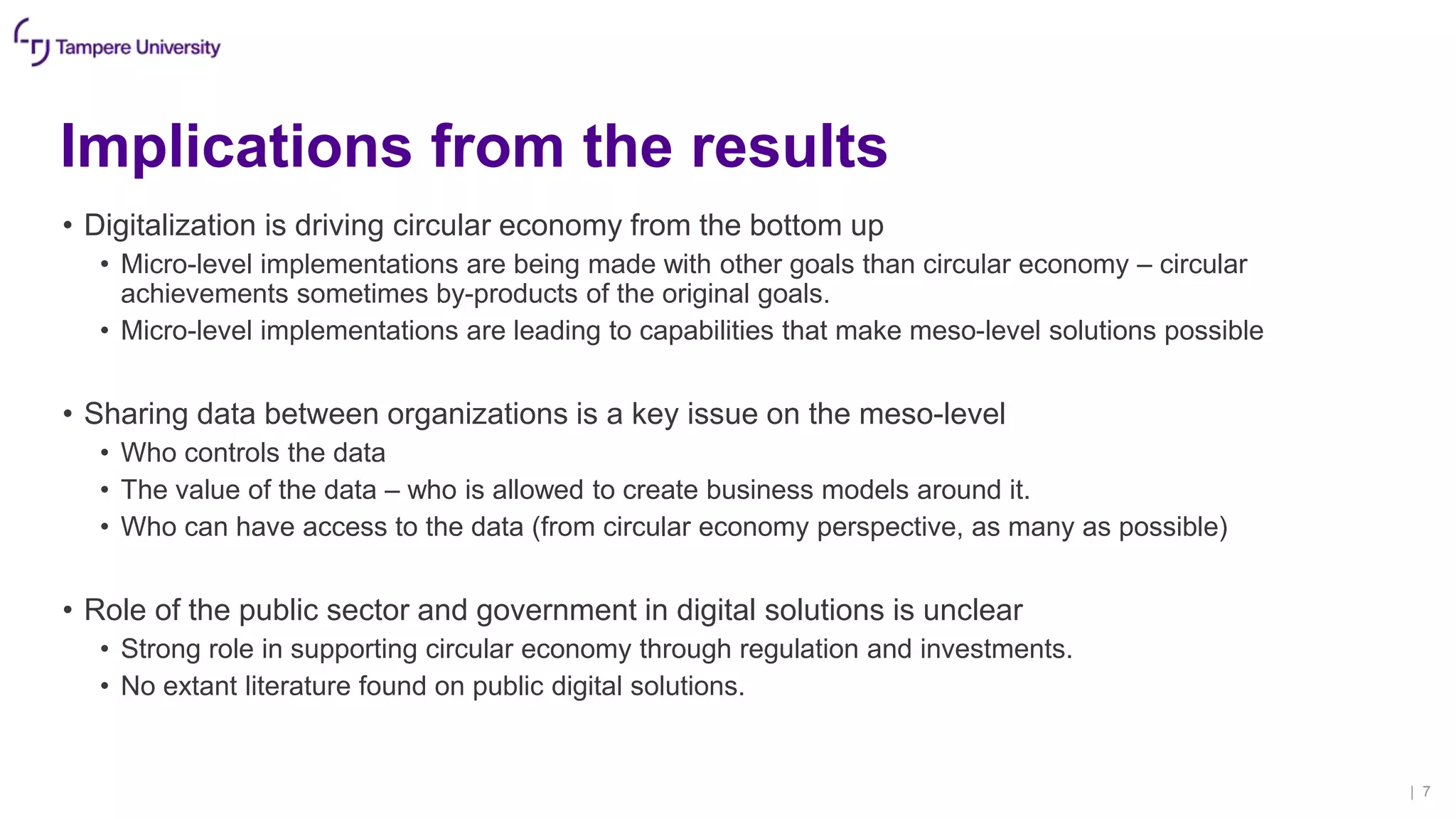
• Digitalization is driving circular economy from the bottom up
• Micro-level implementations are being made with other goals than circular economy – circular
achievements sometimes by-products of the original goals.
• Micro-level implementations are leading to capabilities that make meso-level solutions possible
• Sharing data between organizations is a key issue on the meso-level
• Who controls the data
• The value of the data – who is allowed to create business models around it.
• Who can have access to the data (from circular economy perspective, as many as possible)
• Role of the public sector and government in digital solutions is unclear
• Strong role in supporting circular economy through regulation and investments.
• No extant literature found on public digital solutions.
| 7
Future research avenues
• The phenomenon is young – extant research is mostly conceptual
• Literature found overwhelmingly from 2017 onwards
• Empirical analyses of how digital solutions lead to circular economy related benefits in:
• Digital solutions by single firms
• Identification of forerunners that have the required capabilities in place
• Business ecosystems where a digital solution is implemented by private firms
• Identifying solutions to issues in data sharing: crucial to enable circular economy within systems
• Business ecosystems where a digital solution is implemented by a public organization
• Role of the public sector regarding digital solutions remains unexplored.
| 8
Thank you
Valtteri Ranta
Tampere University
valtteri.ranta@tuni.fi
| 9

Enabling Circular Economy with Software: A Multi-level Approach to Benefits, Requirements and Barriers

  • 1.
    Enabling circular economywith software: A multi-level approach to benefits, requirements, and barriers 10th International Conference on Software Business November 18.-20., 2019 Juha-Matti Väisänen, Valtteri Ranta, Leena Aarikka-Stenroos Tampere University, Center for Innovation and Technology Research (CITER)
  • 2.
    Agenda • Introduction • Background •Circular Economy • Digitalization in the Circular Economy • Research design • Results • Implications • Future Research Avenues | 1
  • 3.
    Introduction • Firms arefacing a growing need to become more environmentally sustainable. • Climate Change • Resource scarcity • Biodiversity loss • Circular Economy has been identified as an avenue towards more sustainable business • Also as an opportunity with net economic benefit potential of €1.8 trillion by 2030 in Europe (McKinsey&Co, 2015) • Circular economy is a systemic change from linear supply chains towards circular supply chains. New information is needed to implement the transformation • Digital solutions play a key role in enabling new information flows. | 2
  • 4.
    Circular Economy | 3 Supplier Supplier Supplier Supplier Component supplier ManufacturerSales channel User Materials Production Sales and use Recycling Reuse Remanufacturing Circular economy Waste disposal
  • 5.
    Digitalization and theCircular Economy | 4 Process optimizations, Virtualization Product monitoring, On-demand products Material identification and tracking, Sales platforms for materials • Initial opportunities from Digitalization for Circular Economy have been identified • However, there is little coherent understanding of how to capture these opportunities
  • 6.
    Research design • Literaturereview on Digitalization in the Circular Economy • Search terms digi* AND ”circular economy” • Scopus and Web of Science searched between 4/2019-5/2019 • To review how to enable circular economy through digitalization, literature was reviewed with an analytical framework: | 5 Technologies Benefits Requirements Barriers Micro Meso Macro What benefits are expected, which technologies are used, what is required for implementation, and what are the frequent challenges, Is the solution implemented within one firm (macro), within a network of firms’ (meso), or as a public infrastructural solution (macro)
  • 7.
  • 8.
    Implications from theresults • Digitalization is driving circular economy from the bottom up • Micro-level implementations are being made with other goals than circular economy – circular achievements sometimes by-products of the original goals. • Micro-level implementations are leading to capabilities that make meso-level solutions possible • Sharing data between organizations is a key issue on the meso-level • Who controls the data • The value of the data – who is allowed to create business models around it. • Who can have access to the data (from circular economy perspective, as many as possible) • Role of the public sector and government in digital solutions is unclear • Strong role in supporting circular economy through regulation and investments. • No extant literature found on public digital solutions. | 7
  • 9.
    Future research avenues •The phenomenon is young – extant research is mostly conceptual • Literature found overwhelmingly from 2017 onwards • Empirical analyses of how digital solutions lead to circular economy related benefits in: • Digital solutions by single firms • Identification of forerunners that have the required capabilities in place • Business ecosystems where a digital solution is implemented by private firms • Identifying solutions to issues in data sharing: crucial to enable circular economy within systems • Business ecosystems where a digital solution is implemented by a public organization • Role of the public sector regarding digital solutions remains unexplored. | 8
  • 10.
    Thank you Valtteri Ranta TampereUniversity valtteri.ranta@tuni.fi | 9