Strategic Planning
HDCS 4393/4394
Internship
Dr. Shirley Ezell
Introduction
• Strategy is the larger vision in a
company that guides the plans for
employees and managers.
• Strategy has its foundation in strategic
thinking. It is the determination of the
long-term goals and objectives of an
organization and the courses of action
and resources necessary for
implementing these goals.
Strategic thinking produces strategies.
• In modern organizations executives
included every level of the organization
in developing and implementing the
overall strategy.
• Strategic planning must anticipate
unexpected events, randomness, and
chaos to provide a good strategy. Good
strategic planning allows a company to
develop a sustainable competitive
advantage.
Introduction (Cont.)
• The earlier history of planning found
organizations using current-year sales, and
environmental trends for 5 to 10 years and basing
their plant, product and investment decisions on
this data within a stable environment.
• The environment changed into one of uncertainty,
intensifying foreign competition, technological
obsolescence, and changing markets and
populations; and, managers turned to strategic
planning.
• Strategic planning is a process that reviews market
conditions, customer needs, competitive strengths
and weaknesses, sociopolitical, legal, and economic
conditions, technological developments, and the
availability of resources to assist the organization in
its planning for opportunities or threats.
• The Strategic Plan includes taking this environmental
information and deciding on a mission, objectives,
strategies and a strategic architecture.
See Figure 6-2 in the readings for a visual diagram of
the process.
Lets look at one strategic plan in
action. Review the
Matsushita process where
department managers provide 3 plans every 6
months:
A five-year plan with technological and
environmental changes, a two-year plan taking
strategies into new products, and a six-month
operating plan that shows monthly projections for
production, sales, profits, inventories, quality
control, and personal requirements.
Organizations need to
reflect to be successful the
critical questions are:
1. What is our business?
2. What should it be?
And these must be answered by top management.
Business Porfolio Matrix
Identify each division, product line -called
strategic business units (SBU’s) which have 4
parts (distinct mission, own competitors, single
business or collection of businesses).
They can be planned independently of other
businesses of the total organization.
Then form a matrix.
What are the Important
Strategic Thinking Frameworks?
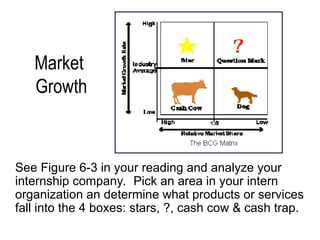
Market
Growth
See Figure 6-3 in your reading and analyze your
internship company. Pick an area in your intern
organization an determine what products or services
fall into the 4 boxes: stars, ?, cash cow & cash trap.
Star is a SBU that has a high share of a high-growth market. They
need a great deal of resources because of growth. When growth
slows they become cash cows.
Cash Cow has a high share of a low-growth market and produces a
good deal of cash for the organization. Since the market is not
growing they do not require a great amount of resources.
Question Mark has a low share of a high-growth market, and the
organization must decide whether to build, phase it out, or
eliminate.
Cash Trap Has a low market share of a low growth market. It may
generate enough cash to maintain itself, or be a drain, but
it does not generate sources of cash.
Definitions
1. Build, if you believe it has the potential to be
a star.
2. Hold, if the SBU is already a successful cash
cow (especially when more cash is needed)
3. Harvest, appropriate for all SBUs except
cash cows.
4. Divest, getting rid of low-growth markets.
So What are your Strategic
Choices using the BCG
Business Porfolio Matrix?
Criticism of this approach
• Market share and market growth are
critical to profitability and sometimes
this finds managers unable to predict
the more profitable project.
• Some other critics contend that
managers focus on what to bring to
market and de-emphasize marketing.
• Also, can this matrix show the many
complex concepts in strategic thinking?
It is widely used across diverse
industries.
2ND
Model: Porter’s Five Forces
Harvard Business School economist
Michael Porter developed a framework
for developing a organization’s strategy.
Five competitive forces are identified:
1. The threat of new entrants
2. The threat of substitute products of services
3. The bargaining power of suppliers
4. The substitute products or services
5. The rivalry among the existing competitors.
He also uses complementors which refers to the dependence
that develops between companies whose products work in
conjunction with each other.
2ND
Model: Porter’s Five Forces
(Cont.)
• The strength of Porter’s model forces varies
in different industries. However, these 5
forces determine profitability since they shape
the firm prices, the costs, the investment
required to compete.
The Strategic Planning Process
1. The process asks manager to ask what they
want the future to be or what they must do to
ensure the ` desired future is achieved.
2. In a high performance organization, strategic
planning never ends.
3. Managers may be involved in the process and
influence it by providing information and
suggestions in their areas of responsibility. They
must know the process and results since their own
department objectives should be derived from the
strategic plan.
Example
One process highlighted was used by Tony Rigato, CEO of
MRM, Inc, a distributor of pneumatic industrial components in
Michigan. He identified 5 questions managers should
consider before the process begins:
1. Do you recognized a need to change?
2. Are you prepared for honest feedback even if it’s painful?
3. Are you willing to change the way you do business and
change yourself?
4. Will you turn the plan into action?
5. Do you have the guts to lead your company into
uncharted waters?
The Components of the
Strategic Process include:
1. Assessing the Organization’s Environment
2. Establishing an Organizational Mission
3. Establishing Organizational Goals and Objectives
4. Setting Operating Strategies.
Review the reading descriptions of these components.
Organizational strategies are the general approaches
used to achieve the organizational objectives. These
strategies include differentiation, low cost, and niche.
Review the descriptions of these strategies.
It is important to remember that if an
organization's strategic plan is properly executed,
the scope, range, issues, and time perspectives
will differ from department to department. But all
the plans will be derived from the strategic plan
and this will guide the achievement.

02StrategicPlanning presentation for beginners

  • 1.
  • 2.
    Introduction • Strategy isthe larger vision in a company that guides the plans for employees and managers. • Strategy has its foundation in strategic thinking. It is the determination of the long-term goals and objectives of an organization and the courses of action and resources necessary for implementing these goals. Strategic thinking produces strategies.
  • 3.
    • In modernorganizations executives included every level of the organization in developing and implementing the overall strategy. • Strategic planning must anticipate unexpected events, randomness, and chaos to provide a good strategy. Good strategic planning allows a company to develop a sustainable competitive advantage. Introduction (Cont.)
  • 4.
    • The earlierhistory of planning found organizations using current-year sales, and environmental trends for 5 to 10 years and basing their plant, product and investment decisions on this data within a stable environment. • The environment changed into one of uncertainty, intensifying foreign competition, technological obsolescence, and changing markets and populations; and, managers turned to strategic planning.
  • 5.
    • Strategic planningis a process that reviews market conditions, customer needs, competitive strengths and weaknesses, sociopolitical, legal, and economic conditions, technological developments, and the availability of resources to assist the organization in its planning for opportunities or threats. • The Strategic Plan includes taking this environmental information and deciding on a mission, objectives, strategies and a strategic architecture. See Figure 6-2 in the readings for a visual diagram of the process.
  • 6.
    Lets look atone strategic plan in action. Review the Matsushita process where department managers provide 3 plans every 6 months: A five-year plan with technological and environmental changes, a two-year plan taking strategies into new products, and a six-month operating plan that shows monthly projections for production, sales, profits, inventories, quality control, and personal requirements.
  • 7.
    Organizations need to reflectto be successful the critical questions are: 1. What is our business? 2. What should it be? And these must be answered by top management.
  • 8.
    Business Porfolio Matrix Identifyeach division, product line -called strategic business units (SBU’s) which have 4 parts (distinct mission, own competitors, single business or collection of businesses). They can be planned independently of other businesses of the total organization. Then form a matrix. What are the Important Strategic Thinking Frameworks?
  • 9.
    Market Growth See Figure 6-3in your reading and analyze your internship company. Pick an area in your intern organization an determine what products or services fall into the 4 boxes: stars, ?, cash cow & cash trap.
  • 10.
    Star is aSBU that has a high share of a high-growth market. They need a great deal of resources because of growth. When growth slows they become cash cows. Cash Cow has a high share of a low-growth market and produces a good deal of cash for the organization. Since the market is not growing they do not require a great amount of resources. Question Mark has a low share of a high-growth market, and the organization must decide whether to build, phase it out, or eliminate. Cash Trap Has a low market share of a low growth market. It may generate enough cash to maintain itself, or be a drain, but it does not generate sources of cash. Definitions
  • 11.
    1. Build, ifyou believe it has the potential to be a star. 2. Hold, if the SBU is already a successful cash cow (especially when more cash is needed) 3. Harvest, appropriate for all SBUs except cash cows. 4. Divest, getting rid of low-growth markets. So What are your Strategic Choices using the BCG Business Porfolio Matrix?
  • 12.
    Criticism of thisapproach • Market share and market growth are critical to profitability and sometimes this finds managers unable to predict the more profitable project. • Some other critics contend that managers focus on what to bring to market and de-emphasize marketing. • Also, can this matrix show the many complex concepts in strategic thinking? It is widely used across diverse industries.
  • 13.
    2ND Model: Porter’s FiveForces Harvard Business School economist Michael Porter developed a framework for developing a organization’s strategy. Five competitive forces are identified: 1. The threat of new entrants 2. The threat of substitute products of services 3. The bargaining power of suppliers 4. The substitute products or services 5. The rivalry among the existing competitors. He also uses complementors which refers to the dependence that develops between companies whose products work in conjunction with each other.
  • 14.
    2ND Model: Porter’s FiveForces (Cont.) • The strength of Porter’s model forces varies in different industries. However, these 5 forces determine profitability since they shape the firm prices, the costs, the investment required to compete.
  • 15.
    The Strategic PlanningProcess 1. The process asks manager to ask what they want the future to be or what they must do to ensure the ` desired future is achieved. 2. In a high performance organization, strategic planning never ends. 3. Managers may be involved in the process and influence it by providing information and suggestions in their areas of responsibility. They must know the process and results since their own department objectives should be derived from the strategic plan.
  • 16.
    Example One process highlightedwas used by Tony Rigato, CEO of MRM, Inc, a distributor of pneumatic industrial components in Michigan. He identified 5 questions managers should consider before the process begins: 1. Do you recognized a need to change? 2. Are you prepared for honest feedback even if it’s painful? 3. Are you willing to change the way you do business and change yourself? 4. Will you turn the plan into action? 5. Do you have the guts to lead your company into uncharted waters?
  • 17.
    The Components ofthe Strategic Process include: 1. Assessing the Organization’s Environment 2. Establishing an Organizational Mission 3. Establishing Organizational Goals and Objectives 4. Setting Operating Strategies. Review the reading descriptions of these components. Organizational strategies are the general approaches used to achieve the organizational objectives. These strategies include differentiation, low cost, and niche.
  • 18.
    Review the descriptionsof these strategies. It is important to remember that if an organization's strategic plan is properly executed, the scope, range, issues, and time perspectives will differ from department to department. But all the plans will be derived from the strategic plan and this will guide the achievement.