Conventional Decline Curve
Analysis
Decline Curve Analysis
Instructional Objectives
• Use conventional decline curve
analysis
• Use effective and nominal decline
equations
• Use exponential and harmonic decline
Decline Curve Analysis
Instructional Objectives
• Match past performance
• Forecast future performance
Why Do We Use Decline Curve
Analysis?
• Match past performance trends with a
model
– Forecast future
– Estimate reserves
What Can Change the Trend?
• Field operations, development
strategies
– Increase or decrease in flowing
bottomhole pressure
– Drilling infill wells
– Drilling stepout wells
– Initiating secondary or tertiary
recovery program
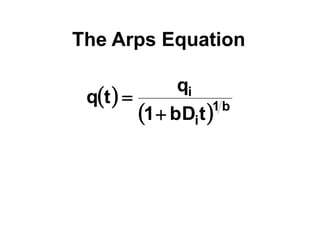
The Arps Equation
 
  b
1
i
i
t
bD
1
q
t
q


Assumptions for Arps Equation
• Well is produced at constant
bottomhole pressure
• Well is producing from a reservoir with
fixed, no-flow boundaries
• Well has constant permeability and skin
factor
• Applicable only to boundary-dominated
flow data
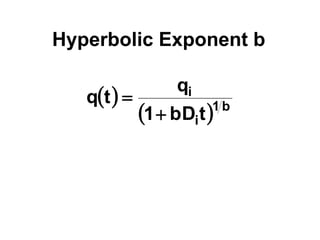
Hyperbolic Exponent b
 
  b
1
i
i
t
bD
1
q
t
q


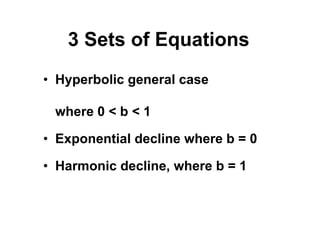
3 Sets of Equations
• Hyperbolic general case
where 0 < b < 1
• Exponential decline where b = 0
• Harmonic decline, where b = 1
0
10
20
30
40
50
60
70
80
90
100
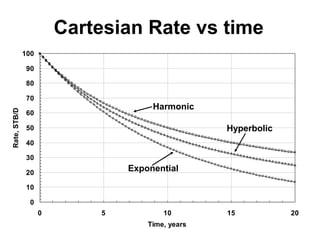
0 5 10 15 20
Time, years
Rate,
STB/D
Cartesian Rate vs time
Exponential
Hyperbolic
Harmonic
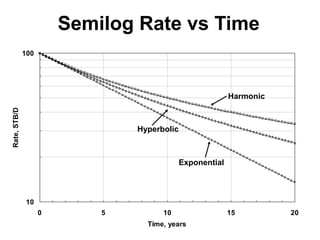
10
100
0 5 10 15 20
Time, years
Rate,
STB/D
Semilog Rate vs Time
Exponential
Hyperbolic
Harmonic
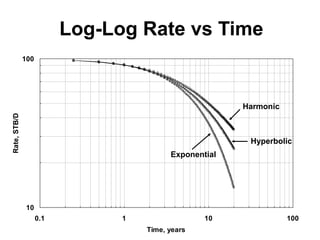
10
100
0.1 1 10 100
Time, years
Rate,
STB/D
Harmonic
Log-Log Rate vs Time
Exponential
Hyperbolic
0
50
100
150
200
250
300
350
400
450
0 5 10 15 20
Time, years
Cumulative
Production,
MSTB
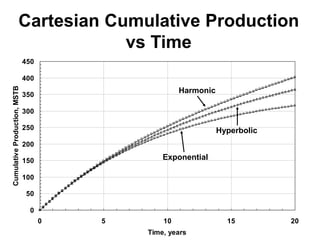
Cartesian Cumulative Production
vs Time
Exponential
Hyperbolic
Harmonic
0
10
20
30
40
50
60
70
80
90
100
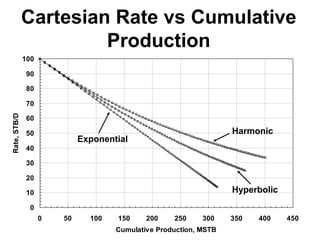
0 50 100 150 200 250 300 350 400 450
Cumulative Production, MSTB
Rate,
STB/D
Harmonic
Cartesian Rate vs Cumulative
Production
Exponential
Hyperbolic
10
100
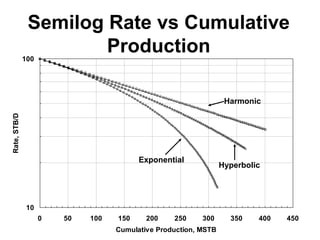
0 50 100 150 200 250 300 350 400 450
Cumulative Production, MSTB
Rate,
STB/D
Semilog Rate vs Cumulative
Production
Exponential
Hyperbolic
Harmonic
10
100
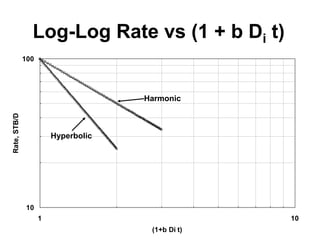
1 10
(1+b Di t)
Rate,
STB/D
Log-Log Rate vs (1 + b Di t)
Hyperbolic
Harmonic
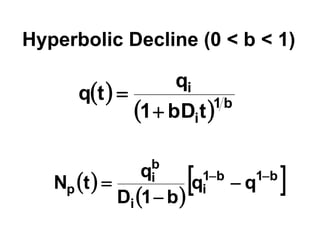
Hyperbolic Decline (0 < b < 1)
 
  b
1
i
i
t
bD
1
q
t
q


 
 
 
b
1
b
1
i
i
b
i
p q
q
b
1
D
q
t
N 




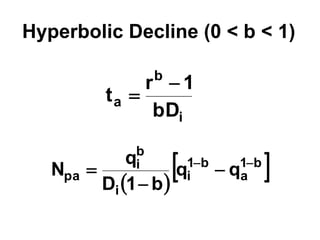
Hyperbolic Decline (0 < b < 1)
i
b
a
bD
1
r
t


 
 
b
1
a
b
1
i
i
b
i
pa q
q
b
1
D
q
N 




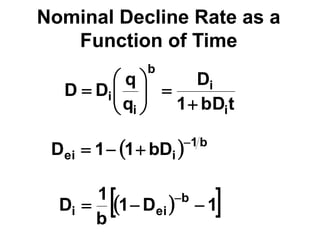
Nominal Decline Rate as a
Function of Time
t
bD
1
D
q
q
D
D
i
i
b
i
i











  b
1
i
ei bD
1
1
D 



 
 
1
D
1
b
1
D b
ei
i 

 
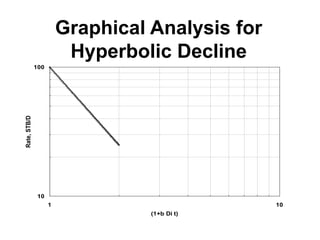
Graphical Analysis for
Hyperbolic Decline
10
100
1 10
(1+b Di t)
Rate,
STB/D
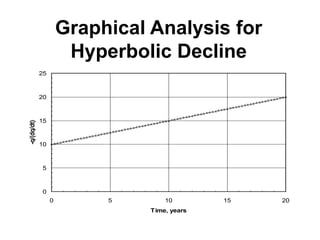
Graphical Analysis for
Hyperbolic Decline
0
5
10
15
20
25
0 5 10 15 20
Time, years
-q/(dq/dt)
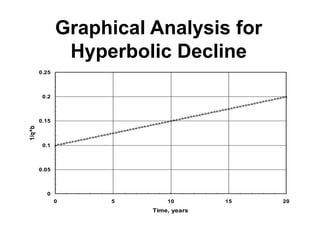
Graphical Analysis for
Hyperbolic Decline
0
0.05
0.1
0.15
0.2
0.25
0 5 10 15 20
Time, years
1/q^b
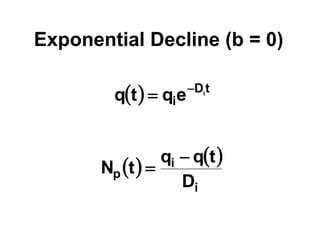
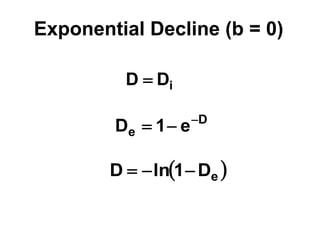
Exponential Decline (b = 0)
  t
D
i
i
e
q
t
q 

   
i
i
p
D
t
q
q
t
N


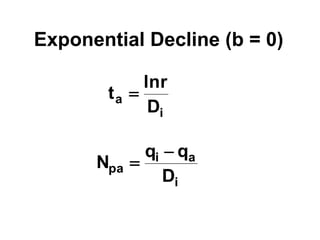
Exponential Decline (b = 0)
i
a
D
r
ln
t 
i
a
i
pa
D
q
q
N


i
D
D 
 
e
D
1
ln
D 


D
e e
1
D 


Exponential Decline (b = 0)
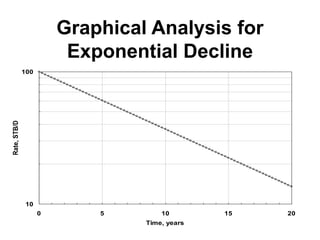
Graphical Analysis for
Exponential Decline
10
100
0 5 10 15 20
Time, years
Rate,
STB/D
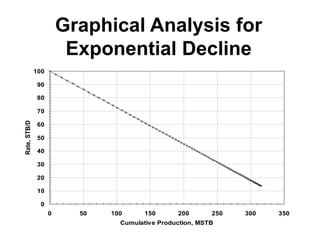
Graphical Analysis for
Exponential Decline
0
10
20
30
40
50
60
70
80
90
100
0 50 100 150 200 250 300 350
Cumulative Production, MSTB
Rate,
STB/D
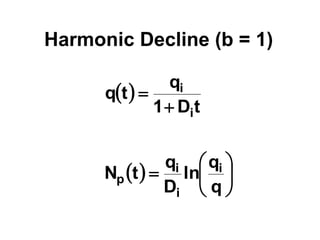
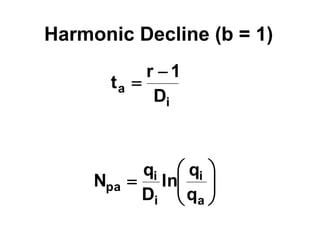
Harmonic Decline (b = 1)
 
t
D
1
q
t
q
i
i


  






q
q
ln
D
q
t
N i
i
i
p
i
a
D
1
r
t











a
i
i
i
pa
q
q
ln
D
q
N
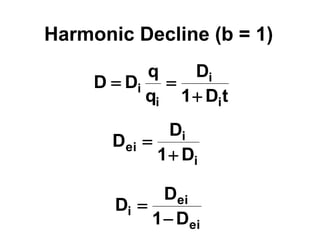
Harmonic Decline (b = 1)
t
D
1
D
q
q
D
D
i
i
i
i



i
i
ei
D
1
D
D


ei
ei
i
D
1
D
D


Harmonic Decline (b = 1)
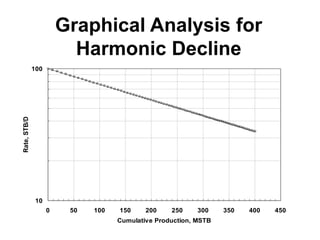
Graphical Analysis for
Harmonic Decline
10
100
0 50 100 150 200 250 300 350 400 450
Cumulative Production, MSTB
Rate,
STB/D
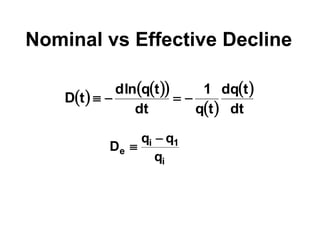
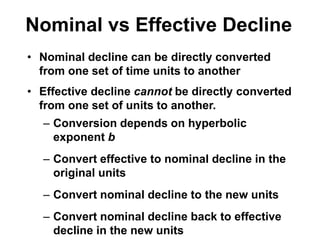
Nominal vs Effective Decline
   
 
 
 
dt
t
dq
t
q
1
dt
t
q
ln
d
t
D 



i
1
i
e
q
q
q
D


• Nominal decline can be directly converted
from one set of time units to another
• Effective decline cannot be directly converted
from one set of units to another.
– Conversion depends on hyperbolic
exponent b
– Convert effective to nominal decline in the
original units
– Convert nominal decline to the new units
– Convert nominal decline back to effective
decline in the new units
Nominal vs Effective Decline
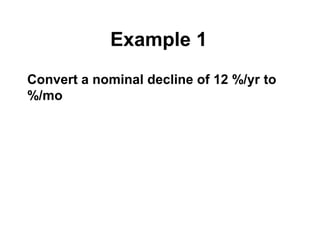
Example 1
Convert a nominal decline of 12 %/yr to
%/mo
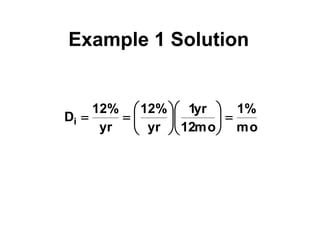
Example 1 Solution
mo
%
1
mo
12
yr
1
yr
%
12
yr
%
12
Di 














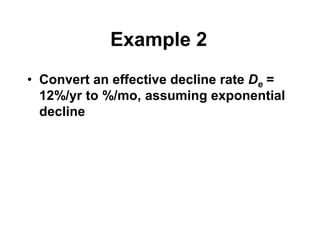
Example 2
• Convert an effective decline rate De =
12%/yr to %/mo, assuming exponential
decline
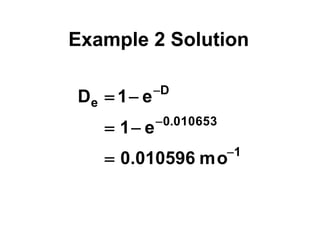
Example 2 Solution
1
010653
.
0
D
e
mo
010596
.
0
e
1
e
1
D








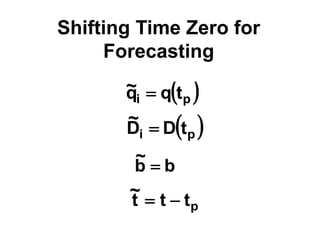
Shifting Time Zero for
Forecasting
 
p
i t
q
q
~ 
 
p
i t
D
D
~

b
b
~

p
t
t
t
~


Example 3
• Determine the values of qi, Di, and b for
Well X, using the data in your notes and
the current date, 1/1/97, as time zero.
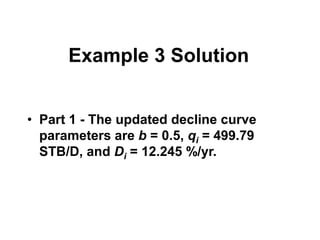
Example 3 Solution
• Part 1 - The updated decline curve
parameters are b = 0.5, qi = 499.79
STB/D, and Di = 12.245 %/yr.
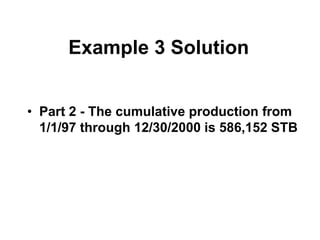
• Part 2 - The cumulative production from
1/1/97 through 12/30/2000 is 586,152 STB
Example 3 Solution
Example 3 Solution
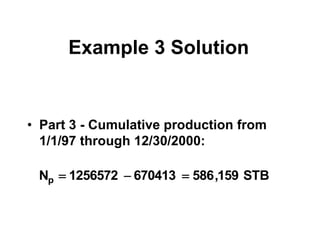
• Part 3 - Cumulative production from
1/1/97 through 12/30/2000:
STB
159
,
586
670413
1256572
Np 


Estimating b From Reservoir
Drive Mechanism
• Each drive mechanism has a
characteristic b value
• If b cannot be estimated from
production data, b may be estimated
from the drive mechanism
Estimating b from Reservoir
Drive Mechanism
References
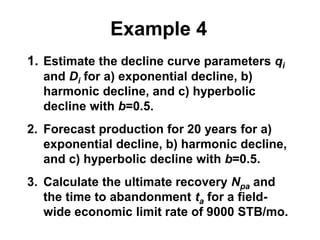
Example 4
1. Estimate the decline curve parameters qi
and Di for a) exponential decline, b)
harmonic decline, and c) hyperbolic
decline with b=0.5.
2. Forecast production for 20 years for a)
exponential decline, b) harmonic decline,
and c) hyperbolic decline with b=0.5.
3. Calculate the ultimate recovery Npa and
the time to abandonment ta for a field-
wide economic limit rate of 9000 STB/mo.
Example 4 Solution
• Prepare the appropriate graphs for
analysis with exponential, harmonic,
and hyperbolic decline and estimate qi
and Di
• For convenience, we use time in
months, and plot the production
volume for the month as a monthly rate
at the midpoint of the month
• Develop a new rate table with time in
decimal months
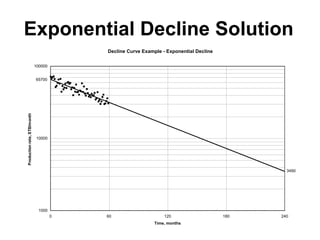
Exponential Decline Solution
Decline Curve Example - Exponential Decline
1000
10000
100000
0 60 120 180 240
Time, months
Production
rate,
STB/month
65700
3490
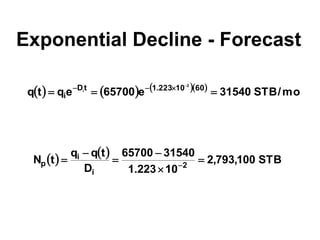
Exponential Decline - Forecast
      
mo
/
STB
31540
e
65700
e
q
t
q 60
10
223
.
1
t
D
i
2
i







   
STB
100
,
793
,
2
10
223
.
1
31540
65700
D
t
q
q
t
N 2
i
i
p 




 
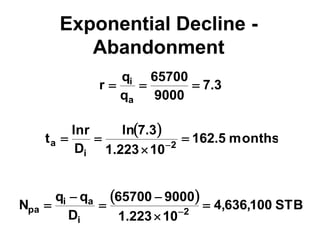
Exponential Decline -
Abandonment
3
.
7
9000
65700
q
q
r
a
i



 
months
5
.
162
10
223
.
1
3
.
7
ln
D
r
ln
t 2
i
a 


 
 
STB
100
,
636
,
4
10
223
.
1
9000
65700
D
q
q
N 2
i
a
i
pa 




 
Harmonic Decline Solution
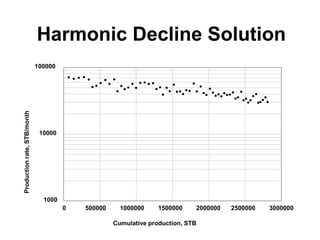
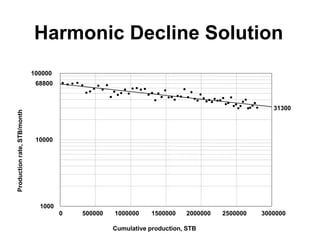
• For harmonic decline, we graph q vs Np on
a semilog scale
• First, we have to compute the cumulative
production as a function of time
• Simply adding the monthly volumes will
give the cumulative production at the end
of each month
• Production rate is calculated as an
average over the month, and should be
plotted at the middle of each month
Harmonic Decline Solution
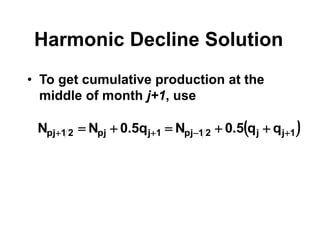
• To get cumulative production at the
middle of month j+1, use
 
1
j
j
2
1
j
p
1
j
j
p
2
1
j
p q
q
5
.
0
N
q
5
.
0
N
N 


 




Harmonic Decline Solution
1000
10000
100000
0 500000 1000000 1500000 2000000 2500000 3000000
Cumulative production, STB
Production
rate,
STB/month
Harmonic Decline Solution
0 500000 1000000 1500000 2000000 2500000 3000000
Cumulative production, STB
Production
rate,
STB/month
1000
10000
100000
68800
31300
Harmonic Decline - Forecast
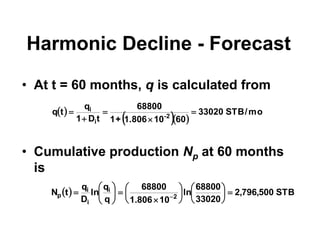
• At t = 60 months, q is calculated from
• Cumulative production Np at 60 months
is
  STB
500
,
796
,
2
33020
68800
ln
10
806
.
1
68800
q
q
ln
D
q
t
N 2
i
i
i
p 




















 
 
  
mo
/
STB
33020
60
10
1.806
+
1
68800
t
D
1
q
t
q 2
-
i
i





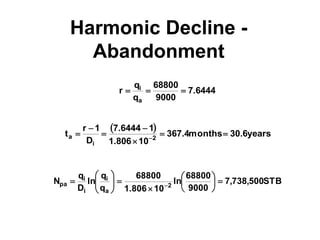
Harmonic Decline -
Abandonment
6444
.
7
9000
68800
q
q
r
a
i



 
years
6
.
30
months
4
.
367
10
806
.
1
1
6444
.
7
D
1
r
t 2
i
a 





 
STB
500
,
738
,
7
9000
68800
ln
10
806
.
1
68800
q
q
ln
D
q
N 2
a
i
i
i
pa 
















 
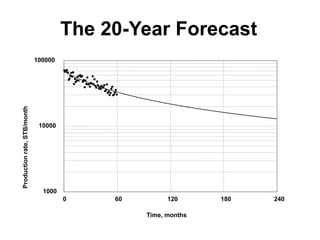
The 20-Year Forecast
1000
10000
100000
0 60 120 180 240
Time, months
Production
rate,
STB/month
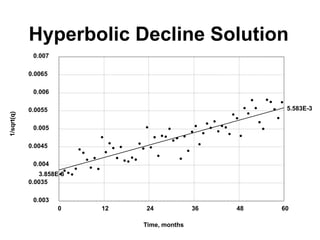
Hyperbolic Decline Solution
0.003
0.0035
0.004
0.0045
0.005
0.0055
0.006
0.0065
0.007
0 12 24 36 48 60
Time, months
1/sqrt(q)
3.858E-3
5.583E-3
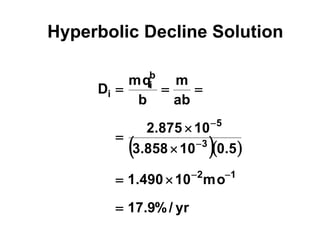
  
yr
/
%
9
.
17
mo
10
490
.
1
5
.
0
10
858
.
3
10
875
.
2
ab
m
b
mq
D
1
2
3
5
b
i
i













Hyperbolic Decline Solution
Hyperbolic Decline - Forecast
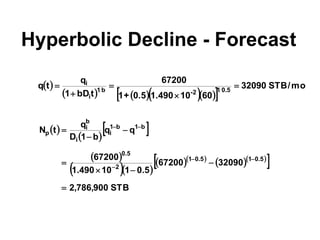
 
     
 
mo
/
STB
32090
60
10
1.490
0.5
+
1
67200
t
bD
1
q
t
q 5
.
0
1
2
-
b
1
i
i





 
 
 
 
  
  
  
 
STB
900
,
786
,
2
32090
67200
5
.
0
1
10
490
.
1
67200
q
q
b
1
D
q
t
N
5
.
0
1
5
.
0
1
2
5
.
0
b
1
b
1
i
i
b
i
p













Hyperbolic Decline -
Abandonment
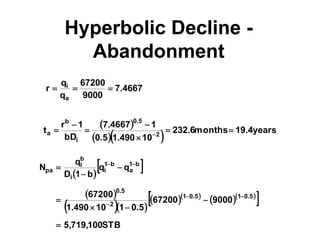
4667
.
7
9000
67200
q
q
r
a
i



 
   years
4
.
19
months
6
.
232
10
490
.
1
5
.
0
1
4667
.
7
bD
1
r
t 2
5
.
0
i
b
a 





 
 
 
 
  
  
  
 
STB
100
,
719
,
5
9000
67200
5
.
0
1
10
490
.
1
67200
q
q
b
1
D
q
N
5
.
0
1
5
.
0
1
2
5
.
0
b
1
a
b
1
i
i
b
i
pa













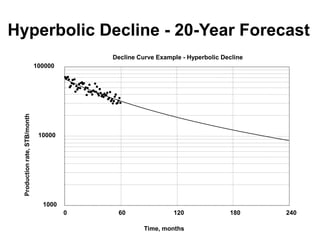
Hyperbolic Decline - 20-Year Forecast
Decline Curve Example - Hyperbolic Decline
1000
10000
100000
0 60 120 180 240
Time, months
Production
rate,
STB/month
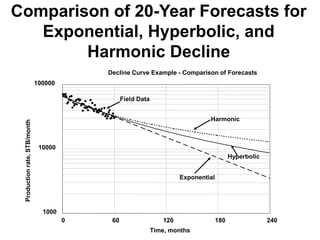
Comparison of 20-Year Forecasts for
Exponential, Hyperbolic, and
Harmonic Decline
Decline Curve Example - Comparison of Forecasts
1000
10000
100000
0 60 120 180 240
Time, months
Production
rate,
STB/month
Field Data
Exponential
Hyperbolic
Harmonic

02_4-Conventional Decline Curve Analysis.ppt