By:
Mohammed Alghanoudi
Supervised by:
Dr. Ibrahim
Sabratha Faculty of Engineering
Petroleum engineering department
Drilling fluids laboratory
Decline Curve Analysis
Contents Introduction
01
Objective
02
Hubbert's theory
03
Chart
04
INTRODUCTION
 In the short and medium term, declines in oil production occur in
a predictable manner based on geological conditions,
government policies, and engineering practices. The shape of
the slope curve varies depending on whether one is considering
a well, a field, or a group of fields. In the long term, technological
developments have challenged some of these expectations.
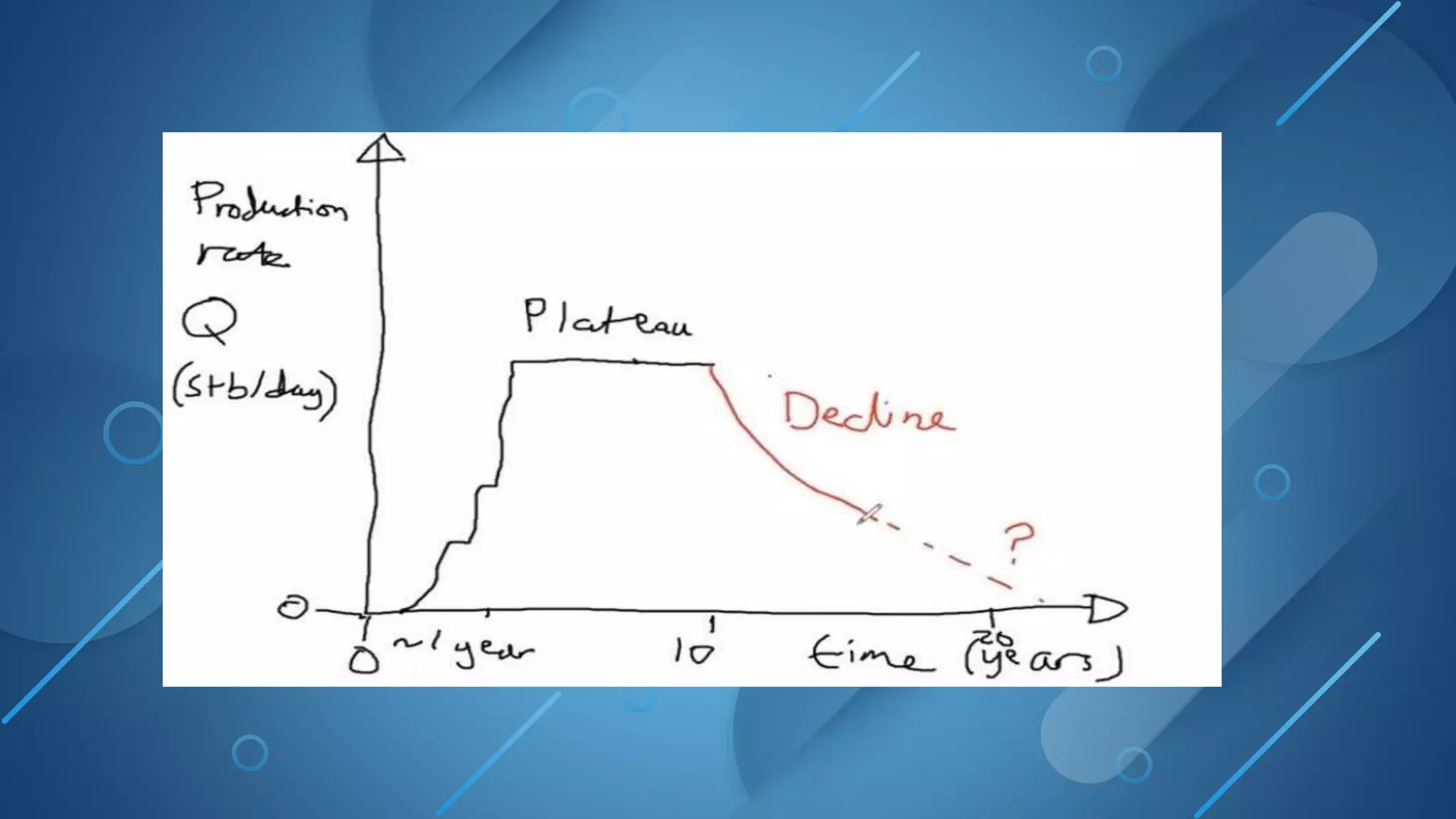
 The decline curve analysis technique relies on analyzing the
previous data for the decline in production performance, which is
expressed in charts that link the production rate and time, or the
production rate and cumulative productivity. And that's for
everyone. wells And Reservoirs.
OBJECTIVE
To predict the depletion of various natural
resources.
The aim of this analysis is to:
Hubbert's theory
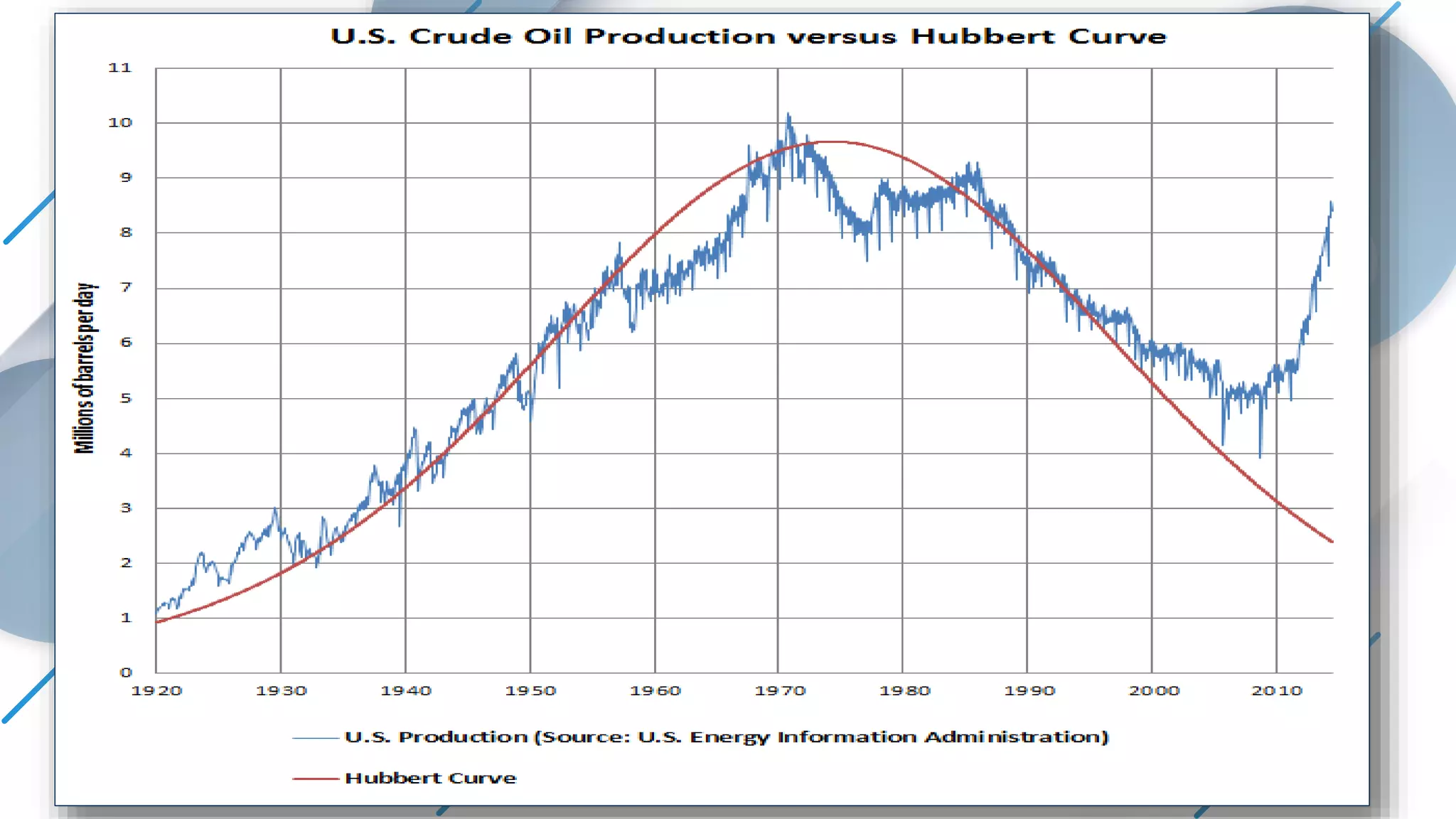
 Hubbert's peak or Hubbert's curve is a model that approximates the
production rate of a resource over a period of time. Specifically, Hubbert's
peak refers to the point at which this production rate is at its highest with
demand for the resource rising, and after this it predicts a drop in
correlation to the increased demand.
 During this drop, there may be dramatic differences in production and
demand as demand continues to increase but production drops overall.
 Figure 1 shows Hubbert's predicted model compared to US oil production.
Although this model can be applied to many resources, it was initially
developed as a model for oil production.
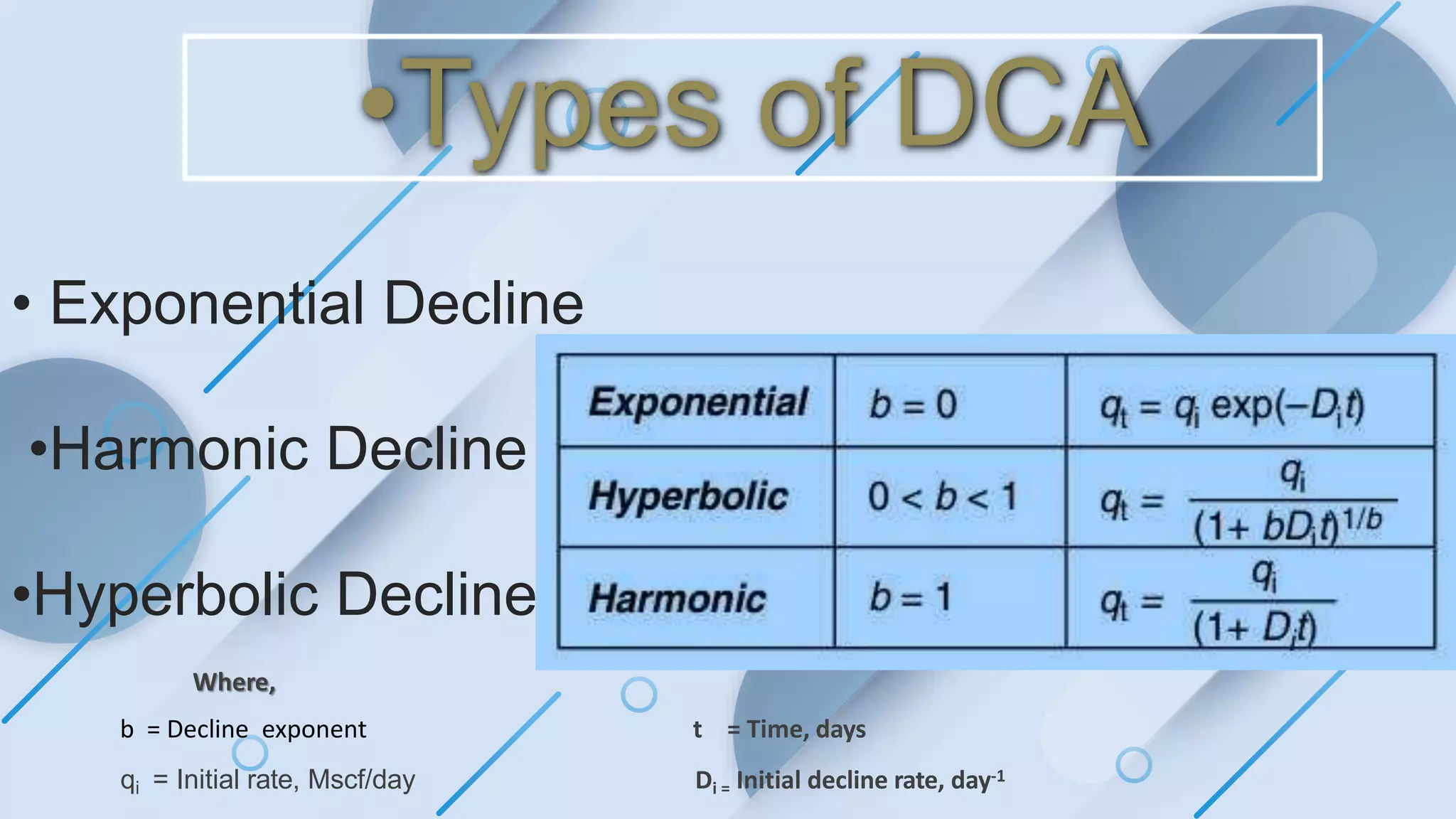
•Types of DCA
• Exponential Decline
•Harmonic Decline
•Hyperbolic Decline
Where,
b = Decline exponent
qi = Initial rate, Mscf/day
t = Time, days
Di = Initial decline rate, day-1
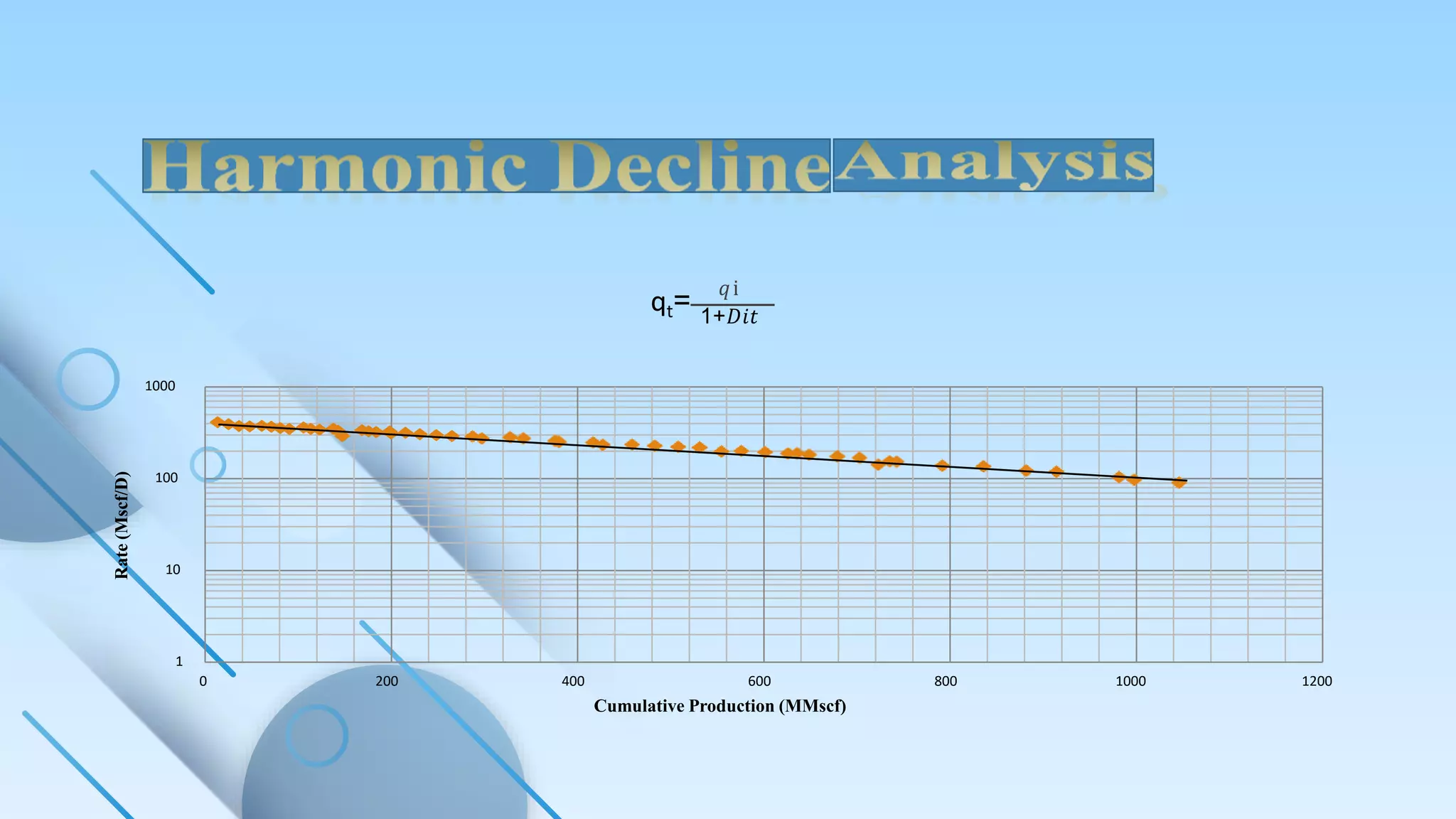
𝑞i
qt= 1+𝐷𝑖𝑡
1
10
100
1000
0 200 400 600 800 1000 1200
Rate
(Mscf/D)
Cumulative Production (MMscf)
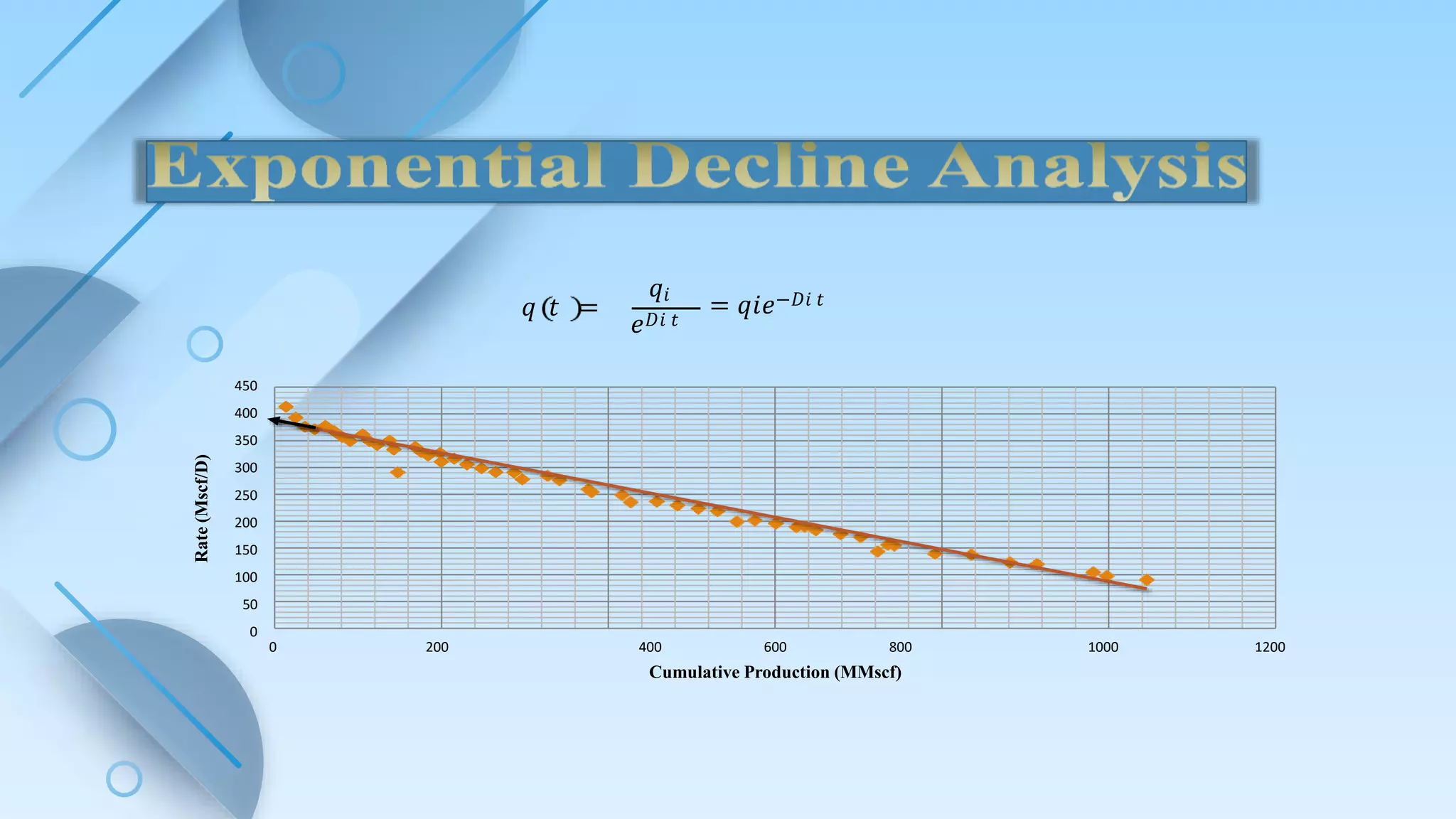
450
400
350
300
250
200
150
100
50
0
0 200 400 600 800
Cumulative Production (MMscf)
1000 1200
Rate
(Mscf/D)
𝑞 𝑡 =
𝑞𝑖
𝑒𝐷𝑖 𝑡
= 𝑞𝑖𝑒−𝐷𝑖 𝑡
References:
 M. King Hubbert. " (PDF). Drilling and Production Practice (1956)
American Petroleum Institute & Shell Development Co. Publication No. 95, See Pp 9-11, 21-
22. Archived from (PDF) on 2008-05-27.^
 Ugo Bardi and Leigh Yaxley. ] Proceedings of the 4th Workshop, Lisbon 2005^ Jean
Laherrere. . July, 1997.^ Patzek, Tad (2008-05-17).
 " ". Archives
of Mining Sciences. 53 (2): 131–159. Retrieved 2018-11-17.
THANK YOU FOR LISTENING

decline curve presentations.pptx

  • 1.
    By: Mohammed Alghanoudi Supervised by: Dr.Ibrahim Sabratha Faculty of Engineering Petroleum engineering department Drilling fluids laboratory Decline Curve Analysis
  • 2.
  • 3.
    INTRODUCTION  In theshort and medium term, declines in oil production occur in a predictable manner based on geological conditions, government policies, and engineering practices. The shape of the slope curve varies depending on whether one is considering a well, a field, or a group of fields. In the long term, technological developments have challenged some of these expectations.  The decline curve analysis technique relies on analyzing the previous data for the decline in production performance, which is expressed in charts that link the production rate and time, or the production rate and cumulative productivity. And that's for everyone. wells And Reservoirs.
  • 4.
    OBJECTIVE To predict thedepletion of various natural resources. The aim of this analysis is to:
  • 5.
    Hubbert's theory  Hubbert'speak or Hubbert's curve is a model that approximates the production rate of a resource over a period of time. Specifically, Hubbert's peak refers to the point at which this production rate is at its highest with demand for the resource rising, and after this it predicts a drop in correlation to the increased demand.  During this drop, there may be dramatic differences in production and demand as demand continues to increase but production drops overall.  Figure 1 shows Hubbert's predicted model compared to US oil production. Although this model can be applied to many resources, it was initially developed as a model for oil production.
  • 7.
    •Types of DCA •Exponential Decline •Harmonic Decline •Hyperbolic Decline Where, b = Decline exponent qi = Initial rate, Mscf/day t = Time, days Di = Initial decline rate, day-1
  • 8.
    𝑞i qt= 1+𝐷𝑖𝑡 1 10 100 1000 0 200400 600 800 1000 1200 Rate (Mscf/D) Cumulative Production (MMscf)
  • 9.
    450 400 350 300 250 200 150 100 50 0 0 200 400600 800 Cumulative Production (MMscf) 1000 1200 Rate (Mscf/D) 𝑞 𝑡 = 𝑞𝑖 𝑒𝐷𝑖 𝑡 = 𝑞𝑖𝑒−𝐷𝑖 𝑡
  • 11.
    References:  M. KingHubbert. " (PDF). Drilling and Production Practice (1956) American Petroleum Institute & Shell Development Co. Publication No. 95, See Pp 9-11, 21- 22. Archived from (PDF) on 2008-05-27.^  Ugo Bardi and Leigh Yaxley. ] Proceedings of the 4th Workshop, Lisbon 2005^ Jean Laherrere. . July, 1997.^ Patzek, Tad (2008-05-17).  " ". Archives of Mining Sciences. 53 (2): 131–159. Retrieved 2018-11-17.
  • 12.
    THANK YOU FORLISTENING

Editor's Notes

  • #4 على المدى القصير والمتوسط، تحدث الانخفاضات في إنتاج النفط بطريقة يمكن التنبؤ بها بناء على الظروف الجيولوجية والسياسات الحكومية والممارسات الهندسية. يختلف شكل منحنى المنحدر اعتمادا على ما إذا كان المرء يفكر في بئر أو حقل أو مجموعة من الحقول. على المدى الطويل ، تحدت التطورات التكنولوجية بعض هذه التوقعات. تعتمد تقنية تحليل منحنى الانحدار على تحليل البيانات السابقة للانخفاض في أداء الإنتاج، والتي يتم التعبير عنها في الرسوم البيانية التي تربط معدل الإنتاج والوقت، أو معدل الإنتاج والإنتاجية التراكمية. وهذا للجميع. الآبار والخزانات.
  • #5 الهدف من هذا التحليل هو: للتنبؤ بنضوب الموارد الطبيعية المختلفة.
  • #6 ذروة هوبرت أو منحنى هوبرت هو نموذج يقارب معدل إنتاج المورد على مدى فترة زمنية. على وجه التحديد ، تشير ذروة هوبرت إلى النقطة التي يكون فيها معدل الإنتاج هذا في أعلى مستوياته مع ارتفاع الطلب على الموارد ، وبعد ذلك يتنبأ بانخفاض في الارتباط بزيادة الطلب. خلال هذا الانخفاض ، قد تكون هناك اختلافات كبيرة في الإنتاج والطلب حيث يستمر الطلب في الزيادة ولكن الإنتاج ينخفض بشكل عام. يوضح الشكل 1 نموذج هوبرت المتوقع مقارنة بإنتاج النفط الأمريكي. على الرغم من أنه يمكن تطبيق هذا النموذج على العديد من الموارد ، فقد تم تطويره في البداية كنموذج لإنتاج النفط.
  • #12 المراجع: