© 2015 Electric Power Research Institute, Inc. All rights reserved.
Jeff Smith
Manager, Power System Studies
Dr. Matthew Rylander
Technical Leader, Power System Studies
Implementing Hosting
Capacity Methods into
Existing Planning
Tools
PV Systems Symposium
PV Grid Integration Workshop Agenda
Tuesday, May 10, 2016
2
© 2015 Electric Power Research Institute, Inc. All rights reserved.
What is Hosting Capacity and Why is it So Important?
 Definition:
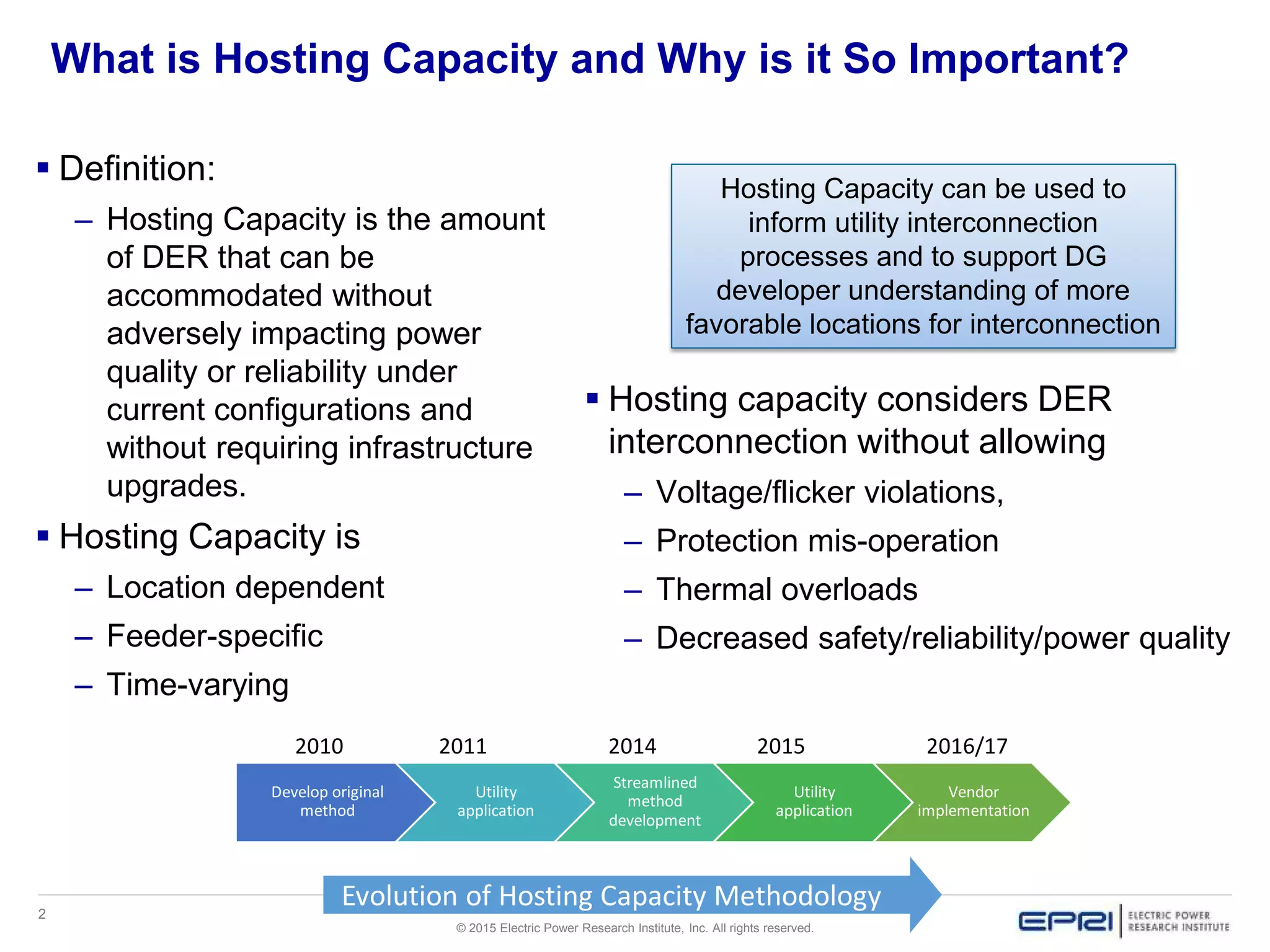
– Hosting Capacity is the amount
of DER that can be
accommodated without
adversely impacting power
quality or reliability under
current configurations and
without requiring infrastructure
upgrades.
 Hosting Capacity is
– Location dependent
– Feeder-specific
– Time-varying
 Hosting capacity considers DER
interconnection without allowing
– Voltage/flicker violations,
– Protection mis-operation
– Thermal overloads
– Decreased safety/reliability/power quality
Hosting Capacity can be used to
inform utility interconnection
processes and to support DG
developer understanding of more
favorable locations for interconnection
Develop original
method
Utility
application
Streamlined
method
development
Utility
application
Vendor
implementation
2010 2011 2014 2015 2016/17
Evolution of Hosting Capacity Methodology
3
© 2015 Electric Power Research Institute, Inc. All rights reserved.
Evolution of Hosting Capacity
Methods
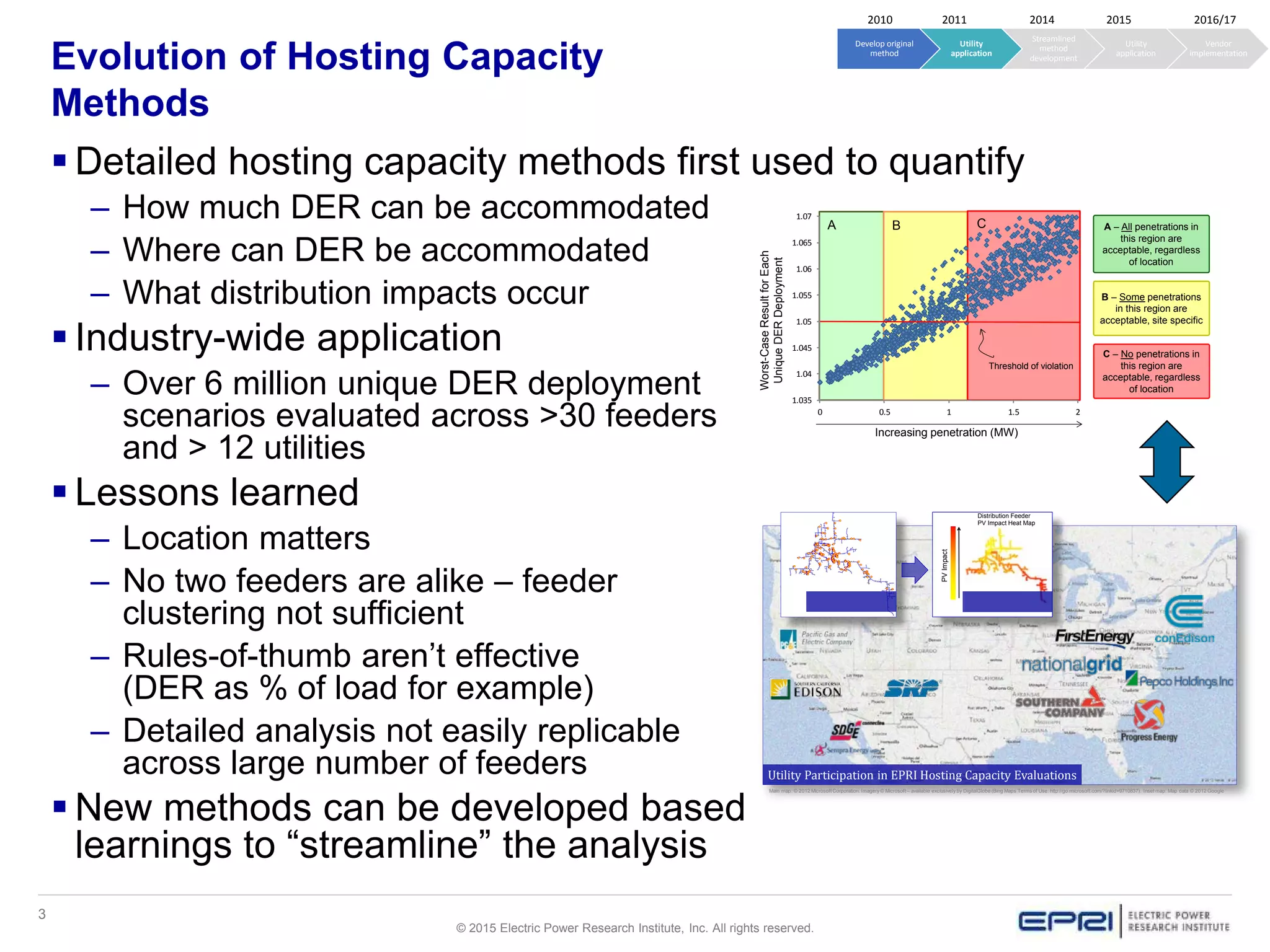
 Detailed hosting capacity methods first used to quantify
– How much DER can be accommodated
– Where can DER be accommodated
– What distribution impacts occur
 Industry-wide application
– Over 6 million unique DER deployment
scenarios evaluated across >30 feeders
and > 12 utilities
 Lessons learned
– Location matters
– No two feeders are alike – feeder
clustering not sufficient
– Rules-of-thumb aren’t effective
(DER as % of load for example)
– Detailed analysis not easily replicable
across large number of feeders
 New methods can be developed based
learnings to “streamline” the analysis
Utility Participation in EPRI Hosting Capacity Evaluations
Main map: © 2012 MicrosoftCorporation. Imagery © Microsoft– available exclusively by DigitalGlobe (Bing Maps Terms of Use: http://go.microsoft.com/?linkid=9710837). Inset map: Map data © 2012 Google
Distribution Feeder
PV Impact Heat Map
PVImpact
Develop original
method
Utility
application
Streamlined
method
development
Utility
application
Vendor
implementation
2010 2011 2014 2015 2016/17
1.035
1.04
1.045
1.05
1.055
1.06
1.065
1.07
0 0.5 1 1.5 2
A B C
Worst-CaseResultforEach
UniqueDERDeployment
Increasing penetration (MW)
Threshold of violation
A – All penetrations in
this region are
acceptable, regardless
of location
B – Some penetrations
in this region are
acceptable, site specific
C – No penetrations in
this region are
acceptable, regardless
of location
4
© 2015 Electric Power Research Institute, Inc. All rights reserved.
Large “Scale” of Distribution System Creates Challenges for
Distribution Planners
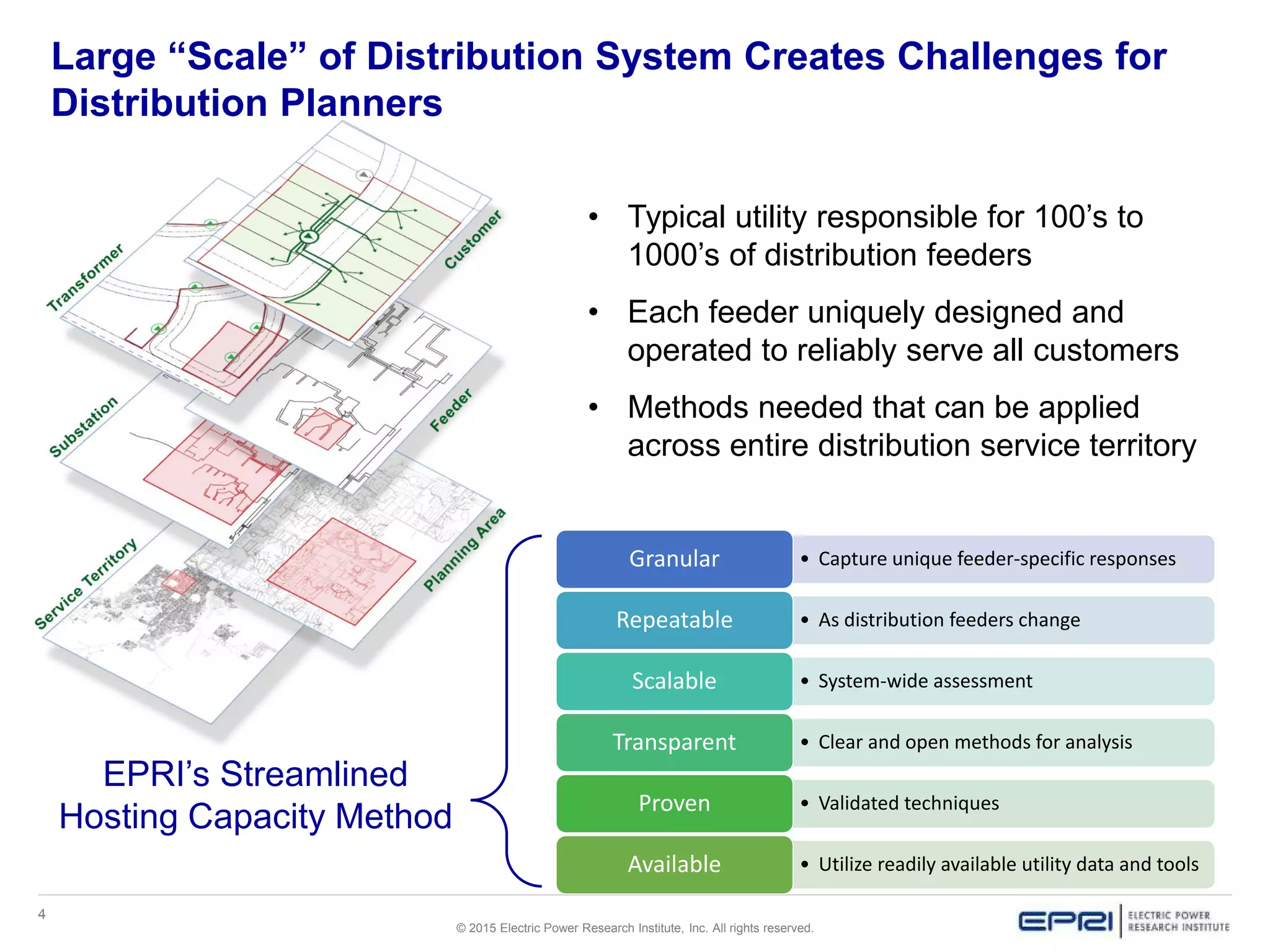
• Typical utility responsible for 100’s to
1000’s of distribution feeders
• Each feeder uniquely designed and
operated to reliably serve all customers
• Methods needed that can be applied
across entire distribution service territory
• Capture unique feeder-specific responsesGranular
• As distribution feeders changeRepeatable
• System-wide assessmentScalable
• Clear and open methods for analysisTransparent
• Validated techniquesProven
• Utilize readily available utility data and toolsAvailable
EPRI’s Streamlined
Hosting Capacity Method
5
© 2015 Electric Power Research Institute, Inc. All rights reserved.
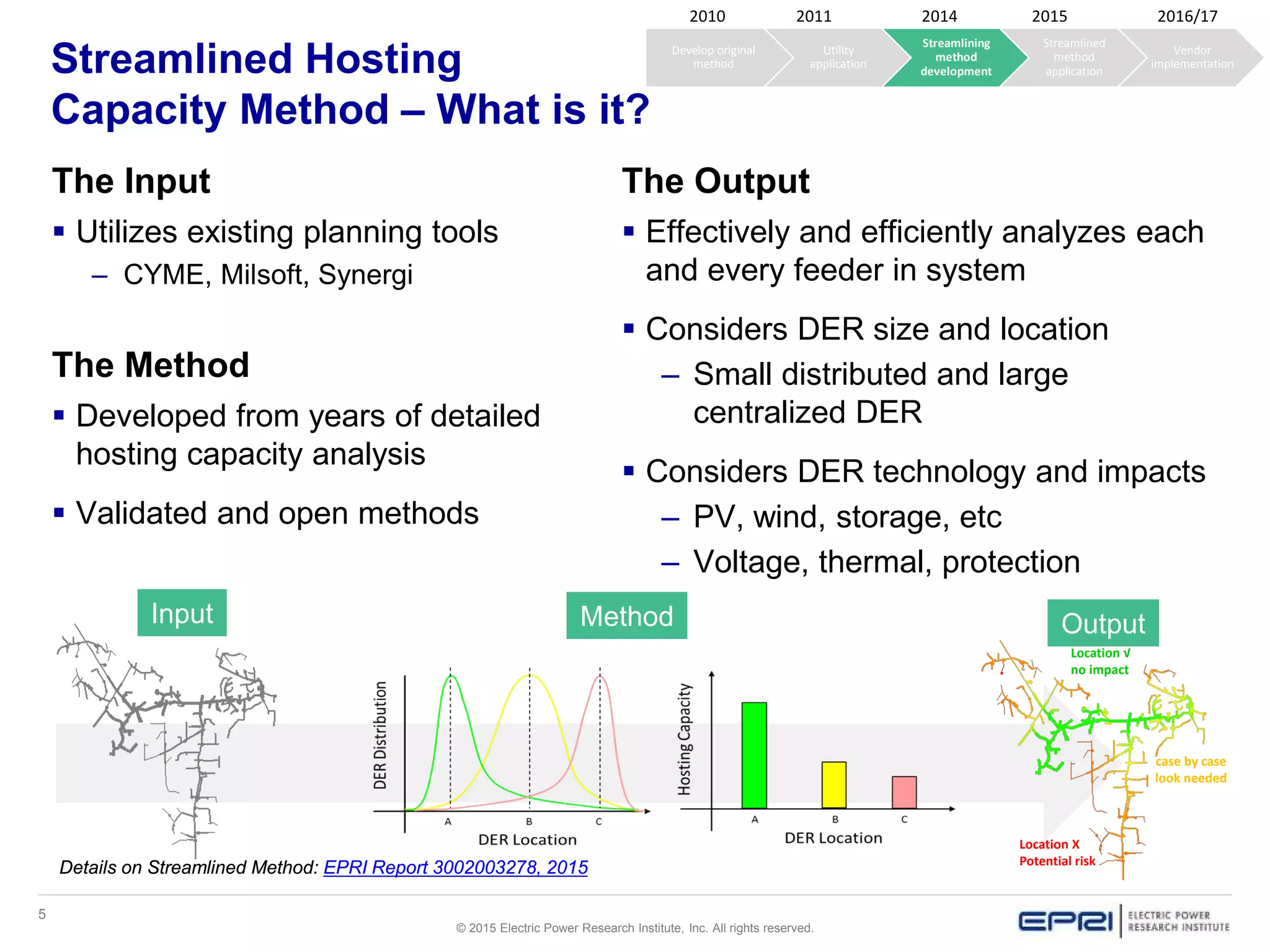
Streamlined Hosting
Capacity Method – What is it?
The Input
 Utilizes existing planning tools
– CYME, Milsoft, Synergi
The Method
 Developed from years of detailed
hosting capacity analysis
 Validated and open methods
The Output
 Effectively and efficiently analyzes each
and every feeder in system
 Considers DER size and location
– Small distributed and large
centralized DER
 Considers DER technology and impacts
– PV, wind, storage, etc
– Voltage, thermal, protection
Input Method Output
case by case
look needed
Location √
no impact
Location X
Potential risk
Details on Streamlined Method: EPRI Report 3002003278, 2015
Develop original
method
Utility
application
Streamlining
method
development
Streamlined
method
application
Vendor
implementation
2010 2011 2014 2015 2016/17
6
© 2015 Electric Power Research Institute, Inc. All rights reserved.
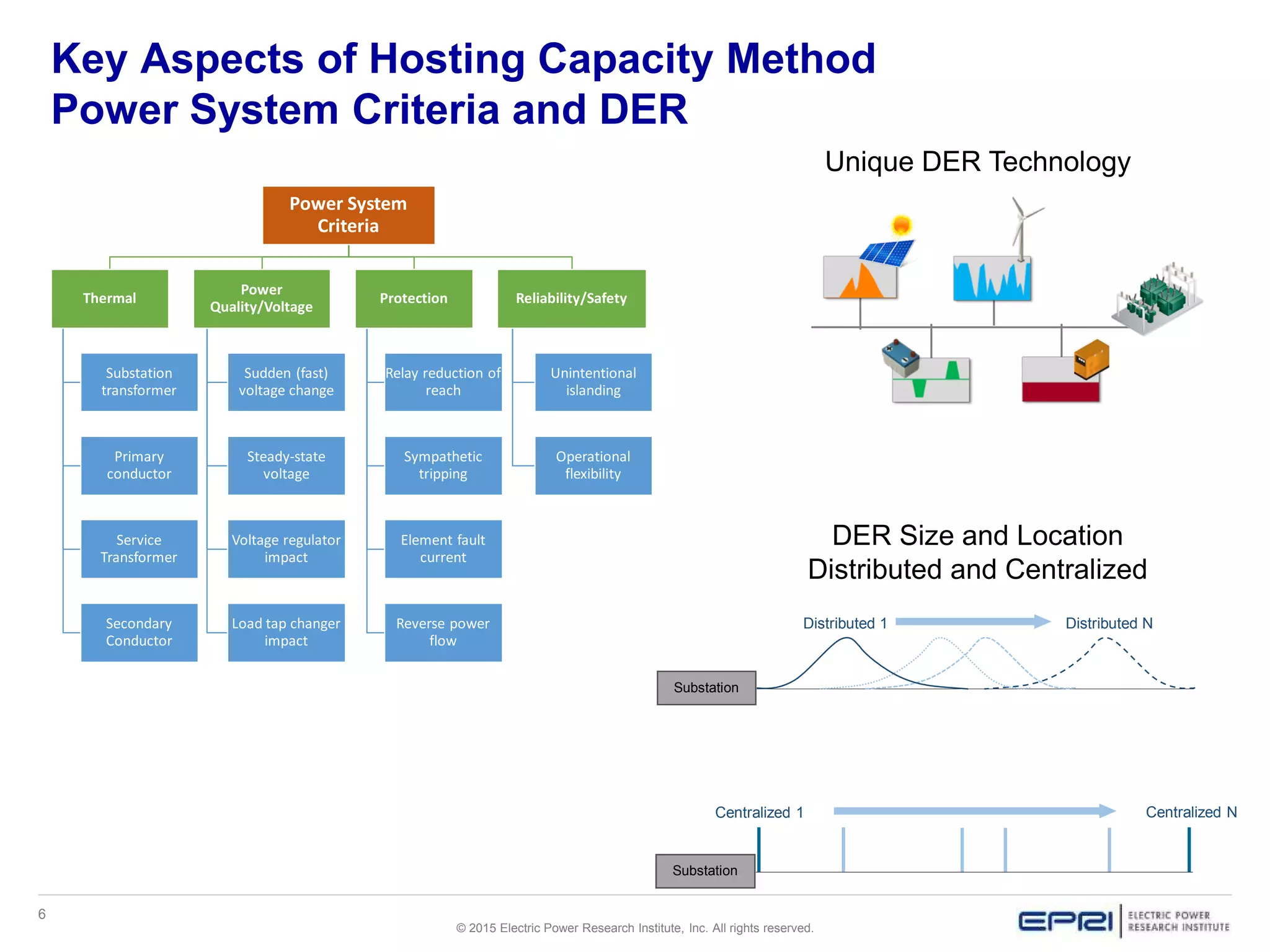
Key Aspects of Hosting Capacity Method
Power System Criteria and DER
Power System
Criteria
Thermal
Substation
transformer
Primary
conductor
Service
Transformer
Secondary
Conductor
Power
Quality/Voltage
Sudden (fast)
voltage change
Steady-state
voltage
Voltage regulator
impact
Load tap changer
impact
Protection
Relay reduction of
reach
Sympathetic
tripping
Element fault
current
Reverse power
flow
Reliability/Safety
Unintentional
islanding
Operational
flexibility
Substation
Distributed 1 Distributed N
Substation
Centralized 1 Centralized N
DER Size and Location
Distributed and Centralized
Unique DER Technology
7
© 2015 Electric Power Research Institute, Inc. All rights reserved.
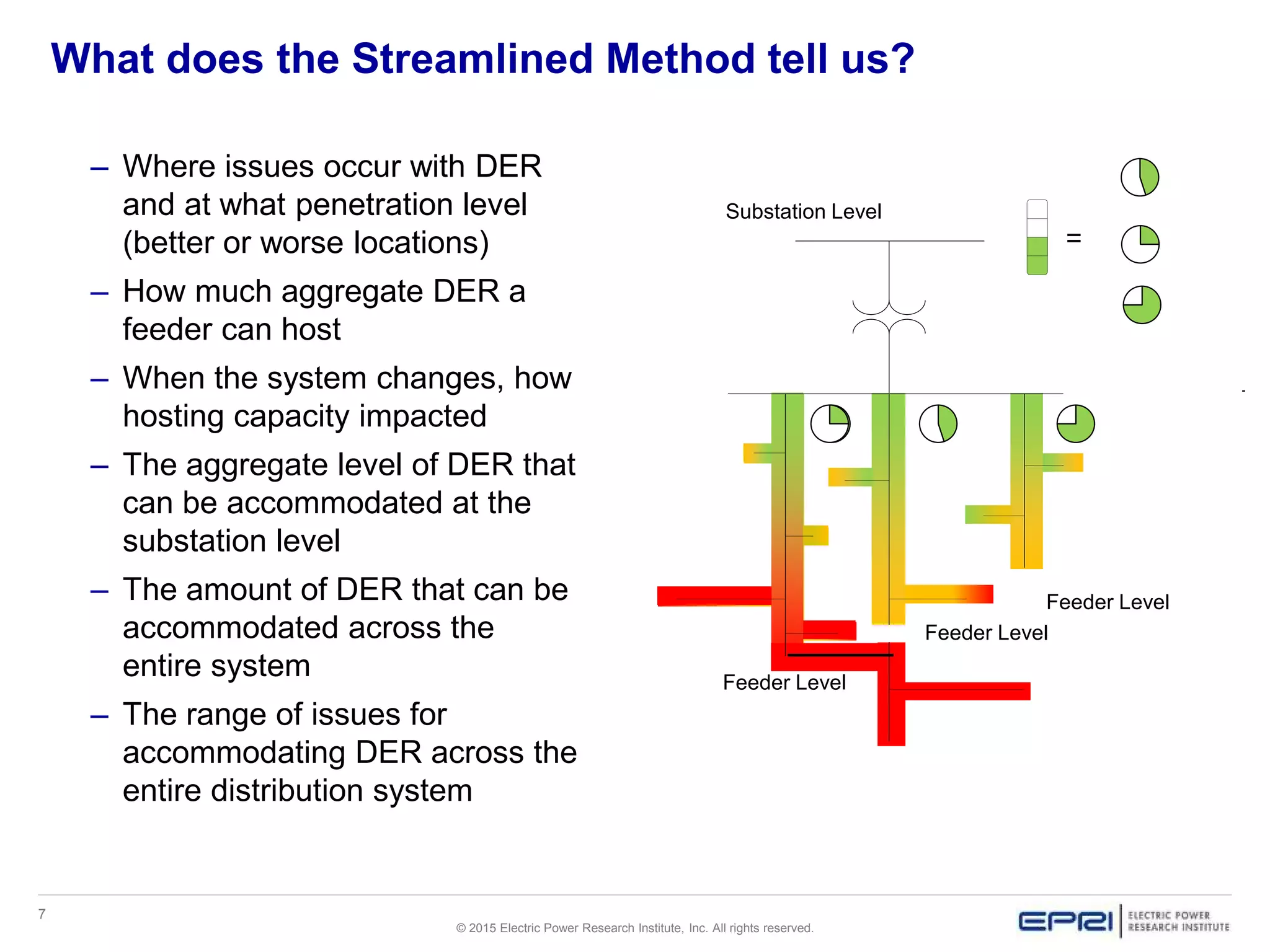
What does the Streamlined Method tell us?
– Where issues occur with DER
and at what penetration level
(better or worse locations)
– How much aggregate DER a
feeder can host
– When the system changes, how
hosting capacity impacted
– The aggregate level of DER that
can be accommodated at the
substation level
– The amount of DER that can be
accommodated across the
entire system
– The range of issues for
accommodating DER across the
entire distribution system
=
Feeder Level
Feeder Level
Feeder Level
Substation Level
8
© 2015 Electric Power Research Institute, Inc. All rights reserved.
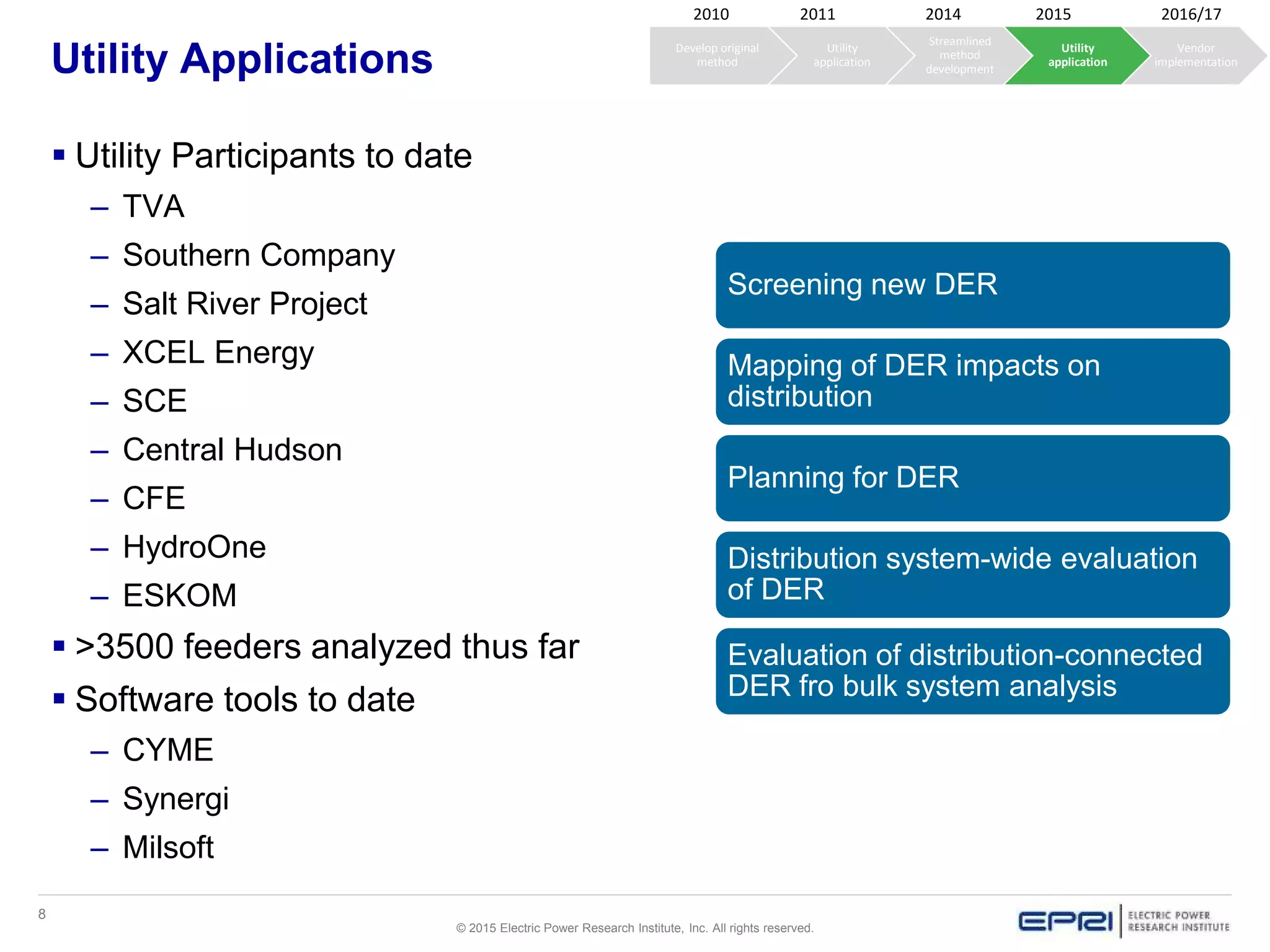
Utility Applications
 Utility Participants to date
– TVA
– Southern Company
– Salt River Project
– XCEL Energy
– SCE
– Central Hudson
– CFE
– HydroOne
– ESKOM
 >3500 feeders analyzed thus far
 Software tools to date
– CYME
– Synergi
– Milsoft
Develop original
method
Utility
application
Streamlined
method
development
Utility
application
Vendor
implementation
2010 2011 2014 2015 2016/17
Screening new DER
Mapping of DER impacts on
distribution
Planning for DER
Distribution system-wide evaluation
of DER
Evaluation of distribution-connected
DER fro bulk system analysis
9
© 2015 Electric Power Research Institute, Inc. All rights reserved.
Substation Marker *Hosting Capacity
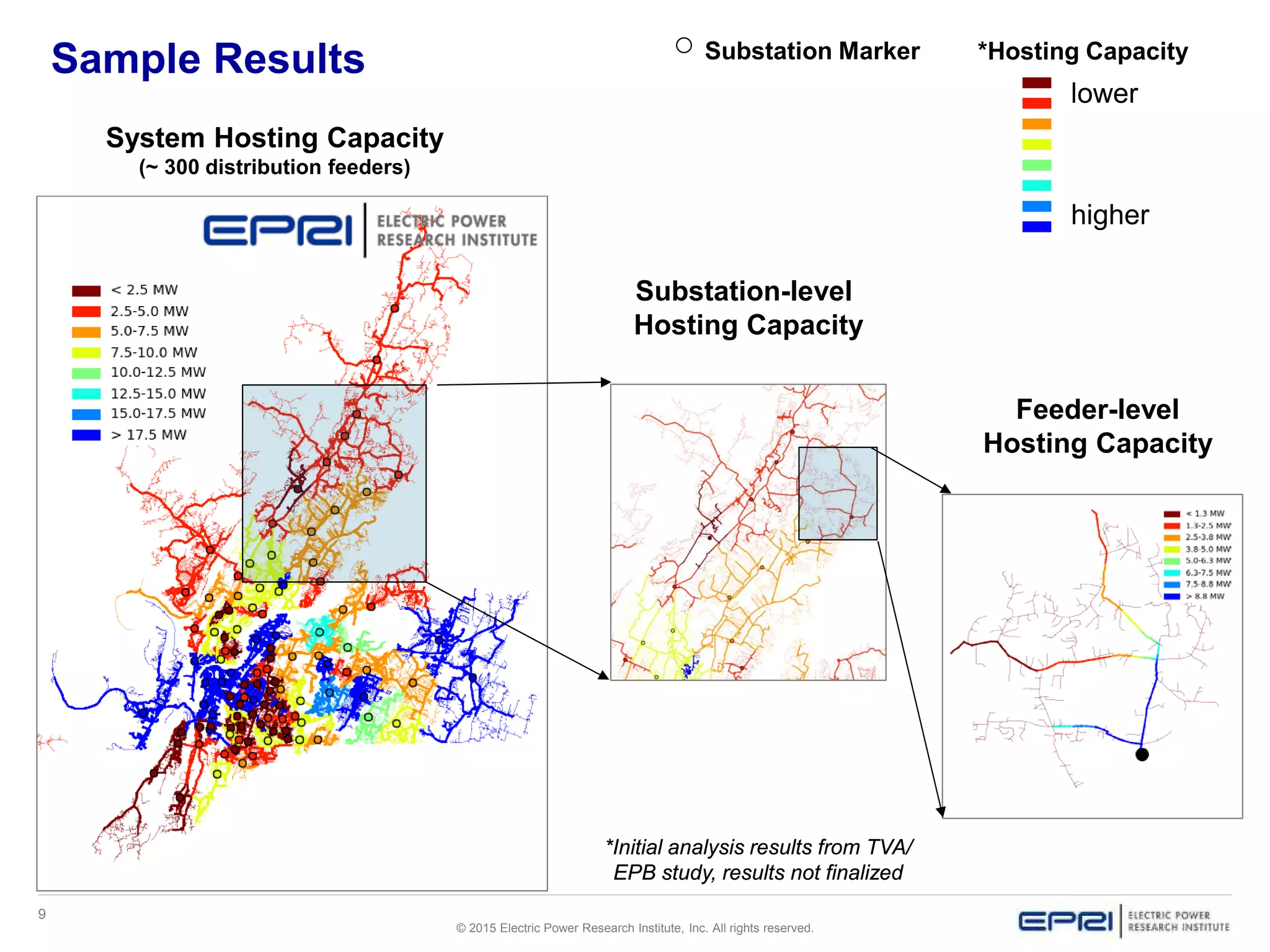
Sample Results
System Hosting Capacity
(~ 300 distribution feeders)
Substation-level
Hosting Capacity
Feeder-level
Hosting Capacity
*Initial analysis results from TVA/
EPB study, results not finalized
lower
higher
10
© 2015 Electric Power Research Institute, Inc. All rights reserved.
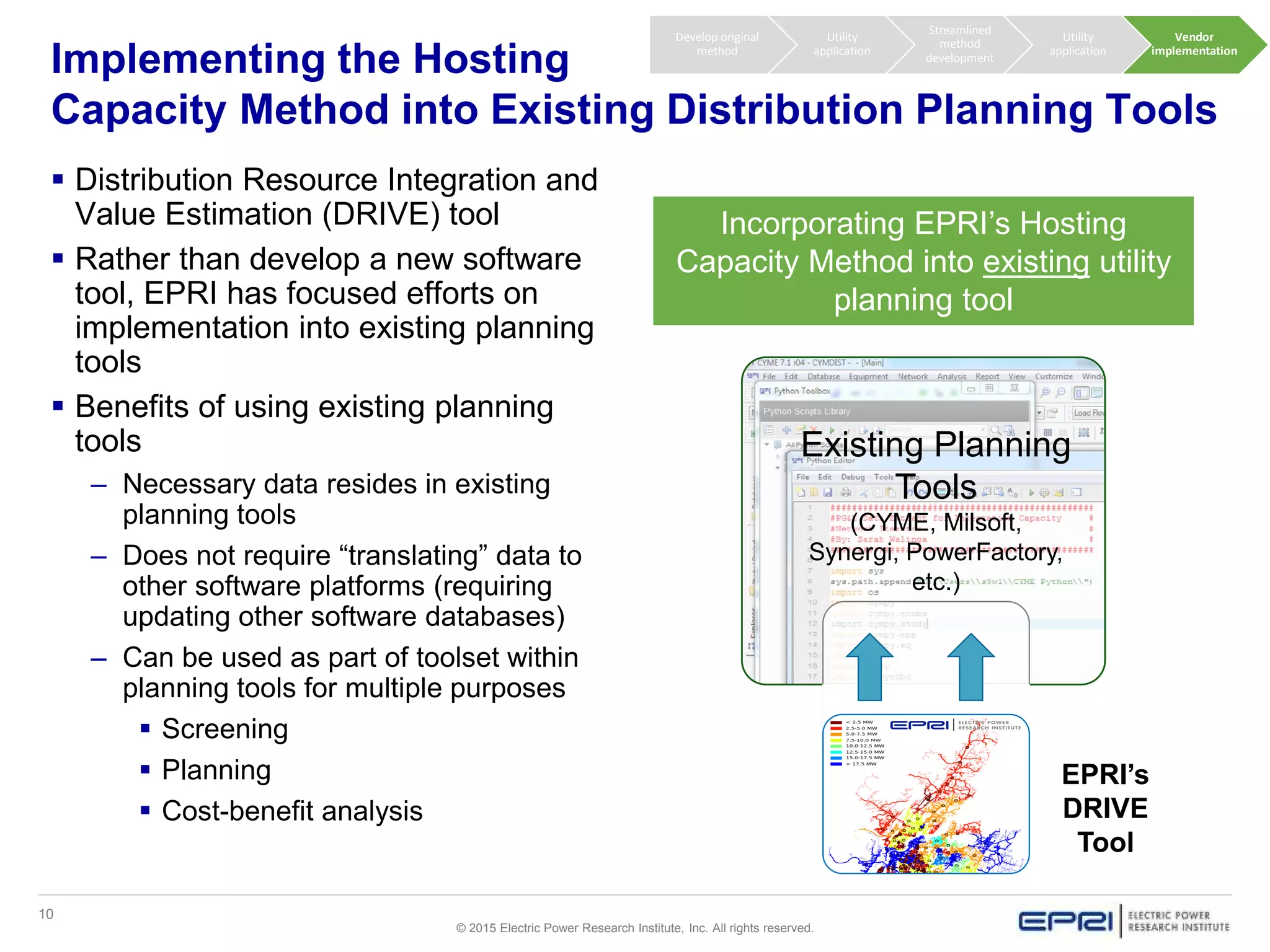
Implementing the Hosting
Capacity Method into Existing Distribution Planning Tools
 Distribution Resource Integration and
Value Estimation (DRIVE) tool
 Rather than develop a new software
tool, EPRI has focused efforts on
implementation into existing planning
tools
 Benefits of using existing planning
tools
– Necessary data resides in existing
planning tools
– Does not require “translating” data to
other software platforms (requiring
updating other software databases)
– Can be used as part of toolset within
planning tools for multiple purposes
 Screening
 Planning
 Cost-benefit analysis
Incorporating EPRI’s Hosting
Capacity Method into existing utility
planning tool
EPRI’s
DRIVE
Tool
Existing Planning
Tools
(CYME, Milsoft,
Synergi, PowerFactory,
etc.)
Develop original
method
Utility
application
Streamlined
method
development
Utility
application
Vendor
implementation
/
11
© 2015 Electric Power Research Institute, Inc. All rights reserved.
Summary
 Hosting capacity analysis
captures necessary impacts of
DER
 Many applications for hosting
capacity (including screening)
 Hosting capacity can be
determined within existing
planning tools
 Based upon rigorous analysis,
EPRI has developed a
streamlined hosting capacity
method that is compatible with
existing planning tools
 EPRI is currently working with
software vendors for incorporation
into distribution planning tools
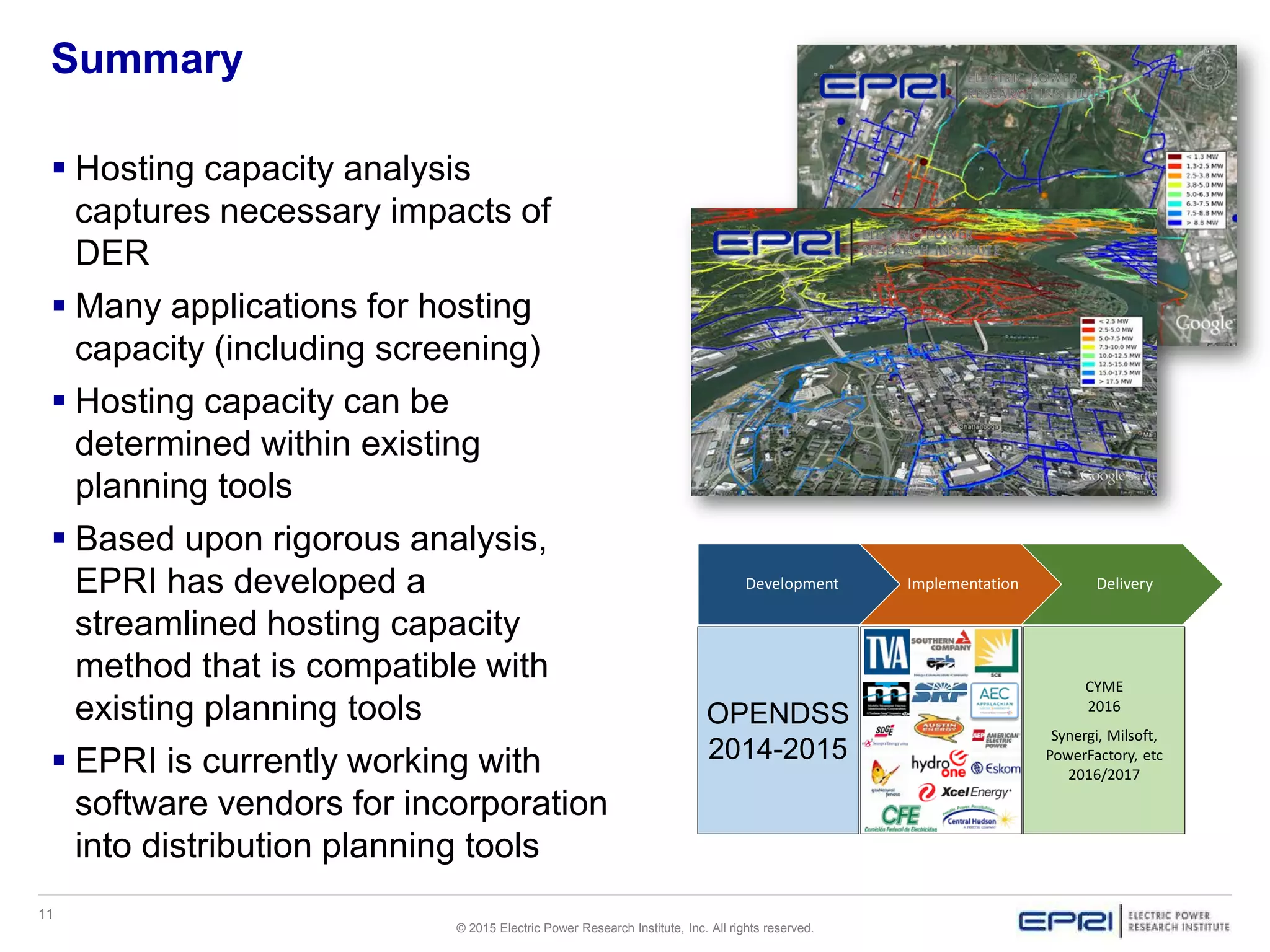
Development Implementation Delivery
OPENDSS
2014-2015
CYME
2016
Synergi, Milsoft,
PowerFactory, etc
2016/2017
12
© 2015 Electric Power Research Institute, Inc. All rights reserved.
References
Detailed Hosting Capacity Method
 Impact of High-Penetration PV on Distribution System Performance: Example Cases
and Analysis Approach. EPRI, Palo Alto, CA: 2011. 1021982
 Analysis of High-Penetration Solar PV Impacts for Distribution Planning: Stochastic
and Time-Series Methods for Determining Feeder Hosting Capacity. EPRI, Palo Alto,
CA: 2012. 1026640
 Rylander, M., Smith, J., “Comprehensive Approach for Determining Distribution
Network Hosting Capacity for Solar PV”, 2nd International Workshop on Integration
of Solar Power Into Power Systems, Lisbon, Portugal, Nov 2012.
 Rylander, M., Smith, J., "Stochastic Approach for Distribution Planning with
Distributed Energy Resources", 2012 CIGRE Grid of the Future Symposium, Kansas
City, MO, 2012
 Rylander, M., Smith, J., "Comprehensive Approach for Determining Distribution
Network Hosting Capacity for Solar PV", 2nd International Workshop on Integration
of Solar Power Into Distribution Systems, 12-13 November, 2012
 Distributed Photovoltaic Feeder Analysis: Preliminary Findings from Hosting Capacity
Analysis of 18 Distribution Feeders. EPRI, Palo Alto, CA: 2013. 3002001245.
 Alternatives to the 15% Rule: Modeling and Hosting Capacity Analysis of 16
Feeders. EPRI, Palo Alto, CA: 2015. 3002005812.
Streamlined Hosting Capacity Method
 Integration of Hosting Capacity Analysis into Distribution Planning Tools. EPRI, Palo
Alto, CA: 2016. 3002005793
 A New Method for Characterizing Distribution System Hosting Capacity for
Distributed Energy Resources: A Streamlined Approach for Solar Photovoltaics.
EPRI, Palo Alto, CA: 2014. 3002003278.
 Rylander, M., Smith, J., Sunderman, W., “Streamlined Method For Determining
Distribution System Hosting Capacity”, 23rd International Conference on Electricity
Distribution, CIRED, Lyon, France, 2015
 Rylander, M., Smith, J., Sunderman, W., “Streamlined Method For Determining
Distribution System Hosting Capacity”, Rural Electric Power Conference, Asheville,
NC, 2015 (accepted for IAS Transactions)
 Distribution Feeder Hosting Capacity: What Matters When Planning for DER?. EPRI,
Palo Alto, CA: 2015. 3002004777
 Smith, J., Rylander, M., Rogers, L., Dugan, R., “It’s All in the Plans: Maximizing the
Benefits and Minimizing the Impacts of DERs in an Integrated Grid”, Power and
Energy Magazine, March/April 2015.
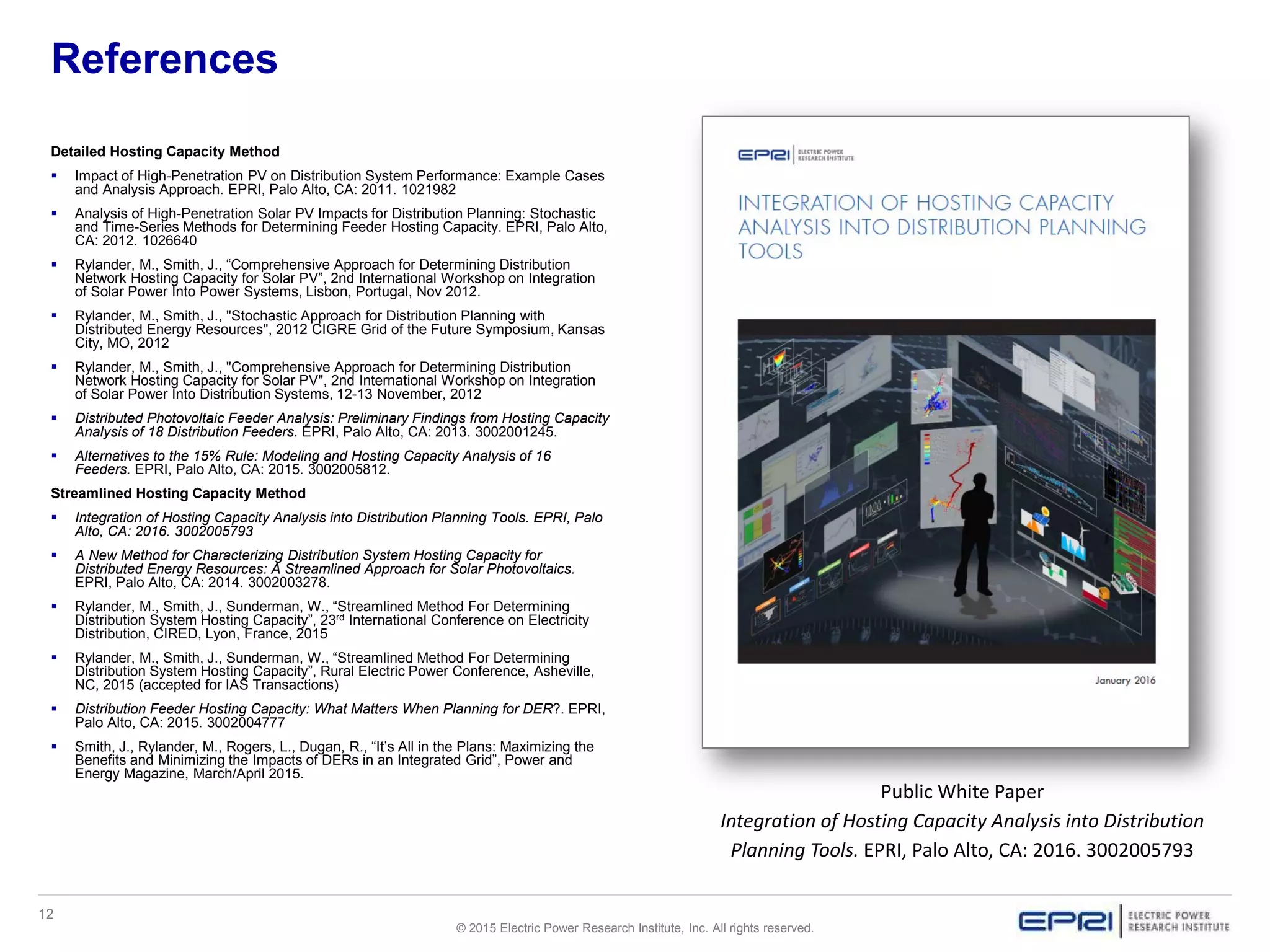
Public White Paper
Integration of Hosting Capacity Analysis into Distribution
Planning Tools. EPRI, Palo Alto, CA: 2016. 3002005793
13
© 2015 Electric Power Research Institute, Inc. All rights reserved.
Questions…
Jeff Smith, jsmith@epri.com
Dr. Matthew Rylander, mrylander@epri.com

02 smith epri_smith_hosting_capacity

  • 1.
    © 2015 ElectricPower Research Institute, Inc. All rights reserved. Jeff Smith Manager, Power System Studies Dr. Matthew Rylander Technical Leader, Power System Studies Implementing Hosting Capacity Methods into Existing Planning Tools PV Systems Symposium PV Grid Integration Workshop Agenda Tuesday, May 10, 2016
  • 2.
    2 © 2015 ElectricPower Research Institute, Inc. All rights reserved. What is Hosting Capacity and Why is it So Important?  Definition: – Hosting Capacity is the amount of DER that can be accommodated without adversely impacting power quality or reliability under current configurations and without requiring infrastructure upgrades.  Hosting Capacity is – Location dependent – Feeder-specific – Time-varying  Hosting capacity considers DER interconnection without allowing – Voltage/flicker violations, – Protection mis-operation – Thermal overloads – Decreased safety/reliability/power quality Hosting Capacity can be used to inform utility interconnection processes and to support DG developer understanding of more favorable locations for interconnection Develop original method Utility application Streamlined method development Utility application Vendor implementation 2010 2011 2014 2015 2016/17 Evolution of Hosting Capacity Methodology
  • 3.
    3 © 2015 ElectricPower Research Institute, Inc. All rights reserved. Evolution of Hosting Capacity Methods  Detailed hosting capacity methods first used to quantify – How much DER can be accommodated – Where can DER be accommodated – What distribution impacts occur  Industry-wide application – Over 6 million unique DER deployment scenarios evaluated across >30 feeders and > 12 utilities  Lessons learned – Location matters – No two feeders are alike – feeder clustering not sufficient – Rules-of-thumb aren’t effective (DER as % of load for example) – Detailed analysis not easily replicable across large number of feeders  New methods can be developed based learnings to “streamline” the analysis Utility Participation in EPRI Hosting Capacity Evaluations Main map: © 2012 MicrosoftCorporation. Imagery © Microsoft– available exclusively by DigitalGlobe (Bing Maps Terms of Use: http://go.microsoft.com/?linkid=9710837). Inset map: Map data © 2012 Google Distribution Feeder PV Impact Heat Map PVImpact Develop original method Utility application Streamlined method development Utility application Vendor implementation 2010 2011 2014 2015 2016/17 1.035 1.04 1.045 1.05 1.055 1.06 1.065 1.07 0 0.5 1 1.5 2 A B C Worst-CaseResultforEach UniqueDERDeployment Increasing penetration (MW) Threshold of violation A – All penetrations in this region are acceptable, regardless of location B – Some penetrations in this region are acceptable, site specific C – No penetrations in this region are acceptable, regardless of location
  • 4.
    4 © 2015 ElectricPower Research Institute, Inc. All rights reserved. Large “Scale” of Distribution System Creates Challenges for Distribution Planners • Typical utility responsible for 100’s to 1000’s of distribution feeders • Each feeder uniquely designed and operated to reliably serve all customers • Methods needed that can be applied across entire distribution service territory • Capture unique feeder-specific responsesGranular • As distribution feeders changeRepeatable • System-wide assessmentScalable • Clear and open methods for analysisTransparent • Validated techniquesProven • Utilize readily available utility data and toolsAvailable EPRI’s Streamlined Hosting Capacity Method
  • 5.
    5 © 2015 ElectricPower Research Institute, Inc. All rights reserved. Streamlined Hosting Capacity Method – What is it? The Input  Utilizes existing planning tools – CYME, Milsoft, Synergi The Method  Developed from years of detailed hosting capacity analysis  Validated and open methods The Output  Effectively and efficiently analyzes each and every feeder in system  Considers DER size and location – Small distributed and large centralized DER  Considers DER technology and impacts – PV, wind, storage, etc – Voltage, thermal, protection Input Method Output case by case look needed Location √ no impact Location X Potential risk Details on Streamlined Method: EPRI Report 3002003278, 2015 Develop original method Utility application Streamlining method development Streamlined method application Vendor implementation 2010 2011 2014 2015 2016/17
  • 6.
    6 © 2015 ElectricPower Research Institute, Inc. All rights reserved. Key Aspects of Hosting Capacity Method Power System Criteria and DER Power System Criteria Thermal Substation transformer Primary conductor Service Transformer Secondary Conductor Power Quality/Voltage Sudden (fast) voltage change Steady-state voltage Voltage regulator impact Load tap changer impact Protection Relay reduction of reach Sympathetic tripping Element fault current Reverse power flow Reliability/Safety Unintentional islanding Operational flexibility Substation Distributed 1 Distributed N Substation Centralized 1 Centralized N DER Size and Location Distributed and Centralized Unique DER Technology
  • 7.
    7 © 2015 ElectricPower Research Institute, Inc. All rights reserved. What does the Streamlined Method tell us? – Where issues occur with DER and at what penetration level (better or worse locations) – How much aggregate DER a feeder can host – When the system changes, how hosting capacity impacted – The aggregate level of DER that can be accommodated at the substation level – The amount of DER that can be accommodated across the entire system – The range of issues for accommodating DER across the entire distribution system = Feeder Level Feeder Level Feeder Level Substation Level
  • 8.
    8 © 2015 ElectricPower Research Institute, Inc. All rights reserved. Utility Applications  Utility Participants to date – TVA – Southern Company – Salt River Project – XCEL Energy – SCE – Central Hudson – CFE – HydroOne – ESKOM  >3500 feeders analyzed thus far  Software tools to date – CYME – Synergi – Milsoft Develop original method Utility application Streamlined method development Utility application Vendor implementation 2010 2011 2014 2015 2016/17 Screening new DER Mapping of DER impacts on distribution Planning for DER Distribution system-wide evaluation of DER Evaluation of distribution-connected DER fro bulk system analysis
  • 9.
    9 © 2015 ElectricPower Research Institute, Inc. All rights reserved. Substation Marker *Hosting Capacity Sample Results System Hosting Capacity (~ 300 distribution feeders) Substation-level Hosting Capacity Feeder-level Hosting Capacity *Initial analysis results from TVA/ EPB study, results not finalized lower higher
  • 10.
    10 © 2015 ElectricPower Research Institute, Inc. All rights reserved. Implementing the Hosting Capacity Method into Existing Distribution Planning Tools  Distribution Resource Integration and Value Estimation (DRIVE) tool  Rather than develop a new software tool, EPRI has focused efforts on implementation into existing planning tools  Benefits of using existing planning tools – Necessary data resides in existing planning tools – Does not require “translating” data to other software platforms (requiring updating other software databases) – Can be used as part of toolset within planning tools for multiple purposes  Screening  Planning  Cost-benefit analysis Incorporating EPRI’s Hosting Capacity Method into existing utility planning tool EPRI’s DRIVE Tool Existing Planning Tools (CYME, Milsoft, Synergi, PowerFactory, etc.) Develop original method Utility application Streamlined method development Utility application Vendor implementation /
  • 11.
    11 © 2015 ElectricPower Research Institute, Inc. All rights reserved. Summary  Hosting capacity analysis captures necessary impacts of DER  Many applications for hosting capacity (including screening)  Hosting capacity can be determined within existing planning tools  Based upon rigorous analysis, EPRI has developed a streamlined hosting capacity method that is compatible with existing planning tools  EPRI is currently working with software vendors for incorporation into distribution planning tools Development Implementation Delivery OPENDSS 2014-2015 CYME 2016 Synergi, Milsoft, PowerFactory, etc 2016/2017
  • 12.
    12 © 2015 ElectricPower Research Institute, Inc. All rights reserved. References Detailed Hosting Capacity Method  Impact of High-Penetration PV on Distribution System Performance: Example Cases and Analysis Approach. EPRI, Palo Alto, CA: 2011. 1021982  Analysis of High-Penetration Solar PV Impacts for Distribution Planning: Stochastic and Time-Series Methods for Determining Feeder Hosting Capacity. EPRI, Palo Alto, CA: 2012. 1026640  Rylander, M., Smith, J., “Comprehensive Approach for Determining Distribution Network Hosting Capacity for Solar PV”, 2nd International Workshop on Integration of Solar Power Into Power Systems, Lisbon, Portugal, Nov 2012.  Rylander, M., Smith, J., "Stochastic Approach for Distribution Planning with Distributed Energy Resources", 2012 CIGRE Grid of the Future Symposium, Kansas City, MO, 2012  Rylander, M., Smith, J., "Comprehensive Approach for Determining Distribution Network Hosting Capacity for Solar PV", 2nd International Workshop on Integration of Solar Power Into Distribution Systems, 12-13 November, 2012  Distributed Photovoltaic Feeder Analysis: Preliminary Findings from Hosting Capacity Analysis of 18 Distribution Feeders. EPRI, Palo Alto, CA: 2013. 3002001245.  Alternatives to the 15% Rule: Modeling and Hosting Capacity Analysis of 16 Feeders. EPRI, Palo Alto, CA: 2015. 3002005812. Streamlined Hosting Capacity Method  Integration of Hosting Capacity Analysis into Distribution Planning Tools. EPRI, Palo Alto, CA: 2016. 3002005793  A New Method for Characterizing Distribution System Hosting Capacity for Distributed Energy Resources: A Streamlined Approach for Solar Photovoltaics. EPRI, Palo Alto, CA: 2014. 3002003278.  Rylander, M., Smith, J., Sunderman, W., “Streamlined Method For Determining Distribution System Hosting Capacity”, 23rd International Conference on Electricity Distribution, CIRED, Lyon, France, 2015  Rylander, M., Smith, J., Sunderman, W., “Streamlined Method For Determining Distribution System Hosting Capacity”, Rural Electric Power Conference, Asheville, NC, 2015 (accepted for IAS Transactions)  Distribution Feeder Hosting Capacity: What Matters When Planning for DER?. EPRI, Palo Alto, CA: 2015. 3002004777  Smith, J., Rylander, M., Rogers, L., Dugan, R., “It’s All in the Plans: Maximizing the Benefits and Minimizing the Impacts of DERs in an Integrated Grid”, Power and Energy Magazine, March/April 2015. Public White Paper Integration of Hosting Capacity Analysis into Distribution Planning Tools. EPRI, Palo Alto, CA: 2016. 3002005793
  • 13.
    13 © 2015 ElectricPower Research Institute, Inc. All rights reserved. Questions… Jeff Smith, jsmith@epri.com Dr. Matthew Rylander, mrylander@epri.com