ELECTRONICS DEPARTMENT
Introduction To Embedded
System
By: Mustafa M. Shiple
http://drshiple-courses.weebly.com/
Quote of the Day
The empires of the future are the empires of the
mind.
– Winston Churchill
‫مرة‬ ‫أسبوع‬ ‫كل‬ ‫في‬ ‫نفسك‬ ‫سألت‬ ‫إذا‬
:
‫قرأت‬ ‫ماذا‬
‫األسبوع‬ ‫هذا‬ ‫في‬
,
‫مستقب‬ ‫أعظم‬ ‫لنفسك‬ ‫ضمنت‬ ‫فقد‬
‫ل‬
‫علمي‬
INTRODUCTION TO Embedded System
2016
http://drshiple-courses.weebly.com/
Embedded Systems
• Embedded system: is a system that
principal function is not computational,
but which is controlled by a computer
embedded within it.
3
INTRODUCTION TO Embedded System
2016
http://drshiple-courses.weebly.com/
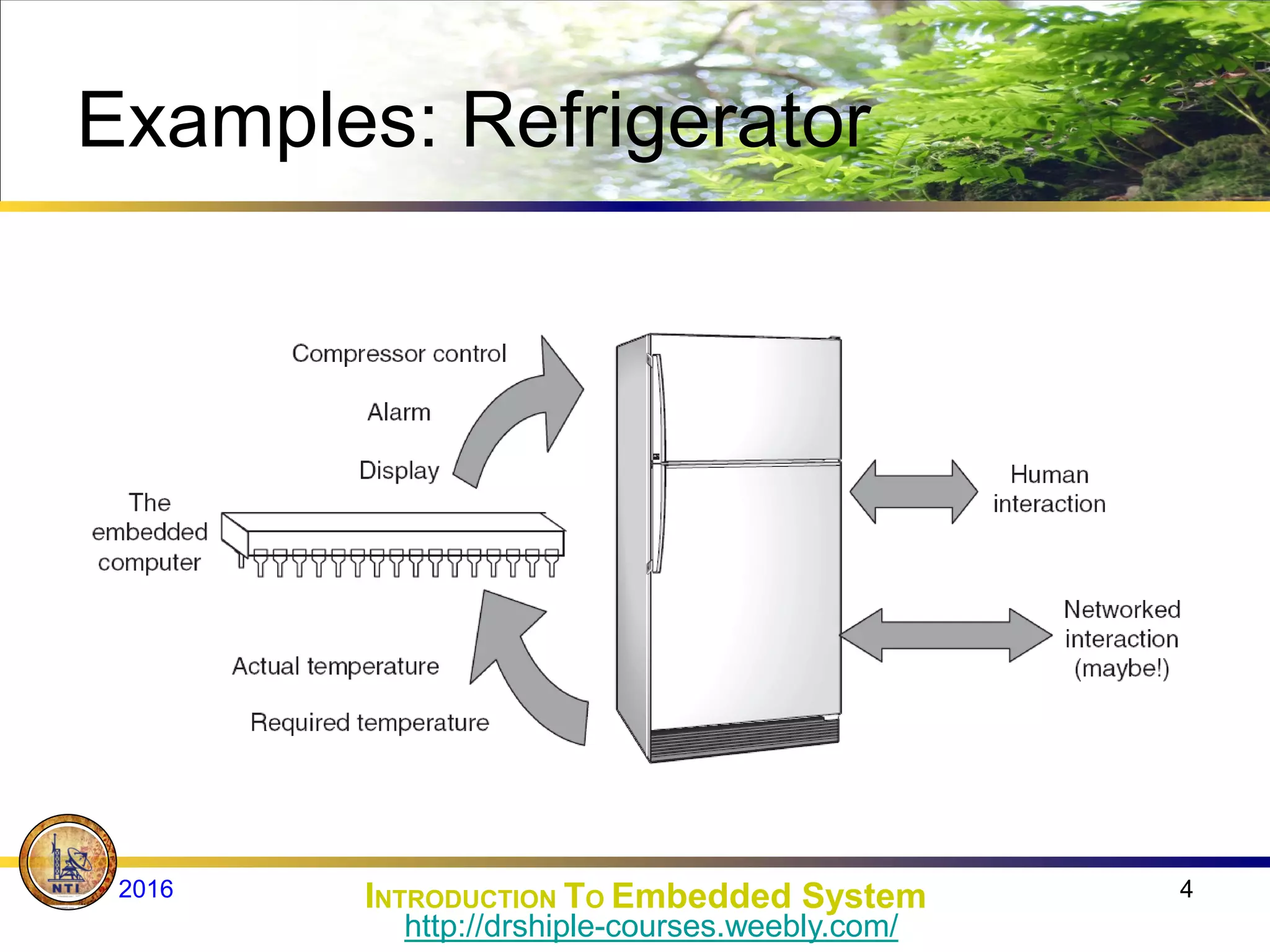
Examples: Refrigerator
4
INTRODUCTION TO Embedded System
2016
http://drshiple-courses.weebly.com/
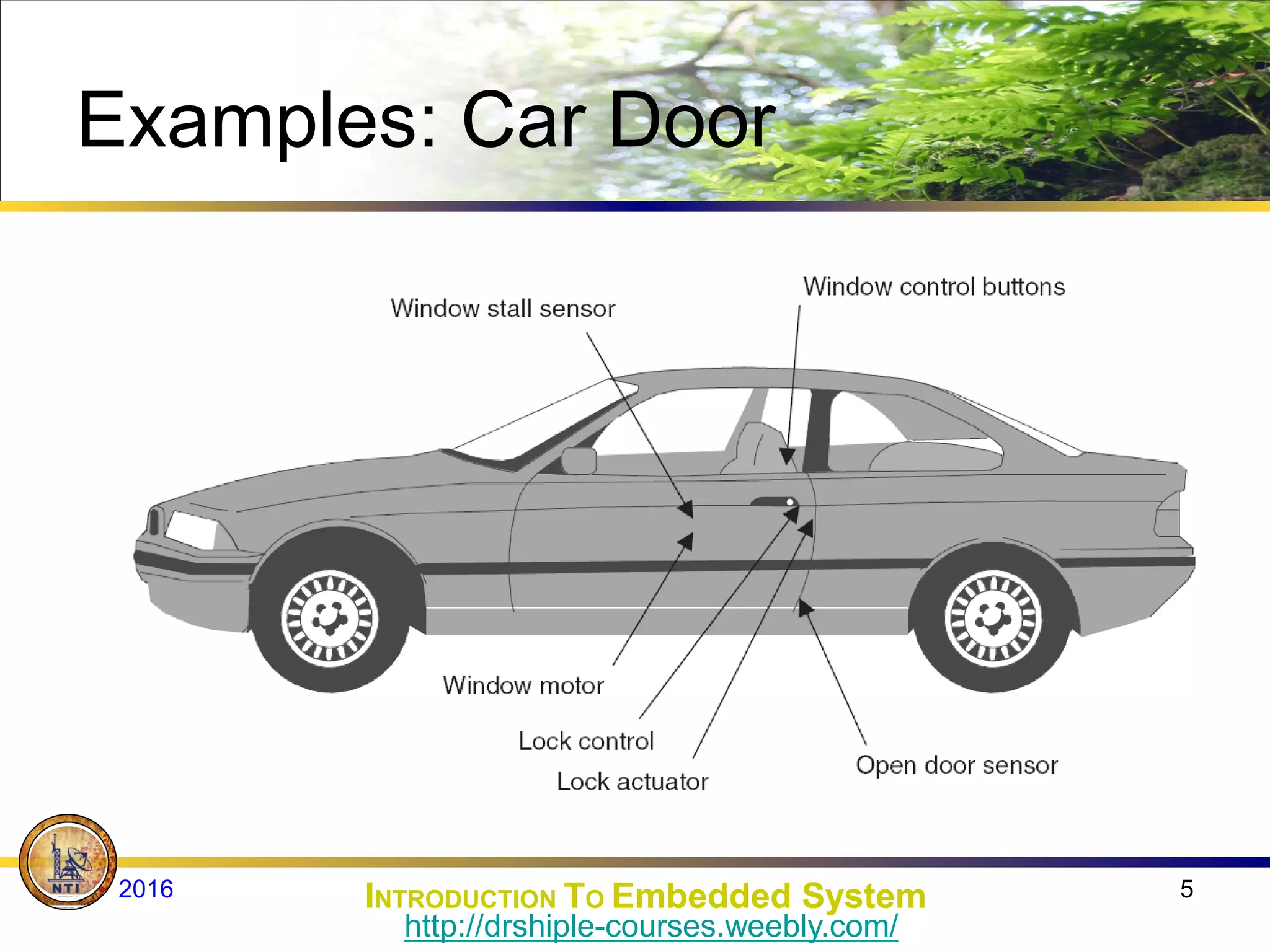
Examples: Car Door
5
INTRODUCTION TO Embedded System
2016
http://drshiple-courses.weebly.com/
Some common characteristics
• Single-functioned
Executes a single program, repeatedly
• Tightly-constrained
Low cost, low power, small, fast, etc.
• Reactive and real-time
Continually reacts to changes in the system’s environment
Must compute certain results in real-time without delay
6
INTRODUCTION TO Embedded System
2016
http://drshiple-courses.weebly.com/
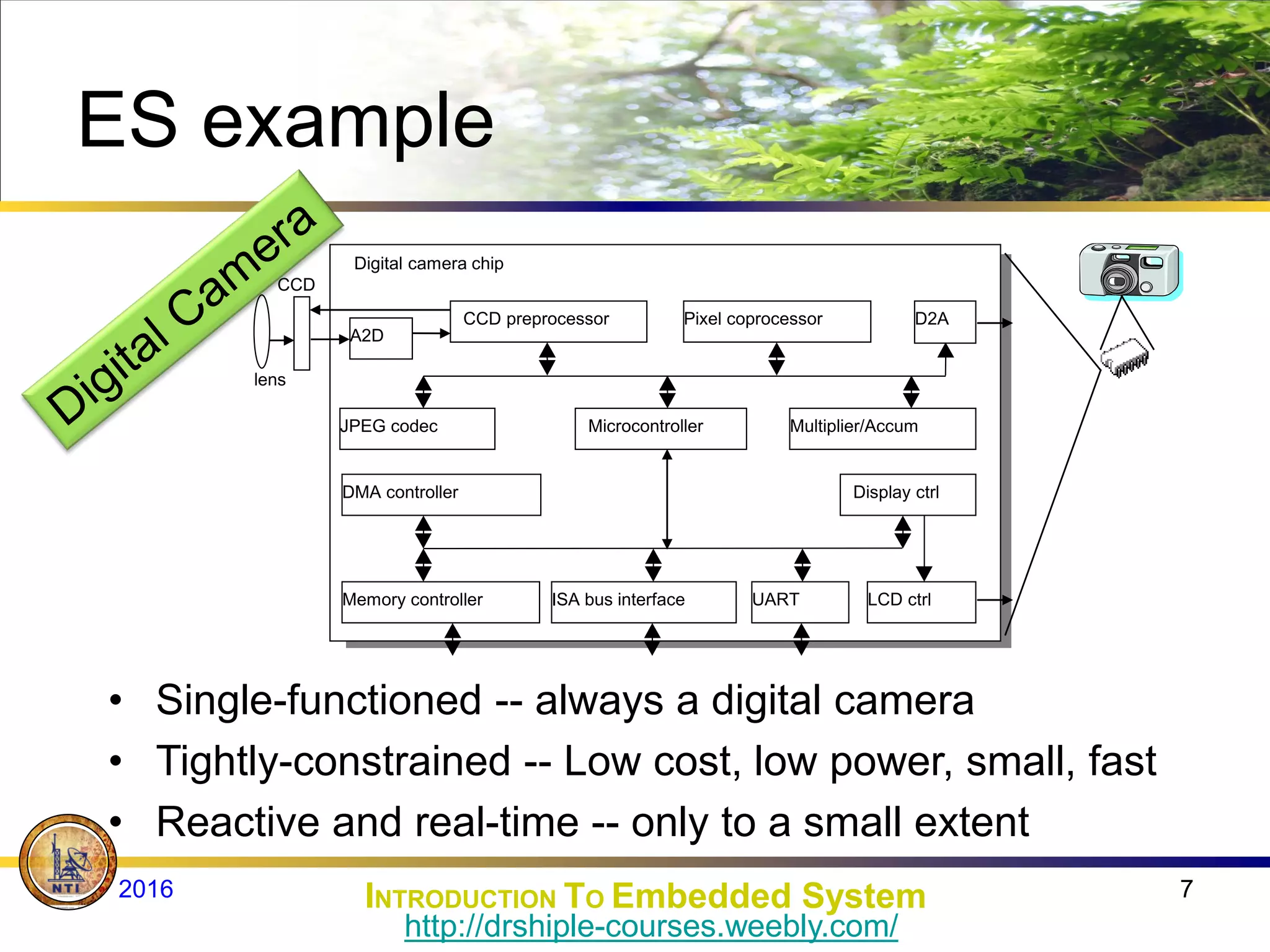
ES example
Microcontroller
CCD preprocessor Pixel coprocessor
A2D
D2A
JPEG codec
DMA controller
Memory controller ISA bus interface UART LCD ctrl
Display ctrl
Multiplier/Accum
Digital camera chip
lens
CCD
• Single-functioned -- always a digital camera
• Tightly-constrained -- Low cost, low power, small, fast
• Reactive and real-time -- only to a small extent
7
INTRODUCTION TO Embedded System
2016
http://drshiple-courses.weebly.com/
Why Embedded Systems
• Replacement for discrete logic-based
circuits
• Provide functional upgrades
• Provide easy maintenance upgrades
• Improves mechanical performance
• Protection of intellectual property
• Replacement for analogue circuits
INTRODUCTION TO Embedded System
2016
http://drshiple-courses.weebly.com/
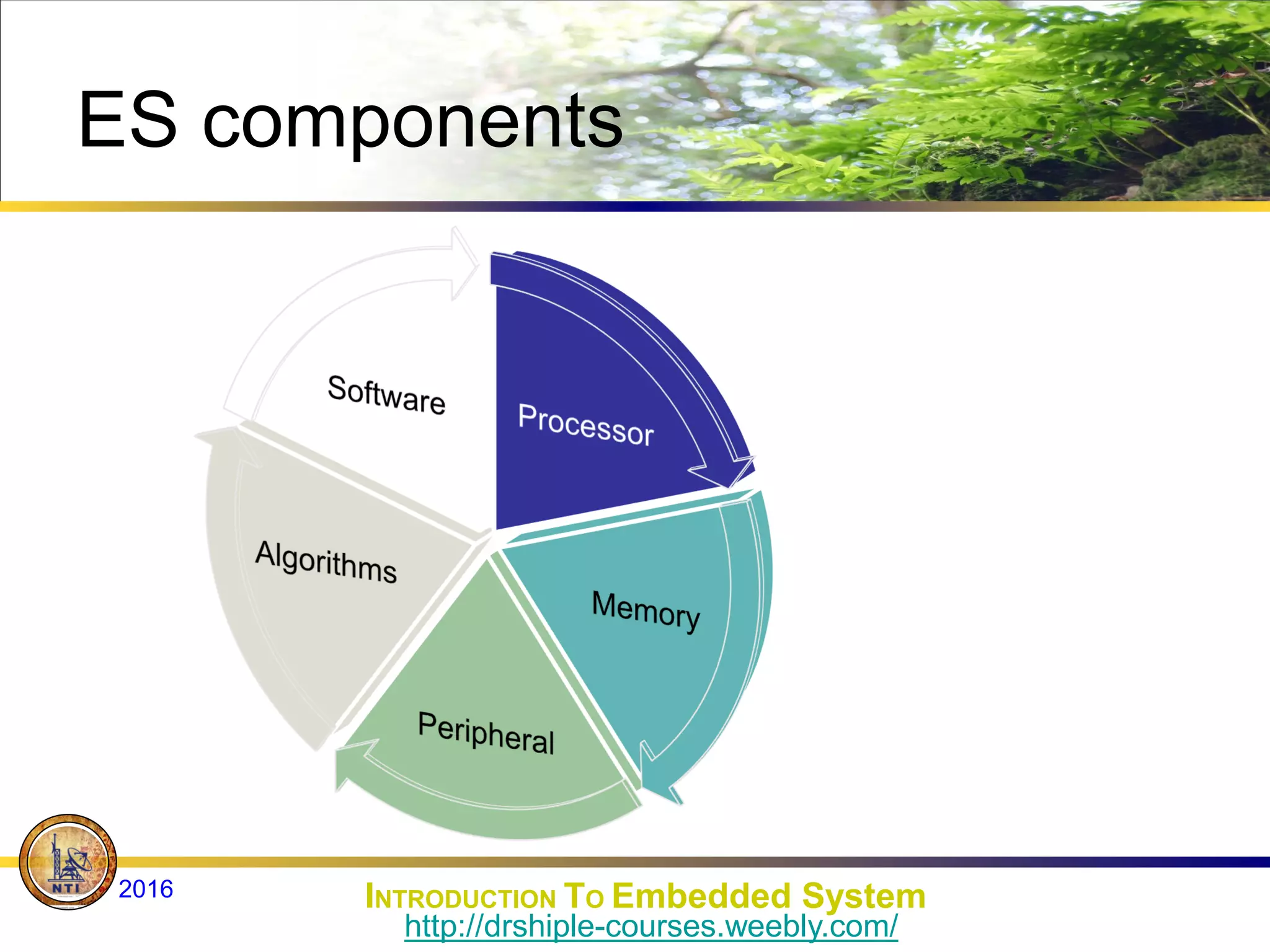
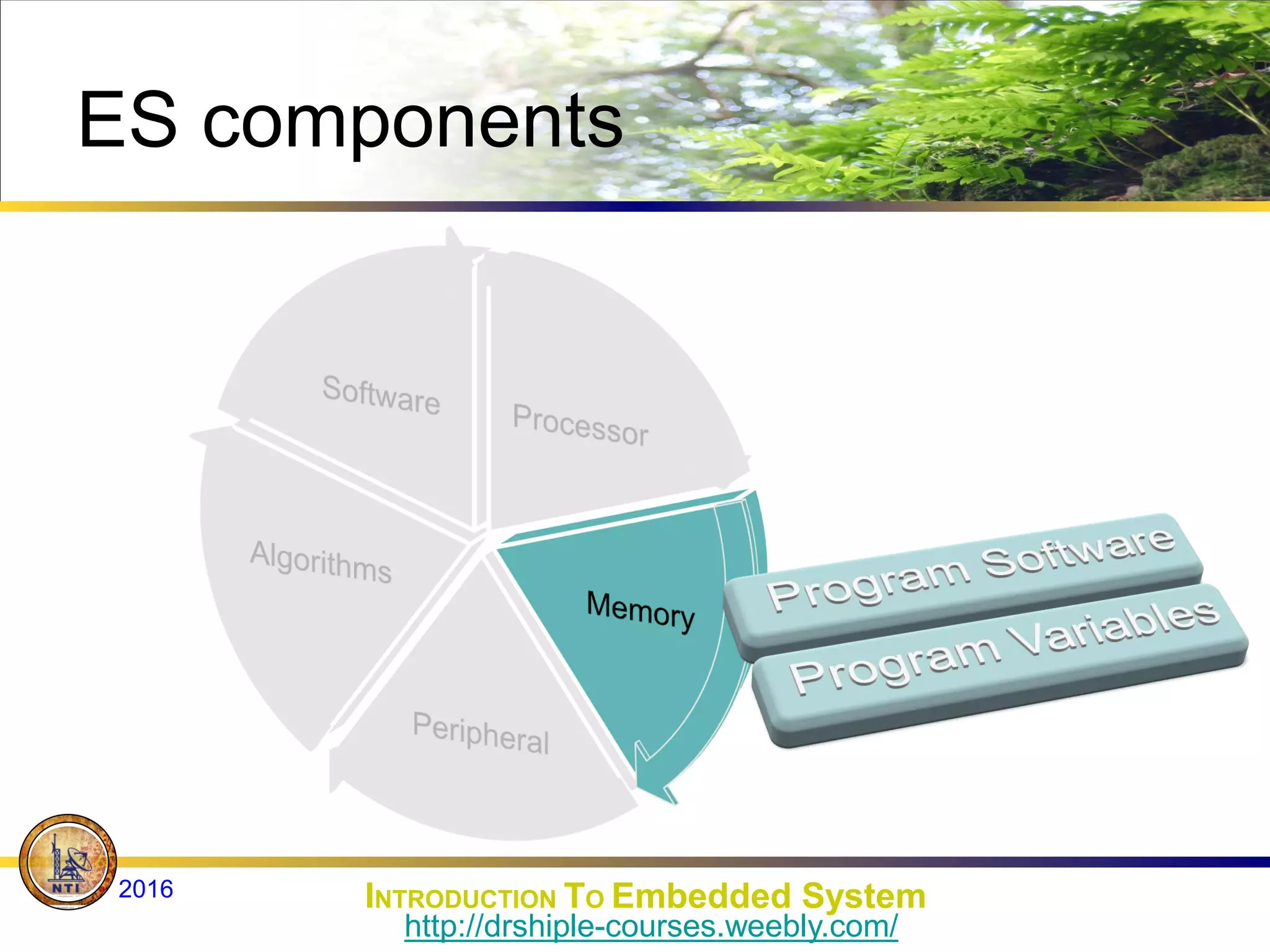
ES components
INTRODUCTION TO Embedded System
2016
http://drshiple-courses.weebly.com/
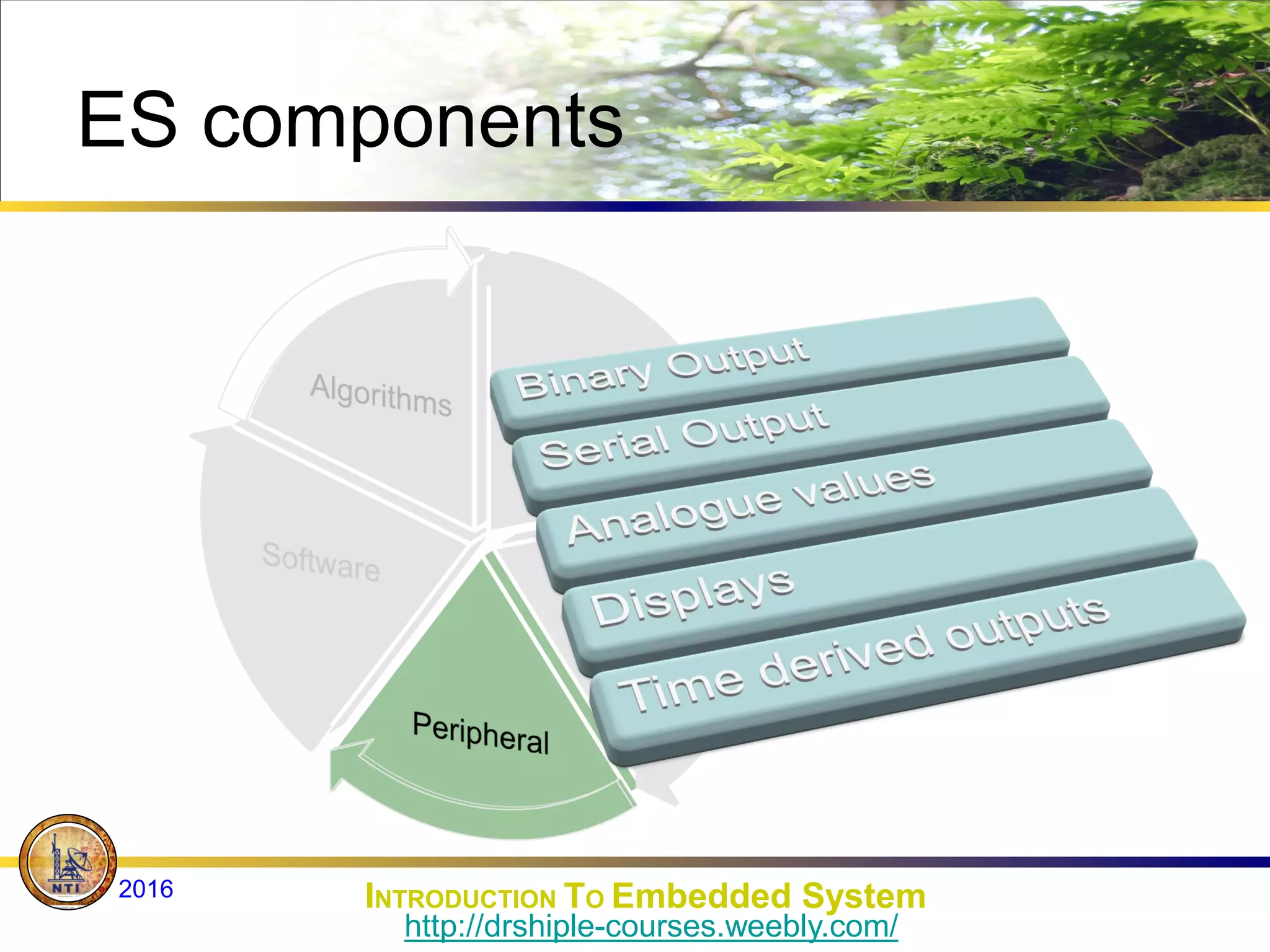
ES components
INTRODUCTION TO Embedded System
2016
http://drshiple-courses.weebly.com/
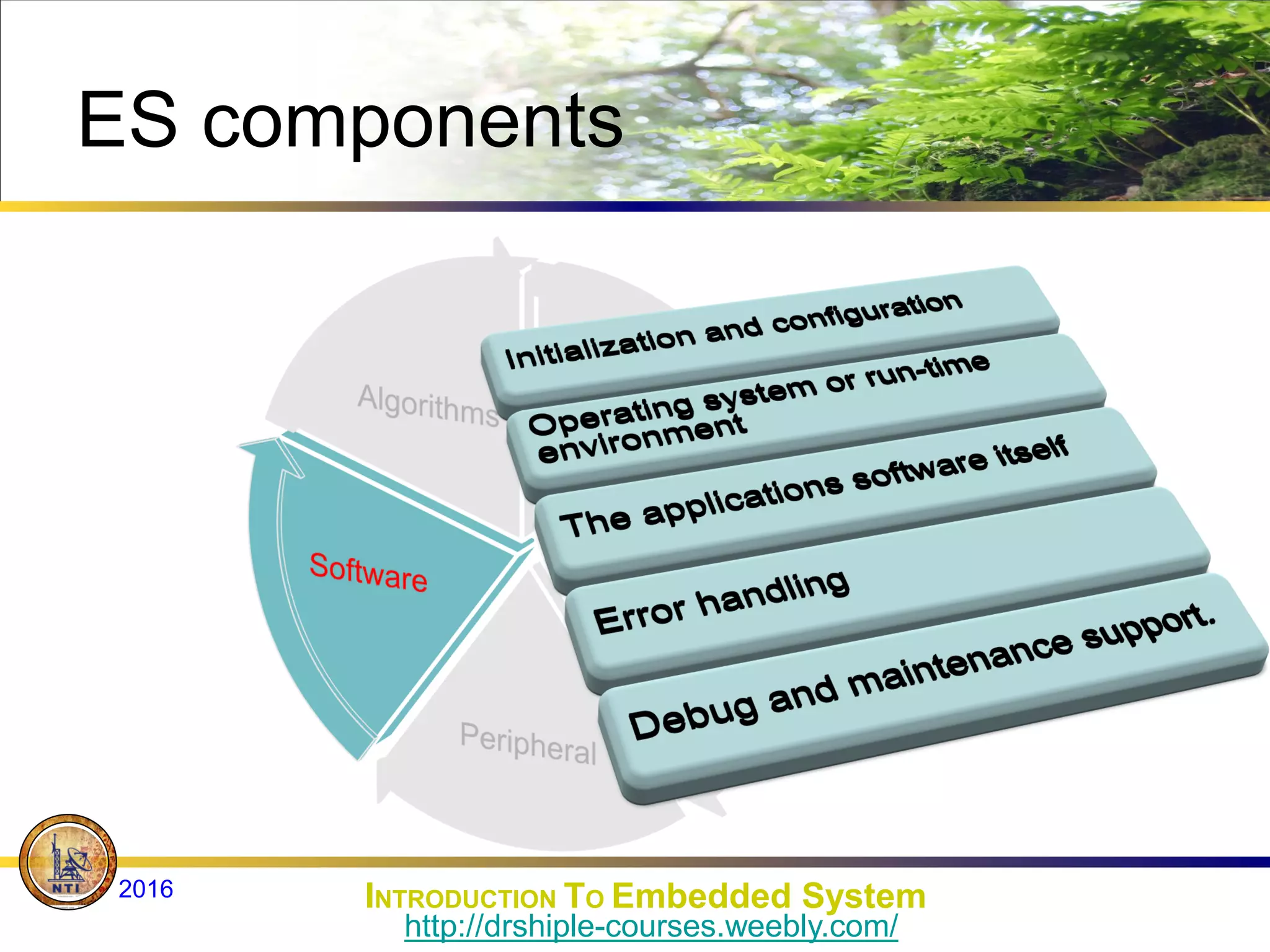
ES components
INTRODUCTION TO Embedded System
2016
http://drshiple-courses.weebly.com/
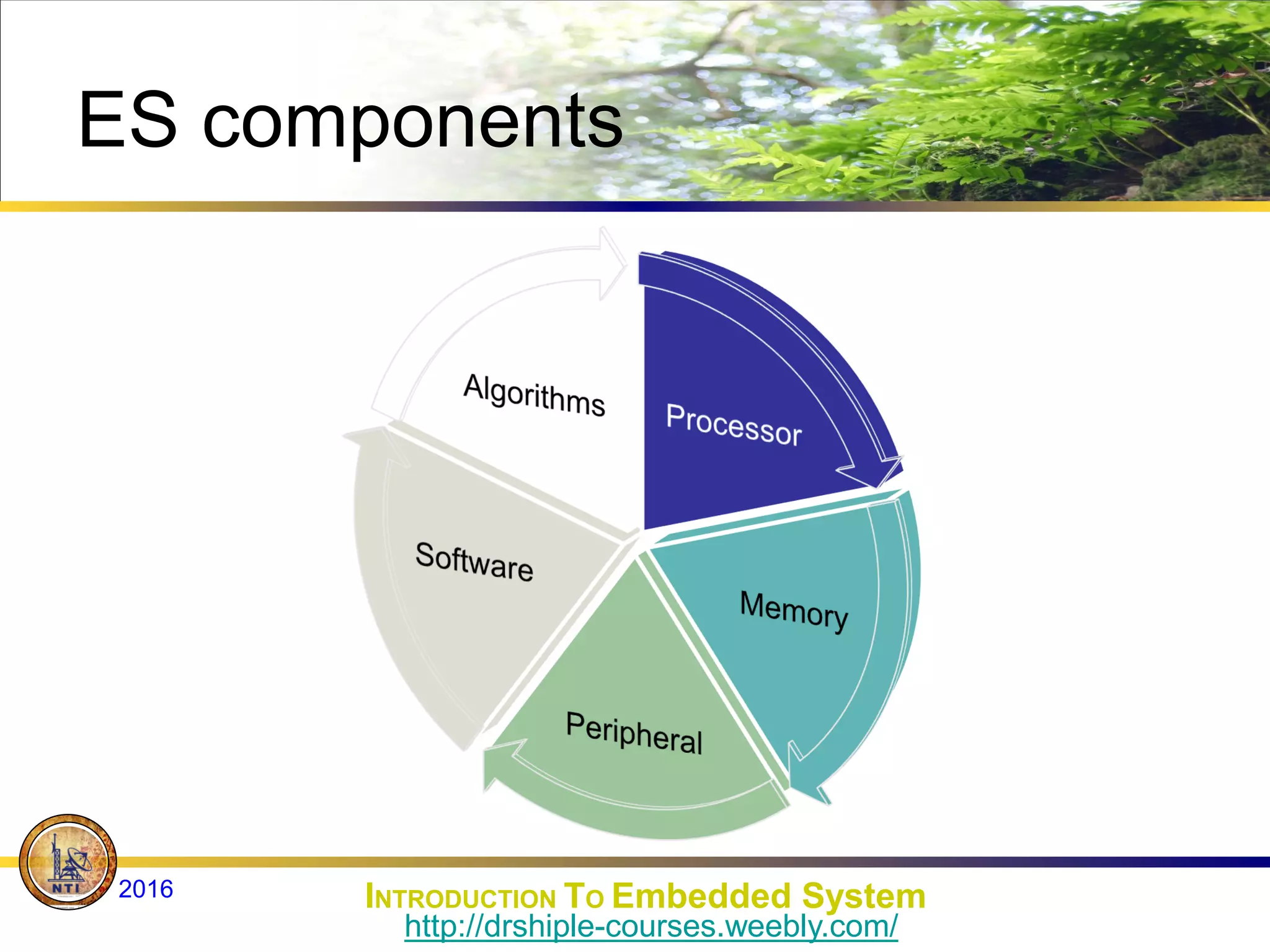
ES components
INTRODUCTION TO Embedded System
2016
http://drshiple-courses.weebly.com/
ES components
INTRODUCTION TO Embedded System
2016
http://drshiple-courses.weebly.com/
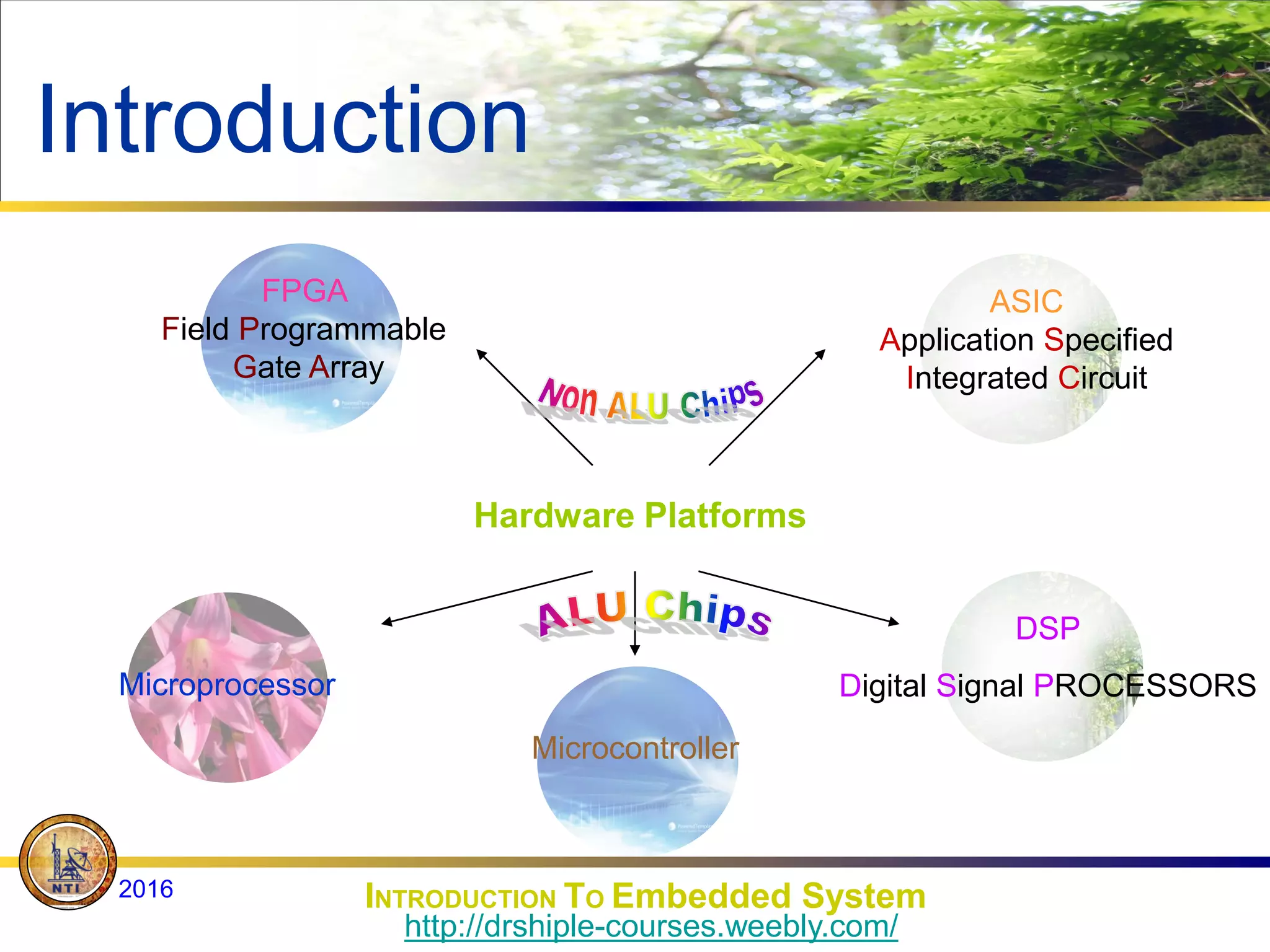
Introduction
Hardware Platforms
DSP
Digital Signal PROCESSORS
Microprocessor
FPGA
Field Programmable
Gate Array
ASIC
Application Specified
Integrated Circuit
Microcontroller
INTRODUCTION TO Embedded System
2016
http://drshiple-courses.weebly.com/
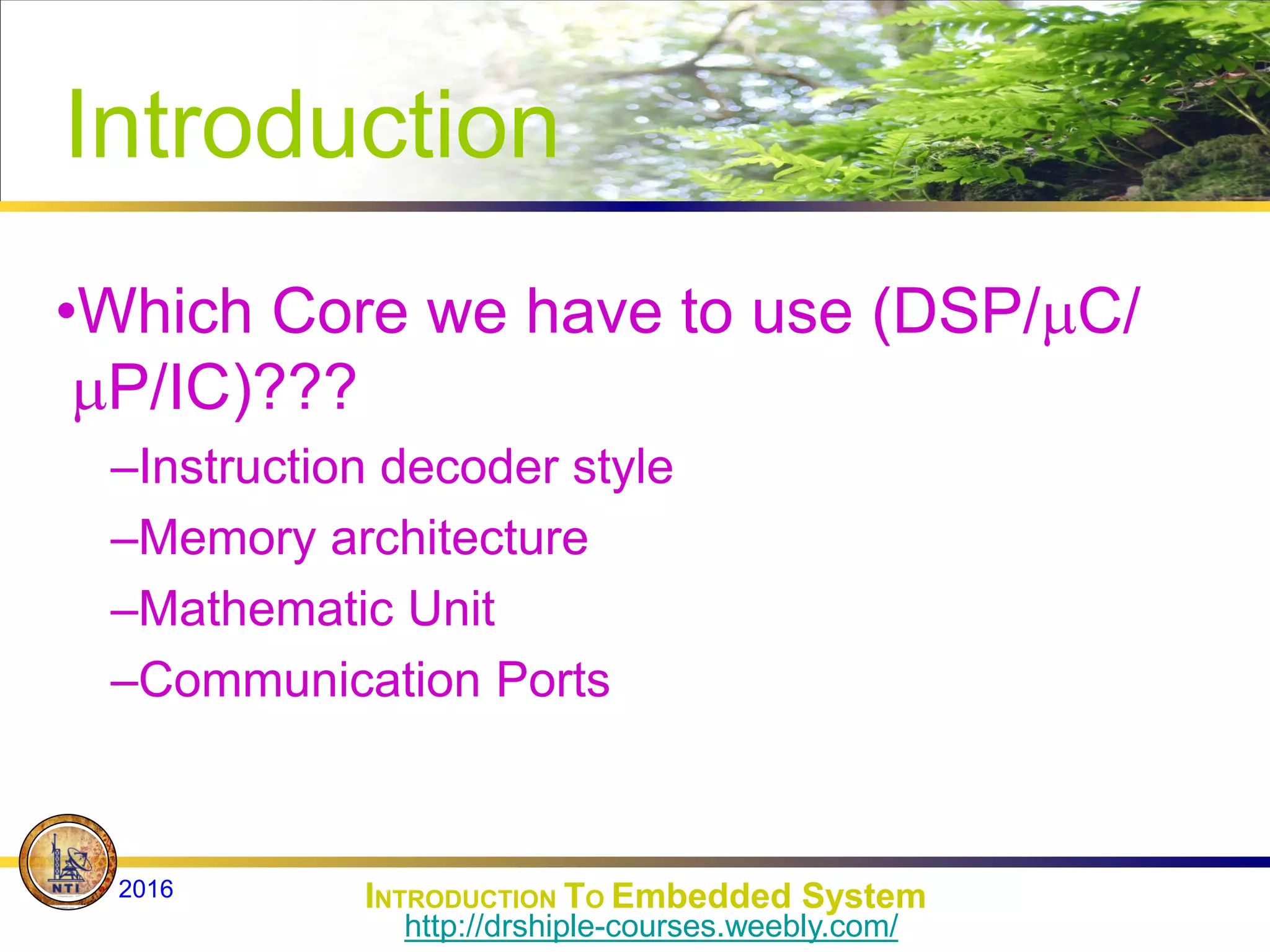
Introduction
•Which Core we have to use (DSP/C/
P/IC)???
–Instruction decoder style
–Memory architecture
–Mathematic Unit
–Communication Ports
INTRODUCTION TO Embedded System
2016
http://drshiple-courses.weebly.com/
Embedded processors
Challenges and Opportunities
INTRODUCTION TO Embedded System
http://drshiple-courses.weebly.com/
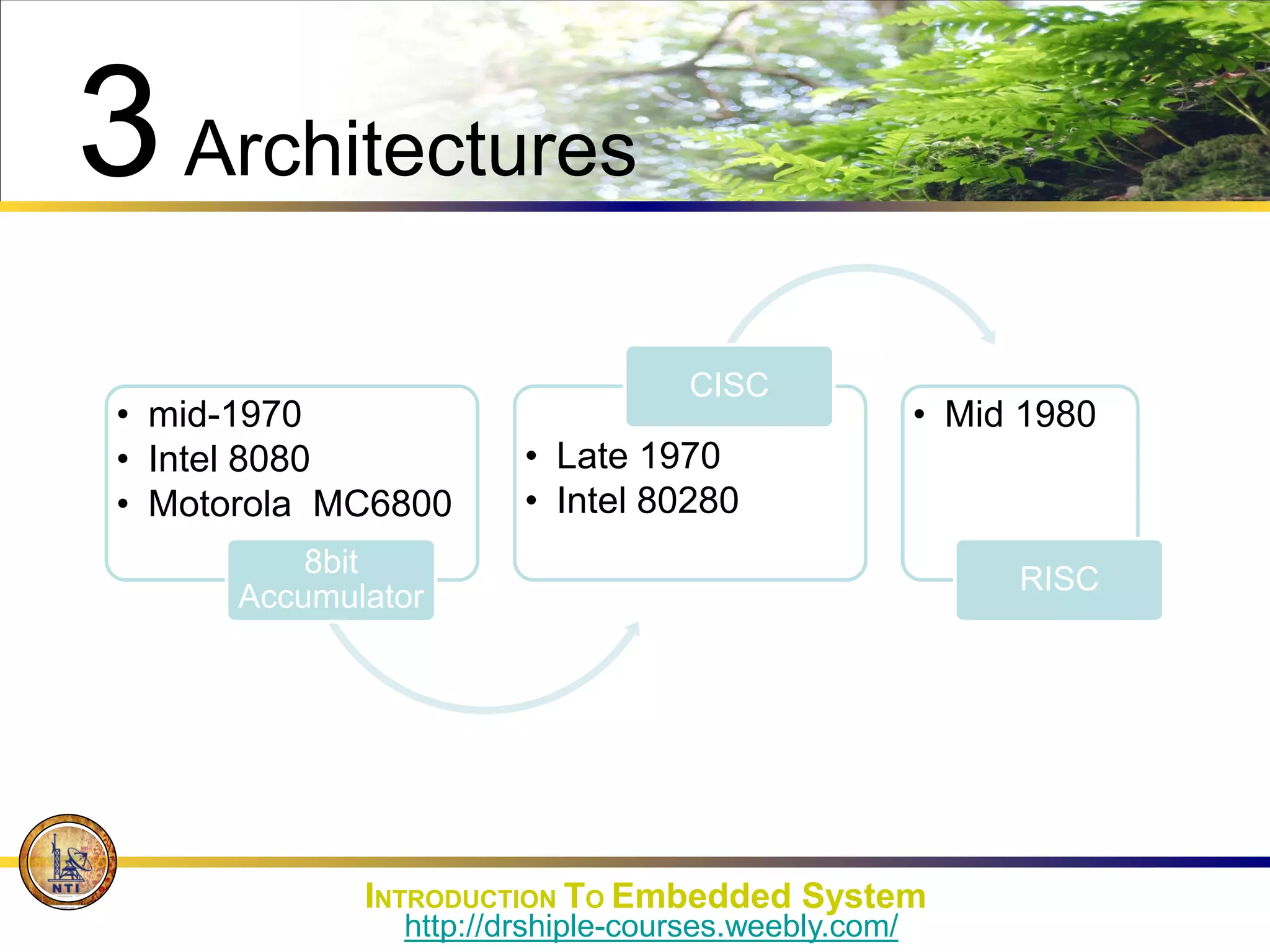
3Architectures
• mid-1970
• Intel 8080
• Motorola MC6800
8bit
Accumulator
• Late 1970
• Intel 80280
CISC
• Mid 1980
RISC
INTRODUCTION TO Embedded System
http://drshiple-courses.weebly.com/
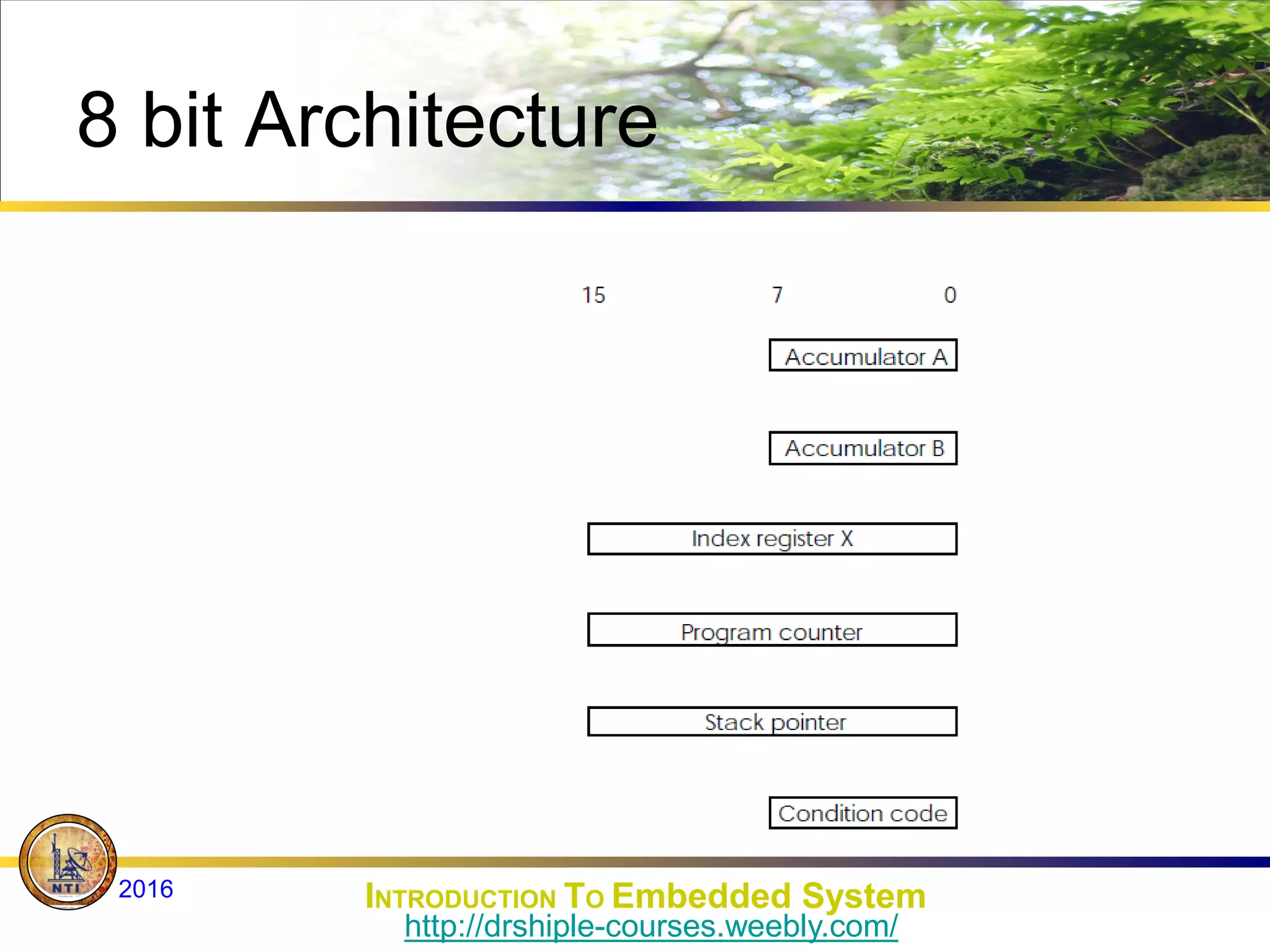
8 bit Architecture
INTRODUCTION TO Embedded System
2016
http://drshiple-courses.weebly.com/
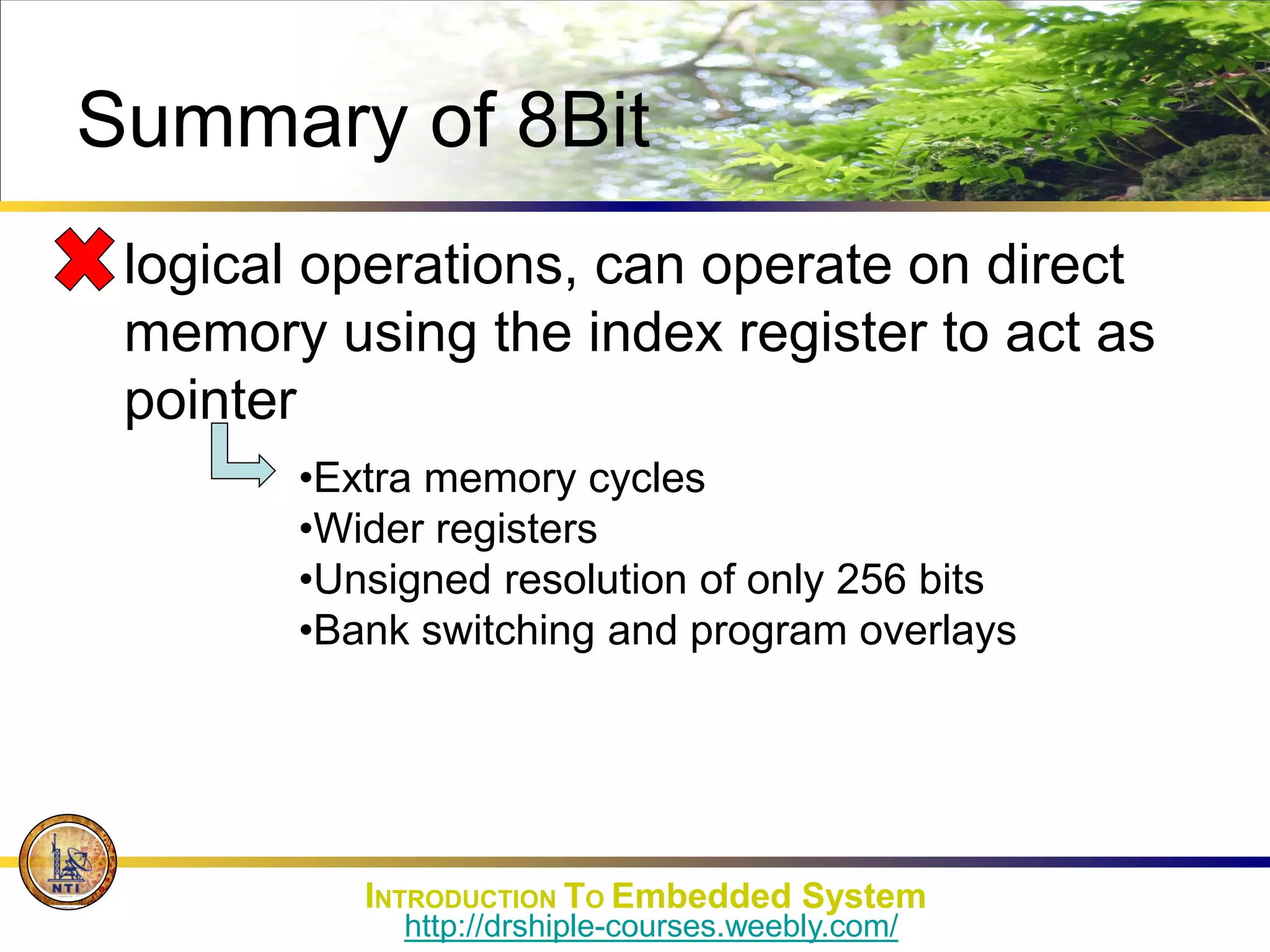
Summary of 8Bit
• logical operations, can operate on direct
memory using the index register to act as
pointer
•Extra memory cycles
•Wider registers
•Unsigned resolution of only 256 bits
•Bank switching and program overlays
INTRODUCTION TO Embedded System
http://drshiple-courses.weebly.com/
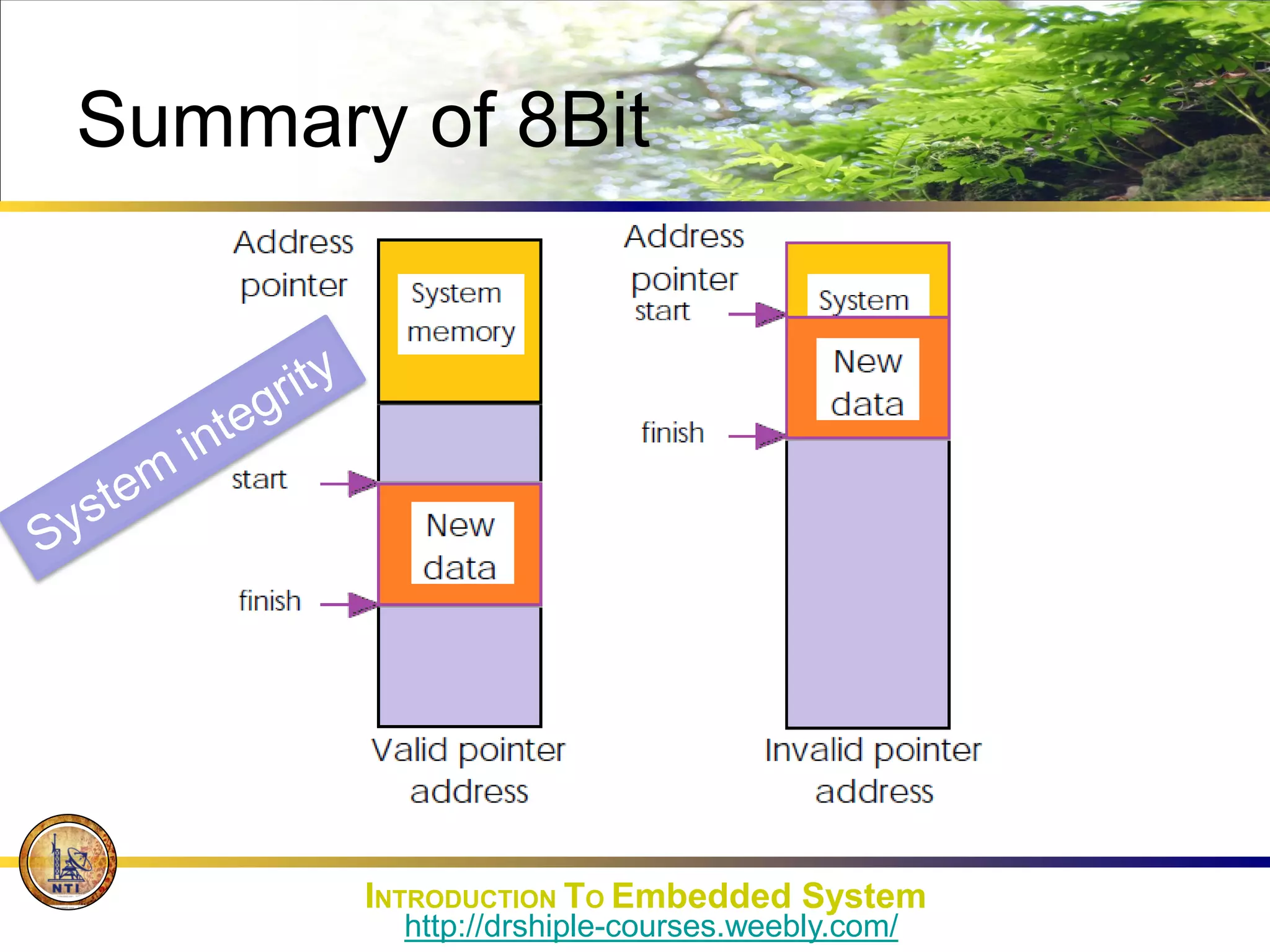
Summary of 8Bit
INTRODUCTION TO Embedded System
http://drshiple-courses.weebly.com/
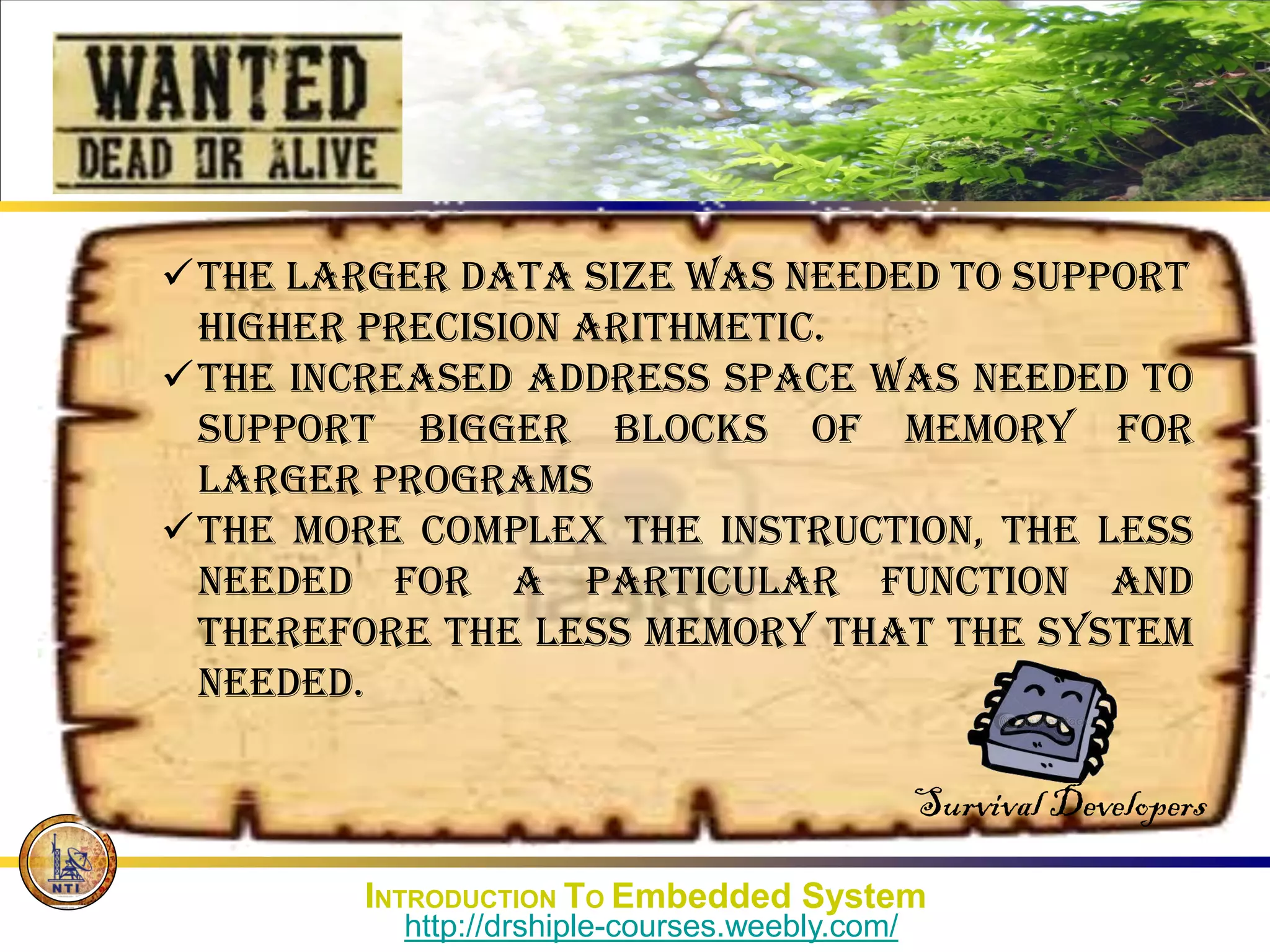
The larger data size was needed to support
higher precision arithmetic.
The increased address space was needed to
support bigger blocks of memory for
larger programs
the more complex the instruction, the less
needed for a particular function and
therefore the less memory that the system
needed.
Survival Developers
INTRODUCTION TO Embedded System
http://drshiple-courses.weebly.com/
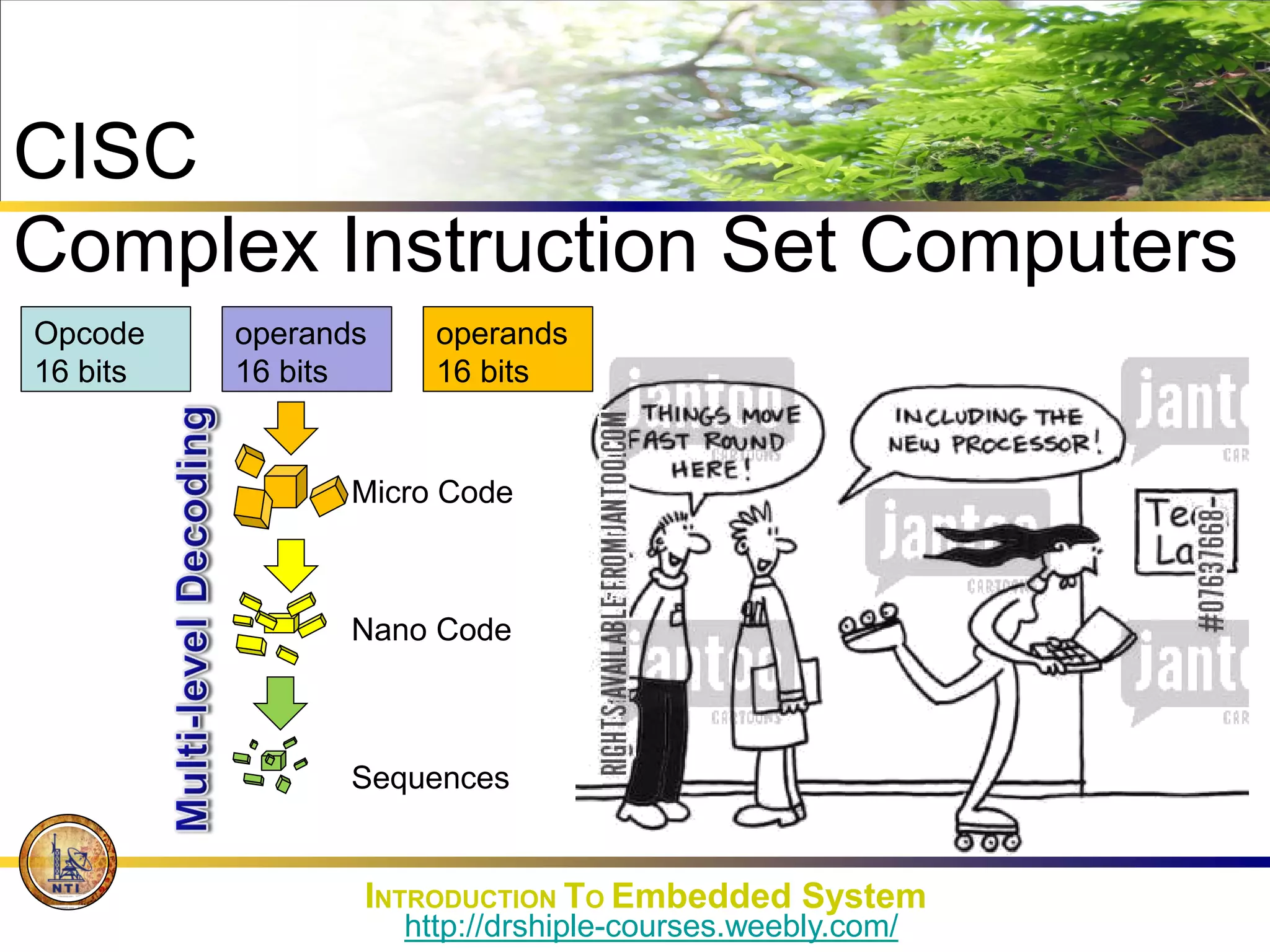
CISC
Complex Instruction Set Computers
Opcode
16 bits
operands
16 bits
operands
16 bits
Micro Code
Nano Code
Sequences
INTRODUCTION TO Embedded System
http://drshiple-courses.weebly.com/
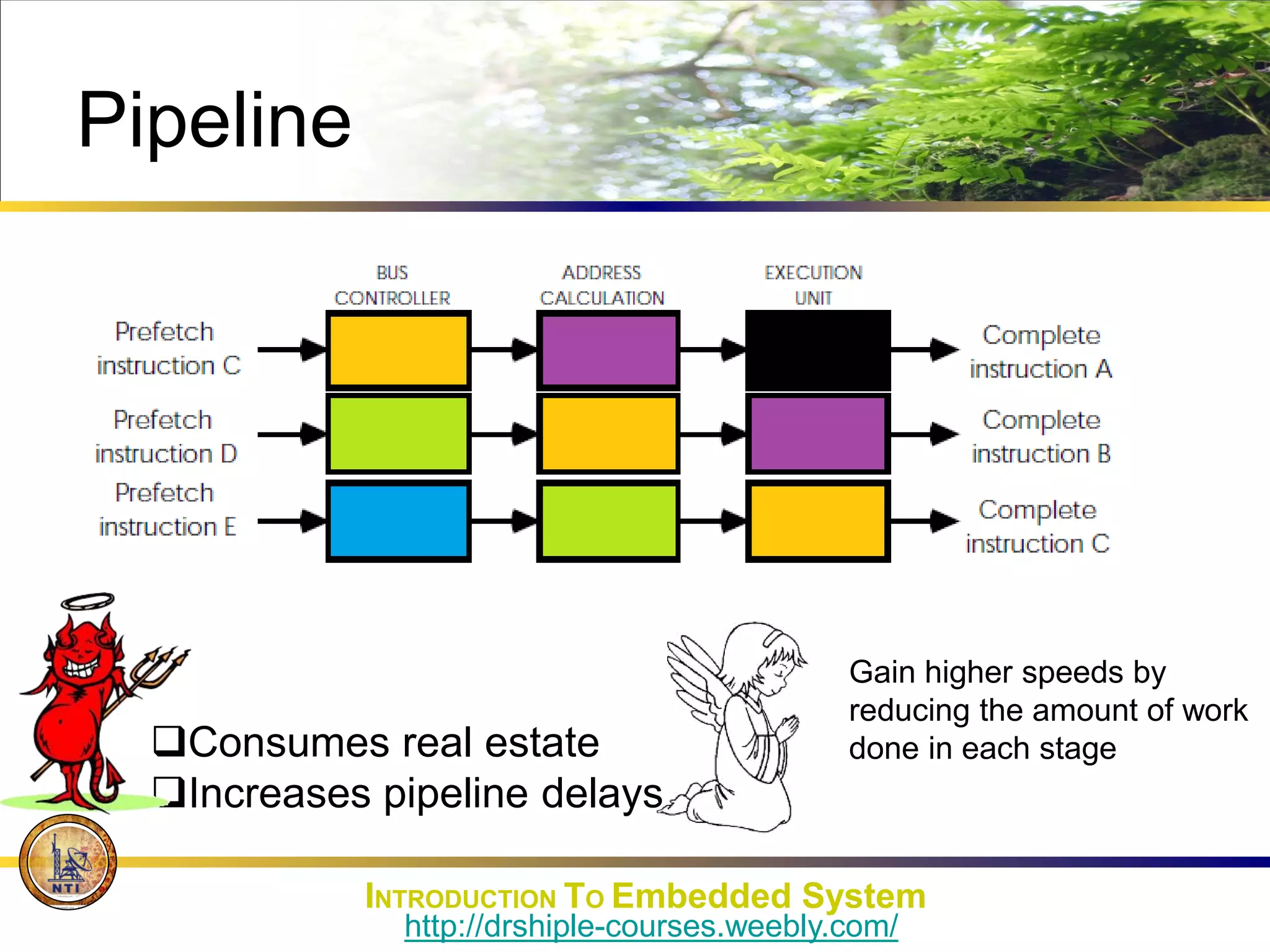
Pipeline
Consumes real estate
Increases pipeline delays
Gain higher speeds by
reducing the amount of work
done in each stage
INTRODUCTION TO Embedded System
http://drshiple-courses.weebly.com/
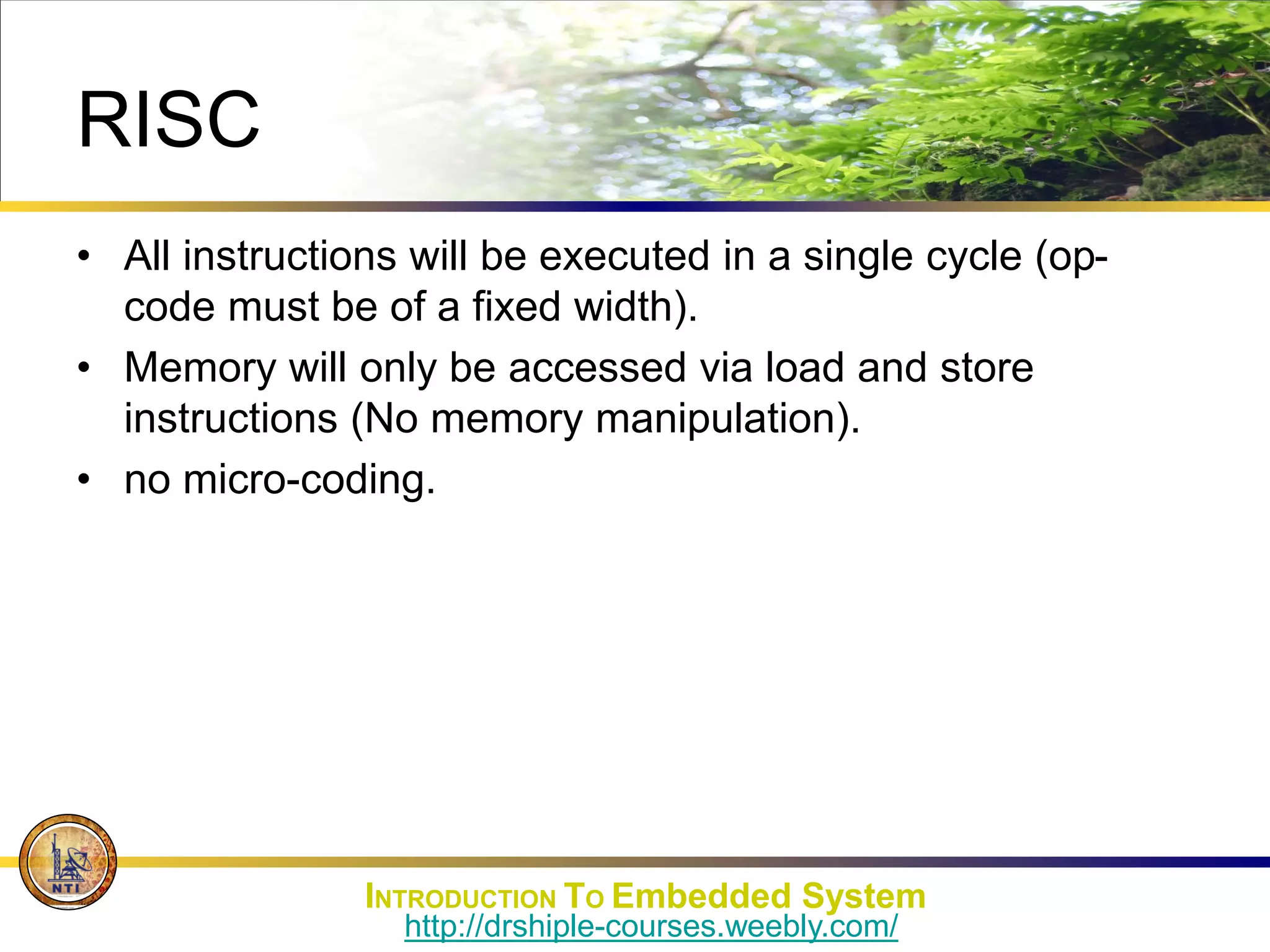
RISC
• All instructions will be executed in a single cycle (op-
code must be of a fixed width).
• Memory will only be accessed via load and store
instructions (No memory manipulation).
• no micro-coding.
INTRODUCTION TO Embedded System
http://drshiple-courses.weebly.com/
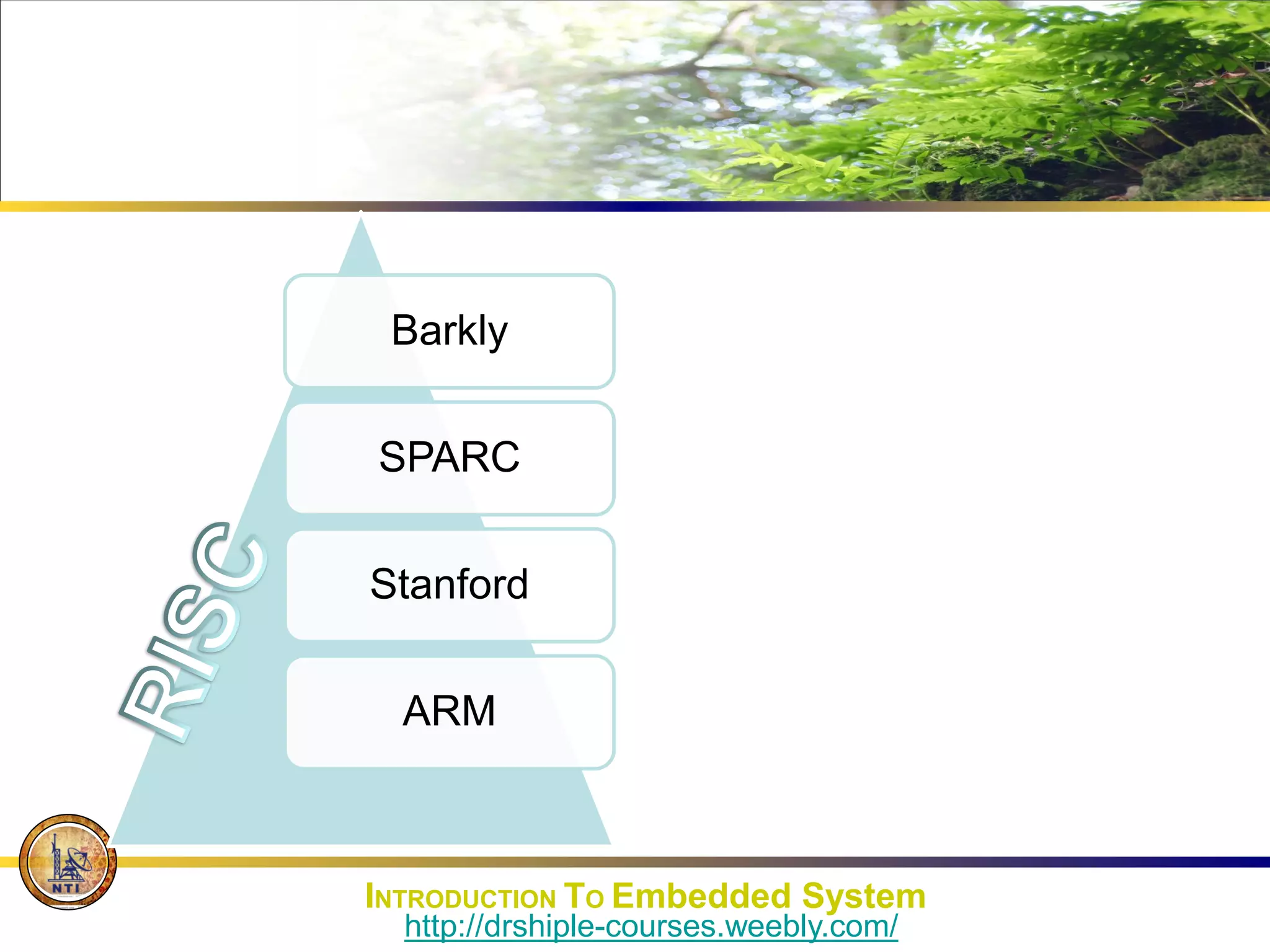
Barkly
SPARC
Stanford
ARM
INTRODUCTION TO Embedded System
http://drshiple-courses.weebly.com/
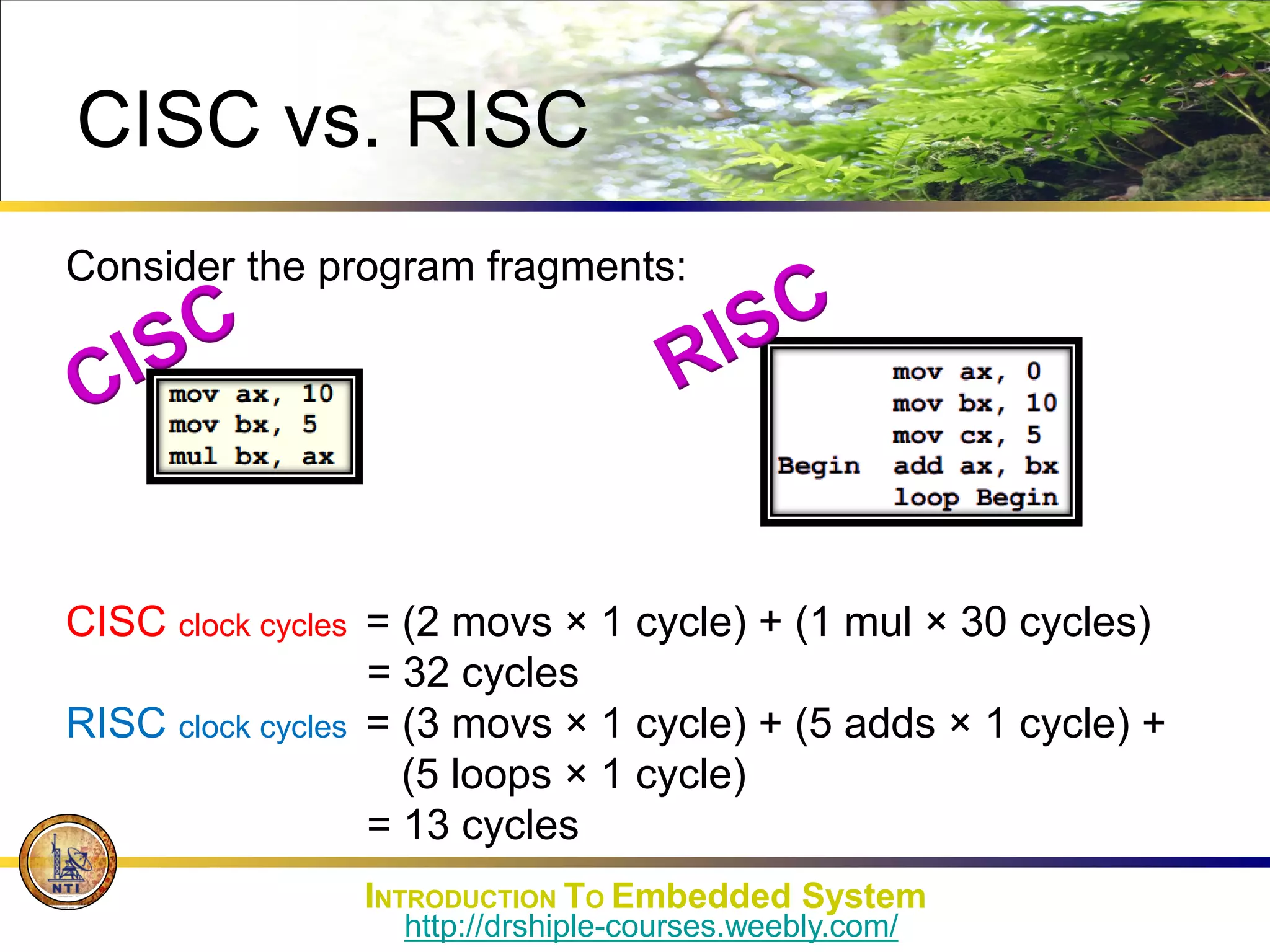
CISC vs. RISC
Consider the program fragments:
CISC clock cycles = (2 movs × 1 cycle) + (1 mul × 30 cycles)
= 32 cycles
RISC clock cycles = (3 movs × 1 cycle) + (5 adds × 1 cycle) +
(5 loops × 1 cycle)
= 13 cycles
INTRODUCTION TO Embedded System
http://drshiple-courses.weebly.com/
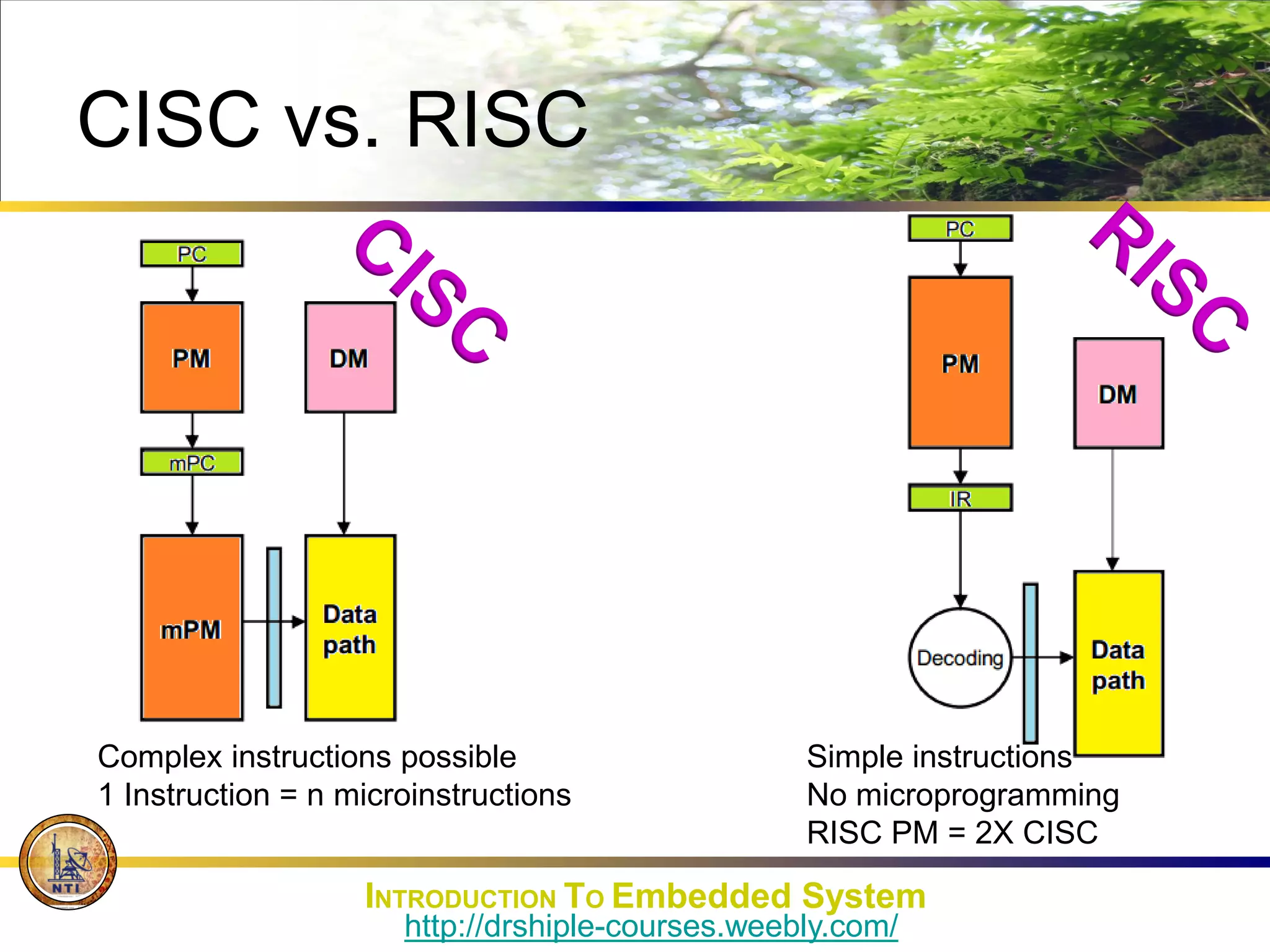
CISC vs. RISC
Complex instructions possible
1 Instruction = n microinstructions
Simple instructions
No microprogramming
RISC PM = 2X CISC
INTRODUCTION TO Embedded System
http://drshiple-courses.weebly.com/
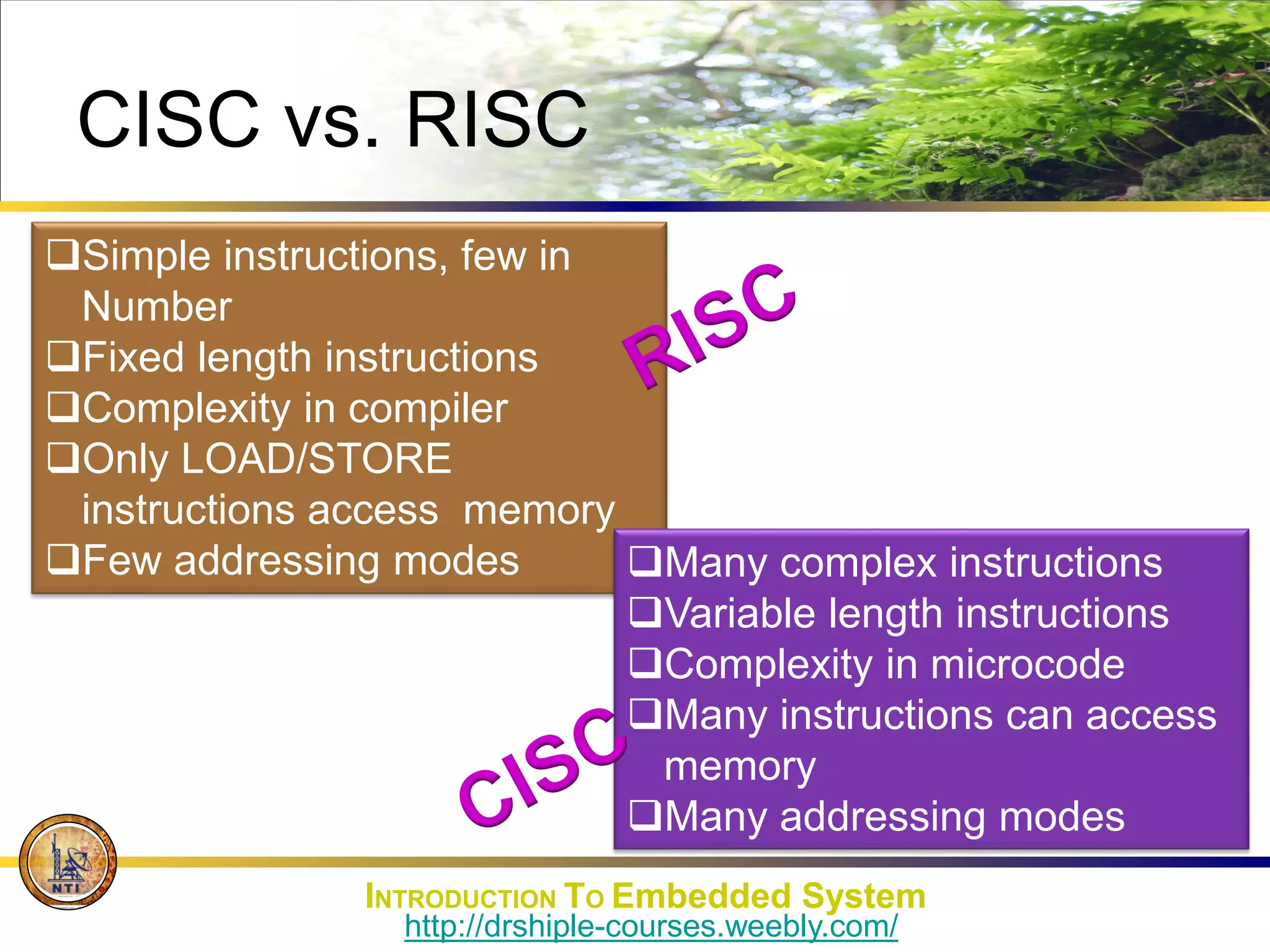
CISC vs. RISC
Simple instructions, few in
Number
Fixed length instructions
Complexity in compiler
Only LOAD/STORE
instructions access memory
Few addressing modes Many complex instructions
Variable length instructions
Complexity in microcode
Many instructions can access
memory
Many addressing modes
INTRODUCTION TO Embedded System
http://drshiple-courses.weebly.com/
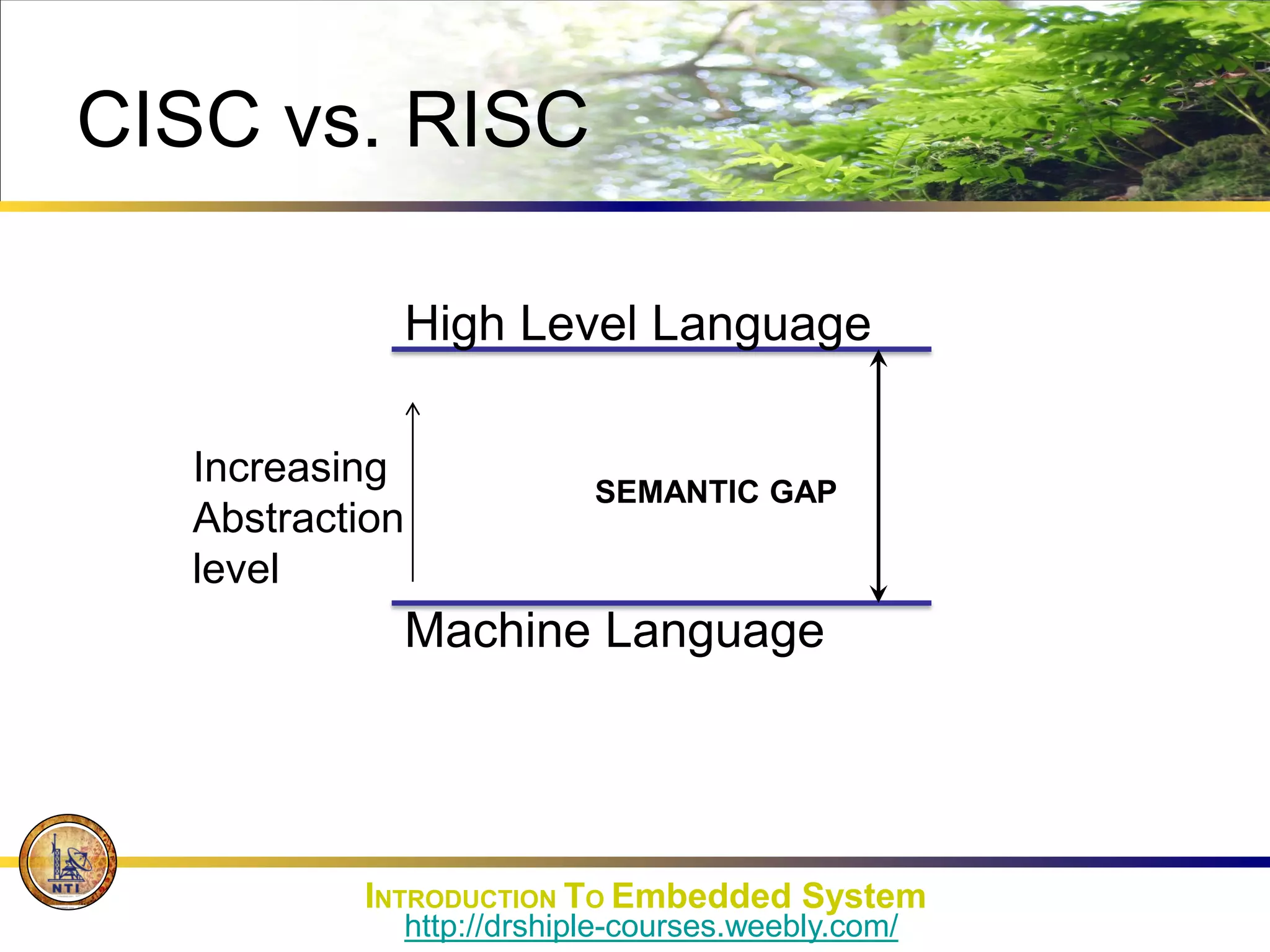
CISC vs. RISC
SEMANTIC GAP
High Level Language
Machine Language
Increasing
Abstraction
level
INTRODUCTION TO Embedded System
http://drshiple-courses.weebly.com/
MEMORY ORGANIZATION
INTRODUCTION TO Embedded System
http://drshiple-courses.weebly.com/
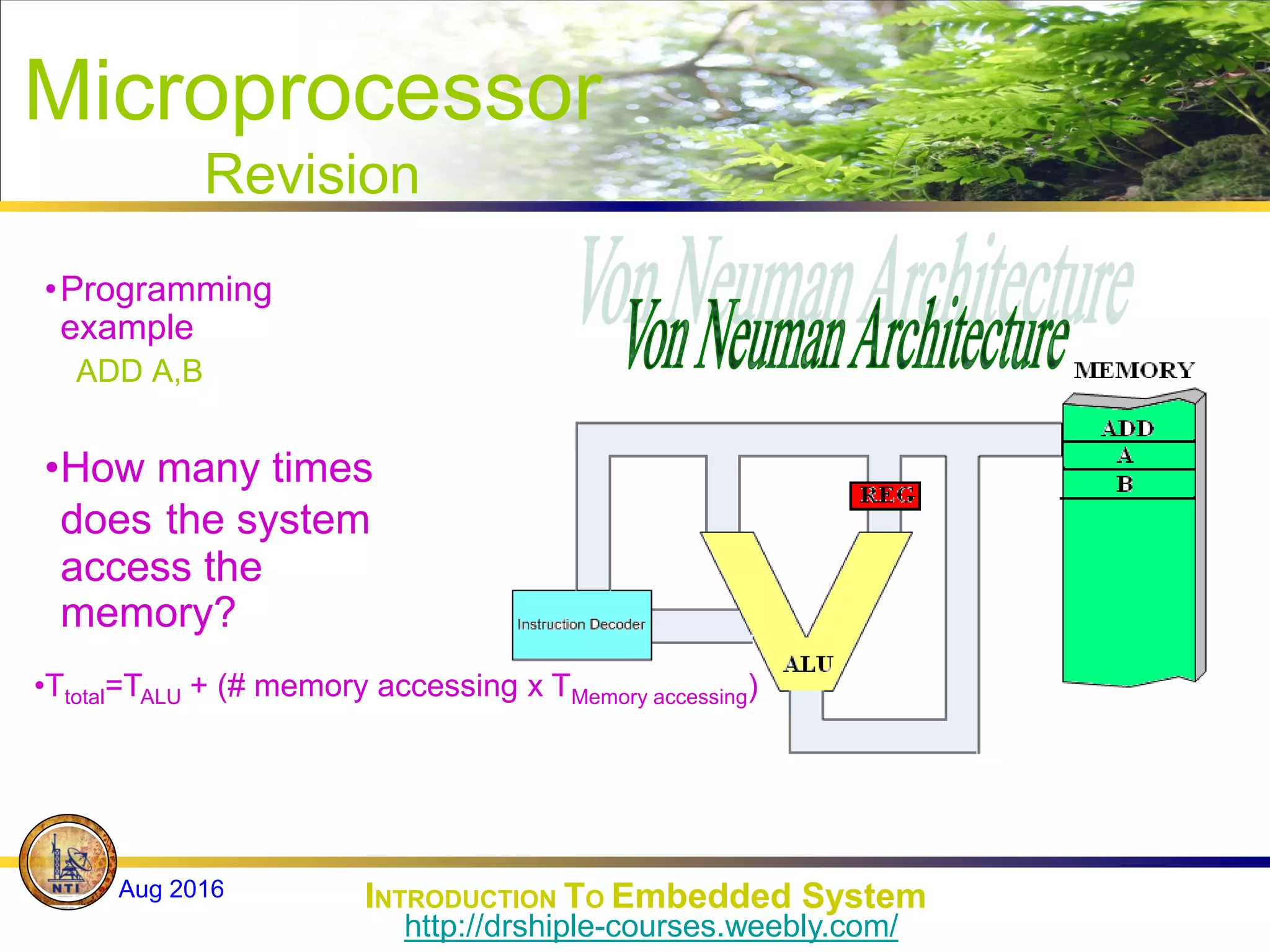
Microprocessor
Revision
•Programming
example
ADD A,B
•How many times
does the system
access the
memory?
•Ttotal=TALU + (# memory accessing x TMemory accessing)
INTRODUCTION TO Embedded System
Aug 2016
http://drshiple-courses.weebly.com/
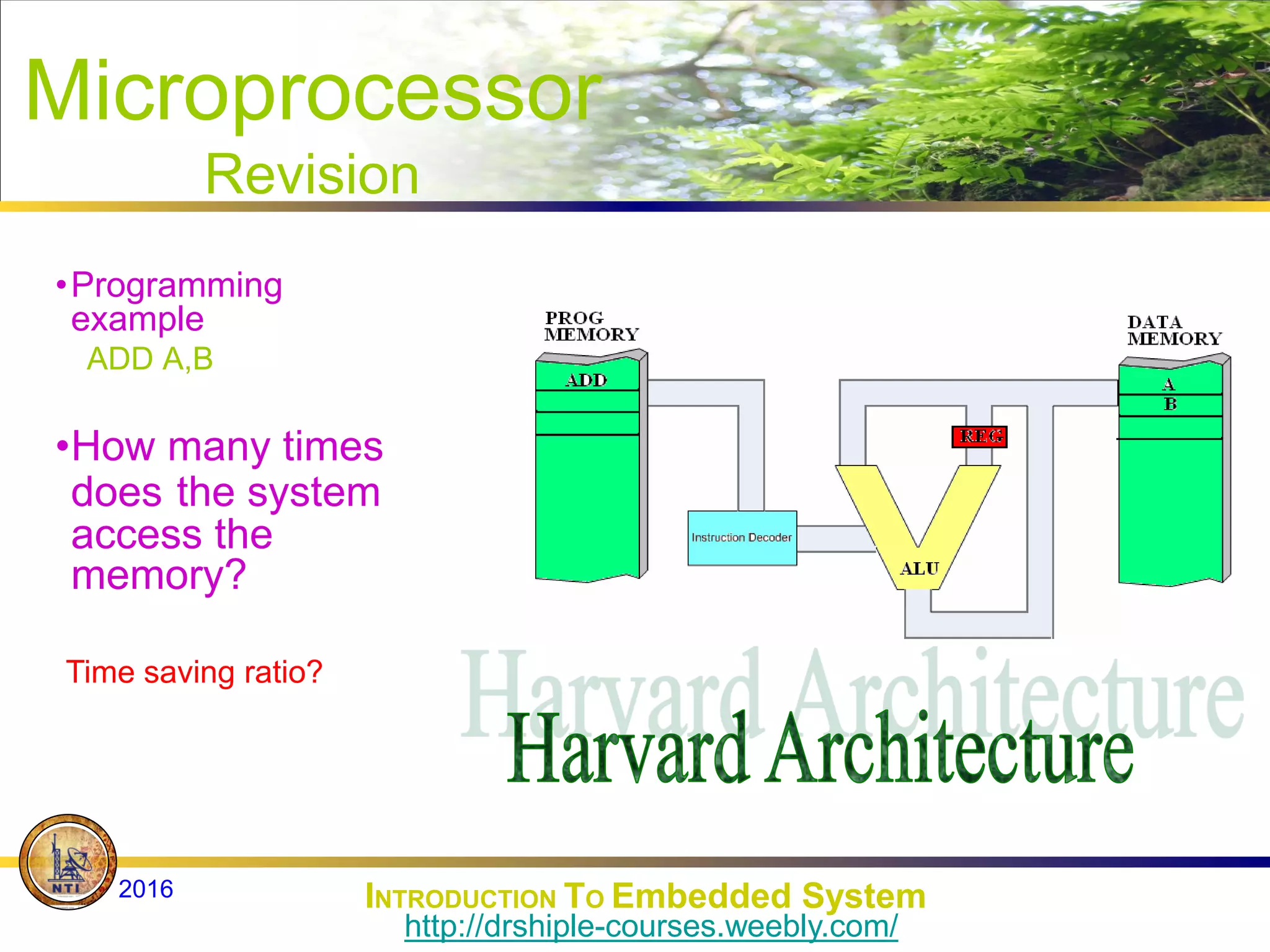
Microprocessor
Revision
•Programming
example
ADD A,B
•How many times
does the system
access the
memory?
Time saving ratio?
INTRODUCTION TO Embedded System
2016
http://drshiple-courses.weebly.com/
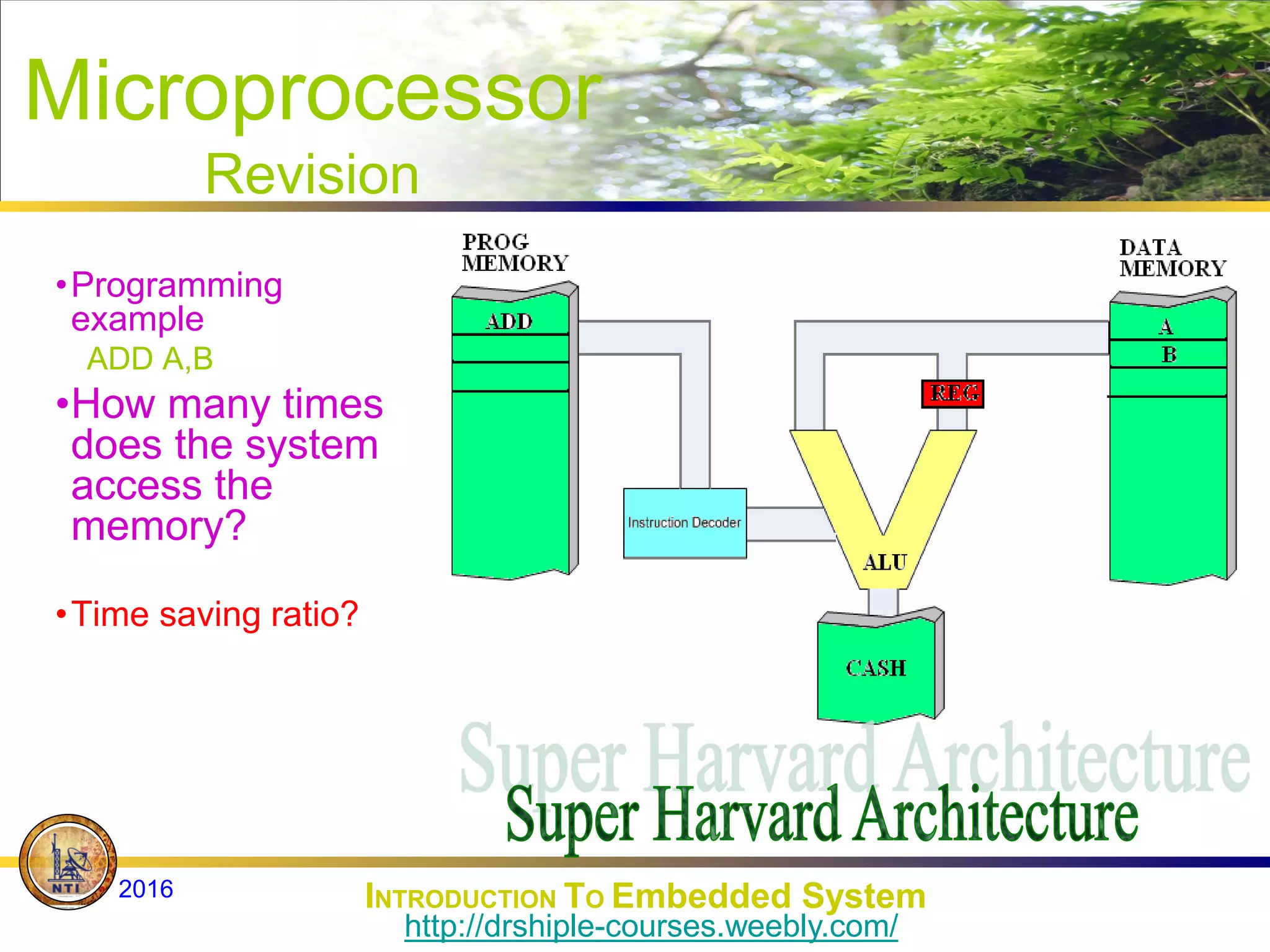
Microprocessor
Revision
•Programming
example
ADD A,B
•How many times
does the system
access the
memory?
•Time saving ratio?
INTRODUCTION TO Embedded System
2016
http://drshiple-courses.weebly.com/
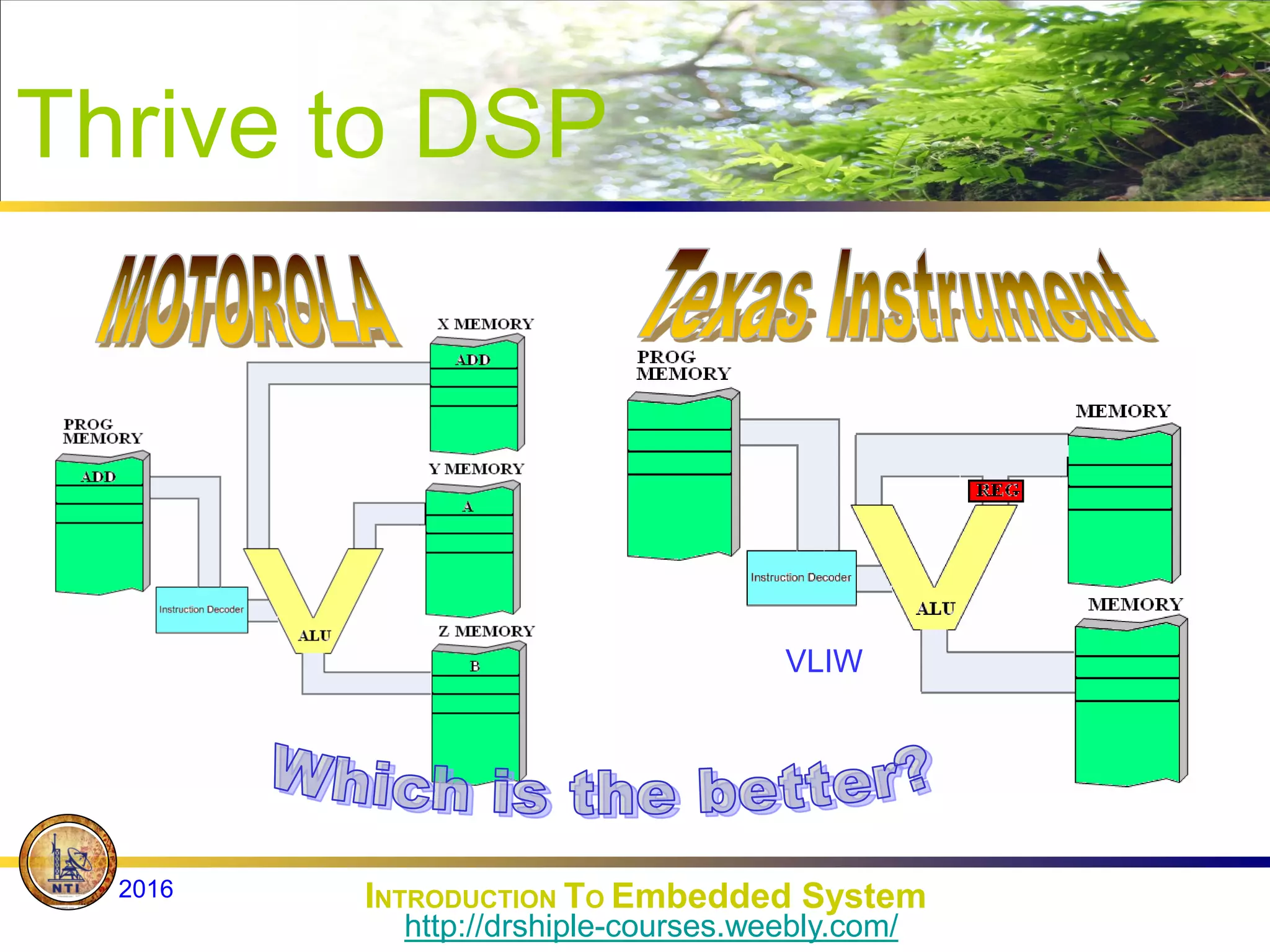
Thrive to DSP
VLIW
INTRODUCTION TO Embedded System
2016
http://drshiple-courses.weebly.com/
Mathematical Unit
INTRODUCTION TO
Embedded System
2016
http://drshiple-courses.weebly.com/
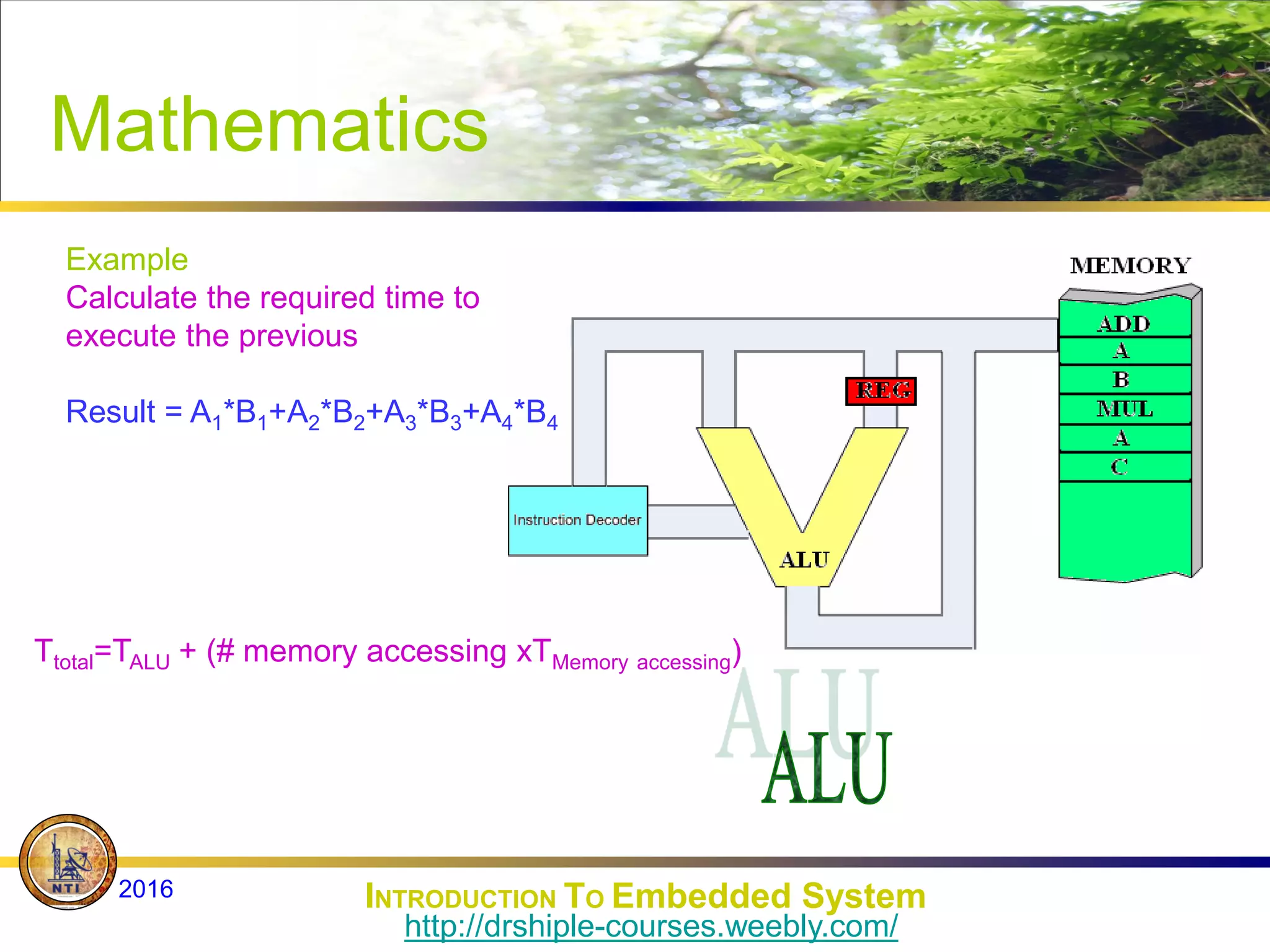
Mathematics
Example
Calculate the required time to
execute the previous
Result = A1*B1+A2*B2+A3*B3+A4*B4
Ttotal=TALU + (# memory accessing xTMemory accessing)
INTRODUCTION TO Embedded System
2016
http://drshiple-courses.weebly.com/
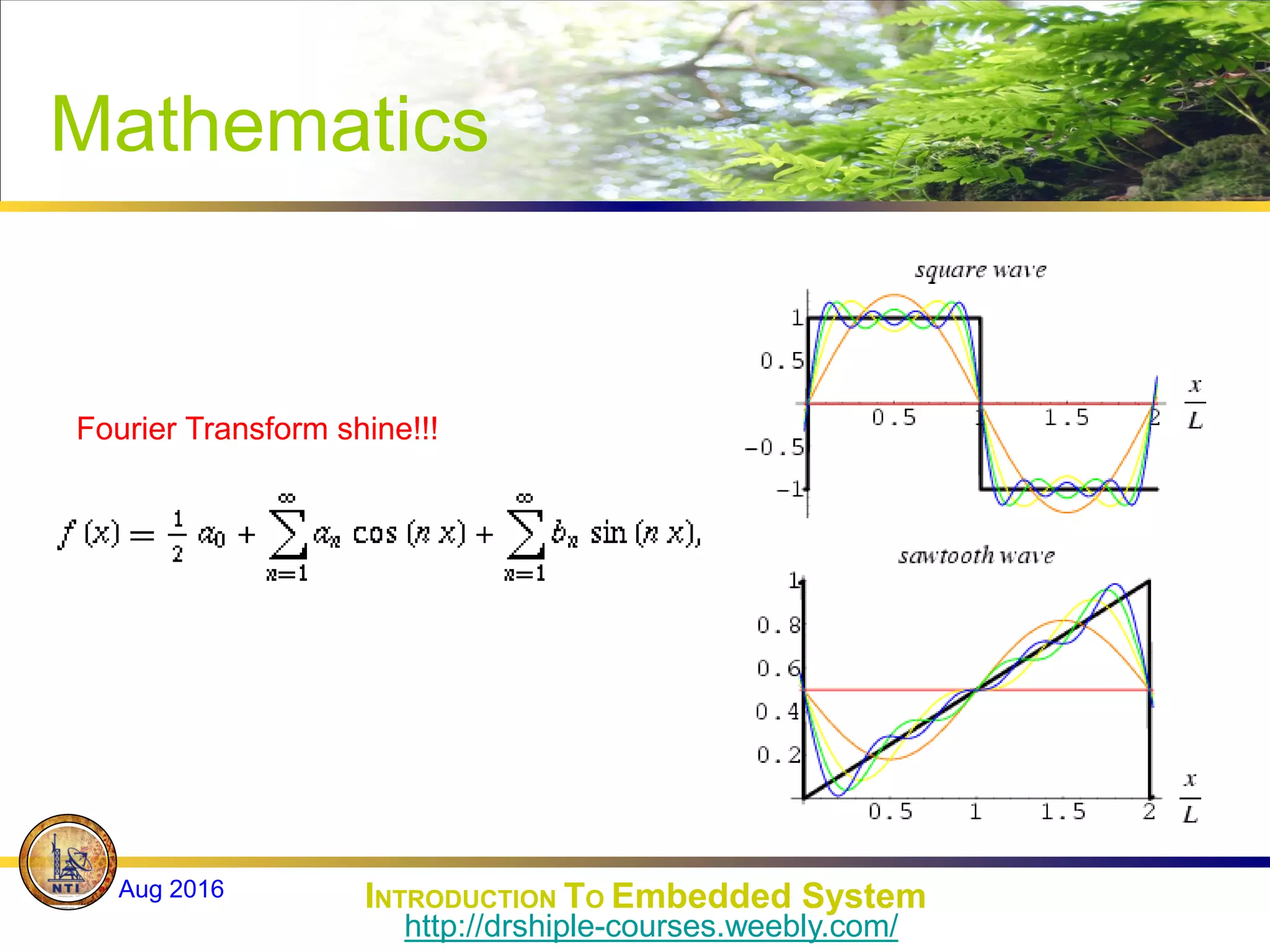
Mathematics
Fourier Transform shine!!!
INTRODUCTION TO Embedded System
Aug 2016
http://drshiple-courses.weebly.com/
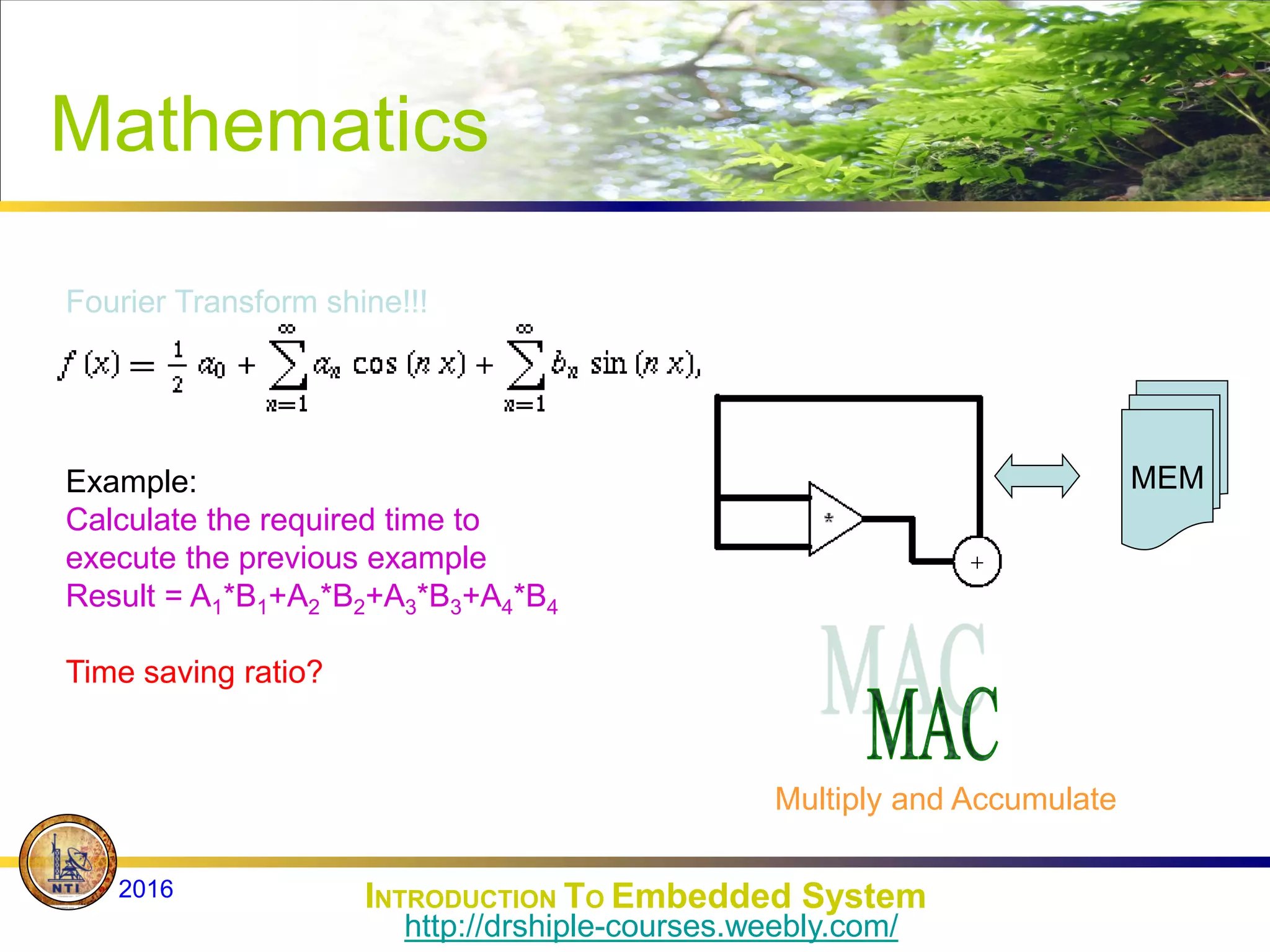
Mathematics
Fourier Transform shine!!!
Example:
Calculate the required time to
execute the previous example
Result = A1*B1+A2*B2+A3*B3+A4*B4
Multiply and Accumulate
MEM
Time saving ratio?
INTRODUCTION TO Embedded System
2016
http://drshiple-courses.weebly.com/
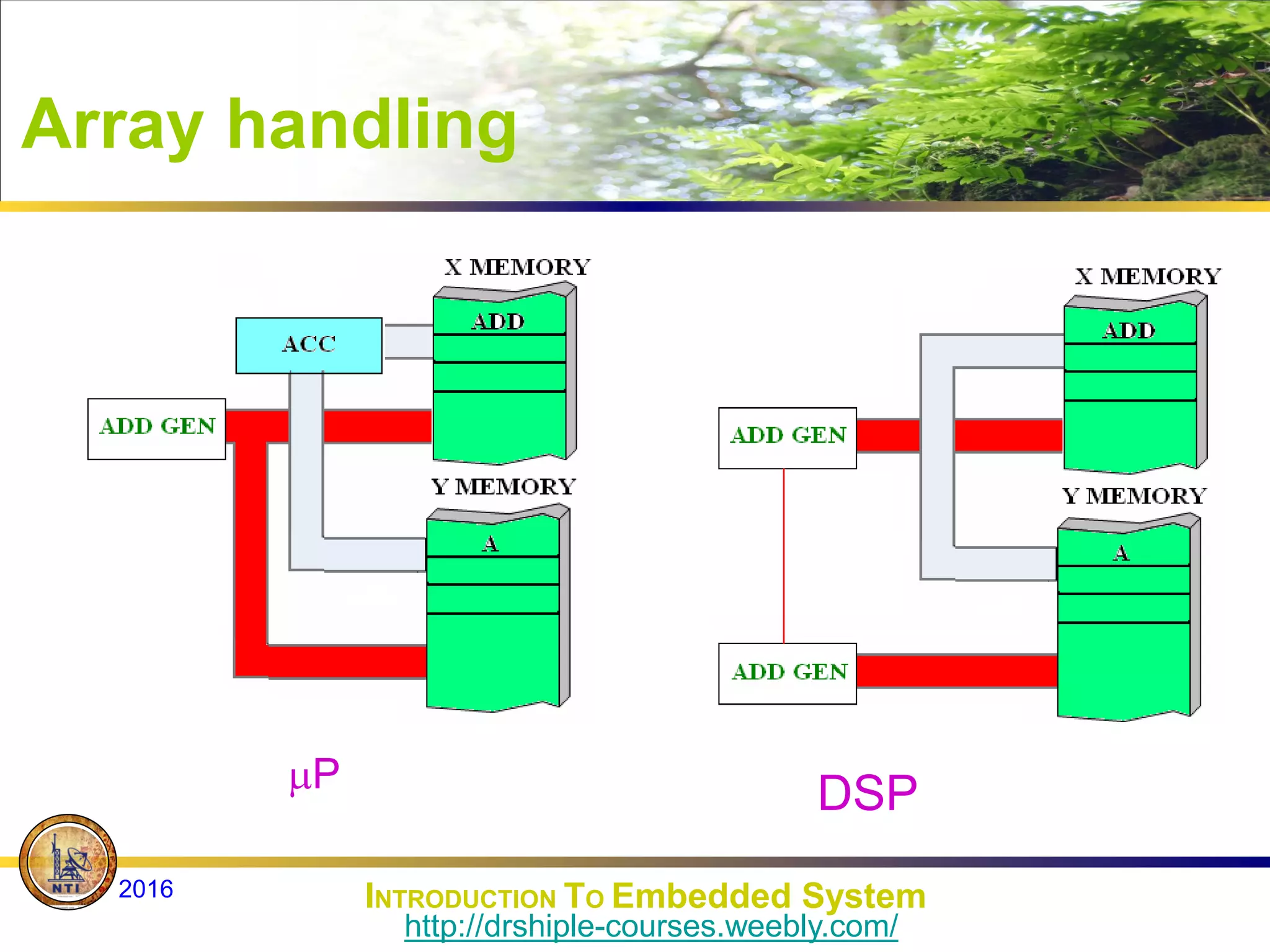
Array handling
P
DSP
INTRODUCTION TO Embedded System
2016
http://drshiple-courses.weebly.com/
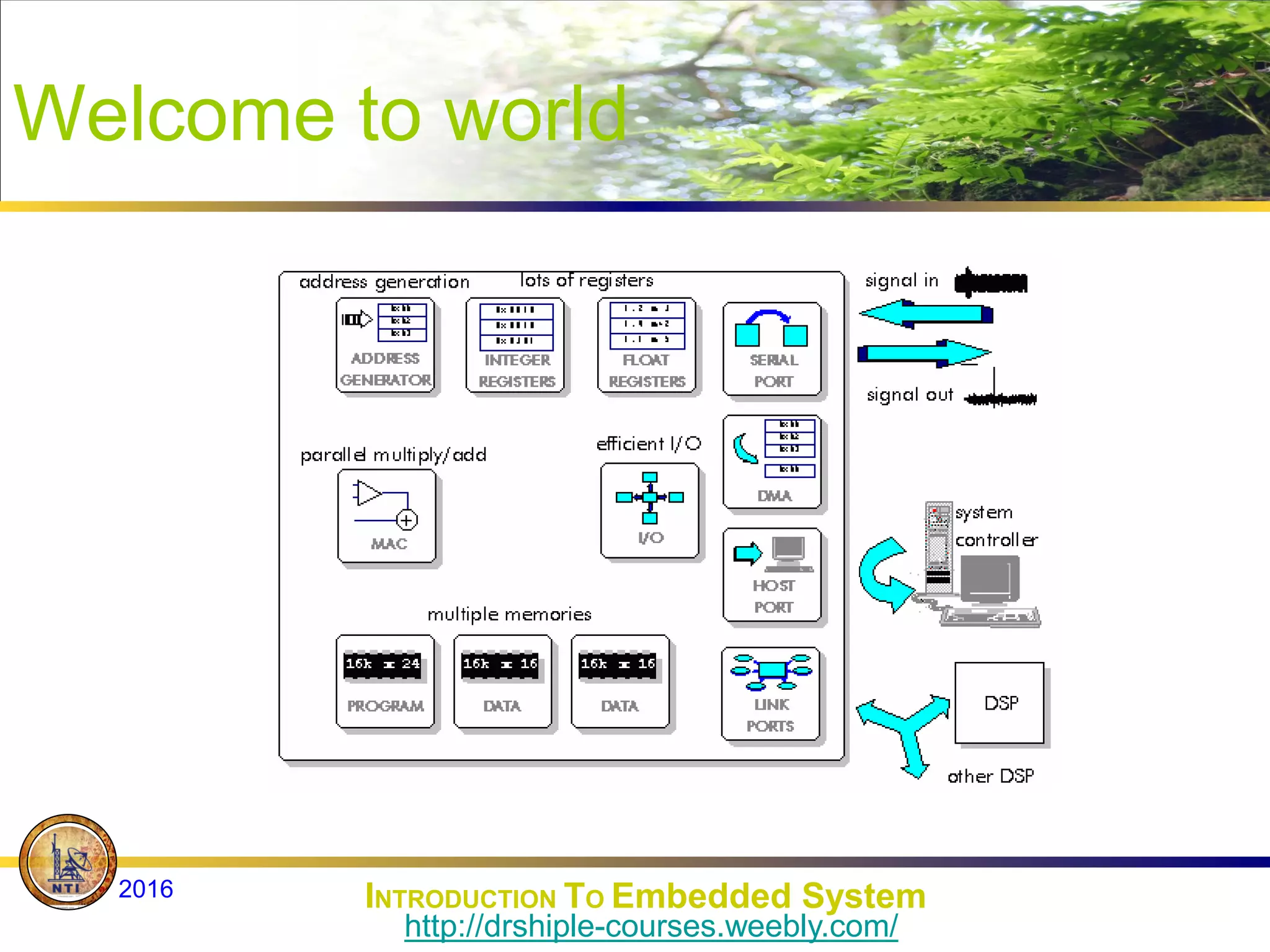
Welcome to world
INTRODUCTION TO Embedded System
2016
http://drshiple-courses.weebly.com/
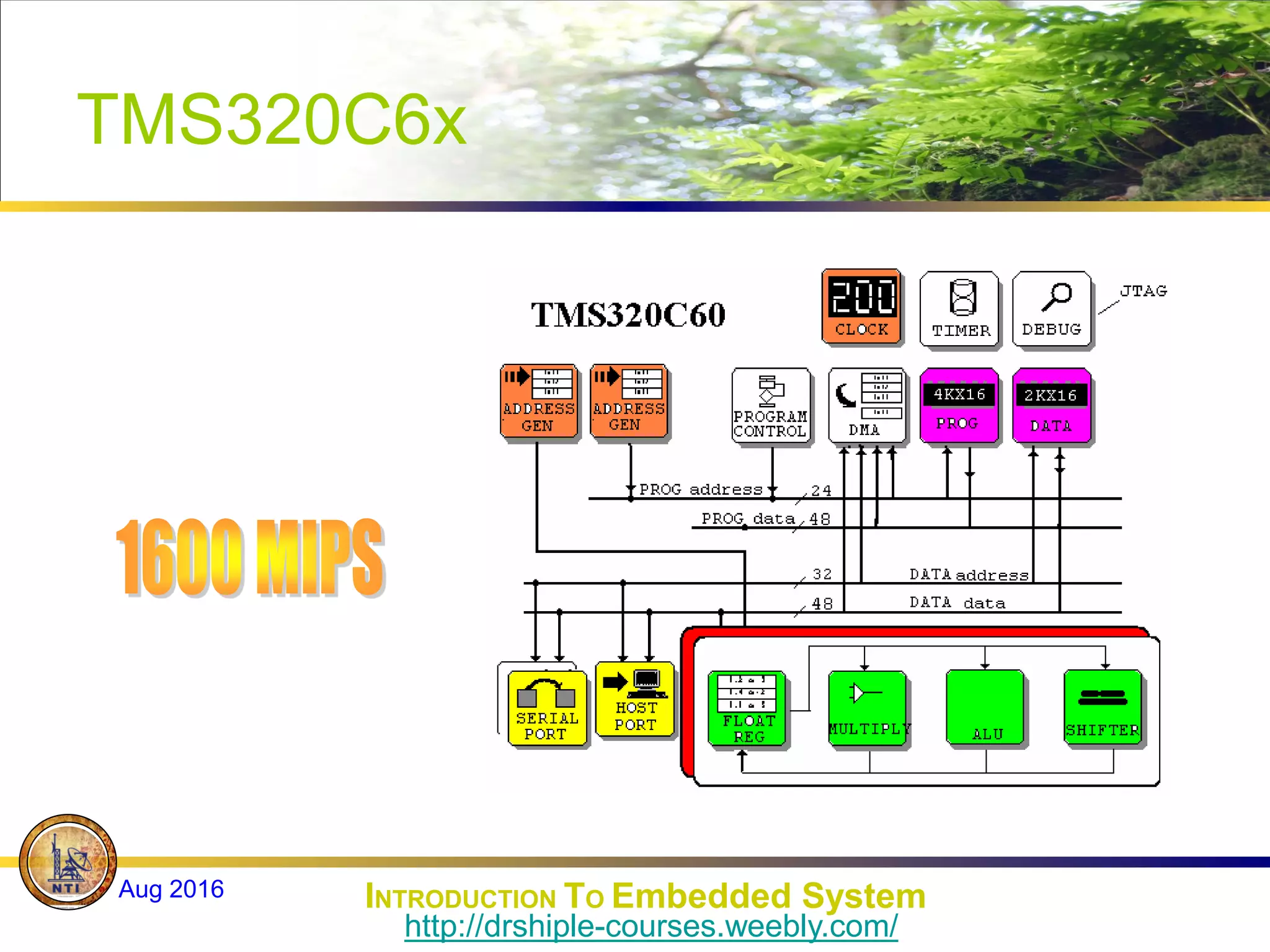
TMS320C6x
INTRODUCTION TO Embedded System
Aug 2016
http://drshiple-courses.weebly.com/
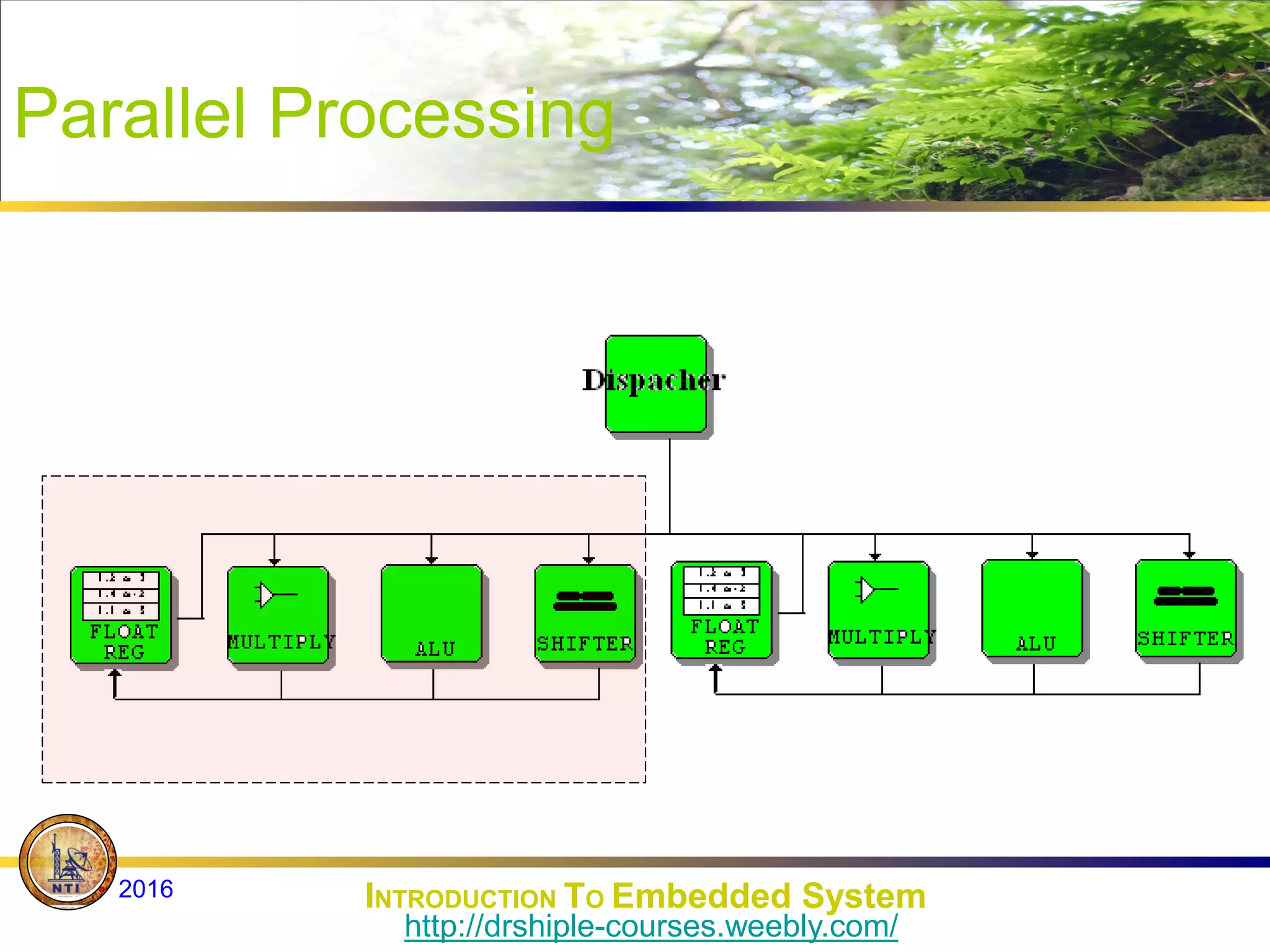
Parallel Processing
INTRODUCTION TO Embedded System
2016
http://drshiple-courses.weebly.com/
Kindly on a piece of paper, evaluate this presentation according to
1. Information adequate.
2. Speed of presentation.
3. Suggestions
Note : DO NOT WRITE YOUR NAME
http://drshiple-courses.weebly.com/

01p1_introduction_to_embedded_system.pdf

  • 1.
    ELECTRONICS DEPARTMENT Introduction ToEmbedded System By: Mustafa M. Shiple http://drshiple-courses.weebly.com/
  • 2.
    Quote of theDay The empires of the future are the empires of the mind. – Winston Churchill ‫مرة‬ ‫أسبوع‬ ‫كل‬ ‫في‬ ‫نفسك‬ ‫سألت‬ ‫إذا‬ : ‫قرأت‬ ‫ماذا‬ ‫األسبوع‬ ‫هذا‬ ‫في‬ , ‫مستقب‬ ‫أعظم‬ ‫لنفسك‬ ‫ضمنت‬ ‫فقد‬ ‫ل‬ ‫علمي‬ INTRODUCTION TO Embedded System 2016 http://drshiple-courses.weebly.com/
  • 3.
    Embedded Systems • Embeddedsystem: is a system that principal function is not computational, but which is controlled by a computer embedded within it. 3 INTRODUCTION TO Embedded System 2016 http://drshiple-courses.weebly.com/
  • 4.
    Examples: Refrigerator 4 INTRODUCTION TOEmbedded System 2016 http://drshiple-courses.weebly.com/
  • 5.
    Examples: Car Door 5 INTRODUCTIONTO Embedded System 2016 http://drshiple-courses.weebly.com/
  • 6.
    Some common characteristics •Single-functioned Executes a single program, repeatedly • Tightly-constrained Low cost, low power, small, fast, etc. • Reactive and real-time Continually reacts to changes in the system’s environment Must compute certain results in real-time without delay 6 INTRODUCTION TO Embedded System 2016 http://drshiple-courses.weebly.com/
  • 7.
    ES example Microcontroller CCD preprocessorPixel coprocessor A2D D2A JPEG codec DMA controller Memory controller ISA bus interface UART LCD ctrl Display ctrl Multiplier/Accum Digital camera chip lens CCD • Single-functioned -- always a digital camera • Tightly-constrained -- Low cost, low power, small, fast • Reactive and real-time -- only to a small extent 7 INTRODUCTION TO Embedded System 2016 http://drshiple-courses.weebly.com/
  • 8.
    Why Embedded Systems •Replacement for discrete logic-based circuits • Provide functional upgrades • Provide easy maintenance upgrades • Improves mechanical performance • Protection of intellectual property • Replacement for analogue circuits INTRODUCTION TO Embedded System 2016 http://drshiple-courses.weebly.com/
  • 9.
    ES components INTRODUCTION TOEmbedded System 2016 http://drshiple-courses.weebly.com/
  • 10.
    ES components INTRODUCTION TOEmbedded System 2016 http://drshiple-courses.weebly.com/
  • 11.
    ES components INTRODUCTION TOEmbedded System 2016 http://drshiple-courses.weebly.com/
  • 12.
    ES components INTRODUCTION TOEmbedded System 2016 http://drshiple-courses.weebly.com/
  • 13.
    ES components INTRODUCTION TOEmbedded System 2016 http://drshiple-courses.weebly.com/
  • 14.
    Introduction Hardware Platforms DSP Digital SignalPROCESSORS Microprocessor FPGA Field Programmable Gate Array ASIC Application Specified Integrated Circuit Microcontroller INTRODUCTION TO Embedded System 2016 http://drshiple-courses.weebly.com/
  • 15.
    Introduction •Which Core wehave to use (DSP/C/ P/IC)??? –Instruction decoder style –Memory architecture –Mathematic Unit –Communication Ports INTRODUCTION TO Embedded System 2016 http://drshiple-courses.weebly.com/
  • 16.
    Embedded processors Challenges andOpportunities INTRODUCTION TO Embedded System http://drshiple-courses.weebly.com/
  • 17.
    3Architectures • mid-1970 • Intel8080 • Motorola MC6800 8bit Accumulator • Late 1970 • Intel 80280 CISC • Mid 1980 RISC INTRODUCTION TO Embedded System http://drshiple-courses.weebly.com/
  • 18.
    8 bit Architecture INTRODUCTIONTO Embedded System 2016 http://drshiple-courses.weebly.com/
  • 19.
    Summary of 8Bit •logical operations, can operate on direct memory using the index register to act as pointer •Extra memory cycles •Wider registers •Unsigned resolution of only 256 bits •Bank switching and program overlays INTRODUCTION TO Embedded System http://drshiple-courses.weebly.com/
  • 20.
    Summary of 8Bit INTRODUCTIONTO Embedded System http://drshiple-courses.weebly.com/
  • 21.
    The larger datasize was needed to support higher precision arithmetic. The increased address space was needed to support bigger blocks of memory for larger programs the more complex the instruction, the less needed for a particular function and therefore the less memory that the system needed. Survival Developers INTRODUCTION TO Embedded System http://drshiple-courses.weebly.com/
  • 22.
    CISC Complex Instruction SetComputers Opcode 16 bits operands 16 bits operands 16 bits Micro Code Nano Code Sequences INTRODUCTION TO Embedded System http://drshiple-courses.weebly.com/
  • 23.
    Pipeline Consumes real estate Increasespipeline delays Gain higher speeds by reducing the amount of work done in each stage INTRODUCTION TO Embedded System http://drshiple-courses.weebly.com/
  • 24.
    RISC • All instructionswill be executed in a single cycle (op- code must be of a fixed width). • Memory will only be accessed via load and store instructions (No memory manipulation). • no micro-coding. INTRODUCTION TO Embedded System http://drshiple-courses.weebly.com/
  • 25.
    Barkly SPARC Stanford ARM INTRODUCTION TO EmbeddedSystem http://drshiple-courses.weebly.com/
  • 26.
    CISC vs. RISC Considerthe program fragments: CISC clock cycles = (2 movs × 1 cycle) + (1 mul × 30 cycles) = 32 cycles RISC clock cycles = (3 movs × 1 cycle) + (5 adds × 1 cycle) + (5 loops × 1 cycle) = 13 cycles INTRODUCTION TO Embedded System http://drshiple-courses.weebly.com/
  • 27.
    CISC vs. RISC Complexinstructions possible 1 Instruction = n microinstructions Simple instructions No microprogramming RISC PM = 2X CISC INTRODUCTION TO Embedded System http://drshiple-courses.weebly.com/
  • 28.
    CISC vs. RISC Simpleinstructions, few in Number Fixed length instructions Complexity in compiler Only LOAD/STORE instructions access memory Few addressing modes Many complex instructions Variable length instructions Complexity in microcode Many instructions can access memory Many addressing modes INTRODUCTION TO Embedded System http://drshiple-courses.weebly.com/
  • 29.
    CISC vs. RISC SEMANTICGAP High Level Language Machine Language Increasing Abstraction level INTRODUCTION TO Embedded System http://drshiple-courses.weebly.com/
  • 30.
    MEMORY ORGANIZATION INTRODUCTION TOEmbedded System http://drshiple-courses.weebly.com/
  • 31.
    Microprocessor Revision •Programming example ADD A,B •How manytimes does the system access the memory? •Ttotal=TALU + (# memory accessing x TMemory accessing) INTRODUCTION TO Embedded System Aug 2016 http://drshiple-courses.weebly.com/
  • 32.
    Microprocessor Revision •Programming example ADD A,B •How manytimes does the system access the memory? Time saving ratio? INTRODUCTION TO Embedded System 2016 http://drshiple-courses.weebly.com/
  • 33.
    Microprocessor Revision •Programming example ADD A,B •How manytimes does the system access the memory? •Time saving ratio? INTRODUCTION TO Embedded System 2016 http://drshiple-courses.weebly.com/
  • 34.
    Thrive to DSP VLIW INTRODUCTIONTO Embedded System 2016 http://drshiple-courses.weebly.com/
  • 35.
    Mathematical Unit INTRODUCTION TO EmbeddedSystem 2016 http://drshiple-courses.weebly.com/
  • 36.
    Mathematics Example Calculate the requiredtime to execute the previous Result = A1*B1+A2*B2+A3*B3+A4*B4 Ttotal=TALU + (# memory accessing xTMemory accessing) INTRODUCTION TO Embedded System 2016 http://drshiple-courses.weebly.com/
  • 37.
    Mathematics Fourier Transform shine!!! INTRODUCTIONTO Embedded System Aug 2016 http://drshiple-courses.weebly.com/
  • 38.
    Mathematics Fourier Transform shine!!! Example: Calculatethe required time to execute the previous example Result = A1*B1+A2*B2+A3*B3+A4*B4 Multiply and Accumulate MEM Time saving ratio? INTRODUCTION TO Embedded System 2016 http://drshiple-courses.weebly.com/
  • 39.
    Array handling P DSP INTRODUCTION TOEmbedded System 2016 http://drshiple-courses.weebly.com/
  • 40.
    Welcome to world INTRODUCTIONTO Embedded System 2016 http://drshiple-courses.weebly.com/
  • 41.
    TMS320C6x INTRODUCTION TO EmbeddedSystem Aug 2016 http://drshiple-courses.weebly.com/
  • 42.
    Parallel Processing INTRODUCTION TOEmbedded System 2016 http://drshiple-courses.weebly.com/
  • 43.
    Kindly on apiece of paper, evaluate this presentation according to 1. Information adequate. 2. Speed of presentation. 3. Suggestions Note : DO NOT WRITE YOUR NAME http://drshiple-courses.weebly.com/