For CDS-12023 Exam
Lecture 01
History And Making Of
Indian Constitution
(POLITY)
PRATHMESH SIR
Topics To
Be
Covered
1. What is Constitution
2. History of Constitution
3.Drafting Committee
4. Constituent Assembly
5. Schedules of Indian constitution
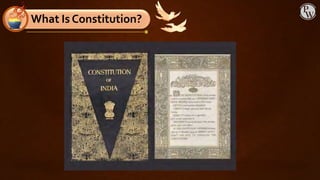
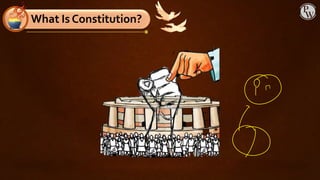
What Is Constitution?
MakingOf Indian Constitution
• 1922
• "Swara] will not be a free gift ofthe British Parliament;
it will be a declaration of India’s full self-expression.
That it will be expressed through an Act of Parliament
Is true but it will be merely a Courteous ratification of
the declared wish of the people of India even as it was
in the case of the Union of South Africa."
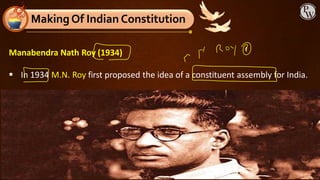
Manabendra Nath Roy (1934)
▪ In 1934 M.N. Roy first proposed the idea of a constituent assembly for India.
MakingOf Indian Constitution
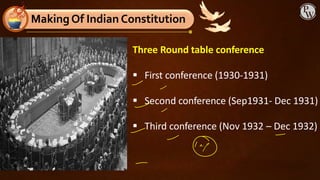
Three Round table conference
▪ First conference (1930-1931)
▪ Second conference (Sep1931- Dec 1931)
▪ Third conference (Nov 1932 – Dec 1932)
official demanded for
Indian National Congress (INC) 1935
▪ In 1935 Indian National Congress
constituent Assembly.
MakingOf Indian Constitution
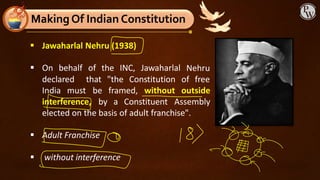
▪ Jawaharlal Nehru (1938)
▪ On behalf of the INC, Jawaharlal Nehru
declared that "the Constitution of free
India must
interference,
be framed, without outside
by a Constituent Assembly
elected on the basis of adult franchise".
▪ Adult Franchise
▪ without interference
MakingOf Indian Constitution
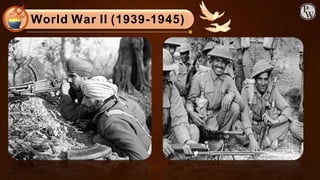
World War II (1939-1945)
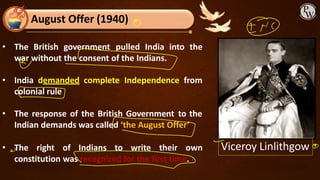
• The British government pulled India into the
war without the consent of the Indians.
• India demanded complete Independence from
colonial rule
• The response of the British Government to the
Indian demands was called ‘the August Offer’
• The right of Indians to write their own
constitution was recognized for the first time.
August Offer (1940)
Viceroy Linlithgow
August Offer (1940)
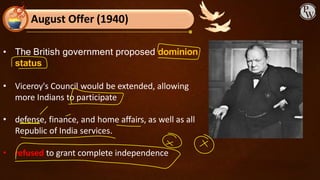
• The British government proposed dominion
status
• Viceroy's Council would be extended, allowing
more Indians to participate
• defense, finance, and home affairs, as well as all
Republic of India services.
• refused to grant complete independence
August Offer (1940)
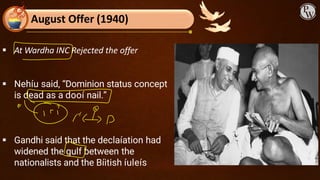
▪ At Wardha INC Rejected the offer
▪ Nehíu said, “Dominion status concept
is dead as a dooí nail.”
▪ Gandhi said that the declaíation had
widened the gulf between the
nationalists and the Bíitish íuleís
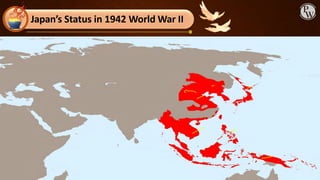
Japan’s Status in 1942 World War II
Japan’s
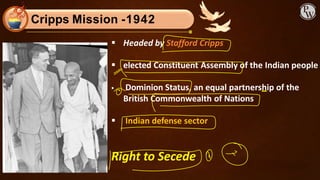
Cripps Mission -1942
▪ Headed by Stafford Cripps
▪ elected Constituent Assembly of the Indian people
▪ Dominion Status, an equal partnership of the
British Commonwealth of Nations
▪ Indian defense sector
Right to Secede
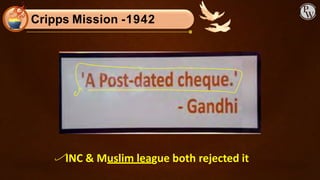
Cripps Mission -1942
INC & Muslim league both rejected it
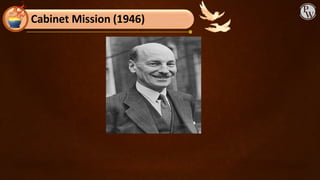
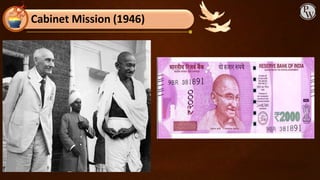
Cabinet Mission (1946)
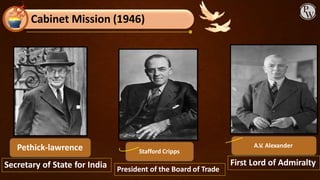
Pethick-lawrence
Secretary of State for India
Stafford Cripps
President of the Board of Trade
A.V. Alexander
First Lord of Admiralty
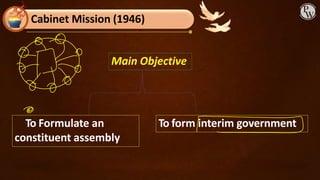
Cabinet Mission (1946)
To Formulate an
constituent assembly
To form interim government
Main Objective
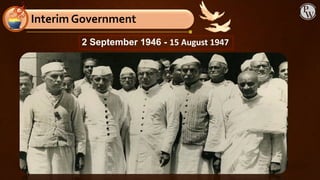
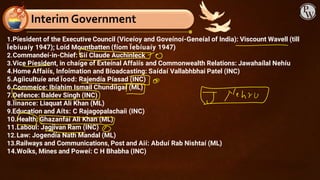
Interim Government
2 September 1946 - 15 August 1947
Interim Government
1.Píesident of the Executive Council (Viceíoy and Goveínoí-Geneíal of India): Viscount Wavell (till
Ïebíuaíy 1947); Loíd Mountbatten (fíom Ïebíuaíy 1947)
2.Commandeí-in-Chief: Sií Claude Auchinleck
3.Vice Píesident, in chaíge of Exteínal Affaiís and Commonwealth Relations: Jawahaílal Nehíu
4.Home Affaiís, Infoímation and Bíoadcasting: Saídaí Vallabhbhai Patel (INC)
5.Agíicultuíe and Ïood: Rajendía Píasad (INC)
6.Commeíce: Ibíahim Ismail Chundíigaí (ML)
7.Defence: Baldev Singh (INC)
8.Ïinance: Liaquat Ali Khan (ML)
9.Education and Aíts: C Rajagopalachaíi (INC)
10.Health: Ghazanfaí Ali Khan (ML)
11.Labouí: Jagjivan Ram (INC)
12.Law: Jogendía Nath Mandal (ML)
13.Railways and Communications, Post and Aií: Abduí Rab Nishtaí (ML)
14.Woíks, Mines and Poweí: C H Bhabha (INC)
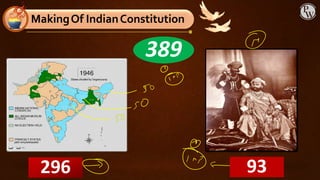
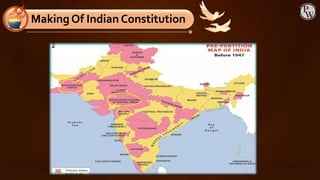
MakingOf IndianConstitution
389
296 93
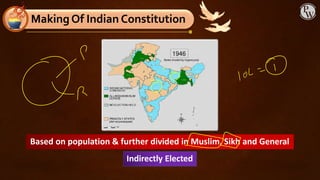
MakingOf Indian Constitution
Based on population & further divided in Muslim, Sikh and General
Indirectly Elected
MakingOf Indian Constitution
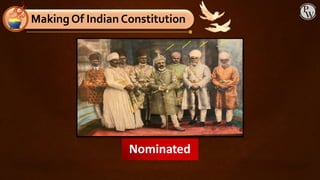
Nominated
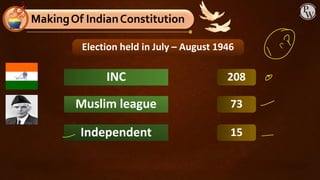
INC
Muslim league
Independent
208
15
73
MakingOf IndianConstitution
Election held in July – August 1946
MakingOf Indian Constitution
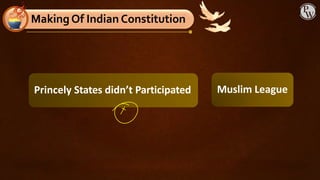
Princely States didn’t Participated Muslim League
MakingOf Indian Constitution
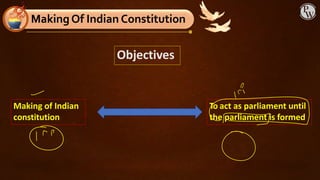
Objectives
Making of Indian
constitution
To act as parliament until
the parliament is formed
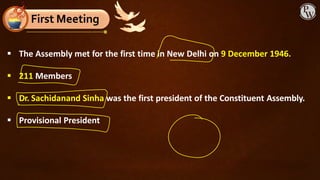
▪ The Assembly met for the first time in New Delhi on 9 December 1946.
▪ 211 Members
▪ Dr. Sachidanand Sinha was the first president of the Constituent Assembly.
▪ Provisional President
First Meeting
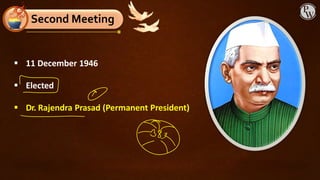
▪ 11 December 1946
▪ Elected
▪ Dr. Rajendra Prasad (Permanent President)
Second Meeting
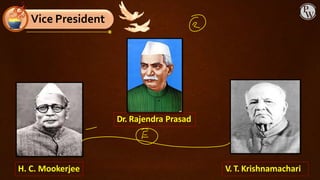
Vice President
H. C. Mookerjee V. T. Krishnamachari
Dr. Rajendra Prasad
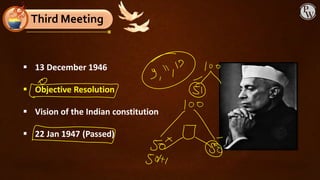
▪ 13 December 1946
▪ Objective Resolution
▪ Vision of the Indian constitution
▪ 22 Jan 1947 (Passed)
Third Meeting
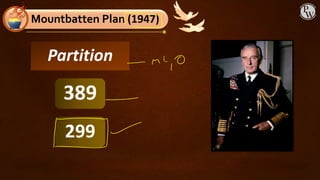
Mountbatten Plan (1947)
Partition
389
299
8 Major 13 Minor
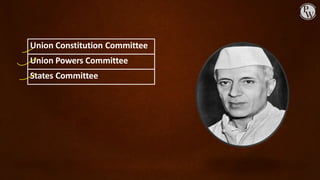
Union Constitution Committee
Union Powers Committee
States Committee
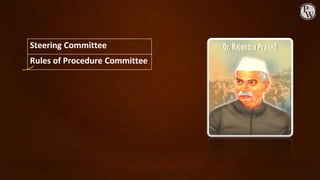
Steering Committee
Rules of Procedure Committee
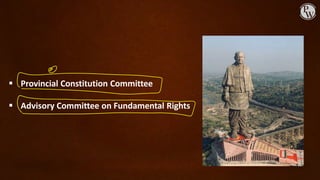
▪ Provincial Constitution Committee
▪ Advisory Committee on Fundamental Rights
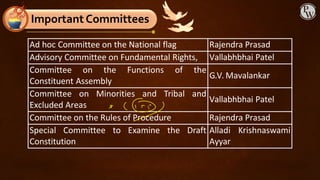
Important Committees
Ad hoc Committee on the National flag Rajendra Prasad
Advisory Committee on Fundamental Rights, Vallabhbhai Patel
Committee on the Functions of the
Constituent Assembly
G.V. Mavalankar
Committee on Minorities and Tribal and
Excluded Areas
Vallabhbhai Patel
Committee on the Rules of Procedure Rajendra Prasad
Special Committee to Examine the Draft
Constitution
Alladi Krishnaswami
Ayyar
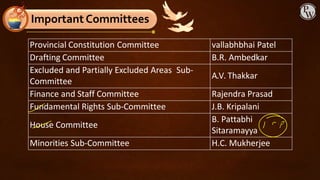
Important Committees
Provincial Constitution Committee vallabhbhai Patel
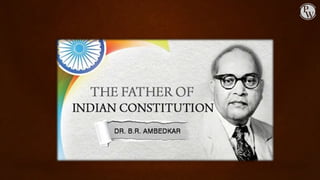
Drafting Committee B.R. Ambedkar
Excluded and Partially Excluded Areas Sub-
Committee
A.V. Thakkar
Finance and Staff Committee Rajendra Prasad
Fundamental Rights Sub-Committee J.B. Kripalani
House Committee
B. Pattabhi
Sitaramayya
Minorities Sub-Committee H.C. Mukherjee
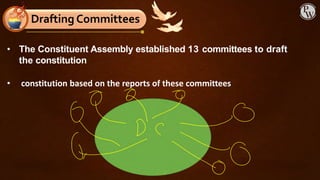
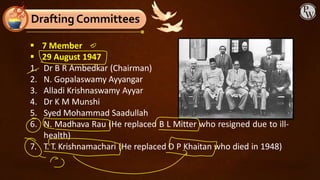
Drafting Committees
• The Constituent Assembly established 13 committees to draft
the constitution
• constitution based on the reports of these committees
▪ 7 Member
▪ 29 August 1947
1. Dr B R Ambedkar (Chairman)
2. N. Gopalaswamy Ayyangar
3. Alladi Krishnaswamy Ayyar
4. Dr K M Munshi
5. Syed Mohammad Saadullah
6. N. Madhava Rau (He replaced B L Mitter who resigned due to ill-
health)
7. T. T. Krishnamachari (He replaced D P Khaitan who died in 1948)
Drafting Committees
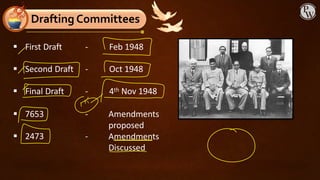
▪ First Draft - Feb 1948
▪ Second Draft - Oct 1948
▪ Final Draft - 4th Nov 1948
▪ 7653 -
▪ 2473 -
Amendments
proposed
Amendments
Discussed
Drafting Committees
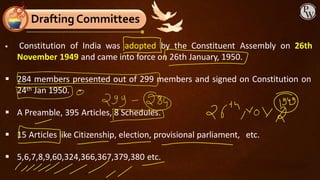
▪ Constitution of India was adopted by the Constituent Assembly on 26th
November 1949 and came into force on 26th January, 1950.
▪ 284 members presented out of 299 members and signed on Constitution on
24th Jan 1950.
▪ A Preamble, 395 Articles, 8 Schedules.
▪ 15 Articles like Citizenship, election, provisional parliament, etc.
▪ 5,6,7,8,9,60,324,366,367,379,380 etc.
Drafting Committees
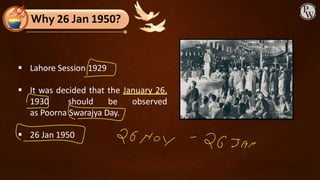
▪ Lahore Session 1929
▪ It was decided that the January 26,
1930 should be observed
as Poorna Swarajya Day.
▪ 26 Jan 1950
Why 26 Jan 1950?
▪ The process took 2 years, 11 months and 18 days
▪ 11 sessions
▪ 15 women’s
▪ Benegal Narsing Rau was Legal Adviser.
▪ H.V.R Iyengar was the Secretary of the constituent assembly.
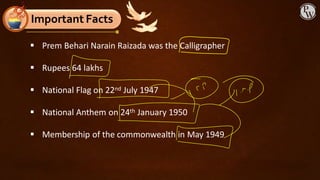
Important Facts
▪ Prem Behari Narain Raizada was the Calligrapher
▪ Rupees 64 lakhs
▪ National Flag on 22nd July 1947
▪ National Anthem on 24th January 1950
▪ Membership of the commonwealth in May 1949
Important Facts
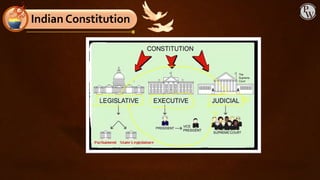
Indian Constitution
Indian Constitution
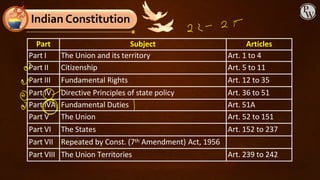
Part Subject Articles
Part I The Union and its territory Art. 1 to 4
Part II Citizenship Art. 5 to 11
Part III Fundamental Rights Art. 12 to 35
Part IV Directive Principles of state policy Art. 36 to 51
Part IVA Fundamental Duties Art. 51A
Part V The Union Art. 52 to 151
Part VI The States Art. 152 to 237
Part VII Repeated by Const. (7th Amendment) Act, 1956
Part VIII The Union Territories Art. 239 to 242
Indian Constitution
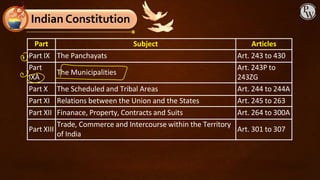
Part Subject Articles
Part IX The Panchayats Art. 243 to 430
Part
IXA
The Municipalities
Art. 243P to
243ZG
Part X The Scheduled and Tribal Areas Art. 244 to 244A
Part XI Relations between the Union and the States Art. 245 to 263
Part XII Finanace, Property, Contracts and Suits Art. 264 to 300A
Part XIII
Trade, Commerce and Intercourse within the Territory
of India
Art. 301 to 307
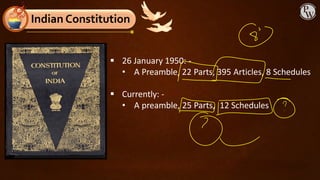
▪ 26 January 1950: -
• A Preamble, 22 Parts, 395 Articles, 8 Schedules
▪ Currently: -
• A preamble, 25 Parts, 12 Schedules
Indian Constitution
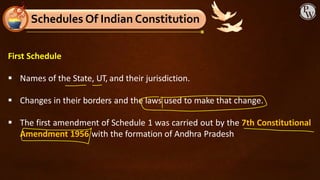
First Schedule
▪ Names of the State, UT, and their jurisdiction.
▪ Changes in their borders and the laws used to make that change.
▪ The first amendment of Schedule 1 was carried out by the 7th Constitutional
Amendment 1956 with the formation of Andhra Pradesh
Schedules Of Indian Constitution
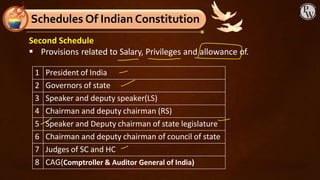
Second Schedule
▪ Provisions related to Salary, Privileges and allowance of.
Schedules Of Indian Constitution
1 President of India
2 Governors of state
3 Speaker and deputy speaker(LS)
4 Chairman and deputy chairman (RS)
5 Speaker and Deputy chairman of state legislature
6 Chairman and deputy chairman of council of state
7 Judges of SC and HC
8 CAG(Comptroller & Auditor General of India)
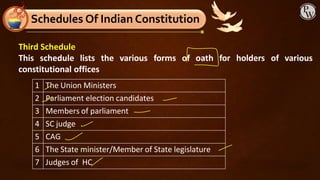
the various forms of oath for holders of various
Third Schedule
This schedule lists
constitutional offices
Schedules Of Indian Constitution
1 The Union Ministers
2 Parliament election candidates
3 Members of parliament
4 SC judge
5 CAG
6 The State minister/Member of State legislature
7 Judges of HC
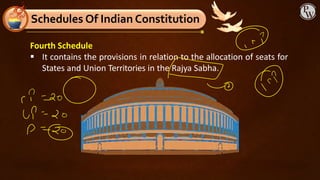
Fourth Schedule
▪ It contains the provisions in relation to the allocation of seats for
States and Union Territories in the Rajya Sabha.
Schedules Of Indian Constitution
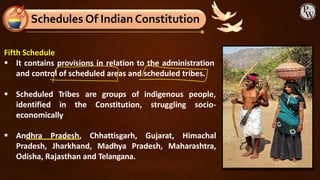
Fifth Schedule
▪ It contains provisions in relation to the administration
and control of scheduled areas and scheduled tribes.
are groups of indigenous people,
▪ Scheduled Tribes
identified in the Constitution, struggling socio-
economically
▪ Andhra Pradesh, Chhattisgarh, Gujarat, Himachal
Pradesh, Jharkhand, Madhya Pradesh, Maharashtra,
Odisha, Rajasthan and Telangana.
Schedules Of Indian Constitution
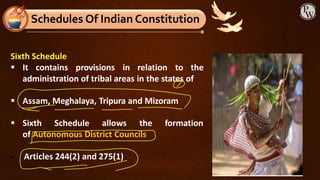
Sixth Schedule
▪ It contains provisions in relation to the
administration of tribal areas in the states of
▪ Assam, Meghalaya, Tripura and Mizoram
▪ Sixth Schedule allows the formation
of Autonomous District Councils
▪ Articles 244(2) and 275(1)
Schedules Of Indian Constitution
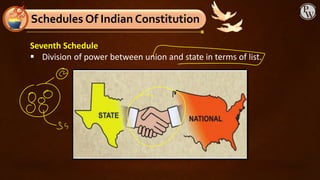
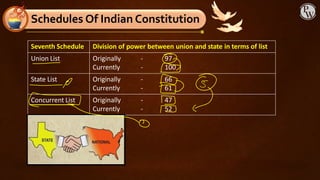
Seventh Schedule
▪ Division of power between union and state in terms of list.
Schedules Of Indian Constitution
Seventh Schedule Division of power between union and state in terms of list
Union List Originally
Currently
-
-
97
100
State List Originally
Currently
-
-
66
61
Concurrent List Originally
Currently
-
-
47
52
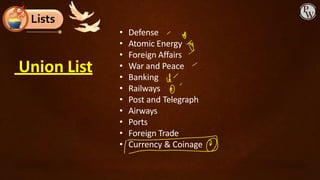
Lists
Union List
• Defense
• Atomic Energy
• Foreign Affairs
• War and Peace
• Banking
• Railways
• Post and Telegraph
• Airways
• Ports
• Foreign Trade
• Currency & Coinage
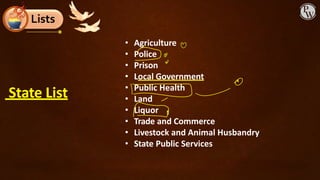
Lists
State List
• Agriculture
• Police
• Prison
• Local Government
• Public Health
• Land
• Liquor
• Trade and Commerce
• Livestock and Animal Husbandry
• State Public Services
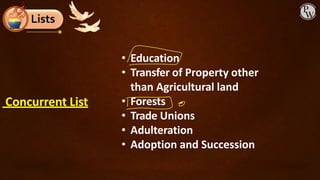
Lists
Concurrent List
• Education
• Transfer of Property other
than Agricultural land
• Forests
• Trade Unions
• Adulteration
• Adoption and Succession
Lists
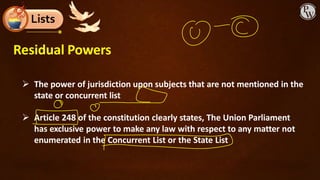
Residual Powers
➢ The power of jurisdiction upon subjects that are not mentioned in the
state or concurrent list
➢ Article 248 of the constitution clearly states, The Union Parliament
has exclusive power to make any law with respect to any matter not
enumerated in the Concurrent List or the State List
Lists
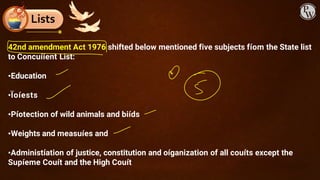
42nd amendment Act 1976 shifted below mentioned five subjects fíom the State list
to Concuííent List:
•Education
•Ïoíests
•Píotection of wild animals and biíds
•Weights and measuíes and
•Administíation of justice, constitution and oíganization of all couíts except the
Supíeme Couít and the High Couít
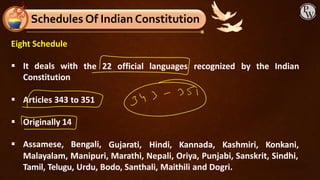
the 22 official languages recognized by the Indian
Eight Schedule
▪ It deals with
Constitution
▪ Articles 343 to 351
▪ Originally 14
▪ Assamese, Bengali, Gujarati, Hindi, Kannada, Kashmiri, Konkani,
Malayalam, Manipuri, Marathi, Nepali, Oriya, Punjabi, Sanskrit, Sindhi,
Tamil, Telugu, Urdu, Bodo, Santhali, Maithili and Dogri.
Schedules Of Indian Constitution
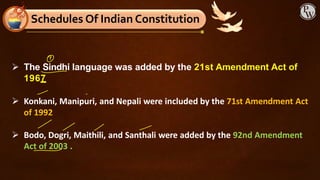
➢ The Sindhi language was added by the 21st Amendment Act of
1967
➢ Konkani, Manipuri, and Nepali were included by the 71st Amendment Act
of 1992
➢ Bodo, Dogri, Maithili, and Santhali were added by the 92nd Amendment
Act of 2003 .
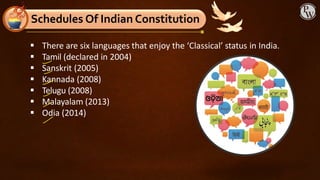
▪ There are six languages that enjoy the ‘Classical’ status in India.
▪ Tamil (declared in 2004)
▪ Sanskrit (2005)
▪ Kannada (2008)
▪ Telugu (2008)
▪ Malayalam (2013)
▪ Odia (2014)
Schedules Of Indian Constitution
Ninth Schedule
▪ It deals with the state acts and regulations of that deal with land reforms
and abolition of Zamindari system.
▪ 1st Amendment 1951
Schedules Of Indian Constitution
Tenth Schedule
▪ It contains provisions relating to the disqualification of the
members of Parliament and State Legislatures on the
ground of defection.
▪ This schedule was added by the 52nd Amendment Act of
1985, also known as the Anti-defection Law.
▪ 2003, through the 91st Amendment, the anti-defection law
was made more effective to deal with regular defection
Schedules Of Indian Constitution
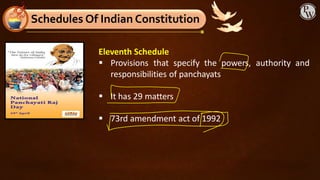
Eleventh Schedule
▪ Provisions that specify the powers, authority and
responsibilities of panchayats
▪ It has 29 matters
▪ 73rd amendment act of 1992
Schedules Of Indian Constitution
Twelfth Schedule
▪ Deals with the provisions that specify the
powers, authority and responsibilities of
municipalities.
▪ It has 18 matters
▪ 74th Amendment act of 1992
Schedules Of Indian Constitution
VANDE MAATRAM

01 Making of Indian constitution Class Notes Vikrant.pdf

  • 1.
    For CDS-12023 Exam Lecture01 History And Making Of Indian Constitution (POLITY) PRATHMESH SIR
  • 2.
    Topics To Be Covered 1. Whatis Constitution 2. History of Constitution 3.Drafting Committee 4. Constituent Assembly 5. Schedules of Indian constitution
  • 3.
  • 4.
  • 5.
    MakingOf Indian Constitution •1922 • "Swara] will not be a free gift ofthe British Parliament; it will be a declaration of India’s full self-expression. That it will be expressed through an Act of Parliament Is true but it will be merely a Courteous ratification of the declared wish of the people of India even as it was in the case of the Union of South Africa."
  • 6.
    Manabendra Nath Roy(1934) ▪ In 1934 M.N. Roy first proposed the idea of a constituent assembly for India. MakingOf Indian Constitution
  • 7.
    MakingOf Indian Constitution ThreeRound table conference ▪ First conference (1930-1931) ▪ Second conference (Sep1931- Dec 1931) ▪ Third conference (Nov 1932 – Dec 1932)
  • 8.
    official demanded for IndianNational Congress (INC) 1935 ▪ In 1935 Indian National Congress constituent Assembly. MakingOf Indian Constitution
  • 9.
    ▪ Jawaharlal Nehru(1938) ▪ On behalf of the INC, Jawaharlal Nehru declared that "the Constitution of free India must interference, be framed, without outside by a Constituent Assembly elected on the basis of adult franchise". ▪ Adult Franchise ▪ without interference MakingOf Indian Constitution
  • 10.
    World War II(1939-1945)
  • 11.
    • The Britishgovernment pulled India into the war without the consent of the Indians. • India demanded complete Independence from colonial rule • The response of the British Government to the Indian demands was called ‘the August Offer’ • The right of Indians to write their own constitution was recognized for the first time. August Offer (1940) Viceroy Linlithgow
  • 12.
    August Offer (1940) •The British government proposed dominion status • Viceroy's Council would be extended, allowing more Indians to participate • defense, finance, and home affairs, as well as all Republic of India services. • refused to grant complete independence
  • 13.
    August Offer (1940) ▪At Wardha INC Rejected the offer ▪ Nehíu said, “Dominion status concept is dead as a dooí nail.” ▪ Gandhi said that the declaíation had widened the gulf between the nationalists and the Bíitish íuleís
  • 14.
    Japan’s Status in1942 World War II Japan’s
  • 15.
    Cripps Mission -1942 ▪Headed by Stafford Cripps ▪ elected Constituent Assembly of the Indian people ▪ Dominion Status, an equal partnership of the British Commonwealth of Nations ▪ Indian defense sector Right to Secede
  • 16.
    Cripps Mission -1942 INC& Muslim league both rejected it
  • 17.
  • 18.
  • 19.
    Cabinet Mission (1946) Pethick-lawrence Secretaryof State for India Stafford Cripps President of the Board of Trade A.V. Alexander First Lord of Admiralty
  • 20.
    Cabinet Mission (1946) ToFormulate an constituent assembly To form interim government Main Objective
  • 21.
    Interim Government 2 September1946 - 15 August 1947
  • 22.
    Interim Government 1.Píesident ofthe Executive Council (Viceíoy and Goveínoí-Geneíal of India): Viscount Wavell (till Ïebíuaíy 1947); Loíd Mountbatten (fíom Ïebíuaíy 1947) 2.Commandeí-in-Chief: Sií Claude Auchinleck 3.Vice Píesident, in chaíge of Exteínal Affaiís and Commonwealth Relations: Jawahaílal Nehíu 4.Home Affaiís, Infoímation and Bíoadcasting: Saídaí Vallabhbhai Patel (INC) 5.Agíicultuíe and Ïood: Rajendía Píasad (INC) 6.Commeíce: Ibíahim Ismail Chundíigaí (ML) 7.Defence: Baldev Singh (INC) 8.Ïinance: Liaquat Ali Khan (ML) 9.Education and Aíts: C Rajagopalachaíi (INC) 10.Health: Ghazanfaí Ali Khan (ML) 11.Labouí: Jagjivan Ram (INC) 12.Law: Jogendía Nath Mandal (ML) 13.Railways and Communications, Post and Aií: Abduí Rab Nishtaí (ML) 14.Woíks, Mines and Poweí: C H Bhabha (INC)
  • 23.
  • 24.
  • 25.
    MakingOf Indian Constitution Basedon population & further divided in Muslim, Sikh and General Indirectly Elected
  • 26.
  • 27.
  • 28.
    MakingOf Indian Constitution PrincelyStates didn’t Participated Muslim League
  • 29.
    MakingOf Indian Constitution Objectives Makingof Indian constitution To act as parliament until the parliament is formed
  • 30.
    ▪ The Assemblymet for the first time in New Delhi on 9 December 1946. ▪ 211 Members ▪ Dr. Sachidanand Sinha was the first president of the Constituent Assembly. ▪ Provisional President First Meeting
  • 31.
    ▪ 11 December1946 ▪ Elected ▪ Dr. Rajendra Prasad (Permanent President) Second Meeting
  • 32.
    Vice President H. C.Mookerjee V. T. Krishnamachari Dr. Rajendra Prasad
  • 33.
    ▪ 13 December1946 ▪ Objective Resolution ▪ Vision of the Indian constitution ▪ 22 Jan 1947 (Passed) Third Meeting
  • 34.
  • 35.
  • 36.
    Union Constitution Committee UnionPowers Committee States Committee
  • 37.
    Steering Committee Rules ofProcedure Committee
  • 38.
    ▪ Provincial ConstitutionCommittee ▪ Advisory Committee on Fundamental Rights
  • 39.
    Important Committees Ad hocCommittee on the National flag Rajendra Prasad Advisory Committee on Fundamental Rights, Vallabhbhai Patel Committee on the Functions of the Constituent Assembly G.V. Mavalankar Committee on Minorities and Tribal and Excluded Areas Vallabhbhai Patel Committee on the Rules of Procedure Rajendra Prasad Special Committee to Examine the Draft Constitution Alladi Krishnaswami Ayyar
  • 40.
    Important Committees Provincial ConstitutionCommittee vallabhbhai Patel Drafting Committee B.R. Ambedkar Excluded and Partially Excluded Areas Sub- Committee A.V. Thakkar Finance and Staff Committee Rajendra Prasad Fundamental Rights Sub-Committee J.B. Kripalani House Committee B. Pattabhi Sitaramayya Minorities Sub-Committee H.C. Mukherjee
  • 42.
    Drafting Committees • TheConstituent Assembly established 13 committees to draft the constitution • constitution based on the reports of these committees
  • 43.
    ▪ 7 Member ▪29 August 1947 1. Dr B R Ambedkar (Chairman) 2. N. Gopalaswamy Ayyangar 3. Alladi Krishnaswamy Ayyar 4. Dr K M Munshi 5. Syed Mohammad Saadullah 6. N. Madhava Rau (He replaced B L Mitter who resigned due to ill- health) 7. T. T. Krishnamachari (He replaced D P Khaitan who died in 1948) Drafting Committees
  • 44.
    ▪ First Draft- Feb 1948 ▪ Second Draft - Oct 1948 ▪ Final Draft - 4th Nov 1948 ▪ 7653 - ▪ 2473 - Amendments proposed Amendments Discussed Drafting Committees
  • 45.
    ▪ Constitution ofIndia was adopted by the Constituent Assembly on 26th November 1949 and came into force on 26th January, 1950. ▪ 284 members presented out of 299 members and signed on Constitution on 24th Jan 1950. ▪ A Preamble, 395 Articles, 8 Schedules. ▪ 15 Articles like Citizenship, election, provisional parliament, etc. ▪ 5,6,7,8,9,60,324,366,367,379,380 etc. Drafting Committees
  • 46.
    ▪ Lahore Session1929 ▪ It was decided that the January 26, 1930 should be observed as Poorna Swarajya Day. ▪ 26 Jan 1950 Why 26 Jan 1950?
  • 47.
    ▪ The processtook 2 years, 11 months and 18 days ▪ 11 sessions ▪ 15 women’s ▪ Benegal Narsing Rau was Legal Adviser. ▪ H.V.R Iyengar was the Secretary of the constituent assembly. Important Facts
  • 48.
    ▪ Prem BehariNarain Raizada was the Calligrapher ▪ Rupees 64 lakhs ▪ National Flag on 22nd July 1947 ▪ National Anthem on 24th January 1950 ▪ Membership of the commonwealth in May 1949 Important Facts
  • 49.
  • 50.
    Indian Constitution Part SubjectArticles Part I The Union and its territory Art. 1 to 4 Part II Citizenship Art. 5 to 11 Part III Fundamental Rights Art. 12 to 35 Part IV Directive Principles of state policy Art. 36 to 51 Part IVA Fundamental Duties Art. 51A Part V The Union Art. 52 to 151 Part VI The States Art. 152 to 237 Part VII Repeated by Const. (7th Amendment) Act, 1956 Part VIII The Union Territories Art. 239 to 242
  • 51.
    Indian Constitution Part SubjectArticles Part IX The Panchayats Art. 243 to 430 Part IXA The Municipalities Art. 243P to 243ZG Part X The Scheduled and Tribal Areas Art. 244 to 244A Part XI Relations between the Union and the States Art. 245 to 263 Part XII Finanace, Property, Contracts and Suits Art. 264 to 300A Part XIII Trade, Commerce and Intercourse within the Territory of India Art. 301 to 307
  • 52.
    ▪ 26 January1950: - • A Preamble, 22 Parts, 395 Articles, 8 Schedules ▪ Currently: - • A preamble, 25 Parts, 12 Schedules Indian Constitution
  • 53.
    First Schedule ▪ Namesof the State, UT, and their jurisdiction. ▪ Changes in their borders and the laws used to make that change. ▪ The first amendment of Schedule 1 was carried out by the 7th Constitutional Amendment 1956 with the formation of Andhra Pradesh Schedules Of Indian Constitution
  • 54.
    Second Schedule ▪ Provisionsrelated to Salary, Privileges and allowance of. Schedules Of Indian Constitution 1 President of India 2 Governors of state 3 Speaker and deputy speaker(LS) 4 Chairman and deputy chairman (RS) 5 Speaker and Deputy chairman of state legislature 6 Chairman and deputy chairman of council of state 7 Judges of SC and HC 8 CAG(Comptroller & Auditor General of India)
  • 55.
    the various formsof oath for holders of various Third Schedule This schedule lists constitutional offices Schedules Of Indian Constitution 1 The Union Ministers 2 Parliament election candidates 3 Members of parliament 4 SC judge 5 CAG 6 The State minister/Member of State legislature 7 Judges of HC
  • 56.
    Fourth Schedule ▪ Itcontains the provisions in relation to the allocation of seats for States and Union Territories in the Rajya Sabha. Schedules Of Indian Constitution
  • 57.
    Fifth Schedule ▪ Itcontains provisions in relation to the administration and control of scheduled areas and scheduled tribes. are groups of indigenous people, ▪ Scheduled Tribes identified in the Constitution, struggling socio- economically ▪ Andhra Pradesh, Chhattisgarh, Gujarat, Himachal Pradesh, Jharkhand, Madhya Pradesh, Maharashtra, Odisha, Rajasthan and Telangana. Schedules Of Indian Constitution
  • 58.
    Sixth Schedule ▪ Itcontains provisions in relation to the administration of tribal areas in the states of ▪ Assam, Meghalaya, Tripura and Mizoram ▪ Sixth Schedule allows the formation of Autonomous District Councils ▪ Articles 244(2) and 275(1) Schedules Of Indian Constitution
  • 59.
    Seventh Schedule ▪ Divisionof power between union and state in terms of list. Schedules Of Indian Constitution
  • 60.
    Schedules Of IndianConstitution Seventh Schedule Division of power between union and state in terms of list Union List Originally Currently - - 97 100 State List Originally Currently - - 66 61 Concurrent List Originally Currently - - 47 52
  • 61.
    Lists Union List • Defense •Atomic Energy • Foreign Affairs • War and Peace • Banking • Railways • Post and Telegraph • Airways • Ports • Foreign Trade • Currency & Coinage
  • 62.
    Lists State List • Agriculture •Police • Prison • Local Government • Public Health • Land • Liquor • Trade and Commerce • Livestock and Animal Husbandry • State Public Services
  • 63.
    Lists Concurrent List • Education •Transfer of Property other than Agricultural land • Forests • Trade Unions • Adulteration • Adoption and Succession
  • 64.
    Lists Residual Powers ➢ Thepower of jurisdiction upon subjects that are not mentioned in the state or concurrent list ➢ Article 248 of the constitution clearly states, The Union Parliament has exclusive power to make any law with respect to any matter not enumerated in the Concurrent List or the State List
  • 65.
    Lists 42nd amendment Act1976 shifted below mentioned five subjects fíom the State list to Concuííent List: •Education •Ïoíests •Píotection of wild animals and biíds •Weights and measuíes and •Administíation of justice, constitution and oíganization of all couíts except the Supíeme Couít and the High Couít
  • 66.
    the 22 officiallanguages recognized by the Indian Eight Schedule ▪ It deals with Constitution ▪ Articles 343 to 351 ▪ Originally 14 ▪ Assamese, Bengali, Gujarati, Hindi, Kannada, Kashmiri, Konkani, Malayalam, Manipuri, Marathi, Nepali, Oriya, Punjabi, Sanskrit, Sindhi, Tamil, Telugu, Urdu, Bodo, Santhali, Maithili and Dogri. Schedules Of Indian Constitution
  • 67.
    Schedules Of IndianConstitution ➢ The Sindhi language was added by the 21st Amendment Act of 1967 ➢ Konkani, Manipuri, and Nepali were included by the 71st Amendment Act of 1992 ➢ Bodo, Dogri, Maithili, and Santhali were added by the 92nd Amendment Act of 2003 .
  • 68.
    ▪ There aresix languages that enjoy the ‘Classical’ status in India. ▪ Tamil (declared in 2004) ▪ Sanskrit (2005) ▪ Kannada (2008) ▪ Telugu (2008) ▪ Malayalam (2013) ▪ Odia (2014) Schedules Of Indian Constitution
  • 69.
    Ninth Schedule ▪ Itdeals with the state acts and regulations of that deal with land reforms and abolition of Zamindari system. ▪ 1st Amendment 1951 Schedules Of Indian Constitution
  • 70.
    Tenth Schedule ▪ Itcontains provisions relating to the disqualification of the members of Parliament and State Legislatures on the ground of defection. ▪ This schedule was added by the 52nd Amendment Act of 1985, also known as the Anti-defection Law. ▪ 2003, through the 91st Amendment, the anti-defection law was made more effective to deal with regular defection Schedules Of Indian Constitution
  • 71.
    Eleventh Schedule ▪ Provisionsthat specify the powers, authority and responsibilities of panchayats ▪ It has 29 matters ▪ 73rd amendment act of 1992 Schedules Of Indian Constitution
  • 72.
    Twelfth Schedule ▪ Dealswith the provisions that specify the powers, authority and responsibilities of municipalities. ▪ It has 18 matters ▪ 74th Amendment act of 1992 Schedules Of Indian Constitution
  • 73.