Sheffield Hallam University

  Faculty of Arts, Computing, Engineering and Sciences


A Development of Electronic Menu (E-menu) Application

                    for Restaurant on iPad


                                By


                    Traitet Thepbandansuk

            MSc Enterprise Systems Professional


                       10 September 2012


               Supervised by: Dr Frances Slack


A dissertation submitted in partial fulfilment of the requirements of
the Sheffield Hallam University for the degree of Master of Science
                 (Enterprise Systems Professional)
Acknowledgements

This research would not have been completed without the support of my supervisor,
restaurant owner, manager and staff at the Thai restaurant, Andy Paul, and my friends and
family. Firstly, Dr Frances Slack, my supervisor, was the most important person, who
provided me with valuable guidance and great support. Secondly, without support from the
restaurant owner, manager and staff, my case study dissertation would have been
impossible. Although they had to spend a lot of time with me, they indicated themselves by
giving me so much useful information for my dissertation, without exception. Furthermore,
I would have to thank Andy Paul, who has helped me to enhance my English skills at all
times. Finally, I would like to express my deep appreciation to my friends and family. They
have always support me strongly both in my academic studies and also with my personal
problems during my study.


                                             i
Abstract

The restaurant industry is an area which has remained behind the technical advances until
recently, when the electronic (e-menu) started being used to improve catering services and
to increase revenue. To answer the research question ‘how can a prototype of an e-menu
application be developed for the casual dining restaurant industry to meet business
requirements’, this dissertation employed a case study approach at a Thai restaurant in the
UK. The research had conducted based on qualitative empirical research to gather business
requirements by direct observation, to develop a prototype using Rapid Application
Development (RAD) methodology, to collect data by group interviews, and finally to
analyse data by content analysis. The purposes of this study were to identify the key issues
relating to development of an e-menu application, to investigate system requirements and
develop an e-menu prototype, to evaluate users’ perceptions on e-menu, and to make
recommendations regarding e-menu development.

As this dissertation is presented by portfolio, it has not only a written paper to describe the
research, but various digital artefacts are also provided to help the reader understand more
fully how an e-menu application could be developed. This dissertation portfolio includes
system analysis and design documents, source codes of iPad e-menu application, Web
services and web application inASP.Net, and presentations of e-menu features on
PowerPoint and in video formats. All digital artefacts can be navigated from a portfolio
navigator file included in the portfolio CD attached in this document.

Finally, this research had examined four potential outcomes relating to the research
question and objectives. Firstly, List of business requirements, UML use case and class
diagrams, and ER (Entity relationship) and workflow diagrams were produced to analyse
and design the e-menu system. Secondly, the prototype of e-menu application, including
source codes, database and prototype presentations, were developed to use as tools for
collection data of the last two potential outcomes, which were users’ perceptions and
recommendations of the e-menu development.


Key words:Restaurant e-menu on iPad, Rapid Application Development (RAD), Model-
View-Controller (MVC), ASP.Net, Xcode, Web services, iPad application and mobile
application development.


                                              ii
Table of Contents

Acknowledgements ................................................................................................................. i
Abstract .................................................................................................................................. ii
Table of Contents .................................................................................................................. iii
List of Figures ........................................................................................................................ v
List of Tables......................................................................................................................... vi
List of Abbreviations............................................................................................................ vii
1.     Introduction .................................................................................................................... 1
       1.1       Aims of the study ................................................................................................. 2
                 1.1.1 Research question ...................................................................................... 2
                 1.1.2 Research objectives ................................................................................... 2
       1.2       Limitations of research ........................................................................................ 3
2.     Literature Review ........................................................................................................... 4
       2.1       Electronic menu (e-menu) for restaurants ........................................................... 4
       2.2       Restaurant service process ................................................................................... 5
       2.3       Software usability and Human-Computer Interaction (HCI) .............................. 6
       2.4       Software development methodologies and prototyping technique ...................... 7
       2.5       Mobile application development on iOS or Android devices.............................. 8
       2.6       Conclusion of the literature review .................................................................... 10
3.     Justifications of the Approaches ................................................................................... 11
       3.1       Research process and framework ...................................................................... 12
       3.2       Case study methodology .................................................................................... 13
       3.3       Software development methodology by RAD with prototyping ....................... 14
4.     Findings and Discussion ............................................................................................... 16
       4.1       Users’ perceptions of the e-menu prototype ...................................................... 17
                 4.1.1 Convenience ............................................................................................ 18
                 4.1.2 Improving customer service .................................................................... 19
                 4.1.3 Preventing human error ........................................................................... 20
                 4.1.4 E-menu issues .......................................................................................... 21
       4.2       Recommendations of e-menu application development .................................... 23
                 4.2.1 Software development processes for e-menu application ....................... 23


                                                                     iii
4.2.2 System design of the e-menu system ....................................................... 24
              4.2.3 Cross-platform communication between .Net and iOS platforms ........... 25
              4.2.4 Model-View-Controller (MVC) design for e-menu system .................... 26
5.   Critical Reflection and Evaluation ............................................................................... 27
     5.1       Knowledge of the domain .................................................................................. 27
     5.2       Justification of the approaches ........................................................................... 29
     5.3       Overall reflective commentary with regards to research outcomes ................... 32
              5.3.1 System analysis and design documents ................................................... 32
              5.3.2 Prototype of e-menu application.............................................................. 33
              5.3.3 Users’ perceptions on the prototype of e-menu application .................... 34
              5.3.4 Recommendations of e-menu application development .......................... 35
6.   Conclusion and Limitations .......................................................................................... 36
     6.1       Conclusions........................................................................................................ 36
     6.2       Critical evaluation of learning experience ......................................................... 37
     6.3       Limitations and recommendations for further research ..................................... 38
     6.4       Research contribution ........................................................................................ 38
7.   References .................................................................................................................... 39
8.   Appendices ................................................................................................................... 44
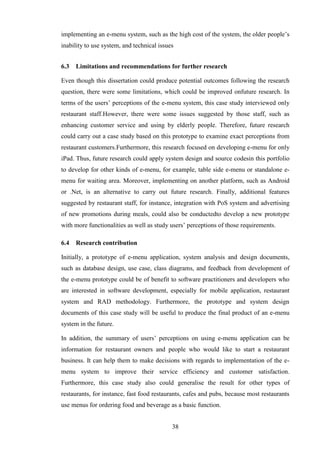
     8.1       Project Plan ........................................................................................................ 44
     8.2       Summary of activities at the case study restaurant ............................................ 46
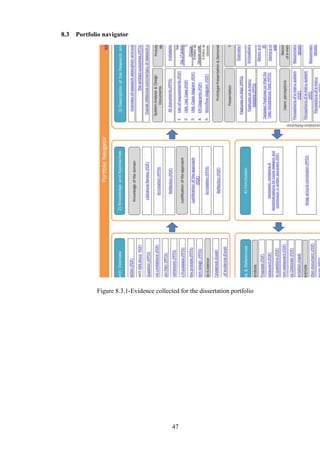
     8.3       Portfolio navigator ............................................................................................. 47
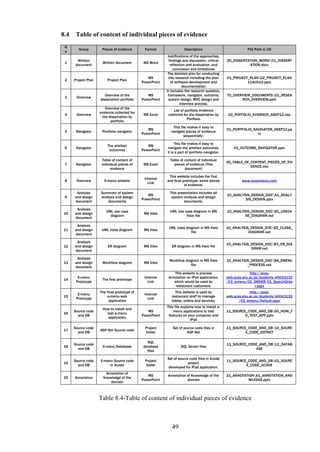
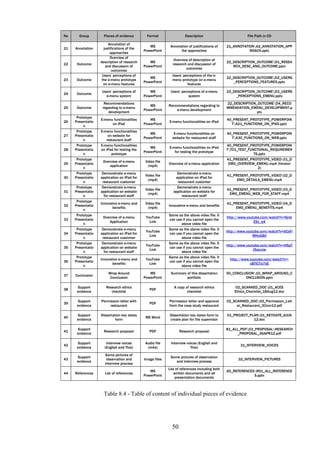
     8.4       Table of content of individual pieces of evidence ............................................. 49
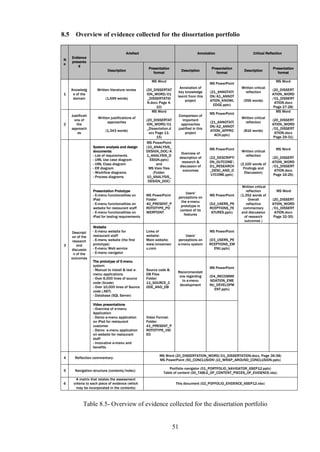
     8.5       Overview of evidence collected for the dissertation portfolio ........................... 51
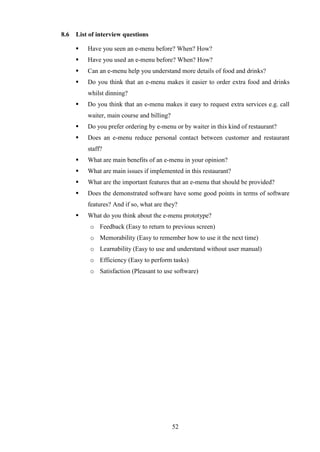
     8.6       List of interview questions ................................................................................. 52
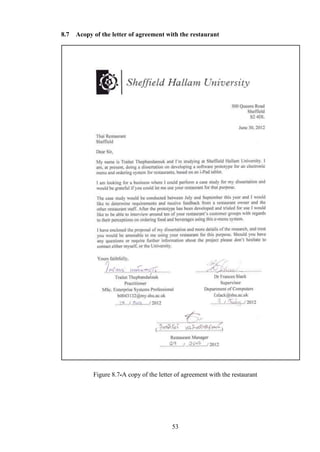
     8.7       A copy of the letter of agreement with the restaurant........................................ 53
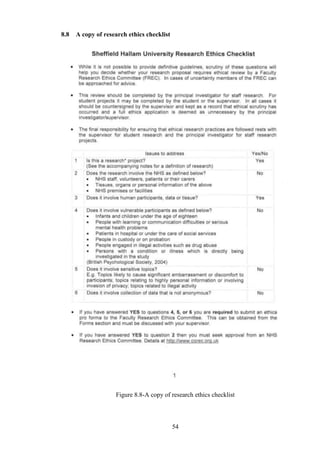
     8.8       A copy of research ethics checklist.................................................................... 54
     8.9       Research Proposal .............................................................................................. 56


                                                                 iv
List of Figures

Figure 1 - E-menu on iPad tablet ........................................................................................... 1
Figure 2.1 - Restaurant e-menu solutions .............................................................................. 4
Figure 2.2 - Basic process flow diagram of restaurant system .............................................. 5
Figure 2.5 - Cross-platform communication using Web services .......................................... 9
Figure 3.1 - Research process and framework ..................................................................... 12
Figure 3.2 - Rapid Application Development (RAD) and prototyping ............................... 15
Figure 4 - Software development process and potential outcomes ...................................... 16
Figure 4.1 - Data collection process and users’ perceptions ................................................ 17
Figure 4.1.1 - Users’ perceptions on convenience ............................................................... 18
Figure 4.1.2 - Users’ perceptions on improving customer service ...................................... 19
Figure 4.1.3 - Users’ perceptions on preventing human error ............................................. 20
Figure 4.1.4 - Users’ perceptions on e-menu issues............................................................. 22
Figure 4.2.1 - E-menu development process and technical system design .......................... 23
Figure 4.2.2 - System design of e-menu system .................................................................. 24
Figure 4.2.3 - Cross-platform communication between .Net and iOS platforms ................ 25
Figure 4.2.4 - Model-View-Controller (MVC) design for e-menu system .......................... 26
Figure 5.2 - Example of an implicit requirement ................................................................. 30
Figure 5.3.2 - The first and final versions of the e-menu prototype .................................... 33
Figure 8.1.1 - The initial and last updated action plan for dissertation ................................ 44
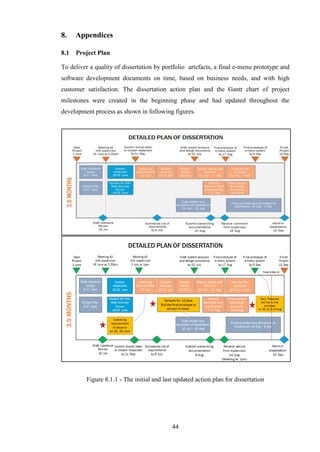
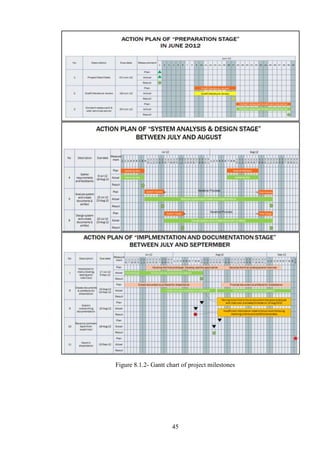
Figure 8.1.2 - Gantt chart of project milestones................................................................... 45
Figure 8.3.1 - Evidence collected for the dissertation portfolio ........................................... 47
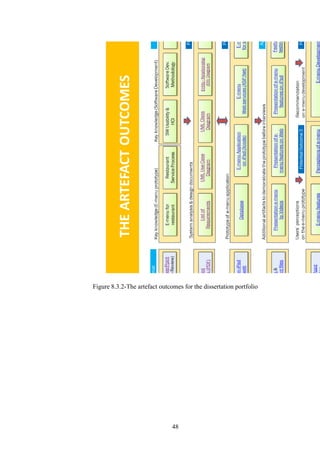
Figure 8.3.2 - The artefact outcomes for the dissertation portfolio ..................................... 48
Figure 8.7 - A copy of the letter of agreement with the restaurant ...................................... 53
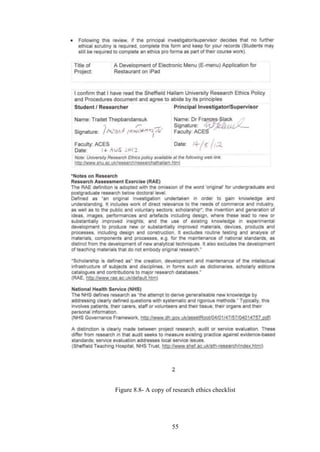
Figure 8.8 - A copy of research ethics checklist .................................................................. 54


                                                              v
List of Tables

Table 2.5 - Comparison of mobile development platforms on iOS and Android .................. 8
Table 3 - Summary of research objectives, methods and outcomes .................................... 11
Table 3.2 - Comparison among observation, interview and questionnaire .......................... 14
Table 4 - Interview participant information ......................................................................... 16
Table 5.1 - Mapping key knowledge, objectives and learning points .................................. 27
Table 5.2 - Mapping approaches, their potentials, limitations and learning points ............. 30
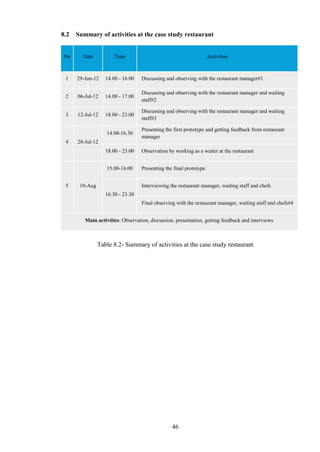
Table 8.2 - Summary of activities at the case study restaurant ............................................ 46
Table 8.4 - Table of content of individual pieces of evidence ............................................. 49
Table 8.5 - Overview of evidence collected for the dissertation portfolio........................... 51


                                                          vi
List of Abbreviations

ASP        Active Server Pages

E-Menu     Electronic Menu

ER         Entity Relationship

GUI        Graphical User Interface

HCI        Human–Computer Interaction

MS         Microsoft

MVC        Model-View-Controller

OS         Operating System

PDF        Portable Document Format

PoS        Point of Sale

RAD        Rapid Application Development

SQL        Structured Query Language

SOAP       Simple Object Access Protocol

UK         United Kingdom

UML        Unified Modelling Language

XML        Extensible Markup Language


                                        vii
1.   Introduction

Development of technology enables people to become more comfortable in most areas
of our lives. The restaurant industry is an area, which has remained behind the technical
advances until recently, when the electronic menu (e-menu) started being used to
improve catering services and increase revenue. Nowadays, the e-menu is becoming
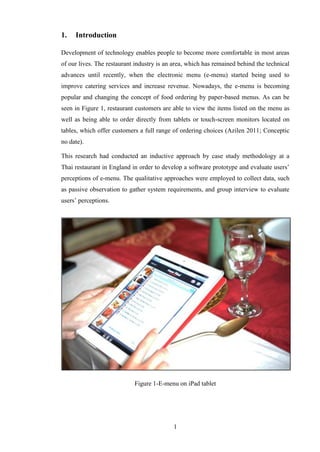
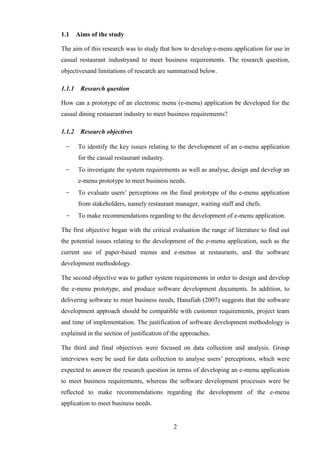
popular and changing the concept of food ordering by paper-based menus. As can be
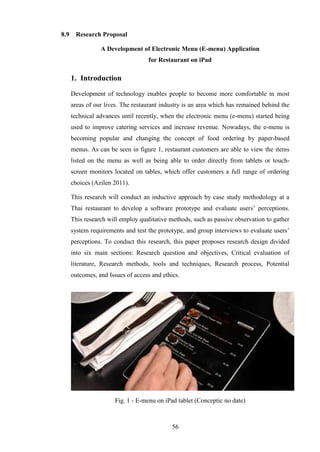
seen in Figure 1, restaurant customers are able to view the items listed on the menu as
well as being able to order directly from tablets or touch-screen monitors located on
tables, which offer customers a full range of ordering choices (Azilen 2011; Conceptic
no date).

This research had conducted an inductive approach by case study methodology at a
Thai restaurant in England in order to develop a software prototype and evaluate users’
perceptions of e-menu. The qualitative approaches were employed to collect data, such
as passive observation to gather system requirements, and group interview to evaluate
users’ perceptions.


                            Figure 1-E-menu on iPad tablet


                                           1
1.1     Aims of the study

The aim of this research was to study that how to develop e-menu application for use in
casual restaurant industryand to meet business requirements. The research question,
objectivesand limitations of research are summarised below.

1.1.1    Research question

How can a prototype of an electronic menu (e-menu) application be developed for the
casual dining restaurant industry to meet business requirements?

1.1.2    Research objectives

 −      To identify the key issues relating to the development of an e-menu application
        for the casual restaurant industry.
 −      To investigate the system requirements as well as analyse, design and develop an
        e-menu prototype to meet business needs.
 −      To evaluate users’ perceptions on the final prototype of the e-menu application
        from stakeholders, namely restaurant manager, waiting staff and chefs.
  −     To make recommendations regarding to the development of e-menu application.

The first objective began with the critical evaluation the range of literature to find out
the potential issues relating to the development of the e-menu application, such as the
current use of paper-based menus and e-menus at restaurants, and the software
development methodology.

The second objective was to gather system requirements in order to design and develop
the e-menu prototype, and produce software development documents. In addition, to
delivering software to meet business needs, Hanafiah (2007) suggests that the software
development approach should be compatible with customer requirements, project team
and time of implementation. The justification of software development methodology is
explained in the section of justification of the approaches.

The third and final objectives were focused on data collection and analysis. Group
interviews were be used for data collection to analyse users’ perceptions, which were
expected to answer the research question in terms of developing an e-menu application
to meet business requirements, whereas the software development processes were be
reflected to make recommendations regarding the development of the e-menu
application to meet business needs.


                                              2
1.2   Limitations of research

This dissertation was a product-based project involving the application of software
engineering techniques to analyse, design, and develop of a piece of software
(University of Oxford no date). The software prototype for this research included only
some specific features, such as ordering food and beverages, previewing order
information, calling for services, and transferring information to the kitchen. Therefore,
other functions, e.g. booking, billing and integrating with a point of sale (POS) system,
were excluded in this project.With regards to group interviews, this research focused on
only three main stakeholders, namely the restaurant manager, waiting staff and chefs, to
obtain their users’ perceptions on the prototype of e-menu application.


                                            3
2.    Literature Review

This literature review explores potential information to identify current knowledge and
key issues relating to development of a prototype of an e-menu application for the
casual restaurant industry to meet business requirements, which are divided into five
sections: E-menu for restaurants, Restaurant service processes, Software usability and
Human-Computer Interaction (HCI), and Software development methodology and
prototyping techniques, and finally Mobile application development for restaurant e-
menu on iOS or Android devices.


2.1   Electronic menu (e-menu) for restaurants

E-menu is a new technology for restaurant ordering solutions. The system includes
touch-screen devices installed with a piece of software to show a restaurant menu with
actual photos of the dishes (Emenunyy 2012). The touch-screen devices are not only
used to display the list of food and beverages, but also to process the restaurant services,
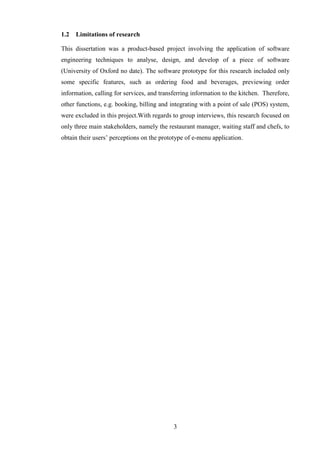
from ordering to payment (Jenie 2011). In general, an e-menu is used in three different
ways: tablet e-menu, table side touch screen e-menu and a touch screen menu for
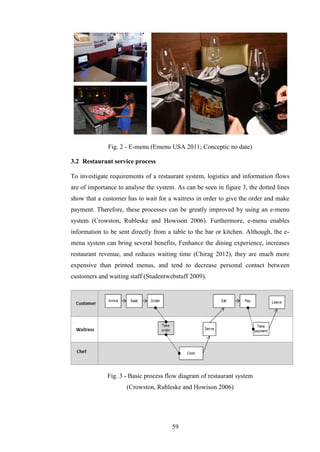
waiting areas, as shown in Figure 2.1 (Emenu USA 2011; Conceptic no date). However,
Chen, Lin and Yen (2011) indicate that interactive restaurant table-top e-menus can also
be implemented by using interactive surface technology to enlarge the size of menus
and increase customer attraction.


                         Figure 2.1- Restaurant e-menu solutions
                         (Emenu USA 2011; Conceptic no date)


                                             4
2.2   Restaurant service process

To investigate requirements of a restaurant system, logistics and information flows are
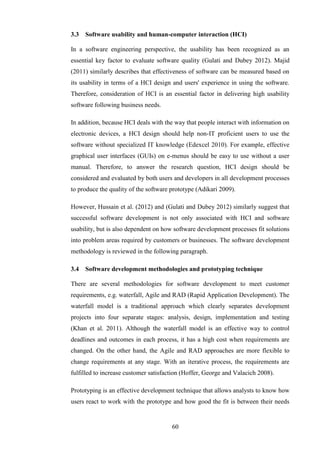
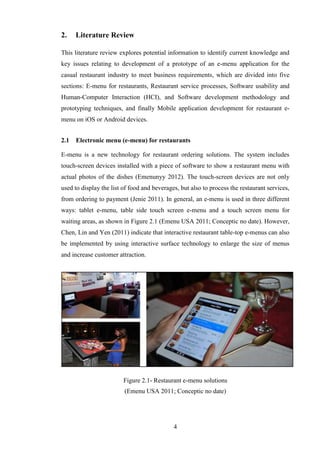
of importance to analyse the system. As can be seen in Figure 2.2, the dotted lines show
that a customer has to wait for a waitress in order to give the order and make payment.
Therefore, these processes can be greatly improved by using an e-menu system
(Crowston, Rubleske and Howison 2006). Furthermore, e-menu enables information to
be sent directly from a dining table to the bar and kitchen. Therefore, customers will
receive their orders faster. It also encourages them to order extra food and drinks during
eating or waiting for their orders.

Although, the e-menu system can bring several benefits, such as enhances the dining
experience, increases restaurant revenue, and reduces waiting time (Chirag 2012), they
are much more expensive than printed menus, and tend to decrease personal contact
between customers and waiting staff (Studentwebstuff 2009). Therefore, these key
issues should be considered when developing a prototype of e-menu application.


              Figure 2.2- Basic process flow diagram of restaurant system
                        (Crowston, Rubleske and Howison 2006)


                                            5
2.3     Software usability and Human-Computer Interaction (HCI)

In a software engineering perspective, the usability has been recognized as an essential
key factor to evaluate software quality (Gulati and Dubey 2012). Majid (2011) similarly
describes that effectiveness of software can be measured based on its usability in terms
of a HCI design and users' experience in using the software. Therefore, consideration of
HCI is an essential factor in delivering high quality software following business needs.

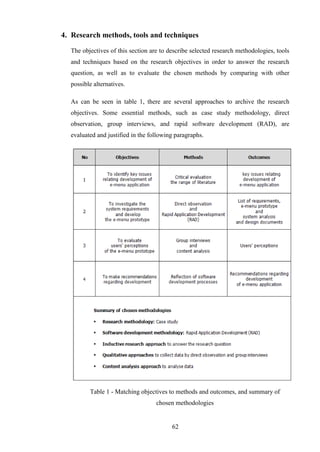
In addition, because HCI deals with the way that people interact with information on
electronic devices, a HCI design should help non-IT proficient users to use the software
without specialized IT knowledge (Edexcel 2010). For example, effective graphical user
interfaces (GUIs) on e-menus should be easy to use without a user manual or long
instruction by users. Therefore, to answer the research question, HCI design should be
considered and evaluated by both users and developers in all development processes to
produce the quality of the software prototype (Adikari 2009). The key quality
components of HCI design suggested by Norman and Nielsen (2011) and Nielsen
(1993) can be used to enhance usability of the prototype developed in this project as
below.

−     Visibility:     The application allows users to know the result of each operation.
−     Feedback:       The application allows users to return to a previous screen.
−     Memorability:   Users are easily able to recognise when they return to use
                      software again. The application should contain consistent user
                      interfaces.
−     Learnability:   Users find it easy to accomplish basic tasks in the first time.
−     Efficiency:     Users are quickly able to learn and perform tasks.
−     Satisfaction:   Users are pleasant to use software.

However, Hussain et al. (2012) and Gulati and Dubey (2012) similarly suggest that
successful software development is not only associated with HCI and software usability,
but is also dependent on how software development processes fit solutions into problem
areas required by customers or businesses. The software development methodology is
reviewed in the following section.


                                            6
2.4   Software development methodologies and prototyping technique

There are several methodologies for software development to meet customer
requirements such as, waterfall, Agile and RAD (Rapid Application Development). The
waterfall model is a traditional approach, which clearly separates project development
into four separate stages: analysis, design, implementation and testing (Khan et al.
2011). Although the waterfall model is an effective way to control deadlines and
outcomes in each process, it has a high cost when requirements are changed. On the
other hand, the Agile and RAD approaches are more flexible to change requirements at
any stage. With an iterative process, the requirements are fulfilled to increase customer
satisfaction (Hoffer, George and Valacich 2008).

Furthermore, prototyping is an effective development technique that allows analysts to
know how users react to work with the prototype, and how good the fit is between their
needs and the prototyped features (Kendall 2011). In addition, after the analysts get the
users’ feedback, they then make a new version to test with users again. This iterative
process continues so that users are relatively satisfied. Therefore, the final product can
be developed in a short time following the customer requirements (Hoffer, George and
Valacich 2008).

However, Khan et al. (2011) claims that the RAD approach with prototyping
concentrates mainly on experimenting with the customer needs. It may results in
insufficiently understanding of the overall business requirements. Moreover, RAD
methodology also requires trial and error activities in order to investigate an appropriate
solution. Consequently, it is able to increase the overall cost and time for implementing
a project that might result in failure of delivery time and spending budget (Cobb
2011).Justification of software development methodology is described in the next
chapter.


                                            7
2.5       Mobile application development on iOS or Android devices

Ordering food and drinks at a dining table usingan e-menu or tablet computer, such as
iPad and Samsung Galaxy, is an effective method. The build-in wireless feature
enablesthe tablets to connect a network and the Internet easily, and multi-touch screen
and its interfaces greatly enhance responsiveness and usability (Ray 2012). With their
slim size, the tablets are easier to install than personal computers used for table side
touch screen e-menu, and their screen size is bigger than one on a general smart phone.
This allows diners to view the e-menu at their convenience and place their orders when
they are ready to do so (Duffy 2011; Chirag 2012).

These days, the majority of applications on tablets are based on Apple’s iOS and
Google’s Android platform because of their popularity and divergent approaches (Tracy
2012). As can be seen in Table 2.5, the iOS platform only supports Apple devices, such
as iPad and iPhone. In contrast, Android is an open-source platform owned by Google,
who distributesAndroid operating system to several mobile manufacturers including
Samsung, HTC and LG, to install on their devices. Furthermore, Android applications
use mainly Java as a programming language. Developers can use open various source
developing tools, such as Google Inventor, IBM Eclipse and NetBeans, whereas the iOS
platform uses Objective-C language, which prefers one particular tool, namely Xcode.

  No                    Platform                      Apple's iOS                      Google's Android

      1        Owner (Developer)                          Apple                             Google
      2        Tablet devices support                      iPad                  Samsung, HTC, HP, and etc.

      3        Sizes of tablet screens                    1 (iPad)               Several sizes based on devices

      4        Operating system (OS)                        iOS                   Android based on Linux OS

      5        Programming language                   Objective-C                       Mainly in Java
               Object Oriented
      6                                                     Yes                               Yes
               Programming (OOP)
                                                                               Google App Inventor, IBM Eclipse
      7        Preferred developing tool             Apple Xcode
                                                                                        and NetBeans
      8        Open source platform                         No                                Yes

      9        Annual fee for development             $99 per year                One time registration fee $25
               Software approval before     Spend 3-4 weeks for app approval
  10                                                                                        No need
               publishing                              by Apple


          Table 2.5 - Comparison of mobile development platforms on iOS and Android
                          (Ray 2012; Lee 2012; Goadrich and Rogers 2011)
Although Android applications can run with a range of hardware, Goadrich and Rogers
(2011) and Shackles (2012) similarly mention that developing applications on Android


                                                      8
devices is more difficult than that on theiOS platform in terms of user interface design
because Android devices support a variety of tablet appliances, which all have varying
screen sizes and hardware specifications. As a result, developers find it hard to design
an application, especially user interfaces that fit with those multiple devices.

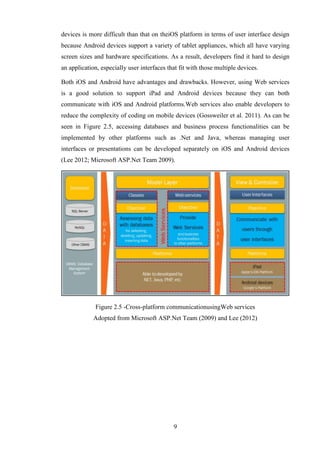
Both iOS and Android have advantages and drawbacks. However, using Web services
is a good solution to support iPad and Android devices because they can both
communicate with iOS and Android platforms.Web services also enable developers to
reduce the complexity of coding on mobile devices (Gossweiler et al. 2011). As can be
seen in Figure 2.5, accessing databases and business process functionalities can be
implemented by other platforms such as .Net and Java, whereas managing user
interfaces or presentations can be developed separately on iOS and Android devices
(Lee 2012; Microsoft ASP.Net Team 2009).


             Figure 2.5 -Cross-platform communicationusingWeb services
             Adopted from Microsoft ASP.Net Team (2009) and Lee (2012)


                                             9
2.6   Conclusion of the literature review

In summary, the literature review evaluates a range of sources in identifying current
knowledge and key issues with reference to the focus of the research question ‘how can
a prototype of an electronic menu (e-menu) application be developed for the casual
dining restaurant industry to meet business requirements?’ Although several sources
have provided useful information related to developing a restaurant e-menu application,
such as types of e-menus, restaurant service processes,software development
methodologies, and mobile development on iOS and Android devices, the studyin the
development ofan e-menu application for casual dining restaurants is extremely limited.
Therefore, research outcomes are able to fulfil a gap in theresearch domain.
Furthermore, the above literature review contains essential information in justifying
appropriate approaches for this research. The diverse justifications are evaluated in the
next section.


                                            10
3.        Justifications of the Approaches

The objectives of this section are to describe selected research methodologies, tools and
techniques based on the research objectives in order to answer the research question, as
well as to evaluate the chosen methods by comparing with other possible alternatives.

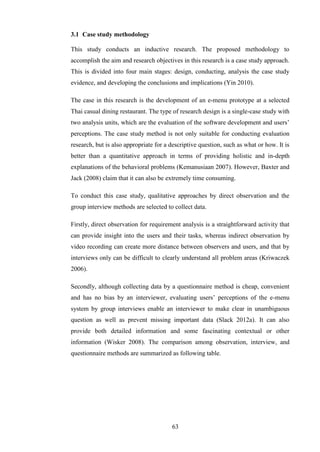
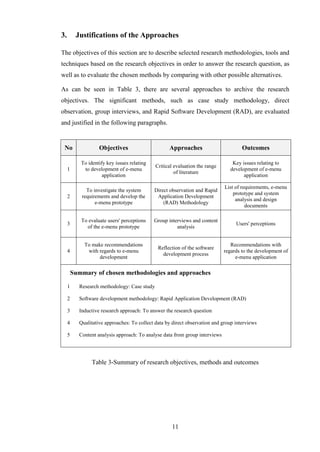
As can be seen in Table 3, there are several approaches to archive the research
objectives. The significant methods, such as case study methodology, direct
observation, group interviews, and Rapid Software Development (RAD), are evaluated
and justified in the following paragraphs.


 No                 Objectives                      Approaches                        Outcomes

            To identify key issues relating                                      Key issues relating to
                                              Critical evaluation the range
     1       to development of e-menu                                           development of e-menu
                                                       of literature
                      application                                                     application

                                                                              List of requirements, e-menu
              To investigate the system       Direct observation and Rapid
                                                                                  prototype and system
     2      requirements and develop the       Application Development
                                                                                   analysis and design
                  e-menu prototype                (RAD) Methodology
                                                                                        documents

            To evaluate users' perceptions    Group interviews and content
     3                                                                             Users' perceptions
              of the e-menu prototype                   analysis


             To make recommendations                                             Recommendations with
                                               Reflection of the software
     4        with regards to e-menu                                          regards to the development of
                                                 development process
                   development                                                     e-menu application

         Summary of chosen methodologies and approaches

     1     Research methodology: Case study

     2     Software development methodology: Rapid Application Development (RAD)

     3     Inductive research approach: To answer the research question

     4     Qualitative approaches: To collect data by direct observation and group interviews

     5     Content analysis approach: To analyse data from group interviews


                 Table 3-Summary of research objectives, methods and outcomes


                                                     11
3.1   Research process and framework

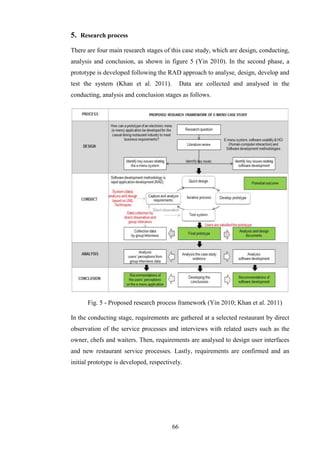
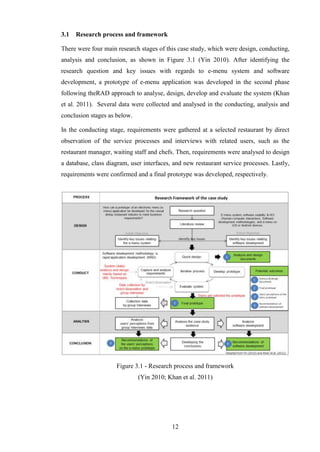
There were four main research stages of this case study, which were design, conducting,
analysis and conclusion, as shown in Figure 3.1 (Yin 2010). After identifying the
research question and key issues with regards to e-menu system and software
development, a prototype of e-menu application was developed in the second phase
following theRAD approach to analyse, design, develop and evaluate the system (Khan
et al. 2011). Several data were collected and analysed in the conducting, analysis and
conclusion stages as below.

In the conducting stage, requirements were gathered at a selected restaurant by direct
observation of the service processes and interviews with related users, such as the
restaurant manager, waiting staff and chefs. Then, requirements were analysed to design
a database, class diagram, user interfaces, and new restaurant service processes. Lastly,
requirements were confirmed and a final prototype was developed, respectively.


                     Figure 3.1 - Research process and framework
                              (Yin 2010; Khan et al. 2011)


                                           12
After the first prototype was developed and evaluated by users, feedback data was
collected by direct observation again in order to analyse and create a new prototype
version. As can be seen in Figure 3.1, the life cycle of developing the prototype was an
iterative process repeated until the users were satisfied. In this case study, the prototype
was demonstrated to the restaurant manager, waiting staff and chefs, whereas the
observation was performed throughout the whole development process.

In data analysis process, the approach for interpreting qualitative data was a content
analysis method. This method could analyse data for the objective and systematic
description of manifest content of communication. The content analysis method was an
effective technique that helped analyst reducing time and the effect of bias (Kohlbacher
2006).

In conclusion, collecting data by direct observation in their natural habitats was an
effective way to understand business processes and requirements, especially implicit
requirements. It was also an effective way for getting feedback about the prototype to
refine requirements so that it satisfies users (Sehlhorst 2006), whereas qualitative group
interview approach was a good method to capture the subjective comments of
participants and find out the perceptions of users (Blom 2006).


3.2   Case study methodology

This study was conducted an inductive research, which chose a non-probability or
convenience sampling, at a Thai casual dining restaurant in UK.This was because the
researcher is a Thai national, who is familiar with Thai food and the restaurant staff,and
has regularly dined at the restaurant for almost one year. Therefore, it allowed the
researcher to be convenientof contacting them to do this case study. Furthermore, the
methodology employed to accomplish the aim and research objectives in this research
was a case study approach. This was divided into four main stages: design, conduction,
analysis of the case study evidence, and the development of the conclusions and
implications (Yin 2010).

The case in this research was the development of an e-menu prototype at the chosen
restaurant.The type of research design was a single-case study with two analysis units,
which were the evaluation of the software development and users’ perceptions on the
prototype of e-menu application. The case study method was not only suitable for
conducting evaluation research, but was also appropriate for a descriptive question,


                                            13
such as what or how. It was vastly better than the quantitative approach in terms of
providing holistic and in-depth explanations of the behavioural problems (Kemanusiaan
2007). However, Baxter and Jack (2008) claim that it can be extremely time-
consuming.

To conduct this case study, qualitative approaches by direct observation and the group
interview methods were selected to collect data.

Firstly, direct observation for requirement analysis is a straightforward activity that can
provide insight into the users and their tasks, whereas indirect observation by video
recording can create more distance between observers and users, and that by interviews
only can be difficult to clearly understand all problem areas (Kriwaczek 2006).

Secondly, although collecting data by a questionnaire method is cheap, convenient and
has no bias by an interviewer, evaluating users’ perceptions of the e-menu system by
group interviews enable an interviewer to make clear in narrative and unambiguous
questions (Flick 2009). It can also provide both detailed information and some
fascinating contextual or other information (Wisker 2008). The comparison among
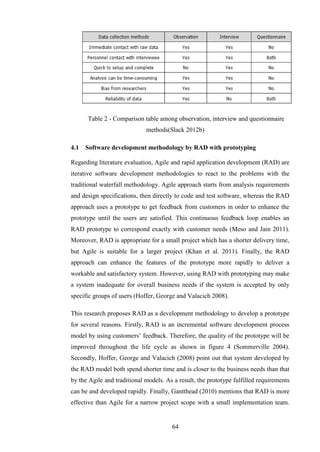
observation, interview, and questionnaire methods are summarised as following table.


          Data collection methods         Group Interview   Questionnaire   Direct Observation

 Data collection can be time-consuming.         No              Yes                Yes

 Data analysis can be time-consuming.           Yes              No                Yes
 Biased by researchers                          Yes              No                Yes
 Complex questions can be explained.            Yes              No                Yes
 Personal contact involved                      Yes              No                Yes
 High response rates likely                     Yes              No                Yes

          Table 3.2-Comparison among observation, interview and questionnaire
                                    (Seale 2012; Flick 2009)


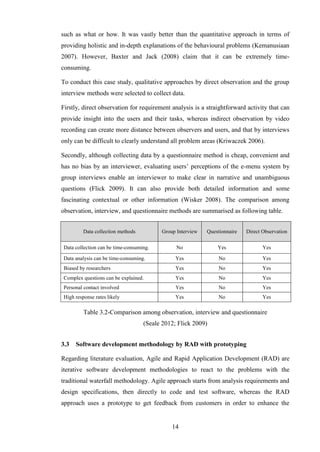
3.3   Software development methodology by RAD with prototyping

Regarding literature evaluation, Agile and Rapid Application Development (RAD) are
iterative software development methodologies to react to the problems with the
traditional waterfall methodology. Agile approach starts from analysis requirements and
design specifications, then directly to code and test software, whereas the RAD
approach uses a prototype to get feedback from customers in order to enhance the


                                              14
prototype until the users are satisfied. This continuous feedback loop enables an RAD
prototype to correspond exactly with customer needs (Meso and Jain 2011).

RAD is appropriate for a small project, which has a shorter delivery time, but Agile is
suitable for a larger project (Khan et al. 2011). Furthermore, the RAD approach can
enhance the features of the prototype more rapidly to deliver a workable and
satisfactory system. However, using RAD with prototyping may make a system
inadequate for overall business needs if the system is accepted by only specific groups
of users (Hoffer, George and Valacich 2008).

This research proposed RAD as a development methodology to develop a prototype for
several reasons. Firstly, RAD is an incremental software development process model by
using customers’ feedback. Therefore, the quality of the prototype will be improved
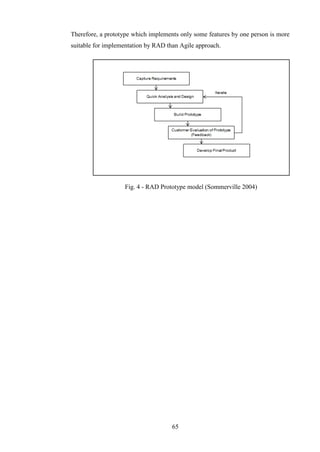
throughout the life cycle as shown in Figure 3.2 (Sommerville 2004). Secondly, Hoffer,
George and Valacich (2008) point out that system developed by the RAD model both
spend shorter time and is closer to the business needs than that by the Agile and
traditional models. As a result, the prototype fulfilled requirements can be and
developed rapidly. Lastly, Gantthead (2010) mentions that RAD is more effective than
Agile for a narrow project scope with a small implementation team. Therefore, a
prototype which implements only some features by one person is more suitable for
implementation by RAD than Agile approach.


          Figure 3.2-Rapid Application Development (RAD)and prototyping
                          Adapted from Sommerville (2004)


                                          15
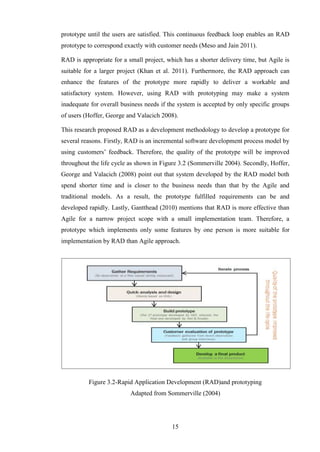
4.     Findings and Discussion

This case study research selected a convenience sampling at a Thai casual dining
restaurant in the UK to do group interviews with ten waiting staff from a total sixteen
members, as shown in Table 4. In addition, Stopher (2012) mentions that convenience
samples can be used in exploratory research when the estimation of standard errors is
not important.

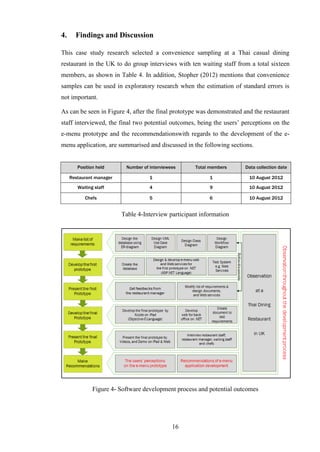
As can be seen in Figure 4, after the final prototype was demonstrated and the restaurant
staff interviewed, the final two potential outcomes, being the users’ perceptions on the
e-menu prototype and the recommendationswith regards to the development of the e-
menu application, are summarised and discussed in the following sections.


        Position held      Number of interviewees     Total members    Data collection date

     Restaurant manager              1                     1             10 August 2012

        Waiting staff                4                     9             10 August 2012

           Chefs                     5                     6             10 August 2012


                          Table 4-Interview participant information


               Figure 4- Software development process and potential outcomes


                                               16
4.1   Users’ perceptions of the e-menu prototype

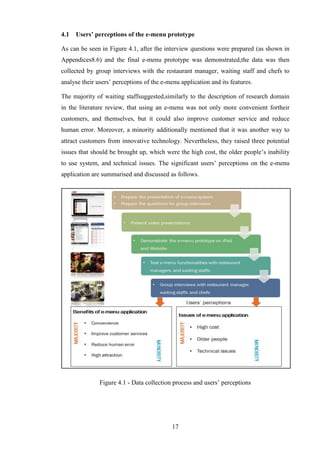
As can be seen in Figure 4.1, after the interview questions were prepared (as shown in
Appendices8.6) and the final e-menu prototype was demonstrated,the data was then
collected by group interviews with the restaurant manager, waiting staff and chefs to
analyse their users’ perceptions of the e-menu application and its features.

The majority of waiting staffsuggested,similarly to the description of research domain
in the literature review, that using an e-menu was not only more convenient fortheir
customers, and themselves, but it could also improve customer service and reduce
human error. Moreover, a minority additionally mentioned that it was another way to
attract customers from innovative technology. Nevertheless, they raised three potential
issues that should be brought up, which were the high cost, the older people’s inability
to use system, and technical issues. The significant users’ perceptions on the e-menu
application are summarised and discussed as follows.


               Figure 4.1 - Data collection process and users’ perceptions


                                            17
4.1.1   Convenience

The most restaurant staff mentioned,correspondingly to Emenunyy (2012) in the
literature review, that an e-menu could enhance convenience for restaurant customers
because it provides full details of food and drinks clearly, such as menu description,
images and spice content. Therefore, it is easy for the customer to select their
favouritedishes. Furthermore, they are also comfortable to make additional ordersand
check the status of their order without having to ask a waiter.

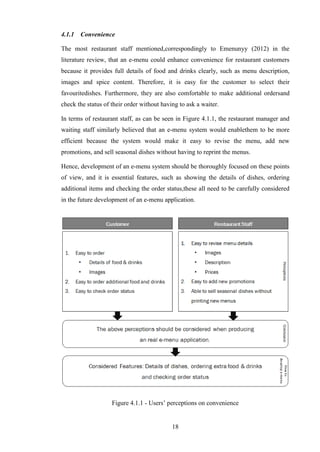
In terms of restaurant staff, as can be seen in Figure 4.1.1, the restaurant manager and
waiting staff similarly believed that an e-menu system would enablethem to be more
efficient because the system would make it easy to revise the menu, add new
promotions, and sell seasonal dishes without having to reprint the menus.

Hence, development of an e-menu system should be thoroughly focused on these points
of view, and it is essential features, such as showing the details of dishes, ordering
additional items and checking the order status,these all need to be carefully considered
in the future development of an e-menu application.


                    Figure 4.1.1 - Users’ perceptions on convenience


                                            18
4.1.2   Improving customer service

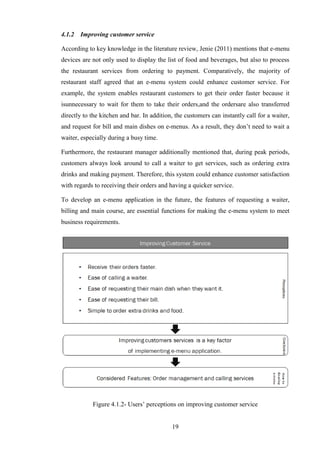
According to key knowledge in the literature review, Jenie (2011) mentions that e-menu
devices are not only used to display the list of food and beverages, but also to process
the restaurant services from ordering to payment. Comparatively, the majority of
restaurant staff agreed that an e-menu system could enhance customer service. For
example, the system enables restaurant customers to get their order faster because it
isunnecessary to wait for them to take their orders,and the ordersare also transferred
directly to the kitchen and bar. In addition, the customers can instantly call for a waiter,
and request for bill and main dishes on e-menus. As a result, they don’t need to wait a
waiter, especially during a busy time.

Furthermore, the restaurant manager additionally mentioned that, during peak periods,
customers always look around to call a waiter to get services, such as ordering extra
drinks and making payment. Therefore, this system could enhance customer satisfaction
with regards to receiving their orders and having a quicker service.

To develop an e-menu application in the future, the features of requesting a waiter,
billing and main course, are essential functions for making the e-menu system to meet
business requirements.


            Figure 4.1.2- Users’ perceptions on improving customer service


                                            19
4.1.3   Preventing human error

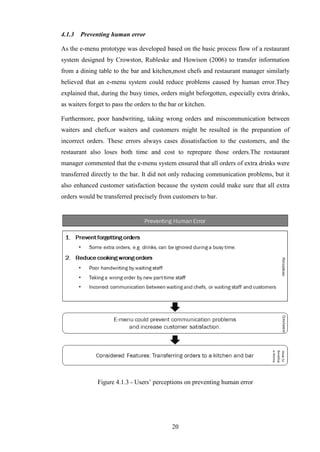
As the e-menu prototype was developed based on the basic process flow of a restaurant
system designed by Crowston, Rubleske and Howison (2006) to transfer information
from a dining table to the bar and kitchen,most chefs and restaurant manager similarly
believed that an e-menu system could reduce problems caused by human error.They
explained that, during the busy times, orders might beforgotten, especially extra drinks,
as waiters forget to pass the orders to the bar or kitchen.

Furthermore, poor handwriting, taking wrong orders and miscommunication between
waiters and chefs,or waiters and customers might be resulted in the preparation of
incorrect orders. These errors always cases dissatisfaction to the customers, and the
restaurant also loses both time and cost to reprepare those orders.The restaurant
manager commented that the e-menu system ensured that all orders of extra drinks were
transferred directly to the bar. It did not only reducing communication problems, but it
also enhanced customer satisfaction because the system could make sure that all extra
orders would be transferred precisely from customers to bar.


              Figure 4.1.3 - Users’ perceptions on preventing human error


                                             20
4.1.4   E-menu issues

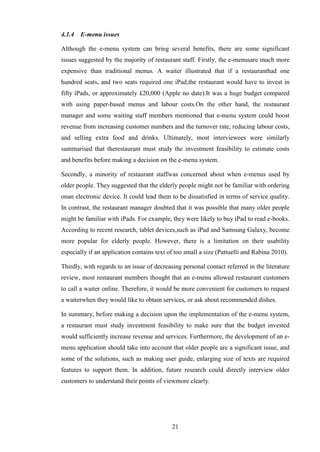
Although the e-menu system can bring several benefits, there are some significant
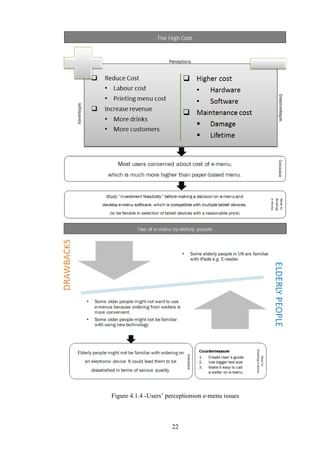
issues suggested by the majority of restaurant staff. Firstly, the e-menusare much more
expensive than traditional menus. A waiter illustrated that if a restauranthad one
hundred seats, and two seats required one iPad;the restaurant would have to invest in
fifty iPads, or approximately £20,000 (Apple no date).It was a huge budget compared
with using paper-based menus and labour costs.On the other hand, the restaurant
manager and some waiting staff members mentioned that e-menu system could boost
revenue from increasing customer numbers and the turnover rate, reducing labour costs,
and selling extra food and drinks. Ultimately, most interviewees were similarly
summarised that therestaurant must study the investment feasibility to estimate costs
and benefits before making a decision on the e-menu system.

Secondly, a minority of restaurant staffwas concerned about when e-menus used by
older people. They suggested that the elderly people might not be familiar with ordering
onan electronic device. It could lead them to be dissatisfied in terms of service quality.
In contrast, the restaurant manager doubted that it was possible that many older people
might be familiar with iPads. For example, they were likely to buy iPad to read e-books.
According to recent research, tablet devices,such as iPad and Samsung Galaxy, become
more popular for elderly people. However, there is a limitation on their usability
especially if an application contains text of too small a size (Pattuelli and Rabina 2010).

Thirdly, with regards to an issue of decreasing personal contact referred in the literature
review, most restaurant members thought that an e-menu allowed restaurant customers
to call a waiter online. Therefore, it would be more convenient for customers to request
a waiterwhen they would like to obtain services, or ask about recommended dishes.

In summary, before making a decision upon the implementation of the e-menu system,
a restaurant must study investment feasibility to make sure that the budget invested
would sufficiently increase revenue and services. Furthermore, the development of an e-
menu application should take into account that older people are a significant issue, and
some of the solutions, such as making user guide, enlarging size of texts are required
features to support them. In addition, future research could directly interview older
customers to understand their points of viewmore clearly.


                                            21
Figure 4.1.4 -Users’ perceptionson e-menu issues


                      22
4.2     Recommendations of e-menu application development

The following paragraphs provide important recommendations in context of e-menu
application development, which is separated into four main sections:Software
development processes for e-menu application, System design of the e-menu system,
Cross-platform communication between .Net and iOS platforms and Model-View-
Controller (MVC) design for e-menu system.

4.2.1    Software development processes for e-menu application

To develop a restaurant e-menu application, RAD (Rapid Application Development),
prototyping and direct observation were effective approaches to deliver a prototype in
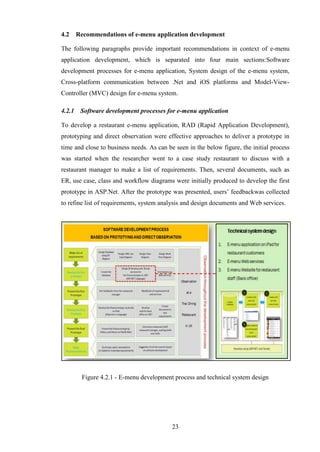
time and close to business needs. As can be seen in the below figure, the initial process
was started when the researcher went to a case study restaurant to discuss with a
restaurant manager to make a list of requirements. Then, several documents, such as
ER, use case, class and workflow diagrams were initially produced to develop the first
prototype in ASP.Net. After the prototype was presented, users’ feedbackwas collected
to refine list of requirements, system analysis and design documents and Web services.


         Figure 4.2.1 - E-menu development process and technical system design


                                           23
Next, the second or final prototype was developed by ASP.Net and Xcode. ASP.Net
was used to develop Web services and the back office website for restaurant staff,
whereas Xcode was used to develop the e-menu application for restaurant customers.
To present the final prototype, several digital artefacts were produced, such as video
and PowerPoint presentations, to present e-menu application, demonstrate software and
interview   restaurant   staff,   respectively.   Finally,    users’   perceptions   and
recommendations of e-menu development were produced in order to answer the
research question.


4.2.2   System design of the e-menu system


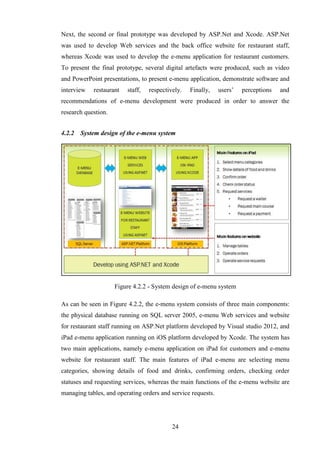
                     Figure 4.2.2 - System design of e-menu system

As can be seen in Figure 4.2.2, the e-menu system consists of three main components:
the physical database running on SQL server 2005, e-menu Web services and website
for restaurant staff running on ASP.Net platform developed by Visual studio 2012, and
iPad e-menu application running on iOS platform developed by Xcode. The system has
two main applications, namely e-menu application on iPad for customers and e-menu
website for restaurant staff. The main features of iPad e-menu are selecting menu
categories, showing details of food and drinks, confirming orders, checking order
statuses and requesting services, whereas the main functions of the e-menu website are
managing tables, and operating orders and service requests.


                                           24
4.2.3    Cross-platform communication between .Net and iOS platforms


        Figure 4.2.3 -Cross-platform communication between .Net and iOS platforms

With regards to using Web services for cross-platform communication, the e-menu
application on iPad has to consume XML Web services as shown in the above figure.
Unfortunately, Xcode does not provide build-in functions to generate and parse XML
data in order to connect with Web services (Lee 2012). Therefore, the researcherhad to
create the WebServiceManager class to generate and translate XML data. The purposes
of this class were to generate SOAP message for consuming Web services, and to
receive SOAP message from Web services and translate it into Xcode variables as
shown in Figure 4.2.3.

The researcher also developedthe ServiceUtils class to combine all functions provided
by Web services, and to convert asynchronous to synchronous communication. As a
result, coding on Xcode for consuming Web services by view’s controllerswasvery easy
and encapsulated. For example, the view’s controller of the Listing Category screen
could use only one line to get a list of menu categories as shown below. The
ServiceUtils class wasalso an example of implementing an object-oriented concept to
enhance reusability and reduce complexityof e-menu application.


               NSMutableArray *ArrMenuCategory = [ServiceUtils GetMenuCategory];


                                              25
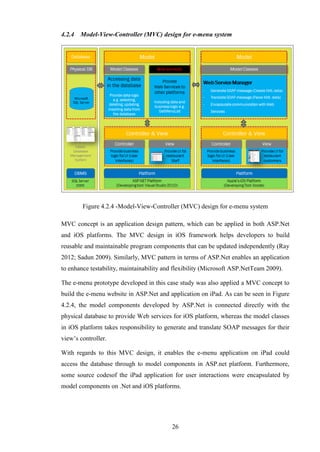
4.2.4   Model-View-Controller (MVC) design for e-menu system


        Figure 4.2.4 -Model-View-Controller (MVC) design for e-menu system

MVC concept is an application design pattern, which can be applied in both ASP.Net
and iOS platforms. The MVC design in iOS framework helps developers to build
reusable and maintainable program components that can be updated independently (Ray
2012; Sadun 2009). Similarly, MVC pattern in terms of ASP.Net enables an application
to enhance testability, maintainability and flexibility (Microsoft ASP.NetTeam 2009).

The e-menu prototype developed in this case study was also applied a MVC concept to
build the e-menu website in ASP.Net and application on iPad. As can be seen in Figure
4.2.4, the model components developed by ASP.Net is connected directly with the
physical database to provide Web services for iOS platform, whereas the model classes
in iOS platform takes responsibility to generate and translate SOAP messages for their
view’s controller.

With regards to this MVC design, it enables the e-menu application on iPad could
access the database through to model components in ASP.net platform. Furthermore,
some source codesof the iPad application for user interactions were encapsulated by
model components on .Net and iOS platforms.


                                          26
5.       Critical Reflection and Evaluation

This critical reflection and evaluation in this section critiques the inclusion of the
artefacts, and illustrates what had been learned as a result. It briefly indicates how the
researcher’s thinking has led to produce those artefacts and why they were included in
the portfolio(Crowther and Hill 2012).


5.1      Knowledge of the domain

During implementation of the e-menu prototype, the researcher gained plenty of
knowledge. This was not only obtained by researching various articles to write the
literature review, but also from whilst carrying out authentictasks(Carraccio and
Englander 2004), such as designing a database and new restaurant system, creating an
application by ASP.Net and Web services, and developing a mobile application on iPad.

However, the literature review was an initial task to gain basic knowledge, as well as to
find a gap in the knowledge domain. After the key knowledge was critically evaluated,
it enabled the researcherto have sufficient background concept to make decisions and
carry out the research in a suitable direction. The mapping of key knowledge, objectives
and learning points are summarised as follows.

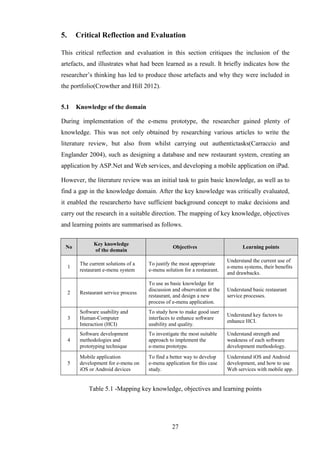
                Key knowledge
 No                                               Objectives                      Learning points
                of the domain
                                                                           Understand the current use of
          The current solutions of a   To justify the most appropriate
     1                                                                     e-menu systems, their benefits
          restaurant e-menu system     e-menu solution for a restaurant.
                                                                           and drawbacks.
                                       To use as basic knowledge for
                                       discussion and observation at the   Understand basic restaurant
     2    Restaurant service process
                                       restaurant, and design a new        service processes.
                                       process of e-menu application.
          Software usability and       To study how to make good user
                                                                           Understand key factors to
     3    Human-Computer               interfaces to enhance software
                                                                           enhance HCI.
          Interaction (HCI)            usability and quality.
          Software development         To investigate the most suitable    Understand strength and
     4    methodologies and            approach to implement the           weakness of each software
          prototyping technique        e-menu prototype.                   development methodology.
          Mobile application           To find a better way to develop     Understand iOS and Android
     5    development for e-menu on    e-menu application for this case    development, and how to use
          iOS or Android devices       study.                              Web services with mobile app.


              Table 5.1 -Mapping key knowledge, objectives and learning points


                                                  27
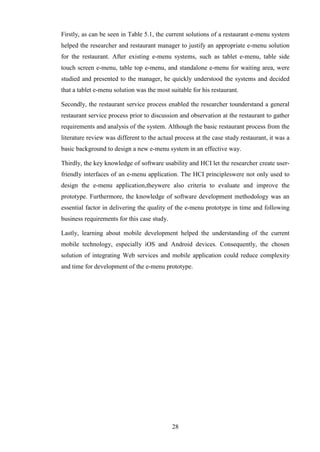
Firstly, as can be seen in Table 5.1, the current solutions of a restaurant e-menu system
helped the researcher and restaurant manager to justify an appropriate e-menu solution
for the restaurant. After existing e-menu systems, such as tablet e-menu, table side
touch screen e-menu, table top e-menu, and standalone e-menu for waiting area, were
studied and presented to the manager, he quickly understood the systems and decided
that a tablet e-menu solution was the most suitable for his restaurant.

Secondly, the restaurant service process enabled the researcher tounderstand a general
restaurant service process prior to discussion and observation at the restaurant to gather
requirements and analysis of the system. Although the basic restaurant process from the
literature review was different to the actual process at the case study restaurant, it was a
basic background to design a new e-menu system in an effective way.

Thirdly, the key knowledge of software usability and HCI let the researcher create user-
friendly interfaces of an e-menu application. The HCI principleswere not only used to
design the e-menu application,theywere also criteria to evaluate and improve the
prototype. Furthermore, the knowledge of software development methodology was an
essential factor in delivering the quality of the e-menu prototype in time and following
business requirements for this case study.

Lastly, learning about mobile development helped the understanding of the current
mobile technology, especially iOS and Android devices. Consequently, the chosen
solution of integrating Web services and mobile application could reduce complexity
and time for development of the e-menu prototype.


                                             28
5.2   Justification of the approaches

Although the key knowledge of several approaches had learned from writing the
literature review and justification of approaches, the researcher could obviously
emphasize the points about them after performing the practical tasks, such as direct
observation, group interviews, system design and the coding of an e-menu application.

There were several problems, which needed to be solved even though the research
framework and essential principles had been considered before starting the software
development stage. For example, as can be seen in Table 5.2, the majority of problems
of the chosen approaches were time-consuming. The researcher, however, had to find
additional tools, namely an action plan as shown in Appendices 8.1, to manage time for
both developing an e-menu prototype and producing research documents.Ultimately,
this dissertation was finishedwell on time, and the e-menu prototype was successfully
produced based on users’ requirements.

Furthermore, choosing the appropriate approaches and methods enabled the
researcherto underpin the dissertation work and create a portfolio in an effective way.
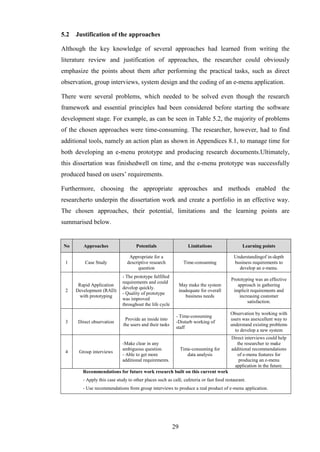
The chosen approaches, their potential, limitations and the learning points are
summarised below.


No       Approaches                  Potentials                    Limitations                 Learning points

                                 Appropriate for a                                        Understandingof in-depth
 1        Case Study            descriptive research             Time-consuming           business requirements to
                                      question                                              develop an e-menu.
                              - The prototype fulfilled
                                                                                         Prototyping was an effective
                              requirements and could
       Rapid Application                                       May make the system          approach in gathering
                              develop quickly.
 2    Development (RAD)                                        inadequate for overall     implicit requirements and
                              - Quality of prototype
        with prototyping                                          business needs             increasing customer
                              was improved
                                                                                                 satisfaction.
                              throughout the life cycle
                                                                                        Observation by working with
                                                           - Time-consuming
                               Provide an inside into                                   users was anexcellent way to
 3     Direct observation                                  -Disturb working of
                              the users and their tasks                                 understand existing problems
                                                           staff
                                                                                          to develop a new system
                                                                                         Direct interviews could help
                              -Make clear in any                                            the researcher to make
                              ambiguous question.              Time-consuming for        additional recommendations
 4     Group interviews
                              - Able to get more                  data analysis             of e-menu features for
                              additional requirements.                                       producing an e-menu
                                                                                           application in the future.
         Recommendations for future work research built on this current work
         - Apply this case study to other places such as café, cafeteria or fast food restaurant.
         - Use recommendations from group interviews to produce a real product of e-menu application.


                                                          29
Table 5.2 - Mapping approaches, their potentials, limitations and learning points

Initially, a case study approach was used as a core methodology for this research.In
terms of software development, the choosing of a pilot project at only one Thai dining
restaurant was an effective way to understand the system requirements, rather than to
gather information from several restaurants because it would take a much longer time to
discover the in-depth requirements.

Secondly, the RAD with a prototyping approach was an effective software development
tool that enabled the researcher to reduce time for implementation as well as to enhance
the features to meet the business needs quicker. Because some implicit requirements
could not be provided by stakeholders at the beginning; therefore, demonstration of the
e-menu prototype allowed the restaurant manager and staff to give more requirements to
fulfil business requirements. For example, a requirement gathered before developing the
prototype was selecting a menu category to order food and drinks. After the prototype
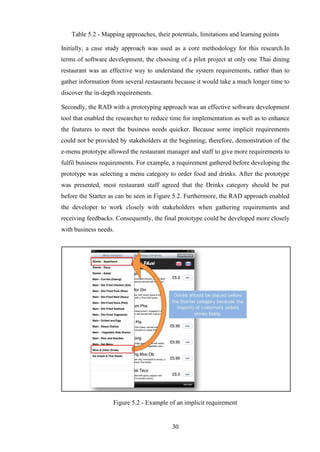
was presented, most restaurant staff agreed that the Drinks category should be put
before the Starter as can be seen in Figure 5.2. Furthermore, the RAD approach enabled
the developer to work closely with stakeholders when gathering requirements and
receiving feedbacks. Consequently, the final prototype could be developed more closely
with business needs.


                    Figure 5.2 - Example of an implicit requirement


                                           30
Thirdly, direct observation was an effective way to analyse restaurant business
procedure.The researcher could work friendly with waiting staff and chefsto monitor all
processes at the restaurant. However, the direct observation method appeared to disturb
working staff. Therefore, the researcher decided to work as a waiter to get more insight
intothe business processes. Eventually, the researcher could understand all restaurant
services processes in a short time in order to develop the prototype of e-menu
application.

Lastly, direct group interviewswere also useful. They did not only help in the users’
understanding and perceptions, but they were also used for software evaluation. As a
result, several useful recommendations of e-the menu features were provided by
restaurant stakeholders, namelythe restaurant manager, waiting staff and chefs, and the
researchercould take advantages of this to make recommendations, which could be used
by software development companies and practitioners who are interested in the
development of an e-menu application.

In conclusion, this case study was specific for only one types of restaurant. However, in
the real world, there are many kinds of eating places, which could use an e-menu
system for instance, cafés, bars, and fast-food restaurants. Therefore, further study could
apply some of the approaches used in this dissertation to carry out future research
forother kinds of restaurants.


                                            31
5.3     Overall reflective commentary with regards to research outcomes

The overall reflective commentary is a scholarly piece of writing that brings the
evidence together to make sense of individual items, and to evaluate the main processes
used and experienced whilst conducting this research to produce the artefacts and
research outcomes as shown in Appendices8.3-8.5(Crowther and Hill 2012). The
research processes for generating potential outcomes are critical evaluated as below.


5.3.1    System analysis and design documents

According to the literature review, software developed by the Rapid Application
Development (RAD) methodology with prototyping takes shorter time and becomes
closer to business requirements other methodologies (Hoffer, George and Valacich
2008). During development of the e-menu prototype, it was found that system analysis
and design documents could be developed quickly because an existing restaurant
system could be investigated effectively by discussion, direct observation and working
as a waiter, whereas collecting requirements without direct observation could make it
difficult to understand all obvious problem areas (Kriwaczek 2006). Ultimately, the
system analysis and design documents had been produced within two weeks to design a
database and develop e-menu application. Those documents are discussed as follows.

Firstly, a list of functional and non-functional requirements was initially produced to
confirm requirements with the restaurant manager and to design the e-menu system.
Secondly, an UML use case diagram was created to discuss with the manager to find
out who users were and what exactly they wanted? (Kendal 2011). Thirdly, an UML
class diagram was used to design the e-menu database and classes in ASP.Net. Revelle,
Gethers and Poshvanyk (2011) mentions that a class diagram is data model of object-
oriented design, which can enhance software quality. With regards to this process, the
researcher realised that the quality of e-menu software was greatly improved because
classes, which was designed based on object-orient concept, enabled software to be
easily maintained and developed. They contained reusable functions, which could
reduce the complexity of source code. Furthermore, ER-diagram was useful to model a
relational database.The details of primary keys, foreign keys and relationships enabled
the e-menu database to be able to prevent incorrect data being inserted into the database
(Connolly and Begg 2011). Finally, using workflow and process diagrams was an
effective way to discuss restaurant service processes with the restaurant manager. Those


                                           32
diagrams helped the researcher more easily confirm requirements than using only verbal
discussion.

To sum up, the system analysis and design documents could be produced during the
observation process to gather system requirements and analyse the system. However,
direct observation appeared to disturb working staff. Therefore, working as a waiter was
a beneficial way to overcome this problem.


5.3.2   Prototype of e-menu application

In this research, two versions of the prototype were developed. The first version was
produced only in ASP.Net, whereas the final version was developed in ASP.Net and
Xcode. Howcroft and Carroll (2000) mention that the RAD prototype does not need to
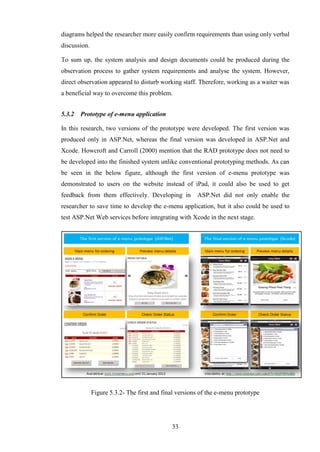
be developed into the finished system unlike conventional prototyping methods. As can
be seen in the below figure, although the first version of e-menu prototype was
demonstrated to users on the website instead of iPad, it could also be used to get
feedback from them effectively. Developing in          ASP.Net did not only enable the
researcher to save time to develop the e-menu application, but it also could be used to
test ASP.Net Web services before integrating with Xcode in the next stage.


              Figure 5.3.2- The first and final versions of the e-menu prototype


                                             33
Furthermore, the final prototype was separated into three main components: the iPad e-
menu application developed for restaurant customers, the e-menu website created in
ASP.Net for restaurant staff, and ASP.Net Web services providing functionalities for
the iPad e-menu application. Moreover, slide and video presentations were produced to
present to restaurant staff before demonstrating the e-menu software. All of these were
used as a set of tools to collect data for the third and final outcomes, namelyusers’
perceptions and recommendations of e-menu application development.


5.3.3   Users’ perceptions on the prototype of e-menu application

After presenting the final prototype of the e-menu application and performing group
interviews at a case study restaurant, three main advantages of e-menu system and the
potential issues analysed from users’ perceptions as below;

Firstly, similar to knowledge in the literature review mentioned by Emenu USA (2011),
using e-menu application can enhance convenience for restaurant customers and staff.
The customers are easy to preview details of food, make additional order and check
status of their orders without having to ask a waiter. On the other hand, restaurant staff
is convenient to revise menu, add a new promotions and sell seasonal dishes without
having to reprint the paper-based menus.

Secondly, an e-menu system can increase customer service because the system allows
diners to order from their table, thenthat orderis be transferred to the kitchen and bar
immediately (Crowston, Rubleske and Howison 2006). Moreover, using e-menuenables
dinners to be more satisfied because it can online call a waiter and request billing.
Therefore, this feature can reduce a problem of the delay in receiving the bill and
services, which causes of customer irritation (Gustafsson et al. 2006).

Thirdly, the e-menu system can reduce problems caused by human error, especially
during the busy times. As the system allows an order to be transferred online, it can
greatly reduce human error, such as a verbal miscommunication between staff and
dinners, or staff and chefs. Serving a wrong order is a risk of dissatisfaction because a
customer has to wait more time for cooking a new dish (Gustafsson et al. 2006).

Although using the e-menu is convenient, enhance customer service, and reduce human
error, there are significant issues, which should be considered when implementing a real
e-menu application. Initially, the cost of an e-menu system is very much higher than
that of a paper-based menu.Moreover, elderly people might not be comfortable using an


                                           34
iPad e-menu. Lastly, additional significant features, which should be developed when
producing the real e-menu software, are support of multiple languages, ordering by
quantity, and providing an e-menu user’s guide.


5.3.4   Recommendations of e-menu application development

After the final prototype of an e-menu application was developed, it was found that
there were three interesting methods,which were mainly concerned in development of
an e-menu application.

Firstly, software development methodology is an essential factor to manage a successful
software project (Khan, Niazi and Ahmad 2009; Misra and Kumar 2009). As RAD
methodology was chosen to develop an e-menu prototype,it was found that the software
prototype could be developed in a short time to meet business needs. With prototyping
and direct observation techniques, several implicit requirements from users’ feedback
were incrementally investigated to fulfil the requirements throughout the development
life-cycle. However, on-site observation could, and did,interrupt working staff.

Moreover, using Web services was a good solution for cross-platform development. In
this project, Web services were not only used to communicate between the back office
website and iPad application, but they were created to support other platform devices,
such as Android devices, for use in the future. Nevertheless, coding in Xcode was
difficult when generating and parsing XML data to communicate with Web services
because Xcode did not provide built-in functions to connect with Web services as do
other languages, such as PHP, Java and .Net (Lee 2012).

Finally, MVC design pattern is useful in separating between business logic and user
interfaces (Ray 2012; ASP.Net Team 2009). The e-menu prototype was also designed
based on MVC concept. As a result, it allowed the researcher to maintain source
codesconveniently after additional requirements were added. It was because of
changing the user interfaces on the iPad application that it became less consequential to
Web services and business logic source codes. Furthermore, the source codes based on
MVC pattern were separatelydeveloped.Therefore, they were also very easy to test and
rectify errors found by users and the researcher. However, this method was quite time-
consuming in      the early stages      of development as       it   was necessary to
completeprogrammingWeb services before creating user interfacesin order to develop
and test the prototype.


                                           35
6.    Conclusion and Limitations

6.1   Conclusions

This dissertation employed a case study approach based on qualitative empirical
research at a Thai restaurant in the UK to answer the research question ‘how can a
prototype of an e-menu application be developed for the casual dining restaurant
industry to meet business requirements’. The purposes of this study were to identify the
key issues relating to development of an e-menu application, to investigate system
requirements and develop an e-menu prototype based on RAD methodology, to evaluate
users’ perceptions on e-menu, and to make recommendations with regards to e-menu
development. As a result, this research could generate four potential outcomes as
follows.

Firstly, during direct observation at a case study restaurant in UK, a list of business
requirements, UML use case and class diagrams, Entity-Relationship (ER), workflow
and process diagrams were produced to analyse and design the system, and to develop
the prototype of e-menu application.

Secondly, after the software development process, the prototype was developed and
separated into three main components: the iPad e-menu application developed for
restaurant customers, the e-menu website created in ASP.Net for restaurant staff, and
the ASP.Net Web services providing functionalities for the iPad e-menu application.
Furthermore, slide and video presentations were produced to present to the restaurant
manager and staff before demonstrating the e-menu software. All of these were used as
a set of tools to collect data for the last two outcomes, namely users’ perceptions, and
recommendations of e-menu application development.

Thirdly, with regards to users’ perceptions, the majority of restaurant staff believed that
using e-menu application would be more convenient for their customers and
themselves, enhance customer service, and reduce human error. However, they
suggested significant issues, which should be considered when developing afinishede-
menu application. For example, the cost of an e-menu system was very much higher
than that of paper-based menus, and elderly people might not be comfortable using iPad
e-menus. Furthermore, additional requirements were also suggested when producing an
e-menu system for the Thai restaurant, such as support of multiple languages, ordering
by quantity, and providing an e-menu user’s guide.


                                            36
Finally, in terms of recommendations with regards to e-menu development, the
prototype was totally developed based on the knowledge domain studied. RAD
methodology with prototyping was an appropriate solution to develop an e-menu
application. It enabled the prototype’s features to be improved to meet business needs in
a short time. Moreover, direct observation was as an excellent approach to help the
researcher to understand obvious business requirements. However, this method did
appear to disturb some of the working staff. Furthermore, as the Web services were
developed in ASP.Net, it could not only reduce complexity and time for coding the iPad
application, but it could also be flexible when developing Android devices in the future.
Lastly, the Model-View-Controller (MVC) concept applied in this project could
enhance testability, maintainability and flexibility of the e-menu application.


6.2   Critical evaluation of learning experience

Throughout the experience of producing this dissertation portfolio, several lessons have
been learned. The following paragraphs evaluate learning experience from two different
aspects: the researcher and restaurant industry.

Firstly, throughout the process of research, the researchers have gained a lot of hard and
soft skills, such as software development, project management, documentation,
presentation and communication skills, all of which will be useful in the future. Firstly,
software development skillswere an important hard skill learned during development of
the e-menu prototype. With regards to programming skills, it was not only coding in
Objective-C language for iPad, but developing Web services and ASP.Net was also
studied at the same time. Furthermore, project management was a learning skill used for
planning and managing resources to achieve the completed portfolio. Lastly, the
researcher had also obtained the soft skill of documentation, during creating several
documents, such as system analysis and design, user manual and formal written
documents, whereas the presentation and communication skills have been learned
whilst gathering business requirements and presenting the prototype.

Secondly, in terms of restaurant industry, the restaurant manager and staff realised that
e-menu system was interesting and it could be more convenient for both restaurant
customers and staff, enhance customer service, reduce human error and attract a new
customer group. However, there are some issues, which should be considered before


                                            37
implementing an e-menu system, such as the high cost of the system, the older people’s
inability to use system, and technical issues


6.3   Limitations and recommendations for further research

Even though this dissertation could produce potential outcomes following the research
question, there were some limitations, which could be improved onfuture research. In
terms of the users’ perceptions of the e-menu system, this case study interviewed only
restaurant staff.However, there were some issues suggested by those staff, such as
enhancing customer service and using by elderly people. Therefore, future research
could carry out a case study based on this prototype to examine exact perceptions from
restaurant customers.Furthermore, this research focused on developing e-menu for only
iPad. Thus, future research could apply system design and source codesin this portfolio
to develop for other kinds of e-menu, for example, table side e-menu or standalone e-
menu for waiting area. Moreover, implementing on another platform, such as Android
or .Net, is an alternative to carry out future research. Finally, additional features
suggested by restaurant staff, for instance, integration with PoS system and advertising
of new promotions during meals, could also be conductedto develop a new prototype
with more functionalities as well as study users’ perceptions of those requirements.

6.4   Research contribution

Initially, a prototype of e-menu application, system analysis and design documents,
such as database design, use case, class diagrams, and feedback from development of
the e-menu prototype could be of benefit to software practitioners and developers who
are interested in software development, especially for mobile application, restaurant
system and RAD methodology. Furthermore, the prototype and system design
documents of this case study will be useful to produce the final product of an e-menu
system in the future.

In addition, the summary of users’ perceptions on using e-menu application can be
information for restaurant owners and people who would like to start a restaurant
business. It can help them to make decisions with regards to implementation of the e-
menu system to improve their service efficiency and customer satisfaction.
Furthermore, this case study also could generalise the result for other types of
restaurants, for instance, fast food restaurants, cafes and pubs, because most restaurants
use menus for ordering food and beverage as a basic function.


                                            38
7.   References

ADIKARI, Sisira (2009). Little design up-front: A design science approach to
integrating usability in Agile requirements engineering. [online]. Information Systems
Journal, 5610, 549-558. Article from SpringerLink last accessed 3 September 2012 at:
http://www.springerlink.com/content/ht82546644q57x36.

APPLE (no date). Apple Store: iPad 2. [online]. Last accessed 3 September 2012 at:
http://store.apple.com/uk/browse/home/shop_ipad/family/ipad.

AZILEN TECHNOLOGY (2011). Significance benefits and role of digital menu in
restaurant. [online]. Last accessed 3 September 2012 at:
http://www.articlesbase.com/business-opportunities-articles/significance-benefits-and-
role-of-digital-menu-in-restaurant-4925002.html.

BAXTER, Pamela and JACK, Susan (2008). Qualitative Case Study Methodology:
Study Design and Implementation for Novice Researchers. [online]. The Qualitative
Report. 13(4), 544-559. Article from Nova South Eastern University last accessed 3
September 2012 at: http://www.nova.edu/ssss/QR/QR13-4/baxter.pdf.

BLOM, Martin (2006). Empirical Evaluations of Semantic Aspects in Software
Development. [online]. Last accessed 3 September 2012 at: http://kau.diva-
portal.org/smash/get/diva2:6529/FULLTEXT01.

CARRACCIO, Carol and ENGLANDER, Robert (2004). Evaluating Competence
Using a Portfolio: A Literature Review and Web-Based Application to the ACGME
Competencies. Teaching and learning in medicine, 6 (14), 381-387.

CHEN, Ting-Han, LIN, Hsin-Hou and YEN, Yi-Di (2011). Mojo iCuisine: The design
and implementation of an interactive restaurant tabletop menu. [online]. Human-
computer Interaction, 6763, 185-194. Article from SpringerLink last accessed 3
September 2012 at:
http://www.springerlink.com/content/m307510134401751/fulltext.pdf.

CHIRAG (2012). E-Menu. [online]. Last accessed 3 September 2012 at: http://e-menu-
chr.blogspot.co.uk/2012_02_01_archive.html.

COBB, Charles G. (2011). Making Sense of Agile Project Management. New Jersey,
John Wiley & Sons.

CONCEPTIC (no date). iPad eMenu for restaurant. [online]. Last accessed 3
September 2012 at: http://www.emenu-international.com/iPad-menu-for-restaurants.

CROWSTON, Kevin, RUBLESKE, Joseph and HOWISON, James (2006).
Coordination Theory: A Ten-Year Retrospective. [online]. Last accessed 3 September
2012 at: http://crowston.syr.edu/system/files/CT%20Review%20to%20distribute.pdf.


                                          39
CROWTHER, Paul and HILL, Richard (2012). Dissertation by portfolio-an alternative
to the traditional thesis. Student engagement and experience journal, 1 (2), 1-12.

DUFFY, Thomas J. (2011). Programming with mobile application: Androidtm, iOS, and
Windows® Phone 7. Boston, USA, Cengage Learning.

EDEXCEL (2010). Human Computer Interaction. [online]. Last accessed 3 September
2012 at:
http://www.edexcel.com/migrationdocuments/BTEC%20Nationals%20from%202010/
Unit-23-Human-Computer-Interaction.pdf.

EMENU USA (2011). eMenu Pictures. [online]. Last accessed 3 September 2012 at:
http://www.emenuny.com/pictures.html.

EMENUNYY (2012). Restaurant menu software ‘eMenu’ Ready to wave goodbye to
traditional paper menus. [online]. Last accessed 3 September 2012 at: http://your-
story.org/restaurant-menu-software-emenu-ready-to-wave-goodbye-to-traditional-
paper-menus-298620.

FLICK, Uwe (2009). An introduction to qualitative research. 4th ed., London, SAGE
Publications.

GANTTHEAD (2010). Rapid Application Development process. [online]. Last accessed
3 September 2012 at: http://www.gantthead.com/content/processes/11306.cfm.

GOADRICH, Mark H. and ROGERS, Michael P. (2011). Proceedings of the 42nd
ACM Technical Symposium on Computer Science Education. In: Proceedings of the
42nd ACM Technical Symposium on Computer Science Education, ACM, 607-612.

GOSSWEILER, Rich, et al. (2011). Argos: Building a Web-Centric Application
Platform on Top of Android. IEEE Pervasive Computing, 10 (4), 10-14.

GULATI, Anubha and DUBEY, Sanjay Kumar (2012). Critical Analysis on Usability
Evaluation Techniques. [online]. International Journal of Engineering Science and
Technology (IJEST), 4(3), 990-997. Article from IJEST last accessed 3 September 2012
at: http://www.ijest.info/docs/IJEST12-04-03-118.pdf.

GUSTAFSSON, Inga-Britt, et al. (2006). The five aspects meal model: A tool for
developing meal services in restaurants. Journal of foodservice, 17 (2), 84-93.

HANAFIAH, Mastura (2007). Suit-method: A tool for finding suitable software
development methodology.The London School of Economics and Political Science.
[online]. Last accessed 3 September 2012 at:
http://csrc.lse.ac.uk/asp/aspecis/20000053.pdf.


                                         40
HOFFER, Jeffrey A., GEORGE, Joey F. and VALACICH, Joseph (2008). Modern
systems analysis and design. 5th ed., USA, Pearson Education.

HOWCROFT, Debra and CARROLL, John (2000). A proposed methodology for web
development. In: Proceedings of the European Conference on Information Systems,
290-297. [online]. Article from IJEST last accessed 4 September 2012 at:
http://www.ijest.info/docs/IJEST12-04-03-118.pdf.
HUSSAIN, Zahid, et al. (2012). Practical Usability in XP Software Development
Processes. In: The Fifth International Conference on Advances in Computer-Human
Interactions, Spain, 30 January 2012. Valencia, IARIA, 208-217. Article from Think
mind last accessed 3 September 2012 at:
http://www.thinkmind.org/index.php?view=article&articleid=achi_2012_8_50_20217.

JENIE, Renan Prasta, et al. (2011). Designing user interface e-menu based on Android
platform. [online]. Last accessed 3 September 2012 at:
http://ict.binus.edu/metamorph/file/research/Journal%20-
%20Android%20Komodo%202.pdf.

KEMANUSIAAN, Jurnal (2007). Case study as a research method. [online]. Last
accessed 3 September 2012 at: http://eprints.utm.my/8221/1/ZZainal2007-
Case_study_as_a_Research.pdf.

KENDALL, Kenneth E. and KENDALL, Julie E (2011). Systems analysis and design.
8th ed., USA, Pearson Education.

KHAN, Asif Irshad, et al. (2011). Comprehensive study of commonly practiced heavy
and light weight software methodologies. [online]. International Journal of Computer
Science, 8(4), 441-450. Article from TechRepublic last accessed 3 September 2012 at:
http://www.techrepublic.com/whitepapers/a-comprehensive-study-of-commonly-
practiced-heavy-and-light-weight-software-methodologies/3809811/post.

KHAN, Siffat Ullah, NIAZI, Mahmood and AHMAD, Rashid (2009). Critical success
factors for offshore software development outsourcing vendors: A systematic literature
review. In: Global Software Engineering, 2009. ICGSE 2009. Fourth IEEE
International Conference, IEEE, 207-216.

KOHLBACHER, Florian (2006). The Use of Qualitative Content Analysis in Case
Study Research. [online]. Last accessed 3 September 2012 at: http://www.qualitative-
research.net/index.php/fqs/article/view/75/153.

KRIWACZEK, Frank (2006). HCI: Requirements Analysis. [online]. Last accessed 3
September 2012 at:
http://www.doc.ic.ac.uk/~frk/frank/da/hci/Requirements%20Analysis%20handout.pdf.

LEE, Wei-Meng (2012). Beginning iOS 5 Application Development. Canada, John
Wiley & Sons, Inc.


                                          41
MAJID, Rogayah Abd, et al. (2011). Users’ frustration and HCI in the software
development life cycle. [online]. International Journal of Information Processing and
Management, 2 (1.5), 44-48. Article from Research Gate last accessed 3 September
2012 at:
http://www.researchgate.net/publication/228823317_Users'_Frustration_and_HCI_in_th
e_Software_Development_Life_Cycle.

MESO, Peter, JAIN, Radhika (2006). Agile Software Development: Adaptive Systems
Principles and Best Practices. [online]. Information Systems Management, 23(3), 19-30.
Article from ISM Journal last accessed 3 September 2012 at: http://www.ism-
journal.com/ITToday/93704.pdf.

MICROSOFTASP.NET TEAM (2009). ASP.NET MVC Overview. [online]. Last
accessed 9 August 2012 at: http://www.asp.net/mvc/tutorials/older-
versions/overview/asp-net-mvc-overview.

MISRA, Subhas Chandra, KUMAR, Vinod and KUMAR, Uma (2009). Identifying
some important success factors in adopting agile software development practices.
Journal of systems and software, 82 (11), 1869-1890.

NIELSEN, Jakob (1993). Usability Engineering. San Francisco, Morgan Kaufmann.

NORMAN, Donald A. and NIELSEN, Jakob (2010). Gestural interfaces: A step
backward in usability. Interactions, 17 (5), 46-49.

PATTUELLI, M. Cristina and RABINA, Debbie (2010). Forms, effects, function: LIS
students' attitudes towards portable e-book readers. [online]. In: Aslib Proceedings,
Emerald Group Publishing Limited, 228-244. Article from WordPress last accessed 3
September 2012 at: http://cpattuelli.files.wordpress.com/2010/04/pattuelli_rabiba_aslib-
2010.pdf.

RAY, John (2012). iOS 5 Application Development in 24 Hours. USA, SAMS.

SEALE, Clive (2012). Researching Society and Culture. 3 ed., London, SAGE
Publications Ltd.

SEHLHORST, Scott (2006). Ten Requirements Gathering Techniques. [online]. Last
accessed 3 September 2012 at: http://tynerblain.com/blog/2006/11/21/ten-requirements-
gathering-techniques.

SHACKLES, Greg (2012). Mobile Development with C#. USA, O'Reilly Media, Inc.

SOMMERVILLE, Ian (2004). Software Engineering. UK, Addison Wesley.

STOPHER, Peter (2012). Collecting, managing, and assessing data using sample
surveys. Cambridge, UK, Cambridge University Press.


                                          42
STUDENTWEBSTAFF (2009). Use of E-Menus in the Restaurant Industry. [online].
Last accessed 3 September 2012 at:
http://www.studentwebstuff.com/mis/showthread.php?t=8049.

TRACY, Kim (2012). Mobile application development experiences on apple's iOS and
android OS. IEEE potentials, 31 (4), 30-34.

UNIVERSITY OF OXFORD (no date). Project and dissertation. [online]. Last
accessed 3 September 2012 at: http://www.cs.ox.ac.uk/softeng/handbook/projects.html.

WISKER, Gina (2008). The postgraduate research handbook: Methods in brief. 2nd
ed., New York, Palgrave Macmillan.

YIN, Robert K. (2010). Application of case study research. 3rd ed., London, SAGE
Publications.


                                         43
8.    Appendices

8.1   Project Plan

To deliver a quality of dissertation by portfolio artefacts, a final e-menu prototype and
software development documents on time, based on business needs, and with high
customer satisfaction. The dissertation action plan and the Gantt chart of project
milestones were created in the beginning phase and had updated throughout the
development process as shown in following figures.


         Figure 8.1.1 - The initial and last updated action plan for dissertation


                                           44
Figure 8.1.2- Gantt chart of project milestones


                      45
8.2   Summary of activities at the case study restaurant


No      Date          Time                                          Activities


 1    29-Jun-12    14.00 - 16.00   Discussing and observing with the restaurant manager#1

                                   Discussing and observing with the restaurant manager and waiting
 2    06-Jul-12    14.00 - 17.00
                                   staff#2

                                   Discussing and observing with the restaurant manager and waiting
 3    12-Jul-12    18.00 - 23.00
                                   staff#3

                                   Presenting the first prototype and getting feedback from restaurant
                   14.00-16.30
                                   manager
 4    20-Jul-12
                   18.00 - 23.00   Observation by working as a waiter at the restaurant


                   15.00-16.00     Presenting the final prototype


 5     10-Aug                      Interviewing the restaurant manager, waiting staff and chefs
                   16.30 - 23.30
                                   Final observing with the restaurant manager, waiting staff and chefs#4


         Main activities: Observation, discussion, presentation, getting feedback and interviews


                Table 8.2- Summary of activities at the case study restaurant


                                                 46
8.3   Portfolio navigator


             Figure 8.3.1-Evidence collected for the dissertation portfolio


                                          47
Figure 8.3.2-The artefact outcomes for the dissertation portfolio


                               48
8.4    Table of content of individual pieces of evidence
 N
         Group        Pieces of evidence       Format                 Description                            File Path in CD
 o
                                                            Justifications of the approaches,
       Written                                               findings and discussion, critical    20_DISSERTATION_WORD01_DISSERT
 1                    Written document         MS Word
      document                                                reflection and evaluation, and                 ATION.docx
                                                                conclusion and limitations
                                                            The detailed plan for conducting
                                                 MS          this research including the plan     01_PROJECT_PLAN02_PROJECT_PLAN
 2    Project Plan       Project Plan
                                              PowerPoint      of software development and                   11AUG12.pptx
                                                                      documentation
                                                           It includes the research question,
                        Overview of the          MS         framework, navigator, outcome,        70_OVERVIEW_DOCUMENTSO1_RESEA
 3     Overview
                     dissertation portfolio   PowerPoint    system design, MVC design and                RCH_OVERVIEW.pptx
                                                                    interview process.
                        Overview of the
                                                               List of portfolio evidence
                     evidence collected for
 4     Overview                                MS Excel    collected for the dissertation by       02_POFFOLIO_EVIDENCE_6SEP12.xlsx
                      the dissertation by
                                                                        Portfolio
                           portfolio
                                                              This file makes it easy to
                                                 MS                                               01_PORTFOLIO_NAVIGATOR_6SEP12.pp
 5     Navigator      Portfolio navigator                    navigate pieces of evidence
                                              PowerPoint                                                         tx
                                                                     sequentially.

                                                                This file makes it easy to
                         The artefact            MS
 6     Navigator                                           navigate the artefact outcomes.            03_OUTCOME_NAVIGATOR.pptx
                          outcomes            PowerPoint
                                                           It is a part of portfolio navigator.

                      Table of content of                    Table of content of individual
                                                                                                  00_TABLE_OF_CONTENT_PIECES_OF_EVI
 7     Navigator      individual pieces of     MS Excel        pieces of evidence (This
                                                                                                              DENCE.xlsx
                            evidence                                  document)

                                                            This website includes the first
                                               Internet
 8     Overview        E-menu website                      and final prototype, some pieces               www.innoemenu.com
                                                 Link
                                                                      of evidence.

       Analysis      Summary of system                       This presentation includes all
                                                 MS                                               10_ANALYSIS_DESIGN_DOCA1_ANALY
 9    and design     analysis and design                      system analysis and design
                                              PowerPoint                                                   SIS_DESIGN.pptx
      document           documents                                    documents.

       Analysis
                         UML use case                        UML Use case diagram in MS           10_ANALYSIS_DESIGN_DOCB1_USECA
10    and design                               MS Visio
                           diagram                                    Visio file                           SE_DIAGRAM.vsd
      document

       Analysis
                                                            UML class diagram in MS Visio         10_ANALYSIS_DESIGN_DOCB2_CLASS_
11    and design      UML class diagram        MS Visio
                                                                         file                                DIAGRAM.vsd
      document

       Analysis
                                                                                                  10_ANALYSIS_DESIGN_DOCB3_ER_DIA
12    and design          ER diagram           MS Visio       ER diagram in MS Visio file
                                                                                                              GRAM.vsd
      document

       Analysis
                                                            Workflow diagram in MS Visio          10_ANALYSIS_DESIGN_DOCB4_EMENU
13    and design      Workflow diagram         MS Visio
                                                                        file                                _PROCESS.vsd
      document
                                                               This website is process                         http://aces-
        E-menu                                 Internet     simulation on iPad application,       web.aces.shu.ac.uk/students/b0043132
14                    The first prototype
       Prototype                                 Link          which would be used by             /03_emenu/02_ORDER/01_SearchOrde
                                                                restaurant customers.                              r.aspx
                     The final prototype of                     This website is used by                        http://aces-
        E-menu                                 Internet
15                       e-menu web                           restaurant staff to manage          web.aces.shu.ac.uk/students/b0043132
       Prototype                                 Link
                          application                         tables, orders and services.               /03_emenu/Default.aspx
                                                           This file explains how to install e-
                      How to install and
      Source code                                MS            menu applications to test          11_SOURCE_CODE_AND_DB00_HOW_T
16                      test e-menu
        and DB                                PowerPoint    features on your computer and                  O_TEST_APP.pptx
                         application
                                                                           iPad

      Source code                              Project        Set of source code files in         11_SOURCE_CODE_AND_DB10_SOURC
17                   ASP.Net Source code
        and DB                                 folder                  ASP.Net                             E_CODE_DOTNET

                                                SQL
      Source code                                                                                 11_SOURCE_CODE_AND_DB11_DATAB
18                     E-menu Database        database              SQL Server files
        and DB                                                                                                 ASE
                                                files

                                                           Set of source code files in Xcode
      Source code    E-menu Source code        Project                                            11_SOURCE_CODE_AND_DB01_SOURC
19                                                                      project
        and DB            in Xcode             folder                                                      E_CODE_XCODE
                                                            developed for iPad application.
                        Annotation of
                                                 MS        Annotation of Knowledge of the         21_ANNOTATIONA1_ANNOTATION_KNO
20    Annotation       Knowledge of the
                                              PowerPoint              domain                                WLEDGE.pptx
                           domain


                     Table 8.4-Table of content of individual pieces of evidence


                                                              49
No     Group         Pieces of evidence        Format                Description                          File Path in CD

                        Annotation of
                                                MS          Annotation of justifications of    21_ANNOTATIONA2_ANNOTATION_APP
21   Annotation      justifications of the
                                             PowerPoint           the approaches                          ROACH.pptx
                         approaches
                         Overview of
                                                              Overview of description of
                   description of research      MS                                             22_DESCRIPTION_OUTCOMED1_RESEA
22    Outcome                                                research and discussion of
                      and discussion of      PowerPoint                                           RCH_DESC_AND_OUTCOME.pptx
                                                                     outcomes
                           outcomes
                    Users’ perceptions of                    Users’ perceptions of the e-
                                                MS                                             22_DESCRIPTION_OUTCOMED2_USERS
23    Outcome       the e-menu prototype                     menu prototype on e-menu
                                             PowerPoint                                           _PERCEPTIONS_FEATURES.pptx
                     on e-menu features                               features

                   Users’ perceptions of        MS          Users’ perceptions of e-menu       22_DESCRIPTION_OUTCOMED3_USERS
24    Outcome
                     e-menu system           PowerPoint                system                       _PERCEPTIONS_EMENU.pptx

                     Recommendations                                                           22_DESCRIPTION_OUTCOMED4_RECO
                                                MS         Recommendations regarding to
25    Outcome       regarding to e-menu                                                        MMENDATION_EMENU_DEVELOPMENT.p
                                             PowerPoint        e-menu development
                       development                                                                            ptx
      Prototype
                   E-menu functionalities       MS                                             40_PRESENT_PROTOTYPE_POWERPOIN
26   Presentatio                                           E-menu functionalities on iPad
                         on iPad             PowerPoint                                          TA21_FUNCTIONS_ON_IPAD.pptx
          n
      Prototype    E-menu functionalities
                                                MS            E-menu functionalities on        40_PRESENT_PROTOTYPE_POWERPOIN
27   Presentatio       on website for
                                             PowerPoint      website for restaurant staff        TA30_FUNCTIONS_ON_WEB.pptx
          n           restaurant staff
      Prototype    E-menu functionalities                                                      40_PRESENT_PROTOTYPE_POWERPOIN
                                                MS         E-menu functionalities on iPad
28   Presentatio   on iPad for testing the                                                     TT01_TEST_FUNCTIONAL_REQUIREMEN
                                             PowerPoint       for testing the prototype
          n              prototype                                                                           TS.pptx
      Prototype                                                                                41_PRESENT_PROTOTYPE_VIDEO01_D
                    Overview of e-menu        Video file
29   Presentatio                                           Overview of e-menu application       EMO_OVERVIEW_EMENU.mp4 (Version
                        application             (mp4)
          n                                                                                                    2)
      Prototype     Demonstrate e-menu                          Demonstrate e-menu
                                              Video file                                       41_PRESENT_PROTOTYPE_VIDEO02_D
30   Presentatio   application on iPad for                     application on iPad for
                                                (mp4)                                               EMO_DETAILS_EMENU.mp4
          n         restaurant customer                         restaurant customer
      Prototype     Demonstrate e-menu                          Demonstrate e-menu
                                              Video file                                       41_PRESENT_PROTOTYPE_VIDEO03_D
31   Presentatio   application on website                     application on website for
                                                (mp4)                                           EMO_EMENU_WEB_FOR_STAFF.mp4
          n          for restaurant staff                          restaurant staff
      Prototype
                   Innovative e-menu and      Video file                                       41_PRESENT_PROTOTYPE_VIDEO04_D
32   Presentatio                                           Innovative e-menu and benefits
                          benefits              (mp4)                                              EMO_EMENU_BENEFITS.mp4
          n
      Prototype                                            Same as the above video file. It
                    Overview of e-menu        YouTube                                          http://www.youtube.com/watch?v=9jret
33   Presentatio                                           can use if you cannot open the
                        Application             Link                                                          ESx_q4
          n                                                       above video file
      Prototype     Demonstrate e-menu                     Same as the above video file. It
                                              YouTube                                          http://www.youtube.com/watch?v=bCsFi
34   Presentatio   application on iPad for                 can use if you cannot open the
                                                Link                                                          MHuG80
          n         restaurant customer                           above video file
      Prototype     Demonstrate e-menu                     Same as the above video file. It
                                              YouTube                                          http://www.youtube.com/watch?v=HSqT
35   Presentatio   application on website                  can use if you cannot open the
                                                Link                                                          J5acxzw
          n          for restaurant staff                         above video file
      Prototype                                            Same as the above video file. It
                   Innovative e-menu and      YouTube                                            http://www.youtube.com/watch?v=-
36   Presentatio                                           can use if you cannot open the
                          benefits              Link                                                        cBTICTa7bE
          n                                                       above video file

                       Wrap Around              MS          Summary of this dissertation       50_CONCLUSION10_WRAP_AROUND_C
37   Conclusion
                        Conclusion           PowerPoint             portfolio                           ONCLUSION.pptx

      Support         Research ethics                         A copy of research ethics            02_SCANNED_DOC01_ACES
38                                              PDF
      evidence           checklist                                    checklist                    Ethics_Checklist_18Aug12.doc

      Support      Permission letter with                  Permission letter and approval      02_SCANNED_DOC02_Permission_Lett
39                                              PDF
      evidence          restaurant                         from the case study restaurant           er_Restaurant_30Jun12.pdf

      Support      Dissertation key dates                  Dissertation key dates form to      01_PROJECT_PLAN01_KEYDATE_6JUN
40                                            MS Word
      evidence              form                           create plan for the supervisor                   12.doc

      Support                                                                                  81_ALL_PDF03_PROPOSALRESEARCH
41                   Research proposal          PDF               Research proposal
      evidence                                                                                       _PROPOSAL_26APR12.pdf

      Support         Interview voices       Audio file     Interview voices (English and
42                                                                                                    31_INTERVIEW_VOICES
      evidence       (English and Thai)       (m4a)                     Thai)

                     Some pictures of
      Support                                               Some pictures of observation
43                    observation and        Image files                                             32_INTERVIEW_PICTURES
      evidence                                                 and interview process
                     interview process
                                                           List of references including both
                                                MS                                             60_REFERENCESR01_ALL_REFERENCE
44   References      List of references                       written documents and all
                                             PowerPoint                                                     S.pptx
                                                               presentation documents


                     Table 8.4 - Table of content of individual pieces of evidence


                                                             50
8.5      Overview of evidence collected for the dissertation portfolio

                                           Artefact                                        Annotation                     Critical Reflection
      Evidence
N
      presente
o
          d
                                                       Presentation                                Presentation                        Presentation
                             Description                                       Description                          Description
                                                          format                                      format                              format

                                                         MS Word                                                                         MS Word
                                                                                                  MS PowerPoint
                                                                            Annotation of                         Written critical
      Knowledg        Written literature review       (20_DISSERTAT                                                                   (20_DISSERT
                                                                           key knowledge          (21_ANNOTATI      reflection
1      e of the                                       ION_WORD/01                                                                     ATION_WORD
                                                                           learnt from this       ON/A1_ANNOT
       domain               (1,699 words)              _DISSERTATIO                                                                   /01_DISSERT
                                                                               project            ATION_KNOWL       (556 words)
                                                       N.docx Page 4-                                                                  ATION.docx
                                                                                                    EDGE.pptx)
                                                            10)                                                                        Page 27-28)
                                                          MS Word                                                                       MS Word
                                                                                                  MS PowerPoint
      Justificati                                                             Comparison of
                       Written justifications of                                                                  Written critical
        ons of                                        (20_DISSERTAT              important                                            (20_DISSERT
                             approaches                                                           (21_ANNOTATI      reflection
2        the                                          ION_WORD/01               approaches                                            ATION_WORD
                                                                                                  ON/A2_ANNOT
      approach                                         _Dissertation.d        justified in this                                       /01_DISSERT
                            (1,343 words)                                                         ATION_APPRO       (816 words)
          es                                            ocx Page 11-              project                                              ATION.docx
                                                                                                    ACH.pptx)
                                                             15)                                                                       Page 29-31)
                                                      MS PowerPoint
                    System analysis and design        (10_ANALYSIS_
                                                                                                  MS PowerPoint                          MS Word
                    documents:                        DESIGN_DOC/A                                                Written critical
                                                                               Overview of
                    - List of requirements            1_ANALYSIS_D                                                  reflection
                                                                              description of      (22_DESCRIPTI                       (20_DISSERT
                    - UML Use case diagram              ESIGN.pptx)
                                                                               research &         ON_OUTCOME                         ATION_WORD
                    - UML Class diagram                     and                                                   (2,100 words of
                                                                              discussion of       D1_RESEARCH                         /01_DISSERT
                    - ER diagram                       MS Visio files                                               Findings and
                                                                                outcomes          _DESC_AND_O                          ATION.docx
                    - Workflow diagrams                   (Folder:                                                   Discussion)
                                                                                                   UTCOME.pptx)                        Page 16-26)
                    - Process diagrams                10_ANALYSIS_
                                                       DESIGN_DOC)
                                                                                                                   Written critical
                    Presentation Prototype                                                                            reflection         MS Word
                                                                                   Users'
                    - E-menu functionalities on       MS PowerPoint                               MS PowerPoint   (1,352 words of
                                                                              perceptions on
                    iPad                              Folder:                                                          Overall        (20_DISSERT
                                                                                the e-menu
                    - E-menu functionalities on       40_PRESENT_P                                (D2_USERS_PE        reflective      ATION_WORD
                                                                               prototype in
                    website for restaurant staff      ROTOTYPE_PO                                 RCEPTIONS_FE      commentary        /01_DISSERT
                                                                               context of its
                    - E-menu functionalities on       WERPOINT                                     ATURES.pptx)    and discussion      ATION.docx
                                                                                  features
                    iPad for testing requirements                                                                    of research       Page 32-35)
                                                                                                                     outcomes )
                    Website
      Descripti     - E-menu website for              Links of                                    MS PowerPoint
      on of the     restaurant staff                  website:                 Users'
      research      - E-menu website (the first       Main website:        perceptions on         (D3_USERS_PE
3        and        prototype)                        www.innoemen         e-menu system          RCEPTIONS_EM
      discussio     - E-menu Web service              u.com                                         ENU.pptx)
       n of the     - E-menu navigator
      outcomes
                    The prototype of E-menu
                    system
                                                                                                  MS PowerPoint
                    - Manual to install & test e-     Source code &
                                                                           Recommendati
                    menu applications                 DB Files
                                                                            ons regarding         (D4_RECOMME
                    - Over 6,000 lines of source      Folder:
                                                                             to e-menu            NDATION_EME
                    code (Xcode)                      11_SOURCE_C
                                                                            development           NU_DEVELOPM
                    - Over 10,000 lines of Source     ODE_AND_DB
                                                                                                     ENT.pptx)
                    code (.NET)
                    - Database (SQL Server)

                    Video presentations
                    - Overview of e-menu
                    Application
                    - Demo e-menu application         Video Format:
                    on iPad for restaurant            Folder:
                    customer                          41_PRESENT_P
                    - Demo e-menu application         ROTOTYPE_VID
                    on website for restaurant         EO
                    staff
                    - Innovative e-menu and
                    benefits

                                                              MS Word (20_DISSERTATION_WORD/01_DISSERTATION.docx, Page 36-38)
4       Reflection commentary:
                                                              MS PowerPoint (50_CONCLUSION10_WRAP_AROUND_CONCLUSION.pptx)

                                                                   Portfolio navigator (01_PORTFOLIO_NAVIGATOR_6SEP12.pptx)
5       Navigation structure (contents/index):
                                                                Table of content (00_TABLE_OF_CONTENT_PIECES_OF_EVIDENCE.xlsx)
         A matrix that relates the assessment
6      criteria to each piece of evidence (which                          This document (02_POFFOLIO_EVIDENCE_6SEP12.xlsx)
         may be incorporated in the contents)


              Table 8.5- Overview of evidence collected for the dissertation portfolio


                                                                         51
8.6   List of interview questions

         Have you seen an e-menu before? When? How?
         Have you used an e-menu before? When? How?
         Can an e-menu help you understand more details of food and drinks?
         Do you think that an e-menu makes it easier to order extra food and drinks
          whilst dinning?
         Do you think that an e-menu makes it easy to request extra services e.g. call
          waiter, main course and billing?
         Do you prefer ordering by e-menu or by waiter in this kind of restaurant?
         Does an e-menu reduce personal contact between customer and restaurant
          staff?
         What are main benefits of an e-menu in your opinion?
         What are main issues if implemented in this restaurant?
         What are the important features that an e-menu that should be provided?
         Does the demonstrated software have some good points in terms of software
          features? And if so, what are they?
         What do you think about the e-menu prototype?
           o Feedback (Easy to return to previous screen)
           o Memorability (Easy to remember how to use it the next time)
           o Learnability (Easy to use and understand without user manual)
           o Efficiency (Easy to perform tasks)
           o Satisfaction (Pleasant to use software)


                                             52
8.7   Acopy of the letter of agreement with the restaurant


            Figure 8.7-A copy of the letter of agreement with the restaurant


                                          53
8.8   A copy of research ethics checklist


                    Figure 8.8-A copy of research ethics checklist


                                            54
Figure 8.8- A copy of research ethics checklist


                      55
8.9    Research Proposal

                 A Development of Electronic Menu (E-menu) Application
                                   for Restaurant on iPad

      1. Introduction

      Development of technology enables people to become more comfortable in most
      areas of our lives. The restaurant industry is an area which has remained behind the
      technical advances until recently, when the electronic menu (e-menu) started being
      used to improve catering services and increase revenue. Nowadays, the e-menu is
      becoming popular and changing the concept of food ordering by paper-based
      menus. As can be seen in figure 1, restaurant customers are able to view the items
      listed on the menu as well as being able to order directly from tablets or touch-
      screen monitors located on tables, which offer customers a full range of ordering
      choices (Azilen 2011).

      This research will conduct an inductive approach by case study methodology at a
      Thai restaurant to develop a software prototype and evaluate users’ perceptions.
      This research will employ qualitative methods, such as passive observation to gather
      system requirements and test the prototype, and group interviews to evaluate users’
      perceptions. To conduct this research, this paper proposes research design divided
      into six main sections: Research question and objectives, Critical evaluation of
      literature, Research methods, tools and techniques, Research process, Potential
      outcomes, and Issues of access and ethics.


                       Fig. 1 - E-menu on iPad tablet (Conceptic no date)


                                             56
2. Research question and objectives

The aim of this research is to study that how to develop e-menu application for
casual restaurants to meet their business requirements. The research question,
objectives and limitations of research are summarised below.

2.1 Research question

How can a prototype of an electronic menu (e-menu) application be developed for
the casual dining restaurant industry to meet business requirements?

2.2 Research objectives

    1. To identify the key issues relating to the development of an e-menu
        application for the casual restaurant industry.
    2. To investigate the system requirements, and analyse, design and develop an
        e-menu prototype to meet business needs.
    3. To evaluate users’ perceptions on the final prototype of the e-menu
        application from stakeholders such as restaurant customers, owners and
        waiting staff.
    4. To make recommendations with regards to the development of the e-menu
        application based on chosen software development methodology.

The first objective begins with the critical evaluation the range of literature to find
out the potential issues relating to the development of the e-menu application, such
as the current use of paper-based menus and e-menus at restaurants, and the
software development methodology.

The second objective is to gather system requirements to design and develop the e-
menu prototype, and produce software development documents. In addition, to
delivering software to meet business needs, Hanafiah (2007) suggests that the
software development approach should be compatible with customer requirements,
project team and time of implementation.

The third and final objectives are focused on data collection and analysis. Group
interviews will be used for data collection to analyse users’ perceptions, which are
expected to answer the research question in terms of developing an e-menu
application to meet business requirements, whereas the software development


                                        57
processes will be reflected to make recommendations with regards to the
   development of the e-menu application to meet business needs.

   2.3 Limitations of research

   The proposed dissertation is a product-based project involving the application of
   software engineering techniques to analyse, design, and develop of a piece of
   software (University of Oxford no date). The software prototype for this research
   includes only some specific features such as ordering food and beverages,
   previewing order information, calling for services, and transferring information to
   the kitchen.    Therefore, other functions, for instance,       booking, billing and
   integrating with a point of sale (POS) system, are excluded in this project.

3. Critical evaluation of literature

   This critical evaluation explores potential information to identify current knowledge
   and key issues relating to development of a prototype of an e-menu application for
   the casual restaurant industry, which are divided into four sections: E-menu for
   restaurants, Restaurant service processes, Software usability and human-computer
   interaction (HCI), and Software development methodology and prototyping
   techniques.

   3.1   Electronic menu (e-menu) for restaurants

   The e-menu system is a new technology for restaurant ordering solutions. The
   system includes touch-screen devices installed with a piece of software to show a
   restaurant menu with actual photos of the dishes (Emenunyy 2012). The touch-
   screen devices are not only used to display the list of food and beverages, but also to
   process the restaurant services, from ordering to payment (Jenie 2011). In general,
   an e-menu is used in three different ways: tablet menu, table side touch screen menu
   and a touch screen menu for waiting areas, as shown in figure 2 (Emenu USA 2011;
   Conceptic no date). However, Chen, Lin, and Yen (2011) indicate that interactive
   restaurant tabletop menus can also be implemented by using interactive surface
   technology to enlarge the size of menus and increase customer attraction.


                                           58
Fig. 2 - E-menu (Emenu USA 2011; Conceptic no date)

3.2 Restaurant service process

To investigate requirements of a restaurant system, logistics and information flows
are of importance to analyse the system. As can be seen in figure 3, the dotted lines
show that a customer has to wait for a waitress in order to give the order and make
payment. Therefore, these processes can be greatly improved by using an e-menu
system (Crowston, Rubleske and Howison 2006). Furthermore, e-menu enables
information to be sent directly from a table to the bar or kitchen. Although, the e-
menu system can bring several benefits, Fenhance the dining experience, increases
restaurant revenue, and reduces waiting time (Chirag 2012), they are much more
expensive than printed menus, and tend to decrease personal contact between
customers and waiting staff (Studentwebstuff 2009).


              Fig. 3 - Basic process flow diagram of restaurant system
                     (Crowston, Rubleske and Howison 2006)


                                       59
3.3   Software usability and human-computer interaction (HCI)

In a software engineering perspective, the usability has been recognized as an
essential key factor to evaluate software quality (Gulati and Dubey 2012). Majid
(2011) similarly describes that effectiveness of software can be measured based on
its usability in terms of a HCI design and users' experience in using the software.
Therefore, consideration of HCI is an essential factor in delivering high usability
software following business needs.

In addition, because HCI deals with the way that people interact with information on
electronic devices, a HCI design should help non-IT proficient users to use the
software without specialized IT knowledge (Edexcel 2010). For example, effective
graphical user interfaces (GUIs) on e-menus should be easy to use without a user
manual. Therefore, to answer the research question, HCI design should be
considered and evaluated by both users and developers in all development processes
to produce the quality of the software prototype (Adikari 2009).

However, Hussain et al. (2012) and (Gulati and Dubey 2012) similarly suggest that
successful software development is not only associated with HCI and software
usability, but is also dependent on how software development processes fit solutions
into problem areas required by customers or businesses. The software development
methodology is reviewed in the following paragraph.

3.4   Software development methodologies and prototyping technique

There are several methodologies for software development to meet customer
requirements, e.g. waterfall, Agile and RAD (Rapid Application Development). The
waterfall model is a traditional approach which clearly separates development
projects into four separate stages: analysis, design, implementation and testing
(Khan et al. 2011). Although the waterfall model is an effective way to control
deadlines and outcomes in each process, it has a high cost when requirements are
changed. On the other hand, the Agile and RAD approaches are more flexible to
change requirements at any stage. With an iterative process, the requirements are
fulfilled to increase customer satisfaction (Hoffer, George and Valacich 2008).

Prototyping is an effective development technique that allows analysts to know how
users react to work with the prototype and how good the fit is between their needs


                                       60
and the prototyped features (Kendall 2011). In addition, after the analysts get the
users’ feedback, they then make a new version to test with users again. This iterative
process continues so that users are relatively satisfied. Therefore, the final product
can be developed in a short time following the customer requirements (Hoffer,
George and Valacich 2008). However, Khan et al. (2011) claims that the RAD
approach with prototyping concentrates mainly on experimenting with the customer
needs. It may results in insufficiently understanding of the overall business
requirements.


                                       61
4. Research methods, tools and techniques

  The objectives of this section are to describe selected research methodologies, tools
  and techniques based on the research objectives in order to answer the research
  question, as well as to evaluate the chosen methods by comparing with other
  possible alternatives.

  As can be seen in table 1, there are several approaches to archive the research
  objectives. Some essential methods, such as case study methodology, direct
  observation, group interviews, and rapid software development (RAD), are
  evaluated and justified in the following paragraphs.


         Table 1 - Matching objectives to methods and outcomes, and summary of
                                   chosen methodologies


                                         62
3.1 Case study methodology

This study conducts an inductive research. The proposed methodology to
accomplish the aim and research objectives in this research is a case study approach.
This is divided into four main stages: design, conducting, analysis the case study
evidence, and developing the conclusions and implications (Yin 2010).

The case in this research is the development of an e-menu prototype at a selected
Thai casual dining restaurant. The type of research design is a single-case study with
two analysis units, which are the evaluation of the software development and users’
perceptions. The case study method is not only suitable for conducting evaluation
research, but is also appropriate for a descriptive question, such as what or how. It is
better than a quantitative approach in terms of providing holistic and in-depth
explanations of the behavioral problems (Kemanusiaan 2007). However, Baxter and
Jack (2008) claim that it can also be extremely time consuming.

To conduct this case study, qualitative approaches by direct observation and the
group interview methods are selected to collect data.

Firstly, direct observation for requirement analysis is a straightforward activity that
can provide insight into the users and their tasks, whereas indirect observation by
video recording can create more distance between observers and users, and that by
interviews only can be difficult to clearly understand all problem areas (Kriwaczek
2006).

Secondly, although collecting data by a questionnaire method is cheap, convenient
and has no bias by an interviewer, evaluating users’ perceptions of the e-menu
system by group interviews enable an interviewer to make clear in unambiguous
question as well as prevent missing important data (Slack 2012a). It can also
provide both detailed information and some fascinating contextual or other
information (Wisker 2008). The comparison among observation, interview, and
questionnaire methods are summarized as following table.


                                        63
Table 2 - Comparison table among observation, interview and questionnaire
                             methods(Slack 2012b)

4.1   Software development methodology by RAD with prototyping

Regarding literature evaluation, Agile and rapid application development (RAD) are
iterative software development methodologies to react to the problems with the
traditional waterfall methodology. Agile approach starts from analysis requirements
and design specifications, then directly to code and test software, whereas the RAD
approach uses a prototype to get feedback from customers in order to enhance the
prototype until the users are satisfied. This continuous feedback loop enables an
RAD prototype to correspond exactly with customer needs (Meso and Jain 2011).
Moreover, RAD is appropriate for a small project which has a shorter delivery time,
but Agile is suitable for a larger project (Khan et al. 2011). Finally, the RAD
approach can enhance the features of the prototype more rapidly to deliver a
workable and satisfactory system. However, using RAD with prototyping may make
a system inadequate for overall business needs if the system is accepted by only
specific groups of users (Hoffer, George and Valacich 2008).

This research proposes RAD as a development methodology to develop a prototype
for several reasons. Firstly, RAD is an incremental software development process
model by using customers’ feedback. Therefore, the quality of the prototype will be
improved throughout the life cycle as shown in figure 4 (Sommerville 2004).
Secondly, Hoffer, George and Valacich (2008) point out that system developed by
the RAD model both spend shorter time and is closer to the business needs than that
by the Agile and traditional models. As a result, the prototype fulfilled requirements
can be and developed rapidly. Finally, Gantthead (2010) mentions that RAD is more
effective than Agile for a narrow project scope with a small implementation team.


                                       64
Therefore, a prototype which implements only some features by one person is more
suitable for implementation by RAD than Agile approach.


                   Fig. 4 - RAD Prototype model (Sommerville 2004)


                                     65
5. Research process
There are four main research stages of this case study, which are design, conducting,
analysis and conclusion, as shown in figure 5 (Yin 2010). In the second phase, a
prototype is developed following the RAD approach to analyse, design, develop and
test the system (Khan et al. 2011).          Data are collected and analysed in the
conducting, analysis and conclusion stages as follows.


      Fig. 5 - Proposed research process framework (Yin 2010; Khan et al. 2011)

In the conducting stage, requirements are gathered at a selected restaurant by direct
observation of the service processes and interviews with related users such as the
owner, chefs and waiters. Then, requirements are analysed to design user interfaces
and new restaurant service processes. Lastly, requirements are confirmed and an
initial prototype is developed, respectively.


                                        66
After the first prototype is developed and tested by users, feedback data is collected
by direct observation again in order to analyse and create a new prototype version.
As can be seen in figure 5, the life cycle of developing the prototype is an iterative
process repeated until the users are satisfied.

In addition, after the final prototype is completed and tested by restaurant staff, data
is then collected by group interviews from the restaurant owner and all waiting staff,
whereas a non-probability sample of around ten customer groups are selected to
interview.

In data analysis process, the approach for interpreting qualitative data is a content
analysis method. This method can analyse data for the objective and systematic
description of manifest content of communication. It is an effective technique that
helps analyst reducing time and the effect of bias (Kohlbacher 2006).

In conclusion, collecting data by direct observation in their natural habitats is an
effective way to understand business processes and requirements, especially implicit
requirements. It is also an effective way for getting feedback about the prototype to
refine requirements so that it satisfies users (Sehlhorst 2006), whereas qualitative
group interview approach is a good method to capture the subjective comments of
participants and find out the perceptions of users (Blom 2006).


                                         67
6. Potential outcomes
This research is expected to design and develop a prototype of e-menu application
for a Thai casual dining restaurant. The potential outcomes can be defined in terms
of software development artifacts, users’ perceptions and recommendations
regarding development of the e-menu application.

Firstly, a prototype of e-menu application, system analysis and design documents,
such as database design, use case, class diagrams, and feedback from development
of the e-menu prototype can be of benefit to software practitioners and developers
who are interested in software development, especially for mobile application,
restaurant system and RAD methodology. Furthermore, the prototype and system
design documents of this case study will be useful to produce the final product of an
e-menu system in the future.

Secondly, the summary of users’ perceptions on using e-menu application can be
information for restaurant owners and people who would like to start a restaurant
business. It can help them to make decisions with regards to implementation of the
e-menu system to improve their service efficiency and customer satisfaction. In
addition, this case study can also generalize the result to other types of restaurants,
e.g. fast food restaurants, cafes and pubs, because most restaurants use menus for
ordering food and beverage as a basic function.

7. Issues of access and ethics
There are some ethical issues that need to be addressed in this research. Firstly, in
the direct observation process at a selected restaurant, a researcher must request
formal permission to observe activities, and must not disclose business information
without permission, e.g. revenue and number of customers. Moreover, all
information has to be reviewed by the restaurant owner and related people before
submission. Finally, in the interview process, the researcher must explain the
objectives of the research to participants and request permission to record sound or
video during the interviews (Wisker 2008).


                                        68
8. Conclusion
To sum up, this inductive research will employ a case study approach to answer the
research question that is how can a prototype of an electronic menu (e-menu)
application be developed for the casual dining restaurant industry to meet business
requirements? The case study will use qualitative approaches i.e. direct observation
to develop a software prototype, and group interviews to evaluate users’
perceptions. Finally, this research is expected that the software prototype, system
design documents and suggestions in this development will be of benefit to software
practitioners and developers who are interested in the development of mobile
applications, especially for the restaurant industry. It is also hoped to be of a
particular interest to restaurant owners who are looking towards improving their
service efficiency and customer satisfaction by using an e-menu system.


                                      69
REFERENCES

ADIKARI, Sisira (2009). Little design up-front: A design science approach to
integrating usability in Agile requirements engineering. [online]. Information Systems
Journal, 5610, 549-558. Article from Mendeley last accessed 1 April 2012 at:
http://www.mendeley.com/research/little-design-upfront-a-design-science-approach-to-
integrating-usability-into-Agile-requirements-engineering-1.
AZILEN TECHNOLOGY (2011). Significance benefits and role of digital menu in
restaurant. [online]. Last accessed 31 March 2012 at:
http://www.articlesbase.com/business-opportunities-articles/significance-benefits-and-
role-of-digital-menu-in-restaurant-4925002.html.
BAXTER, Pamela and JACK, Susan (2008). Qualitative Case Study Methodology:
Study Design and Implementation for Novice Researchers. [online]. The Qualitative
Report. 13(4), 544-559. Article from Nova South Eastern University last accessed 23
March 2012 at: http://www.nova.edu/ssss/QR/QR13-4/baxter.pdf.
BLOM, Martin (2006). Empirical Evaluations of Semantic Aspects in Software
Development. [online]. Last accessed 14 April 2012 at: http://kau.diva-
portal.org/smash/get/diva2:6529/FULLTEXT01.
CHEN, Ting-Han, LIN, Hsin-Hou and YEN, Yi-Di (2011). Mojo iCuisine: The design
and implementation of an interactive restaurant tabletop menu. [online]. Human-
computer Interaction, 6763, 185-194. Article from SpringerLink last accessed 23 April
2012 at: http://www.springerlink.com/content/m307510134401751/fulltext.pdf.
CHIRAG (2012). E-Menu. [online]. Last accessed 21 April 2012 at: http://e-menu-
chr.blogspot.co.uk/2012_02_01_archive.html.
CONCEPTIC (no date). iPad eMenu for restaurant. [online]. Last accessed 22 March
2012 at: http://www.emenu-international.com/iPad-menu-for-restaurants.
CROWSTON, Kevin, RUBLESKE, Joseph and HOWISON, James (2006).
Coordination Theory: A Ten-Year Retrospective. [online]. Last accessed 22 March 2012
at: http://crowston.syr.edu/system/files/CT%20Review%20to%20distribute.pdf.
EDEXCEL (2010). Human Computer Interaction. [online]. Last accessed 21 March
2012 at:
http://www.edexcel.com/migrationdocuments/BTEC%20Nationals%20from%202010/
Unit-23-Human-Computer-Interaction.pdf.
EMENU USA (2011). eMenu Pictures. [online]. Last accessed 21 April 2012 at:
http://www.emenuny.com/pictures.html.
EMENUNYY (2012). Restaurant menu software ‘eMenu’ Ready to wave goodbye to
traditional paper menus. [online]. Last accessed 1 April 2012 at: http://your-
story.org/restaurant-menu-software-emenu-ready-to-wave-goodbye-to-traditional-
paper-menus-298620.


                                          70
GANTTHEAD (2010). Rapid Application Development process. [online]. Last accessed
1 April 2012 at: http://www.gantthead.com/content/processes/11306.cfm.
GULATI, Anubha and DUBEY, Sanjay Kumar (2012). Critical Analysis on Usability
Evaluation Techniques. [online]. International Journal of Engineering Science and
Technology (IJEST), 4(3), 990-997. Article from IJEST last accessed 21 April 2012 at:
http://www.ijest.info/docs/IJEST12-04-03-118.pdf.
HANAFIAH, Mastura (2007). Suit-method: A tool for finding suitable software
development methodology. University of Malaya. [online]. Last accessed 20 April 2012
at: http://dspace.fsktm.um.edu.my/handle/1812/56.
HOFFER, Jeffrey A., GEORGE, Joey F. and VALACICH, Joseph (2008). Modern
systems analysis and design. 5th ed., USA, Pearson Education.
HUSSAIN, Zahid, et al. (2012). Practical Usability in XP Software Development
Processes. In: The Fifth International Conference on Advances in Computer-Human
Interactions, Spain, 30 January 2012. Valencia, IARIA, 208-217. Article from Think
mind last accessed 21 April 2012 at:
http://www.thinkmind.org/index.php?view=article&articleid=achi_2012_8_50_20217.
JENIE, Renan Prasta, et al. (2011). Designing user interface e-menu based on Android
platform. [online]. Last accessed 21 March 2012 at:
http://ict.binus.edu/metamorph/file/research/Journal%20-
%20Android%20Komodo%202.pdf.
KEMANUSIAAN, Jurnal (2007). Case study as a research method. [online]. Last
accessed 23 March 2012 at: http://eprints.utm.my/8221/1/ZZainal2007-
Case_study_as_a_Research.pdf.
KENDALL, Kenneth E. and KENDALL, Julie E (2011). Systems analysis and design.
8th ed., USA, Pearson Education.
KHAN, Asif Irshad, et al. (2011). Comprehensive study of commonly practiced heavy
and light weight software methodologies. [online]. International Journal of Computer
Science, 8(4), 441-450. Article from TechRepublic last accessed 25 April 2012 at:
http://www.techrepublic.com/whitepapers/a-comprehensive-study-of-commonly-
practiced-heavy-and-light-weight-software-methodologies/3809811/post.
KOHLBACHER, Florian (2006). The Use of Qualitative Content Analysis in Case
Study Research. [online]. Last accessed 21 April 2012 at: http://www.qualitative-
research.net/index.php/fqs/article/view/75/153.
KRIWACZEK, Frank (2006). HCI: Requirements Analysis. [online]. Last accessed 16
April 2012 at:
http://www.doc.ic.ac.uk/~frk/frank/da/hci/Requirements%20Analysis%20handout.pdf.
MAJID, Rogayah Abd, et al. (2011). Users’ frustration and HCI in the software
development life cycle. [online]. International Journal of Information Processing and
Management, 2 (1.5), 44-48. Article from Human and Sciences Research Center last


                                          71
accessed 21 April 2012 at:
http://www.humanpub.org/ijipm/ppl/4_%20IJIPM%20Vol2%20No.1-4.pdf.
MESO, Peter, JAIN, Radhika (2006). Agile Software Development: Adaptive Systems
Principles and Best Practices. [online]. Information Systems Management, 23(3), 19-30.
Article from Mendeley last accessed 1 April 2012 at:
http://www.mendeley.com/research/Agile-software-development-adaptive-systems-
principles-best-practices.
SEHLHORST, Scott (2006). Ten Requirements Gathering Techniques. [online]. Last
accessed 30 March 2012 at: http://tynerblain.com/blog/2006/11/21/ten-requirements-
gathering-techniques.
SLACK, Frances (2012a). Questionnaire design and other quantitative methods, lecture
notes distributed in Research Principles and Practice at room 527 Peak LT, Owen
building, Sheffield Hallam University, Sheffield on 2 March 2012.
SLACK, Frances (2012b). Qualitative Techniques, lecture notes distributed in Research
Principles and Practice at room 527 Peak LT, Owen building, Sheffield Hallam
University, Sheffield on 9 March 2012.
SOMMERVILLE, Ian (2004). Software Engineering. UK, Addison Wesley.
STUDENTWEBSTAFF (2009). Use of E-Menus in the Restaurant Industry. [online].
Last accessed 1 April 2012 at:
http://www.studentwebstuff.com/mis/showthread.php?t=8049.
SADUN, Erica (2009). The iPhonetm Developer's Cookbook: Building Applications with
the iPhone SDK. Boston, USA, Pearson Education, Inc.

UNIVERSITY OF OXFORD (no date). Project and dissertation. [online]. Last
accessed 19 March 2012 at: http://www.cs.ox.ac.uk/softeng/handbook/projects.html.
WISKER, Gina (2008). The postgraduate research handbook: Methods in brief. 2nd
ed., New York, Palgrave Macmillan.
YIN, Robert K. (2012). Application of case study research. 3rd ed., London, SAGE
Publications.


                                          72

01 dissertation_Restaurant e-menu on iPad

  • 1.
    Sheffield Hallam University Faculty of Arts, Computing, Engineering and Sciences A Development of Electronic Menu (E-menu) Application for Restaurant on iPad By Traitet Thepbandansuk MSc Enterprise Systems Professional 10 September 2012 Supervised by: Dr Frances Slack A dissertation submitted in partial fulfilment of the requirements of the Sheffield Hallam University for the degree of Master of Science (Enterprise Systems Professional)
  • 2.
    Acknowledgements This research wouldnot have been completed without the support of my supervisor, restaurant owner, manager and staff at the Thai restaurant, Andy Paul, and my friends and family. Firstly, Dr Frances Slack, my supervisor, was the most important person, who provided me with valuable guidance and great support. Secondly, without support from the restaurant owner, manager and staff, my case study dissertation would have been impossible. Although they had to spend a lot of time with me, they indicated themselves by giving me so much useful information for my dissertation, without exception. Furthermore, I would have to thank Andy Paul, who has helped me to enhance my English skills at all times. Finally, I would like to express my deep appreciation to my friends and family. They have always support me strongly both in my academic studies and also with my personal problems during my study. i
  • 3.
    Abstract The restaurant industryis an area which has remained behind the technical advances until recently, when the electronic (e-menu) started being used to improve catering services and to increase revenue. To answer the research question ‘how can a prototype of an e-menu application be developed for the casual dining restaurant industry to meet business requirements’, this dissertation employed a case study approach at a Thai restaurant in the UK. The research had conducted based on qualitative empirical research to gather business requirements by direct observation, to develop a prototype using Rapid Application Development (RAD) methodology, to collect data by group interviews, and finally to analyse data by content analysis. The purposes of this study were to identify the key issues relating to development of an e-menu application, to investigate system requirements and develop an e-menu prototype, to evaluate users’ perceptions on e-menu, and to make recommendations regarding e-menu development. As this dissertation is presented by portfolio, it has not only a written paper to describe the research, but various digital artefacts are also provided to help the reader understand more fully how an e-menu application could be developed. This dissertation portfolio includes system analysis and design documents, source codes of iPad e-menu application, Web services and web application inASP.Net, and presentations of e-menu features on PowerPoint and in video formats. All digital artefacts can be navigated from a portfolio navigator file included in the portfolio CD attached in this document. Finally, this research had examined four potential outcomes relating to the research question and objectives. Firstly, List of business requirements, UML use case and class diagrams, and ER (Entity relationship) and workflow diagrams were produced to analyse and design the e-menu system. Secondly, the prototype of e-menu application, including source codes, database and prototype presentations, were developed to use as tools for collection data of the last two potential outcomes, which were users’ perceptions and recommendations of the e-menu development. Key words:Restaurant e-menu on iPad, Rapid Application Development (RAD), Model- View-Controller (MVC), ASP.Net, Xcode, Web services, iPad application and mobile application development. ii
  • 4.
    Table of Contents Acknowledgements................................................................................................................. i Abstract .................................................................................................................................. ii Table of Contents .................................................................................................................. iii List of Figures ........................................................................................................................ v List of Tables......................................................................................................................... vi List of Abbreviations............................................................................................................ vii 1. Introduction .................................................................................................................... 1 1.1 Aims of the study ................................................................................................. 2 1.1.1 Research question ...................................................................................... 2 1.1.2 Research objectives ................................................................................... 2 1.2 Limitations of research ........................................................................................ 3 2. Literature Review ........................................................................................................... 4 2.1 Electronic menu (e-menu) for restaurants ........................................................... 4 2.2 Restaurant service process ................................................................................... 5 2.3 Software usability and Human-Computer Interaction (HCI) .............................. 6 2.4 Software development methodologies and prototyping technique ...................... 7 2.5 Mobile application development on iOS or Android devices.............................. 8 2.6 Conclusion of the literature review .................................................................... 10 3. Justifications of the Approaches ................................................................................... 11 3.1 Research process and framework ...................................................................... 12 3.2 Case study methodology .................................................................................... 13 3.3 Software development methodology by RAD with prototyping ....................... 14 4. Findings and Discussion ............................................................................................... 16 4.1 Users’ perceptions of the e-menu prototype ...................................................... 17 4.1.1 Convenience ............................................................................................ 18 4.1.2 Improving customer service .................................................................... 19 4.1.3 Preventing human error ........................................................................... 20 4.1.4 E-menu issues .......................................................................................... 21 4.2 Recommendations of e-menu application development .................................... 23 4.2.1 Software development processes for e-menu application ....................... 23 iii
  • 5.
    4.2.2 System designof the e-menu system ....................................................... 24 4.2.3 Cross-platform communication between .Net and iOS platforms ........... 25 4.2.4 Model-View-Controller (MVC) design for e-menu system .................... 26 5. Critical Reflection and Evaluation ............................................................................... 27 5.1 Knowledge of the domain .................................................................................. 27 5.2 Justification of the approaches ........................................................................... 29 5.3 Overall reflective commentary with regards to research outcomes ................... 32 5.3.1 System analysis and design documents ................................................... 32 5.3.2 Prototype of e-menu application.............................................................. 33 5.3.3 Users’ perceptions on the prototype of e-menu application .................... 34 5.3.4 Recommendations of e-menu application development .......................... 35 6. Conclusion and Limitations .......................................................................................... 36 6.1 Conclusions........................................................................................................ 36 6.2 Critical evaluation of learning experience ......................................................... 37 6.3 Limitations and recommendations for further research ..................................... 38 6.4 Research contribution ........................................................................................ 38 7. References .................................................................................................................... 39 8. Appendices ................................................................................................................... 44 8.1 Project Plan ........................................................................................................ 44 8.2 Summary of activities at the case study restaurant ............................................ 46 8.3 Portfolio navigator ............................................................................................. 47 8.4 Table of content of individual pieces of evidence ............................................. 49 8.5 Overview of evidence collected for the dissertation portfolio ........................... 51 8.6 List of interview questions ................................................................................. 52 8.7 A copy of the letter of agreement with the restaurant........................................ 53 8.8 A copy of research ethics checklist.................................................................... 54 8.9 Research Proposal .............................................................................................. 56 iv
  • 6.
    List of Figures Figure1 - E-menu on iPad tablet ........................................................................................... 1 Figure 2.1 - Restaurant e-menu solutions .............................................................................. 4 Figure 2.2 - Basic process flow diagram of restaurant system .............................................. 5 Figure 2.5 - Cross-platform communication using Web services .......................................... 9 Figure 3.1 - Research process and framework ..................................................................... 12 Figure 3.2 - Rapid Application Development (RAD) and prototyping ............................... 15 Figure 4 - Software development process and potential outcomes ...................................... 16 Figure 4.1 - Data collection process and users’ perceptions ................................................ 17 Figure 4.1.1 - Users’ perceptions on convenience ............................................................... 18 Figure 4.1.2 - Users’ perceptions on improving customer service ...................................... 19 Figure 4.1.3 - Users’ perceptions on preventing human error ............................................. 20 Figure 4.1.4 - Users’ perceptions on e-menu issues............................................................. 22 Figure 4.2.1 - E-menu development process and technical system design .......................... 23 Figure 4.2.2 - System design of e-menu system .................................................................. 24 Figure 4.2.3 - Cross-platform communication between .Net and iOS platforms ................ 25 Figure 4.2.4 - Model-View-Controller (MVC) design for e-menu system .......................... 26 Figure 5.2 - Example of an implicit requirement ................................................................. 30 Figure 5.3.2 - The first and final versions of the e-menu prototype .................................... 33 Figure 8.1.1 - The initial and last updated action plan for dissertation ................................ 44 Figure 8.1.2 - Gantt chart of project milestones................................................................... 45 Figure 8.3.1 - Evidence collected for the dissertation portfolio ........................................... 47 Figure 8.3.2 - The artefact outcomes for the dissertation portfolio ..................................... 48 Figure 8.7 - A copy of the letter of agreement with the restaurant ...................................... 53 Figure 8.8 - A copy of research ethics checklist .................................................................. 54 v
  • 7.
    List of Tables Table2.5 - Comparison of mobile development platforms on iOS and Android .................. 8 Table 3 - Summary of research objectives, methods and outcomes .................................... 11 Table 3.2 - Comparison among observation, interview and questionnaire .......................... 14 Table 4 - Interview participant information ......................................................................... 16 Table 5.1 - Mapping key knowledge, objectives and learning points .................................. 27 Table 5.2 - Mapping approaches, their potentials, limitations and learning points ............. 30 Table 8.2 - Summary of activities at the case study restaurant ............................................ 46 Table 8.4 - Table of content of individual pieces of evidence ............................................. 49 Table 8.5 - Overview of evidence collected for the dissertation portfolio........................... 51 vi
  • 8.
    List of Abbreviations ASP Active Server Pages E-Menu Electronic Menu ER Entity Relationship GUI Graphical User Interface HCI Human–Computer Interaction MS Microsoft MVC Model-View-Controller OS Operating System PDF Portable Document Format PoS Point of Sale RAD Rapid Application Development SQL Structured Query Language SOAP Simple Object Access Protocol UK United Kingdom UML Unified Modelling Language XML Extensible Markup Language vii
  • 9.
    1. Introduction Development of technology enables people to become more comfortable in most areas of our lives. The restaurant industry is an area, which has remained behind the technical advances until recently, when the electronic menu (e-menu) started being used to improve catering services and increase revenue. Nowadays, the e-menu is becoming popular and changing the concept of food ordering by paper-based menus. As can be seen in Figure 1, restaurant customers are able to view the items listed on the menu as well as being able to order directly from tablets or touch-screen monitors located on tables, which offer customers a full range of ordering choices (Azilen 2011; Conceptic no date). This research had conducted an inductive approach by case study methodology at a Thai restaurant in England in order to develop a software prototype and evaluate users’ perceptions of e-menu. The qualitative approaches were employed to collect data, such as passive observation to gather system requirements, and group interview to evaluate users’ perceptions. Figure 1-E-menu on iPad tablet 1
  • 10.
    1.1 Aims of the study The aim of this research was to study that how to develop e-menu application for use in casual restaurant industryand to meet business requirements. The research question, objectivesand limitations of research are summarised below. 1.1.1 Research question How can a prototype of an electronic menu (e-menu) application be developed for the casual dining restaurant industry to meet business requirements? 1.1.2 Research objectives − To identify the key issues relating to the development of an e-menu application for the casual restaurant industry. − To investigate the system requirements as well as analyse, design and develop an e-menu prototype to meet business needs. − To evaluate users’ perceptions on the final prototype of the e-menu application from stakeholders, namely restaurant manager, waiting staff and chefs. − To make recommendations regarding to the development of e-menu application. The first objective began with the critical evaluation the range of literature to find out the potential issues relating to the development of the e-menu application, such as the current use of paper-based menus and e-menus at restaurants, and the software development methodology. The second objective was to gather system requirements in order to design and develop the e-menu prototype, and produce software development documents. In addition, to delivering software to meet business needs, Hanafiah (2007) suggests that the software development approach should be compatible with customer requirements, project team and time of implementation. The justification of software development methodology is explained in the section of justification of the approaches. The third and final objectives were focused on data collection and analysis. Group interviews were be used for data collection to analyse users’ perceptions, which were expected to answer the research question in terms of developing an e-menu application to meet business requirements, whereas the software development processes were be reflected to make recommendations regarding the development of the e-menu application to meet business needs. 2
  • 11.
    1.2 Limitations of research This dissertation was a product-based project involving the application of software engineering techniques to analyse, design, and develop of a piece of software (University of Oxford no date). The software prototype for this research included only some specific features, such as ordering food and beverages, previewing order information, calling for services, and transferring information to the kitchen. Therefore, other functions, e.g. booking, billing and integrating with a point of sale (POS) system, were excluded in this project.With regards to group interviews, this research focused on only three main stakeholders, namely the restaurant manager, waiting staff and chefs, to obtain their users’ perceptions on the prototype of e-menu application. 3
  • 12.
    2. Literature Review This literature review explores potential information to identify current knowledge and key issues relating to development of a prototype of an e-menu application for the casual restaurant industry to meet business requirements, which are divided into five sections: E-menu for restaurants, Restaurant service processes, Software usability and Human-Computer Interaction (HCI), and Software development methodology and prototyping techniques, and finally Mobile application development for restaurant e- menu on iOS or Android devices. 2.1 Electronic menu (e-menu) for restaurants E-menu is a new technology for restaurant ordering solutions. The system includes touch-screen devices installed with a piece of software to show a restaurant menu with actual photos of the dishes (Emenunyy 2012). The touch-screen devices are not only used to display the list of food and beverages, but also to process the restaurant services, from ordering to payment (Jenie 2011). In general, an e-menu is used in three different ways: tablet e-menu, table side touch screen e-menu and a touch screen menu for waiting areas, as shown in Figure 2.1 (Emenu USA 2011; Conceptic no date). However, Chen, Lin and Yen (2011) indicate that interactive restaurant table-top e-menus can also be implemented by using interactive surface technology to enlarge the size of menus and increase customer attraction. Figure 2.1- Restaurant e-menu solutions (Emenu USA 2011; Conceptic no date) 4
  • 13.
    2.2 Restaurant service process To investigate requirements of a restaurant system, logistics and information flows are of importance to analyse the system. As can be seen in Figure 2.2, the dotted lines show that a customer has to wait for a waitress in order to give the order and make payment. Therefore, these processes can be greatly improved by using an e-menu system (Crowston, Rubleske and Howison 2006). Furthermore, e-menu enables information to be sent directly from a dining table to the bar and kitchen. Therefore, customers will receive their orders faster. It also encourages them to order extra food and drinks during eating or waiting for their orders. Although, the e-menu system can bring several benefits, such as enhances the dining experience, increases restaurant revenue, and reduces waiting time (Chirag 2012), they are much more expensive than printed menus, and tend to decrease personal contact between customers and waiting staff (Studentwebstuff 2009). Therefore, these key issues should be considered when developing a prototype of e-menu application. Figure 2.2- Basic process flow diagram of restaurant system (Crowston, Rubleske and Howison 2006) 5
  • 14.
    2.3 Software usability and Human-Computer Interaction (HCI) In a software engineering perspective, the usability has been recognized as an essential key factor to evaluate software quality (Gulati and Dubey 2012). Majid (2011) similarly describes that effectiveness of software can be measured based on its usability in terms of a HCI design and users' experience in using the software. Therefore, consideration of HCI is an essential factor in delivering high quality software following business needs. In addition, because HCI deals with the way that people interact with information on electronic devices, a HCI design should help non-IT proficient users to use the software without specialized IT knowledge (Edexcel 2010). For example, effective graphical user interfaces (GUIs) on e-menus should be easy to use without a user manual or long instruction by users. Therefore, to answer the research question, HCI design should be considered and evaluated by both users and developers in all development processes to produce the quality of the software prototype (Adikari 2009). The key quality components of HCI design suggested by Norman and Nielsen (2011) and Nielsen (1993) can be used to enhance usability of the prototype developed in this project as below. − Visibility: The application allows users to know the result of each operation. − Feedback: The application allows users to return to a previous screen. − Memorability: Users are easily able to recognise when they return to use software again. The application should contain consistent user interfaces. − Learnability: Users find it easy to accomplish basic tasks in the first time. − Efficiency: Users are quickly able to learn and perform tasks. − Satisfaction: Users are pleasant to use software. However, Hussain et al. (2012) and Gulati and Dubey (2012) similarly suggest that successful software development is not only associated with HCI and software usability, but is also dependent on how software development processes fit solutions into problem areas required by customers or businesses. The software development methodology is reviewed in the following section. 6
  • 15.
    2.4 Software development methodologies and prototyping technique There are several methodologies for software development to meet customer requirements such as, waterfall, Agile and RAD (Rapid Application Development). The waterfall model is a traditional approach, which clearly separates project development into four separate stages: analysis, design, implementation and testing (Khan et al. 2011). Although the waterfall model is an effective way to control deadlines and outcomes in each process, it has a high cost when requirements are changed. On the other hand, the Agile and RAD approaches are more flexible to change requirements at any stage. With an iterative process, the requirements are fulfilled to increase customer satisfaction (Hoffer, George and Valacich 2008). Furthermore, prototyping is an effective development technique that allows analysts to know how users react to work with the prototype, and how good the fit is between their needs and the prototyped features (Kendall 2011). In addition, after the analysts get the users’ feedback, they then make a new version to test with users again. This iterative process continues so that users are relatively satisfied. Therefore, the final product can be developed in a short time following the customer requirements (Hoffer, George and Valacich 2008). However, Khan et al. (2011) claims that the RAD approach with prototyping concentrates mainly on experimenting with the customer needs. It may results in insufficiently understanding of the overall business requirements. Moreover, RAD methodology also requires trial and error activities in order to investigate an appropriate solution. Consequently, it is able to increase the overall cost and time for implementing a project that might result in failure of delivery time and spending budget (Cobb 2011).Justification of software development methodology is described in the next chapter. 7
  • 16.
    2.5 Mobile application development on iOS or Android devices Ordering food and drinks at a dining table usingan e-menu or tablet computer, such as iPad and Samsung Galaxy, is an effective method. The build-in wireless feature enablesthe tablets to connect a network and the Internet easily, and multi-touch screen and its interfaces greatly enhance responsiveness and usability (Ray 2012). With their slim size, the tablets are easier to install than personal computers used for table side touch screen e-menu, and their screen size is bigger than one on a general smart phone. This allows diners to view the e-menu at their convenience and place their orders when they are ready to do so (Duffy 2011; Chirag 2012). These days, the majority of applications on tablets are based on Apple’s iOS and Google’s Android platform because of their popularity and divergent approaches (Tracy 2012). As can be seen in Table 2.5, the iOS platform only supports Apple devices, such as iPad and iPhone. In contrast, Android is an open-source platform owned by Google, who distributesAndroid operating system to several mobile manufacturers including Samsung, HTC and LG, to install on their devices. Furthermore, Android applications use mainly Java as a programming language. Developers can use open various source developing tools, such as Google Inventor, IBM Eclipse and NetBeans, whereas the iOS platform uses Objective-C language, which prefers one particular tool, namely Xcode. No Platform Apple's iOS Google's Android 1 Owner (Developer) Apple Google 2 Tablet devices support iPad Samsung, HTC, HP, and etc. 3 Sizes of tablet screens 1 (iPad) Several sizes based on devices 4 Operating system (OS) iOS Android based on Linux OS 5 Programming language Objective-C Mainly in Java Object Oriented 6 Yes Yes Programming (OOP) Google App Inventor, IBM Eclipse 7 Preferred developing tool Apple Xcode and NetBeans 8 Open source platform No Yes 9 Annual fee for development $99 per year One time registration fee $25 Software approval before Spend 3-4 weeks for app approval 10 No need publishing by Apple Table 2.5 - Comparison of mobile development platforms on iOS and Android (Ray 2012; Lee 2012; Goadrich and Rogers 2011) Although Android applications can run with a range of hardware, Goadrich and Rogers (2011) and Shackles (2012) similarly mention that developing applications on Android 8
  • 17.
    devices is moredifficult than that on theiOS platform in terms of user interface design because Android devices support a variety of tablet appliances, which all have varying screen sizes and hardware specifications. As a result, developers find it hard to design an application, especially user interfaces that fit with those multiple devices. Both iOS and Android have advantages and drawbacks. However, using Web services is a good solution to support iPad and Android devices because they can both communicate with iOS and Android platforms.Web services also enable developers to reduce the complexity of coding on mobile devices (Gossweiler et al. 2011). As can be seen in Figure 2.5, accessing databases and business process functionalities can be implemented by other platforms such as .Net and Java, whereas managing user interfaces or presentations can be developed separately on iOS and Android devices (Lee 2012; Microsoft ASP.Net Team 2009). Figure 2.5 -Cross-platform communicationusingWeb services Adopted from Microsoft ASP.Net Team (2009) and Lee (2012) 9
  • 18.
    2.6 Conclusion of the literature review In summary, the literature review evaluates a range of sources in identifying current knowledge and key issues with reference to the focus of the research question ‘how can a prototype of an electronic menu (e-menu) application be developed for the casual dining restaurant industry to meet business requirements?’ Although several sources have provided useful information related to developing a restaurant e-menu application, such as types of e-menus, restaurant service processes,software development methodologies, and mobile development on iOS and Android devices, the studyin the development ofan e-menu application for casual dining restaurants is extremely limited. Therefore, research outcomes are able to fulfil a gap in theresearch domain. Furthermore, the above literature review contains essential information in justifying appropriate approaches for this research. The diverse justifications are evaluated in the next section. 10
  • 19.
    3. Justifications of the Approaches The objectives of this section are to describe selected research methodologies, tools and techniques based on the research objectives in order to answer the research question, as well as to evaluate the chosen methods by comparing with other possible alternatives. As can be seen in Table 3, there are several approaches to archive the research objectives. The significant methods, such as case study methodology, direct observation, group interviews, and Rapid Software Development (RAD), are evaluated and justified in the following paragraphs. No Objectives Approaches Outcomes To identify key issues relating Key issues relating to Critical evaluation the range 1 to development of e-menu development of e-menu of literature application application List of requirements, e-menu To investigate the system Direct observation and Rapid prototype and system 2 requirements and develop the Application Development analysis and design e-menu prototype (RAD) Methodology documents To evaluate users' perceptions Group interviews and content 3 Users' perceptions of the e-menu prototype analysis To make recommendations Recommendations with Reflection of the software 4 with regards to e-menu regards to the development of development process development e-menu application Summary of chosen methodologies and approaches 1 Research methodology: Case study 2 Software development methodology: Rapid Application Development (RAD) 3 Inductive research approach: To answer the research question 4 Qualitative approaches: To collect data by direct observation and group interviews 5 Content analysis approach: To analyse data from group interviews Table 3-Summary of research objectives, methods and outcomes 11
  • 20.
    3.1 Research process and framework There were four main research stages of this case study, which were design, conducting, analysis and conclusion, as shown in Figure 3.1 (Yin 2010). After identifying the research question and key issues with regards to e-menu system and software development, a prototype of e-menu application was developed in the second phase following theRAD approach to analyse, design, develop and evaluate the system (Khan et al. 2011). Several data were collected and analysed in the conducting, analysis and conclusion stages as below. In the conducting stage, requirements were gathered at a selected restaurant by direct observation of the service processes and interviews with related users, such as the restaurant manager, waiting staff and chefs. Then, requirements were analysed to design a database, class diagram, user interfaces, and new restaurant service processes. Lastly, requirements were confirmed and a final prototype was developed, respectively. Figure 3.1 - Research process and framework (Yin 2010; Khan et al. 2011) 12
  • 21.
    After the firstprototype was developed and evaluated by users, feedback data was collected by direct observation again in order to analyse and create a new prototype version. As can be seen in Figure 3.1, the life cycle of developing the prototype was an iterative process repeated until the users were satisfied. In this case study, the prototype was demonstrated to the restaurant manager, waiting staff and chefs, whereas the observation was performed throughout the whole development process. In data analysis process, the approach for interpreting qualitative data was a content analysis method. This method could analyse data for the objective and systematic description of manifest content of communication. The content analysis method was an effective technique that helped analyst reducing time and the effect of bias (Kohlbacher 2006). In conclusion, collecting data by direct observation in their natural habitats was an effective way to understand business processes and requirements, especially implicit requirements. It was also an effective way for getting feedback about the prototype to refine requirements so that it satisfies users (Sehlhorst 2006), whereas qualitative group interview approach was a good method to capture the subjective comments of participants and find out the perceptions of users (Blom 2006). 3.2 Case study methodology This study was conducted an inductive research, which chose a non-probability or convenience sampling, at a Thai casual dining restaurant in UK.This was because the researcher is a Thai national, who is familiar with Thai food and the restaurant staff,and has regularly dined at the restaurant for almost one year. Therefore, it allowed the researcher to be convenientof contacting them to do this case study. Furthermore, the methodology employed to accomplish the aim and research objectives in this research was a case study approach. This was divided into four main stages: design, conduction, analysis of the case study evidence, and the development of the conclusions and implications (Yin 2010). The case in this research was the development of an e-menu prototype at the chosen restaurant.The type of research design was a single-case study with two analysis units, which were the evaluation of the software development and users’ perceptions on the prototype of e-menu application. The case study method was not only suitable for conducting evaluation research, but was also appropriate for a descriptive question, 13
  • 22.
    such as whator how. It was vastly better than the quantitative approach in terms of providing holistic and in-depth explanations of the behavioural problems (Kemanusiaan 2007). However, Baxter and Jack (2008) claim that it can be extremely time- consuming. To conduct this case study, qualitative approaches by direct observation and the group interview methods were selected to collect data. Firstly, direct observation for requirement analysis is a straightforward activity that can provide insight into the users and their tasks, whereas indirect observation by video recording can create more distance between observers and users, and that by interviews only can be difficult to clearly understand all problem areas (Kriwaczek 2006). Secondly, although collecting data by a questionnaire method is cheap, convenient and has no bias by an interviewer, evaluating users’ perceptions of the e-menu system by group interviews enable an interviewer to make clear in narrative and unambiguous questions (Flick 2009). It can also provide both detailed information and some fascinating contextual or other information (Wisker 2008). The comparison among observation, interview, and questionnaire methods are summarised as following table. Data collection methods Group Interview Questionnaire Direct Observation Data collection can be time-consuming. No Yes Yes Data analysis can be time-consuming. Yes No Yes Biased by researchers Yes No Yes Complex questions can be explained. Yes No Yes Personal contact involved Yes No Yes High response rates likely Yes No Yes Table 3.2-Comparison among observation, interview and questionnaire (Seale 2012; Flick 2009) 3.3 Software development methodology by RAD with prototyping Regarding literature evaluation, Agile and Rapid Application Development (RAD) are iterative software development methodologies to react to the problems with the traditional waterfall methodology. Agile approach starts from analysis requirements and design specifications, then directly to code and test software, whereas the RAD approach uses a prototype to get feedback from customers in order to enhance the 14
  • 23.
    prototype until theusers are satisfied. This continuous feedback loop enables an RAD prototype to correspond exactly with customer needs (Meso and Jain 2011). RAD is appropriate for a small project, which has a shorter delivery time, but Agile is suitable for a larger project (Khan et al. 2011). Furthermore, the RAD approach can enhance the features of the prototype more rapidly to deliver a workable and satisfactory system. However, using RAD with prototyping may make a system inadequate for overall business needs if the system is accepted by only specific groups of users (Hoffer, George and Valacich 2008). This research proposed RAD as a development methodology to develop a prototype for several reasons. Firstly, RAD is an incremental software development process model by using customers’ feedback. Therefore, the quality of the prototype will be improved throughout the life cycle as shown in Figure 3.2 (Sommerville 2004). Secondly, Hoffer, George and Valacich (2008) point out that system developed by the RAD model both spend shorter time and is closer to the business needs than that by the Agile and traditional models. As a result, the prototype fulfilled requirements can be and developed rapidly. Lastly, Gantthead (2010) mentions that RAD is more effective than Agile for a narrow project scope with a small implementation team. Therefore, a prototype which implements only some features by one person is more suitable for implementation by RAD than Agile approach. Figure 3.2-Rapid Application Development (RAD)and prototyping Adapted from Sommerville (2004) 15
  • 24.
    4. Findings and Discussion This case study research selected a convenience sampling at a Thai casual dining restaurant in the UK to do group interviews with ten waiting staff from a total sixteen members, as shown in Table 4. In addition, Stopher (2012) mentions that convenience samples can be used in exploratory research when the estimation of standard errors is not important. As can be seen in Figure 4, after the final prototype was demonstrated and the restaurant staff interviewed, the final two potential outcomes, being the users’ perceptions on the e-menu prototype and the recommendationswith regards to the development of the e- menu application, are summarised and discussed in the following sections. Position held Number of interviewees Total members Data collection date Restaurant manager 1 1 10 August 2012 Waiting staff 4 9 10 August 2012 Chefs 5 6 10 August 2012 Table 4-Interview participant information Figure 4- Software development process and potential outcomes 16
  • 25.
    4.1 Users’ perceptions of the e-menu prototype As can be seen in Figure 4.1, after the interview questions were prepared (as shown in Appendices8.6) and the final e-menu prototype was demonstrated,the data was then collected by group interviews with the restaurant manager, waiting staff and chefs to analyse their users’ perceptions of the e-menu application and its features. The majority of waiting staffsuggested,similarly to the description of research domain in the literature review, that using an e-menu was not only more convenient fortheir customers, and themselves, but it could also improve customer service and reduce human error. Moreover, a minority additionally mentioned that it was another way to attract customers from innovative technology. Nevertheless, they raised three potential issues that should be brought up, which were the high cost, the older people’s inability to use system, and technical issues. The significant users’ perceptions on the e-menu application are summarised and discussed as follows. Figure 4.1 - Data collection process and users’ perceptions 17
  • 26.
    4.1.1 Convenience The most restaurant staff mentioned,correspondingly to Emenunyy (2012) in the literature review, that an e-menu could enhance convenience for restaurant customers because it provides full details of food and drinks clearly, such as menu description, images and spice content. Therefore, it is easy for the customer to select their favouritedishes. Furthermore, they are also comfortable to make additional ordersand check the status of their order without having to ask a waiter. In terms of restaurant staff, as can be seen in Figure 4.1.1, the restaurant manager and waiting staff similarly believed that an e-menu system would enablethem to be more efficient because the system would make it easy to revise the menu, add new promotions, and sell seasonal dishes without having to reprint the menus. Hence, development of an e-menu system should be thoroughly focused on these points of view, and it is essential features, such as showing the details of dishes, ordering additional items and checking the order status,these all need to be carefully considered in the future development of an e-menu application. Figure 4.1.1 - Users’ perceptions on convenience 18
  • 27.
    4.1.2 Improving customer service According to key knowledge in the literature review, Jenie (2011) mentions that e-menu devices are not only used to display the list of food and beverages, but also to process the restaurant services from ordering to payment. Comparatively, the majority of restaurant staff agreed that an e-menu system could enhance customer service. For example, the system enables restaurant customers to get their order faster because it isunnecessary to wait for them to take their orders,and the ordersare also transferred directly to the kitchen and bar. In addition, the customers can instantly call for a waiter, and request for bill and main dishes on e-menus. As a result, they don’t need to wait a waiter, especially during a busy time. Furthermore, the restaurant manager additionally mentioned that, during peak periods, customers always look around to call a waiter to get services, such as ordering extra drinks and making payment. Therefore, this system could enhance customer satisfaction with regards to receiving their orders and having a quicker service. To develop an e-menu application in the future, the features of requesting a waiter, billing and main course, are essential functions for making the e-menu system to meet business requirements. Figure 4.1.2- Users’ perceptions on improving customer service 19
  • 28.
    4.1.3 Preventing human error As the e-menu prototype was developed based on the basic process flow of a restaurant system designed by Crowston, Rubleske and Howison (2006) to transfer information from a dining table to the bar and kitchen,most chefs and restaurant manager similarly believed that an e-menu system could reduce problems caused by human error.They explained that, during the busy times, orders might beforgotten, especially extra drinks, as waiters forget to pass the orders to the bar or kitchen. Furthermore, poor handwriting, taking wrong orders and miscommunication between waiters and chefs,or waiters and customers might be resulted in the preparation of incorrect orders. These errors always cases dissatisfaction to the customers, and the restaurant also loses both time and cost to reprepare those orders.The restaurant manager commented that the e-menu system ensured that all orders of extra drinks were transferred directly to the bar. It did not only reducing communication problems, but it also enhanced customer satisfaction because the system could make sure that all extra orders would be transferred precisely from customers to bar. Figure 4.1.3 - Users’ perceptions on preventing human error 20
  • 29.
    4.1.4 E-menu issues Although the e-menu system can bring several benefits, there are some significant issues suggested by the majority of restaurant staff. Firstly, the e-menusare much more expensive than traditional menus. A waiter illustrated that if a restauranthad one hundred seats, and two seats required one iPad;the restaurant would have to invest in fifty iPads, or approximately £20,000 (Apple no date).It was a huge budget compared with using paper-based menus and labour costs.On the other hand, the restaurant manager and some waiting staff members mentioned that e-menu system could boost revenue from increasing customer numbers and the turnover rate, reducing labour costs, and selling extra food and drinks. Ultimately, most interviewees were similarly summarised that therestaurant must study the investment feasibility to estimate costs and benefits before making a decision on the e-menu system. Secondly, a minority of restaurant staffwas concerned about when e-menus used by older people. They suggested that the elderly people might not be familiar with ordering onan electronic device. It could lead them to be dissatisfied in terms of service quality. In contrast, the restaurant manager doubted that it was possible that many older people might be familiar with iPads. For example, they were likely to buy iPad to read e-books. According to recent research, tablet devices,such as iPad and Samsung Galaxy, become more popular for elderly people. However, there is a limitation on their usability especially if an application contains text of too small a size (Pattuelli and Rabina 2010). Thirdly, with regards to an issue of decreasing personal contact referred in the literature review, most restaurant members thought that an e-menu allowed restaurant customers to call a waiter online. Therefore, it would be more convenient for customers to request a waiterwhen they would like to obtain services, or ask about recommended dishes. In summary, before making a decision upon the implementation of the e-menu system, a restaurant must study investment feasibility to make sure that the budget invested would sufficiently increase revenue and services. Furthermore, the development of an e- menu application should take into account that older people are a significant issue, and some of the solutions, such as making user guide, enlarging size of texts are required features to support them. In addition, future research could directly interview older customers to understand their points of viewmore clearly. 21
  • 30.
    Figure 4.1.4 -Users’perceptionson e-menu issues 22
  • 31.
    4.2 Recommendations of e-menu application development The following paragraphs provide important recommendations in context of e-menu application development, which is separated into four main sections:Software development processes for e-menu application, System design of the e-menu system, Cross-platform communication between .Net and iOS platforms and Model-View- Controller (MVC) design for e-menu system. 4.2.1 Software development processes for e-menu application To develop a restaurant e-menu application, RAD (Rapid Application Development), prototyping and direct observation were effective approaches to deliver a prototype in time and close to business needs. As can be seen in the below figure, the initial process was started when the researcher went to a case study restaurant to discuss with a restaurant manager to make a list of requirements. Then, several documents, such as ER, use case, class and workflow diagrams were initially produced to develop the first prototype in ASP.Net. After the prototype was presented, users’ feedbackwas collected to refine list of requirements, system analysis and design documents and Web services. Figure 4.2.1 - E-menu development process and technical system design 23
  • 32.
    Next, the secondor final prototype was developed by ASP.Net and Xcode. ASP.Net was used to develop Web services and the back office website for restaurant staff, whereas Xcode was used to develop the e-menu application for restaurant customers. To present the final prototype, several digital artefacts were produced, such as video and PowerPoint presentations, to present e-menu application, demonstrate software and interview restaurant staff, respectively. Finally, users’ perceptions and recommendations of e-menu development were produced in order to answer the research question. 4.2.2 System design of the e-menu system Figure 4.2.2 - System design of e-menu system As can be seen in Figure 4.2.2, the e-menu system consists of three main components: the physical database running on SQL server 2005, e-menu Web services and website for restaurant staff running on ASP.Net platform developed by Visual studio 2012, and iPad e-menu application running on iOS platform developed by Xcode. The system has two main applications, namely e-menu application on iPad for customers and e-menu website for restaurant staff. The main features of iPad e-menu are selecting menu categories, showing details of food and drinks, confirming orders, checking order statuses and requesting services, whereas the main functions of the e-menu website are managing tables, and operating orders and service requests. 24
  • 33.
    4.2.3 Cross-platform communication between .Net and iOS platforms Figure 4.2.3 -Cross-platform communication between .Net and iOS platforms With regards to using Web services for cross-platform communication, the e-menu application on iPad has to consume XML Web services as shown in the above figure. Unfortunately, Xcode does not provide build-in functions to generate and parse XML data in order to connect with Web services (Lee 2012). Therefore, the researcherhad to create the WebServiceManager class to generate and translate XML data. The purposes of this class were to generate SOAP message for consuming Web services, and to receive SOAP message from Web services and translate it into Xcode variables as shown in Figure 4.2.3. The researcher also developedthe ServiceUtils class to combine all functions provided by Web services, and to convert asynchronous to synchronous communication. As a result, coding on Xcode for consuming Web services by view’s controllerswasvery easy and encapsulated. For example, the view’s controller of the Listing Category screen could use only one line to get a list of menu categories as shown below. The ServiceUtils class wasalso an example of implementing an object-oriented concept to enhance reusability and reduce complexityof e-menu application. NSMutableArray *ArrMenuCategory = [ServiceUtils GetMenuCategory]; 25
  • 34.
    4.2.4 Model-View-Controller (MVC) design for e-menu system Figure 4.2.4 -Model-View-Controller (MVC) design for e-menu system MVC concept is an application design pattern, which can be applied in both ASP.Net and iOS platforms. The MVC design in iOS framework helps developers to build reusable and maintainable program components that can be updated independently (Ray 2012; Sadun 2009). Similarly, MVC pattern in terms of ASP.Net enables an application to enhance testability, maintainability and flexibility (Microsoft ASP.NetTeam 2009). The e-menu prototype developed in this case study was also applied a MVC concept to build the e-menu website in ASP.Net and application on iPad. As can be seen in Figure 4.2.4, the model components developed by ASP.Net is connected directly with the physical database to provide Web services for iOS platform, whereas the model classes in iOS platform takes responsibility to generate and translate SOAP messages for their view’s controller. With regards to this MVC design, it enables the e-menu application on iPad could access the database through to model components in ASP.net platform. Furthermore, some source codesof the iPad application for user interactions were encapsulated by model components on .Net and iOS platforms. 26
  • 35.
    5. Critical Reflection and Evaluation This critical reflection and evaluation in this section critiques the inclusion of the artefacts, and illustrates what had been learned as a result. It briefly indicates how the researcher’s thinking has led to produce those artefacts and why they were included in the portfolio(Crowther and Hill 2012). 5.1 Knowledge of the domain During implementation of the e-menu prototype, the researcher gained plenty of knowledge. This was not only obtained by researching various articles to write the literature review, but also from whilst carrying out authentictasks(Carraccio and Englander 2004), such as designing a database and new restaurant system, creating an application by ASP.Net and Web services, and developing a mobile application on iPad. However, the literature review was an initial task to gain basic knowledge, as well as to find a gap in the knowledge domain. After the key knowledge was critically evaluated, it enabled the researcherto have sufficient background concept to make decisions and carry out the research in a suitable direction. The mapping of key knowledge, objectives and learning points are summarised as follows. Key knowledge No Objectives Learning points of the domain Understand the current use of The current solutions of a To justify the most appropriate 1 e-menu systems, their benefits restaurant e-menu system e-menu solution for a restaurant. and drawbacks. To use as basic knowledge for discussion and observation at the Understand basic restaurant 2 Restaurant service process restaurant, and design a new service processes. process of e-menu application. Software usability and To study how to make good user Understand key factors to 3 Human-Computer interfaces to enhance software enhance HCI. Interaction (HCI) usability and quality. Software development To investigate the most suitable Understand strength and 4 methodologies and approach to implement the weakness of each software prototyping technique e-menu prototype. development methodology. Mobile application To find a better way to develop Understand iOS and Android 5 development for e-menu on e-menu application for this case development, and how to use iOS or Android devices study. Web services with mobile app. Table 5.1 -Mapping key knowledge, objectives and learning points 27
  • 36.
    Firstly, as canbe seen in Table 5.1, the current solutions of a restaurant e-menu system helped the researcher and restaurant manager to justify an appropriate e-menu solution for the restaurant. After existing e-menu systems, such as tablet e-menu, table side touch screen e-menu, table top e-menu, and standalone e-menu for waiting area, were studied and presented to the manager, he quickly understood the systems and decided that a tablet e-menu solution was the most suitable for his restaurant. Secondly, the restaurant service process enabled the researcher tounderstand a general restaurant service process prior to discussion and observation at the restaurant to gather requirements and analysis of the system. Although the basic restaurant process from the literature review was different to the actual process at the case study restaurant, it was a basic background to design a new e-menu system in an effective way. Thirdly, the key knowledge of software usability and HCI let the researcher create user- friendly interfaces of an e-menu application. The HCI principleswere not only used to design the e-menu application,theywere also criteria to evaluate and improve the prototype. Furthermore, the knowledge of software development methodology was an essential factor in delivering the quality of the e-menu prototype in time and following business requirements for this case study. Lastly, learning about mobile development helped the understanding of the current mobile technology, especially iOS and Android devices. Consequently, the chosen solution of integrating Web services and mobile application could reduce complexity and time for development of the e-menu prototype. 28
  • 37.
    5.2 Justification of the approaches Although the key knowledge of several approaches had learned from writing the literature review and justification of approaches, the researcher could obviously emphasize the points about them after performing the practical tasks, such as direct observation, group interviews, system design and the coding of an e-menu application. There were several problems, which needed to be solved even though the research framework and essential principles had been considered before starting the software development stage. For example, as can be seen in Table 5.2, the majority of problems of the chosen approaches were time-consuming. The researcher, however, had to find additional tools, namely an action plan as shown in Appendices 8.1, to manage time for both developing an e-menu prototype and producing research documents.Ultimately, this dissertation was finishedwell on time, and the e-menu prototype was successfully produced based on users’ requirements. Furthermore, choosing the appropriate approaches and methods enabled the researcherto underpin the dissertation work and create a portfolio in an effective way. The chosen approaches, their potential, limitations and the learning points are summarised below. No Approaches Potentials Limitations Learning points Appropriate for a Understandingof in-depth 1 Case Study descriptive research Time-consuming business requirements to question develop an e-menu. - The prototype fulfilled Prototyping was an effective requirements and could Rapid Application May make the system approach in gathering develop quickly. 2 Development (RAD) inadequate for overall implicit requirements and - Quality of prototype with prototyping business needs increasing customer was improved satisfaction. throughout the life cycle Observation by working with - Time-consuming Provide an inside into users was anexcellent way to 3 Direct observation -Disturb working of the users and their tasks understand existing problems staff to develop a new system Direct interviews could help -Make clear in any the researcher to make ambiguous question. Time-consuming for additional recommendations 4 Group interviews - Able to get more data analysis of e-menu features for additional requirements. producing an e-menu application in the future. Recommendations for future work research built on this current work - Apply this case study to other places such as café, cafeteria or fast food restaurant. - Use recommendations from group interviews to produce a real product of e-menu application. 29
  • 38.
    Table 5.2 -Mapping approaches, their potentials, limitations and learning points Initially, a case study approach was used as a core methodology for this research.In terms of software development, the choosing of a pilot project at only one Thai dining restaurant was an effective way to understand the system requirements, rather than to gather information from several restaurants because it would take a much longer time to discover the in-depth requirements. Secondly, the RAD with a prototyping approach was an effective software development tool that enabled the researcher to reduce time for implementation as well as to enhance the features to meet the business needs quicker. Because some implicit requirements could not be provided by stakeholders at the beginning; therefore, demonstration of the e-menu prototype allowed the restaurant manager and staff to give more requirements to fulfil business requirements. For example, a requirement gathered before developing the prototype was selecting a menu category to order food and drinks. After the prototype was presented, most restaurant staff agreed that the Drinks category should be put before the Starter as can be seen in Figure 5.2. Furthermore, the RAD approach enabled the developer to work closely with stakeholders when gathering requirements and receiving feedbacks. Consequently, the final prototype could be developed more closely with business needs. Figure 5.2 - Example of an implicit requirement 30
  • 39.
    Thirdly, direct observationwas an effective way to analyse restaurant business procedure.The researcher could work friendly with waiting staff and chefsto monitor all processes at the restaurant. However, the direct observation method appeared to disturb working staff. Therefore, the researcher decided to work as a waiter to get more insight intothe business processes. Eventually, the researcher could understand all restaurant services processes in a short time in order to develop the prototype of e-menu application. Lastly, direct group interviewswere also useful. They did not only help in the users’ understanding and perceptions, but they were also used for software evaluation. As a result, several useful recommendations of e-the menu features were provided by restaurant stakeholders, namelythe restaurant manager, waiting staff and chefs, and the researchercould take advantages of this to make recommendations, which could be used by software development companies and practitioners who are interested in the development of an e-menu application. In conclusion, this case study was specific for only one types of restaurant. However, in the real world, there are many kinds of eating places, which could use an e-menu system for instance, cafés, bars, and fast-food restaurants. Therefore, further study could apply some of the approaches used in this dissertation to carry out future research forother kinds of restaurants. 31
  • 40.
    5.3 Overall reflective commentary with regards to research outcomes The overall reflective commentary is a scholarly piece of writing that brings the evidence together to make sense of individual items, and to evaluate the main processes used and experienced whilst conducting this research to produce the artefacts and research outcomes as shown in Appendices8.3-8.5(Crowther and Hill 2012). The research processes for generating potential outcomes are critical evaluated as below. 5.3.1 System analysis and design documents According to the literature review, software developed by the Rapid Application Development (RAD) methodology with prototyping takes shorter time and becomes closer to business requirements other methodologies (Hoffer, George and Valacich 2008). During development of the e-menu prototype, it was found that system analysis and design documents could be developed quickly because an existing restaurant system could be investigated effectively by discussion, direct observation and working as a waiter, whereas collecting requirements without direct observation could make it difficult to understand all obvious problem areas (Kriwaczek 2006). Ultimately, the system analysis and design documents had been produced within two weeks to design a database and develop e-menu application. Those documents are discussed as follows. Firstly, a list of functional and non-functional requirements was initially produced to confirm requirements with the restaurant manager and to design the e-menu system. Secondly, an UML use case diagram was created to discuss with the manager to find out who users were and what exactly they wanted? (Kendal 2011). Thirdly, an UML class diagram was used to design the e-menu database and classes in ASP.Net. Revelle, Gethers and Poshvanyk (2011) mentions that a class diagram is data model of object- oriented design, which can enhance software quality. With regards to this process, the researcher realised that the quality of e-menu software was greatly improved because classes, which was designed based on object-orient concept, enabled software to be easily maintained and developed. They contained reusable functions, which could reduce the complexity of source code. Furthermore, ER-diagram was useful to model a relational database.The details of primary keys, foreign keys and relationships enabled the e-menu database to be able to prevent incorrect data being inserted into the database (Connolly and Begg 2011). Finally, using workflow and process diagrams was an effective way to discuss restaurant service processes with the restaurant manager. Those 32
  • 41.
    diagrams helped theresearcher more easily confirm requirements than using only verbal discussion. To sum up, the system analysis and design documents could be produced during the observation process to gather system requirements and analyse the system. However, direct observation appeared to disturb working staff. Therefore, working as a waiter was a beneficial way to overcome this problem. 5.3.2 Prototype of e-menu application In this research, two versions of the prototype were developed. The first version was produced only in ASP.Net, whereas the final version was developed in ASP.Net and Xcode. Howcroft and Carroll (2000) mention that the RAD prototype does not need to be developed into the finished system unlike conventional prototyping methods. As can be seen in the below figure, although the first version of e-menu prototype was demonstrated to users on the website instead of iPad, it could also be used to get feedback from them effectively. Developing in ASP.Net did not only enable the researcher to save time to develop the e-menu application, but it also could be used to test ASP.Net Web services before integrating with Xcode in the next stage. Figure 5.3.2- The first and final versions of the e-menu prototype 33
  • 42.
    Furthermore, the finalprototype was separated into three main components: the iPad e- menu application developed for restaurant customers, the e-menu website created in ASP.Net for restaurant staff, and ASP.Net Web services providing functionalities for the iPad e-menu application. Moreover, slide and video presentations were produced to present to restaurant staff before demonstrating the e-menu software. All of these were used as a set of tools to collect data for the third and final outcomes, namelyusers’ perceptions and recommendations of e-menu application development. 5.3.3 Users’ perceptions on the prototype of e-menu application After presenting the final prototype of the e-menu application and performing group interviews at a case study restaurant, three main advantages of e-menu system and the potential issues analysed from users’ perceptions as below; Firstly, similar to knowledge in the literature review mentioned by Emenu USA (2011), using e-menu application can enhance convenience for restaurant customers and staff. The customers are easy to preview details of food, make additional order and check status of their orders without having to ask a waiter. On the other hand, restaurant staff is convenient to revise menu, add a new promotions and sell seasonal dishes without having to reprint the paper-based menus. Secondly, an e-menu system can increase customer service because the system allows diners to order from their table, thenthat orderis be transferred to the kitchen and bar immediately (Crowston, Rubleske and Howison 2006). Moreover, using e-menuenables dinners to be more satisfied because it can online call a waiter and request billing. Therefore, this feature can reduce a problem of the delay in receiving the bill and services, which causes of customer irritation (Gustafsson et al. 2006). Thirdly, the e-menu system can reduce problems caused by human error, especially during the busy times. As the system allows an order to be transferred online, it can greatly reduce human error, such as a verbal miscommunication between staff and dinners, or staff and chefs. Serving a wrong order is a risk of dissatisfaction because a customer has to wait more time for cooking a new dish (Gustafsson et al. 2006). Although using the e-menu is convenient, enhance customer service, and reduce human error, there are significant issues, which should be considered when implementing a real e-menu application. Initially, the cost of an e-menu system is very much higher than that of a paper-based menu.Moreover, elderly people might not be comfortable using an 34
  • 43.
    iPad e-menu. Lastly,additional significant features, which should be developed when producing the real e-menu software, are support of multiple languages, ordering by quantity, and providing an e-menu user’s guide. 5.3.4 Recommendations of e-menu application development After the final prototype of an e-menu application was developed, it was found that there were three interesting methods,which were mainly concerned in development of an e-menu application. Firstly, software development methodology is an essential factor to manage a successful software project (Khan, Niazi and Ahmad 2009; Misra and Kumar 2009). As RAD methodology was chosen to develop an e-menu prototype,it was found that the software prototype could be developed in a short time to meet business needs. With prototyping and direct observation techniques, several implicit requirements from users’ feedback were incrementally investigated to fulfil the requirements throughout the development life-cycle. However, on-site observation could, and did,interrupt working staff. Moreover, using Web services was a good solution for cross-platform development. In this project, Web services were not only used to communicate between the back office website and iPad application, but they were created to support other platform devices, such as Android devices, for use in the future. Nevertheless, coding in Xcode was difficult when generating and parsing XML data to communicate with Web services because Xcode did not provide built-in functions to connect with Web services as do other languages, such as PHP, Java and .Net (Lee 2012). Finally, MVC design pattern is useful in separating between business logic and user interfaces (Ray 2012; ASP.Net Team 2009). The e-menu prototype was also designed based on MVC concept. As a result, it allowed the researcher to maintain source codesconveniently after additional requirements were added. It was because of changing the user interfaces on the iPad application that it became less consequential to Web services and business logic source codes. Furthermore, the source codes based on MVC pattern were separatelydeveloped.Therefore, they were also very easy to test and rectify errors found by users and the researcher. However, this method was quite time- consuming in the early stages of development as it was necessary to completeprogrammingWeb services before creating user interfacesin order to develop and test the prototype. 35
  • 44.
    6. Conclusion and Limitations 6.1 Conclusions This dissertation employed a case study approach based on qualitative empirical research at a Thai restaurant in the UK to answer the research question ‘how can a prototype of an e-menu application be developed for the casual dining restaurant industry to meet business requirements’. The purposes of this study were to identify the key issues relating to development of an e-menu application, to investigate system requirements and develop an e-menu prototype based on RAD methodology, to evaluate users’ perceptions on e-menu, and to make recommendations with regards to e-menu development. As a result, this research could generate four potential outcomes as follows. Firstly, during direct observation at a case study restaurant in UK, a list of business requirements, UML use case and class diagrams, Entity-Relationship (ER), workflow and process diagrams were produced to analyse and design the system, and to develop the prototype of e-menu application. Secondly, after the software development process, the prototype was developed and separated into three main components: the iPad e-menu application developed for restaurant customers, the e-menu website created in ASP.Net for restaurant staff, and the ASP.Net Web services providing functionalities for the iPad e-menu application. Furthermore, slide and video presentations were produced to present to the restaurant manager and staff before demonstrating the e-menu software. All of these were used as a set of tools to collect data for the last two outcomes, namely users’ perceptions, and recommendations of e-menu application development. Thirdly, with regards to users’ perceptions, the majority of restaurant staff believed that using e-menu application would be more convenient for their customers and themselves, enhance customer service, and reduce human error. However, they suggested significant issues, which should be considered when developing afinishede- menu application. For example, the cost of an e-menu system was very much higher than that of paper-based menus, and elderly people might not be comfortable using iPad e-menus. Furthermore, additional requirements were also suggested when producing an e-menu system for the Thai restaurant, such as support of multiple languages, ordering by quantity, and providing an e-menu user’s guide. 36
  • 45.
    Finally, in termsof recommendations with regards to e-menu development, the prototype was totally developed based on the knowledge domain studied. RAD methodology with prototyping was an appropriate solution to develop an e-menu application. It enabled the prototype’s features to be improved to meet business needs in a short time. Moreover, direct observation was as an excellent approach to help the researcher to understand obvious business requirements. However, this method did appear to disturb some of the working staff. Furthermore, as the Web services were developed in ASP.Net, it could not only reduce complexity and time for coding the iPad application, but it could also be flexible when developing Android devices in the future. Lastly, the Model-View-Controller (MVC) concept applied in this project could enhance testability, maintainability and flexibility of the e-menu application. 6.2 Critical evaluation of learning experience Throughout the experience of producing this dissertation portfolio, several lessons have been learned. The following paragraphs evaluate learning experience from two different aspects: the researcher and restaurant industry. Firstly, throughout the process of research, the researchers have gained a lot of hard and soft skills, such as software development, project management, documentation, presentation and communication skills, all of which will be useful in the future. Firstly, software development skillswere an important hard skill learned during development of the e-menu prototype. With regards to programming skills, it was not only coding in Objective-C language for iPad, but developing Web services and ASP.Net was also studied at the same time. Furthermore, project management was a learning skill used for planning and managing resources to achieve the completed portfolio. Lastly, the researcher had also obtained the soft skill of documentation, during creating several documents, such as system analysis and design, user manual and formal written documents, whereas the presentation and communication skills have been learned whilst gathering business requirements and presenting the prototype. Secondly, in terms of restaurant industry, the restaurant manager and staff realised that e-menu system was interesting and it could be more convenient for both restaurant customers and staff, enhance customer service, reduce human error and attract a new customer group. However, there are some issues, which should be considered before 37
  • 46.
    implementing an e-menusystem, such as the high cost of the system, the older people’s inability to use system, and technical issues 6.3 Limitations and recommendations for further research Even though this dissertation could produce potential outcomes following the research question, there were some limitations, which could be improved onfuture research. In terms of the users’ perceptions of the e-menu system, this case study interviewed only restaurant staff.However, there were some issues suggested by those staff, such as enhancing customer service and using by elderly people. Therefore, future research could carry out a case study based on this prototype to examine exact perceptions from restaurant customers.Furthermore, this research focused on developing e-menu for only iPad. Thus, future research could apply system design and source codesin this portfolio to develop for other kinds of e-menu, for example, table side e-menu or standalone e- menu for waiting area. Moreover, implementing on another platform, such as Android or .Net, is an alternative to carry out future research. Finally, additional features suggested by restaurant staff, for instance, integration with PoS system and advertising of new promotions during meals, could also be conductedto develop a new prototype with more functionalities as well as study users’ perceptions of those requirements. 6.4 Research contribution Initially, a prototype of e-menu application, system analysis and design documents, such as database design, use case, class diagrams, and feedback from development of the e-menu prototype could be of benefit to software practitioners and developers who are interested in software development, especially for mobile application, restaurant system and RAD methodology. Furthermore, the prototype and system design documents of this case study will be useful to produce the final product of an e-menu system in the future. In addition, the summary of users’ perceptions on using e-menu application can be information for restaurant owners and people who would like to start a restaurant business. It can help them to make decisions with regards to implementation of the e- menu system to improve their service efficiency and customer satisfaction. Furthermore, this case study also could generalise the result for other types of restaurants, for instance, fast food restaurants, cafes and pubs, because most restaurants use menus for ordering food and beverage as a basic function. 38
  • 47.
    7. References ADIKARI, Sisira (2009). Little design up-front: A design science approach to integrating usability in Agile requirements engineering. [online]. Information Systems Journal, 5610, 549-558. Article from SpringerLink last accessed 3 September 2012 at: http://www.springerlink.com/content/ht82546644q57x36. APPLE (no date). Apple Store: iPad 2. [online]. Last accessed 3 September 2012 at: http://store.apple.com/uk/browse/home/shop_ipad/family/ipad. AZILEN TECHNOLOGY (2011). Significance benefits and role of digital menu in restaurant. [online]. Last accessed 3 September 2012 at: http://www.articlesbase.com/business-opportunities-articles/significance-benefits-and- role-of-digital-menu-in-restaurant-4925002.html. BAXTER, Pamela and JACK, Susan (2008). Qualitative Case Study Methodology: Study Design and Implementation for Novice Researchers. [online]. The Qualitative Report. 13(4), 544-559. Article from Nova South Eastern University last accessed 3 September 2012 at: http://www.nova.edu/ssss/QR/QR13-4/baxter.pdf. BLOM, Martin (2006). Empirical Evaluations of Semantic Aspects in Software Development. [online]. Last accessed 3 September 2012 at: http://kau.diva- portal.org/smash/get/diva2:6529/FULLTEXT01. CARRACCIO, Carol and ENGLANDER, Robert (2004). Evaluating Competence Using a Portfolio: A Literature Review and Web-Based Application to the ACGME Competencies. Teaching and learning in medicine, 6 (14), 381-387. CHEN, Ting-Han, LIN, Hsin-Hou and YEN, Yi-Di (2011). Mojo iCuisine: The design and implementation of an interactive restaurant tabletop menu. [online]. Human- computer Interaction, 6763, 185-194. Article from SpringerLink last accessed 3 September 2012 at: http://www.springerlink.com/content/m307510134401751/fulltext.pdf. CHIRAG (2012). E-Menu. [online]. Last accessed 3 September 2012 at: http://e-menu- chr.blogspot.co.uk/2012_02_01_archive.html. COBB, Charles G. (2011). Making Sense of Agile Project Management. New Jersey, John Wiley & Sons. CONCEPTIC (no date). iPad eMenu for restaurant. [online]. Last accessed 3 September 2012 at: http://www.emenu-international.com/iPad-menu-for-restaurants. CROWSTON, Kevin, RUBLESKE, Joseph and HOWISON, James (2006). Coordination Theory: A Ten-Year Retrospective. [online]. Last accessed 3 September 2012 at: http://crowston.syr.edu/system/files/CT%20Review%20to%20distribute.pdf. 39
  • 48.
    CROWTHER, Paul andHILL, Richard (2012). Dissertation by portfolio-an alternative to the traditional thesis. Student engagement and experience journal, 1 (2), 1-12. DUFFY, Thomas J. (2011). Programming with mobile application: Androidtm, iOS, and Windows® Phone 7. Boston, USA, Cengage Learning. EDEXCEL (2010). Human Computer Interaction. [online]. Last accessed 3 September 2012 at: http://www.edexcel.com/migrationdocuments/BTEC%20Nationals%20from%202010/ Unit-23-Human-Computer-Interaction.pdf. EMENU USA (2011). eMenu Pictures. [online]. Last accessed 3 September 2012 at: http://www.emenuny.com/pictures.html. EMENUNYY (2012). Restaurant menu software ‘eMenu’ Ready to wave goodbye to traditional paper menus. [online]. Last accessed 3 September 2012 at: http://your- story.org/restaurant-menu-software-emenu-ready-to-wave-goodbye-to-traditional- paper-menus-298620. FLICK, Uwe (2009). An introduction to qualitative research. 4th ed., London, SAGE Publications. GANTTHEAD (2010). Rapid Application Development process. [online]. Last accessed 3 September 2012 at: http://www.gantthead.com/content/processes/11306.cfm. GOADRICH, Mark H. and ROGERS, Michael P. (2011). Proceedings of the 42nd ACM Technical Symposium on Computer Science Education. In: Proceedings of the 42nd ACM Technical Symposium on Computer Science Education, ACM, 607-612. GOSSWEILER, Rich, et al. (2011). Argos: Building a Web-Centric Application Platform on Top of Android. IEEE Pervasive Computing, 10 (4), 10-14. GULATI, Anubha and DUBEY, Sanjay Kumar (2012). Critical Analysis on Usability Evaluation Techniques. [online]. International Journal of Engineering Science and Technology (IJEST), 4(3), 990-997. Article from IJEST last accessed 3 September 2012 at: http://www.ijest.info/docs/IJEST12-04-03-118.pdf. GUSTAFSSON, Inga-Britt, et al. (2006). The five aspects meal model: A tool for developing meal services in restaurants. Journal of foodservice, 17 (2), 84-93. HANAFIAH, Mastura (2007). Suit-method: A tool for finding suitable software development methodology.The London School of Economics and Political Science. [online]. Last accessed 3 September 2012 at: http://csrc.lse.ac.uk/asp/aspecis/20000053.pdf. 40
  • 49.
    HOFFER, Jeffrey A.,GEORGE, Joey F. and VALACICH, Joseph (2008). Modern systems analysis and design. 5th ed., USA, Pearson Education. HOWCROFT, Debra and CARROLL, John (2000). A proposed methodology for web development. In: Proceedings of the European Conference on Information Systems, 290-297. [online]. Article from IJEST last accessed 4 September 2012 at: http://www.ijest.info/docs/IJEST12-04-03-118.pdf. HUSSAIN, Zahid, et al. (2012). Practical Usability in XP Software Development Processes. In: The Fifth International Conference on Advances in Computer-Human Interactions, Spain, 30 January 2012. Valencia, IARIA, 208-217. Article from Think mind last accessed 3 September 2012 at: http://www.thinkmind.org/index.php?view=article&articleid=achi_2012_8_50_20217. JENIE, Renan Prasta, et al. (2011). Designing user interface e-menu based on Android platform. [online]. Last accessed 3 September 2012 at: http://ict.binus.edu/metamorph/file/research/Journal%20- %20Android%20Komodo%202.pdf. KEMANUSIAAN, Jurnal (2007). Case study as a research method. [online]. Last accessed 3 September 2012 at: http://eprints.utm.my/8221/1/ZZainal2007- Case_study_as_a_Research.pdf. KENDALL, Kenneth E. and KENDALL, Julie E (2011). Systems analysis and design. 8th ed., USA, Pearson Education. KHAN, Asif Irshad, et al. (2011). Comprehensive study of commonly practiced heavy and light weight software methodologies. [online]. International Journal of Computer Science, 8(4), 441-450. Article from TechRepublic last accessed 3 September 2012 at: http://www.techrepublic.com/whitepapers/a-comprehensive-study-of-commonly- practiced-heavy-and-light-weight-software-methodologies/3809811/post. KHAN, Siffat Ullah, NIAZI, Mahmood and AHMAD, Rashid (2009). Critical success factors for offshore software development outsourcing vendors: A systematic literature review. In: Global Software Engineering, 2009. ICGSE 2009. Fourth IEEE International Conference, IEEE, 207-216. KOHLBACHER, Florian (2006). The Use of Qualitative Content Analysis in Case Study Research. [online]. Last accessed 3 September 2012 at: http://www.qualitative- research.net/index.php/fqs/article/view/75/153. KRIWACZEK, Frank (2006). HCI: Requirements Analysis. [online]. Last accessed 3 September 2012 at: http://www.doc.ic.ac.uk/~frk/frank/da/hci/Requirements%20Analysis%20handout.pdf. LEE, Wei-Meng (2012). Beginning iOS 5 Application Development. Canada, John Wiley & Sons, Inc. 41
  • 50.
    MAJID, Rogayah Abd,et al. (2011). Users’ frustration and HCI in the software development life cycle. [online]. International Journal of Information Processing and Management, 2 (1.5), 44-48. Article from Research Gate last accessed 3 September 2012 at: http://www.researchgate.net/publication/228823317_Users'_Frustration_and_HCI_in_th e_Software_Development_Life_Cycle. MESO, Peter, JAIN, Radhika (2006). Agile Software Development: Adaptive Systems Principles and Best Practices. [online]. Information Systems Management, 23(3), 19-30. Article from ISM Journal last accessed 3 September 2012 at: http://www.ism- journal.com/ITToday/93704.pdf. MICROSOFTASP.NET TEAM (2009). ASP.NET MVC Overview. [online]. Last accessed 9 August 2012 at: http://www.asp.net/mvc/tutorials/older- versions/overview/asp-net-mvc-overview. MISRA, Subhas Chandra, KUMAR, Vinod and KUMAR, Uma (2009). Identifying some important success factors in adopting agile software development practices. Journal of systems and software, 82 (11), 1869-1890. NIELSEN, Jakob (1993). Usability Engineering. San Francisco, Morgan Kaufmann. NORMAN, Donald A. and NIELSEN, Jakob (2010). Gestural interfaces: A step backward in usability. Interactions, 17 (5), 46-49. PATTUELLI, M. Cristina and RABINA, Debbie (2010). Forms, effects, function: LIS students' attitudes towards portable e-book readers. [online]. In: Aslib Proceedings, Emerald Group Publishing Limited, 228-244. Article from WordPress last accessed 3 September 2012 at: http://cpattuelli.files.wordpress.com/2010/04/pattuelli_rabiba_aslib- 2010.pdf. RAY, John (2012). iOS 5 Application Development in 24 Hours. USA, SAMS. SEALE, Clive (2012). Researching Society and Culture. 3 ed., London, SAGE Publications Ltd. SEHLHORST, Scott (2006). Ten Requirements Gathering Techniques. [online]. Last accessed 3 September 2012 at: http://tynerblain.com/blog/2006/11/21/ten-requirements- gathering-techniques. SHACKLES, Greg (2012). Mobile Development with C#. USA, O'Reilly Media, Inc. SOMMERVILLE, Ian (2004). Software Engineering. UK, Addison Wesley. STOPHER, Peter (2012). Collecting, managing, and assessing data using sample surveys. Cambridge, UK, Cambridge University Press. 42
  • 51.
    STUDENTWEBSTAFF (2009). Useof E-Menus in the Restaurant Industry. [online]. Last accessed 3 September 2012 at: http://www.studentwebstuff.com/mis/showthread.php?t=8049. TRACY, Kim (2012). Mobile application development experiences on apple's iOS and android OS. IEEE potentials, 31 (4), 30-34. UNIVERSITY OF OXFORD (no date). Project and dissertation. [online]. Last accessed 3 September 2012 at: http://www.cs.ox.ac.uk/softeng/handbook/projects.html. WISKER, Gina (2008). The postgraduate research handbook: Methods in brief. 2nd ed., New York, Palgrave Macmillan. YIN, Robert K. (2010). Application of case study research. 3rd ed., London, SAGE Publications. 43
  • 52.
    8. Appendices 8.1 Project Plan To deliver a quality of dissertation by portfolio artefacts, a final e-menu prototype and software development documents on time, based on business needs, and with high customer satisfaction. The dissertation action plan and the Gantt chart of project milestones were created in the beginning phase and had updated throughout the development process as shown in following figures. Figure 8.1.1 - The initial and last updated action plan for dissertation 44
  • 53.
    Figure 8.1.2- Ganttchart of project milestones 45
  • 54.
    8.2 Summary of activities at the case study restaurant No Date Time Activities 1 29-Jun-12 14.00 - 16.00 Discussing and observing with the restaurant manager#1 Discussing and observing with the restaurant manager and waiting 2 06-Jul-12 14.00 - 17.00 staff#2 Discussing and observing with the restaurant manager and waiting 3 12-Jul-12 18.00 - 23.00 staff#3 Presenting the first prototype and getting feedback from restaurant 14.00-16.30 manager 4 20-Jul-12 18.00 - 23.00 Observation by working as a waiter at the restaurant 15.00-16.00 Presenting the final prototype 5 10-Aug Interviewing the restaurant manager, waiting staff and chefs 16.30 - 23.30 Final observing with the restaurant manager, waiting staff and chefs#4 Main activities: Observation, discussion, presentation, getting feedback and interviews Table 8.2- Summary of activities at the case study restaurant 46
  • 55.
    8.3 Portfolio navigator Figure 8.3.1-Evidence collected for the dissertation portfolio 47
  • 56.
    Figure 8.3.2-The artefactoutcomes for the dissertation portfolio 48
  • 57.
    8.4 Table of content of individual pieces of evidence N Group Pieces of evidence Format Description File Path in CD o Justifications of the approaches, Written findings and discussion, critical 20_DISSERTATION_WORD01_DISSERT 1 Written document MS Word document reflection and evaluation, and ATION.docx conclusion and limitations The detailed plan for conducting MS this research including the plan 01_PROJECT_PLAN02_PROJECT_PLAN 2 Project Plan Project Plan PowerPoint of software development and 11AUG12.pptx documentation It includes the research question, Overview of the MS framework, navigator, outcome, 70_OVERVIEW_DOCUMENTSO1_RESEA 3 Overview dissertation portfolio PowerPoint system design, MVC design and RCH_OVERVIEW.pptx interview process. Overview of the List of portfolio evidence evidence collected for 4 Overview MS Excel collected for the dissertation by 02_POFFOLIO_EVIDENCE_6SEP12.xlsx the dissertation by Portfolio portfolio This file makes it easy to MS 01_PORTFOLIO_NAVIGATOR_6SEP12.pp 5 Navigator Portfolio navigator navigate pieces of evidence PowerPoint tx sequentially. This file makes it easy to The artefact MS 6 Navigator navigate the artefact outcomes. 03_OUTCOME_NAVIGATOR.pptx outcomes PowerPoint It is a part of portfolio navigator. Table of content of Table of content of individual 00_TABLE_OF_CONTENT_PIECES_OF_EVI 7 Navigator individual pieces of MS Excel pieces of evidence (This DENCE.xlsx evidence document) This website includes the first Internet 8 Overview E-menu website and final prototype, some pieces www.innoemenu.com Link of evidence. Analysis Summary of system This presentation includes all MS 10_ANALYSIS_DESIGN_DOCA1_ANALY 9 and design analysis and design system analysis and design PowerPoint SIS_DESIGN.pptx document documents documents. Analysis UML use case UML Use case diagram in MS 10_ANALYSIS_DESIGN_DOCB1_USECA 10 and design MS Visio diagram Visio file SE_DIAGRAM.vsd document Analysis UML class diagram in MS Visio 10_ANALYSIS_DESIGN_DOCB2_CLASS_ 11 and design UML class diagram MS Visio file DIAGRAM.vsd document Analysis 10_ANALYSIS_DESIGN_DOCB3_ER_DIA 12 and design ER diagram MS Visio ER diagram in MS Visio file GRAM.vsd document Analysis Workflow diagram in MS Visio 10_ANALYSIS_DESIGN_DOCB4_EMENU 13 and design Workflow diagram MS Visio file _PROCESS.vsd document This website is process http://aces- E-menu Internet simulation on iPad application, web.aces.shu.ac.uk/students/b0043132 14 The first prototype Prototype Link which would be used by /03_emenu/02_ORDER/01_SearchOrde restaurant customers. r.aspx The final prototype of This website is used by http://aces- E-menu Internet 15 e-menu web restaurant staff to manage web.aces.shu.ac.uk/students/b0043132 Prototype Link application tables, orders and services. /03_emenu/Default.aspx This file explains how to install e- How to install and Source code MS menu applications to test 11_SOURCE_CODE_AND_DB00_HOW_T 16 test e-menu and DB PowerPoint features on your computer and O_TEST_APP.pptx application iPad Source code Project Set of source code files in 11_SOURCE_CODE_AND_DB10_SOURC 17 ASP.Net Source code and DB folder ASP.Net E_CODE_DOTNET SQL Source code 11_SOURCE_CODE_AND_DB11_DATAB 18 E-menu Database database SQL Server files and DB ASE files Set of source code files in Xcode Source code E-menu Source code Project 11_SOURCE_CODE_AND_DB01_SOURC 19 project and DB in Xcode folder E_CODE_XCODE developed for iPad application. Annotation of MS Annotation of Knowledge of the 21_ANNOTATIONA1_ANNOTATION_KNO 20 Annotation Knowledge of the PowerPoint domain WLEDGE.pptx domain Table 8.4-Table of content of individual pieces of evidence 49
  • 58.
    No Group Pieces of evidence Format Description File Path in CD Annotation of MS Annotation of justifications of 21_ANNOTATIONA2_ANNOTATION_APP 21 Annotation justifications of the PowerPoint the approaches ROACH.pptx approaches Overview of Overview of description of description of research MS 22_DESCRIPTION_OUTCOMED1_RESEA 22 Outcome research and discussion of and discussion of PowerPoint RCH_DESC_AND_OUTCOME.pptx outcomes outcomes Users’ perceptions of Users’ perceptions of the e- MS 22_DESCRIPTION_OUTCOMED2_USERS 23 Outcome the e-menu prototype menu prototype on e-menu PowerPoint _PERCEPTIONS_FEATURES.pptx on e-menu features features Users’ perceptions of MS Users’ perceptions of e-menu 22_DESCRIPTION_OUTCOMED3_USERS 24 Outcome e-menu system PowerPoint system _PERCEPTIONS_EMENU.pptx Recommendations 22_DESCRIPTION_OUTCOMED4_RECO MS Recommendations regarding to 25 Outcome regarding to e-menu MMENDATION_EMENU_DEVELOPMENT.p PowerPoint e-menu development development ptx Prototype E-menu functionalities MS 40_PRESENT_PROTOTYPE_POWERPOIN 26 Presentatio E-menu functionalities on iPad on iPad PowerPoint TA21_FUNCTIONS_ON_IPAD.pptx n Prototype E-menu functionalities MS E-menu functionalities on 40_PRESENT_PROTOTYPE_POWERPOIN 27 Presentatio on website for PowerPoint website for restaurant staff TA30_FUNCTIONS_ON_WEB.pptx n restaurant staff Prototype E-menu functionalities 40_PRESENT_PROTOTYPE_POWERPOIN MS E-menu functionalities on iPad 28 Presentatio on iPad for testing the TT01_TEST_FUNCTIONAL_REQUIREMEN PowerPoint for testing the prototype n prototype TS.pptx Prototype 41_PRESENT_PROTOTYPE_VIDEO01_D Overview of e-menu Video file 29 Presentatio Overview of e-menu application EMO_OVERVIEW_EMENU.mp4 (Version application (mp4) n 2) Prototype Demonstrate e-menu Demonstrate e-menu Video file 41_PRESENT_PROTOTYPE_VIDEO02_D 30 Presentatio application on iPad for application on iPad for (mp4) EMO_DETAILS_EMENU.mp4 n restaurant customer restaurant customer Prototype Demonstrate e-menu Demonstrate e-menu Video file 41_PRESENT_PROTOTYPE_VIDEO03_D 31 Presentatio application on website application on website for (mp4) EMO_EMENU_WEB_FOR_STAFF.mp4 n for restaurant staff restaurant staff Prototype Innovative e-menu and Video file 41_PRESENT_PROTOTYPE_VIDEO04_D 32 Presentatio Innovative e-menu and benefits benefits (mp4) EMO_EMENU_BENEFITS.mp4 n Prototype Same as the above video file. It Overview of e-menu YouTube http://www.youtube.com/watch?v=9jret 33 Presentatio can use if you cannot open the Application Link ESx_q4 n above video file Prototype Demonstrate e-menu Same as the above video file. It YouTube http://www.youtube.com/watch?v=bCsFi 34 Presentatio application on iPad for can use if you cannot open the Link MHuG80 n restaurant customer above video file Prototype Demonstrate e-menu Same as the above video file. It YouTube http://www.youtube.com/watch?v=HSqT 35 Presentatio application on website can use if you cannot open the Link J5acxzw n for restaurant staff above video file Prototype Same as the above video file. It Innovative e-menu and YouTube http://www.youtube.com/watch?v=- 36 Presentatio can use if you cannot open the benefits Link cBTICTa7bE n above video file Wrap Around MS Summary of this dissertation 50_CONCLUSION10_WRAP_AROUND_C 37 Conclusion Conclusion PowerPoint portfolio ONCLUSION.pptx Support Research ethics A copy of research ethics 02_SCANNED_DOC01_ACES 38 PDF evidence checklist checklist Ethics_Checklist_18Aug12.doc Support Permission letter with Permission letter and approval 02_SCANNED_DOC02_Permission_Lett 39 PDF evidence restaurant from the case study restaurant er_Restaurant_30Jun12.pdf Support Dissertation key dates Dissertation key dates form to 01_PROJECT_PLAN01_KEYDATE_6JUN 40 MS Word evidence form create plan for the supervisor 12.doc Support 81_ALL_PDF03_PROPOSALRESEARCH 41 Research proposal PDF Research proposal evidence _PROPOSAL_26APR12.pdf Support Interview voices Audio file Interview voices (English and 42 31_INTERVIEW_VOICES evidence (English and Thai) (m4a) Thai) Some pictures of Support Some pictures of observation 43 observation and Image files 32_INTERVIEW_PICTURES evidence and interview process interview process List of references including both MS 60_REFERENCESR01_ALL_REFERENCE 44 References List of references written documents and all PowerPoint S.pptx presentation documents Table 8.4 - Table of content of individual pieces of evidence 50
  • 59.
    8.5 Overview of evidence collected for the dissertation portfolio Artefact Annotation Critical Reflection Evidence N presente o d Presentation Presentation Presentation Description Description Description format format format MS Word MS Word MS PowerPoint Annotation of Written critical Knowledg Written literature review (20_DISSERTAT (20_DISSERT key knowledge (21_ANNOTATI reflection 1 e of the ION_WORD/01 ATION_WORD learnt from this ON/A1_ANNOT domain (1,699 words) _DISSERTATIO /01_DISSERT project ATION_KNOWL (556 words) N.docx Page 4- ATION.docx EDGE.pptx) 10) Page 27-28) MS Word MS Word MS PowerPoint Justificati Comparison of Written justifications of Written critical ons of (20_DISSERTAT important (20_DISSERT approaches (21_ANNOTATI reflection 2 the ION_WORD/01 approaches ATION_WORD ON/A2_ANNOT approach _Dissertation.d justified in this /01_DISSERT (1,343 words) ATION_APPRO (816 words) es ocx Page 11- project ATION.docx ACH.pptx) 15) Page 29-31) MS PowerPoint System analysis and design (10_ANALYSIS_ MS PowerPoint MS Word documents: DESIGN_DOC/A Written critical Overview of - List of requirements 1_ANALYSIS_D reflection description of (22_DESCRIPTI (20_DISSERT - UML Use case diagram ESIGN.pptx) research & ON_OUTCOME ATION_WORD - UML Class diagram and (2,100 words of discussion of D1_RESEARCH /01_DISSERT - ER diagram MS Visio files Findings and outcomes _DESC_AND_O ATION.docx - Workflow diagrams (Folder: Discussion) UTCOME.pptx) Page 16-26) - Process diagrams 10_ANALYSIS_ DESIGN_DOC) Written critical Presentation Prototype reflection MS Word Users' - E-menu functionalities on MS PowerPoint MS PowerPoint (1,352 words of perceptions on iPad Folder: Overall (20_DISSERT the e-menu - E-menu functionalities on 40_PRESENT_P (D2_USERS_PE reflective ATION_WORD prototype in website for restaurant staff ROTOTYPE_PO RCEPTIONS_FE commentary /01_DISSERT context of its - E-menu functionalities on WERPOINT ATURES.pptx) and discussion ATION.docx features iPad for testing requirements of research Page 32-35) outcomes ) Website Descripti - E-menu website for Links of MS PowerPoint on of the restaurant staff website: Users' research - E-menu website (the first Main website: perceptions on (D3_USERS_PE 3 and prototype) www.innoemen e-menu system RCEPTIONS_EM discussio - E-menu Web service u.com ENU.pptx) n of the - E-menu navigator outcomes The prototype of E-menu system MS PowerPoint - Manual to install & test e- Source code & Recommendati menu applications DB Files ons regarding (D4_RECOMME - Over 6,000 lines of source Folder: to e-menu NDATION_EME code (Xcode) 11_SOURCE_C development NU_DEVELOPM - Over 10,000 lines of Source ODE_AND_DB ENT.pptx) code (.NET) - Database (SQL Server) Video presentations - Overview of e-menu Application - Demo e-menu application Video Format: on iPad for restaurant Folder: customer 41_PRESENT_P - Demo e-menu application ROTOTYPE_VID on website for restaurant EO staff - Innovative e-menu and benefits MS Word (20_DISSERTATION_WORD/01_DISSERTATION.docx, Page 36-38) 4 Reflection commentary: MS PowerPoint (50_CONCLUSION10_WRAP_AROUND_CONCLUSION.pptx) Portfolio navigator (01_PORTFOLIO_NAVIGATOR_6SEP12.pptx) 5 Navigation structure (contents/index): Table of content (00_TABLE_OF_CONTENT_PIECES_OF_EVIDENCE.xlsx) A matrix that relates the assessment 6 criteria to each piece of evidence (which This document (02_POFFOLIO_EVIDENCE_6SEP12.xlsx) may be incorporated in the contents) Table 8.5- Overview of evidence collected for the dissertation portfolio 51
  • 60.
    8.6 List of interview questions  Have you seen an e-menu before? When? How?  Have you used an e-menu before? When? How?  Can an e-menu help you understand more details of food and drinks?  Do you think that an e-menu makes it easier to order extra food and drinks whilst dinning?  Do you think that an e-menu makes it easy to request extra services e.g. call waiter, main course and billing?  Do you prefer ordering by e-menu or by waiter in this kind of restaurant?  Does an e-menu reduce personal contact between customer and restaurant staff?  What are main benefits of an e-menu in your opinion?  What are main issues if implemented in this restaurant?  What are the important features that an e-menu that should be provided?  Does the demonstrated software have some good points in terms of software features? And if so, what are they?  What do you think about the e-menu prototype? o Feedback (Easy to return to previous screen) o Memorability (Easy to remember how to use it the next time) o Learnability (Easy to use and understand without user manual) o Efficiency (Easy to perform tasks) o Satisfaction (Pleasant to use software) 52
  • 61.
    8.7 Acopy of the letter of agreement with the restaurant Figure 8.7-A copy of the letter of agreement with the restaurant 53
  • 62.
    8.8 A copy of research ethics checklist Figure 8.8-A copy of research ethics checklist 54
  • 63.
    Figure 8.8- Acopy of research ethics checklist 55
  • 64.
    8.9 Research Proposal A Development of Electronic Menu (E-menu) Application for Restaurant on iPad 1. Introduction Development of technology enables people to become more comfortable in most areas of our lives. The restaurant industry is an area which has remained behind the technical advances until recently, when the electronic menu (e-menu) started being used to improve catering services and increase revenue. Nowadays, the e-menu is becoming popular and changing the concept of food ordering by paper-based menus. As can be seen in figure 1, restaurant customers are able to view the items listed on the menu as well as being able to order directly from tablets or touch- screen monitors located on tables, which offer customers a full range of ordering choices (Azilen 2011). This research will conduct an inductive approach by case study methodology at a Thai restaurant to develop a software prototype and evaluate users’ perceptions. This research will employ qualitative methods, such as passive observation to gather system requirements and test the prototype, and group interviews to evaluate users’ perceptions. To conduct this research, this paper proposes research design divided into six main sections: Research question and objectives, Critical evaluation of literature, Research methods, tools and techniques, Research process, Potential outcomes, and Issues of access and ethics. Fig. 1 - E-menu on iPad tablet (Conceptic no date) 56
  • 65.
    2. Research questionand objectives The aim of this research is to study that how to develop e-menu application for casual restaurants to meet their business requirements. The research question, objectives and limitations of research are summarised below. 2.1 Research question How can a prototype of an electronic menu (e-menu) application be developed for the casual dining restaurant industry to meet business requirements? 2.2 Research objectives 1. To identify the key issues relating to the development of an e-menu application for the casual restaurant industry. 2. To investigate the system requirements, and analyse, design and develop an e-menu prototype to meet business needs. 3. To evaluate users’ perceptions on the final prototype of the e-menu application from stakeholders such as restaurant customers, owners and waiting staff. 4. To make recommendations with regards to the development of the e-menu application based on chosen software development methodology. The first objective begins with the critical evaluation the range of literature to find out the potential issues relating to the development of the e-menu application, such as the current use of paper-based menus and e-menus at restaurants, and the software development methodology. The second objective is to gather system requirements to design and develop the e- menu prototype, and produce software development documents. In addition, to delivering software to meet business needs, Hanafiah (2007) suggests that the software development approach should be compatible with customer requirements, project team and time of implementation. The third and final objectives are focused on data collection and analysis. Group interviews will be used for data collection to analyse users’ perceptions, which are expected to answer the research question in terms of developing an e-menu application to meet business requirements, whereas the software development 57
  • 66.
    processes will bereflected to make recommendations with regards to the development of the e-menu application to meet business needs. 2.3 Limitations of research The proposed dissertation is a product-based project involving the application of software engineering techniques to analyse, design, and develop of a piece of software (University of Oxford no date). The software prototype for this research includes only some specific features such as ordering food and beverages, previewing order information, calling for services, and transferring information to the kitchen. Therefore, other functions, for instance, booking, billing and integrating with a point of sale (POS) system, are excluded in this project. 3. Critical evaluation of literature This critical evaluation explores potential information to identify current knowledge and key issues relating to development of a prototype of an e-menu application for the casual restaurant industry, which are divided into four sections: E-menu for restaurants, Restaurant service processes, Software usability and human-computer interaction (HCI), and Software development methodology and prototyping techniques. 3.1 Electronic menu (e-menu) for restaurants The e-menu system is a new technology for restaurant ordering solutions. The system includes touch-screen devices installed with a piece of software to show a restaurant menu with actual photos of the dishes (Emenunyy 2012). The touch- screen devices are not only used to display the list of food and beverages, but also to process the restaurant services, from ordering to payment (Jenie 2011). In general, an e-menu is used in three different ways: tablet menu, table side touch screen menu and a touch screen menu for waiting areas, as shown in figure 2 (Emenu USA 2011; Conceptic no date). However, Chen, Lin, and Yen (2011) indicate that interactive restaurant tabletop menus can also be implemented by using interactive surface technology to enlarge the size of menus and increase customer attraction. 58
  • 67.
    Fig. 2 -E-menu (Emenu USA 2011; Conceptic no date) 3.2 Restaurant service process To investigate requirements of a restaurant system, logistics and information flows are of importance to analyse the system. As can be seen in figure 3, the dotted lines show that a customer has to wait for a waitress in order to give the order and make payment. Therefore, these processes can be greatly improved by using an e-menu system (Crowston, Rubleske and Howison 2006). Furthermore, e-menu enables information to be sent directly from a table to the bar or kitchen. Although, the e- menu system can bring several benefits, Fenhance the dining experience, increases restaurant revenue, and reduces waiting time (Chirag 2012), they are much more expensive than printed menus, and tend to decrease personal contact between customers and waiting staff (Studentwebstuff 2009). Fig. 3 - Basic process flow diagram of restaurant system (Crowston, Rubleske and Howison 2006) 59
  • 68.
    3.3 Software usability and human-computer interaction (HCI) In a software engineering perspective, the usability has been recognized as an essential key factor to evaluate software quality (Gulati and Dubey 2012). Majid (2011) similarly describes that effectiveness of software can be measured based on its usability in terms of a HCI design and users' experience in using the software. Therefore, consideration of HCI is an essential factor in delivering high usability software following business needs. In addition, because HCI deals with the way that people interact with information on electronic devices, a HCI design should help non-IT proficient users to use the software without specialized IT knowledge (Edexcel 2010). For example, effective graphical user interfaces (GUIs) on e-menus should be easy to use without a user manual. Therefore, to answer the research question, HCI design should be considered and evaluated by both users and developers in all development processes to produce the quality of the software prototype (Adikari 2009). However, Hussain et al. (2012) and (Gulati and Dubey 2012) similarly suggest that successful software development is not only associated with HCI and software usability, but is also dependent on how software development processes fit solutions into problem areas required by customers or businesses. The software development methodology is reviewed in the following paragraph. 3.4 Software development methodologies and prototyping technique There are several methodologies for software development to meet customer requirements, e.g. waterfall, Agile and RAD (Rapid Application Development). The waterfall model is a traditional approach which clearly separates development projects into four separate stages: analysis, design, implementation and testing (Khan et al. 2011). Although the waterfall model is an effective way to control deadlines and outcomes in each process, it has a high cost when requirements are changed. On the other hand, the Agile and RAD approaches are more flexible to change requirements at any stage. With an iterative process, the requirements are fulfilled to increase customer satisfaction (Hoffer, George and Valacich 2008). Prototyping is an effective development technique that allows analysts to know how users react to work with the prototype and how good the fit is between their needs 60
  • 69.
    and the prototypedfeatures (Kendall 2011). In addition, after the analysts get the users’ feedback, they then make a new version to test with users again. This iterative process continues so that users are relatively satisfied. Therefore, the final product can be developed in a short time following the customer requirements (Hoffer, George and Valacich 2008). However, Khan et al. (2011) claims that the RAD approach with prototyping concentrates mainly on experimenting with the customer needs. It may results in insufficiently understanding of the overall business requirements. 61
  • 70.
    4. Research methods,tools and techniques The objectives of this section are to describe selected research methodologies, tools and techniques based on the research objectives in order to answer the research question, as well as to evaluate the chosen methods by comparing with other possible alternatives. As can be seen in table 1, there are several approaches to archive the research objectives. Some essential methods, such as case study methodology, direct observation, group interviews, and rapid software development (RAD), are evaluated and justified in the following paragraphs. Table 1 - Matching objectives to methods and outcomes, and summary of chosen methodologies 62
  • 71.
    3.1 Case studymethodology This study conducts an inductive research. The proposed methodology to accomplish the aim and research objectives in this research is a case study approach. This is divided into four main stages: design, conducting, analysis the case study evidence, and developing the conclusions and implications (Yin 2010). The case in this research is the development of an e-menu prototype at a selected Thai casual dining restaurant. The type of research design is a single-case study with two analysis units, which are the evaluation of the software development and users’ perceptions. The case study method is not only suitable for conducting evaluation research, but is also appropriate for a descriptive question, such as what or how. It is better than a quantitative approach in terms of providing holistic and in-depth explanations of the behavioral problems (Kemanusiaan 2007). However, Baxter and Jack (2008) claim that it can also be extremely time consuming. To conduct this case study, qualitative approaches by direct observation and the group interview methods are selected to collect data. Firstly, direct observation for requirement analysis is a straightforward activity that can provide insight into the users and their tasks, whereas indirect observation by video recording can create more distance between observers and users, and that by interviews only can be difficult to clearly understand all problem areas (Kriwaczek 2006). Secondly, although collecting data by a questionnaire method is cheap, convenient and has no bias by an interviewer, evaluating users’ perceptions of the e-menu system by group interviews enable an interviewer to make clear in unambiguous question as well as prevent missing important data (Slack 2012a). It can also provide both detailed information and some fascinating contextual or other information (Wisker 2008). The comparison among observation, interview, and questionnaire methods are summarized as following table. 63
  • 72.
    Table 2 -Comparison table among observation, interview and questionnaire methods(Slack 2012b) 4.1 Software development methodology by RAD with prototyping Regarding literature evaluation, Agile and rapid application development (RAD) are iterative software development methodologies to react to the problems with the traditional waterfall methodology. Agile approach starts from analysis requirements and design specifications, then directly to code and test software, whereas the RAD approach uses a prototype to get feedback from customers in order to enhance the prototype until the users are satisfied. This continuous feedback loop enables an RAD prototype to correspond exactly with customer needs (Meso and Jain 2011). Moreover, RAD is appropriate for a small project which has a shorter delivery time, but Agile is suitable for a larger project (Khan et al. 2011). Finally, the RAD approach can enhance the features of the prototype more rapidly to deliver a workable and satisfactory system. However, using RAD with prototyping may make a system inadequate for overall business needs if the system is accepted by only specific groups of users (Hoffer, George and Valacich 2008). This research proposes RAD as a development methodology to develop a prototype for several reasons. Firstly, RAD is an incremental software development process model by using customers’ feedback. Therefore, the quality of the prototype will be improved throughout the life cycle as shown in figure 4 (Sommerville 2004). Secondly, Hoffer, George and Valacich (2008) point out that system developed by the RAD model both spend shorter time and is closer to the business needs than that by the Agile and traditional models. As a result, the prototype fulfilled requirements can be and developed rapidly. Finally, Gantthead (2010) mentions that RAD is more effective than Agile for a narrow project scope with a small implementation team. 64
  • 73.
    Therefore, a prototypewhich implements only some features by one person is more suitable for implementation by RAD than Agile approach. Fig. 4 - RAD Prototype model (Sommerville 2004) 65
  • 74.
    5. Research process Thereare four main research stages of this case study, which are design, conducting, analysis and conclusion, as shown in figure 5 (Yin 2010). In the second phase, a prototype is developed following the RAD approach to analyse, design, develop and test the system (Khan et al. 2011). Data are collected and analysed in the conducting, analysis and conclusion stages as follows. Fig. 5 - Proposed research process framework (Yin 2010; Khan et al. 2011) In the conducting stage, requirements are gathered at a selected restaurant by direct observation of the service processes and interviews with related users such as the owner, chefs and waiters. Then, requirements are analysed to design user interfaces and new restaurant service processes. Lastly, requirements are confirmed and an initial prototype is developed, respectively. 66
  • 75.
    After the firstprototype is developed and tested by users, feedback data is collected by direct observation again in order to analyse and create a new prototype version. As can be seen in figure 5, the life cycle of developing the prototype is an iterative process repeated until the users are satisfied. In addition, after the final prototype is completed and tested by restaurant staff, data is then collected by group interviews from the restaurant owner and all waiting staff, whereas a non-probability sample of around ten customer groups are selected to interview. In data analysis process, the approach for interpreting qualitative data is a content analysis method. This method can analyse data for the objective and systematic description of manifest content of communication. It is an effective technique that helps analyst reducing time and the effect of bias (Kohlbacher 2006). In conclusion, collecting data by direct observation in their natural habitats is an effective way to understand business processes and requirements, especially implicit requirements. It is also an effective way for getting feedback about the prototype to refine requirements so that it satisfies users (Sehlhorst 2006), whereas qualitative group interview approach is a good method to capture the subjective comments of participants and find out the perceptions of users (Blom 2006). 67
  • 76.
    6. Potential outcomes Thisresearch is expected to design and develop a prototype of e-menu application for a Thai casual dining restaurant. The potential outcomes can be defined in terms of software development artifacts, users’ perceptions and recommendations regarding development of the e-menu application. Firstly, a prototype of e-menu application, system analysis and design documents, such as database design, use case, class diagrams, and feedback from development of the e-menu prototype can be of benefit to software practitioners and developers who are interested in software development, especially for mobile application, restaurant system and RAD methodology. Furthermore, the prototype and system design documents of this case study will be useful to produce the final product of an e-menu system in the future. Secondly, the summary of users’ perceptions on using e-menu application can be information for restaurant owners and people who would like to start a restaurant business. It can help them to make decisions with regards to implementation of the e-menu system to improve their service efficiency and customer satisfaction. In addition, this case study can also generalize the result to other types of restaurants, e.g. fast food restaurants, cafes and pubs, because most restaurants use menus for ordering food and beverage as a basic function. 7. Issues of access and ethics There are some ethical issues that need to be addressed in this research. Firstly, in the direct observation process at a selected restaurant, a researcher must request formal permission to observe activities, and must not disclose business information without permission, e.g. revenue and number of customers. Moreover, all information has to be reviewed by the restaurant owner and related people before submission. Finally, in the interview process, the researcher must explain the objectives of the research to participants and request permission to record sound or video during the interviews (Wisker 2008). 68
  • 77.
    8. Conclusion To sumup, this inductive research will employ a case study approach to answer the research question that is how can a prototype of an electronic menu (e-menu) application be developed for the casual dining restaurant industry to meet business requirements? The case study will use qualitative approaches i.e. direct observation to develop a software prototype, and group interviews to evaluate users’ perceptions. Finally, this research is expected that the software prototype, system design documents and suggestions in this development will be of benefit to software practitioners and developers who are interested in the development of mobile applications, especially for the restaurant industry. It is also hoped to be of a particular interest to restaurant owners who are looking towards improving their service efficiency and customer satisfaction by using an e-menu system. 69
  • 78.
    REFERENCES ADIKARI, Sisira (2009).Little design up-front: A design science approach to integrating usability in Agile requirements engineering. [online]. Information Systems Journal, 5610, 549-558. Article from Mendeley last accessed 1 April 2012 at: http://www.mendeley.com/research/little-design-upfront-a-design-science-approach-to- integrating-usability-into-Agile-requirements-engineering-1. AZILEN TECHNOLOGY (2011). Significance benefits and role of digital menu in restaurant. [online]. Last accessed 31 March 2012 at: http://www.articlesbase.com/business-opportunities-articles/significance-benefits-and- role-of-digital-menu-in-restaurant-4925002.html. BAXTER, Pamela and JACK, Susan (2008). Qualitative Case Study Methodology: Study Design and Implementation for Novice Researchers. [online]. The Qualitative Report. 13(4), 544-559. Article from Nova South Eastern University last accessed 23 March 2012 at: http://www.nova.edu/ssss/QR/QR13-4/baxter.pdf. BLOM, Martin (2006). Empirical Evaluations of Semantic Aspects in Software Development. [online]. Last accessed 14 April 2012 at: http://kau.diva- portal.org/smash/get/diva2:6529/FULLTEXT01. CHEN, Ting-Han, LIN, Hsin-Hou and YEN, Yi-Di (2011). Mojo iCuisine: The design and implementation of an interactive restaurant tabletop menu. [online]. Human- computer Interaction, 6763, 185-194. Article from SpringerLink last accessed 23 April 2012 at: http://www.springerlink.com/content/m307510134401751/fulltext.pdf. CHIRAG (2012). E-Menu. [online]. Last accessed 21 April 2012 at: http://e-menu- chr.blogspot.co.uk/2012_02_01_archive.html. CONCEPTIC (no date). iPad eMenu for restaurant. [online]. Last accessed 22 March 2012 at: http://www.emenu-international.com/iPad-menu-for-restaurants. CROWSTON, Kevin, RUBLESKE, Joseph and HOWISON, James (2006). Coordination Theory: A Ten-Year Retrospective. [online]. Last accessed 22 March 2012 at: http://crowston.syr.edu/system/files/CT%20Review%20to%20distribute.pdf. EDEXCEL (2010). Human Computer Interaction. [online]. Last accessed 21 March 2012 at: http://www.edexcel.com/migrationdocuments/BTEC%20Nationals%20from%202010/ Unit-23-Human-Computer-Interaction.pdf. EMENU USA (2011). eMenu Pictures. [online]. Last accessed 21 April 2012 at: http://www.emenuny.com/pictures.html. EMENUNYY (2012). Restaurant menu software ‘eMenu’ Ready to wave goodbye to traditional paper menus. [online]. Last accessed 1 April 2012 at: http://your- story.org/restaurant-menu-software-emenu-ready-to-wave-goodbye-to-traditional- paper-menus-298620. 70
  • 79.
    GANTTHEAD (2010). RapidApplication Development process. [online]. Last accessed 1 April 2012 at: http://www.gantthead.com/content/processes/11306.cfm. GULATI, Anubha and DUBEY, Sanjay Kumar (2012). Critical Analysis on Usability Evaluation Techniques. [online]. International Journal of Engineering Science and Technology (IJEST), 4(3), 990-997. Article from IJEST last accessed 21 April 2012 at: http://www.ijest.info/docs/IJEST12-04-03-118.pdf. HANAFIAH, Mastura (2007). Suit-method: A tool for finding suitable software development methodology. University of Malaya. [online]. Last accessed 20 April 2012 at: http://dspace.fsktm.um.edu.my/handle/1812/56. HOFFER, Jeffrey A., GEORGE, Joey F. and VALACICH, Joseph (2008). Modern systems analysis and design. 5th ed., USA, Pearson Education. HUSSAIN, Zahid, et al. (2012). Practical Usability in XP Software Development Processes. In: The Fifth International Conference on Advances in Computer-Human Interactions, Spain, 30 January 2012. Valencia, IARIA, 208-217. Article from Think mind last accessed 21 April 2012 at: http://www.thinkmind.org/index.php?view=article&articleid=achi_2012_8_50_20217. JENIE, Renan Prasta, et al. (2011). Designing user interface e-menu based on Android platform. [online]. Last accessed 21 March 2012 at: http://ict.binus.edu/metamorph/file/research/Journal%20- %20Android%20Komodo%202.pdf. KEMANUSIAAN, Jurnal (2007). Case study as a research method. [online]. Last accessed 23 March 2012 at: http://eprints.utm.my/8221/1/ZZainal2007- Case_study_as_a_Research.pdf. KENDALL, Kenneth E. and KENDALL, Julie E (2011). Systems analysis and design. 8th ed., USA, Pearson Education. KHAN, Asif Irshad, et al. (2011). Comprehensive study of commonly practiced heavy and light weight software methodologies. [online]. International Journal of Computer Science, 8(4), 441-450. Article from TechRepublic last accessed 25 April 2012 at: http://www.techrepublic.com/whitepapers/a-comprehensive-study-of-commonly- practiced-heavy-and-light-weight-software-methodologies/3809811/post. KOHLBACHER, Florian (2006). The Use of Qualitative Content Analysis in Case Study Research. [online]. Last accessed 21 April 2012 at: http://www.qualitative- research.net/index.php/fqs/article/view/75/153. KRIWACZEK, Frank (2006). HCI: Requirements Analysis. [online]. Last accessed 16 April 2012 at: http://www.doc.ic.ac.uk/~frk/frank/da/hci/Requirements%20Analysis%20handout.pdf. MAJID, Rogayah Abd, et al. (2011). Users’ frustration and HCI in the software development life cycle. [online]. International Journal of Information Processing and Management, 2 (1.5), 44-48. Article from Human and Sciences Research Center last 71
  • 80.
    accessed 21 April2012 at: http://www.humanpub.org/ijipm/ppl/4_%20IJIPM%20Vol2%20No.1-4.pdf. MESO, Peter, JAIN, Radhika (2006). Agile Software Development: Adaptive Systems Principles and Best Practices. [online]. Information Systems Management, 23(3), 19-30. Article from Mendeley last accessed 1 April 2012 at: http://www.mendeley.com/research/Agile-software-development-adaptive-systems- principles-best-practices. SEHLHORST, Scott (2006). Ten Requirements Gathering Techniques. [online]. Last accessed 30 March 2012 at: http://tynerblain.com/blog/2006/11/21/ten-requirements- gathering-techniques. SLACK, Frances (2012a). Questionnaire design and other quantitative methods, lecture notes distributed in Research Principles and Practice at room 527 Peak LT, Owen building, Sheffield Hallam University, Sheffield on 2 March 2012. SLACK, Frances (2012b). Qualitative Techniques, lecture notes distributed in Research Principles and Practice at room 527 Peak LT, Owen building, Sheffield Hallam University, Sheffield on 9 March 2012. SOMMERVILLE, Ian (2004). Software Engineering. UK, Addison Wesley. STUDENTWEBSTAFF (2009). Use of E-Menus in the Restaurant Industry. [online]. Last accessed 1 April 2012 at: http://www.studentwebstuff.com/mis/showthread.php?t=8049. SADUN, Erica (2009). The iPhonetm Developer's Cookbook: Building Applications with the iPhone SDK. Boston, USA, Pearson Education, Inc. UNIVERSITY OF OXFORD (no date). Project and dissertation. [online]. Last accessed 19 March 2012 at: http://www.cs.ox.ac.uk/softeng/handbook/projects.html. WISKER, Gina (2008). The postgraduate research handbook: Methods in brief. 2nd ed., New York, Palgrave Macmillan. YIN, Robert K. (2012). Application of case study research. 3rd ed., London, SAGE Publications. 72