Faculty of Sciences
Department of Physical & Chemical Sciences
January—May 2021 Prof. Sello Alfred Likuku
Office Block 28
BSB 228: Introduction to Fluid Mechanics
1-1 Introduction and Basic Concepts
March 12, 2021 2
Fluid Definition: A substance in the liquid or gas phase is referred to as a fluid.
What makes the difference between a solid and a fluid is their ability to resist an applied
shear (or tangential) stress that tends to change its shape.
 A solid can resist an applied shear stress by deforming, whereas a fluid deforms
continuously under the influence of shear stress, no matter how small.
 In solids stress is proportional to strain, but in fluids stress is proportional to strain rate.
 When a constant shear force is applied, a solid eventually stops deforming, at some fixed
strain angle, whereas a fluid never stops deforming and approaches a certain rate of
strain.
1-1 Introduction and Basic Concepts
March 12, 2021 3
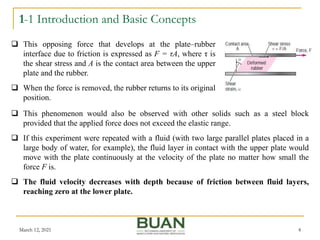
Let us consider a rectangular rubber block tightly
placed between two (upper and lower) plates.
As the upper plate is pulled with a force F while the
lower plate is held fixed, the rubber block deforms, as
shown in Fig.
 This angle increases in proportion to the applied force F.
 Assuming there is no slip between the rubber and the plates, the upper surface of the
rubber is displaced by an amount equal to the displacement of the upper plate while the
lower surface remains stationary.
 In equilibrium, the net force acting on the plate in the horizontal direction must be zero,
and thus a force equal and opposite to F must be acting on the plate.
 The angle of deformation α (called the shear strain
or angular displacement)
1-1 Introduction and Basic Concepts
March 12, 2021 4
 This phenomenon would also be observed with other solids such as a steel block
provided that the applied force does not exceed the elastic range.
 If this experiment were repeated with a fluid (with two large parallel plates placed in a
large body of water, for example), the fluid layer in contact with the upper plate would
move with the plate continuously at the velocity of the plate no matter how small the
force F is.
 The fluid velocity decreases with depth because of friction between fluid layers,
reaching zero at the lower plate.
 This opposing force that develops at the plate–rubber
interface due to friction is expressed as F = τA, where τ is
the shear stress and A is the contact area between the upper
plate and the rubber.
 When the force is removed, the rubber returns to its original
position.
1-1 Introduction and Basic Concepts
March 12, 2021 5
 In a fluid at rest, the normal stress is called pressure.
 The supporting walls of a fluid eliminate shear stress, and thus a fluid at rest is at a state
of zero shear stress.
 When the walls are removed or a liquid container is tilted, a shear develops and the
liquid splashes or moves to attain a horizontal free surface.
Terminology: Consider Fig.
 Stress is defined as force per unit area.
 It is determined by dividing the force by the area
upon which it acts.
 The normal component of the force acting on a
surface per unit area is called the normal stress.
dA
Fn


Stress,
Normal
dA
Ft


Stress,
Shear
1-1 Introduction and Basic Concepts
March 12, 2021 6
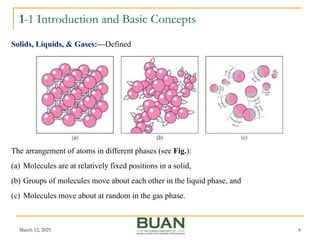
The arrangement of atoms in different phases (see Fig.):
(a) Molecules are at relatively fixed positions in a solid,
(b) Groups of molecules move about each other in the liquid phase, and
(c) Molecules move about at random in the gas phase.
Solids, Liquids, & Gases:—Defined
1-1 Introduction and Basic Concepts
March 12, 2021 7
The heart is constantly
pumping blood to all parts
of the human body through
the arteries and veins, and
the lungs are the sites of
airflow in alternating
directions.
Artificial hearts, breathing
machines, and dialysis
systems are designed using
fluid dynamics.
Applications Areas of Fluid Mechanics: The Human Body
You will learn this somewhere along your Biological Physics Degree Program: Hemodynamics /
Physiological Fluid Mechanics?
1-1 Introduction and Basic Concepts
March 12, 2021 8
 No-Slip Condition
Experimental observations have indicated that a fluid in motion comes to a complete stop at
the surface and assumes a zero velocity relative to the surface; considering the flow of a
fluid in a stationary pipe or over a solid surface that is nonporous (i.e., impermeable to the
fluid).
That is, a fluid in direct contact with a solid “sticks” to the surface due to viscous effects,
and there is no slip. This is known as the no-slip condition.
 Boundary Layer
The layer that sticks to the surface slows the adjacent fluid layer because of viscous forces
between the fluid layers, which slows the next layer, and so on.
Therefore, the no-slip condition is responsible for the development of the velocity profile.
The flow region adjacent to the wall in which the viscous effects (and thus the velocity
gradients) are significant is called the boundary layer.
Some Terminology: In Fluid Mechanics
1-1 Introduction and Basic Concepts
March 12, 2021 9
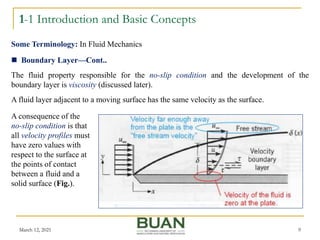
 Boundary Layer—Cont..
The fluid property responsible for the no-slip condition and the development of the
boundary layer is viscosity (discussed later).
A fluid layer adjacent to a moving surface has the same velocity as the surface.
Some Terminology: In Fluid Mechanics
A consequence of the
no-slip condition is that
all velocity profiles must
have zero values with
respect to the surface at
the points of contact
between a fluid and a
solid surface (Fig.).
1-1 Introduction and Basic Concepts
March 12, 2021 10
 Boundary Layer—
Cont..
Another consequence of
the no-slip condition is
the surface drag, which
is the force a fluid exerts
on a surface in the flow
direction.
Some Terminology: In Fluid Mechanics
1-1 Introduction and Basic Concepts
March 12, 2021 11
 Viscous & Inviscid regions of flow
When two fluid layers move relative to each other, a frictional force develops between them;
and the slower layer tries to slow down the faster layer.
This internal resistance to flow is quantified by the fluid property viscosity, which is a
measure of internal stickiness of the fluid.
Viscosity is caused by cohesive forces between the molecules in liquids and by molecular
collisions in gases.
There is no fluid with zero viscosity, and thus all fluid flows involve viscous effects to
some degree.
Flows in which the frictional effects are significant are called viscous flows. However, in
many flows of practical interest, there are regions (typically regions not close to solid
surfaces) where viscous forces are negligibly small compared to inertial or pressure forces.
Classification of Fluids
1-1 Introduction and Basic Concepts
March 12, 2021 12
 Viscous & Inviscid regions of flow
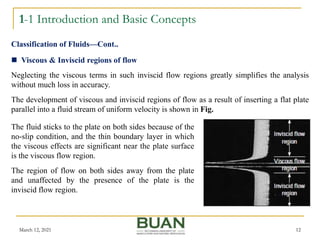
Neglecting the viscous terms in such inviscid flow regions greatly simplifies the analysis
without much loss in accuracy.
The development of viscous and inviscid regions of flow as a result of inserting a flat plate
parallel into a fluid stream of uniform velocity is shown in Fig.
Classification of Fluids—Cont..
The fluid sticks to the plate on both sides because of the
no-slip condition, and the thin boundary layer in which
the viscous effects are significant near the plate surface
is the viscous flow region.
The region of flow on both sides away from the plate
and unaffected by the presence of the plate is the
inviscid flow region.
1-1 Introduction and Basic Concepts
March 12, 2021 13
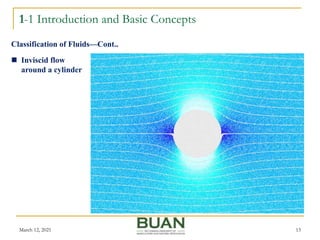
 Inviscid flow
around a cylinder
Classification of Fluids—Cont..
1-1 Introduction and Basic Concepts
March 12, 2021 14
 Internal & External flow
A fluid flow is classified as being internal or external, depending on whether the fluid is
forced to flow in a confined channel or over a surface.
The flow of an unbounded fluid over a surface such as a plate, a wire, or an exposed pipe is
external flow.
The flow in a pipe or duct is internal flow if the fluid is completely bounded by solid
surfaces.
Water flow in a pipe, for example, is internal flow, and airflow over a ball or over an
exposed pipe during a windy day is external flow.
Internal flows are dominated by the influence of viscosity throughout the flow field. In
external flows the viscous effects are limited to boundary layers near solid surfaces and to
wake regions downstream of bodies.
Classification of Fluids—Cont..
1-1 Introduction and Basic Concepts
March 12, 2021 15
 Internal & External
flow
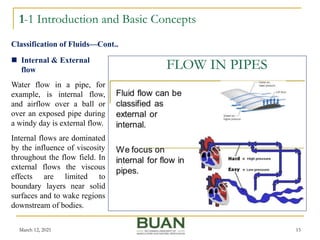
Water flow in a pipe, for
example, is internal flow,
and airflow over a ball or
over an exposed pipe during
a windy day is external flow.
Internal flows are dominated
by the influence of viscosity
throughout the flow field. In
external flows the viscous
effects are limited to
boundary layers near solid
surfaces and to wake regions
downstream of bodies.
Classification of Fluids—Cont..
1-1 Introduction and Basic Concepts
March 12, 2021 16
 Compressible & Incompressible flow
A flow is classified as being compressible or incompressible, depending on the level of
variation of density during flow.
Incompressibility is an approximation, and a flow is said to be incompressible if the
density remains nearly constant throughout.
Therefore, the volume of every portion of fluid remains unchanged over the course of its
motion when the flow (or the fluid) is incompressible.
The densities of liquids are essentially constant, and thus the flow of liquids is typically
incompressible.
Therefore, liquids are usually referred to as incompressible substances.
Classification of Fluids—Cont..
1-1 Introduction and Basic Concepts
March 12, 2021 17
 Compressible & Incompressible flow
A pressure of 210 atm., for example, causes the density of liquid water at 1 atm. to change
by just 1 percent.
Gases, on the other hand, are highly compressible. A pressure change of just 0.01 atm., for
example, causes a change of 1 percent in the density of atmospheric air.
When analysing rockets, spacecraft, and other systems that involve high-speed gas flows,
the flow speed is often expressed in terms of the dimensionless Mach number defined as:
Classification of Fluids—Cont..













Hypersonic
:
1
Supersonic
:
1
Sonic
:
1
Subsonic
:
1
Sound
of
Speed
Speed
Flow
Ma
c
V
1-1 Introduction and Basic Concepts
March 12, 2021 18
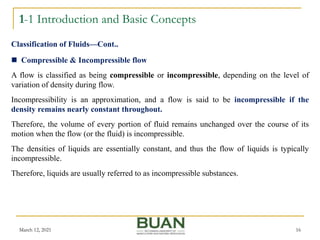
 Laminar & Turbulent flow
Some flows are smooth and orderly while others are rather chaotic. The highly ordered fluid
motion characterized by smooth layers of fluid is called laminar.
The highly disordered fluid motion that typically occurs at high velocities and is
characterized by velocity fluctuations is called turbulent (Fig.).
The flow of low-viscosity fluids such as air at high velocities is typically turbulent. The flow
regime greatly influences the required power for pumping.
A flow that alternates between being laminar and turbulent is called transitional.
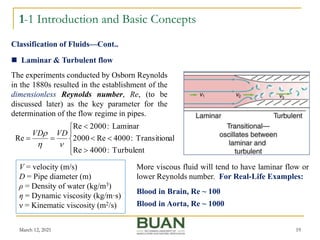
The experiments conducted by Osborn Reynolds in the 1880s resulted in the establishment
of the dimensionless Reynolds number, Re, as the key parameter for the determination of the
flow regime in pipes.
Classification of Fluids—Cont..
1-1 Introduction and Basic Concepts
March 12, 2021 19
 Laminar & Turbulent flow
The experiments conducted by Osborn Reynolds
in the 1880s resulted in the establishment of the
dimensionless Reynolds number, Re, (to be
discussed later) as the key parameter for the
determination of the flow regime in pipes.
Classification of Fluids—Cont..











Turbulent
:
4000
Re
al
Transition
:
4000
Re
2000
Laminar
:
2000
Re
Re


 VD
VD
V = velocity (m/s)
D = Pipe diameter (m)
ρ = Density of water (kg/m3)
η = Dynamic viscosity (kg/m·s)
ν = Kinematic viscosity (m2/s)
More viscous fluid will tend to have laminar flow or
lower Reynolds number. For Real-Life Examples:
Blood in Brain, Re ~ 100
Blood in Aorta, Re ~ 1000
1-1 Introduction and Basic Concepts
March 12, 2021 20
 Natural (or unforced) & forced flow
A fluid flow is said to be natural or forced, depending on how the fluid motion is initiated.
In forced flow, a fluid is forced to flow over a surface or in a pipe by external means such as
a pump or a fan.
In natural flows, any fluid motion is due to natural means such as the buoyancy effect,
which manifests itself as the rise of the warmer (and thus lighter) fluid and the fall of cooler
(and thus denser) fluid.
Classification of Fluids—Cont..
1-1 Introduction and Basic Concepts
March 12, 2021 21
 Steady & Unsteady flow
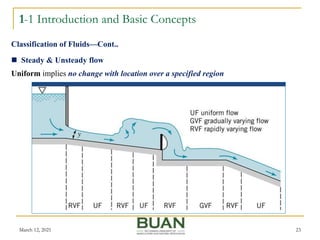
Steady implies no change at a point with time. The opposite of steady is unsteady.
Uniform implies no change with location over a specified region.
The terms unsteady and transient are often used interchangeably, but these terms are not
synonyms.
Classification of Fluids—Cont..
1-1 Introduction and Basic Concepts
March 12, 2021 22
 Steady & Unsteady flow
Classification of Fluids—Cont..
Steady implies no change at a point
with time. The opposite of steady is
unsteady.
1-1 Introduction and Basic Concepts
March 12, 2021 23
 Steady & Unsteady flow
Classification of Fluids—Cont..
Uniform implies no change with location over a specified region
1-1 Introduction and Basic Concepts
March 12, 2021 24
 System and Control Volume
A system is defined as a quantity of matter or a region in space
chosen for study.
The mass or region outside the system is called the surroundings. The
real or imaginary surface that separates the system from its
surroundings is called the boundary (see Fig.).
Some Terminology: In Fluid Mechanics
The boundary of a system can be fixed or movable. Note that the boundary is the contact
surface shared by both the system and the surroundings.
Mathematically speaking, the boundary has zero thickness, and thus it can neither contain
any mass nor occupy any volume in space.
Systems may be considered to be closed or open, depending on whether a fixed mass or a
volume in space is chosen for study.
1-1 Introduction and Basic Concepts
March 12, 2021 25
 System and Control Volume
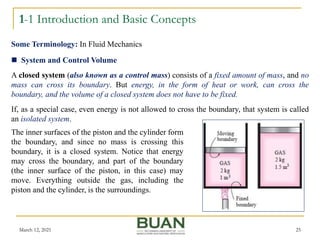
A closed system (also known as a control mass) consists of a fixed amount of mass, and no
mass can cross its boundary. But energy, in the form of heat or work, can cross the
boundary, and the volume of a closed system does not have to be fixed.
If, as a special case, even energy is not allowed to cross the boundary, that system is called
an isolated system.
Some Terminology: In Fluid Mechanics
The inner surfaces of the piston and the cylinder form
the boundary, and since no mass is crossing this
boundary, it is a closed system. Notice that energy
may cross the boundary, and part of the boundary
(the inner surface of the piston, in this case) may
move. Everything outside the gas, including the
piston and the cylinder, is the surroundings.
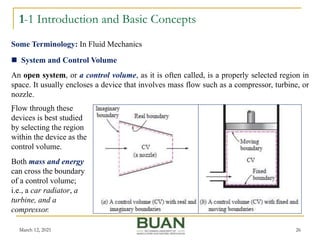
1-1 Introduction and Basic Concepts
March 12, 2021 26
 System and Control Volume
An open system, or a control volume, as it is often called, is a properly selected region in
space. It usually encloses a device that involves mass flow such as a compressor, turbine, or
nozzle.
.
Some Terminology: In Fluid Mechanics
Flow through these
devices is best studied
by selecting the region
within the device as the
control volume.
Both mass and energy
can cross the boundary
of a control volume;
i.e., a car radiator, a
turbine, and a
compressor.
1-1 Introduction and Basic Concepts
March 12, 2021 27
 System and Control Volume
In general, any arbitrary region in space can be selected as a control volume. There are no
concrete rules for the selection of control volumes, but the proper choice certainly makes the
analysis much easier. If we were to analyse the flow of air through a nozzle, for example, a
good choice for the control volume would be the region within the nozzle.
A control volume can be fixed in size and shape, as in the case of a nozzle, or it may involve
a moving boundary, as shown in Fig. (a)-previous slide. Most control volumes, however,
have fixed boundaries and thus do not involve any moving boundaries. A control volume
may also involve heat and work interactions just as a closed system, in addition to mass
interaction.
Some Terminology: In Fluid Mechanics
1-1 Introduction and Basic Concepts
March 12, 2021 28
Any physical quantity can be characterized by
dimensions. The magnitudes assigned to the
dimensions are called units.
Dimensions and Units—their importance
Some basic dimensions such as mass M, length L, time
T, and temperature θ are selected as primary or
fundamental dimensions, while others such as velocity
V, energy E, and volume V are expressed in terms of the
primary dimensions and are called secondary
dimensions, or derived dimensions.
Topic 7 will introduce
you to detailed
concepts in
dimensional analysis

01 1 introduction and basic concepts

  • 1.
    Faculty of Sciences Departmentof Physical & Chemical Sciences January—May 2021 Prof. Sello Alfred Likuku Office Block 28 BSB 228: Introduction to Fluid Mechanics
  • 2.
    1-1 Introduction andBasic Concepts March 12, 2021 2 Fluid Definition: A substance in the liquid or gas phase is referred to as a fluid. What makes the difference between a solid and a fluid is their ability to resist an applied shear (or tangential) stress that tends to change its shape.  A solid can resist an applied shear stress by deforming, whereas a fluid deforms continuously under the influence of shear stress, no matter how small.  In solids stress is proportional to strain, but in fluids stress is proportional to strain rate.  When a constant shear force is applied, a solid eventually stops deforming, at some fixed strain angle, whereas a fluid never stops deforming and approaches a certain rate of strain.
  • 3.
    1-1 Introduction andBasic Concepts March 12, 2021 3 Let us consider a rectangular rubber block tightly placed between two (upper and lower) plates. As the upper plate is pulled with a force F while the lower plate is held fixed, the rubber block deforms, as shown in Fig.  This angle increases in proportion to the applied force F.  Assuming there is no slip between the rubber and the plates, the upper surface of the rubber is displaced by an amount equal to the displacement of the upper plate while the lower surface remains stationary.  In equilibrium, the net force acting on the plate in the horizontal direction must be zero, and thus a force equal and opposite to F must be acting on the plate.  The angle of deformation α (called the shear strain or angular displacement)
  • 4.
    1-1 Introduction andBasic Concepts March 12, 2021 4  This phenomenon would also be observed with other solids such as a steel block provided that the applied force does not exceed the elastic range.  If this experiment were repeated with a fluid (with two large parallel plates placed in a large body of water, for example), the fluid layer in contact with the upper plate would move with the plate continuously at the velocity of the plate no matter how small the force F is.  The fluid velocity decreases with depth because of friction between fluid layers, reaching zero at the lower plate.  This opposing force that develops at the plate–rubber interface due to friction is expressed as F = τA, where τ is the shear stress and A is the contact area between the upper plate and the rubber.  When the force is removed, the rubber returns to its original position.
  • 5.
    1-1 Introduction andBasic Concepts March 12, 2021 5  In a fluid at rest, the normal stress is called pressure.  The supporting walls of a fluid eliminate shear stress, and thus a fluid at rest is at a state of zero shear stress.  When the walls are removed or a liquid container is tilted, a shear develops and the liquid splashes or moves to attain a horizontal free surface. Terminology: Consider Fig.  Stress is defined as force per unit area.  It is determined by dividing the force by the area upon which it acts.  The normal component of the force acting on a surface per unit area is called the normal stress. dA Fn   Stress, Normal dA Ft   Stress, Shear
  • 6.
    1-1 Introduction andBasic Concepts March 12, 2021 6 The arrangement of atoms in different phases (see Fig.): (a) Molecules are at relatively fixed positions in a solid, (b) Groups of molecules move about each other in the liquid phase, and (c) Molecules move about at random in the gas phase. Solids, Liquids, & Gases:—Defined
  • 7.
    1-1 Introduction andBasic Concepts March 12, 2021 7 The heart is constantly pumping blood to all parts of the human body through the arteries and veins, and the lungs are the sites of airflow in alternating directions. Artificial hearts, breathing machines, and dialysis systems are designed using fluid dynamics. Applications Areas of Fluid Mechanics: The Human Body You will learn this somewhere along your Biological Physics Degree Program: Hemodynamics / Physiological Fluid Mechanics?
  • 8.
    1-1 Introduction andBasic Concepts March 12, 2021 8  No-Slip Condition Experimental observations have indicated that a fluid in motion comes to a complete stop at the surface and assumes a zero velocity relative to the surface; considering the flow of a fluid in a stationary pipe or over a solid surface that is nonporous (i.e., impermeable to the fluid). That is, a fluid in direct contact with a solid “sticks” to the surface due to viscous effects, and there is no slip. This is known as the no-slip condition.  Boundary Layer The layer that sticks to the surface slows the adjacent fluid layer because of viscous forces between the fluid layers, which slows the next layer, and so on. Therefore, the no-slip condition is responsible for the development of the velocity profile. The flow region adjacent to the wall in which the viscous effects (and thus the velocity gradients) are significant is called the boundary layer. Some Terminology: In Fluid Mechanics
  • 9.
    1-1 Introduction andBasic Concepts March 12, 2021 9  Boundary Layer—Cont.. The fluid property responsible for the no-slip condition and the development of the boundary layer is viscosity (discussed later). A fluid layer adjacent to a moving surface has the same velocity as the surface. Some Terminology: In Fluid Mechanics A consequence of the no-slip condition is that all velocity profiles must have zero values with respect to the surface at the points of contact between a fluid and a solid surface (Fig.).
  • 10.
    1-1 Introduction andBasic Concepts March 12, 2021 10  Boundary Layer— Cont.. Another consequence of the no-slip condition is the surface drag, which is the force a fluid exerts on a surface in the flow direction. Some Terminology: In Fluid Mechanics
  • 11.
    1-1 Introduction andBasic Concepts March 12, 2021 11  Viscous & Inviscid regions of flow When two fluid layers move relative to each other, a frictional force develops between them; and the slower layer tries to slow down the faster layer. This internal resistance to flow is quantified by the fluid property viscosity, which is a measure of internal stickiness of the fluid. Viscosity is caused by cohesive forces between the molecules in liquids and by molecular collisions in gases. There is no fluid with zero viscosity, and thus all fluid flows involve viscous effects to some degree. Flows in which the frictional effects are significant are called viscous flows. However, in many flows of practical interest, there are regions (typically regions not close to solid surfaces) where viscous forces are negligibly small compared to inertial or pressure forces. Classification of Fluids
  • 12.
    1-1 Introduction andBasic Concepts March 12, 2021 12  Viscous & Inviscid regions of flow Neglecting the viscous terms in such inviscid flow regions greatly simplifies the analysis without much loss in accuracy. The development of viscous and inviscid regions of flow as a result of inserting a flat plate parallel into a fluid stream of uniform velocity is shown in Fig. Classification of Fluids—Cont.. The fluid sticks to the plate on both sides because of the no-slip condition, and the thin boundary layer in which the viscous effects are significant near the plate surface is the viscous flow region. The region of flow on both sides away from the plate and unaffected by the presence of the plate is the inviscid flow region.
  • 13.
    1-1 Introduction andBasic Concepts March 12, 2021 13  Inviscid flow around a cylinder Classification of Fluids—Cont..
  • 14.
    1-1 Introduction andBasic Concepts March 12, 2021 14  Internal & External flow A fluid flow is classified as being internal or external, depending on whether the fluid is forced to flow in a confined channel or over a surface. The flow of an unbounded fluid over a surface such as a plate, a wire, or an exposed pipe is external flow. The flow in a pipe or duct is internal flow if the fluid is completely bounded by solid surfaces. Water flow in a pipe, for example, is internal flow, and airflow over a ball or over an exposed pipe during a windy day is external flow. Internal flows are dominated by the influence of viscosity throughout the flow field. In external flows the viscous effects are limited to boundary layers near solid surfaces and to wake regions downstream of bodies. Classification of Fluids—Cont..
  • 15.
    1-1 Introduction andBasic Concepts March 12, 2021 15  Internal & External flow Water flow in a pipe, for example, is internal flow, and airflow over a ball or over an exposed pipe during a windy day is external flow. Internal flows are dominated by the influence of viscosity throughout the flow field. In external flows the viscous effects are limited to boundary layers near solid surfaces and to wake regions downstream of bodies. Classification of Fluids—Cont..
  • 16.
    1-1 Introduction andBasic Concepts March 12, 2021 16  Compressible & Incompressible flow A flow is classified as being compressible or incompressible, depending on the level of variation of density during flow. Incompressibility is an approximation, and a flow is said to be incompressible if the density remains nearly constant throughout. Therefore, the volume of every portion of fluid remains unchanged over the course of its motion when the flow (or the fluid) is incompressible. The densities of liquids are essentially constant, and thus the flow of liquids is typically incompressible. Therefore, liquids are usually referred to as incompressible substances. Classification of Fluids—Cont..
  • 17.
    1-1 Introduction andBasic Concepts March 12, 2021 17  Compressible & Incompressible flow A pressure of 210 atm., for example, causes the density of liquid water at 1 atm. to change by just 1 percent. Gases, on the other hand, are highly compressible. A pressure change of just 0.01 atm., for example, causes a change of 1 percent in the density of atmospheric air. When analysing rockets, spacecraft, and other systems that involve high-speed gas flows, the flow speed is often expressed in terms of the dimensionless Mach number defined as: Classification of Fluids—Cont..              Hypersonic : 1 Supersonic : 1 Sonic : 1 Subsonic : 1 Sound of Speed Speed Flow Ma c V
  • 18.
    1-1 Introduction andBasic Concepts March 12, 2021 18  Laminar & Turbulent flow Some flows are smooth and orderly while others are rather chaotic. The highly ordered fluid motion characterized by smooth layers of fluid is called laminar. The highly disordered fluid motion that typically occurs at high velocities and is characterized by velocity fluctuations is called turbulent (Fig.). The flow of low-viscosity fluids such as air at high velocities is typically turbulent. The flow regime greatly influences the required power for pumping. A flow that alternates between being laminar and turbulent is called transitional. The experiments conducted by Osborn Reynolds in the 1880s resulted in the establishment of the dimensionless Reynolds number, Re, as the key parameter for the determination of the flow regime in pipes. Classification of Fluids—Cont..
  • 19.
    1-1 Introduction andBasic Concepts March 12, 2021 19  Laminar & Turbulent flow The experiments conducted by Osborn Reynolds in the 1880s resulted in the establishment of the dimensionless Reynolds number, Re, (to be discussed later) as the key parameter for the determination of the flow regime in pipes. Classification of Fluids—Cont..            Turbulent : 4000 Re al Transition : 4000 Re 2000 Laminar : 2000 Re Re    VD VD V = velocity (m/s) D = Pipe diameter (m) ρ = Density of water (kg/m3) η = Dynamic viscosity (kg/m·s) ν = Kinematic viscosity (m2/s) More viscous fluid will tend to have laminar flow or lower Reynolds number. For Real-Life Examples: Blood in Brain, Re ~ 100 Blood in Aorta, Re ~ 1000
  • 20.
    1-1 Introduction andBasic Concepts March 12, 2021 20  Natural (or unforced) & forced flow A fluid flow is said to be natural or forced, depending on how the fluid motion is initiated. In forced flow, a fluid is forced to flow over a surface or in a pipe by external means such as a pump or a fan. In natural flows, any fluid motion is due to natural means such as the buoyancy effect, which manifests itself as the rise of the warmer (and thus lighter) fluid and the fall of cooler (and thus denser) fluid. Classification of Fluids—Cont..
  • 21.
    1-1 Introduction andBasic Concepts March 12, 2021 21  Steady & Unsteady flow Steady implies no change at a point with time. The opposite of steady is unsteady. Uniform implies no change with location over a specified region. The terms unsteady and transient are often used interchangeably, but these terms are not synonyms. Classification of Fluids—Cont..
  • 22.
    1-1 Introduction andBasic Concepts March 12, 2021 22  Steady & Unsteady flow Classification of Fluids—Cont.. Steady implies no change at a point with time. The opposite of steady is unsteady.
  • 23.
    1-1 Introduction andBasic Concepts March 12, 2021 23  Steady & Unsteady flow Classification of Fluids—Cont.. Uniform implies no change with location over a specified region
  • 24.
    1-1 Introduction andBasic Concepts March 12, 2021 24  System and Control Volume A system is defined as a quantity of matter or a region in space chosen for study. The mass or region outside the system is called the surroundings. The real or imaginary surface that separates the system from its surroundings is called the boundary (see Fig.). Some Terminology: In Fluid Mechanics The boundary of a system can be fixed or movable. Note that the boundary is the contact surface shared by both the system and the surroundings. Mathematically speaking, the boundary has zero thickness, and thus it can neither contain any mass nor occupy any volume in space. Systems may be considered to be closed or open, depending on whether a fixed mass or a volume in space is chosen for study.
  • 25.
    1-1 Introduction andBasic Concepts March 12, 2021 25  System and Control Volume A closed system (also known as a control mass) consists of a fixed amount of mass, and no mass can cross its boundary. But energy, in the form of heat or work, can cross the boundary, and the volume of a closed system does not have to be fixed. If, as a special case, even energy is not allowed to cross the boundary, that system is called an isolated system. Some Terminology: In Fluid Mechanics The inner surfaces of the piston and the cylinder form the boundary, and since no mass is crossing this boundary, it is a closed system. Notice that energy may cross the boundary, and part of the boundary (the inner surface of the piston, in this case) may move. Everything outside the gas, including the piston and the cylinder, is the surroundings.
  • 26.
    1-1 Introduction andBasic Concepts March 12, 2021 26  System and Control Volume An open system, or a control volume, as it is often called, is a properly selected region in space. It usually encloses a device that involves mass flow such as a compressor, turbine, or nozzle. . Some Terminology: In Fluid Mechanics Flow through these devices is best studied by selecting the region within the device as the control volume. Both mass and energy can cross the boundary of a control volume; i.e., a car radiator, a turbine, and a compressor.
  • 27.
    1-1 Introduction andBasic Concepts March 12, 2021 27  System and Control Volume In general, any arbitrary region in space can be selected as a control volume. There are no concrete rules for the selection of control volumes, but the proper choice certainly makes the analysis much easier. If we were to analyse the flow of air through a nozzle, for example, a good choice for the control volume would be the region within the nozzle. A control volume can be fixed in size and shape, as in the case of a nozzle, or it may involve a moving boundary, as shown in Fig. (a)-previous slide. Most control volumes, however, have fixed boundaries and thus do not involve any moving boundaries. A control volume may also involve heat and work interactions just as a closed system, in addition to mass interaction. Some Terminology: In Fluid Mechanics
  • 28.
    1-1 Introduction andBasic Concepts March 12, 2021 28 Any physical quantity can be characterized by dimensions. The magnitudes assigned to the dimensions are called units. Dimensions and Units—their importance Some basic dimensions such as mass M, length L, time T, and temperature θ are selected as primary or fundamental dimensions, while others such as velocity V, energy E, and volume V are expressed in terms of the primary dimensions and are called secondary dimensions, or derived dimensions. Topic 7 will introduce you to detailed concepts in dimensional analysis