Lecture 8-1
Lecture 8-1
Computer Science 425
Distributed Systems
CS 425 / CSE 424 / ECE 428
Fall 2012
Indranil Gupta (Indy)
September 20, 2012
Lecture 8
RPCs and Distributed Objects
Reading: Section 4.3, parts of Chapter 5
 2012, I. Gupta, K. Nahrtstedt, S. Mitra, N. Vaidya, M. T. Harandi, J. Hou
Lecture 8-2
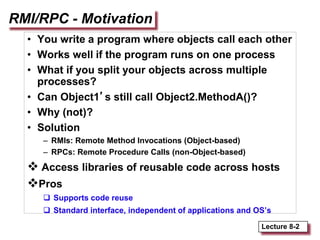
RMI/RPC - Motivation
• You write a program where objects call each other
• Works well if the program runs on one process
• What if you split your objects across multiple
processes?
• Can Object1’s still call Object2.MethodA()?
• Why (not)?
• Solution
– RMIs: Remote Method Invocations (Object-based)
– RPCs: Remote Procedure Calls (non-Object-based)
 Access libraries of reusable code across hosts
Pros
 Supports code reuse
 Standard interface, independent of applications and OS’s
Lecture 8-3
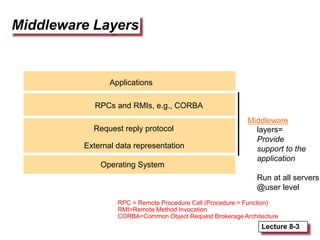
Middleware Layers
Applications
Middleware
layers=
Provide
support to the
application
Run at all servers
@user level
Request reply protocol
External data representation
Operating System
RPCs and RMIs, e.g., CORBA
RPC = Remote Procedure Call (Procedure = Function)
RMI=Remote Method Invocation
CORBA=Common Object Request Brokerage Architecture
Lecture 8-4
Local Objects
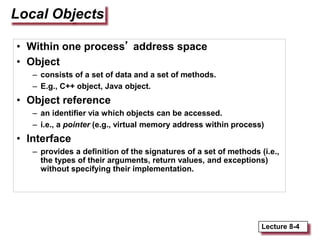
• Within one process’ address space
• Object
– consists of a set of data and a set of methods.
– E.g., C++ object, Java object.
• Object reference
– an identifier via which objects can be accessed.
– i.e., a pointer (e.g., virtual memory address within process)
• Interface
– provides a definition of the signatures of a set of methods (i.e.,
the types of their arguments, return values, and exceptions)
without specifying their implementation.
Lecture 8-5
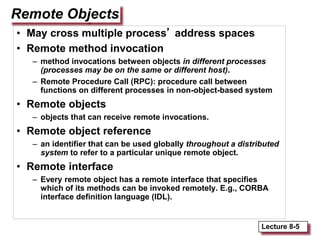
Remote Objects
• May cross multiple process’ address spaces
• Remote method invocation
– method invocations between objects in different processes
(processes may be on the same or different host).
– Remote Procedure Call (RPC): procedure call between
functions on different processes in non-object-based system
• Remote objects
– objects that can receive remote invocations.
• Remote object reference
– an identifier that can be used globally throughout a distributed
system to refer to a particular unique remote object.
• Remote interface
– Every remote object has a remote interface that specifies
which of its methods can be invoked remotely. E.g., CORBA
interface definition language (IDL).
Lecture 8-6
A Remote Object and Its Remote Interface
interface
remote
m1
m2
m3
m4
m5
m6
Data
implementation
remoteobject
{ of methods
Example Remote Object reference=(IP,port,objectnumber,signature,time)
Lecture 8-7
Remote and Local Method Invocations
invocation invocation
remote
invocation
remote
local
local
local
invocation
invocation
A
B
C
D
E
F
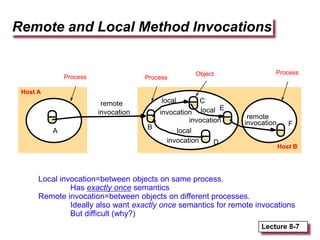
Local invocation=between objects on same process.
Has exactly once semantics
Remote invocation=between objects on different processes.
Ideally also want exactly once semantics for remote invocations
But difficult (why?)
Process Object Process
Process
Host A
Host B
Lecture 8-8
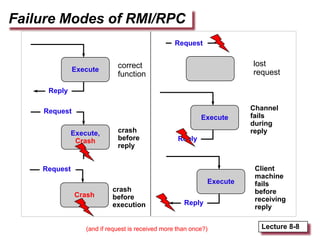
Failure Modes of RMI/RPC
Execute
Reply
correct
function
Execute,
Crash
Request
Crash
Request
Request
Execute
Reply
Execute
Reply
crash
before
reply
crash
before
execution
lost
request
Channel
fails
during
reply
Client
machine
fails
before
receiving
reply
(and if request is received more than once?)
Lecture 8-9
Invocation Semantics
Fault tolerance measures Invocation
semantics
Retransmit request
message
Duplicate
filtering
Re-execute procedure
or retransmit reply
No
Yes
Yes
Not applicable
No
Yes
Not applicable
Re-execute procedure
Retransmit old reply At-most-once
At-least-once
Maybe
Whether or not to
retransmit the request
message until either
a reply is received or
the server is assumed
to be failed
when retransmissions
are used, whether to
filter out duplicate
requests at the server.
whether to keep a
history of result
messages to enable
lost results to be
retransmitted without
re-executing the
operations
Java RMI,
CORBA
CORBA
Sun RPC
Transparency=remote invocation has same behavior as
local invocation
[Birrell and Nelson, inventors of RPC, 1984]
Very difficult to implement in asynchronous network…
(ok for idempotent operations)
Idempotent=same result if applied repeatedly, w/o side effects
Lecture 8-10
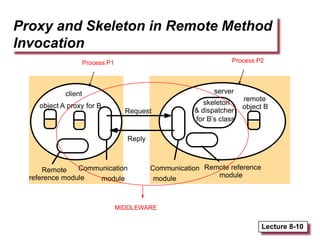
Proxy and Skeleton in Remote Method
Invocation
object A object B
skeleton
Request
proxy for B
Reply
Communication
Remote Remote reference
Communication
module
module
reference module module
for B’s class
& dispatcher
remote
client server
Process P1 Process P2
MIDDLEWARE
Lecture 8-11
Proxy and Skeleton in Remote Method
Invocation
object A object B
skeleton
Request
proxy for B
Reply
Communication
Remote Remote reference
Communication
module
module
reference module module
for B’s class
& dispatcher
remote
client server
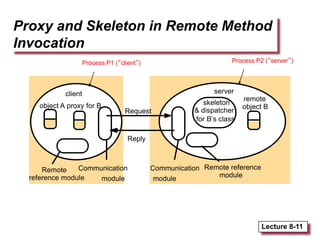
Process P1 (“client”) Process P2 (“server”)
Lecture 8-12
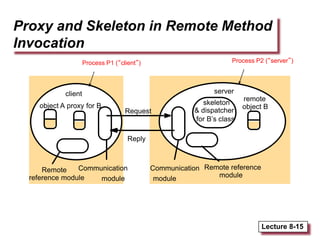
Proxy
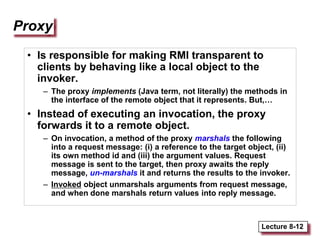
• Is responsible for making RMI transparent to
clients by behaving like a local object to the
invoker.
– The proxy implements (Java term, not literally) the methods in
the interface of the remote object that it represents. But,…
• Instead of executing an invocation, the proxy
forwards it to a remote object.
– On invocation, a method of the proxy marshals the following
into a request message: (i) a reference to the target object, (ii)
its own method id and (iii) the argument values. Request
message is sent to the target, then proxy awaits the reply
message, un-marshals it and returns the results to the invoker.
– Invoked object unmarshals arguments from request message,
and when done marshals return values into reply message.
Lecture 8-13
Marshalling & Unmarshalling
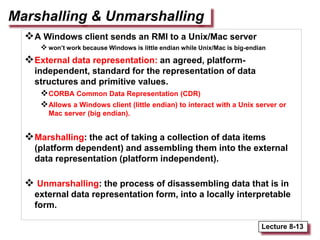
A Windows client sends an RMI to a Unix/Mac server
 won’t work because Windows is little endian while Unix/Mac is big-endian
External data representation: an agreed, platform-
independent, standard for the representation of data
structures and primitive values.
CORBA Common Data Representation (CDR)
Allows a Windows client (little endian) to interact with a Unix server or
Mac server (big endian).
Marshalling: the act of taking a collection of data items
(platform dependent) and assembling them into the external
data representation (platform independent).
 Unmarshalling: the process of disassembling data that is in
external data representation form, into a locally interpretable
form.
Lecture 8-14
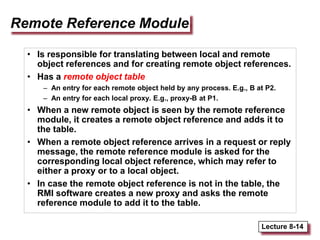
Remote Reference Module
• Is responsible for translating between local and remote
object references and for creating remote object references.
• Has a remote object table
– An entry for each remote object held by any process. E.g., B at P2.
– An entry for each local proxy. E.g., proxy-B at P1.
• When a new remote object is seen by the remote reference
module, it creates a remote object reference and adds it to
the table.
• When a remote object reference arrives in a request or reply
message, the remote reference module is asked for the
corresponding local object reference, which may refer to
either a proxy or to a local object.
• In case the remote object reference is not in the table, the
RMI software creates a new proxy and asks the remote
reference module to add it to the table.
Lecture 8-15
Proxy and Skeleton in Remote Method
Invocation
object A object B
skeleton
Request
proxy for B
Reply
Communication
Remote Remote reference
Communication
module
module
reference module module
for B’s class
& dispatcher
remote
client server
Process P1 (“client”) Process P2 (“server”)
Lecture 8-16
What about Server Side?
Dispatcher and Skeleton
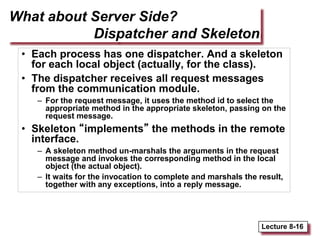
• Each process has one dispatcher. And a skeleton
for each local object (actually, for the class).
• The dispatcher receives all request messages
from the communication module.
– For the request message, it uses the method id to select the
appropriate method in the appropriate skeleton, passing on the
request message.
• Skeleton “implements” the methods in the remote
interface.
– A skeleton method un-marshals the arguments in the request
message and invokes the corresponding method in the local
object (the actual object).
– It waits for the invocation to complete and marshals the result,
together with any exceptions, into a reply message.
Lecture 8-17
Summary of Remote Method Invocation (RMI)
Object A
Object
B
Comm.
Module
Comm.
Module
Skeleton
for B’s
Class
Server
Process
Client
Process
Proxy
Object
B
Remote
Reference
Module
Dispatcher
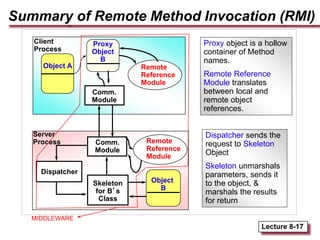
Proxy object is a hollow
container of Method
names.
Remote Reference
Module translates
between local and
remote object
references.
Dispatcher sends the
request to Skeleton
Object
Skeleton unmarshals
parameters, sends it
to the object, &
marshals the results
for return
Remote
Reference
Module
MIDDLEWARE
Lecture 8-18
Generation of Proxies, Dispatchers and
Skeletons
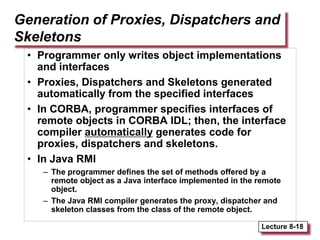
• Programmer only writes object implementations
and interfaces
• Proxies, Dispatchers and Skeletons generated
automatically from the specified interfaces
• In CORBA, programmer specifies interfaces of
remote objects in CORBA IDL; then, the interface
compiler automatically generates code for
proxies, dispatchers and skeletons.
• In Java RMI
– The programmer defines the set of methods offered by a
remote object as a Java interface implemented in the remote
object.
– The Java RMI compiler generates the proxy, dispatcher and
skeleton classes from the class of the remote object.
Lecture 8-19
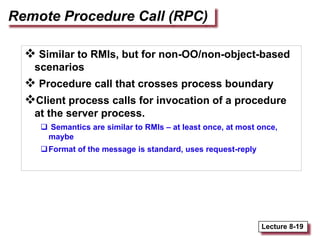
Remote Procedure Call (RPC)
 Similar to RMIs, but for non-OO/non-object-based
scenarios
 Procedure call that crosses process boundary
Client process calls for invocation of a procedure
at the server process.
 Semantics are similar to RMIs – at least once, at most once,
maybe
Format of the message is standard, uses request-reply
Lecture 8-20
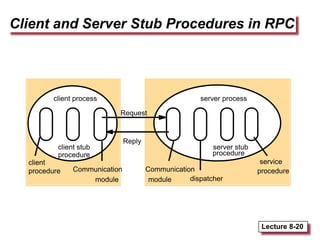
Client and Server Stub Procedures in RPC
client
procedure
Request
Reply
Communication
Communication
module
module dispatcher
service
client stub server stub
procedure procedure
client process server process
procedure
Lecture 8-21
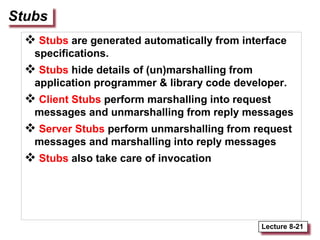
Stubs
 Stubs are generated automatically from interface
specifications.
 Stubs hide details of (un)marshalling from
application programmer & library code developer.
 Client Stubs perform marshalling into request
messages and unmarshalling from reply messages
 Server Stubs perform unmarshalling from request
messages and marshalling into reply messages
 Stubs also take care of invocation
Lecture 8-22
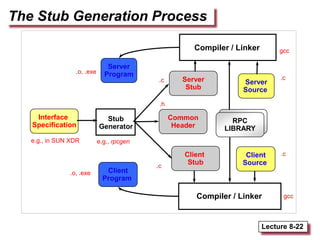
The Stub Generation Process
Interface
Specification
Stub
Generator
Server
Stub
Common
Header
Client
Stub
Client
Source
RPC
LIBRARY
Server
Source
Compiler / Linker
RPC
LIBRARY
Client
Program
Server
Program
Compiler / Linker
e.g., in SUN XDR e.g., rpcgen
gcc
.o, .exe
.o, .exe
.c
.c
.c
.c
.h
gcc
Lecture 8-23
Announcements
• Next Friday Sep 28 – Tours of Blue Waters
Datacenter!
– Signup sheet link will be posted soon on Piazza
• HW2 released soon.
• MP2 already released.
• Next week: P2P systems!
Lecture 8-24
Lecture 8-24
Optional Slides
Lecture 8-25
Files Interface in Sun XDR
const MAX = 1000;
typedef int FileIdentifier;
typedef int FilePointer;
typedef int Length;
struct Data {
int length;
char buffer[MAX];
};
struct writeargs {
FileIdentifier f;
FilePointer position;
Data data;
};
struct readargs {
FileIdentifier f;
FilePointer position;
Length length;
};
program FILEREADWRITE {
version VERSION {
void WRITE(writeargs)=1; 1
Data READ(readargs)=2; 2
}=2;
} = 9999; Program number
Version number
Only one argument allowed
Can specify as struct
Available with most Sun systems, and NFS
Lecture 8-26
Finding RPCs
Client
Program
Server
procedure
Server
Stub
Client
Stub
Comm.
Module
Comm.
Module
Dispatcher
SERVER
CLIENT
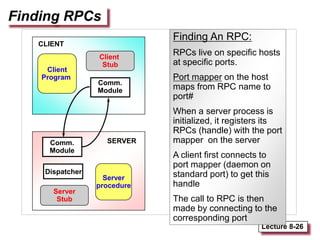
Finding An RPC:
RPCs live on specific hosts
at specific ports.
Port mapper on the host
maps from RPC name to
port#
When a server process is
initialized, it registers its
RPCs (handle) with the port
mapper on the server
A client first connects to
port mapper (daemon on
standard port) to get this
handle
The call to RPC is then
made by connecting to the
corresponding port
Lecture 8-27
Dealing Room System
Dealer’s computer
Information
provider
Dealer
External
source
External
source
Information
provider
Dealer
Dealer
Dealer
Notification
Notification
Notification
Notification
Notification
Notification
Notification
Notification
Dealer’s computer
Dealer’s computer
Dealer’s computer
Notification
Notification
At each dealer:
One object per
stock type
of interest
[Publish-Subscribe System]
e.g, stock market
Lecture 8-28
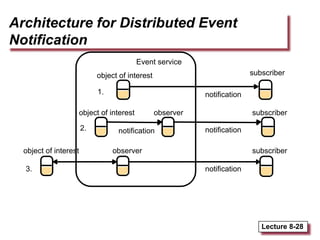
Architecture for Distributed Event
Notification
subscriber
observer
object of interest
Event service
object of interest
object of interest observer
subscriber
subscriber
3.
1.
2. notification
notification
notification
notification
Lecture 8-29
Binder and Activator
• Binder: A separate service that maintains a table containing
mappings from textual names to remote object references.
(sort of like DNS, but for the specific middleware)
– Used by servers to register their remote objects by name. Used by
clients to look them up. E.g., Java RMI Registry, CORBA Naming Svc.
• Activation of remote objects
– A remote object is active when it is available for invocation within a
running process.
– A passive object consists of (i) implementation of its methods; and (ii)
its state in the marshalled form (a form in which it is shippable).
– Activation creates a new instance of the class of a passive object and
initializes its instance variables. It is called on-demand.
– An activator is responsible for
» Registering passive objects at the binder
» Starting named server processes and activating remote objects in
them.
» Keeping track of the locations of the servers for remote objects it
has already activated
– E.g., Activator=Inetd, Passive Object/service=FTP (invoked on demand)
Lecture 8-30
Etc.
• Persistent Object = an object that survives
between simultaneous invocation of a process.
E.g., Persistent Java, PerDIS, Khazana.
• If objects migrate, may not be a good idea to have
remote object reference=(IP,port,…)
– Location service= maps a remote object reference to its likely
current location
– Allows the object to migrate from host to host, without
changing remote object reference
– Example: Akamai is a location service for web objects. It
“migrates” web objects using the DNS location service

009693652.pdf

  • 1.
    Lecture 8-1 Lecture 8-1 ComputerScience 425 Distributed Systems CS 425 / CSE 424 / ECE 428 Fall 2012 Indranil Gupta (Indy) September 20, 2012 Lecture 8 RPCs and Distributed Objects Reading: Section 4.3, parts of Chapter 5  2012, I. Gupta, K. Nahrtstedt, S. Mitra, N. Vaidya, M. T. Harandi, J. Hou
  • 2.
    Lecture 8-2 RMI/RPC -Motivation • You write a program where objects call each other • Works well if the program runs on one process • What if you split your objects across multiple processes? • Can Object1’s still call Object2.MethodA()? • Why (not)? • Solution – RMIs: Remote Method Invocations (Object-based) – RPCs: Remote Procedure Calls (non-Object-based)  Access libraries of reusable code across hosts Pros  Supports code reuse  Standard interface, independent of applications and OS’s
  • 3.
    Lecture 8-3 Middleware Layers Applications Middleware layers= Provide supportto the application Run at all servers @user level Request reply protocol External data representation Operating System RPCs and RMIs, e.g., CORBA RPC = Remote Procedure Call (Procedure = Function) RMI=Remote Method Invocation CORBA=Common Object Request Brokerage Architecture
  • 4.
    Lecture 8-4 Local Objects •Within one process’ address space • Object – consists of a set of data and a set of methods. – E.g., C++ object, Java object. • Object reference – an identifier via which objects can be accessed. – i.e., a pointer (e.g., virtual memory address within process) • Interface – provides a definition of the signatures of a set of methods (i.e., the types of their arguments, return values, and exceptions) without specifying their implementation.
  • 5.
    Lecture 8-5 Remote Objects •May cross multiple process’ address spaces • Remote method invocation – method invocations between objects in different processes (processes may be on the same or different host). – Remote Procedure Call (RPC): procedure call between functions on different processes in non-object-based system • Remote objects – objects that can receive remote invocations. • Remote object reference – an identifier that can be used globally throughout a distributed system to refer to a particular unique remote object. • Remote interface – Every remote object has a remote interface that specifies which of its methods can be invoked remotely. E.g., CORBA interface definition language (IDL).
  • 6.
    Lecture 8-6 A RemoteObject and Its Remote Interface interface remote m1 m2 m3 m4 m5 m6 Data implementation remoteobject { of methods Example Remote Object reference=(IP,port,objectnumber,signature,time)
  • 7.
    Lecture 8-7 Remote andLocal Method Invocations invocation invocation remote invocation remote local local local invocation invocation A B C D E F Local invocation=between objects on same process. Has exactly once semantics Remote invocation=between objects on different processes. Ideally also want exactly once semantics for remote invocations But difficult (why?) Process Object Process Process Host A Host B
  • 8.
    Lecture 8-8 Failure Modesof RMI/RPC Execute Reply correct function Execute, Crash Request Crash Request Request Execute Reply Execute Reply crash before reply crash before execution lost request Channel fails during reply Client machine fails before receiving reply (and if request is received more than once?)
  • 9.
    Lecture 8-9 Invocation Semantics Faulttolerance measures Invocation semantics Retransmit request message Duplicate filtering Re-execute procedure or retransmit reply No Yes Yes Not applicable No Yes Not applicable Re-execute procedure Retransmit old reply At-most-once At-least-once Maybe Whether or not to retransmit the request message until either a reply is received or the server is assumed to be failed when retransmissions are used, whether to filter out duplicate requests at the server. whether to keep a history of result messages to enable lost results to be retransmitted without re-executing the operations Java RMI, CORBA CORBA Sun RPC Transparency=remote invocation has same behavior as local invocation [Birrell and Nelson, inventors of RPC, 1984] Very difficult to implement in asynchronous network… (ok for idempotent operations) Idempotent=same result if applied repeatedly, w/o side effects
  • 10.
    Lecture 8-10 Proxy andSkeleton in Remote Method Invocation object A object B skeleton Request proxy for B Reply Communication Remote Remote reference Communication module module reference module module for B’s class & dispatcher remote client server Process P1 Process P2 MIDDLEWARE
  • 11.
    Lecture 8-11 Proxy andSkeleton in Remote Method Invocation object A object B skeleton Request proxy for B Reply Communication Remote Remote reference Communication module module reference module module for B’s class & dispatcher remote client server Process P1 (“client”) Process P2 (“server”)
  • 12.
    Lecture 8-12 Proxy • Isresponsible for making RMI transparent to clients by behaving like a local object to the invoker. – The proxy implements (Java term, not literally) the methods in the interface of the remote object that it represents. But,… • Instead of executing an invocation, the proxy forwards it to a remote object. – On invocation, a method of the proxy marshals the following into a request message: (i) a reference to the target object, (ii) its own method id and (iii) the argument values. Request message is sent to the target, then proxy awaits the reply message, un-marshals it and returns the results to the invoker. – Invoked object unmarshals arguments from request message, and when done marshals return values into reply message.
  • 13.
    Lecture 8-13 Marshalling &Unmarshalling A Windows client sends an RMI to a Unix/Mac server  won’t work because Windows is little endian while Unix/Mac is big-endian External data representation: an agreed, platform- independent, standard for the representation of data structures and primitive values. CORBA Common Data Representation (CDR) Allows a Windows client (little endian) to interact with a Unix server or Mac server (big endian). Marshalling: the act of taking a collection of data items (platform dependent) and assembling them into the external data representation (platform independent).  Unmarshalling: the process of disassembling data that is in external data representation form, into a locally interpretable form.
  • 14.
    Lecture 8-14 Remote ReferenceModule • Is responsible for translating between local and remote object references and for creating remote object references. • Has a remote object table – An entry for each remote object held by any process. E.g., B at P2. – An entry for each local proxy. E.g., proxy-B at P1. • When a new remote object is seen by the remote reference module, it creates a remote object reference and adds it to the table. • When a remote object reference arrives in a request or reply message, the remote reference module is asked for the corresponding local object reference, which may refer to either a proxy or to a local object. • In case the remote object reference is not in the table, the RMI software creates a new proxy and asks the remote reference module to add it to the table.
  • 15.
    Lecture 8-15 Proxy andSkeleton in Remote Method Invocation object A object B skeleton Request proxy for B Reply Communication Remote Remote reference Communication module module reference module module for B’s class & dispatcher remote client server Process P1 (“client”) Process P2 (“server”)
  • 16.
    Lecture 8-16 What aboutServer Side? Dispatcher and Skeleton • Each process has one dispatcher. And a skeleton for each local object (actually, for the class). • The dispatcher receives all request messages from the communication module. – For the request message, it uses the method id to select the appropriate method in the appropriate skeleton, passing on the request message. • Skeleton “implements” the methods in the remote interface. – A skeleton method un-marshals the arguments in the request message and invokes the corresponding method in the local object (the actual object). – It waits for the invocation to complete and marshals the result, together with any exceptions, into a reply message.
  • 17.
    Lecture 8-17 Summary ofRemote Method Invocation (RMI) Object A Object B Comm. Module Comm. Module Skeleton for B’s Class Server Process Client Process Proxy Object B Remote Reference Module Dispatcher Proxy object is a hollow container of Method names. Remote Reference Module translates between local and remote object references. Dispatcher sends the request to Skeleton Object Skeleton unmarshals parameters, sends it to the object, & marshals the results for return Remote Reference Module MIDDLEWARE
  • 18.
    Lecture 8-18 Generation ofProxies, Dispatchers and Skeletons • Programmer only writes object implementations and interfaces • Proxies, Dispatchers and Skeletons generated automatically from the specified interfaces • In CORBA, programmer specifies interfaces of remote objects in CORBA IDL; then, the interface compiler automatically generates code for proxies, dispatchers and skeletons. • In Java RMI – The programmer defines the set of methods offered by a remote object as a Java interface implemented in the remote object. – The Java RMI compiler generates the proxy, dispatcher and skeleton classes from the class of the remote object.
  • 19.
    Lecture 8-19 Remote ProcedureCall (RPC)  Similar to RMIs, but for non-OO/non-object-based scenarios  Procedure call that crosses process boundary Client process calls for invocation of a procedure at the server process.  Semantics are similar to RMIs – at least once, at most once, maybe Format of the message is standard, uses request-reply
  • 20.
    Lecture 8-20 Client andServer Stub Procedures in RPC client procedure Request Reply Communication Communication module module dispatcher service client stub server stub procedure procedure client process server process procedure
  • 21.
    Lecture 8-21 Stubs  Stubsare generated automatically from interface specifications.  Stubs hide details of (un)marshalling from application programmer & library code developer.  Client Stubs perform marshalling into request messages and unmarshalling from reply messages  Server Stubs perform unmarshalling from request messages and marshalling into reply messages  Stubs also take care of invocation
  • 22.
    Lecture 8-22 The StubGeneration Process Interface Specification Stub Generator Server Stub Common Header Client Stub Client Source RPC LIBRARY Server Source Compiler / Linker RPC LIBRARY Client Program Server Program Compiler / Linker e.g., in SUN XDR e.g., rpcgen gcc .o, .exe .o, .exe .c .c .c .c .h gcc
  • 23.
    Lecture 8-23 Announcements • NextFriday Sep 28 – Tours of Blue Waters Datacenter! – Signup sheet link will be posted soon on Piazza • HW2 released soon. • MP2 already released. • Next week: P2P systems!
  • 24.
  • 25.
    Lecture 8-25 Files Interfacein Sun XDR const MAX = 1000; typedef int FileIdentifier; typedef int FilePointer; typedef int Length; struct Data { int length; char buffer[MAX]; }; struct writeargs { FileIdentifier f; FilePointer position; Data data; }; struct readargs { FileIdentifier f; FilePointer position; Length length; }; program FILEREADWRITE { version VERSION { void WRITE(writeargs)=1; 1 Data READ(readargs)=2; 2 }=2; } = 9999; Program number Version number Only one argument allowed Can specify as struct Available with most Sun systems, and NFS
  • 26.
    Lecture 8-26 Finding RPCs Client Program Server procedure Server Stub Client Stub Comm. Module Comm. Module Dispatcher SERVER CLIENT FindingAn RPC: RPCs live on specific hosts at specific ports. Port mapper on the host maps from RPC name to port# When a server process is initialized, it registers its RPCs (handle) with the port mapper on the server A client first connects to port mapper (daemon on standard port) to get this handle The call to RPC is then made by connecting to the corresponding port
  • 27.
    Lecture 8-27 Dealing RoomSystem Dealer’s computer Information provider Dealer External source External source Information provider Dealer Dealer Dealer Notification Notification Notification Notification Notification Notification Notification Notification Dealer’s computer Dealer’s computer Dealer’s computer Notification Notification At each dealer: One object per stock type of interest [Publish-Subscribe System] e.g, stock market
  • 28.
    Lecture 8-28 Architecture forDistributed Event Notification subscriber observer object of interest Event service object of interest object of interest observer subscriber subscriber 3. 1. 2. notification notification notification notification
  • 29.
    Lecture 8-29 Binder andActivator • Binder: A separate service that maintains a table containing mappings from textual names to remote object references. (sort of like DNS, but for the specific middleware) – Used by servers to register their remote objects by name. Used by clients to look them up. E.g., Java RMI Registry, CORBA Naming Svc. • Activation of remote objects – A remote object is active when it is available for invocation within a running process. – A passive object consists of (i) implementation of its methods; and (ii) its state in the marshalled form (a form in which it is shippable). – Activation creates a new instance of the class of a passive object and initializes its instance variables. It is called on-demand. – An activator is responsible for » Registering passive objects at the binder » Starting named server processes and activating remote objects in them. » Keeping track of the locations of the servers for remote objects it has already activated – E.g., Activator=Inetd, Passive Object/service=FTP (invoked on demand)
  • 30.
    Lecture 8-30 Etc. • PersistentObject = an object that survives between simultaneous invocation of a process. E.g., Persistent Java, PerDIS, Khazana. • If objects migrate, may not be a good idea to have remote object reference=(IP,port,…) – Location service= maps a remote object reference to its likely current location – Allows the object to migrate from host to host, without changing remote object reference – Example: Akamai is a location service for web objects. It “migrates” web objects using the DNS location service