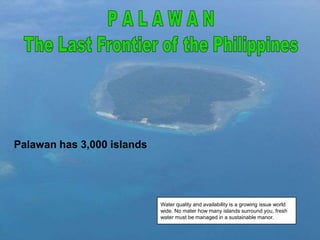
Palawan has 3,000 islands

Water quality and availability is a growing issue world
wide. No mater how many islands surround you, fresh
water must be managed in a sustainable manor.
•To manufacture one car, including tires, 147,972 liters of
water are used.
• 13% of municipal piped water is lost in pipeline leaks.
• The human brain is 75% water.
• Outdoor watering uses 35 liters of water each minute
(over 9 gallons).
• One drop of oil can make up to 25 liters of water unfit for
drinking.
• Half of world‟s wetlands have been lost since 1900.
• Each year, over 89 billion liters of bottled water are sold.
Fresh water is essential for terrestrial life. Every house
and farm needs water to maintain health and life.
Without high quality fresh water life is impossible for
plants, animals and humans.
There is a very complex food chain, a food web
actually, that relies on water and produces abundant
food if the soil surrounding the water ecosystem is
healthy.
Palawan and Puerto Princesa City are host to one of
the Seven Wonders of Nature. The water flowing
through this complex ecosystem needs to be clean and
free of pollution to support life and remain pristine for
the enjoyment of the visitors who partake of the ecotourism activities in the area.
Creation is a Natural Sanctuary

Eco tourism is on the rise world wide and relies on
responsible water management. Agricultural practices
must preserve the habitat that feeds into this natural
system in the area.
Agricultural practices in the watershed flowing into
the Puerto Princesa subterranean river are not
sustainable. They are mostly farmed conventionally.
That means a regular use of toxic and poisonous
chemical treatments that leach into the water system
and poison the environment. Sustainable and profitable
agriculture can be done with natural means using
Nature Farming methods, organic systems and
Permaculture techniques.
Aquaponics
Module 1 of 5

Growing more fish and plants for human consumption and enjoyment
Aloha Vaquaponics

Aloha House has developed and implemented systems for
sustainable food production by integrating fish with plant
production. Aquaponics has been successfully used
around the world and many methods have proven
themselves over time. Vaquaponics: Vermiculture within
the aquaponic system bring more stability and health by
recovering fish waste solids and biologically upgrading it
to castings through the integrated earth worms. This is
done in the grow beds of the plant component. Humates
are introduced to the biodiverse system as a secondary by
product within the castings.
Basil
Plants and fish
living together

Gabi/ taro

Kang kong

Start
with
Nitrate
loving
leafy
greens

1/2 Kilo Nile Tilapia
Historical Example

Chinampas in Xochimilco
The "floating
gardens", actually an
artificial peninsula.
Chinampero
scooping up canal
muck.

Mucking for blocks
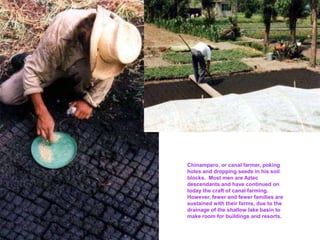
Chinampero, or canal farmer, poking
holes and dropping seeds in his soil
blocks. Most men are Aztec
descendants and have continued on
today the craft of canal farming.
However, fewer and fewer families are
sustained with their farms, due to the
drainage of the shallow lake basin to
make room for buildings and resorts.
Definition of Chinampas:
An artificial island, or
A long, narrow strip of farm
land surrounded on at least
three sides by water. Properly
maintained, they can produce
several crops a year and will
remain fertile for centuries
without having to lie fallow.
Each Chinampa is 300 feet
long and between 15-30 feet
wide(and any size with this
proportion). The surface of the
garden is a 2-3 feet above the
water and is topped every year
with the sediment found at the
bottom of the water canal that
surrounds it.
Intensive Nursery 10 years

Our transition to a closed loop circulating aquaponic unit
started with a successful conventional soil based nursery
and vegetable farm. We grow 55 vegetables and 33 herbs
on 4 hectares of land. We practice composting and
vermiculture as well as crop rotation and companion
planting. We sell commercially to chefs, restaurants and
groceries in the area as well as walk-in customers.
Intensive Nursery 10 years

Natural,chemical free, organic

Economical
Racking system

Efficient Transport of Seedlings
Bread Tray
Intensive Nursery 10 years
Natural,chemical free, organic

Economical
Racking system

Efficient Transport of Seedlings
Bread Tray
Intensive Nursery 10 years

Natural,chemical free, organic

Overflow of Seedlings
Bread Tray
Intensive Nursery 10 years

Natural,chemical free, organic

Overflow of Seedlings
Designed for Bread Tray
Semi-intensive Fish Pond 7 years
“Static Pond”
Natural, chemical free, organic

Home made feed

Rainwater from tanks from
roof water catchment
Sechi disk
4 kilo N
1-2 Kilo P

Floating Feeder
15 m2 X 10pcs/m2 =150 pcs
150 Tilapia X 105 days = 300 g
Semi-intensive Fish Pond 7 years

Oreochromis niloticus

Natural,chemical free, organic

15 m2 X 10pcs/m2 =150 pcs
150 Tilapia X 105 days = 300 g
Semi-intensive Fish Pond 7 years

Home made feed

Natural,chemical free, organic
Semi-intensive Fish Pond 7 years

Home grown feed

Natural,chemical free, organic
10,000 sq m/hect x 1,600mm/year = 16,000,000 liters/hect/year

Vetiver erosion control
Swale 3

Water harvesting
Swale 3

Water harvesting
The Swale
The best way to maximize rain
water is by slowing it down so
that it can soak into the
ground. Give it the longest path
on the slowest course.

Water harvesting technique on
contour with the land

Water harvesting
The Swale
Water provides extra
growth potential in the
soil system

Water harvesting

Water percolates through
to the lower soil 2 ways
swale

Water harvesting
Dam Construction

•Replace valuable
topsoil for replanting
and preventing muddy
water

Dam Integrity

Water harvesting
Dam Construction

Shade slows evaporation

•Replace valuable
topsoil for replanting
and preventing muddy
water
•Plant cover crop to
prevent silt
•Trees are not in dam - to prevent
leaks/weakness

Dam longevity

Water harvesting
1.
2.
3.

Deepen pond
Fill old spillway
Add swale w/ spillway

Pond 1
old spillway

swale
spillway

Water harvesting
swale
spillway

Filling

The swale with a spillway tied to a dam collects water and flows it to the dam
till it is full then backflows to the spill way gently releasing the rain water
overflow through the spillway.

Water harvesting
swale

Releasing

spillway

The swale with a spillway tied to a dam collects water and flows it to the dam
till it is full then backflows to the spill way gently releasing the rain water
overflow through the spillway.

Water harvesting
Green Water Culture

Gills covered
With membrane
To digest algae

compost

Tilapia

4 kilo N
1-2 Kilo P

High O2

30cm protein
Vertical column of Phytoplankton

hotter

1 to 1.5 m

Low O2

cooler
Green Water Culture

Tilapia

Water harvesting

Vertical column of Phytoplankton
30cm protein
Green Water Culture

Vertical column of Phytoplankton
30cm protein

Tilapia

Common fertilization rates used to establish a phytoplankton bloom in fish ponds.
Low hardness
Granular
18-46-0

Water harvesting

Moderate hardness

High hardness

4-8 kilo/hectare

8-16 kilo/hectare

16-32 kilo/hectare
Pond 5

Pond 4

swales

swales
Pond 0

Pond 1

swales

Pond 2
Pond 3

swales

Dorms

Pond 00

Orphanage

swales

5 year Master development plan - 3 hectares - tropical - 1,600mm annual rainfall
30% pasture, 30% forest,15% water, 25% fruits/vegetables

Pond 00 - ridge dam
Pond 0 - contour dam
Pond 1 - contour dam
Pond 2 - barrier/check dam
Pond 3 - keyline dam
Pond 4 - saddle dam
Pond 5 - ridge dam
12,000L rainwater storage
Vetiver erosion control

12 months
Established vetiver for
erosion control
Intensive Nursery 15 years ago

Natural,chemical free, organic
Intensive Nursery 15 years ago

Semi-intensive Fish Pond 12 years ago

+
Natural, chemical free, organic

=
15 m2 X 10pcs/m2 =150 pcs tilapia

Intensive Recirculating Aquaponic System 5 years ago

15 m3 X 250pcs/m3 =3,000 pcs tilapia
Intensive Nursery 15 years ago

Semi-intensive Fish Pond 12 years ago

+
Natural, chemical free, organic

=
15 m2 X 10pcs/m2 =150 pcs tilapia

Intensive Recirculating Aquaponic System 5 years ago
DWC
Floating Raft Method

15 m3 X 250pcs/m3 =3,000 pcs tilapia

Aloha
House
Who should engage in this technology?

Appropriate Technology
If land is expensive
You live in a dense urban environment
You have access to a niche market
Energy costs are low, never disrupted*
You can sell at premium prices
Water is scarce (it conserves water)
You want to improve your food supply

Inappropriate Technology
If land is inexpensive /abundant water
You‟re in a remote location
Energy costs are high, or disrupted*
You do not have a market to sell into
You‟re not concerned about a poisoned food supply**

*Pumps usually run 24hrs/day 7days/week
**Pesticides on the plant will kill the fish
Hanging Raft Method

Aloha
House
Intensive Aquaponic Nursery

Self watering system
Less water consumption
Lower labor costs
There are currently
hydroponic growers
from California to
Montreal, Hong
Kong to Dubai, but
few produce high
volume and tests
show fairly short
and unreliable shelf
life. Some offer it
with roots and
some do not.
Nutrient density
and Brixº readings
are usually poor to
average.

Hydroponics
Plants are grown in a soil-less medium
ORIGIN: 1930s from hydro- [of water] + Greek ponos „labor‟ + -ics .

Plants

Add and balance
Chemical nutrients

clean
waste
untreated
discharge
pollutes the
environment

Water Filtration
Criticism of Hydroponics
1. Technologically Advanced
2. Management Intensive
3. Can you find a system in
operation over 1 year?
4. How about 5 years old?
5. Often Exotic Imported Mediums
6. Nutritionally lacking…
Nutritional proof lacking: Claims only

With intensive use:
Water gets worse not better…
Soil gets better, not worse

Hydroponic Farming Eliminates The Soil
Then God said, "Let the land produce vegetation:
seed-bearing plants and trees on the land that
bear fruit with seed in it, according to their various
kinds." And it was so. 12 The land produced
vegetation: plants bearing seed according to their
kinds and trees bearing fruit with seed in it according
to their kinds. And God saw that it was good. 13
And there was evening, and there was morning, the
third day.
Do I believe in hydroponics?
Hydrophonics

ORIGIN: 2010s from hydro- [of water] + Greek phono [sound] + -ics

Many people coming to our farm inquire
about hydrophonics. Hydrophonics is
not Hydroponics. Hydrophonics does
not exist and appears in no modern or
ancient dictionary. I suppose if the word
did exist then the Greek would mean
sound in water, like a dolphin perhaps
communicating to it‟s pod. Please make
sure you pronounce the words for
agricultural study as accurately as
possible.
Recirculating Aquaculture
Fish are grown in a water tank or pond system
ORIGIN mid

19th cent.: from Latin aqua „water‟ + culture , on the pattern of words such as agriculture.

Exploited marine
feed fish species

Water Filtration

Add feed
and balance water

waste
untreated
discharge
pollutes the
environment

clean
Fish production
Aquaponics =
Aquaculture + Hydroponics
ORIGIN: 1960s from Aqua - [implying fish] + Greek ponos „labor‟ + -ics .

Soil Based

Grow natural feeds
to balance water

Fish production
vAquaponics = Integrated Vermiculture

Filtered clean water

Plant Fertilizer

Plants and bedding are the Water Filtration
Fish and plants living in a balanced self limiting ecosystem

In Thailand, Malasia and China fish and
aquatic plants have been kept together in
decorative vases and pots for thousands of
years. The fish prevent mosquito eggs and
larvae from growing into pests and serve
as feed for the fish.

Static aquaponics
Static aquaponics

Algae is seen growing in the water,
utilizing any available sunlight and also
nutrients from the fish waste. Many fish
in turn feed on the high protein
phytoplankton, string algae and blanket
algae. The balance between fish and
algae needs periodic monitoring and
intervention depending on the breeding
rate of your fish, waste production,
sunlight and the algae growth rate.

Fish and plants living in a balanced self limiting ecosystem
Static aquaponics

Phytoplankton, unicellular algae, is seen
growing in the water, utilizing any
available sunlight and also nutrients
from the fish waste. The catfish were
fed commercial feed and vegetable
scraps. Water hyacinth utilize the
nutrient load from the fish and grow
rapidly.

Catfish and Water Hyacinth
Water hyacinth utilize the nutrient load
from the fish and grow rapidly. The
catfish do not consume the plant or it‟s
root, proving to be an appropriate
companion system.

Static aquaponics

Catfish and Water Hyacinth
Water hyacinth are systematically culled
and fed to the chicken. They will
consume the insects that a resident in
the host plant and the the plant itself,
proving to be a well integrated food
source from the static aquaponic unit
that rears catfish.

Static aquaponics

Chaquaponics
Water hyacinth utilize the nutrient load
from the turtles and grow rapidly. The
turtles will consume the plant so growth
rate and quantity of plants need to be
balanced. This is an appropriate
companion system if quantities of water
hyacinth out grow the consumption rate
of the turtles.

Turtleponics
Duckweed utilizse the nutrient load from
the fish and ducks and grow rapidly.
The tilapia and ducks consume the
plant, proving to be an appropriate
companion system if addition grow
ponds are available as duck stocks
grow larger and consume more.

Duckponics
Aquaponics =
Aquaculture + Hydroponics
V

ORIGIN: 1960s from Aqua - [implying fish] + Greek ponos „labor‟ + -ics .

Vermiculture
Soil Based

pump

Grow natural feeds
to balance water

Fish production
vAquaponics = Integrated Vermiculture

gravity

Filtered clean water

Plant Fertilizer

Plants and bedding are the Water Filtration
The highly desirous kang kong is grown
outside the pond area and manually
harvested and fed to the ducks. The
plant is growing in a gravel flow through
bed nurtured from the waste of the fish
and ducks.

Duckponics
Duckweed utilizes the nutrient load from
the fish and ducks and grow rapidly. As
ducks mature addition grow ponds are
available to grow more duckweed.

Duckponics
Conventional confinement systems
deprive ducks of their natural
development and produce lower
nutrition than sun drenched, naturally
fed aquatic ducks.
Water is continually circulated through
grow beds that act as biological and
solids filters where earthworms and
bacteria do all the hard work.

Duckponics
Tigerponics

Algae in nutrient rich tiger bath water could
circulate through simple grow beds with feed
species for other animals in the zoo. The water
would not need to be flushed into the wild
waterways, thus keeping Thailand clean and
green.
Fact is you can integrate unlimited
combinations of nutrient sources to
produce more food for people and
livestock any where in the world.

Bootponics
Nitrate loving leafy greens

Simulated river bed

Soil based
Aquaponics
Gotocola
Simulated river bed

Soil based
Nitrate loving leafy greens

Kangkong

Aquaponics
Aloha Bioponics

Complex systems the mimic nature can
be designed to run in a simplified unit
that is profitable and “natural”.

ORIGIN: 1800s from Greek Bio - life + Greek ponos „labor‟ + -ics .
Educational opportunities connecting
people with their food supply
'finally got it to cycle”
Submitted on: June 09, 2010, 09:22:44 pm
After days of experimenting and trying to figure out the
ins and outs (no pun intended) of AP, I finally got the
water to cycle from my 55 g blue barrel FT to my grow
bed and back. Below is the parts list for my mini-system.
I have yet to get my fishies and start the seeds but as
soon as I do, I'll post pictures.
FT: 55 gallon blue barrel
Grow bed: 1 bag of Niu black cinder
Pump: Maxi Jet 400 (110 gpf)
Tube: 1/2" ID clear vinyl tubing
There are many helpful resources
online, but few are commercially viable
despite the claims of the proponents. A
high degree of the internet bandwidth
for aquaponics consists of amateur
tinkerers, dabblers and hobbyists who
spend a disproportionate amount of
resources (time and money) compared
to the actual yield in their aquaponic
unit. Much can be learned what to do
(or not do) from these sites. Often the
size of the system is to small to be
stable. Size limitations will be discussed
later in this first part.
2,000 liters
Aquaponics

Concrete mixing
containers

A professional aquaculturist skeptically
builds his first aquaponic unit for
evaluation. A gravel bed ebb and flow
bell siphon system is a good starting
point due to ease of operation and
minimal filtration needs. Note the low
head for pump efficiency to minimize
energy costs. He admitted he has the
advantage of his many years of fish
rearing and needs to expand his
horticultural knowledge.
Chiang Mai Children‟s
Home
Aquaponics
Red tilapia

A professional aquaculturist has the
advantage of many years of fish rearing
and the red tilapia were robust in this
raft method aquaponic system.

Chiang Mai Children‟s
Home
Aquaponics
A professional aquaculturist builds his
second aquaponic unit for evaluation. A
raft method is selected due to it‟s higher
yield potential. This system requires an
extensive filtration unit. Note the low
head for pump efficiency to minimize
energy costs.

Filter

Chiang Mai Children‟s
Home
Aquaponics
Raft Method
vegetable
production

Biofouling is noted often in raft
method. Without extensive
filtering of settled and
suspended solids the roots of
this basil will limit nutrient
uptake. It requires a more
complete filtration unit.

Chiang Mai Children‟s
Home
Aquaponics
Who should engage in this technology?

Appropriate Technology
If land is expensive
You live in a dense urban environment
You have access to a niche market
Energy costs are low, never disrupted*
You can sell at premium prices
You want to improve your food supply

Inappropriate Technology
If land is inexpensive /abundant water
You‟re in a remote location
Energy costs are high, or disrupted*
You do not have a market to sell into
You‟re not concerned about a poisoned food supply**

*Pumps usually run 24hrs/day 7days/week
**Pesticides on the plant will kill the fish
Best
plant
growth
is soil
based

Through capillary action soil wicks water
up into the root zone of the plants. This
gives the plant the advantage of the soil
food web and it‟s microbial helpers. The
pH can be easily controlled by the right
ingredients, assuring full availability of
nutrients.
Ease of management
Bed types for plant types
1. Soil based Plants get soil
2. Water based plants get gravel
3. Floating Plants get to Float

Best
Biofiltration
is gravel
based
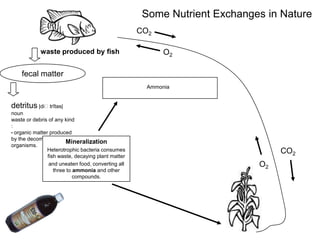
Some Nutrient Exchanges in Nature
CO2
O2

CO2
O2
Some Nutrient Exchanges in Nature
CO2
O2

At night phytoplankton
do not produce oxygen,
the biological oxygen
demand must be met
for all components of
the system

CO2
O2
Some Nutrient Exchanges in Nature
CO2
waste produced by fish

O2

fecal matter
Ammonia

detritus |diˈtrītəs|
noun
waste or debris of any kind
:
• organic matter produced
by the decomposition of
Mineralization
organisms.
Heterotrophic bacteria consumes
fish waste, decaying plant matter
and uneaten food, converting all
three to ammonia and other
compounds.

CO2
O2
Some Nutrient Exchanges in Nature
CO2
waste produced by fish

fecal matter

O2

Ammonia
(50% + secreted through gills and urine)

NH3

Fish poison

Mineralization
Heterotrophic bacteria consumes
fish waste, decaying plant matter
and uneaten food, converting all
three to ammonia and other
compounds.

CO2
O2
Some Nutrient Exchanges in Nature
CO2
waste produced by fish

fecal matter

O2

Ammonia
(50% + secreted through gills and urine)

NH4+
Ammonium

NH3

Fish poison

Mineralization
Heterotrophic bacteria consumes
fish waste, decaying plant matter
and uneaten food, converting all
three to ammonia and other
compounds.

CO2
O2
Some Nutrient Exchanges in Nature
CO2
waste produced by fish

fecal matter

O2

Ammonia
(50% + secreted through gills and urine)

NH4+
Ammonium

NH3

Biofiltration
Nitrifying bacteria

Mineralization
Heterotrophic bacteria consumes
fish waste, decaying plant matter
and uneaten food, converting all
three to ammonia and other
compounds.

(Nitrosomonas bacteria)

nitrite

No2-

Fish poison

CO2
O2
Some Nutrient Exchanges in Nature
CO2
waste produced by fish

fecal matter

O2

Ammonia
(50% + secreted through gills and urine)

NH4+
Ammonium

NH3

Biofiltration
Nitrifying bacteria

Mineralization
Heterotrophic bacteria consumes
fish waste, decaying plant matter
and uneaten food, converting all
three to ammonia and other
compounds.

(Nitrosomonas bacteria)

nitrite

CO2

No2-

Biofilters perform optimally at a (Nitrobacter)
temperature range of 77 to 86
nitrate
°F (25-30 ºC), a pH range of
7.0 to 9.0, Saturated DO, low
BOD (<20 mg/liter) and total
alkalinity of 100 mg/liter

O2
NO3-
Plant development
nitrate

Vegetative growth stage
Reproductive stage
Flowering stage
Flower setting
Fruit setting

Calcium
Ammonium

less

more

more
Best
plant
growth

Nitrifying
bacteria

O
P
T
I
M
U
M
p
H
Iron deficiency due to
low pH requires
supplementation

ethylenediaminetetraacetate
Abiotic components are such
physical and chemical factors of an
ecosystem as light, temperature,
atmosphere gases(nitrogen,
oxygen, carbon dioxide are the
most important), water, wind, soil.

Detrital
Food Web

Biotic Components
The living organisms that are in an
ecosystem.
Abiotic components are such physical and chemical factors of
an ecosystem as light, temperature, atmosphere gases (nitrogen,
oxygen, carbon dioxide are the most important), water, wind, soil.

Biotic Components
The living organisms that are in an ecosystem.
Autotrophs produce their own organic nutrients for themselves and
other members of the community; called the producers. two kinds of
autotrophs, Chemautotrophs are bacteria that obtain energy by
oxidizing inorganic compounds such as ammonia, nitrites, and sulfides
, and they use this energy to synthesize carbohydrates.
Photoautotrophs are photosynthesizers such as algae and green
plants that produce most of the organic nutrients for the biosphere.
Heterotrophs, consumers unable to produce, are constantly looking
for source of organic nutrients from elsewhere. Herbivores like grass
carp graze directly on plants or algae. Carnivores like trout feed on
other animals; Omnivores like tilapia feed on plants and animals.
Detritivores are organisms that rely on detritus, the decomposing
particles of organic matter, for food. Earthworms, beetles, termites,
and maggots are all terrestrial detritivores.
Nonphotosynthetic bacteria and fungi, including mushrooms, are
decomposers that carry out decomposition, the breakdown of dead
organic matter, including animal waste. Decomposers perform a very
valuable service by releasing inorganic substances that are taken up
by plants
IRON COMPLEXING
Ferrous iron
is soluble as a cation, ferric iron (Fe+3) is not.
However, ferric iron can form soluble complexes with many inorganic
and organic ligands
(Fe+2)

Humic acid, fulvic acid and tannic acid are examples on noncontaminant organic complexes. Phosphate also serves as a very
effective complexing agent for iron.

Mineralization
Heterotrophic bacteria consumes
fish waste, decaying plant matter
and uneaten food, converting all
three to ammonia and other
compounds.

In water systems iron occurs in one of two oxidation states: reduced
soluble divalent ferrous iron (Fe+2) or oxidized insoluble trivalent ferric
iron (Fe+3). The atmosphere has 21% oxygen, causing most of the iron
in shallow water and subsurface soils to be in the oxidized ferric state.

Non toxic Sources of Iron
Laterite, oxisol rocks,
oxisol clay mudballs, Cast
iron

Fe+2

Fe+2
Fe+2

Anaerobic
Detritus

Fe+2 will adsorb to humic
and fulvic acids formed in
worm castings or with
added humic substances
Humic substances
Leonardite is the best source for humic and fulvic acids because its biological activity is much greater than other
sources of humic acid. Biologically, humic acids increase production of plant enzymes; act as an organic catalyst in biological processes; stimulate the production of
micro-organisms; enhance natural resistance against plant disease and pests; aid in the uptake of nutrients through improved permeability of plant cells; provide building blocks
for sugars, amino acids, and chlorophyll; stimulate plant growth by increasing cell division; and improve yields by decreasing plant stress
Europonic® FossilFuel® is created from the highest quality humic acids, which
provide complex interactions with soils, potting mixes, and organic hydroponic
media to promote healthy soils and growing media which in turn helps to
produce lush plant growth and expansive root systems.
The humic acids in Europonic® FossilFuel® are derived solely from Leonardite,
organic matter that is the result of a long humification process. Research has
shown that Leonardite is the best source for humic and fulvic acids
because its biological activity is much greater than other sources of
humic acid.
Biologically, humic acids increase production of plant enzymes; act as an
organic catalyst in biological processes; stimulate the production of microorganisms; enhance natural resistance against plant disease and pests; aid in
the uptake of nutrients through improved permeability of plant cells; provide
building blocks for sugars, amino acids, and chlorophyll; stimulate plant growth
by increasing cell division; and improve yields by decreasing plant stress
The Water Food Web
EM prevents the muddy
algae taste and fishy smell
Costing
0.00 3 sacks oxisol or Laterite clay
50.00 1/2 sack Uling (CRH)
20.00 EME
30.00 Molasses
100.00
Yield = 9 Trays X 36 = 300 pcs
33 centavos each
Water Treatment
Sludge
Sludge
Some Water Quality
Monitoring Parameters
Biological Oxygen Demand
Dissolved Oxygen
Turbidity
Ammonia
Nitrate
Nitrite

Properly sized, biodiverse
systems are stable and require
minimal testing
The System Overview
The System Overview

Water Based Plants
(closed loop Recirculating)

Soil Based Plants
(Fish water nutrients)
Red Tilapia

T1

26

40

Denitrification
or solids
(%)
34

T2

32

41

27

T3

22

49

29

Mean

27

43

30

Tank

Fish
Lettuce
biomass biomass
(%)
(%)
Tank

Fish
Lettuce
biomass biomass
(%)
(%)

Denitrification
or solids
(%)

T1

26

40

34

T2

32

41

27

T3

22

49

29

Mean

27

43

30

Grow high value herbs and vegetables
Culture profitable fish
Generate your own feed
Aquatic Plants

The System Overview

Vetiver grass filter
The System Overview

7,000 G
28,000 L
1,000,000 Fl Oz
The System Overview

Safety Rails for children
Grow all your feed

Salvinia molesta
[Giant Salvinia, Water Fern, Kariba Weed]

“Vegetarian piranhas”
Grow all your feed

High energy vegetative feed
--Lettuce---Kangkong--Camote--
Grow all your feed

Cosmos
Grow all your feed

Camote tops
The System Overview

Cage culture for
ease of harvest
The System Overview

Duck weed for
fingerlings
The System Overview

Produce mercury free soy free - floating feed
economically
Drum

The System Overview

Tank culture for
ease of
production

Ref liner
Grow all your feed

Regular additions of beneficial
microorganisms is very helpful in
your system. You can also brew
compost teas, and add sea salt
and seaweed extracts. These
nutrients and trace elements
greatly improve micro flora as
well as plankton. The biological
diversity will bring greater plant
growth and fish health.

Phytoplankton and Zooplankton
1/2 kilo Nile Tilapia
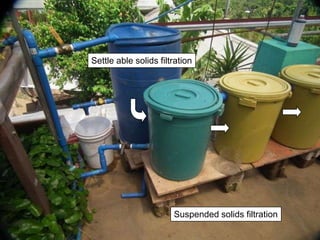
Settle able solids filtration

Suspended solids filtration
Settle able solids filtration
Suspended solids filtration
Discharge filter
Bottom exit flow- C.H.O.P.s
Raft Method
Raft Method
Raft Method

Duckweed feed
Hanging Raft Method
Hanging Raft Method
Hanging Raft Method
Raft Method

Wick Method
(soil based)
Develop safe reliable system using one pump

Utilize gravity

Understand head, hp to watts to kwh to
cost

GFIC required
Understanding dissolved oxygen

Venturi

Sheeting

Use Flow form aeration where ever
possible
Understanding filtration

Gravel beds for trapping solids and also
for additional biofiltration

Ebb and flow – Build simple bell siphon
prototype

Flow through beds

NFT- Nutrient film technique

Low cost main biofilter
Plants are for

Nitrate removal

Ammonia removal

CO2 / carbonic acid production

First Prototype

Meet plant fertilizer needs

Grow plants in soil if not aquatic

Soil based plants - vermicast, cocopeat

Dependant on capillary action of potting
soil – we have ideal materials
Pump Size to Use at 250V (lph=liters per hour)
750 lph=10.5W
1200lph=14.5W
1500lph=25W
2000lph=48W
3000lph=66W

One Pump
System Costs

.1243 kw
125 watts
1/6 hp
3,000 gallons/hr

Convert horsepower to kw
Hp X .746 = kilowatts
Pump Size to Use at 250V (lph=liters per hour)
750 lph=10.5W
1200lph=14.5W
1500lph=25W
2000lph=48W
3000lph=66W

One Pump
System Costs

Pump size dictates pond size
Pond size dictates fish carrying capacity
Feed Weight dictates number of filter beds
Pump L/hr x 1/2 = pond size x 1 fish/3.8 L (gallon) = critical carrying capacity

Calibrate actual pump flow

1/6 hp
3,000 gallons/hr
Pump Size to Use at 250V (lph=liters per hour)
750 lph=10.5W
1200lph=14.5W
1500lph=25W
2000lph=48W
3000lph=66W

One Pump
System Costs
5m

head

2m

0m

1/6 hp
3,000 gallons/hr

Specifications
1/3 HP Model BW1033
GPH @ 0‟
3200
GPH @ 10‟
2200
Pump diameter
6.2”

1/2 HP Model BW1050
4000
2820
6.2”
Pump Size to Use at 250V (lph=liters per hour)
750 lph=10.5W
1200lph=14.5W
1500lph=25W
2000lph=48W
3000lph=66W

Pump

H.P.

1/8

0.134

Watts

Kw

100.0 0.10

Kw/
day
2.40

1/6 hp
3,000 gallons/hr

P/
kwh
9.00

cost/day
25.91

One Pump
System Costs

Harvest
Pump
days
Electrical Cost
120.00

3,109.28

Specifications
1/3 HP Model BW1033
GPH @ 0‟
3200
GPH @ 10‟
2200
Pump diameter
6.2”

L/hr
@ 0'
head
3,000

L/hr
@ 10'
(3m)
head
2,400

1/2 HP Model BW1050
4000
2820
6.2”

pond size
in liters
1,200
1.5 barrels X 200L = 300 L
Extra
Head
Atlanta, Georgia
IBC Tote Liquid

1.000 liters

500 liters for fish
and 300 liters
grow bed

International Bulk Container
IBC Tote Liquid

1,000 liters

Not stable under
1,000 liters

1,000 liters water
minimum for a
stable system!
1,000 liters water
minimum for a
stable system!
Pump Size to Use at 250V (lph=liters per hour)
750 lph=10.5W
1200lph=14.5W
1500lph=25W
2000lph=48W
3000lph=66W

One Pump
System Costs

Based on average Philippine Power rates

Pump

H.P.

1/8

0.134

Watts

Kw

100.0 0.10

harv
stocking est
rate
wt

harvest
in kilos
105

P/
kwh

2.40

sale
peso/
kilo

316 0.33

Kw/
day

80

1/8 hp
3,000 gallons/hr

cost/day

9.00

25.91

fish income
8,412.63

Harvest
Pump
days
Electrical Cost
120.00

beds
2.4

3,109.28

income/
bed

L/hr
@ 0'
head
3,000

vege income

1,333.00

Specifications
1/3 HP Model BW1033
GPH @ 0‟
3200
GPH @ 10‟
2200
Pump diameter
6.2”

L/hr
@ 10'
(3m)
head

pond size
in liters

2,400

1,200

profit

3,199.20

1/2 HP Model BW1050
4000
2820
6.2”

8,502.55
Pump Size to Use at 250V (lph=liters per hour)
750 lph=10.5W
1200lph=14.5W
1500lph=25W
2000lph=48W
3000lph=66W

Pump
1/8
1/6
1/4
1/3
1/2
_ 1

H.P.
0.134
0.167
0.250
0.333
0.500
1.000

Watts
100.0
124.6
186.5
248.4
373.0
746.0

Kw
0.10
0.12
0.19
0.25
0.37
0.75

Kw/
day

P/
kwh

2.40
2.99
4.48
5.96
8.95
17.90

9.00
9.00
9.00
9.00
9.00
9.00

1/6 hp
3,000 gallons/hr

cost/day
25.91
32.29
48.34
64.39
96.68
193.36

One Pump
System Costs

Harvest
days

Pump Cost

L/hr
@ 0'
head

120.00
120.00
120.00
120.00
120.00
120.00

3,109.28
3,875.00
5,800.90
7,726.79
11,601.79
23,203.58

3,000
11,400
17,000
22,000
30,400
60,800

Specifications
1/3 HP Model BW1033
GPH @ 0‟
3200
GPH @ 10‟
2200
Pump diameter
6.2”

L/hr
@ 10'
(3m)
head
2,400
9,120
13,600
17,600
24,320
48,640

1/2 HP Model BW1050
4000
2820
6.2”

pond size
in liters
1,200
4,560
6,800
8,800
12,160
24,320
Pump Size to Use at 250V (lph=liters per hour)
750 lph=10.5W
1200lph=14.5W
1500lph=25W
2000lph=48W
3000lph=66W

Pump
1/8
1/6
1/4
1/3
1/2
_ 1

H.P.
0.134
0.167
0.250
0.333
0.500
1.000

harv
stocking est
rate
wt
316
1200
1789
2316
3200
6400

0.33
0.33
0.33
0.33
0.33
0.33

Watts
100.0
124.6
186.5
248.4
373.0
746.0

Kw
0.10
0.12
0.19
0.25
0.37
0.75

harvest
in kilos

P/
kwh

2.40
2.99
4.48
5.96
8.95
17.90

9.00
9.00
9.00
9.00
9.00
9.00

sale
peso/
kilo

105
400
596
771
1,066
2,131

Kw/
day

80
80
80
80
80
80

1/6 hp
3,000 gallons/hr

One Pump
System Costs

Harvest
days

cost/day
25.91
32.29
48.34
64.39
96.68
193.36

Pump Cost

L/hr
@ 0'
head

120.00
120.00
120.00
120.00
120.00
120.00

3,109.28
3,875.00
5,800.90
7,726.79
11,601.79
23,203.58

3,000
11,400
17,000
22,000
30,400
60,800

fish income

beds

income/
bed

8,412.63
31,968.00
47,671.58
61,692.63
85,248.00
170,496.00

2.4
9.1
13.6
17.6
24.3
48.6

1,333.00
1,333.00
1,333.00
1,333.00
1,333.00
1,333.00

vege income
3,199.20
12,156.96
18,128.80
23,460.80
32,418.56
64,837.12

Specifications
1/3 HP Model BW1033
GPH @ 0‟
3200
GPH @ 10‟
2200
Pump diameter
6.2”

L/hr
@ 10'
(3m)
head
2,400
9,120
13,600
17,600
24,320
48,640

pond size
in liters
1,200
4,560
6,800
8,800
12,160
24,320

profit
8,502.55
40,249.96
59,999.48
77,426.64
106,064.77
212,129.54

1/2 HP Model BW1050
4000
2820
6.2”
Pump Size to Use at 250V (lph=liters per hour)
750 lph=10.5W
1200lph=14.5W
1500lph=25W
2000lph=48W
3000lph=66W

One Pump
System

Solar/wind Success – store your
wattage for rainy days






Low head
Must be RELIABLE!
Inexpensive storage and delivery of power
Step up power to industry efficient 220v water pumps and air blower
Or
Find efficient 12v water pumps and air blowers
(harder to find in developing countries)

(batteries do not last long in the tropics)
220v 150 watt aquarium pump
Efficient One Pump
Recirculating Closed Loop System

Highest
Vortex Filter

Lowest
Efficient One Pump
Recirculating Closed Loop System
Bacci
Tower

N.F.S.

Grow beds

Grow beds

Rain
Catchment

Potted and
Hanging
plants

Cheese cave pond
Fish feed
Aeration

Water slide
pool
Main pond
Vortex
filter

Bottom Drain

Overflow
Backup
pump

Sump

Bottom Drain
Settled
solids

Fish feed

Vermiculture
Bulati
Efficient One Pump
Recirculating Closed Loop System

Grow beds

Aeration

Main pond
Sump
Bottom Drain
Efficient One Pump
Recirculating Closed Loop System

CHOPS

Grow beds

Aeration

Main pond

Sump
Lift water extra high to
generate electricity off
a dynamo?

Watts spent lifting water will be
greater than watts generated
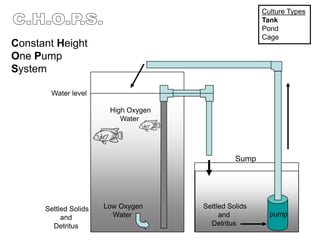
Culture Types
Tank
Pond
Cage

Constant Height
One Pump
System
Water level
High Oxygen
Water

Sump

Settled Solids
and
Detritus

Low Oxygen
Water

Settled Solids
and
Detritus

pump
Constant Height
One Pump
System
Water level
High Oxygen
Water

Sump

Settled Solids
and
Detritus

Low Oxygen
Water

Settled Solids
and
Detritus

pump
Observation Filter with
Bell Siphon
Redundant upper drain

“In the unlikely event of clogage”

Bottom Drain Guard
Redundant upper drain

Bottom Drain Guard
Leaf gutter Gaurd

4” clean out

3 screws

Bottom Drain Guard
Vortex Filter

WT 1500

Sump
Vortex Filter

Gravity Settled solids
Settled Solids Catchment
2 ponds, 2 bottom drains

Rain Water Feed Line
“water slide pool”

Bottom Drain Feed Line
“Main Pond”
Vortex Drain to Sump

Bottom Drain Feed Line
“Main Pond”

Rain Water Feed Line
“water slide pool”
Settled Solids Drain
Vortex Filter
Vortex Drain to Sump
Settled Solids Drain

Settled Solids Drain

Commercial system

Settled Solids Drain
External pump

Cement vortex filters

In-ground Koi filters
A1 Aquaponics - intro and design

A1 Aquaponics - intro and design

  • 1.
    Palawan has 3,000islands Water quality and availability is a growing issue world wide. No mater how many islands surround you, fresh water must be managed in a sustainable manor.
  • 2.
    •To manufacture onecar, including tires, 147,972 liters of water are used. • 13% of municipal piped water is lost in pipeline leaks. • The human brain is 75% water. • Outdoor watering uses 35 liters of water each minute (over 9 gallons). • One drop of oil can make up to 25 liters of water unfit for drinking. • Half of world‟s wetlands have been lost since 1900. • Each year, over 89 billion liters of bottled water are sold.
  • 3.
    Fresh water isessential for terrestrial life. Every house and farm needs water to maintain health and life. Without high quality fresh water life is impossible for plants, animals and humans.
  • 4.
    There is avery complex food chain, a food web actually, that relies on water and produces abundant food if the soil surrounding the water ecosystem is healthy.
  • 5.
    Palawan and PuertoPrincesa City are host to one of the Seven Wonders of Nature. The water flowing through this complex ecosystem needs to be clean and free of pollution to support life and remain pristine for the enjoyment of the visitors who partake of the ecotourism activities in the area.
  • 6.
    Creation is aNatural Sanctuary Eco tourism is on the rise world wide and relies on responsible water management. Agricultural practices must preserve the habitat that feeds into this natural system in the area.
  • 7.
    Agricultural practices inthe watershed flowing into the Puerto Princesa subterranean river are not sustainable. They are mostly farmed conventionally. That means a regular use of toxic and poisonous chemical treatments that leach into the water system and poison the environment. Sustainable and profitable agriculture can be done with natural means using Nature Farming methods, organic systems and Permaculture techniques.
  • 8.
    Aquaponics Module 1 of5 Growing more fish and plants for human consumption and enjoyment
  • 9.
    Aloha Vaquaponics Aloha Househas developed and implemented systems for sustainable food production by integrating fish with plant production. Aquaponics has been successfully used around the world and many methods have proven themselves over time. Vaquaponics: Vermiculture within the aquaponic system bring more stability and health by recovering fish waste solids and biologically upgrading it to castings through the integrated earth worms. This is done in the grow beds of the plant component. Humates are introduced to the biodiverse system as a secondary by product within the castings.
  • 11.
    Basil Plants and fish livingtogether Gabi/ taro Kang kong Start with Nitrate loving leafy greens 1/2 Kilo Nile Tilapia
  • 12.
  • 13.
    The "floating gardens", actuallyan artificial peninsula.
  • 14.
  • 15.
    Chinampero, or canalfarmer, poking holes and dropping seeds in his soil blocks. Most men are Aztec descendants and have continued on today the craft of canal farming. However, fewer and fewer families are sustained with their farms, due to the drainage of the shallow lake basin to make room for buildings and resorts.
  • 17.
    Definition of Chinampas: Anartificial island, or A long, narrow strip of farm land surrounded on at least three sides by water. Properly maintained, they can produce several crops a year and will remain fertile for centuries without having to lie fallow. Each Chinampa is 300 feet long and between 15-30 feet wide(and any size with this proportion). The surface of the garden is a 2-3 feet above the water and is topped every year with the sediment found at the bottom of the water canal that surrounds it.
  • 24.
    Intensive Nursery 10years Our transition to a closed loop circulating aquaponic unit started with a successful conventional soil based nursery and vegetable farm. We grow 55 vegetables and 33 herbs on 4 hectares of land. We practice composting and vermiculture as well as crop rotation and companion planting. We sell commercially to chefs, restaurants and groceries in the area as well as walk-in customers.
  • 25.
    Intensive Nursery 10years Natural,chemical free, organic Economical Racking system Efficient Transport of Seedlings Bread Tray
  • 26.
    Intensive Nursery 10years Natural,chemical free, organic Economical Racking system Efficient Transport of Seedlings Bread Tray
  • 27.
    Intensive Nursery 10years Natural,chemical free, organic Overflow of Seedlings Bread Tray
  • 28.
    Intensive Nursery 10years Natural,chemical free, organic Overflow of Seedlings Designed for Bread Tray
  • 29.
    Semi-intensive Fish Pond7 years “Static Pond” Natural, chemical free, organic Home made feed Rainwater from tanks from roof water catchment Sechi disk 4 kilo N 1-2 Kilo P Floating Feeder 15 m2 X 10pcs/m2 =150 pcs 150 Tilapia X 105 days = 300 g
  • 30.
    Semi-intensive Fish Pond7 years Oreochromis niloticus Natural,chemical free, organic 15 m2 X 10pcs/m2 =150 pcs 150 Tilapia X 105 days = 300 g
  • 31.
    Semi-intensive Fish Pond7 years Home made feed Natural,chemical free, organic
  • 32.
    Semi-intensive Fish Pond7 years Home grown feed Natural,chemical free, organic
  • 33.
    10,000 sq m/hectx 1,600mm/year = 16,000,000 liters/hect/year Vetiver erosion control
  • 34.
  • 35.
  • 36.
    The Swale The bestway to maximize rain water is by slowing it down so that it can soak into the ground. Give it the longest path on the slowest course. Water harvesting technique on contour with the land Water harvesting
  • 37.
    The Swale Water providesextra growth potential in the soil system Water harvesting Water percolates through to the lower soil 2 ways
  • 38.
  • 39.
    Dam Construction •Replace valuable topsoilfor replanting and preventing muddy water Dam Integrity Water harvesting
  • 40.
    Dam Construction Shade slowsevaporation •Replace valuable topsoil for replanting and preventing muddy water •Plant cover crop to prevent silt •Trees are not in dam - to prevent leaks/weakness Dam longevity Water harvesting
  • 41.
    1. 2. 3. Deepen pond Fill oldspillway Add swale w/ spillway Pond 1 old spillway swale spillway Water harvesting
  • 42.
    swale spillway Filling The swale witha spillway tied to a dam collects water and flows it to the dam till it is full then backflows to the spill way gently releasing the rain water overflow through the spillway. Water harvesting
  • 43.
    swale Releasing spillway The swale witha spillway tied to a dam collects water and flows it to the dam till it is full then backflows to the spill way gently releasing the rain water overflow through the spillway. Water harvesting
  • 44.
    Green Water Culture Gillscovered With membrane To digest algae compost Tilapia 4 kilo N 1-2 Kilo P High O2 30cm protein Vertical column of Phytoplankton hotter 1 to 1.5 m Low O2 cooler
  • 45.
    Green Water Culture Tilapia Waterharvesting Vertical column of Phytoplankton 30cm protein
  • 46.
    Green Water Culture Verticalcolumn of Phytoplankton 30cm protein Tilapia Common fertilization rates used to establish a phytoplankton bloom in fish ponds. Low hardness Granular 18-46-0 Water harvesting Moderate hardness High hardness 4-8 kilo/hectare 8-16 kilo/hectare 16-32 kilo/hectare
  • 47.
    Pond 5 Pond 4 swales swales Pond0 Pond 1 swales Pond 2 Pond 3 swales Dorms Pond 00 Orphanage swales 5 year Master development plan - 3 hectares - tropical - 1,600mm annual rainfall 30% pasture, 30% forest,15% water, 25% fruits/vegetables Pond 00 - ridge dam Pond 0 - contour dam Pond 1 - contour dam Pond 2 - barrier/check dam Pond 3 - keyline dam Pond 4 - saddle dam Pond 5 - ridge dam 12,000L rainwater storage
  • 48.
  • 49.
    Vetiver erosion control 12months Established vetiver for erosion control
  • 50.
    Intensive Nursery 15years ago Natural,chemical free, organic
  • 51.
    Intensive Nursery 15years ago Semi-intensive Fish Pond 12 years ago + Natural, chemical free, organic = 15 m2 X 10pcs/m2 =150 pcs tilapia Intensive Recirculating Aquaponic System 5 years ago 15 m3 X 250pcs/m3 =3,000 pcs tilapia
  • 52.
    Intensive Nursery 15years ago Semi-intensive Fish Pond 12 years ago + Natural, chemical free, organic = 15 m2 X 10pcs/m2 =150 pcs tilapia Intensive Recirculating Aquaponic System 5 years ago DWC Floating Raft Method 15 m3 X 250pcs/m3 =3,000 pcs tilapia Aloha House
  • 53.
    Who should engagein this technology? Appropriate Technology If land is expensive You live in a dense urban environment You have access to a niche market Energy costs are low, never disrupted* You can sell at premium prices Water is scarce (it conserves water) You want to improve your food supply Inappropriate Technology If land is inexpensive /abundant water You‟re in a remote location Energy costs are high, or disrupted* You do not have a market to sell into You‟re not concerned about a poisoned food supply** *Pumps usually run 24hrs/day 7days/week **Pesticides on the plant will kill the fish
  • 54.
  • 55.
    Intensive Aquaponic Nursery Selfwatering system Less water consumption Lower labor costs
  • 57.
    There are currently hydroponicgrowers from California to Montreal, Hong Kong to Dubai, but few produce high volume and tests show fairly short and unreliable shelf life. Some offer it with roots and some do not. Nutrient density and Brixº readings are usually poor to average. Hydroponics Plants are grown in a soil-less medium ORIGIN: 1930s from hydro- [of water] + Greek ponos „labor‟ + -ics . Plants Add and balance Chemical nutrients clean waste untreated discharge pollutes the environment Water Filtration
  • 58.
    Criticism of Hydroponics 1.Technologically Advanced 2. Management Intensive 3. Can you find a system in operation over 1 year? 4. How about 5 years old? 5. Often Exotic Imported Mediums 6. Nutritionally lacking… Nutritional proof lacking: Claims only With intensive use: Water gets worse not better… Soil gets better, not worse Hydroponic Farming Eliminates The Soil Then God said, "Let the land produce vegetation: seed-bearing plants and trees on the land that bear fruit with seed in it, according to their various kinds." And it was so. 12 The land produced vegetation: plants bearing seed according to their kinds and trees bearing fruit with seed in it according to their kinds. And God saw that it was good. 13 And there was evening, and there was morning, the third day.
  • 59.
    Do I believein hydroponics?
  • 60.
    Do I believein hydroponics?
  • 61.
    Hydrophonics ORIGIN: 2010s fromhydro- [of water] + Greek phono [sound] + -ics Many people coming to our farm inquire about hydrophonics. Hydrophonics is not Hydroponics. Hydrophonics does not exist and appears in no modern or ancient dictionary. I suppose if the word did exist then the Greek would mean sound in water, like a dolphin perhaps communicating to it‟s pod. Please make sure you pronounce the words for agricultural study as accurately as possible.
  • 62.
    Recirculating Aquaculture Fish aregrown in a water tank or pond system ORIGIN mid 19th cent.: from Latin aqua „water‟ + culture , on the pattern of words such as agriculture. Exploited marine feed fish species Water Filtration Add feed and balance water waste untreated discharge pollutes the environment clean Fish production
  • 63.
    Aquaponics = Aquaculture +Hydroponics ORIGIN: 1960s from Aqua - [implying fish] + Greek ponos „labor‟ + -ics . Soil Based Grow natural feeds to balance water Fish production vAquaponics = Integrated Vermiculture Filtered clean water Plant Fertilizer Plants and bedding are the Water Filtration
  • 64.
    Fish and plantsliving in a balanced self limiting ecosystem In Thailand, Malasia and China fish and aquatic plants have been kept together in decorative vases and pots for thousands of years. The fish prevent mosquito eggs and larvae from growing into pests and serve as feed for the fish. Static aquaponics
  • 65.
    Static aquaponics Algae isseen growing in the water, utilizing any available sunlight and also nutrients from the fish waste. Many fish in turn feed on the high protein phytoplankton, string algae and blanket algae. The balance between fish and algae needs periodic monitoring and intervention depending on the breeding rate of your fish, waste production, sunlight and the algae growth rate. Fish and plants living in a balanced self limiting ecosystem
  • 66.
    Static aquaponics Phytoplankton, unicellularalgae, is seen growing in the water, utilizing any available sunlight and also nutrients from the fish waste. The catfish were fed commercial feed and vegetable scraps. Water hyacinth utilize the nutrient load from the fish and grow rapidly. Catfish and Water Hyacinth
  • 67.
    Water hyacinth utilizethe nutrient load from the fish and grow rapidly. The catfish do not consume the plant or it‟s root, proving to be an appropriate companion system. Static aquaponics Catfish and Water Hyacinth
  • 68.
    Water hyacinth aresystematically culled and fed to the chicken. They will consume the insects that a resident in the host plant and the the plant itself, proving to be a well integrated food source from the static aquaponic unit that rears catfish. Static aquaponics Chaquaponics
  • 69.
    Water hyacinth utilizethe nutrient load from the turtles and grow rapidly. The turtles will consume the plant so growth rate and quantity of plants need to be balanced. This is an appropriate companion system if quantities of water hyacinth out grow the consumption rate of the turtles. Turtleponics
  • 70.
    Duckweed utilizse thenutrient load from the fish and ducks and grow rapidly. The tilapia and ducks consume the plant, proving to be an appropriate companion system if addition grow ponds are available as duck stocks grow larger and consume more. Duckponics
  • 71.
    Aquaponics = Aquaculture +Hydroponics V ORIGIN: 1960s from Aqua - [implying fish] + Greek ponos „labor‟ + -ics . Vermiculture Soil Based pump Grow natural feeds to balance water Fish production vAquaponics = Integrated Vermiculture gravity Filtered clean water Plant Fertilizer Plants and bedding are the Water Filtration
  • 72.
    The highly desirouskang kong is grown outside the pond area and manually harvested and fed to the ducks. The plant is growing in a gravel flow through bed nurtured from the waste of the fish and ducks. Duckponics
  • 73.
    Duckweed utilizes thenutrient load from the fish and ducks and grow rapidly. As ducks mature addition grow ponds are available to grow more duckweed. Duckponics
  • 74.
    Conventional confinement systems depriveducks of their natural development and produce lower nutrition than sun drenched, naturally fed aquatic ducks.
  • 75.
    Water is continuallycirculated through grow beds that act as biological and solids filters where earthworms and bacteria do all the hard work. Duckponics
  • 76.
    Tigerponics Algae in nutrientrich tiger bath water could circulate through simple grow beds with feed species for other animals in the zoo. The water would not need to be flushed into the wild waterways, thus keeping Thailand clean and green.
  • 77.
    Fact is youcan integrate unlimited combinations of nutrient sources to produce more food for people and livestock any where in the world. Bootponics
  • 78.
    Nitrate loving leafygreens Simulated river bed Soil based Aquaponics Gotocola
  • 79.
    Simulated river bed Soilbased Nitrate loving leafy greens Kangkong Aquaponics
  • 80.
    Aloha Bioponics Complex systemsthe mimic nature can be designed to run in a simplified unit that is profitable and “natural”. ORIGIN: 1800s from Greek Bio - life + Greek ponos „labor‟ + -ics .
  • 81.
  • 82.
    'finally got itto cycle” Submitted on: June 09, 2010, 09:22:44 pm After days of experimenting and trying to figure out the ins and outs (no pun intended) of AP, I finally got the water to cycle from my 55 g blue barrel FT to my grow bed and back. Below is the parts list for my mini-system. I have yet to get my fishies and start the seeds but as soon as I do, I'll post pictures. FT: 55 gallon blue barrel Grow bed: 1 bag of Niu black cinder Pump: Maxi Jet 400 (110 gpf) Tube: 1/2" ID clear vinyl tubing There are many helpful resources online, but few are commercially viable despite the claims of the proponents. A high degree of the internet bandwidth for aquaponics consists of amateur tinkerers, dabblers and hobbyists who spend a disproportionate amount of resources (time and money) compared to the actual yield in their aquaponic unit. Much can be learned what to do (or not do) from these sites. Often the size of the system is to small to be stable. Size limitations will be discussed later in this first part.
  • 83.
    2,000 liters Aquaponics Concrete mixing containers Aprofessional aquaculturist skeptically builds his first aquaponic unit for evaluation. A gravel bed ebb and flow bell siphon system is a good starting point due to ease of operation and minimal filtration needs. Note the low head for pump efficiency to minimize energy costs. He admitted he has the advantage of his many years of fish rearing and needs to expand his horticultural knowledge.
  • 84.
  • 85.
    Red tilapia A professionalaquaculturist has the advantage of many years of fish rearing and the red tilapia were robust in this raft method aquaponic system. Chiang Mai Children‟s Home Aquaponics
  • 86.
    A professional aquaculturistbuilds his second aquaponic unit for evaluation. A raft method is selected due to it‟s higher yield potential. This system requires an extensive filtration unit. Note the low head for pump efficiency to minimize energy costs. Filter Chiang Mai Children‟s Home Aquaponics
  • 87.
    Raft Method vegetable production Biofouling isnoted often in raft method. Without extensive filtering of settled and suspended solids the roots of this basil will limit nutrient uptake. It requires a more complete filtration unit. Chiang Mai Children‟s Home Aquaponics
  • 89.
    Who should engagein this technology? Appropriate Technology If land is expensive You live in a dense urban environment You have access to a niche market Energy costs are low, never disrupted* You can sell at premium prices You want to improve your food supply Inappropriate Technology If land is inexpensive /abundant water You‟re in a remote location Energy costs are high, or disrupted* You do not have a market to sell into You‟re not concerned about a poisoned food supply** *Pumps usually run 24hrs/day 7days/week **Pesticides on the plant will kill the fish
  • 90.
    Best plant growth is soil based Through capillaryaction soil wicks water up into the root zone of the plants. This gives the plant the advantage of the soil food web and it‟s microbial helpers. The pH can be easily controlled by the right ingredients, assuring full availability of nutrients.
  • 91.
    Ease of management Bedtypes for plant types 1. Soil based Plants get soil 2. Water based plants get gravel 3. Floating Plants get to Float Best Biofiltration is gravel based
  • 92.
    Some Nutrient Exchangesin Nature CO2 O2 CO2 O2
  • 93.
    Some Nutrient Exchangesin Nature CO2 O2 At night phytoplankton do not produce oxygen, the biological oxygen demand must be met for all components of the system CO2 O2
  • 94.
    Some Nutrient Exchangesin Nature CO2 waste produced by fish O2 fecal matter Ammonia detritus |diˈtrītəs| noun waste or debris of any kind : • organic matter produced by the decomposition of Mineralization organisms. Heterotrophic bacteria consumes fish waste, decaying plant matter and uneaten food, converting all three to ammonia and other compounds. CO2 O2
  • 95.
    Some Nutrient Exchangesin Nature CO2 waste produced by fish fecal matter O2 Ammonia (50% + secreted through gills and urine) NH3 Fish poison Mineralization Heterotrophic bacteria consumes fish waste, decaying plant matter and uneaten food, converting all three to ammonia and other compounds. CO2 O2
  • 96.
    Some Nutrient Exchangesin Nature CO2 waste produced by fish fecal matter O2 Ammonia (50% + secreted through gills and urine) NH4+ Ammonium NH3 Fish poison Mineralization Heterotrophic bacteria consumes fish waste, decaying plant matter and uneaten food, converting all three to ammonia and other compounds. CO2 O2
  • 97.
    Some Nutrient Exchangesin Nature CO2 waste produced by fish fecal matter O2 Ammonia (50% + secreted through gills and urine) NH4+ Ammonium NH3 Biofiltration Nitrifying bacteria Mineralization Heterotrophic bacteria consumes fish waste, decaying plant matter and uneaten food, converting all three to ammonia and other compounds. (Nitrosomonas bacteria) nitrite No2- Fish poison CO2 O2
  • 98.
    Some Nutrient Exchangesin Nature CO2 waste produced by fish fecal matter O2 Ammonia (50% + secreted through gills and urine) NH4+ Ammonium NH3 Biofiltration Nitrifying bacteria Mineralization Heterotrophic bacteria consumes fish waste, decaying plant matter and uneaten food, converting all three to ammonia and other compounds. (Nitrosomonas bacteria) nitrite CO2 No2- Biofilters perform optimally at a (Nitrobacter) temperature range of 77 to 86 nitrate °F (25-30 ºC), a pH range of 7.0 to 9.0, Saturated DO, low BOD (<20 mg/liter) and total alkalinity of 100 mg/liter O2 NO3-
  • 99.
    Plant development nitrate Vegetative growthstage Reproductive stage Flowering stage Flower setting Fruit setting Calcium Ammonium less more more
  • 100.
  • 101.
    Iron deficiency dueto low pH requires supplementation ethylenediaminetetraacetate
  • 102.
    Abiotic components aresuch physical and chemical factors of an ecosystem as light, temperature, atmosphere gases(nitrogen, oxygen, carbon dioxide are the most important), water, wind, soil. Detrital Food Web Biotic Components The living organisms that are in an ecosystem.
  • 103.
    Abiotic components aresuch physical and chemical factors of an ecosystem as light, temperature, atmosphere gases (nitrogen, oxygen, carbon dioxide are the most important), water, wind, soil. Biotic Components The living organisms that are in an ecosystem. Autotrophs produce their own organic nutrients for themselves and other members of the community; called the producers. two kinds of autotrophs, Chemautotrophs are bacteria that obtain energy by oxidizing inorganic compounds such as ammonia, nitrites, and sulfides , and they use this energy to synthesize carbohydrates. Photoautotrophs are photosynthesizers such as algae and green plants that produce most of the organic nutrients for the biosphere. Heterotrophs, consumers unable to produce, are constantly looking for source of organic nutrients from elsewhere. Herbivores like grass carp graze directly on plants or algae. Carnivores like trout feed on other animals; Omnivores like tilapia feed on plants and animals. Detritivores are organisms that rely on detritus, the decomposing particles of organic matter, for food. Earthworms, beetles, termites, and maggots are all terrestrial detritivores. Nonphotosynthetic bacteria and fungi, including mushrooms, are decomposers that carry out decomposition, the breakdown of dead organic matter, including animal waste. Decomposers perform a very valuable service by releasing inorganic substances that are taken up by plants
  • 104.
    IRON COMPLEXING Ferrous iron issoluble as a cation, ferric iron (Fe+3) is not. However, ferric iron can form soluble complexes with many inorganic and organic ligands (Fe+2) Humic acid, fulvic acid and tannic acid are examples on noncontaminant organic complexes. Phosphate also serves as a very effective complexing agent for iron. Mineralization Heterotrophic bacteria consumes fish waste, decaying plant matter and uneaten food, converting all three to ammonia and other compounds. In water systems iron occurs in one of two oxidation states: reduced soluble divalent ferrous iron (Fe+2) or oxidized insoluble trivalent ferric iron (Fe+3). The atmosphere has 21% oxygen, causing most of the iron in shallow water and subsurface soils to be in the oxidized ferric state. Non toxic Sources of Iron Laterite, oxisol rocks, oxisol clay mudballs, Cast iron Fe+2 Fe+2 Fe+2 Anaerobic Detritus Fe+2 will adsorb to humic and fulvic acids formed in worm castings or with added humic substances
  • 105.
    Humic substances Leonardite isthe best source for humic and fulvic acids because its biological activity is much greater than other sources of humic acid. Biologically, humic acids increase production of plant enzymes; act as an organic catalyst in biological processes; stimulate the production of micro-organisms; enhance natural resistance against plant disease and pests; aid in the uptake of nutrients through improved permeability of plant cells; provide building blocks for sugars, amino acids, and chlorophyll; stimulate plant growth by increasing cell division; and improve yields by decreasing plant stress
  • 106.
    Europonic® FossilFuel® iscreated from the highest quality humic acids, which provide complex interactions with soils, potting mixes, and organic hydroponic media to promote healthy soils and growing media which in turn helps to produce lush plant growth and expansive root systems. The humic acids in Europonic® FossilFuel® are derived solely from Leonardite, organic matter that is the result of a long humification process. Research has shown that Leonardite is the best source for humic and fulvic acids because its biological activity is much greater than other sources of humic acid. Biologically, humic acids increase production of plant enzymes; act as an organic catalyst in biological processes; stimulate the production of microorganisms; enhance natural resistance against plant disease and pests; aid in the uptake of nutrients through improved permeability of plant cells; provide building blocks for sugars, amino acids, and chlorophyll; stimulate plant growth by increasing cell division; and improve yields by decreasing plant stress
  • 107.
    The Water FoodWeb EM prevents the muddy algae taste and fishy smell
  • 108.
    Costing 0.00 3 sacksoxisol or Laterite clay 50.00 1/2 sack Uling (CRH) 20.00 EME 30.00 Molasses 100.00 Yield = 9 Trays X 36 = 300 pcs 33 centavos each
  • 109.
  • 110.
  • 111.
  • 112.
    Some Water Quality MonitoringParameters Biological Oxygen Demand Dissolved Oxygen Turbidity Ammonia Nitrate Nitrite Properly sized, biodiverse systems are stable and require minimal testing
  • 114.
  • 115.
    The System Overview WaterBased Plants (closed loop Recirculating) Soil Based Plants (Fish water nutrients)
  • 116.
  • 117.
  • 118.
  • 119.
  • 120.
    Aquatic Plants The SystemOverview Vetiver grass filter
  • 121.
    The System Overview 7,000G 28,000 L 1,000,000 Fl Oz
  • 122.
    The System Overview SafetyRails for children
  • 123.
    Grow all yourfeed Salvinia molesta [Giant Salvinia, Water Fern, Kariba Weed] “Vegetarian piranhas”
  • 124.
    Grow all yourfeed High energy vegetative feed --Lettuce---Kangkong--Camote--
  • 125.
    Grow all yourfeed Cosmos
  • 126.
    Grow all yourfeed Camote tops
  • 127.
    The System Overview Cageculture for ease of harvest
  • 128.
    The System Overview Duckweed for fingerlings
  • 129.
    The System Overview Producemercury free soy free - floating feed economically
  • 131.
    Drum The System Overview Tankculture for ease of production Ref liner
  • 132.
    Grow all yourfeed Regular additions of beneficial microorganisms is very helpful in your system. You can also brew compost teas, and add sea salt and seaweed extracts. These nutrients and trace elements greatly improve micro flora as well as plankton. The biological diversity will bring greater plant growth and fish health. Phytoplankton and Zooplankton
  • 133.
  • 134.
    Settle able solidsfiltration Suspended solids filtration
  • 135.
  • 136.
  • 137.
  • 138.
  • 139.
  • 140.
  • 141.
  • 142.
  • 143.
  • 144.
  • 145.
  • 146.
    Develop safe reliablesystem using one pump  Utilize gravity  Understand head, hp to watts to kwh to cost  GFIC required Understanding dissolved oxygen  Venturi  Sheeting  Use Flow form aeration where ever possible Understanding filtration  Gravel beds for trapping solids and also for additional biofiltration  Ebb and flow – Build simple bell siphon prototype  Flow through beds  NFT- Nutrient film technique  Low cost main biofilter Plants are for  Nitrate removal  Ammonia removal  CO2 / carbonic acid production First Prototype Meet plant fertilizer needs  Grow plants in soil if not aquatic  Soil based plants - vermicast, cocopeat  Dependant on capillary action of potting soil – we have ideal materials
  • 147.
    Pump Size toUse at 250V (lph=liters per hour) 750 lph=10.5W 1200lph=14.5W 1500lph=25W 2000lph=48W 3000lph=66W One Pump System Costs .1243 kw 125 watts 1/6 hp 3,000 gallons/hr Convert horsepower to kw Hp X .746 = kilowatts
  • 148.
    Pump Size toUse at 250V (lph=liters per hour) 750 lph=10.5W 1200lph=14.5W 1500lph=25W 2000lph=48W 3000lph=66W One Pump System Costs Pump size dictates pond size Pond size dictates fish carrying capacity Feed Weight dictates number of filter beds Pump L/hr x 1/2 = pond size x 1 fish/3.8 L (gallon) = critical carrying capacity Calibrate actual pump flow 1/6 hp 3,000 gallons/hr
  • 149.
    Pump Size toUse at 250V (lph=liters per hour) 750 lph=10.5W 1200lph=14.5W 1500lph=25W 2000lph=48W 3000lph=66W One Pump System Costs 5m head 2m 0m 1/6 hp 3,000 gallons/hr Specifications 1/3 HP Model BW1033 GPH @ 0‟ 3200 GPH @ 10‟ 2200 Pump diameter 6.2” 1/2 HP Model BW1050 4000 2820 6.2”
  • 150.
    Pump Size toUse at 250V (lph=liters per hour) 750 lph=10.5W 1200lph=14.5W 1500lph=25W 2000lph=48W 3000lph=66W Pump H.P. 1/8 0.134 Watts Kw 100.0 0.10 Kw/ day 2.40 1/6 hp 3,000 gallons/hr P/ kwh 9.00 cost/day 25.91 One Pump System Costs Harvest Pump days Electrical Cost 120.00 3,109.28 Specifications 1/3 HP Model BW1033 GPH @ 0‟ 3200 GPH @ 10‟ 2200 Pump diameter 6.2” L/hr @ 0' head 3,000 L/hr @ 10' (3m) head 2,400 1/2 HP Model BW1050 4000 2820 6.2” pond size in liters 1,200
  • 151.
    1.5 barrels X200L = 300 L
  • 152.
  • 153.
  • 154.
    IBC Tote Liquid 1.000liters 500 liters for fish and 300 liters grow bed International Bulk Container
  • 155.
    IBC Tote Liquid 1,000liters Not stable under 1,000 liters 1,000 liters water minimum for a stable system!
  • 158.
    1,000 liters water minimumfor a stable system!
  • 159.
    Pump Size toUse at 250V (lph=liters per hour) 750 lph=10.5W 1200lph=14.5W 1500lph=25W 2000lph=48W 3000lph=66W One Pump System Costs Based on average Philippine Power rates Pump H.P. 1/8 0.134 Watts Kw 100.0 0.10 harv stocking est rate wt harvest in kilos 105 P/ kwh 2.40 sale peso/ kilo 316 0.33 Kw/ day 80 1/8 hp 3,000 gallons/hr cost/day 9.00 25.91 fish income 8,412.63 Harvest Pump days Electrical Cost 120.00 beds 2.4 3,109.28 income/ bed L/hr @ 0' head 3,000 vege income 1,333.00 Specifications 1/3 HP Model BW1033 GPH @ 0‟ 3200 GPH @ 10‟ 2200 Pump diameter 6.2” L/hr @ 10' (3m) head pond size in liters 2,400 1,200 profit 3,199.20 1/2 HP Model BW1050 4000 2820 6.2” 8,502.55
  • 160.
    Pump Size toUse at 250V (lph=liters per hour) 750 lph=10.5W 1200lph=14.5W 1500lph=25W 2000lph=48W 3000lph=66W Pump 1/8 1/6 1/4 1/3 1/2 _ 1 H.P. 0.134 0.167 0.250 0.333 0.500 1.000 Watts 100.0 124.6 186.5 248.4 373.0 746.0 Kw 0.10 0.12 0.19 0.25 0.37 0.75 Kw/ day P/ kwh 2.40 2.99 4.48 5.96 8.95 17.90 9.00 9.00 9.00 9.00 9.00 9.00 1/6 hp 3,000 gallons/hr cost/day 25.91 32.29 48.34 64.39 96.68 193.36 One Pump System Costs Harvest days Pump Cost L/hr @ 0' head 120.00 120.00 120.00 120.00 120.00 120.00 3,109.28 3,875.00 5,800.90 7,726.79 11,601.79 23,203.58 3,000 11,400 17,000 22,000 30,400 60,800 Specifications 1/3 HP Model BW1033 GPH @ 0‟ 3200 GPH @ 10‟ 2200 Pump diameter 6.2” L/hr @ 10' (3m) head 2,400 9,120 13,600 17,600 24,320 48,640 1/2 HP Model BW1050 4000 2820 6.2” pond size in liters 1,200 4,560 6,800 8,800 12,160 24,320
  • 161.
    Pump Size toUse at 250V (lph=liters per hour) 750 lph=10.5W 1200lph=14.5W 1500lph=25W 2000lph=48W 3000lph=66W Pump 1/8 1/6 1/4 1/3 1/2 _ 1 H.P. 0.134 0.167 0.250 0.333 0.500 1.000 harv stocking est rate wt 316 1200 1789 2316 3200 6400 0.33 0.33 0.33 0.33 0.33 0.33 Watts 100.0 124.6 186.5 248.4 373.0 746.0 Kw 0.10 0.12 0.19 0.25 0.37 0.75 harvest in kilos P/ kwh 2.40 2.99 4.48 5.96 8.95 17.90 9.00 9.00 9.00 9.00 9.00 9.00 sale peso/ kilo 105 400 596 771 1,066 2,131 Kw/ day 80 80 80 80 80 80 1/6 hp 3,000 gallons/hr One Pump System Costs Harvest days cost/day 25.91 32.29 48.34 64.39 96.68 193.36 Pump Cost L/hr @ 0' head 120.00 120.00 120.00 120.00 120.00 120.00 3,109.28 3,875.00 5,800.90 7,726.79 11,601.79 23,203.58 3,000 11,400 17,000 22,000 30,400 60,800 fish income beds income/ bed 8,412.63 31,968.00 47,671.58 61,692.63 85,248.00 170,496.00 2.4 9.1 13.6 17.6 24.3 48.6 1,333.00 1,333.00 1,333.00 1,333.00 1,333.00 1,333.00 vege income 3,199.20 12,156.96 18,128.80 23,460.80 32,418.56 64,837.12 Specifications 1/3 HP Model BW1033 GPH @ 0‟ 3200 GPH @ 10‟ 2200 Pump diameter 6.2” L/hr @ 10' (3m) head 2,400 9,120 13,600 17,600 24,320 48,640 pond size in liters 1,200 4,560 6,800 8,800 12,160 24,320 profit 8,502.55 40,249.96 59,999.48 77,426.64 106,064.77 212,129.54 1/2 HP Model BW1050 4000 2820 6.2”
  • 162.
    Pump Size toUse at 250V (lph=liters per hour) 750 lph=10.5W 1200lph=14.5W 1500lph=25W 2000lph=48W 3000lph=66W One Pump System Solar/wind Success – store your wattage for rainy days      Low head Must be RELIABLE! Inexpensive storage and delivery of power Step up power to industry efficient 220v water pumps and air blower Or Find efficient 12v water pumps and air blowers (harder to find in developing countries) (batteries do not last long in the tropics)
  • 163.
    220v 150 wattaquarium pump
  • 164.
    220v 150 wattaquarium pump
  • 165.
    Efficient One Pump RecirculatingClosed Loop System Highest Vortex Filter Lowest
  • 166.
    Efficient One Pump RecirculatingClosed Loop System Bacci Tower N.F.S. Grow beds Grow beds Rain Catchment Potted and Hanging plants Cheese cave pond Fish feed Aeration Water slide pool Main pond Vortex filter Bottom Drain Overflow Backup pump Sump Bottom Drain Settled solids Fish feed Vermiculture Bulati
  • 167.
    Efficient One Pump RecirculatingClosed Loop System Grow beds Aeration Main pond Sump Bottom Drain
  • 168.
    Efficient One Pump RecirculatingClosed Loop System CHOPS Grow beds Aeration Main pond Sump
  • 169.
    Lift water extrahigh to generate electricity off a dynamo? Watts spent lifting water will be greater than watts generated
  • 170.
    Culture Types Tank Pond Cage Constant Height OnePump System Water level High Oxygen Water Sump Settled Solids and Detritus Low Oxygen Water Settled Solids and Detritus pump
  • 171.
    Constant Height One Pump System Waterlevel High Oxygen Water Sump Settled Solids and Detritus Low Oxygen Water Settled Solids and Detritus pump
  • 172.
  • 173.
    Redundant upper drain “Inthe unlikely event of clogage” Bottom Drain Guard
  • 174.
  • 175.
    Leaf gutter Gaurd 4”clean out 3 screws Bottom Drain Guard
  • 176.
  • 177.
    Vortex Filter Gravity Settledsolids Settled Solids Catchment
  • 178.
    2 ponds, 2bottom drains Rain Water Feed Line “water slide pool” Bottom Drain Feed Line “Main Pond”
  • 179.
    Vortex Drain toSump Bottom Drain Feed Line “Main Pond” Rain Water Feed Line “water slide pool” Settled Solids Drain
  • 180.
  • 181.
  • 182.
  • 183.
    Settled Solids Drain SettledSolids Drain Commercial system Settled Solids Drain
  • 184.
    External pump Cement vortexfilters In-ground Koi filters