0/1 knapsack using DP
0/1 Knapsack Problem
• We are given a knapsack of capacity m and a set of n objects numbered
1,2,…,n. Each object i has weight wi and profit pi.
• Let x = [x1, x2,…, xn] be a solution vector in which xi = 0 if object i is not in
the knapsack, and xi = 1 if it is in the knapsack.
• The goal is to find a subset of objects to put into the knapsack so that
(that is, the objects fit into the knapsack) and
is maximized (that is, the profit is maximized).
0/1 Knapsack Problem
• The naive method is to consider all 2n
possible subsets of
the n objects and choose the one that fits into the
knapsack and maximizes the profit.
• Let F[i,x] be the maximum profit for a knapsack of capacity
x using only objects {1,2,…,i}. The DP formulation is:
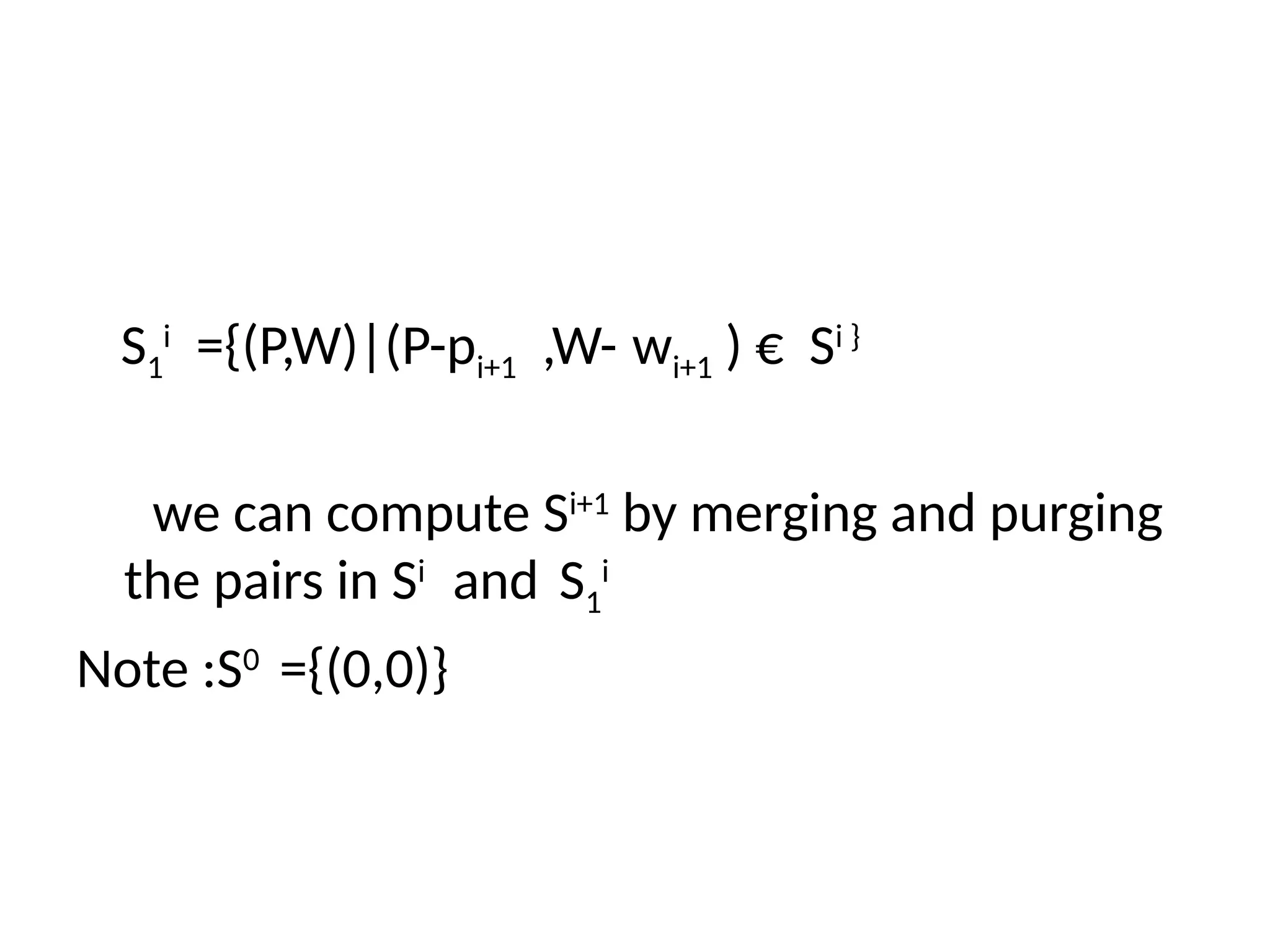
S1
i
={(P,W)|(P-pi+1 ,W- wi+1 ) € Si }
we can compute Si+1
by merging and purging
the pairs in Si
and S1
i
Note :S0
={(0,0)}
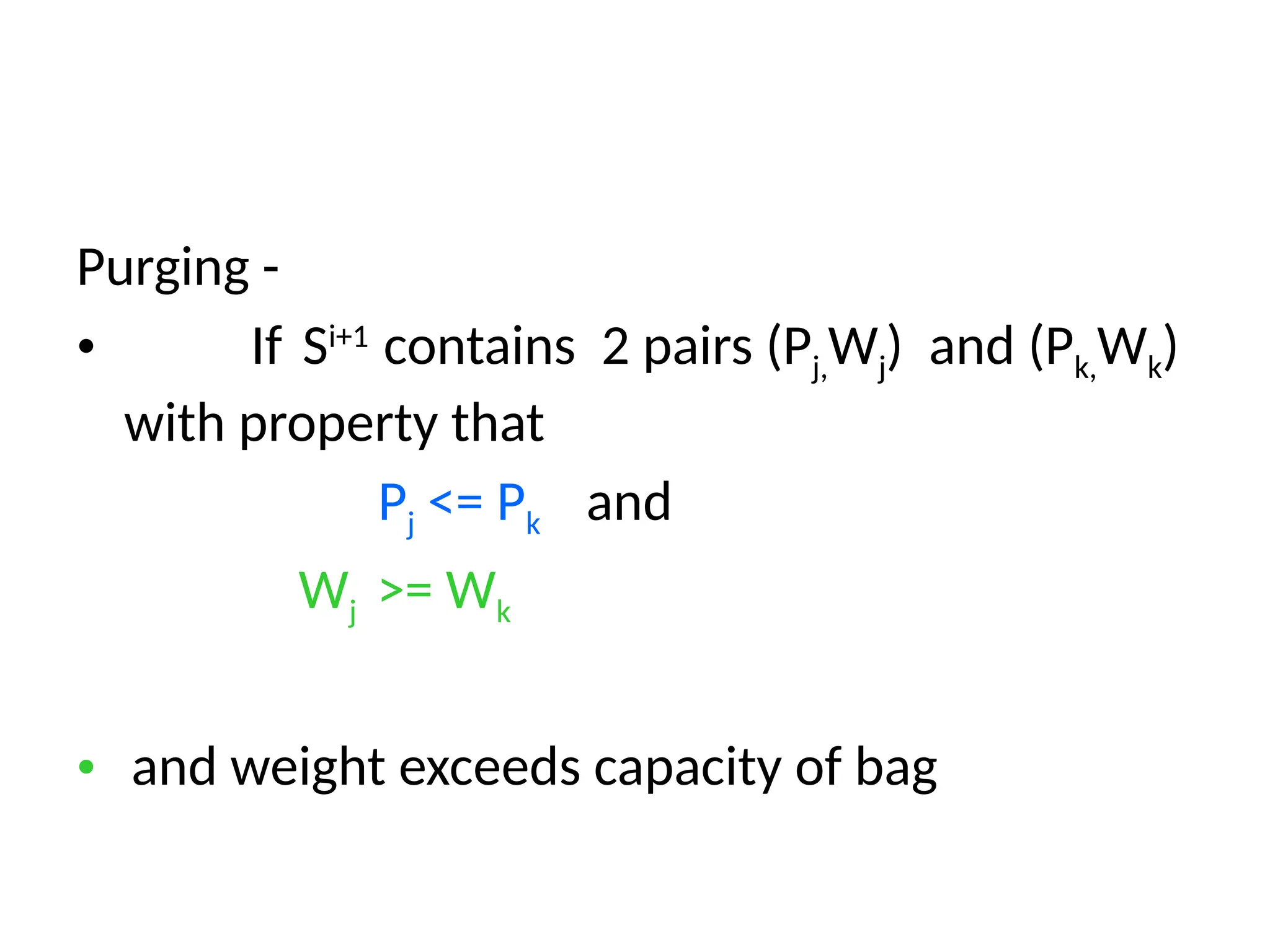
Purging -
• If Si+1
contains 2 pairs (Pj,Wj) and (Pk,Wk)
with property that
Pj <= Pk and
Wj >= Wk
• and weight exceeds capacity of bag
Example
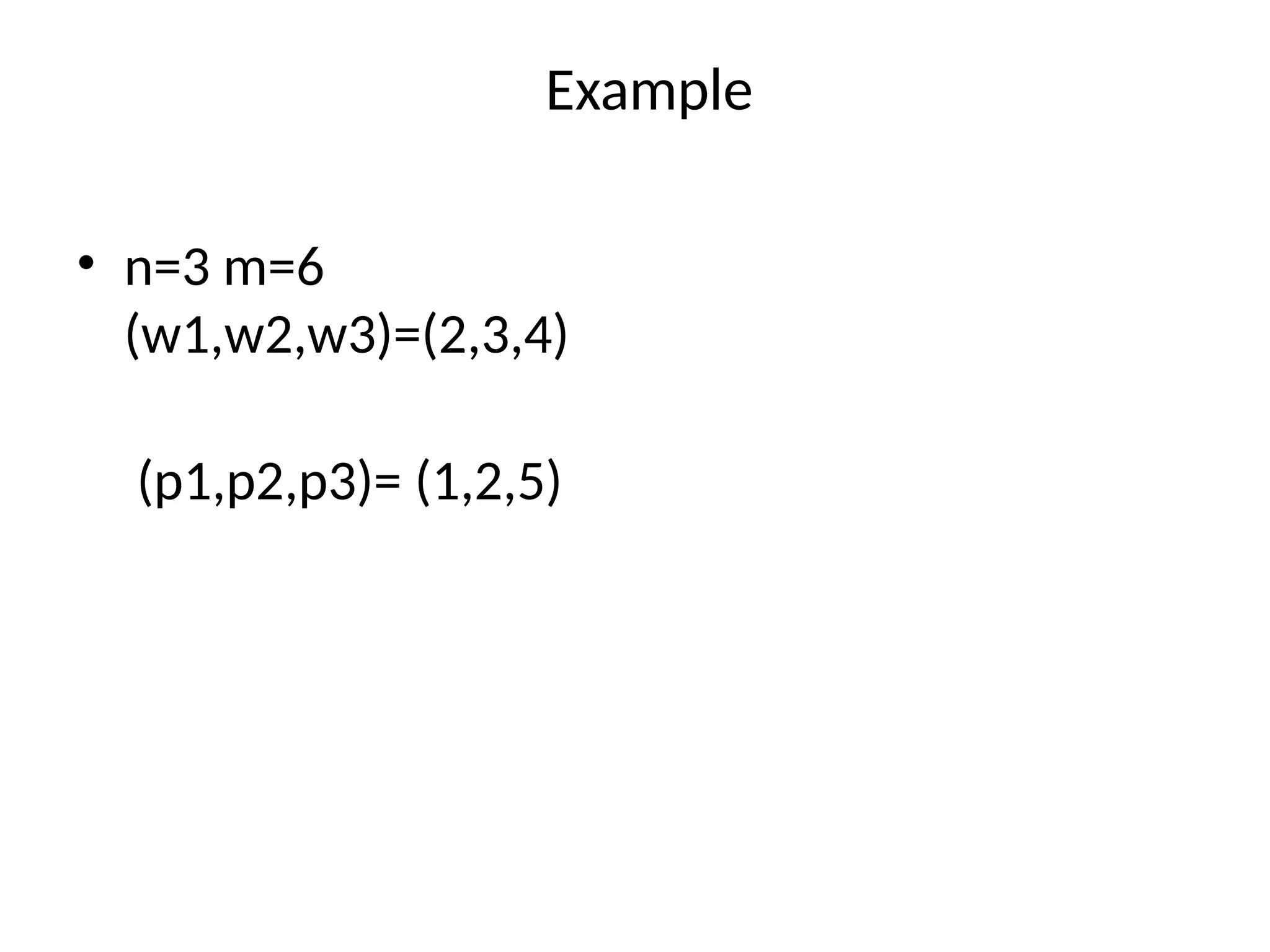
• n=3 m=6
(w1,w2,w3)=(2,3,4)
(p1,p2,p3)= (1,2,5)
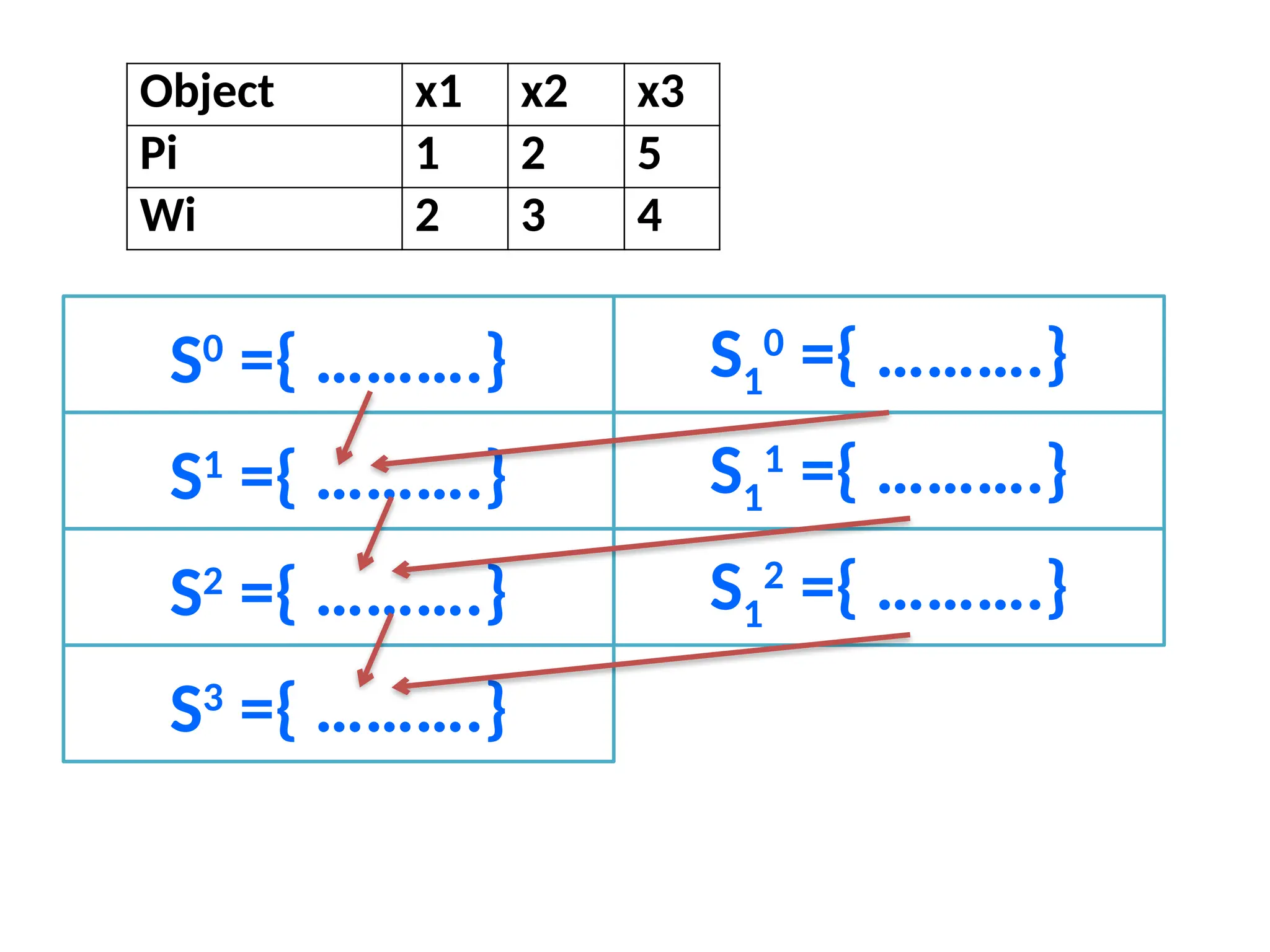
Object x1 x2 x3
Pi 1 2 5
Wi 2 3 4
S0
={ ……….}
S1
={ ……….}
S2
={ ……….}
S3
={ ……….}
S1
0
={ ……….}
S1
1
={ ……….}
S1
2
={ ……….}
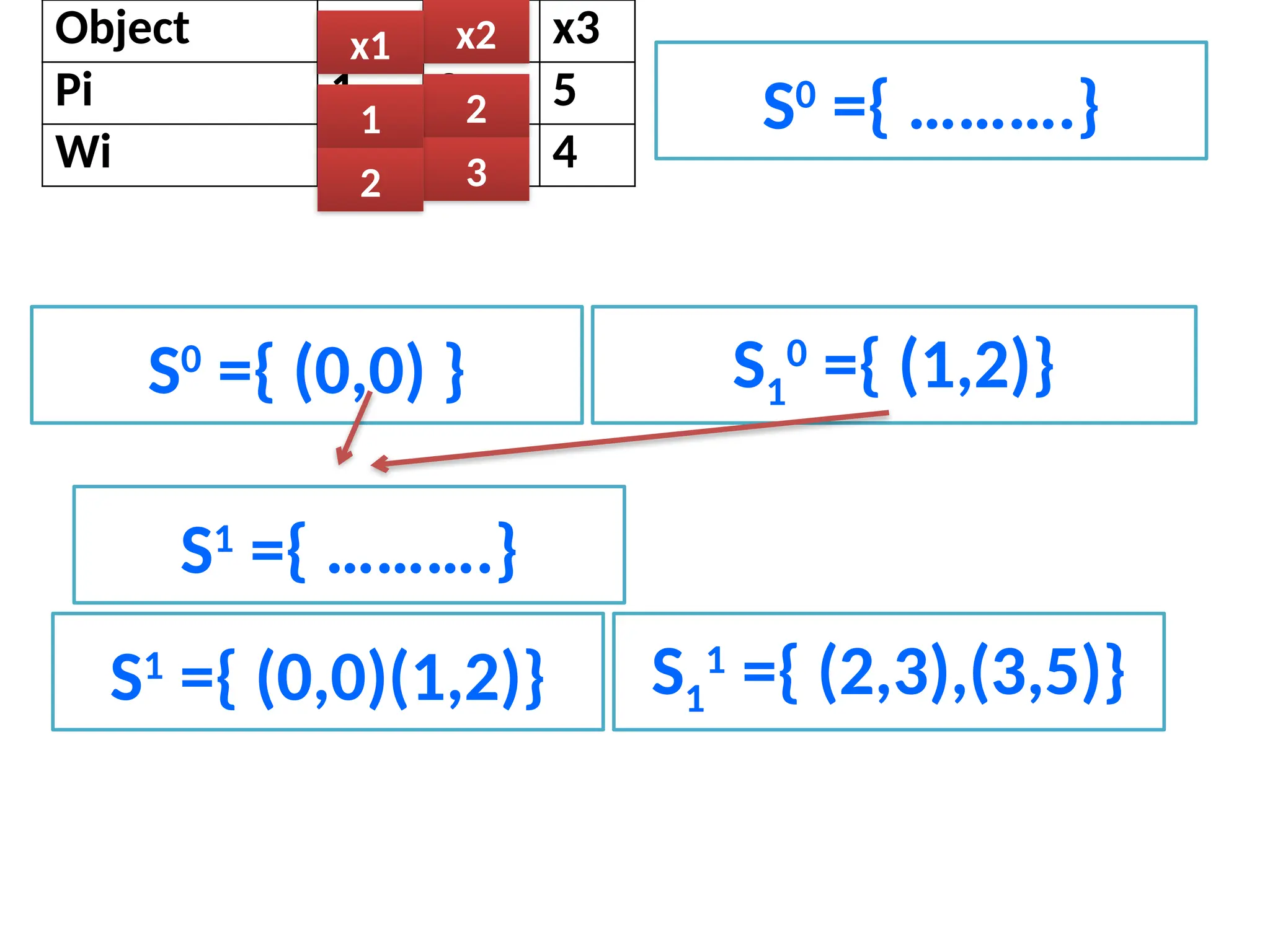
Object x1 x2 x3
Pi 1 2 5
Wi 2 3 4
S0
={ ……….}
S0
={ (0,0) } S1
0
={ (1,2)}
S1
={ ……….}
S1
={ (0,0)(1,2)} S1
1
={ (2,3),(3,5)}
x2
2
3
x1
1
2
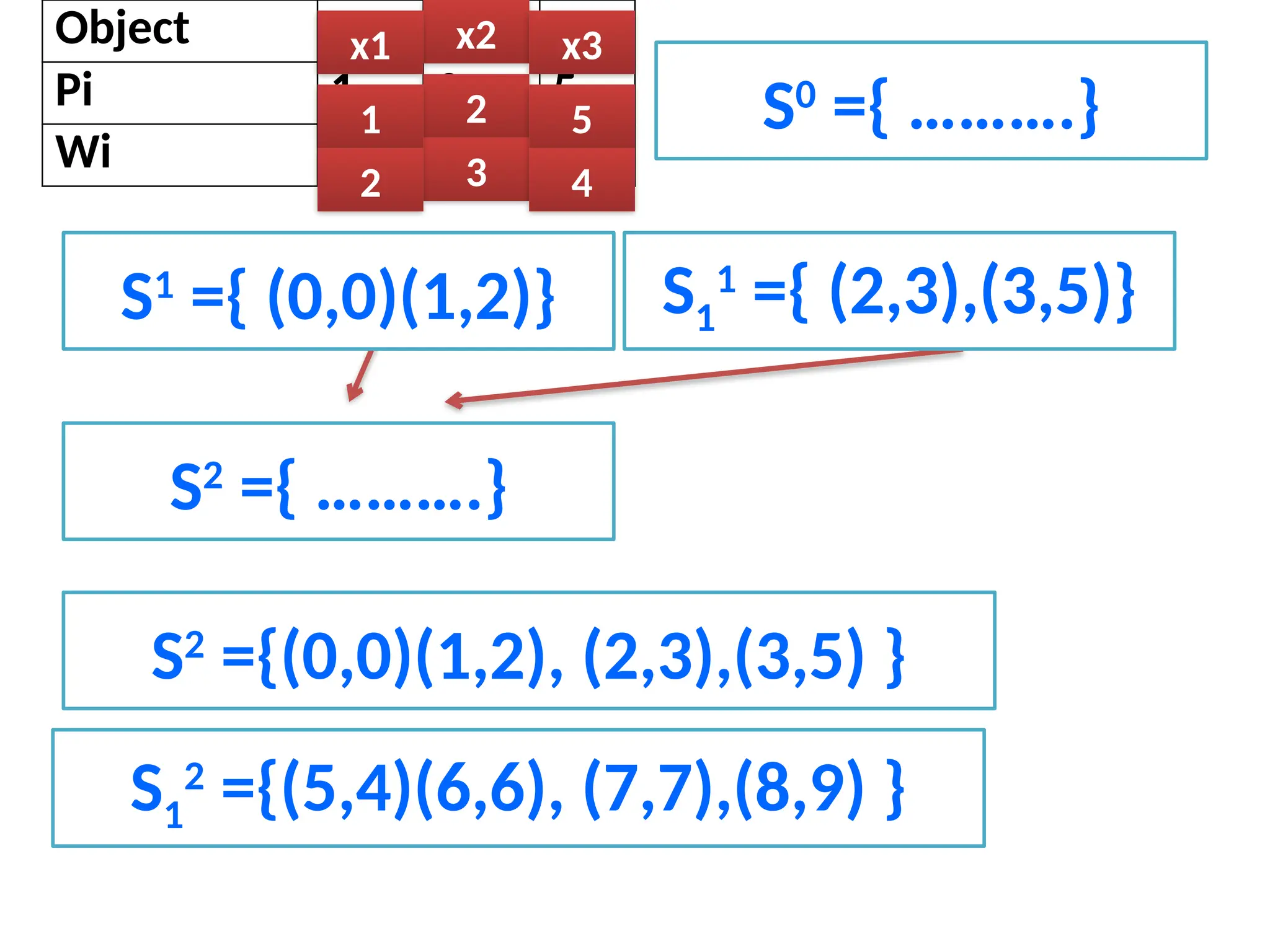
Object x1 x2 x3
Pi 1 2 5
Wi 2 3 4
S0
={ ……….}
S1
={ (0,0)(1,2)} S1
1
={ (2,3),(3,5)}
x2
2
3
x1
1
2
S2
={ ……….}
S2
={(0,0)(1,2), (2,3),(3,5) }
x3
5
4
S1
2
={(5,4)(6,6), (7,7),(8,9) }
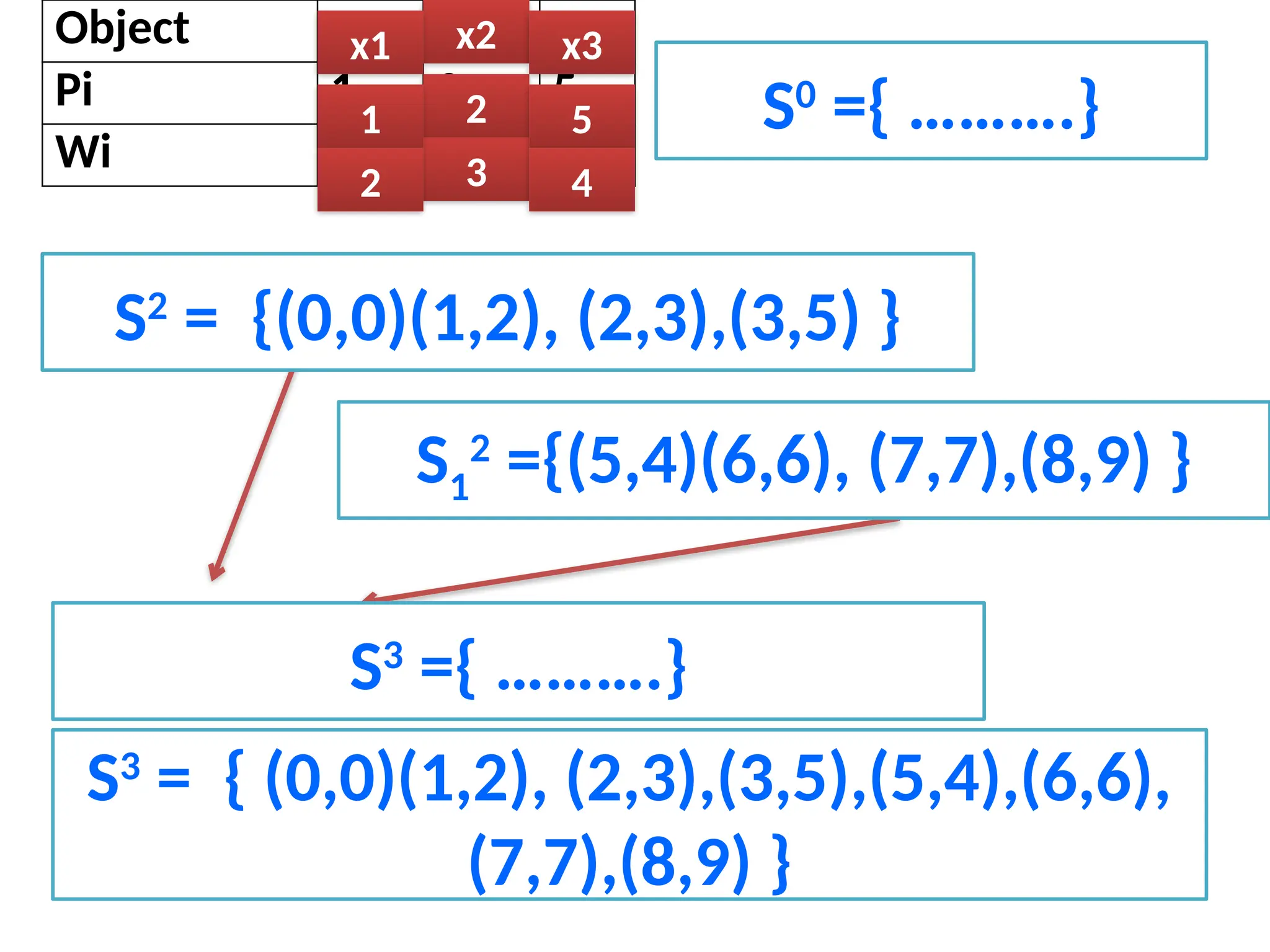
Object x1 x2 x3
Pi 1 2 5
Wi 2 3 4
S0
={ ……….}
x2
2
3
x1
1
2
S2
= {(0,0)(1,2), (2,3),(3,5) }
x3
5
4
S1
2
={(5,4)(6,6), (7,7),(8,9) }
S3
={ ……….}
S3
= { (0,0)(1,2), (2,3),(3,5),(5,4),(6,6),
(7,7),(8,9) }
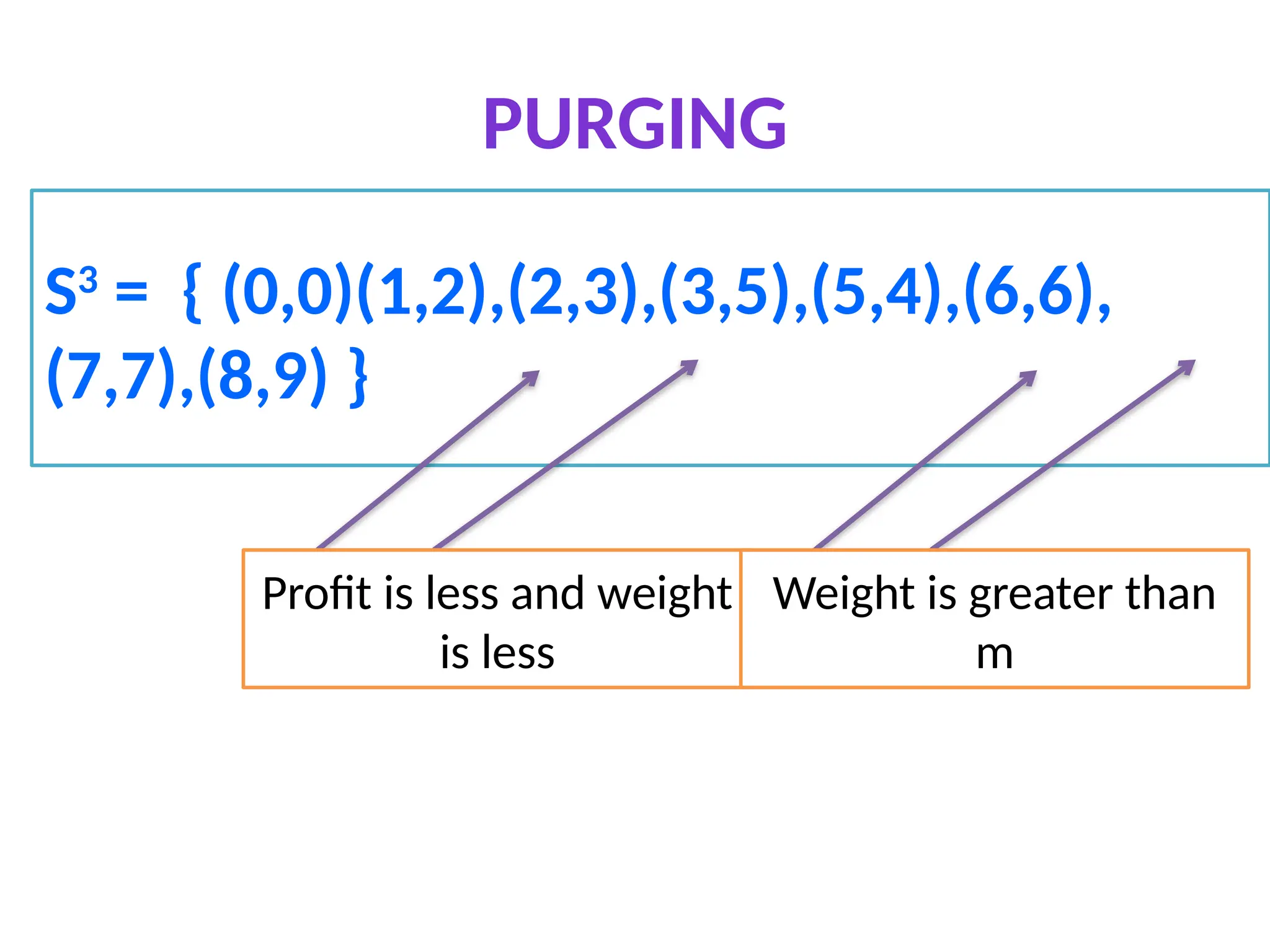
PURGING
S3
= { (0,0)(1,2),(2,3),(3,5),(5,4),(6,6),
(7,7),(8,9) }
Profit is less and weight
is less
Weight is greater than
m
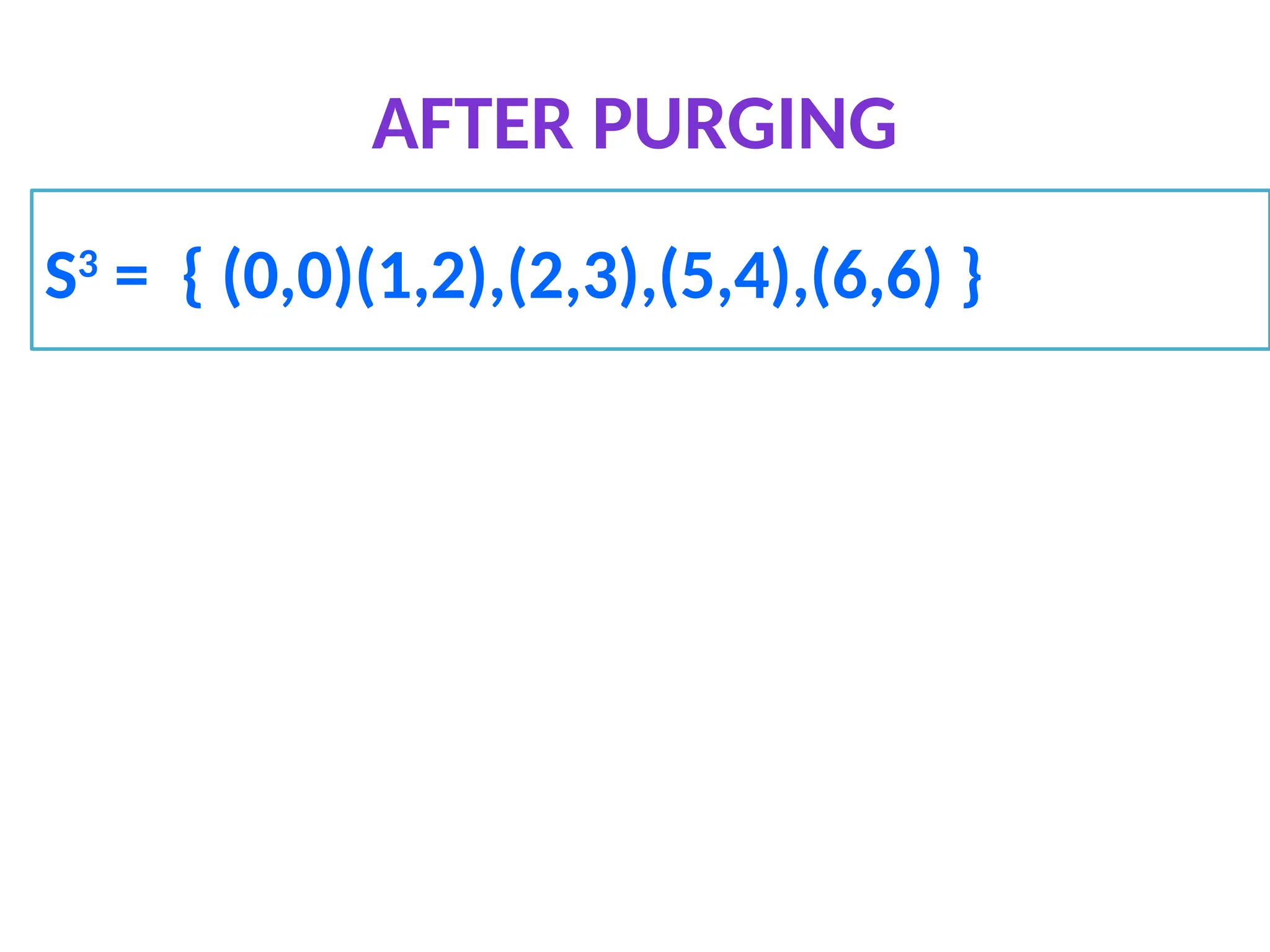
AFTER PURGING
S3
= { (0,0)(1,2),(2,3),(5,4),(6,6) }
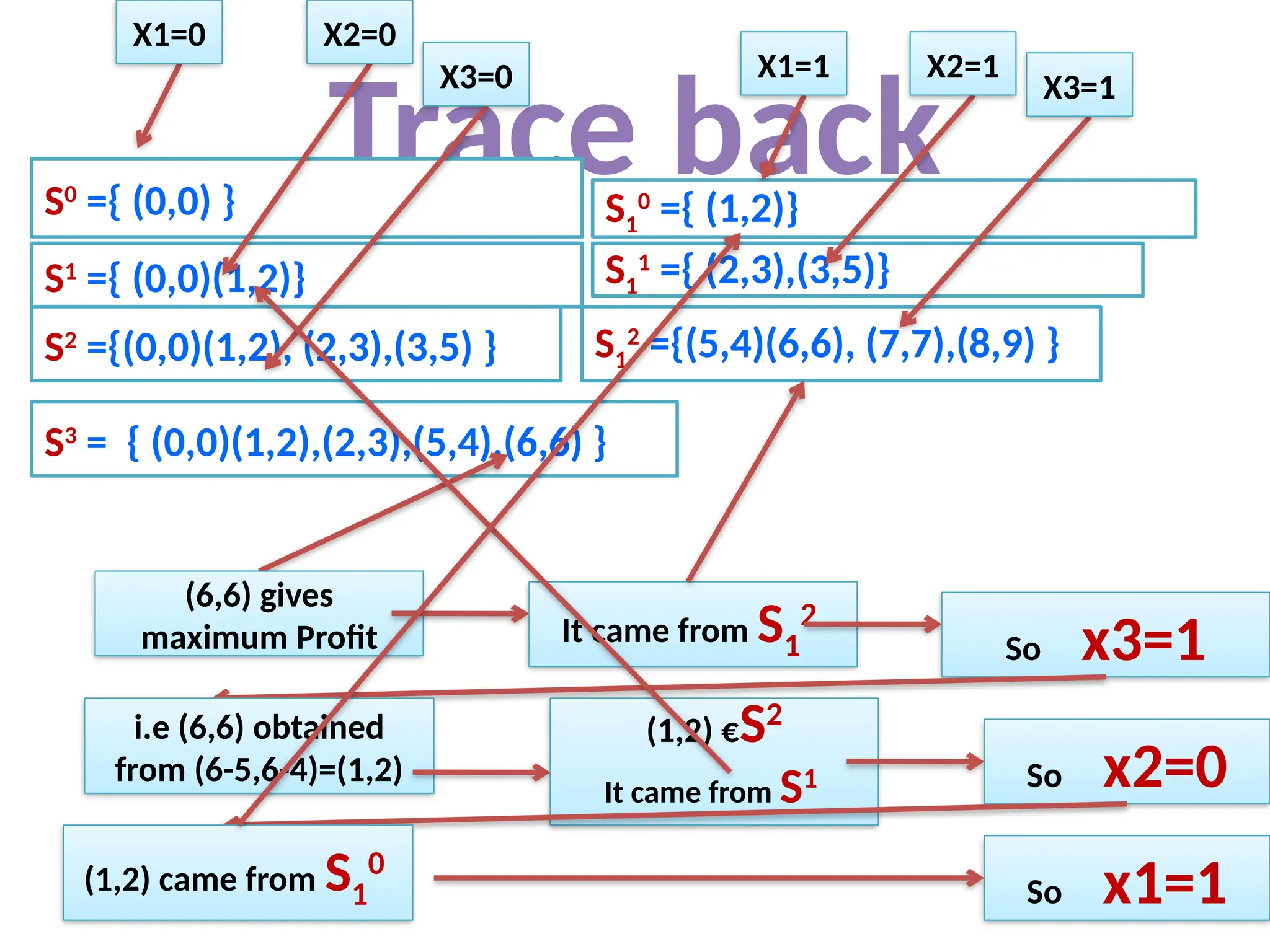
Trace back
S0
={ (0,0) } S1
0
={ (1,2)}
S1
={ (0,0)(1,2)} S1
1
={ (2,3),(3,5)}
S2
={(0,0)(1,2), (2,3),(3,5) } S1
2
={(5,4)(6,6), (7,7),(8,9) }
S3
= { (0,0)(1,2),(2,3),(5,4),(6,6) }
X1=0
X1=1
X2=0
X2=1
X3=0 X3=1
(6,6) gives
maximum Profit It came from S1
2
So x3=1
i.e (6,6) obtained
from (6-5,6-4)=(1,2)
(1,2) €S2
It came from S1 So x2=0
(1,2) came from S1
0
So x1=1
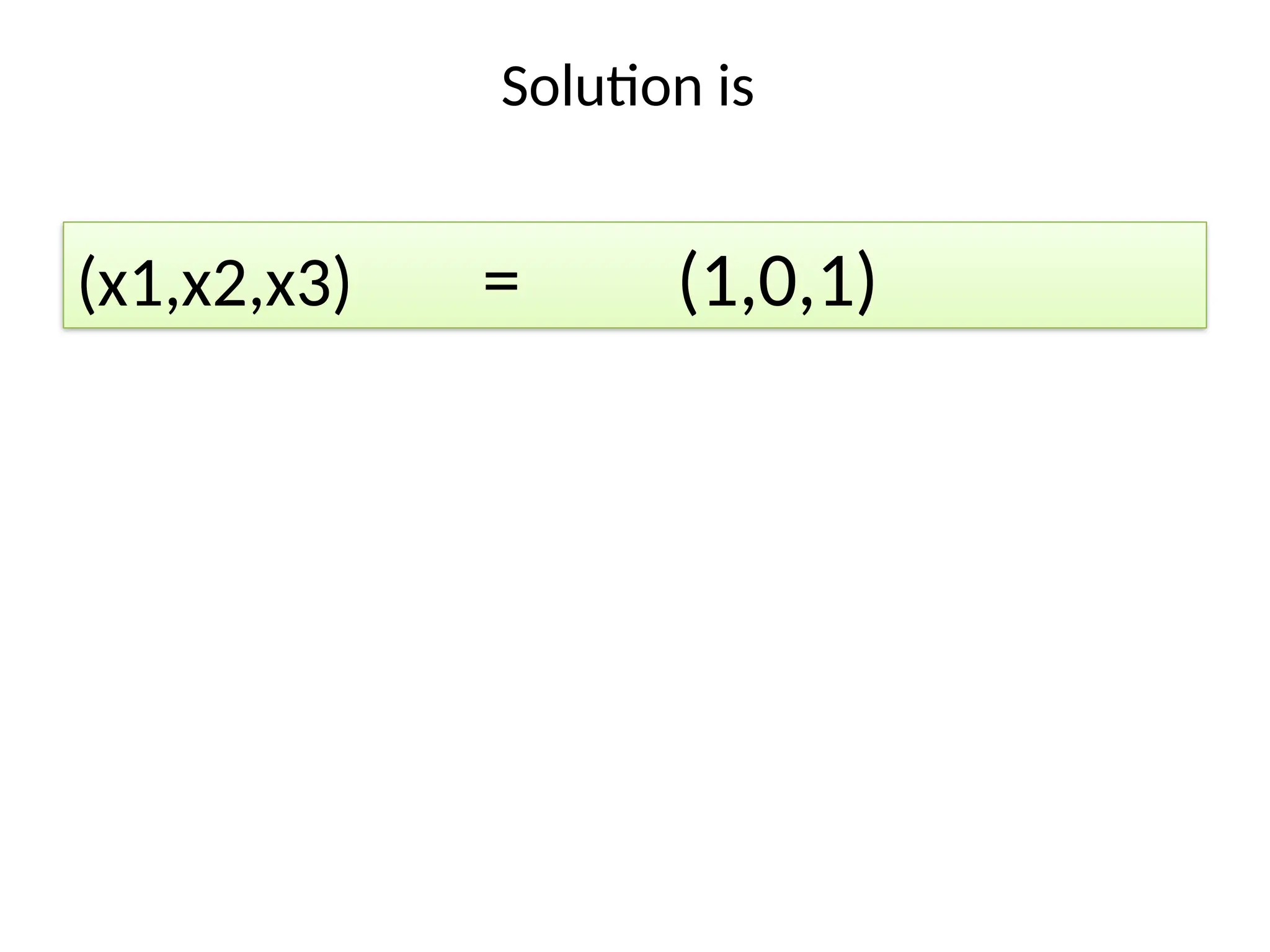
Solution is
(x1,x2,x3) = (1,0,1)
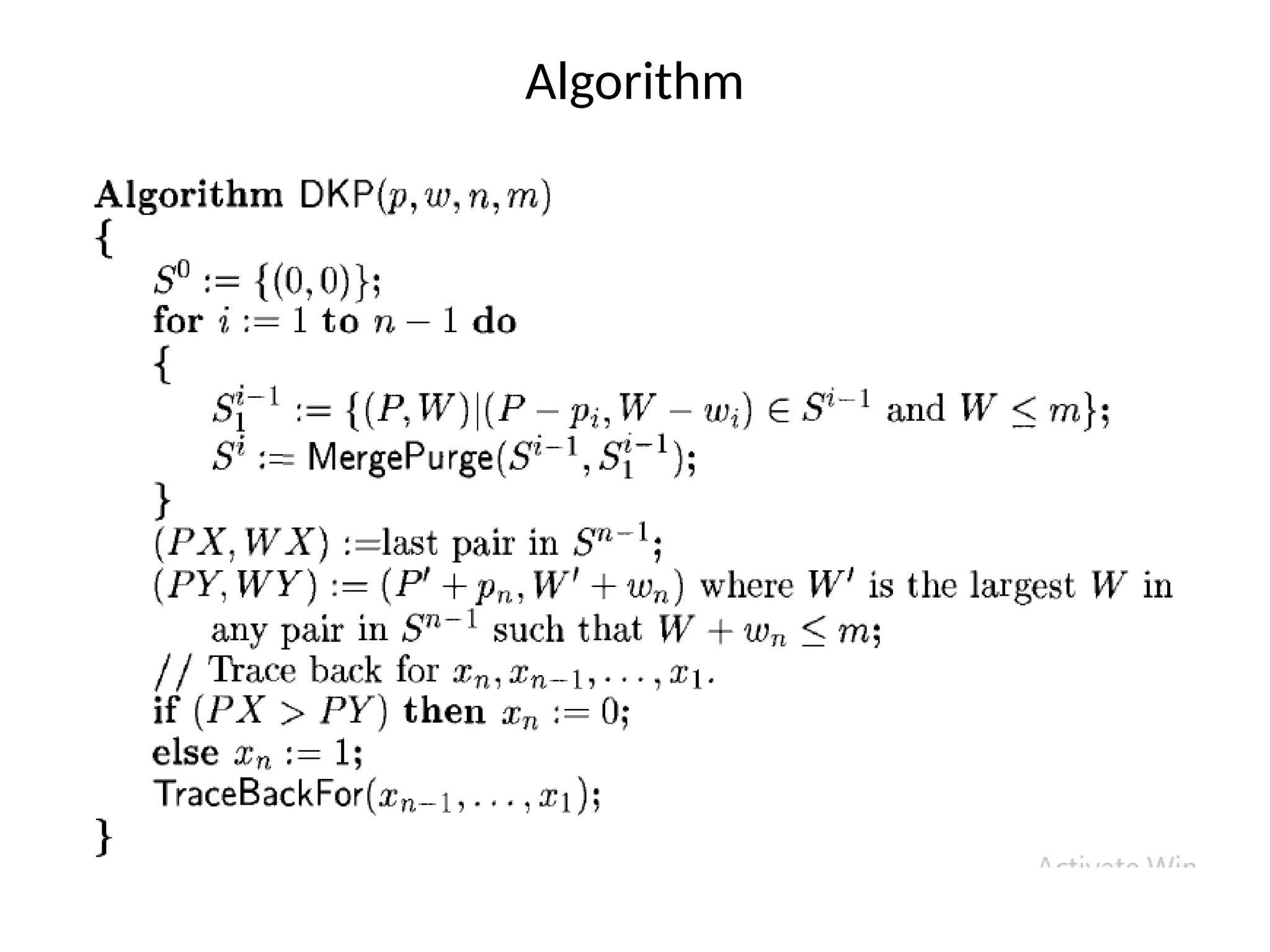
Algorithm

0-1_knapsack_using_DP, types of knapsack

  • 1.
  • 2.
    0/1 Knapsack Problem •We are given a knapsack of capacity m and a set of n objects numbered 1,2,…,n. Each object i has weight wi and profit pi. • Let x = [x1, x2,…, xn] be a solution vector in which xi = 0 if object i is not in the knapsack, and xi = 1 if it is in the knapsack. • The goal is to find a subset of objects to put into the knapsack so that (that is, the objects fit into the knapsack) and is maximized (that is, the profit is maximized).
  • 3.
    0/1 Knapsack Problem •The naive method is to consider all 2n possible subsets of the n objects and choose the one that fits into the knapsack and maximizes the profit. • Let F[i,x] be the maximum profit for a knapsack of capacity x using only objects {1,2,…,i}. The DP formulation is:
  • 4.
    S1 i ={(P,W)|(P-pi+1 ,W- wi+1) € Si } we can compute Si+1 by merging and purging the pairs in Si and S1 i Note :S0 ={(0,0)}
  • 5.
    Purging - • IfSi+1 contains 2 pairs (Pj,Wj) and (Pk,Wk) with property that Pj <= Pk and Wj >= Wk • and weight exceeds capacity of bag
  • 6.
  • 7.
    Object x1 x2x3 Pi 1 2 5 Wi 2 3 4 S0 ={ ……….} S1 ={ ……….} S2 ={ ……….} S3 ={ ……….} S1 0 ={ ……….} S1 1 ={ ……….} S1 2 ={ ……….}
  • 8.
    Object x1 x2x3 Pi 1 2 5 Wi 2 3 4 S0 ={ ……….} S0 ={ (0,0) } S1 0 ={ (1,2)} S1 ={ ……….} S1 ={ (0,0)(1,2)} S1 1 ={ (2,3),(3,5)} x2 2 3 x1 1 2
  • 9.
    Object x1 x2x3 Pi 1 2 5 Wi 2 3 4 S0 ={ ……….} S1 ={ (0,0)(1,2)} S1 1 ={ (2,3),(3,5)} x2 2 3 x1 1 2 S2 ={ ……….} S2 ={(0,0)(1,2), (2,3),(3,5) } x3 5 4 S1 2 ={(5,4)(6,6), (7,7),(8,9) }
  • 10.
    Object x1 x2x3 Pi 1 2 5 Wi 2 3 4 S0 ={ ……….} x2 2 3 x1 1 2 S2 = {(0,0)(1,2), (2,3),(3,5) } x3 5 4 S1 2 ={(5,4)(6,6), (7,7),(8,9) } S3 ={ ……….} S3 = { (0,0)(1,2), (2,3),(3,5),(5,4),(6,6), (7,7),(8,9) }
  • 11.
    PURGING S3 = { (0,0)(1,2),(2,3),(3,5),(5,4),(6,6), (7,7),(8,9)} Profit is less and weight is less Weight is greater than m
  • 12.
    AFTER PURGING S3 = {(0,0)(1,2),(2,3),(5,4),(6,6) }
  • 13.
    Trace back S0 ={ (0,0)} S1 0 ={ (1,2)} S1 ={ (0,0)(1,2)} S1 1 ={ (2,3),(3,5)} S2 ={(0,0)(1,2), (2,3),(3,5) } S1 2 ={(5,4)(6,6), (7,7),(8,9) } S3 = { (0,0)(1,2),(2,3),(5,4),(6,6) } X1=0 X1=1 X2=0 X2=1 X3=0 X3=1 (6,6) gives maximum Profit It came from S1 2 So x3=1 i.e (6,6) obtained from (6-5,6-4)=(1,2) (1,2) €S2 It came from S1 So x2=0 (1,2) came from S1 0 So x1=1
  • 14.
  • 15.