©2014. All rights reserved. Girish Suryanarayana, Ganesh Samarthyam, Tushar Sharma. 
Based on "Refactoring for software design smells: Managing Techincal Debt", Morgan Kaufmann/Elsevier, 2014. 
http://amzn.com/0128013974 
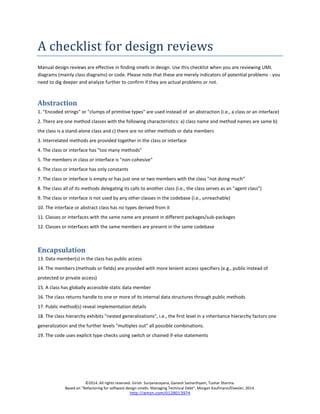
A checklist for design reviews 
Manual design reviews are effective in finding smells in design. Use this checklist when you are reviewing UML diagrams (mainly class diagrams) or code. Please note that these are merely indicators of potential problems - you need to dig deeper and analyze further to confirm if they are actual problems or not. 
Abstraction 
1. "Encoded strings" or "clumps of primitive types" are used instead of an abstraction (i.e., a class or an interface) 
2. There are one method classes with the following characteristics: a) class name and method names are same b) the class is a stand-alone class and c) there are no other methods or data members 
3. Interrelated methods are provided together in the class or interface 
4. The class or interface has "too many methods" 
5. The members in class or interface is "non-cohesive" 
6. The class or interface has only constants 
7. The class or interface is empty or has just one or two members with the class "not doing much" 
8. The class all of its methods delegating its calls to another class (i.e., the class serves as an "agent class") 
9. The class or interface is not used by any other classes in the codebase (i.e., unreachable) 
10. The interface or abstract class has no types derived from it 
11. Classes or interfaces with the same name are present in different packages/sub-packages 
12. Classes or interfaces with the same members are present in the same codebase 
Encapsulation 
13. Data member(s) in the class has public access 
14. The members (methods or fields) are provided with more lenient access specifiers (e.g., public instead of protected or private access) 
15. A class has globally accessible static data member 
16. The class returns handle to one or more of its internal data structures through public methods 
17. Public method(s) reveal implementation details 
18. The class hierarchy exhibits "nested generalizations", i.e., the first level in a inheritance hierarchy factors one generalization and the further levels "multiples out" all possible combinations. 
19. The code uses explicit type checks using switch or chained if-else statements
©2014. All rights reserved. Girish Suryanarayana, Ganesh Samarthyam, Tushar Sharma. 
Based on "Refactoring for software design smells: Managing Techincal Debt", Morgan Kaufmann/Elsevier, 2014. 
http://amzn.com/0128013974 
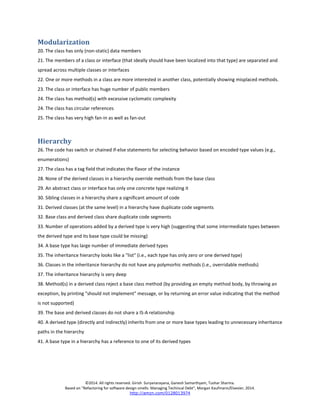
Modularization 
20. The class has only (non-static) data members 
21. The members of a class or interface (that ideally should have been localized into that type) are separated and spread across multiple classes or interfaces 
22. One or more methods in a class are more interested in another class, potentially showing misplaced methods. 
23. The class or interface has huge number of public members 
24. The class has method(s) with excessive cyclomatic complexity 
24. The class has circular references 
25. The class has very high fan-in as well as fan-out 
Hierarchy 
26. The code has switch or chained if-else statements for selecting behavior based on encoded type values (e.g., enumerations) 
27. The class has a tag field that indicates the flavor of the instance 
28. None of the derived classes in a hierarchy override methods from the base class 
29. An abstract class or interface has only one concrete type realizing it 
30. Sibling classes in a hierarchy share a significant amount of code 
31. Derived classes (at the same level) in a hierarchy have duplicate code segments 
32. Base class and derived class share duplicate code segments 
33. Number of operations added by a derived type is very high (suggesting that some intermediate types between the derived type and its base type could be missing) 
34. A base type has large number of immediate derived types 
35. The inheritance hierarchy looks like a "list" (i.e., each type has only zero or one derived type) 
36. Classes in the inheritance hierarchy do not have any polymorhic methods (i.e., overridable methods) 
37. The inheritance hierarchy is very deep 
38. Method(s) in a derived class reject a base class method (by providing an empty method body, by throwing an exception, by printing "should not implement" message, or by returning an error value indicating that the method is not supported) 
39. The base and derived classes do not share a IS-A relationship 
40. A derived type (directly and indirectly) inherits from one or more base types leading to unnecessary inheritance paths in the hierarchy 
41. A base type in a hierarchy has a reference to one of its derived types

A Checklist for Design Reviews

  • 1.
    ©2014. All rightsreserved. Girish Suryanarayana, Ganesh Samarthyam, Tushar Sharma. Based on "Refactoring for software design smells: Managing Techincal Debt", Morgan Kaufmann/Elsevier, 2014. http://amzn.com/0128013974 A checklist for design reviews Manual design reviews are effective in finding smells in design. Use this checklist when you are reviewing UML diagrams (mainly class diagrams) or code. Please note that these are merely indicators of potential problems - you need to dig deeper and analyze further to confirm if they are actual problems or not. Abstraction 1. "Encoded strings" or "clumps of primitive types" are used instead of an abstraction (i.e., a class or an interface) 2. There are one method classes with the following characteristics: a) class name and method names are same b) the class is a stand-alone class and c) there are no other methods or data members 3. Interrelated methods are provided together in the class or interface 4. The class or interface has "too many methods" 5. The members in class or interface is "non-cohesive" 6. The class or interface has only constants 7. The class or interface is empty or has just one or two members with the class "not doing much" 8. The class all of its methods delegating its calls to another class (i.e., the class serves as an "agent class") 9. The class or interface is not used by any other classes in the codebase (i.e., unreachable) 10. The interface or abstract class has no types derived from it 11. Classes or interfaces with the same name are present in different packages/sub-packages 12. Classes or interfaces with the same members are present in the same codebase Encapsulation 13. Data member(s) in the class has public access 14. The members (methods or fields) are provided with more lenient access specifiers (e.g., public instead of protected or private access) 15. A class has globally accessible static data member 16. The class returns handle to one or more of its internal data structures through public methods 17. Public method(s) reveal implementation details 18. The class hierarchy exhibits "nested generalizations", i.e., the first level in a inheritance hierarchy factors one generalization and the further levels "multiples out" all possible combinations. 19. The code uses explicit type checks using switch or chained if-else statements
  • 2.
    ©2014. All rightsreserved. Girish Suryanarayana, Ganesh Samarthyam, Tushar Sharma. Based on "Refactoring for software design smells: Managing Techincal Debt", Morgan Kaufmann/Elsevier, 2014. http://amzn.com/0128013974 Modularization 20. The class has only (non-static) data members 21. The members of a class or interface (that ideally should have been localized into that type) are separated and spread across multiple classes or interfaces 22. One or more methods in a class are more interested in another class, potentially showing misplaced methods. 23. The class or interface has huge number of public members 24. The class has method(s) with excessive cyclomatic complexity 24. The class has circular references 25. The class has very high fan-in as well as fan-out Hierarchy 26. The code has switch or chained if-else statements for selecting behavior based on encoded type values (e.g., enumerations) 27. The class has a tag field that indicates the flavor of the instance 28. None of the derived classes in a hierarchy override methods from the base class 29. An abstract class or interface has only one concrete type realizing it 30. Sibling classes in a hierarchy share a significant amount of code 31. Derived classes (at the same level) in a hierarchy have duplicate code segments 32. Base class and derived class share duplicate code segments 33. Number of operations added by a derived type is very high (suggesting that some intermediate types between the derived type and its base type could be missing) 34. A base type has large number of immediate derived types 35. The inheritance hierarchy looks like a "list" (i.e., each type has only zero or one derived type) 36. Classes in the inheritance hierarchy do not have any polymorhic methods (i.e., overridable methods) 37. The inheritance hierarchy is very deep 38. Method(s) in a derived class reject a base class method (by providing an empty method body, by throwing an exception, by printing "should not implement" message, or by returning an error value indicating that the method is not supported) 39. The base and derived classes do not share a IS-A relationship 40. A derived type (directly and indirectly) inherits from one or more base types leading to unnecessary inheritance paths in the hierarchy 41. A base type in a hierarchy has a reference to one of its derived types