Challenges to Implementing DSpace as a LOR Scott Leslie for COPPUL Distance Education Group May 30, 2006
Outline What a ‘classic’ LOR is ‘supposed’ to do DSpace-specific challenges as a LOR General challenges and pitfalls for LORs
In general, LORs appear to Store actual resources, not just metadata  Be part of a CMS/LMS-centric paradigm Deal with (hopefully) volatile content Contain  diverse  stuff  (as no one really knows what a Learning Object is anyways.)
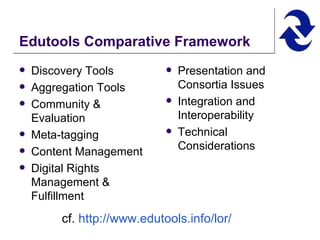
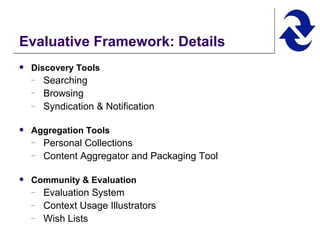
Edutools Comparative Framework Discovery Tools Aggregation Tools Community & Evaluation Meta-tagging Content Management Digital Rights Management & Fulfillment Presentation and Consortia Issues Integration and Interoperability Technical Considerations cf.  http:// www.edutools.info/lor /
Evaluative Framework: Details Discovery Tools Searching Browsing Syndication & Notification Aggregation Tools Personal Collections Content Aggregator and Packaging Tool Community & Evaluation Evaluation System Context Usage Illustrators Wish Lists
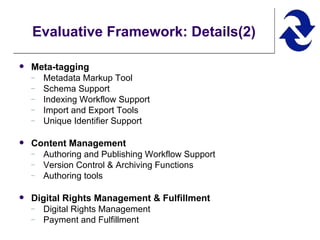
Meta-tagging Metadata Markup Tool Schema Support Indexing Workflow Support Import and Export Tools Unique Identifier Support Content Management Authoring and Publishing Workflow Support Version Control & Archiving Functions Authoring tools Digital Rights Management & Fulfillment Digital Rights Management Payment and Fulfillment Evaluative Framework: Details(2)
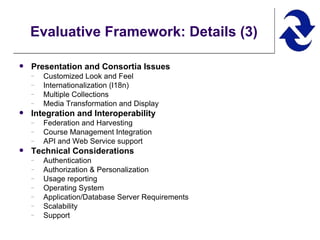
Presentation and Consortia Issues Customized Look and Feel Internationalization (I18n) Multiple Collections Media Transformation and Display Integration and Interoperability Federation and Harvesting Course Management Integration API and Web Service support Technical Considerations Authentication Authorization & Personalization Usage reporting  Operating System Application/Database Server Requirements Scalability Support Evaluative Framework: Details (3)
Challenges for DSpace as a LOR
‘ Perceived’ Shortcomings of DSpace Limited metadata schema support Lack of support for federated searching Lack of useful browseable subject classification  No IMS Content Package support Limited Multi-page Website support Multi-contributor workflows Versioning and content management issues Community evaluation, community building DSpace as a service Others?
Metadata Schema Support Issue:   DSpace currently supports Dublin Core with limited qualifications, whilst most other LORs have used IEEE LOM Possible Mitigations:   Implement LOM in DSpace http://cwspace.mit.edu/wiki/MetadataIssueThree Crosswalks http://wiki.dspace.org/CrosswalkPlugins   http://www.imsproject.org/metadata/mdbestv1p1.html#Dublin2 Disregard, as most of LOM not used anyways http://www.ariadne.ac.uk/issue41/godby/
Federated Searching Issue:   Dpsace supports OAI-PMH, a harvesting model, but not a ‘federated search’ mechanism either between DSpace instances or with other repository software Possible Mitigations:   Implement SQI or one of the other federated search interfaces http://sourceforge.net/mailarchive/message.php?msg_id=11812130   Use SRU/SRW as mechanism to federate search http://www.loc.gov/standards/sru/short-topics.html#federated   OKI OSIDs http:// wiki.dspace.org/SakaiIntegration   Disregard, harvestability is enough/better anyways
Browseable Subject Classification Issue:   Currently DSpace only supports browsing by Title, Author and Date, and the only limited way to structure by subject is through ‘Collections’ Possible Mitigations:   use ‘keywords’ field for either constrained or unconstrained (folksonomic) approach; build interface to ‘browse’ by keywords disregard problem in favour of ‘search’ as main method to retrieve items
IMS Content Packages Issue:  DSpace currently treats IMS Content Packages as binary ‘blobs.’ They need to be previewable on the server, and any existing metadata consumable Possible Mitigations:   work being done in CWSpace to handle Content Packages, or promise of system extensibility in v 2.0 see  http:// wiki.dspace.org/PackagerPlugins   http://wiki.dspace.org/XmlNamespaces_2fCwspaceImscp?action= highlight&value =IMS
Multi-Page Websites Issue:  Many ‘learning objects’ are actually multi-file websites; these need to be EASILY uploaded ‘en masse’ AND EASILY assessable by potential users Possible Mitigations: Upload each file of the site individually using multiple upload controls (ICKK!) ??
Multi-contributor workflows Issue:   Not every object has just one contributor, and not every submitter has all the required info nor will for all time Possible Mitigations:   Disregard, hold to single submitter-to-single-resource model and use moderation as mechanism to add more metadata ??
Versioning and content management Issue:   DSpace has clunky support for multiple versions of content Possible Mitigations:   currently proposed DSpace solution (manually link multiple records together, use relation field) http://wiki.dspace.org/VersioningSupport?action=highlight&value=version   ??
Community Feedback Issue:   DSpace has limited support for the community to express the judgments of value of any piece of content  Possible Mitigations:   Add these on through third party tools or possibly extensions to DSpace
DSpace as a service Issue:   LOR content needs to be consumed in CMS, accessed by authoring tools Possible Mitigations: “ Lightweight Network Interface (for CWSpace)” / WebDav stuff http://wiki.dspace.org/LightweightNetworkInterface?action=highlight&value=WebDAV   OKI OSIDs / Sakai Integration http://wiki.dspace.org/SakaiIntegration
Summary - Specific Challenges If you deploy DSpace “out of the box” as a LOR, then you  may  find users have a difficult time assessing the usefulness of certain types of content you  may  have some interoperability issues with other LORs you  may  have some challenges offering access to the repository contents as a service to specific LMS or authoring tools the system  may  prove cumbersome to working with volatile content or typical learning content authoring workflows
Some Important Projects for  Dspace as a LOR DSpace 2.0 Proposal http://www.dspace.org/conference/presentations/architecture.ppt   CWSpace (Using DSpace for OpenCourseWare) http://cwspace.mit.edu/ d+ (Distributed e-Learning Resources Discovery) http://www.jisc.ac.uk/index.cfm?name=dplus   Using DSpace as a LOR mailing list http://mailman.mit.edu/mailman/listinfo/dspace-lor   (seems to have disappeared, contact Alan Wolf, University of Wisconsin; Louse Ratliff, UCLA for more info)
Some existing LORs using DSpace http://lor.ccconline.cccs.edu/dspace/index.jsp   https://www.dlearn.arizona.edu/index.jsp   http://cwspace.mit.edu/wiki/LorDlearnUnivArizona https://mspace.lib.umanitoba.ca/handle/1993/122
General Issues for LOR Implementers The high cost of metadata / Self-service questionable Intellectual Property/DRM challenges LOs and increasingly questioned LCMS/LMS paradigm LO/LORs ignoring innovations from social software ‘ Reusability’ Paradox of LOs themselves If LORs are the answer, what was the problem again?
At the end of the day… What were the original goals behind Learning Object Repositories / Learning Objects? Share  learning resources and have them reused to increase quality of learning experience decrease cost of producing learning content Help make resources  findable and identifiable  that were formerly not being found or well identified Make clear what people can  do  with the resources and give them access to resources they are  allowed  to use Are there LORs which are achieving this? Which ones? What’s missing from the ones which aren’t doing this? Time? Training? A different paradigm?

Using DSpace as a LOR

  • 1.
    Challenges to ImplementingDSpace as a LOR Scott Leslie for COPPUL Distance Education Group May 30, 2006
  • 2.
    Outline What a‘classic’ LOR is ‘supposed’ to do DSpace-specific challenges as a LOR General challenges and pitfalls for LORs
  • 3.
    In general, LORsappear to Store actual resources, not just metadata Be part of a CMS/LMS-centric paradigm Deal with (hopefully) volatile content Contain diverse stuff (as no one really knows what a Learning Object is anyways.)
  • 4.
    Edutools Comparative FrameworkDiscovery Tools Aggregation Tools Community & Evaluation Meta-tagging Content Management Digital Rights Management & Fulfillment Presentation and Consortia Issues Integration and Interoperability Technical Considerations cf. http:// www.edutools.info/lor /
  • 5.
    Evaluative Framework: DetailsDiscovery Tools Searching Browsing Syndication & Notification Aggregation Tools Personal Collections Content Aggregator and Packaging Tool Community & Evaluation Evaluation System Context Usage Illustrators Wish Lists
  • 6.
    Meta-tagging Metadata MarkupTool Schema Support Indexing Workflow Support Import and Export Tools Unique Identifier Support Content Management Authoring and Publishing Workflow Support Version Control & Archiving Functions Authoring tools Digital Rights Management & Fulfillment Digital Rights Management Payment and Fulfillment Evaluative Framework: Details(2)
  • 7.
    Presentation and ConsortiaIssues Customized Look and Feel Internationalization (I18n) Multiple Collections Media Transformation and Display Integration and Interoperability Federation and Harvesting Course Management Integration API and Web Service support Technical Considerations Authentication Authorization & Personalization Usage reporting Operating System Application/Database Server Requirements Scalability Support Evaluative Framework: Details (3)
  • 8.
  • 9.
    ‘ Perceived’ Shortcomingsof DSpace Limited metadata schema support Lack of support for federated searching Lack of useful browseable subject classification No IMS Content Package support Limited Multi-page Website support Multi-contributor workflows Versioning and content management issues Community evaluation, community building DSpace as a service Others?
  • 10.
    Metadata Schema SupportIssue: DSpace currently supports Dublin Core with limited qualifications, whilst most other LORs have used IEEE LOM Possible Mitigations: Implement LOM in DSpace http://cwspace.mit.edu/wiki/MetadataIssueThree Crosswalks http://wiki.dspace.org/CrosswalkPlugins http://www.imsproject.org/metadata/mdbestv1p1.html#Dublin2 Disregard, as most of LOM not used anyways http://www.ariadne.ac.uk/issue41/godby/
  • 11.
    Federated Searching Issue: Dpsace supports OAI-PMH, a harvesting model, but not a ‘federated search’ mechanism either between DSpace instances or with other repository software Possible Mitigations: Implement SQI or one of the other federated search interfaces http://sourceforge.net/mailarchive/message.php?msg_id=11812130 Use SRU/SRW as mechanism to federate search http://www.loc.gov/standards/sru/short-topics.html#federated OKI OSIDs http:// wiki.dspace.org/SakaiIntegration Disregard, harvestability is enough/better anyways
  • 12.
    Browseable Subject ClassificationIssue: Currently DSpace only supports browsing by Title, Author and Date, and the only limited way to structure by subject is through ‘Collections’ Possible Mitigations: use ‘keywords’ field for either constrained or unconstrained (folksonomic) approach; build interface to ‘browse’ by keywords disregard problem in favour of ‘search’ as main method to retrieve items
  • 13.
    IMS Content PackagesIssue: DSpace currently treats IMS Content Packages as binary ‘blobs.’ They need to be previewable on the server, and any existing metadata consumable Possible Mitigations: work being done in CWSpace to handle Content Packages, or promise of system extensibility in v 2.0 see http:// wiki.dspace.org/PackagerPlugins http://wiki.dspace.org/XmlNamespaces_2fCwspaceImscp?action= highlight&value =IMS
  • 14.
    Multi-Page Websites Issue: Many ‘learning objects’ are actually multi-file websites; these need to be EASILY uploaded ‘en masse’ AND EASILY assessable by potential users Possible Mitigations: Upload each file of the site individually using multiple upload controls (ICKK!) ??
  • 15.
    Multi-contributor workflows Issue: Not every object has just one contributor, and not every submitter has all the required info nor will for all time Possible Mitigations: Disregard, hold to single submitter-to-single-resource model and use moderation as mechanism to add more metadata ??
  • 16.
    Versioning and contentmanagement Issue: DSpace has clunky support for multiple versions of content Possible Mitigations: currently proposed DSpace solution (manually link multiple records together, use relation field) http://wiki.dspace.org/VersioningSupport?action=highlight&value=version ??
  • 17.
    Community Feedback Issue: DSpace has limited support for the community to express the judgments of value of any piece of content Possible Mitigations: Add these on through third party tools or possibly extensions to DSpace
  • 18.
    DSpace as aservice Issue: LOR content needs to be consumed in CMS, accessed by authoring tools Possible Mitigations: “ Lightweight Network Interface (for CWSpace)” / WebDav stuff http://wiki.dspace.org/LightweightNetworkInterface?action=highlight&value=WebDAV OKI OSIDs / Sakai Integration http://wiki.dspace.org/SakaiIntegration
  • 19.
    Summary - SpecificChallenges If you deploy DSpace “out of the box” as a LOR, then you may find users have a difficult time assessing the usefulness of certain types of content you may have some interoperability issues with other LORs you may have some challenges offering access to the repository contents as a service to specific LMS or authoring tools the system may prove cumbersome to working with volatile content or typical learning content authoring workflows
  • 20.
    Some Important Projectsfor Dspace as a LOR DSpace 2.0 Proposal http://www.dspace.org/conference/presentations/architecture.ppt CWSpace (Using DSpace for OpenCourseWare) http://cwspace.mit.edu/ d+ (Distributed e-Learning Resources Discovery) http://www.jisc.ac.uk/index.cfm?name=dplus Using DSpace as a LOR mailing list http://mailman.mit.edu/mailman/listinfo/dspace-lor (seems to have disappeared, contact Alan Wolf, University of Wisconsin; Louse Ratliff, UCLA for more info)
  • 21.
    Some existing LORsusing DSpace http://lor.ccconline.cccs.edu/dspace/index.jsp https://www.dlearn.arizona.edu/index.jsp http://cwspace.mit.edu/wiki/LorDlearnUnivArizona https://mspace.lib.umanitoba.ca/handle/1993/122
  • 22.
    General Issues forLOR Implementers The high cost of metadata / Self-service questionable Intellectual Property/DRM challenges LOs and increasingly questioned LCMS/LMS paradigm LO/LORs ignoring innovations from social software ‘ Reusability’ Paradox of LOs themselves If LORs are the answer, what was the problem again?
  • 23.
    At the endof the day… What were the original goals behind Learning Object Repositories / Learning Objects? Share learning resources and have them reused to increase quality of learning experience decrease cost of producing learning content Help make resources findable and identifiable that were formerly not being found or well identified Make clear what people can do with the resources and give them access to resources they are allowed to use Are there LORs which are achieving this? Which ones? What’s missing from the ones which aren’t doing this? Time? Training? A different paradigm?