TREADMILL TESTING
introduction
• Exercise electrocardiographic testing is among the most
fundamental and widely used tests for the evaluation of
patients with CVD
• It is easy to perform, and interpret; it is flexible and
adaptable; and it is reliable, inexpensive, and readily available
in hospital or practice settings.
• The exercise test has been used by clinicians for more than half
a century, and its durability can be attributed to its evolution
over time
INDICATIONS OF EXERCISE TESTING
• Elicit abnormalities not present at rest
• Estimate functional capacity
• Estimate prognosis of CAD
• Likelihood of coronary artery disease
• Extent of coronary artery disease
• Effect of treatment
• Evaluation and management of patients with a wide variety of
cardiovascular conditions, including valvular heart disease,
congenital heart diseasearrhythmias, and peripheral arterial
disease (PAD).
3
METHODS
4
• General concerns prior to performing an exercise test include
• Patient preparation
• Choosing a test type
• Choosing a test protocol
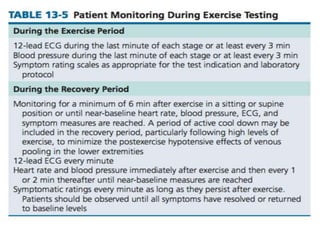
• Patient monitoring
• Reasons to terminate a test
• Post test monitoring
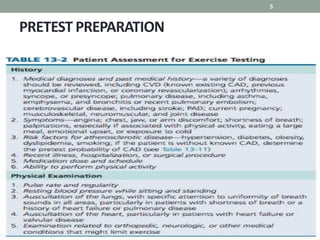
PRETEST PREPARATION
5
 Any history of light headed or fainted while exercising sholud
be asked.
 The physician should also ask about family history and general
medical history, making note of any considerations that may
increase the risk of sudden death.
 A brief physical examination should always be performed prior
to testing to rule out significant outflow obstruction
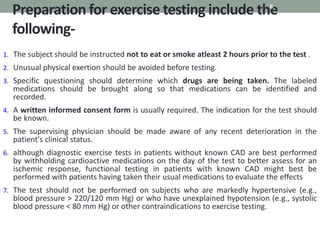
Preparation for exercise testing include the
following-
6
1. The subject should be instructed not to eat or smoke atleast 2 hours prior to the test .
2. Unusual physical exertion should be avoided before testing.
3. Specific questioning should determine which drugs are being taken. The labeled
medications should be brought along so that medications can be identified and
recorded.
4. A written informed consent form is usually required. The indication for the test should
be known.
5. The supervising physician should be made aware of any recent deterioration in the
patient's clinical status.
6. although diagnostic exercise tests in patients without known CAD are best performed
by withholding cardioactive medications on the day of the test to better assess for an
ischemic response, functional testing in patients with known CAD might best be
performed with patients having taken their usual medications to evaluate the effects
7. The test should not be performed on subjects who are markedly hypertensive (e.g.,
blood pressure > 220/120 mm Hg) or who have unexplained hypotension (e.g., systolic
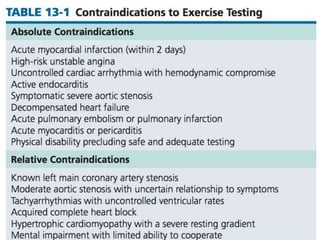
blood pressure < 80 mm Hg) or other contraindications to exercise testing.
EXERCISE PROTOCOLS
1. Isotonic or dynamic exercise,
2. isometric or static exercise,
3. resistive (combined isometric and isotonic) exercise.
• Dynamic protocols are most frequently used to assess
cardiovascular reserve, and those suitable for clinical testing
should include a low-intensity warm-up phase.
• In general, 6 to 12 minutes of continuous progressive exercise
during which the myocardial oxygen demand is elevated to the
patient's maximal level is optimal for diagnostic and prognostic
purposes.
• The protocol should include a suitable recovery or cool-down
period.
DYNAMIC EXERCISES
• Arm Ergometry
• Bicycle Ergometry
• Treadmill test
• Walk Test
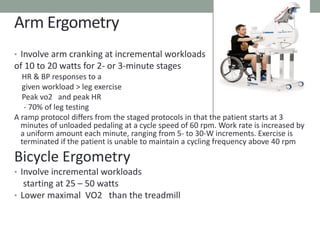
Arm Ergometry
• Involve arm cranking at incremental workloads
of 10 to 20 watts for 2- or 3-minute stages
HR & BP responses to a
given workload > leg exercise
Peak vo2 and peak HR
- 70% of leg testing
A ramp protocol differs from the staged protocols in that the patient starts at 3
minutes of unloaded pedaling at a cycle speed of 60 rpm. Work rate is increased by
a uniform amount each minute, ranging from 5- to 30-W increments. Exercise is
terminated if the patient is unable to maintain a cycling frequency above 40 rpm
Bicycle Ergometry
• Involve incremental workloads
starting at 25 – 50 watts
• Lower maximal VO2 than the treadmill
Treadmill Protocols
• Bruce
• Modified Bruce
• Cornell
• Blake ware
• Naughton and Weber
• ACIP (Asymptomatic cardiac ischemia pilot)
• Modified ACIP
13
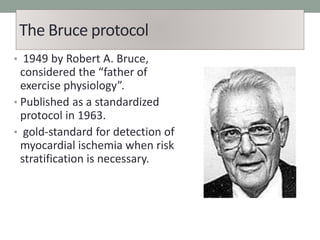
The Bruce protocol
• 1949 by Robert A. Bruce,
considered the “father of
exercise physiology”.
• Published as a standardized
protocol in 1963.
• gold-standard for detection of
myocardial ischemia when risk
stratification is necessary.
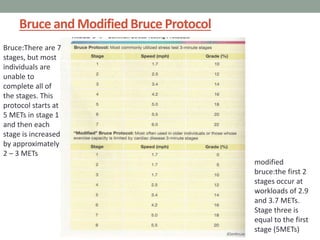
Bruce and ModifiedBruce Protocol
Bruce:There are 7
stages, but most
individuals are
unable to
complete all of
the stages. This
protocol starts at
5 METs in stage 1
and then each
stage is increased
by approximately
2 – 3 METs
modified
bruce:the first 2
stages occur at
workloads of 2.9
and 3.7 METs.
Stage three is
equal to the first
stage (5METs)
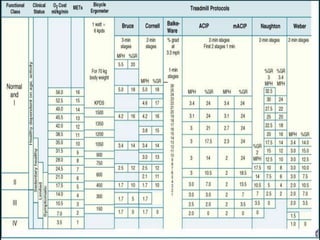
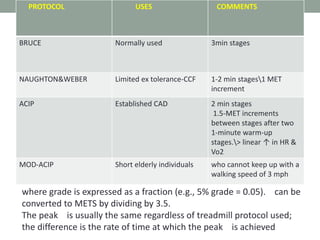
where grade is expressed as a fraction (e.g., 5% grade = 0.05). can be
converted to METS by dividing by 3.5.
The peak is usually the same regardless of treadmill protocol used;
the difference is the rate of time at which the peak is achieved
PROTOCOL USES COMMENTS
BRUCE Normally used 3min stages
NAUGHTON&WEBER Limited ex tolerance-CCF 1-2 min stages1 MET
increment
ACIP Established CAD 2 min stages
1.5-MET increments
between stages after two
1-minute warm-up
stages.> linear ↑ in HR &
Vo2
MOD-ACIP Short elderly individuals who cannot keep up with a
walking speed of 3 mph
The 6-Minute Walk Test
17
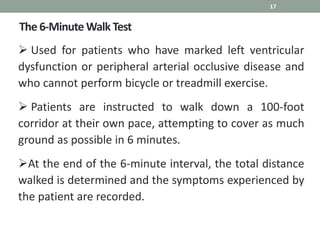
 Used for patients who have marked left ventricular
dysfunction or peripheral arterial occlusive disease and
who cannot perform bicycle or treadmill exercise.
 Patients are instructed to walk down a 100-foot
corridor at their own pace, attempting to cover as much
ground as possible in 6 minutes.
At the end of the 6-minute interval, the total distance
walked is determined and the symptoms experienced by
the patient are recorded.
ECG MEASUREMENTS
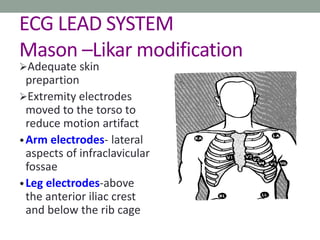
ECG LEAD SYSTEM
Mason –Likar modification
Adequate skin
prepartion
Extremity electrodes
moved to the torso to
reduce motion artifact
•Arm electrodes- lateral
aspects of infraclavicular
fossae
•Leg electrodes-above
the anterior iliac crest
and below the rib cage
Mason –Likar modification
It results in
• Right axis shift
• Increased voltage in inferior leads
• May produce loss of inferior Q waves and development of new Q
waves in lead aVL
Thus, the body torso limb lead positions cannot be used to
interpret a diagnostic rest 12-lead ECG
Types of ST Segment Displacement
In normal persons
•The PR, QRS, and QT intervals shorten as heart rate
increases
•P amplitude increases
•PR segment becomes progressively more downsloping
in the inferior leads
•J point or junctional depression will occur
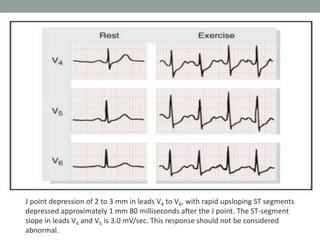
J point depression of 2 to 3 mm in leads V4 to V6, with rapid upsloping ST segments
depressed approximately 1 mm 80 milliseconds after the J point. The ST-segment
slope in leads V4 and V5 is 3.0 mV/sec. This response should not be considered
abnormal.
Types of ST Segment Displacement
In patients with myocardial ischemia
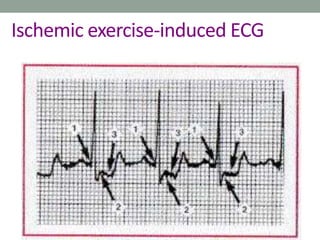
• ST segment usually becomes more horizontal (flattens) as the
severity of the ischemic response worsens.
• With progressive exercise, the depth of ST segment depression may
increase, involving more ECG leads, and the patient may develop
angina
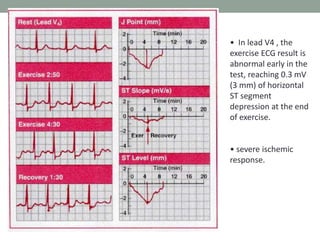
• In lead V4 , the
exercise ECG result is
abnormal early in the
test, reaching 0.3 mV
(3 mm) of horizontal
ST segment
depression at the end
of exercise.
• severe ischemic
response.
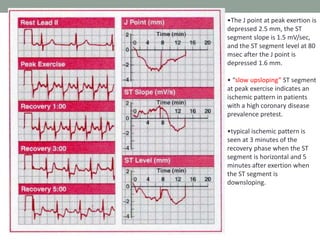
•The J point at peak exertion is
depressed 2.5 mm, the ST
segment slope is 1.5 mV/sec,
and the ST segment level at 80
msec after the J point is
depressed 1.6 mm.
• “slow upsloping” ST segment
at peak exercise indicates an
ischemic pattern in patients
with a high coronary disease
prevalence pretest.
•typical ischemic pattern is
seen at 3 minutes of the
recovery phase when the ST
segment is horizontal and 5
minutes after exertion when
the ST segment is
downsloping.
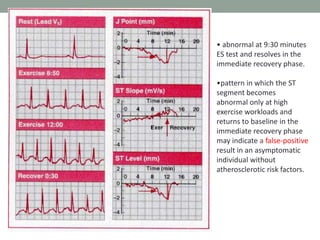
• abnormal at 9:30 minutes
ES test and resolves in the
immediate recovery phase.
•pattern in which the ST
segment becomes
abnormal only at high
exercise workloads and
returns to baseline in the
immediate recovery phase
may indicate a false-positive
result in an asymptomatic
individual without
atherosclerotic risk factors.
Types of ST Segment Displacement
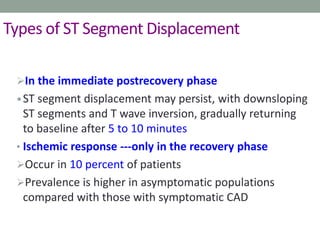
In the immediate postrecovery phase
•ST segment displacement may persist, with downsloping
ST segments and T wave inversion, gradually returning
to baseline after 5 to 10 minutes
• Ischemic response ---only in the recovery phase
Occur in 10 percent of patients
Prevalence is higher in asymptomatic populations
compared with those with symptomatic CAD
MEASUREMENT OF ST SEGMENT DISPLACEMENT
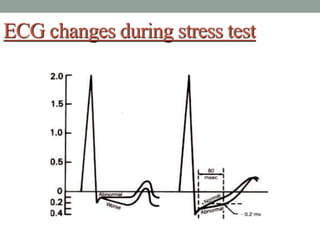
True isoelectric point ----TP segment
•For purposes of interpretation--- PQ junction is usually
chosen as the isoelectric point
Abnormal response
•The development of 1 mm or greater of J point depression
•with a relatively flat ST segment slope (<1 mV/sec)
• depressed greater than or equal to 0.10 mV 80 msec after
the J point (ST 80) in three consecutive beats with a stable
baseline
ECG changes during stress test
Ischemic exercise-induced ECG
MEASUREMENT OF ST SEGMENT
DISPLACEMENT
When the ST 80 measurement is difficult to determine at
rapid heart rates (e.g., >130 beats/min), the ST 60
measurement should be used.
The ST segment at rest may occasionally be depressed.
When this occurs, the J point and ST 60 or ST 80
measurements should be depressed an additional 0.10 mV
or greater to be considered
When the degree of resting ST segment depression is 0.1
mV or greater, the exercise ECG becomes less specific, and
myocardial imaging modalities should be considered
MEASUREMENT OF ST SEGMENT DISPLACEMENT
In early repolarization
• Normal response---Resting ST segment elevation returns to the PQ
junction
• Magnitude of exercise-induced ST segment depression should be
determined from the PQ junction and not from the elevated
position of the J point before exercise
MEASUREMENT OF ST SEGMENT
DISPLACEMENT
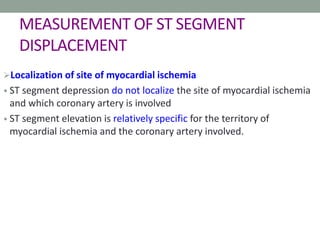
Localization of site of myocardial ischemia
• ST segment depression do not localize the site of myocardial ischemia
and which coronary artery is involved
• ST segment elevation is relatively specific for the territory of
myocardial ischemia and the coronary artery involved.
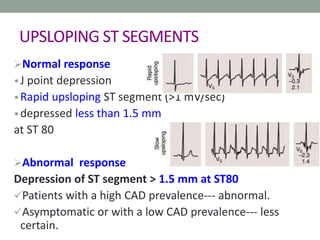
UPSLOPING ST SEGMENTS
Normal response
•J point depression
•Rapid upsloping ST segment (>1 mV/sec)
•depressed less than 1.5 mm
at ST 80
Abnormal response
Depression of ST segment > 1.5 mm at ST80
Patients with a high CAD prevalence--- abnormal.
Asymptomatic or with a low CAD prevalence--- less
certain.
ST SEGMENT ELEVATION
ST segment elevation may occur in
• an infarct territory where Q waves are present
• in a noninfarct territory.
Abnormal response
1 mm elevation at ST60 for 3 consecutive beats with a stable
baseline.
ST SEGMENT ELEVATION
ST segment elevation in leads with abnormal Q waves
• Occur in 30% of anterior MI & 15% of inferior MI
• Have a lower ejection fraction
• greater severity of resting wall motion abnormalities
• worse prognosis.
• not a marker of more extensive CAD
• rarely indicates myocardial ischemia.
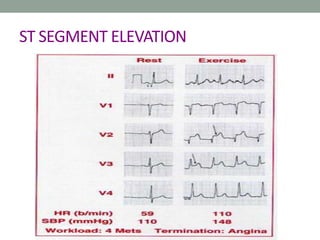
ST SEGMENT ELEVATION
ST segment elevation in leads without Q waves
Indicates transmural myocardial ischemia caused by coronary
vasospasm or a high-grade coronary narrowing
Occurring in a 1 percent of patients with obstructive CAD.
Site of ST segment elevation is relatively specific for the coronary
artery involved
ST SEGMENT ELEVATION
T WAVE CHANGES
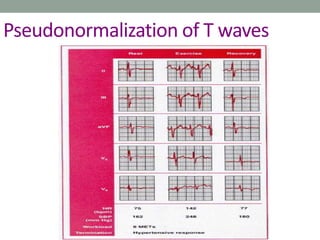
 Pseudonormalization of T waves
• T-waves inverted at rest and becoming upright with exercise
• Nondiagnostic finding --- in low CAD prevalence populations
• In rare instance--- marker for myocardial ischemia
Pseudonormalization of T waves
OTHER ECG MARKERS
Changes in R wave amplitude
Relatively nonspecific and are related to the level of exercise
performed
In LVH the ST segment response cannot be used reliably to
diagnose CAD
U wave inversion
may occasionally be seen in the precordial leads at heart rates of
120 beats/min
Relatively specific and relatively insensitive for CAD
ST/HR SLOPE MAESUREMENTS
• HR adj of ST seg dep-↑ sensitivity
• ST/HR slope of 2.4 mV/beats/min-abnormal
• >6mV/beats/min -3 vessel disease
• CORNELL protocol-gradual inc in HR
• ST seg/HR index-av change of ST depression with HR
through out the course of exercise test
• > 1.6 -abnormal
NONELECTROCARDIOGRAPHIC
OBSERVATIONS
Blood Pressure
Normal Exercise response
• SBP - Increase to 160 to 200 mm HG
• DBP - Does not change significantly
In LV dysfunction (or) an excessive reduction in systemic vascular
resistance
• Failure to increase SBP> 120 mm HG
• (or) Sustained decrease > 10 mm HG repeatable within 15 seconds
• (or) Fall in SBP below standing rest values
Exertional Hypotension
Ranges from 3 to 9 %
Higher in patients with TVD (or) Left main CAD
Cardiomyopathy
Cardiac arrhythmias
Vasovagal reactions
LVOT Obstruction
On Antihypertensive drugs
Hypovolemia
Prolonged Vigorous Exercise
Work Capacity
Limited work capacity
Associated with increased risk of cardiac events in known(or) suspected CAD
In estimating functional capacity, the amount of work performed
(or exercise stage achieved ) should be the parameter measured
and not the number of minutes of exercise
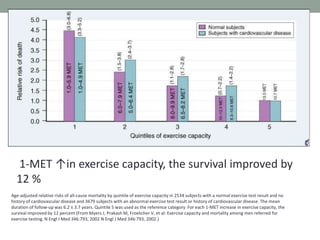
1-MET ↑in exercise capacity, the survival improved by
12 %
Age-adjusted relative risks of all-cause mortality by quintile of exercise capacity in 2534 subjects with a normal exercise test result and no
history of cardiovascular disease and 3679 subjects with an abnormal exercise test result or history of cardiovascular disease. The mean
duration of follow-up was 6.2 ± 3.7 years. Quintile 5 was used as the reference category. For each 1-MET increase in exercise capacity, the
survival improved by 12 percent (From Myers J, Prakash M, Froelicher V, et al: Exercise capacity and mortality among men referred for
exercise testing. N Engl J Med 346:793, 2002 N Engl J Med 346:793, 2002.)
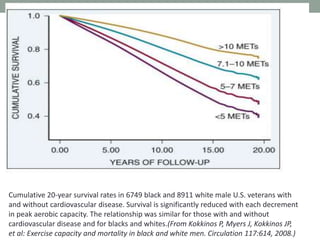
Cumulative 20-year survival rates in 6749 black and 8911 white male U.S. veterans with
and without cardiovascular disease. Survival is significantly reduced with each decrement
in peak aerobic capacity. The relationship was similar for those with and without
cardiovascular disease and for blacks and whites.(From Kokkinos P, Myers J, Kokkinos JP,
et al: Exercise capacity and mortality in black and white men. Circulation 117:614, 2008.)
Heart rate response
Sinus rate increases progressively with exercise.
Inappropriate increase in heart rate at low work loads -
• Atrial fibrillation
• Physically deconditioned
• Hypovolumic
• Anemia
• Marginal left ventricular function
• When the heart rate fails to incraese appropriately with
exercise it is associated with adverse prognosis
Maximum Heart Rate
• The maximum heart rate with exercise is a fundamental physiologic
parameter that provides the clinician relevant information concerning the
intensity of exercise, the adequacy of the exercise test, the effect of
medications that influence heart rate, the poten- tial contribution to
exercise intolerance, and the patient’s progno- sis
• The maximum achievable heart rate (HRmax) is unique for each patient but
can be estimated by using regression equations that adjust for the patient’s
age. The most familiar equation, which was developed principally in middle-
aged men, is
HRmax = 220 − Age
• Although easy to apply and calculate, there is considerable variability with
this equation, especially in patients with CAD who are taking beta blockers.
Newer equations have been proposed to replace the 220 − age rule to
generate the age-predicted maximum heart rate:
Men: HRmax = 208 − (0.7 × Age)
Women: HRmax = 206 − (0.88 × Age)
CAD with beta blockers: HRmax = 164 − (0.7 × Age)
Sub-Maximal Exercise
• when the peak heart rate achieved is below the age-predicted maximum heart
rate.
• An inadequate study is defined by failure to achieve a predefined goal, such as
85% of the age-predicted maximum heart rate.
• If a patient without known CAD has an inadequate study, the term
nondiagnostic study is often applied. As with all things, this “nondiagnostic”
status is relative.
52
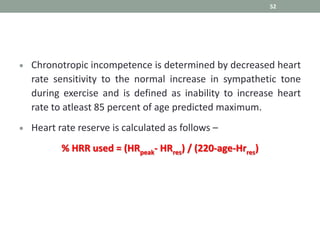
 Chronotropic incompetence is determined by decreased heart
rate sensitivity to the normal increase in sympathetic tone
during exercise and is defined as inability to increase heart
rate to atleast 85 percent of age predicted maximum.
 Heart rate reserve is calculated as follows –
% HRR used = (HRpeak- HRres) / (220-age-Hrres)
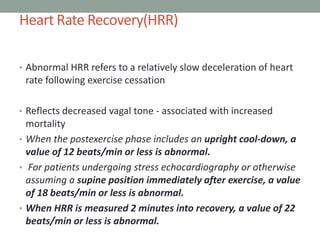
Heart Rate Recovery(HRR)
• Abnormal HRR refers to a relatively slow deceleration of heart
rate following exercise cessation
• Reflects decreased vagal tone - associated with increased
mortality
• When the postexercise phase includes an upright cool-down, a
value of 12 beats/min or less is abnormal.
• For patients undergoing stress echocardiography or otherwise
assuming a supine position immediately after exercise, a value
of 18 beats/min or less is abnormal.
• When HRR is measured 2 minutes into recovery, a value of 22
beats/min or less is abnormal.
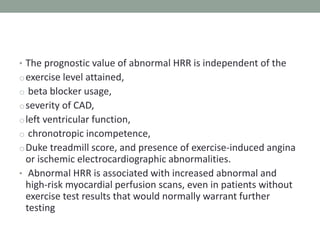
• The prognostic value of abnormal HRR is independent of the
oexercise level attained,
o beta blocker usage,
oseverity of CAD,
oleft ventricular function,
o chronotropic incompetence,
oDuke treadmill score, and presence of exercise-induced angina
or ischemic electrocardiographic abnormalities.
• Abnormal HRR is associated with increased abnormal and
high-risk myocardial perfusion scans, even in patients without
exercise test results that would normally warrant further
testing
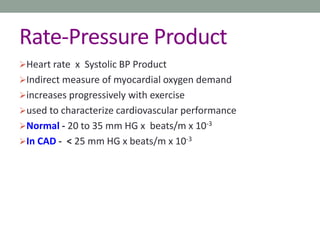
Rate-Pressure Product
Heart rate x Systolic BP Product
Indirect measure of myocardial oxygen demand
increases progressively with exercise
used to characterize cardiovascular performance
Normal - 20 to 35 mm HG x beats/m x 10-3
In CAD - < 25 mm HG x beats/m x 10-3
Chest discomfort
It occurs usually after the onset of ischemic ST segment
depression
In some patients , it may be the only signal of obstructive CAD
In CSA , Chest discomfort occurs less frequently than ischemic
ST segment depression
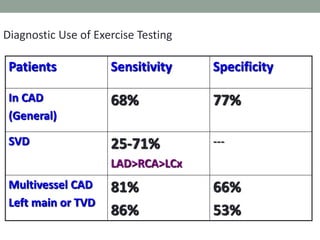
Diagnostic Use of Exercise Testing
66%
53%
81%
86%
Multivessel CAD
Left main or TVD
---25-71%
LAD>RCA>LCx
SVD
77%68%In CAD
(General)
SpecificitySensitivityPatients
• Approximately 75% to 80% of the diagnostic information on
exercise-induced ST-segment depression in patients with a
normal resting ECG is contained in leads V4 to V6.
• The exercise ECG is less specific when patients in whom false-
positive results are more common are included, such as those
with valvular heart disease, left ventricular hypertrophy,
marked resting ST segment depression, or digitalis therapy.
Noncoronary causes of ST
segment depression
Severe aortic stenosis
Severe hypertension
Cardiomyopathy
Anemia
Hypokalemia
Severe hypoxia
Digitalis use
Sudden excessive exercise
Noncoronary causes of ST segment
depression
Glucose load
Left ventricular hypertrophy
Hyperventilation
Mitral valve prolapse
Interventricular conduction disturbance
Preexitation syndrome
Severe volume overload (aortic,mitral regurgitation)
Supraventricular tacyarrhythmias
Bayes’ Theorem
• Incorporates pretest risk of disease & sensitivity and specificity
of test to calculate post-test probability of CAD
• Clinical information and exercise test results are used to make
final estimate about probability of CAD
• Diagnostic power maximal when pretest probability of CAD is
intermediate (30% to 70%)
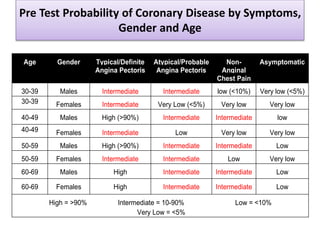
Pretest Probability
• Based on the pat's h/o ( age, gender, chest pain ), phy ex and initial
testing, and the clinician's experience.
• Typical or definite angina →pretest probability high - test result does
not dramatically change the probability.
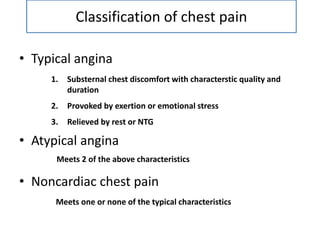
Classification of chest pain
• Typical angina
• Atypical angina
• Noncardiac chest pain
1. Substernal chest discomfort with characterstic quality and
duration
2. Provoked by exertion or emotional stress
3. Relieved by rest or NTG
Meets 2 of the above characteristics
Meets one or none of the typical characteristics
Pre Test Probability of Coronary Disease by Symptoms,
Gender and Age
Age Gender Typical/Definite
Angina Pectoris
Atypical/Probable
Angina Pectoris
Non-
Anginal
Chest Pain
Asymptomatic
30-39 Males Intermediate Intermediate low (<10%) Very low (<5%)
30-39 Females Intermediate Very Low (<5%) Very low Very low
40-49 Males High (>90%) Intermediate Intermediate low
40-49 Females Intermediate Low Very low Very low
50-59 Males High (>90%) Intermediate Intermediate Low
50-59 Females Intermediate Intermediate Low Very low
60-69 Males High Intermediate Intermediate Low
60-69 Females High Intermediate Intermediate Low
High = >90% Intermediate = 10-90% Low = <10%
Very Low = <5%
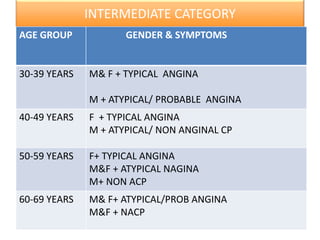
INTERMEDIATE CATEGORY
AGE GROUP GENDER & SYMPTOMS
30-39 YEARS M& F + TYPICAL ANGINA
M + ATYPICAL/ PROBABLE ANGINA
40-49 YEARS F + TYPICAL ANGINA
M + ATYPICAL/ NON ANGINAL CP
50-59 YEARS F+ TYPICAL ANGINA
M&F + ATYPICAL NAGINA
M+ NON ACP
60-69 YEARS M& F+ ATYPICAL/PROB ANGINA
M&F + NACP
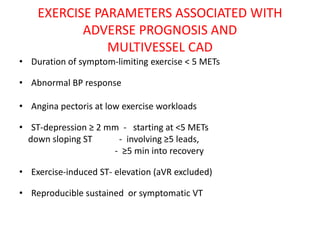
EXERCISE PARAMETERS ASSOCIATED WITH
ADVERSE PROGNOSIS AND
MULTIVESSEL CAD
• Duration of symptom-limiting exercise < 5 METs
• Abnormal BP response
• Angina pectoris at low exercise workloads
• ST-depression ≥ 2 mm - starting at <5 METs
down sloping ST - involving ≥5 leads,
- ≥5 min into recovery
• Exercise-induced ST- elevation (aVR excluded)
• Reproducible sustained or symptomatic VT
.
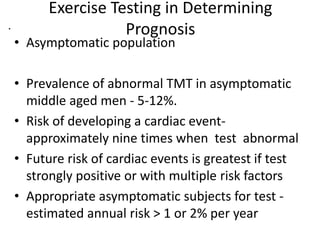
Exercise Testing in Determining
Prognosis
• Asymptomatic population
• Prevalence of abnormal TMT in asymptomatic
middle aged men - 5-12%.
• Risk of developing a cardiac event-
approximately nine times when test abnormal
• Future risk of cardiac events is greatest if test
strongly positive or with multiple risk factors
• Appropriate asymptomatic subjects for test -
estimated annual risk > 1 or 2% per year
Prognostic Value of the Exercise
Electrocardiogram
• Prognostic Variables
The strongest predictor of prognosis derived from
the exercise test is exercise capacity.
• The weakest predictor is ST-segment depression.
• All other variables, such as the heart rate
achieved, HRR, blood pres- sure response,
ventricular arrhythmias, and exercise-induced
angina, fall between these two extremes. This
prognostic hierarchy is similar in both men and
women.
Symptomatic patients
• Exercise ECG should be routinely performed in
patients with chronic CAD before CAG
• Patients with good effort tolerance (>10 METS)
have excellent prognosis regardless of anatomical
extent of CAD.
• Provides an estimate of functional significance of
CAG documented coronary stenoses
RISK ASSESSMENT AND PROGNOSIS in PATIENTS WITH
SYMPTOMS OR PRIOR HISTORY OF CAD
CLASS INDICATION ACC/AHAGuidelines 2002
I 1. Patients undergoing initial evaluation
Exceptions
a. Preexcitation syndrome
b. Electronically paced ventricular rhythm
c. >1 mm of ST-segment depression at rest
d. Complete left bundle branch block
2. Patients after a significant change in cardiac symptoms
3. Low-risk unstable angina patients 8 to 12 hr after presentation who have been
free of active ischemic or heart failure symptoms
4. Intermediate-risk unstable angina patients 2 to 3 days after presentation who
have been free of active ischemic or heart failure symptoms
III
Patients with severe comorbidity likely to limit life expectancy or prevent
revascularization
Duke tread mill score
• Developed by Mark and co-workers
• Provide survival estimates based on results from
exercise test
• Provides accurate prognostic & diagnostic information
• Adds independent prognostic information to that
provided by clinical data & coronary anatomy
• Less effective in estimating risk in subjects > 75
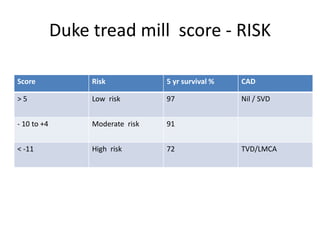
Duke tread mill score - RISK
Score Risk 5 yr survival % CAD
> 5 Low risk 97 Nil / SVD
- 10 to +4 Moderate risk 91
< -11 High risk 72 TVD/LMCA
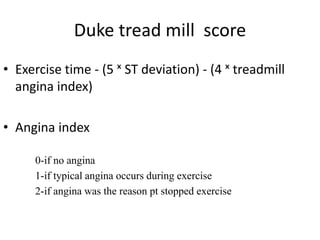
Duke tread mill score
• Exercise time - (5 ˣ ST deviation) - (4 ˣ treadmill
angina index)
• Angina index
0-if no angina
1-if typical angina occurs during exercise
2-if angina was the reason pt stopped exercise
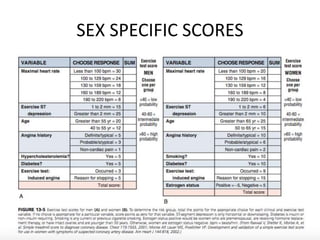
SEX SPECIFIC SCORES
POST MI STATUS
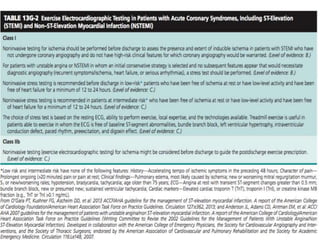
• Since 2002, when the last full set of exercise testing guidelines was
updated,21 treatment of myocardial infarction and evaluation of
post– myocardial infarction patients have evolved greatly. In those
guidelines, exercise testing carried class I indica- tions before
hospital discharge (sub- maximal 4 to 7 days), 14 to 21 days after
discharge (symptom limited if not performed before discharge), and
3 to 6 weeks after discharge (symptom limited if predischarge
submaxi- III mal performed). These recommendations were based
largely on the then existing ACC/AHA guidelines for the
management of acute myo- cardial infarction. In this setting the
exercise test was found to be safe, with a reported mortality rate of
0.03% and a nonfatal event rate of 0.09%.
• Present clinical environment, realistic goals of
exercise testing in the post–myocardial
infarction setting, whenever it is per- formed,
should be threefold: to provide (1) a
functional evaluation to guide the exercise
rehabilitation prescription, (2) a basis for
advice concerning return to work and other
physical activities, and (3) an evaluation of
present therapy.
TREADMILL TESTING

TREADMILL TESTING

  • 1.
  • 2.
    introduction • Exercise electrocardiographictesting is among the most fundamental and widely used tests for the evaluation of patients with CVD • It is easy to perform, and interpret; it is flexible and adaptable; and it is reliable, inexpensive, and readily available in hospital or practice settings. • The exercise test has been used by clinicians for more than half a century, and its durability can be attributed to its evolution over time
  • 3.
    INDICATIONS OF EXERCISETESTING • Elicit abnormalities not present at rest • Estimate functional capacity • Estimate prognosis of CAD • Likelihood of coronary artery disease • Extent of coronary artery disease • Effect of treatment • Evaluation and management of patients with a wide variety of cardiovascular conditions, including valvular heart disease, congenital heart diseasearrhythmias, and peripheral arterial disease (PAD). 3
  • 4.
    METHODS 4 • General concernsprior to performing an exercise test include • Patient preparation • Choosing a test type • Choosing a test protocol • Patient monitoring • Reasons to terminate a test • Post test monitoring
  • 5.
    PRETEST PREPARATION 5  Anyhistory of light headed or fainted while exercising sholud be asked.  The physician should also ask about family history and general medical history, making note of any considerations that may increase the risk of sudden death.  A brief physical examination should always be performed prior to testing to rule out significant outflow obstruction
  • 6.
    Preparation for exercisetesting include the following- 6 1. The subject should be instructed not to eat or smoke atleast 2 hours prior to the test . 2. Unusual physical exertion should be avoided before testing. 3. Specific questioning should determine which drugs are being taken. The labeled medications should be brought along so that medications can be identified and recorded. 4. A written informed consent form is usually required. The indication for the test should be known. 5. The supervising physician should be made aware of any recent deterioration in the patient's clinical status. 6. although diagnostic exercise tests in patients without known CAD are best performed by withholding cardioactive medications on the day of the test to better assess for an ischemic response, functional testing in patients with known CAD might best be performed with patients having taken their usual medications to evaluate the effects 7. The test should not be performed on subjects who are markedly hypertensive (e.g., blood pressure > 220/120 mm Hg) or who have unexplained hypotension (e.g., systolic blood pressure < 80 mm Hg) or other contraindications to exercise testing.
  • 9.
    EXERCISE PROTOCOLS 1. Isotonicor dynamic exercise, 2. isometric or static exercise, 3. resistive (combined isometric and isotonic) exercise. • Dynamic protocols are most frequently used to assess cardiovascular reserve, and those suitable for clinical testing should include a low-intensity warm-up phase. • In general, 6 to 12 minutes of continuous progressive exercise during which the myocardial oxygen demand is elevated to the patient's maximal level is optimal for diagnostic and prognostic purposes. • The protocol should include a suitable recovery or cool-down period.
  • 10.
    DYNAMIC EXERCISES • ArmErgometry • Bicycle Ergometry • Treadmill test • Walk Test
  • 11.
    Arm Ergometry • Involvearm cranking at incremental workloads of 10 to 20 watts for 2- or 3-minute stages HR & BP responses to a given workload > leg exercise Peak vo2 and peak HR - 70% of leg testing A ramp protocol differs from the staged protocols in that the patient starts at 3 minutes of unloaded pedaling at a cycle speed of 60 rpm. Work rate is increased by a uniform amount each minute, ranging from 5- to 30-W increments. Exercise is terminated if the patient is unable to maintain a cycling frequency above 40 rpm Bicycle Ergometry • Involve incremental workloads starting at 25 – 50 watts • Lower maximal VO2 than the treadmill
  • 12.
    Treadmill Protocols • Bruce •Modified Bruce • Cornell • Blake ware • Naughton and Weber • ACIP (Asymptomatic cardiac ischemia pilot) • Modified ACIP
  • 13.
  • 14.
    The Bruce protocol •1949 by Robert A. Bruce, considered the “father of exercise physiology”. • Published as a standardized protocol in 1963. • gold-standard for detection of myocardial ischemia when risk stratification is necessary.
  • 15.
    Bruce and ModifiedBruceProtocol Bruce:There are 7 stages, but most individuals are unable to complete all of the stages. This protocol starts at 5 METs in stage 1 and then each stage is increased by approximately 2 – 3 METs modified bruce:the first 2 stages occur at workloads of 2.9 and 3.7 METs. Stage three is equal to the first stage (5METs)
  • 16.
    where grade isexpressed as a fraction (e.g., 5% grade = 0.05). can be converted to METS by dividing by 3.5. The peak is usually the same regardless of treadmill protocol used; the difference is the rate of time at which the peak is achieved PROTOCOL USES COMMENTS BRUCE Normally used 3min stages NAUGHTON&WEBER Limited ex tolerance-CCF 1-2 min stages1 MET increment ACIP Established CAD 2 min stages 1.5-MET increments between stages after two 1-minute warm-up stages.> linear ↑ in HR & Vo2 MOD-ACIP Short elderly individuals who cannot keep up with a walking speed of 3 mph
  • 17.
    The 6-Minute WalkTest 17  Used for patients who have marked left ventricular dysfunction or peripheral arterial occlusive disease and who cannot perform bicycle or treadmill exercise.  Patients are instructed to walk down a 100-foot corridor at their own pace, attempting to cover as much ground as possible in 6 minutes. At the end of the 6-minute interval, the total distance walked is determined and the symptoms experienced by the patient are recorded.
  • 18.
  • 19.
    ECG LEAD SYSTEM Mason–Likar modification Adequate skin prepartion Extremity electrodes moved to the torso to reduce motion artifact •Arm electrodes- lateral aspects of infraclavicular fossae •Leg electrodes-above the anterior iliac crest and below the rib cage
  • 20.
    Mason –Likar modification Itresults in • Right axis shift • Increased voltage in inferior leads • May produce loss of inferior Q waves and development of new Q waves in lead aVL Thus, the body torso limb lead positions cannot be used to interpret a diagnostic rest 12-lead ECG
  • 21.
    Types of STSegment Displacement In normal persons •The PR, QRS, and QT intervals shorten as heart rate increases •P amplitude increases •PR segment becomes progressively more downsloping in the inferior leads •J point or junctional depression will occur
  • 22.
    J point depressionof 2 to 3 mm in leads V4 to V6, with rapid upsloping ST segments depressed approximately 1 mm 80 milliseconds after the J point. The ST-segment slope in leads V4 and V5 is 3.0 mV/sec. This response should not be considered abnormal.
  • 23.
    Types of STSegment Displacement In patients with myocardial ischemia • ST segment usually becomes more horizontal (flattens) as the severity of the ischemic response worsens. • With progressive exercise, the depth of ST segment depression may increase, involving more ECG leads, and the patient may develop angina
  • 24.
    • In leadV4 , the exercise ECG result is abnormal early in the test, reaching 0.3 mV (3 mm) of horizontal ST segment depression at the end of exercise. • severe ischemic response.
  • 25.
    •The J pointat peak exertion is depressed 2.5 mm, the ST segment slope is 1.5 mV/sec, and the ST segment level at 80 msec after the J point is depressed 1.6 mm. • “slow upsloping” ST segment at peak exercise indicates an ischemic pattern in patients with a high coronary disease prevalence pretest. •typical ischemic pattern is seen at 3 minutes of the recovery phase when the ST segment is horizontal and 5 minutes after exertion when the ST segment is downsloping.
  • 26.
    • abnormal at9:30 minutes ES test and resolves in the immediate recovery phase. •pattern in which the ST segment becomes abnormal only at high exercise workloads and returns to baseline in the immediate recovery phase may indicate a false-positive result in an asymptomatic individual without atherosclerotic risk factors.
  • 27.
    Types of STSegment Displacement In the immediate postrecovery phase •ST segment displacement may persist, with downsloping ST segments and T wave inversion, gradually returning to baseline after 5 to 10 minutes • Ischemic response ---only in the recovery phase Occur in 10 percent of patients Prevalence is higher in asymptomatic populations compared with those with symptomatic CAD
  • 28.
    MEASUREMENT OF STSEGMENT DISPLACEMENT True isoelectric point ----TP segment •For purposes of interpretation--- PQ junction is usually chosen as the isoelectric point Abnormal response •The development of 1 mm or greater of J point depression •with a relatively flat ST segment slope (<1 mV/sec) • depressed greater than or equal to 0.10 mV 80 msec after the J point (ST 80) in three consecutive beats with a stable baseline
  • 29.
    ECG changes duringstress test
  • 30.
  • 31.
    MEASUREMENT OF STSEGMENT DISPLACEMENT When the ST 80 measurement is difficult to determine at rapid heart rates (e.g., >130 beats/min), the ST 60 measurement should be used. The ST segment at rest may occasionally be depressed. When this occurs, the J point and ST 60 or ST 80 measurements should be depressed an additional 0.10 mV or greater to be considered When the degree of resting ST segment depression is 0.1 mV or greater, the exercise ECG becomes less specific, and myocardial imaging modalities should be considered
  • 32.
    MEASUREMENT OF STSEGMENT DISPLACEMENT In early repolarization • Normal response---Resting ST segment elevation returns to the PQ junction • Magnitude of exercise-induced ST segment depression should be determined from the PQ junction and not from the elevated position of the J point before exercise
  • 33.
    MEASUREMENT OF STSEGMENT DISPLACEMENT Localization of site of myocardial ischemia • ST segment depression do not localize the site of myocardial ischemia and which coronary artery is involved • ST segment elevation is relatively specific for the territory of myocardial ischemia and the coronary artery involved.
  • 34.
    UPSLOPING ST SEGMENTS Normalresponse •J point depression •Rapid upsloping ST segment (>1 mV/sec) •depressed less than 1.5 mm at ST 80 Abnormal response Depression of ST segment > 1.5 mm at ST80 Patients with a high CAD prevalence--- abnormal. Asymptomatic or with a low CAD prevalence--- less certain.
  • 35.
    ST SEGMENT ELEVATION STsegment elevation may occur in • an infarct territory where Q waves are present • in a noninfarct territory. Abnormal response 1 mm elevation at ST60 for 3 consecutive beats with a stable baseline.
  • 36.
    ST SEGMENT ELEVATION STsegment elevation in leads with abnormal Q waves • Occur in 30% of anterior MI & 15% of inferior MI • Have a lower ejection fraction • greater severity of resting wall motion abnormalities • worse prognosis. • not a marker of more extensive CAD • rarely indicates myocardial ischemia.
  • 37.
    ST SEGMENT ELEVATION STsegment elevation in leads without Q waves Indicates transmural myocardial ischemia caused by coronary vasospasm or a high-grade coronary narrowing Occurring in a 1 percent of patients with obstructive CAD. Site of ST segment elevation is relatively specific for the coronary artery involved
  • 38.
  • 39.
    T WAVE CHANGES Pseudonormalization of T waves • T-waves inverted at rest and becoming upright with exercise • Nondiagnostic finding --- in low CAD prevalence populations • In rare instance--- marker for myocardial ischemia
  • 40.
  • 41.
    OTHER ECG MARKERS Changesin R wave amplitude Relatively nonspecific and are related to the level of exercise performed In LVH the ST segment response cannot be used reliably to diagnose CAD U wave inversion may occasionally be seen in the precordial leads at heart rates of 120 beats/min Relatively specific and relatively insensitive for CAD
  • 42.
    ST/HR SLOPE MAESUREMENTS •HR adj of ST seg dep-↑ sensitivity • ST/HR slope of 2.4 mV/beats/min-abnormal • >6mV/beats/min -3 vessel disease • CORNELL protocol-gradual inc in HR • ST seg/HR index-av change of ST depression with HR through out the course of exercise test • > 1.6 -abnormal
  • 43.
  • 44.
    Blood Pressure Normal Exerciseresponse • SBP - Increase to 160 to 200 mm HG • DBP - Does not change significantly In LV dysfunction (or) an excessive reduction in systemic vascular resistance • Failure to increase SBP> 120 mm HG • (or) Sustained decrease > 10 mm HG repeatable within 15 seconds • (or) Fall in SBP below standing rest values
  • 45.
    Exertional Hypotension Ranges from3 to 9 % Higher in patients with TVD (or) Left main CAD Cardiomyopathy Cardiac arrhythmias Vasovagal reactions LVOT Obstruction On Antihypertensive drugs Hypovolemia Prolonged Vigorous Exercise
  • 46.
    Work Capacity Limited workcapacity Associated with increased risk of cardiac events in known(or) suspected CAD In estimating functional capacity, the amount of work performed (or exercise stage achieved ) should be the parameter measured and not the number of minutes of exercise
  • 47.
    1-MET ↑in exercisecapacity, the survival improved by 12 % Age-adjusted relative risks of all-cause mortality by quintile of exercise capacity in 2534 subjects with a normal exercise test result and no history of cardiovascular disease and 3679 subjects with an abnormal exercise test result or history of cardiovascular disease. The mean duration of follow-up was 6.2 ± 3.7 years. Quintile 5 was used as the reference category. For each 1-MET increase in exercise capacity, the survival improved by 12 percent (From Myers J, Prakash M, Froelicher V, et al: Exercise capacity and mortality among men referred for exercise testing. N Engl J Med 346:793, 2002 N Engl J Med 346:793, 2002.)
  • 48.
    Cumulative 20-year survivalrates in 6749 black and 8911 white male U.S. veterans with and without cardiovascular disease. Survival is significantly reduced with each decrement in peak aerobic capacity. The relationship was similar for those with and without cardiovascular disease and for blacks and whites.(From Kokkinos P, Myers J, Kokkinos JP, et al: Exercise capacity and mortality in black and white men. Circulation 117:614, 2008.)
  • 49.
    Heart rate response Sinusrate increases progressively with exercise. Inappropriate increase in heart rate at low work loads - • Atrial fibrillation • Physically deconditioned • Hypovolumic • Anemia • Marginal left ventricular function • When the heart rate fails to incraese appropriately with exercise it is associated with adverse prognosis
  • 50.
    Maximum Heart Rate •The maximum heart rate with exercise is a fundamental physiologic parameter that provides the clinician relevant information concerning the intensity of exercise, the adequacy of the exercise test, the effect of medications that influence heart rate, the poten- tial contribution to exercise intolerance, and the patient’s progno- sis • The maximum achievable heart rate (HRmax) is unique for each patient but can be estimated by using regression equations that adjust for the patient’s age. The most familiar equation, which was developed principally in middle- aged men, is HRmax = 220 − Age • Although easy to apply and calculate, there is considerable variability with this equation, especially in patients with CAD who are taking beta blockers. Newer equations have been proposed to replace the 220 − age rule to generate the age-predicted maximum heart rate: Men: HRmax = 208 − (0.7 × Age) Women: HRmax = 206 − (0.88 × Age) CAD with beta blockers: HRmax = 164 − (0.7 × Age)
  • 51.
    Sub-Maximal Exercise • whenthe peak heart rate achieved is below the age-predicted maximum heart rate. • An inadequate study is defined by failure to achieve a predefined goal, such as 85% of the age-predicted maximum heart rate. • If a patient without known CAD has an inadequate study, the term nondiagnostic study is often applied. As with all things, this “nondiagnostic” status is relative.
  • 52.
    52  Chronotropic incompetenceis determined by decreased heart rate sensitivity to the normal increase in sympathetic tone during exercise and is defined as inability to increase heart rate to atleast 85 percent of age predicted maximum.  Heart rate reserve is calculated as follows – % HRR used = (HRpeak- HRres) / (220-age-Hrres)
  • 53.
    Heart Rate Recovery(HRR) •Abnormal HRR refers to a relatively slow deceleration of heart rate following exercise cessation • Reflects decreased vagal tone - associated with increased mortality • When the postexercise phase includes an upright cool-down, a value of 12 beats/min or less is abnormal. • For patients undergoing stress echocardiography or otherwise assuming a supine position immediately after exercise, a value of 18 beats/min or less is abnormal. • When HRR is measured 2 minutes into recovery, a value of 22 beats/min or less is abnormal.
  • 54.
    • The prognosticvalue of abnormal HRR is independent of the oexercise level attained, o beta blocker usage, oseverity of CAD, oleft ventricular function, o chronotropic incompetence, oDuke treadmill score, and presence of exercise-induced angina or ischemic electrocardiographic abnormalities. • Abnormal HRR is associated with increased abnormal and high-risk myocardial perfusion scans, even in patients without exercise test results that would normally warrant further testing
  • 55.
    Rate-Pressure Product Heart ratex Systolic BP Product Indirect measure of myocardial oxygen demand increases progressively with exercise used to characterize cardiovascular performance Normal - 20 to 35 mm HG x beats/m x 10-3 In CAD - < 25 mm HG x beats/m x 10-3
  • 56.
    Chest discomfort It occursusually after the onset of ischemic ST segment depression In some patients , it may be the only signal of obstructive CAD In CSA , Chest discomfort occurs less frequently than ischemic ST segment depression
  • 57.
    Diagnostic Use ofExercise Testing 66% 53% 81% 86% Multivessel CAD Left main or TVD ---25-71% LAD>RCA>LCx SVD 77%68%In CAD (General) SpecificitySensitivityPatients
  • 58.
    • Approximately 75%to 80% of the diagnostic information on exercise-induced ST-segment depression in patients with a normal resting ECG is contained in leads V4 to V6. • The exercise ECG is less specific when patients in whom false- positive results are more common are included, such as those with valvular heart disease, left ventricular hypertrophy, marked resting ST segment depression, or digitalis therapy.
  • 59.
    Noncoronary causes ofST segment depression Severe aortic stenosis Severe hypertension Cardiomyopathy Anemia Hypokalemia Severe hypoxia Digitalis use Sudden excessive exercise
  • 60.
    Noncoronary causes ofST segment depression Glucose load Left ventricular hypertrophy Hyperventilation Mitral valve prolapse Interventricular conduction disturbance Preexitation syndrome Severe volume overload (aortic,mitral regurgitation) Supraventricular tacyarrhythmias
  • 61.
    Bayes’ Theorem • Incorporatespretest risk of disease & sensitivity and specificity of test to calculate post-test probability of CAD • Clinical information and exercise test results are used to make final estimate about probability of CAD • Diagnostic power maximal when pretest probability of CAD is intermediate (30% to 70%)
  • 62.
    Pretest Probability • Basedon the pat's h/o ( age, gender, chest pain ), phy ex and initial testing, and the clinician's experience. • Typical or definite angina →pretest probability high - test result does not dramatically change the probability.
  • 63.
    Classification of chestpain • Typical angina • Atypical angina • Noncardiac chest pain 1. Substernal chest discomfort with characterstic quality and duration 2. Provoked by exertion or emotional stress 3. Relieved by rest or NTG Meets 2 of the above characteristics Meets one or none of the typical characteristics
  • 64.
    Pre Test Probabilityof Coronary Disease by Symptoms, Gender and Age Age Gender Typical/Definite Angina Pectoris Atypical/Probable Angina Pectoris Non- Anginal Chest Pain Asymptomatic 30-39 Males Intermediate Intermediate low (<10%) Very low (<5%) 30-39 Females Intermediate Very Low (<5%) Very low Very low 40-49 Males High (>90%) Intermediate Intermediate low 40-49 Females Intermediate Low Very low Very low 50-59 Males High (>90%) Intermediate Intermediate Low 50-59 Females Intermediate Intermediate Low Very low 60-69 Males High Intermediate Intermediate Low 60-69 Females High Intermediate Intermediate Low High = >90% Intermediate = 10-90% Low = <10% Very Low = <5%
  • 65.
    INTERMEDIATE CATEGORY AGE GROUPGENDER & SYMPTOMS 30-39 YEARS M& F + TYPICAL ANGINA M + ATYPICAL/ PROBABLE ANGINA 40-49 YEARS F + TYPICAL ANGINA M + ATYPICAL/ NON ANGINAL CP 50-59 YEARS F+ TYPICAL ANGINA M&F + ATYPICAL NAGINA M+ NON ACP 60-69 YEARS M& F+ ATYPICAL/PROB ANGINA M&F + NACP
  • 66.
    EXERCISE PARAMETERS ASSOCIATEDWITH ADVERSE PROGNOSIS AND MULTIVESSEL CAD • Duration of symptom-limiting exercise < 5 METs • Abnormal BP response • Angina pectoris at low exercise workloads • ST-depression ≥ 2 mm - starting at <5 METs down sloping ST - involving ≥5 leads, - ≥5 min into recovery • Exercise-induced ST- elevation (aVR excluded) • Reproducible sustained or symptomatic VT
  • 67.
    . Exercise Testing inDetermining Prognosis • Asymptomatic population • Prevalence of abnormal TMT in asymptomatic middle aged men - 5-12%. • Risk of developing a cardiac event- approximately nine times when test abnormal • Future risk of cardiac events is greatest if test strongly positive or with multiple risk factors • Appropriate asymptomatic subjects for test - estimated annual risk > 1 or 2% per year
  • 68.
    Prognostic Value ofthe Exercise Electrocardiogram • Prognostic Variables The strongest predictor of prognosis derived from the exercise test is exercise capacity. • The weakest predictor is ST-segment depression. • All other variables, such as the heart rate achieved, HRR, blood pres- sure response, ventricular arrhythmias, and exercise-induced angina, fall between these two extremes. This prognostic hierarchy is similar in both men and women.
  • 69.
    Symptomatic patients • ExerciseECG should be routinely performed in patients with chronic CAD before CAG • Patients with good effort tolerance (>10 METS) have excellent prognosis regardless of anatomical extent of CAD. • Provides an estimate of functional significance of CAG documented coronary stenoses
  • 70.
    RISK ASSESSMENT ANDPROGNOSIS in PATIENTS WITH SYMPTOMS OR PRIOR HISTORY OF CAD CLASS INDICATION ACC/AHAGuidelines 2002 I 1. Patients undergoing initial evaluation Exceptions a. Preexcitation syndrome b. Electronically paced ventricular rhythm c. >1 mm of ST-segment depression at rest d. Complete left bundle branch block 2. Patients after a significant change in cardiac symptoms 3. Low-risk unstable angina patients 8 to 12 hr after presentation who have been free of active ischemic or heart failure symptoms 4. Intermediate-risk unstable angina patients 2 to 3 days after presentation who have been free of active ischemic or heart failure symptoms III Patients with severe comorbidity likely to limit life expectancy or prevent revascularization
  • 71.
    Duke tread millscore • Developed by Mark and co-workers • Provide survival estimates based on results from exercise test • Provides accurate prognostic & diagnostic information • Adds independent prognostic information to that provided by clinical data & coronary anatomy • Less effective in estimating risk in subjects > 75
  • 72.
    Duke tread millscore - RISK Score Risk 5 yr survival % CAD > 5 Low risk 97 Nil / SVD - 10 to +4 Moderate risk 91 < -11 High risk 72 TVD/LMCA
  • 73.
    Duke tread millscore • Exercise time - (5 ˣ ST deviation) - (4 ˣ treadmill angina index) • Angina index 0-if no angina 1-if typical angina occurs during exercise 2-if angina was the reason pt stopped exercise
  • 74.
  • 75.
    POST MI STATUS •Since 2002, when the last full set of exercise testing guidelines was updated,21 treatment of myocardial infarction and evaluation of post– myocardial infarction patients have evolved greatly. In those guidelines, exercise testing carried class I indica- tions before hospital discharge (sub- maximal 4 to 7 days), 14 to 21 days after discharge (symptom limited if not performed before discharge), and 3 to 6 weeks after discharge (symptom limited if predischarge submaxi- III mal performed). These recommendations were based largely on the then existing ACC/AHA guidelines for the management of acute myo- cardial infarction. In this setting the exercise test was found to be safe, with a reported mortality rate of 0.03% and a nonfatal event rate of 0.09%.
  • 76.
    • Present clinicalenvironment, realistic goals of exercise testing in the post–myocardial infarction setting, whenever it is per- formed, should be threefold: to provide (1) a functional evaluation to guide the exercise rehabilitation prescription, (2) a basis for advice concerning return to work and other physical activities, and (3) an evaluation of present therapy.