Physical education
Project
Submitted to: mrs. saroj (pet)
2016-2017
Submitted by :shivang
xii-d
20
shivang (xii-d)
Index
• Athletics
• Kabbadi (indian sport)
• Yoga
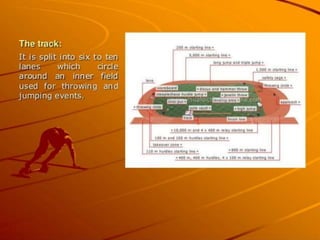
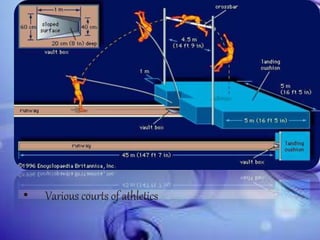
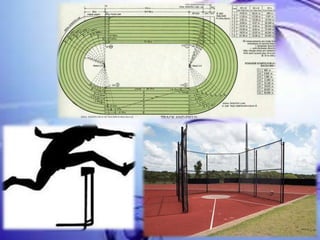
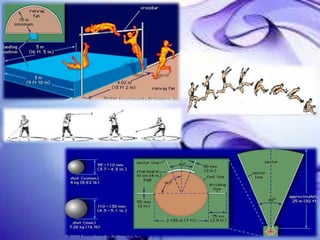
• Various courts of athletics
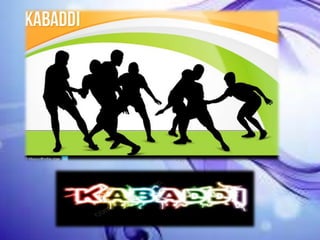
Kabaddi
Kabaddi is a team contact sport. It is popular in
different names.
In the southern parts of India, the game is called
Chedugudu or Hu-Tu-Tu.
In the eastern parts it is fondly called Hadudu (for
men) and Kit-Kit(For women).
The game is known as Kabaddi in northern India.
This game was originated in Tamil Nadu, India for
preparing soldiers.
Kabaddi is the national game of Bangladesh, the state
game of Punjab, Tamil Nadu and Andhra Pradesh in
India.
About Kabaddi:
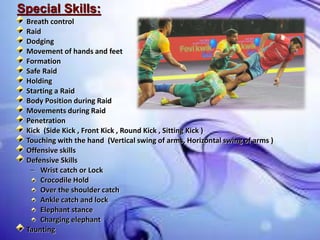
Special Skills:
Breath control
Raid
Dodging
Movement of hands and feet
Formation
Safe Raid
Holding
Starting a Raid
Body Position during Raid
Movements during Raid
Penetration
Kick (Side Kick , Front Kick , Round Kick , Sitting Kick )
Touching with the hand (Vertical swing of arms, Horizontal swing of arms )
Offensive skills
Defensive Skills
– Wrist catch or Lock
Crocodile Hold
Over the shoulder catch
Ankle catch and lock
Elephant stance
Charging elephant
Taunting
Rules:
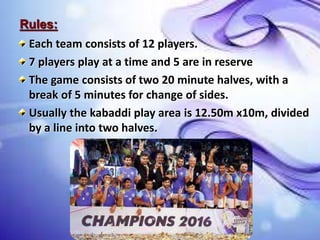
Each team consists of 12 players.
7 players play at a time and 5 are in reserve
The game consists of two 20 minute halves, with a
break of 5 minutes for change of sides.
Usually the kabaddi play area is 12.50m x10m, divided
by a line into two halves.
How to play:
The side winning the toss sends a ‘raider,’ who enters the opponents' court chanting “kabaddi-
kabaddi.”
The raider’s aim is to touch any or all players on the opposing side, and return to his court in one
breath.
The person whom the raider touches will then be out.
The aim of the opposing team, will be to hold the raider, and stop him from returning to his own
court until he takes another breath.
If the raider cannot return to his court in the same breath while chanting “kabaddi,” he will be
declared out.
Each team alternates in sending a player into the opponent’s court.
If a player goes out of the boundary line, or if any part of his body touches the ground outside the
boundary while playing, he will be out, except during a struggle.
The team scores a lona (a bonus of two points), if the entire opposition is declared out.
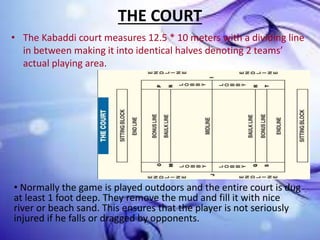
THE COURT
• The Kabaddi court measures 12.5 * 10 meters with a dividing line
in between making it into identical halves denoting 2 teams’
actual playing area.
• Normally the game is played outdoors and the entire court is dug
at least 1 foot deep. They remove the mud and fill it with nice
river or beach sand. This ensures that the player is not seriously
injured if he falls or dragged by opponents.
Forms of Kabaddi
Amar
In the 'Amar' form of Kabaddi, whenever any player is touched (out), he does
not go out of the court, but stays inside, and one point is awarded to the
team that touched him. This game is also played on a time basis, i.e the time
is fixed. This form of kabaddi is played in Punjab, Canada, England, New
Zealand, USA, Pakistan and Australia. In the Amar form of Kabaddi, each
team consists of 5-6 stoppers and 4-5 raiders. At one time, only 4 stoppers
are allowed to play on the field. Every time a stopper stops the raider from
going back to his ting point, that stoppers team gets 1 point. On the other
hand, every time the raider tags one of the stoppers and returns to his
starting point, his team gets one point. At one time, only one of the stoppers
can try to stop the raider. If more than one touch the raider, an automatic
point is awarded to the raider's team. If the stopper is pushed out by the
raider or vice versa, then the team whose member is still in the field gets a
point. If both the raider and the stopper go out, the result is a common point,
where nobody gets a point.
•Amar
•Surjeevani
•Gaminee
Surjeevani
In Surjeevani Kabaddi, one player is revived against one player of the opposite team
who is out, one out, one in. The duration, the number of players, dimensions of the
court, etc. have been fixed by the Kabaddi Federation of India. This form of Kabaddi is
the closest to the present game. In this form of Kabaddi, players are put out and
revived and the game lasts 40 minutes with a 5-minute break in between. There are
nine players on each side. The team that puts out all the players on the opponent's
side scores four extra points for a 'Iona'. The winning team is the one that scores
most points after 40 minutes. The field is bigger in this form of Kabaddi and the 'cant'
different in various regions. Modern Kabaddi resembles this form of Kabaddi
especially with regard to 'out & revival system' and 'Iona'. The present form of
Kabaddi is a synthesis of all these forms with changes in the rules.
Gaminee
This is played with nine players on either side, in a field of no specific measurements.
The characteristic is that a player put out has to remain out until all his team members
are out. The team that is successful in putting out all the players of the opponent's side
secures a point. This is akin to the present system of 'Iona'. After all the players are put
out, the team is revived and the game continues. The game continues until five or
seven 'Iona' are secured. The game has no fixed time. The main disadvantage of this
form of Kabaddi is that the player Is not in position to give his best performance since
he is likely to remain out for the better part of the match until an Iona is scored.[3][4]
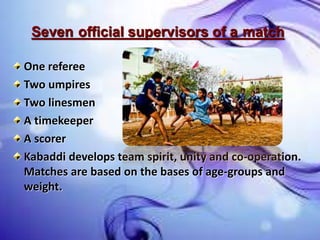
Seven official supervisors of a match
One referee
Two umpires
Two linesmen
A timekeeper
A scorer
Kabaddi develops team spirit, unity and co-operation.
Matches are based on the bases of age-groups and
weight.
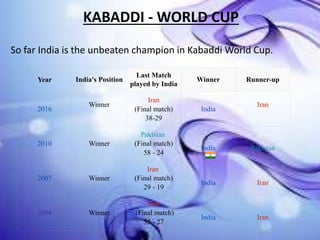
So far India is the unbeaten champion in Kabaddi World Cup.
Year India's Position
Last Match
played by India
Winner Runner-up
2016
Winner
Iran
(Final match)
38-29
India
Iran
2010 Winner
Pakistan
(Final match)
58 - 24
India Pakistan
2007 Winner
Iran
(Final match)
29 - 19
India Iran
2004 Winner
Iran
(Final match)
55 - 27
India Iran
KABADDI - WORLD CUP
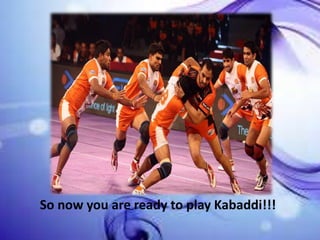
So now you are ready to play Kabaddi!!!
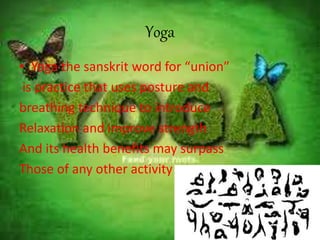
Yoga
• Yoga the sanskrit word for “union”
is practice that uses posture and
breathing technique to introduce
Relaxation and improve strength
And its health benefits may surpass
Those of any other activity
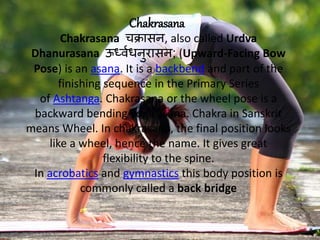
Chakrasana
Chakrasana चक्रासन, also called Urdva
Dhanurasana ऊर्ध्वधनुरासन; (Upward-Facing Bow
Pose) is an asana. It is a backbend and part of the
finishing sequence in the Primary Series
of Ashtanga. Chakrasana or the wheel pose is a
backward bending yoga asana. Chakra in Sanskrit
means Wheel. In chakrasana, the final position looks
like a wheel, hence the name. It gives great
flexibility to the spine.
In acrobatics and gymnastics this body position is
commonly called a back bridge
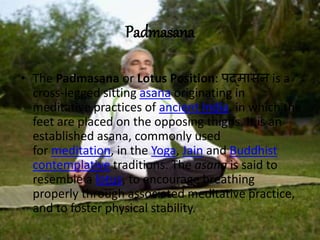
Padmasana
• The Padmasana or Lotus Position: पद्मासन is a
cross-legged sitting asana originating in
meditative practices of ancient India, in which the
feet are placed on the opposing thighs. It is an
established asana, commonly used
for meditation, in the Yoga, Jain and Buddhist
contemplative traditions. The asana is said to
resemble a lotus, to encourage breathing
properly through associated meditative practice,
and to foster physical stability.
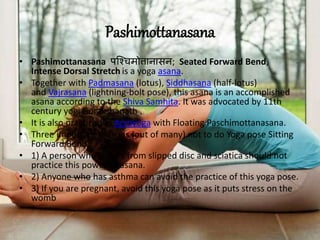
Pashimottanasana
• Pashimottanasana पश्चचमोत्तानासन; Seated Forward Bend,
Intense Dorsal Stretch is a yoga asana.
• Together with Padmasana (lotus), Siddhasana (half-lotus)
and Vajrasana (lightning-bolt pose), this asana is an accomplished
asana according to the Shiva Samhita. It was advocated by 11th
century yogi Gorakshanath .
• It is also practiced in Acroyoga with Floating Paschimottanasana.
• Three important reasons (out of many) not to do Yoga pose Sitting
Forward Bend:
• 1) A person who suffers from slipped disc and sciatica should not
practice this powerful asana.
• 2) Anyone who has asthma can avoid the practice of this yoga pose.
• 3) If you are pregnant, avoid this yoga pose as it puts stress on the
womb
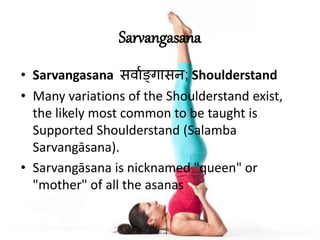
Sarvangasana
• Sarvangasana स्ावङ्गासन; Shoulderstand
• Many variations of the Shoulderstand exist,
the likely most common to be taught is
Supported Shoulderstand (Salamba
Sarvangāsana).
• Sarvangāsana is nicknamed "queen" or
"mother" of all the asanas
Matsyasana
• Matsyasana मत्स्यासन Fish Poseis an asana.
• It is commonly considered a counterasana
to Sarvangasana, or shoulder stand,
specifically within the context of the Ashtanga
Vinyasa Yoga Primary Series.
• The name comes from the Sanskritt
words matsya (मत्स्य) meaning
"fish"[4] and asana (आसन) meaning "posture"
Physical education project

Physical education project

  • 1.
    Physical education Project Submitted to:mrs. saroj (pet) 2016-2017 Submitted by :shivang xii-d 20
  • 2.
  • 3.
    Index • Athletics • Kabbadi(indian sport) • Yoga
  • 7.
    • Various courtsof athletics
  • 32.
    Kabaddi Kabaddi is ateam contact sport. It is popular in different names. In the southern parts of India, the game is called Chedugudu or Hu-Tu-Tu. In the eastern parts it is fondly called Hadudu (for men) and Kit-Kit(For women). The game is known as Kabaddi in northern India. This game was originated in Tamil Nadu, India for preparing soldiers. Kabaddi is the national game of Bangladesh, the state game of Punjab, Tamil Nadu and Andhra Pradesh in India. About Kabaddi:
  • 33.
    Special Skills: Breath control Raid Dodging Movementof hands and feet Formation Safe Raid Holding Starting a Raid Body Position during Raid Movements during Raid Penetration Kick (Side Kick , Front Kick , Round Kick , Sitting Kick ) Touching with the hand (Vertical swing of arms, Horizontal swing of arms ) Offensive skills Defensive Skills – Wrist catch or Lock Crocodile Hold Over the shoulder catch Ankle catch and lock Elephant stance Charging elephant Taunting
  • 34.
    Rules: Each team consistsof 12 players. 7 players play at a time and 5 are in reserve The game consists of two 20 minute halves, with a break of 5 minutes for change of sides. Usually the kabaddi play area is 12.50m x10m, divided by a line into two halves.
  • 35.
    How to play: Theside winning the toss sends a ‘raider,’ who enters the opponents' court chanting “kabaddi- kabaddi.” The raider’s aim is to touch any or all players on the opposing side, and return to his court in one breath. The person whom the raider touches will then be out. The aim of the opposing team, will be to hold the raider, and stop him from returning to his own court until he takes another breath. If the raider cannot return to his court in the same breath while chanting “kabaddi,” he will be declared out. Each team alternates in sending a player into the opponent’s court. If a player goes out of the boundary line, or if any part of his body touches the ground outside the boundary while playing, he will be out, except during a struggle. The team scores a lona (a bonus of two points), if the entire opposition is declared out.
  • 36.
    THE COURT • TheKabaddi court measures 12.5 * 10 meters with a dividing line in between making it into identical halves denoting 2 teams’ actual playing area. • Normally the game is played outdoors and the entire court is dug at least 1 foot deep. They remove the mud and fill it with nice river or beach sand. This ensures that the player is not seriously injured if he falls or dragged by opponents.
  • 37.
    Forms of Kabaddi Amar Inthe 'Amar' form of Kabaddi, whenever any player is touched (out), he does not go out of the court, but stays inside, and one point is awarded to the team that touched him. This game is also played on a time basis, i.e the time is fixed. This form of kabaddi is played in Punjab, Canada, England, New Zealand, USA, Pakistan and Australia. In the Amar form of Kabaddi, each team consists of 5-6 stoppers and 4-5 raiders. At one time, only 4 stoppers are allowed to play on the field. Every time a stopper stops the raider from going back to his ting point, that stoppers team gets 1 point. On the other hand, every time the raider tags one of the stoppers and returns to his starting point, his team gets one point. At one time, only one of the stoppers can try to stop the raider. If more than one touch the raider, an automatic point is awarded to the raider's team. If the stopper is pushed out by the raider or vice versa, then the team whose member is still in the field gets a point. If both the raider and the stopper go out, the result is a common point, where nobody gets a point. •Amar •Surjeevani •Gaminee
  • 38.
    Surjeevani In Surjeevani Kabaddi,one player is revived against one player of the opposite team who is out, one out, one in. The duration, the number of players, dimensions of the court, etc. have been fixed by the Kabaddi Federation of India. This form of Kabaddi is the closest to the present game. In this form of Kabaddi, players are put out and revived and the game lasts 40 minutes with a 5-minute break in between. There are nine players on each side. The team that puts out all the players on the opponent's side scores four extra points for a 'Iona'. The winning team is the one that scores most points after 40 minutes. The field is bigger in this form of Kabaddi and the 'cant' different in various regions. Modern Kabaddi resembles this form of Kabaddi especially with regard to 'out & revival system' and 'Iona'. The present form of Kabaddi is a synthesis of all these forms with changes in the rules.
  • 39.
    Gaminee This is playedwith nine players on either side, in a field of no specific measurements. The characteristic is that a player put out has to remain out until all his team members are out. The team that is successful in putting out all the players of the opponent's side secures a point. This is akin to the present system of 'Iona'. After all the players are put out, the team is revived and the game continues. The game continues until five or seven 'Iona' are secured. The game has no fixed time. The main disadvantage of this form of Kabaddi is that the player Is not in position to give his best performance since he is likely to remain out for the better part of the match until an Iona is scored.[3][4]
  • 40.
    Seven official supervisorsof a match One referee Two umpires Two linesmen A timekeeper A scorer Kabaddi develops team spirit, unity and co-operation. Matches are based on the bases of age-groups and weight.
  • 41.
    So far Indiais the unbeaten champion in Kabaddi World Cup. Year India's Position Last Match played by India Winner Runner-up 2016 Winner Iran (Final match) 38-29 India Iran 2010 Winner Pakistan (Final match) 58 - 24 India Pakistan 2007 Winner Iran (Final match) 29 - 19 India Iran 2004 Winner Iran (Final match) 55 - 27 India Iran KABADDI - WORLD CUP
  • 42.
    So now youare ready to play Kabaddi!!!
  • 43.
    Yoga • Yoga thesanskrit word for “union” is practice that uses posture and breathing technique to introduce Relaxation and improve strength And its health benefits may surpass Those of any other activity
  • 44.
    Chakrasana Chakrasana चक्रासन, alsocalled Urdva Dhanurasana ऊर्ध्वधनुरासन; (Upward-Facing Bow Pose) is an asana. It is a backbend and part of the finishing sequence in the Primary Series of Ashtanga. Chakrasana or the wheel pose is a backward bending yoga asana. Chakra in Sanskrit means Wheel. In chakrasana, the final position looks like a wheel, hence the name. It gives great flexibility to the spine. In acrobatics and gymnastics this body position is commonly called a back bridge
  • 45.
    Padmasana • The Padmasanaor Lotus Position: पद्मासन is a cross-legged sitting asana originating in meditative practices of ancient India, in which the feet are placed on the opposing thighs. It is an established asana, commonly used for meditation, in the Yoga, Jain and Buddhist contemplative traditions. The asana is said to resemble a lotus, to encourage breathing properly through associated meditative practice, and to foster physical stability.
  • 46.
    Pashimottanasana • Pashimottanasana पश्चचमोत्तानासन;Seated Forward Bend, Intense Dorsal Stretch is a yoga asana. • Together with Padmasana (lotus), Siddhasana (half-lotus) and Vajrasana (lightning-bolt pose), this asana is an accomplished asana according to the Shiva Samhita. It was advocated by 11th century yogi Gorakshanath . • It is also practiced in Acroyoga with Floating Paschimottanasana. • Three important reasons (out of many) not to do Yoga pose Sitting Forward Bend: • 1) A person who suffers from slipped disc and sciatica should not practice this powerful asana. • 2) Anyone who has asthma can avoid the practice of this yoga pose. • 3) If you are pregnant, avoid this yoga pose as it puts stress on the womb
  • 47.
    Sarvangasana • Sarvangasana स्ावङ्गासन;Shoulderstand • Many variations of the Shoulderstand exist, the likely most common to be taught is Supported Shoulderstand (Salamba Sarvangāsana). • Sarvangāsana is nicknamed "queen" or "mother" of all the asanas
  • 48.
    Matsyasana • Matsyasana मत्स्यासनFish Poseis an asana. • It is commonly considered a counterasana to Sarvangasana, or shoulder stand, specifically within the context of the Ashtanga Vinyasa Yoga Primary Series. • The name comes from the Sanskritt words matsya (मत्स्य) meaning "fish"[4] and asana (आसन) meaning "posture"