

Kabaddi Script presentation
By
Arghya Mazumdar, Devdeep Dutta & Granthik Sen
Origin and Evolution of
Kabaddi
According to legends, Kabaddi originated in India about 4000 years ago,
in the battle of Kurukshetra as depicted in the Hindu epic
Mahabharata.
The Kauravas had engaged the lone warrior Abhimanyu by
creating a 7 tiered defense called the ‘Chakravyuha’ from which he
couldn’t escape successfully
As per the reference of Buddhist literature, Buddha used to play Kabaddi for
recreation
Kabaddi is an ancient sport which originated in India as a way to develop the physical
strength in young men
The ancient wrestling sport derives its name 'Kabaddi' from a Tamil word,
Kai-pidi which means “holding hands
Kabaddi is the National Game of Bangladesh
Most of the Indian states do play this game
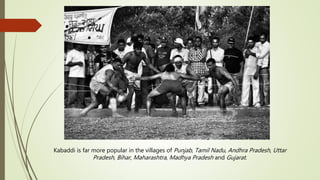
Kabaddi is far more popular in the villages of Punjab, Tamil Nadu, Andhra Pradesh, Uttar
Pradesh, Bihar, Maharashtra, Madhya Pradesh and Gujarat.
Kabaddi received its first international exposure during the 1936 Berlin
Olympics, when India demonstrated the game to the world
The sport of Kabaddi, has been deeply entrenched in the Indian culture since time
immemorial as India holds the world cups for both the men's and women's category in
the game
Kabaddi is the only sport in which the Indian team, both men and women, have won all the world
cups since its conception
Kabaddi has different names according to the regions where most people like to play it.
As in Bangladesh, this game is well known as ‘Hududu’. Also other names of kabaddi are
‘Hututu’ in Maharashtra, ‘Baibalaa’ in Maldives, ‘Sadugudu’ in Tamil Nadu
and ‘Chedugudu’ in Andhra Pradesh
Life and Kabaddi -
An unequivocal
resemblance
Twists and turns in our daily lives with the raids and arrests of Kabaddi bear semblance to how
we live our day to day lives; sometimes we raid successfully other times we get trapped
Most importantly, it rewards the art of team-work more than anything else, just like in life.
Also, some theories state that the word kabaddi comes from the tamil word kai-pidi which means to
hold hands, so it literally shows that in life holding hands would achieve way more than a lone hand
An attacker in kabaddi basically represents the concept of one vs the
world in life. An individual can only shine if he/she is bold, cunning
and willing to take risks
Kabaddi also teaches the value of not giving up till the last breath (literally). And
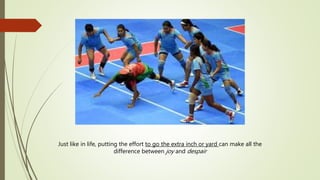
just like in life, putting the effort to go the extra inch or yard can make all the
difference between joy and despair.
Just like in life, putting the effort to go the extra inch or yard can make all the
difference between joy and despair
Kabaddi also teaches the value of not giving up till the last breath (literally)
An individual can only shine if he/she is bold, cunning and willing to take risks.
It also teaches the value of a proper thought process
Kabaddi rewards the art of team work more than anything else, just like in life.
A single defender would find it very difficult to wrestle an attacker to the ground, and the
grows easier as the number of defenders increase
An attacker in kabaddi basically represents the concept of ‘one vs the
world’ in life
Kabaddi-Rules and
Regulations
The kabaddi playing field
It’s a rectangular arena
usually measuring 13 meters
meters (42.7 ft) wide x 10
meters (32.8 ft) long.
Two teams occupy opposite halves of a small field and take turns sending a raider into the other half, in
order to win points by tagging/wrestling members of the opposing team; the raider then tries to return
to his own half while holding his breath and chanting "kabaddi, kabaddi, kabaddi" during the whole raid
RULES:
 Seven players start the game. There are five substitutes available
 20-minute halves with a 10-minute break
 The teams take turns sending a “raider” into the other half
 To win a point, the raider must take a deep breath and hold it, run into the
opposing half, tag one or more members of the opposite team, then return
his home half before inhaling again
RULES:
 The defenders tagged in a successful raid have to leave the court
temporarily
 For every player tagged in a successful raid, one point is earned
 When all the defenders of a particular team are out and the opposition
gets two points but all seven defenders can come back on court
 The leaders on points at full time wins
HOW A RAIDER CAN BE OUT:
 A raider is out if he strays out of court (including the lobby),
if he is pushed out of the playing area. If he takes a defender with
the defender is out too
 If a raider inhales during a raid, he is out. The chant “kabaddi,
has to begin before he leaves his half
Super Tackle in Pro Kabaddi is a specific scenario where a
raider from the opponent team has to be tackled captured or
caught by either 3 or less than 3 players of the non-raiding or
defending team
There is one bonus line which can grant extra points for
the raider if he manages to touch it and return
successfully
CHEER FOR
BENGAL
WARRIORS !!
Watch the Warriors roar in their den.
Cheer for your favorite team
Hear them roar and roar with them
COME AND WATCH THEM LIVE
Make them #TouchTheVictory.
Imbibe the atmosphere of PKL 2016 season with your friends and family.

kabaddi script Final

  • 1.
    Kabaddi Script presentation By ArghyaMazumdar, Devdeep Dutta & Granthik Sen
  • 2.
  • 3.
    According to legends,Kabaddi originated in India about 4000 years ago, in the battle of Kurukshetra as depicted in the Hindu epic Mahabharata.
  • 4.
    The Kauravas hadengaged the lone warrior Abhimanyu by creating a 7 tiered defense called the ‘Chakravyuha’ from which he couldn’t escape successfully
  • 5.
    As per thereference of Buddhist literature, Buddha used to play Kabaddi for recreation
  • 6.
    Kabaddi is anancient sport which originated in India as a way to develop the physical strength in young men
  • 7.
    The ancient wrestlingsport derives its name 'Kabaddi' from a Tamil word, Kai-pidi which means “holding hands
  • 8.
    Kabaddi is theNational Game of Bangladesh
  • 9.
    Most of theIndian states do play this game
  • 10.
    Kabaddi is farmore popular in the villages of Punjab, Tamil Nadu, Andhra Pradesh, Uttar Pradesh, Bihar, Maharashtra, Madhya Pradesh and Gujarat.
  • 11.
    Kabaddi received itsfirst international exposure during the 1936 Berlin Olympics, when India demonstrated the game to the world
  • 12.
    The sport ofKabaddi, has been deeply entrenched in the Indian culture since time immemorial as India holds the world cups for both the men's and women's category in the game
  • 13.
    Kabaddi is theonly sport in which the Indian team, both men and women, have won all the world cups since its conception
  • 14.
    Kabaddi has differentnames according to the regions where most people like to play it. As in Bangladesh, this game is well known as ‘Hududu’. Also other names of kabaddi are ‘Hututu’ in Maharashtra, ‘Baibalaa’ in Maldives, ‘Sadugudu’ in Tamil Nadu and ‘Chedugudu’ in Andhra Pradesh
  • 15.
    Life and Kabaddi- An unequivocal resemblance
  • 16.
    Twists and turnsin our daily lives with the raids and arrests of Kabaddi bear semblance to how we live our day to day lives; sometimes we raid successfully other times we get trapped
  • 17.
    Most importantly, itrewards the art of team-work more than anything else, just like in life. Also, some theories state that the word kabaddi comes from the tamil word kai-pidi which means to hold hands, so it literally shows that in life holding hands would achieve way more than a lone hand
  • 18.
    An attacker inkabaddi basically represents the concept of one vs the world in life. An individual can only shine if he/she is bold, cunning and willing to take risks
  • 19.
    Kabaddi also teachesthe value of not giving up till the last breath (literally). And just like in life, putting the effort to go the extra inch or yard can make all the difference between joy and despair.
  • 20.
    Just like inlife, putting the effort to go the extra inch or yard can make all the difference between joy and despair
  • 21.
    Kabaddi also teachesthe value of not giving up till the last breath (literally)
  • 22.
    An individual canonly shine if he/she is bold, cunning and willing to take risks. It also teaches the value of a proper thought process
  • 23.
    Kabaddi rewards theart of team work more than anything else, just like in life. A single defender would find it very difficult to wrestle an attacker to the ground, and the grows easier as the number of defenders increase
  • 24.
    An attacker inkabaddi basically represents the concept of ‘one vs the world’ in life
  • 25.
  • 26.
    The kabaddi playingfield It’s a rectangular arena usually measuring 13 meters meters (42.7 ft) wide x 10 meters (32.8 ft) long.
  • 28.
    Two teams occupyopposite halves of a small field and take turns sending a raider into the other half, in order to win points by tagging/wrestling members of the opposing team; the raider then tries to return to his own half while holding his breath and chanting "kabaddi, kabaddi, kabaddi" during the whole raid
  • 29.
    RULES:  Seven playersstart the game. There are five substitutes available  20-minute halves with a 10-minute break  The teams take turns sending a “raider” into the other half  To win a point, the raider must take a deep breath and hold it, run into the opposing half, tag one or more members of the opposite team, then return his home half before inhaling again
  • 30.
    RULES:  The defenderstagged in a successful raid have to leave the court temporarily  For every player tagged in a successful raid, one point is earned  When all the defenders of a particular team are out and the opposition gets two points but all seven defenders can come back on court  The leaders on points at full time wins
  • 31.
    HOW A RAIDERCAN BE OUT:  A raider is out if he strays out of court (including the lobby), if he is pushed out of the playing area. If he takes a defender with the defender is out too  If a raider inhales during a raid, he is out. The chant “kabaddi, has to begin before he leaves his half
  • 32.
    Super Tackle inPro Kabaddi is a specific scenario where a raider from the opponent team has to be tackled captured or caught by either 3 or less than 3 players of the non-raiding or defending team
  • 33.
    There is onebonus line which can grant extra points for the raider if he manages to touch it and return successfully
  • 34.
  • 35.
    Watch the Warriorsroar in their den.
  • 36.
    Cheer for yourfavorite team
  • 37.
    Hear them roarand roar with them
  • 38.
    COME AND WATCHTHEM LIVE
  • 39.
  • 40.
    Imbibe the atmosphereof PKL 2016 season with your friends and family.