FIRST WORLD
AND
THIRD WORLD
COUNTRIES
Classification
 First World Countries(developed countries): are a
small group of rich industrialized countries. Eg:
USA, Canada, France, Italy, UK …
 Second World Countries: it referred to the former
communist countries of Eastern Europe and the
USSR.
These countries are called transitional economies.
 Third World Countries(developing or least developed
countries): a large group of countries in Asia, African
and Latin America which have lower incomes than
first world countries.
 Third world countries differ in themselves and further
divided into groups.
The poorest countries are called Forth World
countries or low income countries or least developed
countries
Third world countries are known as middle income
countries
Fast growing middle income countries are called
emerging economies as they are emerging to take
place amongst the developed countries of the world. .
Eg: Mexico, Thailand, Malaysia
Countries such as South Korea, Singapore, Taiwan
and others are called newly industrialized
countries(NICs)or Tiger Economies as now their
economies have a strong, Western-style,
industrialized base.
Brazil, Russia, India and China are called BRIC
countries as it is forecasted that by 2050, they will be
four of the most dominant economies in the world.
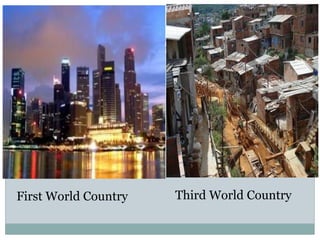
First World Country Third World Country
Problems in the Third World Countries
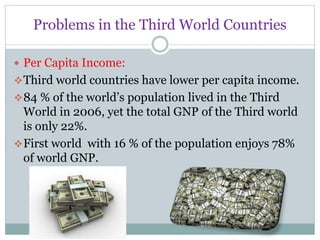
 Per Capita Income:
Third world countries have lower per capita income.
84 % of the world’s population lived in the Third
World in 2006, yet the total GNP of the Third world
is only 22%.
First world with 16 % of the population enjoys 78%
of world GNP.
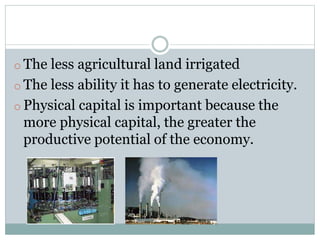
• Physical capital
 Third World countries have far less physical capital
per capita than First World countries.
 They are poor infrastructure as weak in physical
capital.
 A country tends to be less developed:
o The fewer the number of telephone mainlines per
person
o The lower the % of roads that are paved
o The fewer the % of the population with access to
improved sanitation facilities
o The less agricultural land irrigated
o The less ability it has to generate electricity.
o Physical capital is important because the
more physical capital, the greater the
productive potential of the economy.
• Human capital
 Developing countries have lower levels of human
capital than developed countries.
 The percentage enrolment on different stages of
education:
Least developed countries would expect to have the
lowest proportions of the total age group enrolled in
education.
Country Primary
enrolment
Secondary
enrolment
Ethiopia 61% 99%
UK 28% 95%
 The percentage of primary school children who
finish their schooling once they have started:
In most countires , children repeat their year of
schooling if they fail to make sufficient progress “ if
they fail”
Country % of students starting primary school
reaching the final year in class in primary
school
Malawi 42%
UK 100%
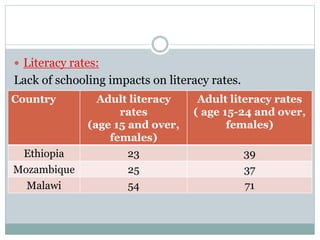
 Literacy rates:
Lack of schooling impacts on literacy rates.
Country Adult literacy
rates
(age 15 and over,
females)
Adult literacy rates
( age 15-24 and over,
females)
Ethiopia 23 39
Mozambique 25 37
Malawi 54 71
Cont………….
 Education levels are vital to the ability of countries to
grow in future.
 Countries which invest today in education,
particularly primary education, shows that rates of
return on the investment are highest and are likely to
grow in future.
 In recent years , there has been growing interest in
female education.
 In developing countries , females are less likely to
receive formal education than males.
 However it is argued that the rate of return on
educating females is higher than males.
 A woman who can read and write is far more likely to
pass on these skills to her children and grand
children than man.
 Women also have the primary responsibility for the
nutrition and health care of family units.
 Literate women are able to take part in family
planning programs.
• High population growth
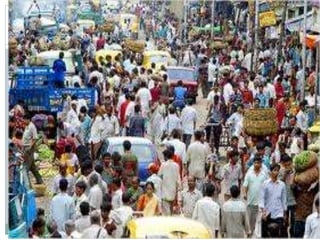
 Third world countries have had relatively high rates of
population growth compared to first world countries.
 This has two problems:
They need to invest large amounts in both physical and
human capital in order to create the goods and services
and jobs need for their growing populations.
It means they have to forgo some consumption and
invest more but it is not possible as high population
means more consumption.
High population growth brings high dependency ratios.
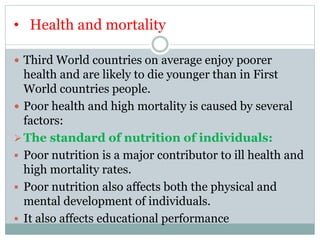
• Health and mortality
 Third World countries on average enjoy poorer
health and are likely to die younger than in First
World countries people.
 Poor health and high mortality is caused by several
factors:
The standard of nutrition of individuals:
 Poor nutrition is a major contributor to ill health and
high mortality rates.
 Poor nutrition also affects both the physical and
mental development of individuals.
 It also affects educational performance
Nutrition in third
world countries
Nutrition in first world
countries
The physical infrastructure of the country:
 Access to clean water is vital for health.
 Also clean environment is vital for health.
 Large number of people die from water-borne
diseases and diseases carried by animals such as
malaria.
 In first world these diseases have been eliminated
through proper infrastructure or control of the
natural environment.
Infrastructure in
third world
Infrastructure in first
world
The working environment:
• People often are forced to work in poor conditions
which severely damage their health.
• Many start work at a much younger age than in first
world countries.
Health care provision is poor:
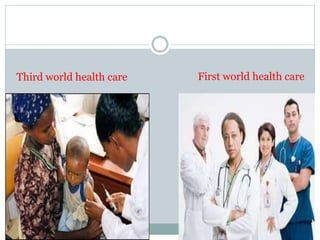
• Low and middle income countries tend to have less
health staff relative to their population than high
income countries.
Third world health care First world health care
Country Life
expectancy
at birth,
years
Prevalence
of
malnutritio
n. % of
children
under
weight
Under-5
mortality
Rate per
1000,
Live births
One year
Olds fully
Immunize
d
Against
measles
Births
attended
by
Skilled
health
staff % of
total
Malawi 46 22 125 82 56
Ethiopia 52 38 127 59 6
Mozamb
ique
43 24 145 77 48
UK 79 0 6 82 100
USA 78 2 7 93 99
• Unemployment and underemployment
 Third world countries tend to have much higher
unemployment and underemployment than first world
countries.
Reasons:
Lack of physical capital:
 Without the machines, factories and offices, workers are
structurally unemployed.
 Also poor government economic policies and
protectionism can play a role in that.
 In countries heavily reliant on agriculture,
unemployment is highly seasonal.
• Structure of the economy
 Growth and development alters the structure of
output in the economy.
 Developed countries have gradually shifted from
primary to secondary and then tertiary production
over time.
Primary Secondary Tertiary
Distribution of Gross Domestic Product(%)
Country Agriculture Industry Services
Malawi 36 20 45
Ethiopia 48 13 39
Tanzania 45 17 37
UK 1 26 73
USA 1 22 77
Singapore 0 35 65
• Institutional structures, governance and
corruption
 Developed countries have a complex
system of institutional structures.
 They have well-developed legal systems which
protect private property and trade transactions.
 They have sophisticated financial systems which
give opportunities to most citizens to save, borrow
and transfer money.
 Government is relatively efficient.
 There will be some level of corruption but this will
be low.
 Developed economies tend to have established
democracies.
 Developing countries range widely on these issues.
 Poor developing countries are characterized by
weak financial systems which are often
inaccessible to most of the population.
 The rule of law is weak and government is often
highly corrupt.
 A wide variety of different forms of government is
found in third world countries.
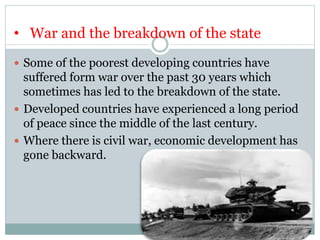
• War and the breakdown of the state
 Some of the poorest developing countries have
suffered form war over the past 30 years which
sometimes has led to the breakdown of the state.
 Developed countries have experienced a long period
of peace since the middle of the last century.
 Where there is civil war, economic development has
gone backward.
Foreign trade, capital flows and debt
 Developing countries vary enormously in their
trading relationships with other countries.
 Some have been heavily reliant on exports of
commodities such as oil or coffee.
 Other are resource poor.
 Sometimes exports are not high enough and there is
a foreign currency gap.
 Development has been slowed down as the country is
unable to import enough to stimulate economic
growth.
 Some countries have developed manufacturing and
service industries.
 Flows of financial capital also vary between
developing countries.
 Some countries such as China, have seen large
flows of financial inflows which have been invested
directly into industry.
 However, some countries find it difficult to attract
foreign direct investment.
 Some countries have borrowed heavily and then
unable to repay the interest and capital, which led
to debt crisis.
 Development might be limited because of capital
flight.
 This is when citizens and businesses of a country
believe that the economy will deteriorate in the
future and so send their money abroad by buying
foreign currency and other assets.
 This reduces financial resources available within the
country.
• History, religion and ethnicity
 Third world countries differ considerably in
history, religion and ethnicity.
 Some argue that history is important as many third
world countries are former colonies of current
developed countries.
 Religion can be important to development because
of differences in attitudes to work and personal
freedom.
 Ethnicity can also be defining characteristics for
countries.
 Ethnic diversity could be argued to fuel economic
growth.
 Migrants are attracted from all over the world to the
USA which creates a dynamic culture.
 Countries like Sri Lanka, ethnic diversity has hindered
development through civil war.
First world n third world comparison

First world n third world comparison

  • 1.
  • 2.
    Classification  First WorldCountries(developed countries): are a small group of rich industrialized countries. Eg: USA, Canada, France, Italy, UK …  Second World Countries: it referred to the former communist countries of Eastern Europe and the USSR. These countries are called transitional economies.  Third World Countries(developing or least developed countries): a large group of countries in Asia, African and Latin America which have lower incomes than first world countries.
  • 3.
     Third worldcountries differ in themselves and further divided into groups. The poorest countries are called Forth World countries or low income countries or least developed countries Third world countries are known as middle income countries
  • 4.
    Fast growing middleincome countries are called emerging economies as they are emerging to take place amongst the developed countries of the world. . Eg: Mexico, Thailand, Malaysia Countries such as South Korea, Singapore, Taiwan and others are called newly industrialized countries(NICs)or Tiger Economies as now their economies have a strong, Western-style, industrialized base. Brazil, Russia, India and China are called BRIC countries as it is forecasted that by 2050, they will be four of the most dominant economies in the world.
  • 6.
    First World CountryThird World Country
  • 7.
    Problems in theThird World Countries  Per Capita Income: Third world countries have lower per capita income. 84 % of the world’s population lived in the Third World in 2006, yet the total GNP of the Third world is only 22%. First world with 16 % of the population enjoys 78% of world GNP.
  • 8.
    • Physical capital Third World countries have far less physical capital per capita than First World countries.  They are poor infrastructure as weak in physical capital.  A country tends to be less developed: o The fewer the number of telephone mainlines per person o The lower the % of roads that are paved o The fewer the % of the population with access to improved sanitation facilities
  • 9.
    o The lessagricultural land irrigated o The less ability it has to generate electricity. o Physical capital is important because the more physical capital, the greater the productive potential of the economy.
  • 10.
    • Human capital Developing countries have lower levels of human capital than developed countries.  The percentage enrolment on different stages of education: Least developed countries would expect to have the lowest proportions of the total age group enrolled in education. Country Primary enrolment Secondary enrolment Ethiopia 61% 99% UK 28% 95%
  • 11.
     The percentageof primary school children who finish their schooling once they have started: In most countires , children repeat their year of schooling if they fail to make sufficient progress “ if they fail” Country % of students starting primary school reaching the final year in class in primary school Malawi 42% UK 100%
  • 12.
     Literacy rates: Lackof schooling impacts on literacy rates. Country Adult literacy rates (age 15 and over, females) Adult literacy rates ( age 15-24 and over, females) Ethiopia 23 39 Mozambique 25 37 Malawi 54 71
  • 13.
    Cont………….  Education levelsare vital to the ability of countries to grow in future.  Countries which invest today in education, particularly primary education, shows that rates of return on the investment are highest and are likely to grow in future.  In recent years , there has been growing interest in female education.  In developing countries , females are less likely to receive formal education than males.
  • 14.
     However itis argued that the rate of return on educating females is higher than males.  A woman who can read and write is far more likely to pass on these skills to her children and grand children than man.  Women also have the primary responsibility for the nutrition and health care of family units.  Literate women are able to take part in family planning programs.
  • 16.
    • High populationgrowth  Third world countries have had relatively high rates of population growth compared to first world countries.  This has two problems: They need to invest large amounts in both physical and human capital in order to create the goods and services and jobs need for their growing populations. It means they have to forgo some consumption and invest more but it is not possible as high population means more consumption. High population growth brings high dependency ratios.
  • 18.
    • Health andmortality  Third World countries on average enjoy poorer health and are likely to die younger than in First World countries people.  Poor health and high mortality is caused by several factors: The standard of nutrition of individuals:  Poor nutrition is a major contributor to ill health and high mortality rates.  Poor nutrition also affects both the physical and mental development of individuals.  It also affects educational performance
  • 19.
    Nutrition in third worldcountries Nutrition in first world countries
  • 20.
    The physical infrastructureof the country:  Access to clean water is vital for health.  Also clean environment is vital for health.  Large number of people die from water-borne diseases and diseases carried by animals such as malaria.  In first world these diseases have been eliminated through proper infrastructure or control of the natural environment.
  • 21.
  • 22.
    The working environment: •People often are forced to work in poor conditions which severely damage their health. • Many start work at a much younger age than in first world countries. Health care provision is poor: • Low and middle income countries tend to have less health staff relative to their population than high income countries.
  • 23.
    Third world healthcare First world health care
  • 25.
    Country Life expectancy at birth, years Prevalence of malnutritio n.% of children under weight Under-5 mortality Rate per 1000, Live births One year Olds fully Immunize d Against measles Births attended by Skilled health staff % of total Malawi 46 22 125 82 56 Ethiopia 52 38 127 59 6 Mozamb ique 43 24 145 77 48 UK 79 0 6 82 100 USA 78 2 7 93 99
  • 26.
    • Unemployment andunderemployment  Third world countries tend to have much higher unemployment and underemployment than first world countries. Reasons: Lack of physical capital:  Without the machines, factories and offices, workers are structurally unemployed.  Also poor government economic policies and protectionism can play a role in that.  In countries heavily reliant on agriculture, unemployment is highly seasonal.
  • 27.
    • Structure ofthe economy  Growth and development alters the structure of output in the economy.  Developed countries have gradually shifted from primary to secondary and then tertiary production over time. Primary Secondary Tertiary
  • 28.
    Distribution of GrossDomestic Product(%) Country Agriculture Industry Services Malawi 36 20 45 Ethiopia 48 13 39 Tanzania 45 17 37 UK 1 26 73 USA 1 22 77 Singapore 0 35 65
  • 29.
    • Institutional structures,governance and corruption  Developed countries have a complex system of institutional structures.  They have well-developed legal systems which protect private property and trade transactions.  They have sophisticated financial systems which give opportunities to most citizens to save, borrow and transfer money.  Government is relatively efficient.
  • 30.
     There willbe some level of corruption but this will be low.  Developed economies tend to have established democracies.  Developing countries range widely on these issues.  Poor developing countries are characterized by weak financial systems which are often inaccessible to most of the population.  The rule of law is weak and government is often highly corrupt.  A wide variety of different forms of government is found in third world countries.
  • 31.
    • War andthe breakdown of the state  Some of the poorest developing countries have suffered form war over the past 30 years which sometimes has led to the breakdown of the state.  Developed countries have experienced a long period of peace since the middle of the last century.  Where there is civil war, economic development has gone backward.
  • 32.
    Foreign trade, capitalflows and debt  Developing countries vary enormously in their trading relationships with other countries.  Some have been heavily reliant on exports of commodities such as oil or coffee.  Other are resource poor.  Sometimes exports are not high enough and there is a foreign currency gap.  Development has been slowed down as the country is unable to import enough to stimulate economic growth.  Some countries have developed manufacturing and service industries.
  • 33.
     Flows offinancial capital also vary between developing countries.  Some countries such as China, have seen large flows of financial inflows which have been invested directly into industry.  However, some countries find it difficult to attract foreign direct investment.  Some countries have borrowed heavily and then unable to repay the interest and capital, which led to debt crisis.
  • 34.
     Development mightbe limited because of capital flight.  This is when citizens and businesses of a country believe that the economy will deteriorate in the future and so send their money abroad by buying foreign currency and other assets.  This reduces financial resources available within the country.
  • 35.
    • History, religionand ethnicity  Third world countries differ considerably in history, religion and ethnicity.  Some argue that history is important as many third world countries are former colonies of current developed countries.  Religion can be important to development because of differences in attitudes to work and personal freedom.
  • 36.
     Ethnicity canalso be defining characteristics for countries.  Ethnic diversity could be argued to fuel economic growth.  Migrants are attracted from all over the world to the USA which creates a dynamic culture.  Countries like Sri Lanka, ethnic diversity has hindered development through civil war.