PORTER’S GENERIC STRATEGY
Porter thesis is straightforward: To compete
successfully the strategist needs to select a
generic strategy and pursue it consistently
This can be done, porter suggests, by taking
into account a variety of factors, the five
most significant of which are:
•The bargaining power of suppliers
•The bargaining power of customers
•The threat of new entrants to the industry
•The threat of substitutes product or
services
•The rivalry among current competitors
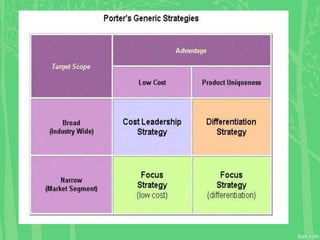
COST LEADERSHIP
• An integrated set of actions designed to
produce or deliver goods and service either
at lowest cost or features that are acceptable
by consumers.
• Aiming to become lowest cost producer.
• Targets a broad market.
• Competitive advantage is gained by driving
down cost.
• The firm can compete with every other
industry and earn higher unit profit.
Examples for Cost Leadership is
:
•Tata steel.
•Dell computers.
•Wall mart.
•IKEA.
•Micromax.
•Coca cola
DIFFERENTIATION
• Helps to understand “STAND OUT FROM
THE CROWD”
• Also called broad scope strategy.
• Few ways to succeed while using
differentiated strategy.
• Differentiation can be achieved by means
of the brand image and packaging.
Examples for differentiation :
• McDonald's
• Kamath hotels (India) limited.
• Emami fair and handsome.
• Dominos pizza – 30 minute home delivery.
• Nokia.
• Samsung.
• Nike.
• Lactose.
MARKET SEGMENTATION
• Also known as Niche Market.
•Helps in implementing premium
price.
• By this firm is able to build a
grater in dept knowledge of each
of the segment.
Examples for Focus Strategy :
• PEPSICO.
• Pedigree.
• Ferrari.
• Taj hotels.
• RR- Rolls Royce.
• Vertu.
Are you stuck in the
middle???!
•A company’s failure to make a
choice between cost leadership &
differentiation essentially implies that
the company is stuck in the middle.
• There is no competitive advantage for
a company that is stuck in the middle
and the result is often poor financial
performance.
Companies like Toyota and
Benetton were exception to this
fourth concept and they were
successful.

Porter’s generic strategy

  • 1.
  • 2.
    Porter thesis isstraightforward: To compete successfully the strategist needs to select a generic strategy and pursue it consistently This can be done, porter suggests, by taking into account a variety of factors, the five most significant of which are: •The bargaining power of suppliers •The bargaining power of customers •The threat of new entrants to the industry •The threat of substitutes product or services •The rivalry among current competitors
  • 4.
    COST LEADERSHIP • Anintegrated set of actions designed to produce or deliver goods and service either at lowest cost or features that are acceptable by consumers. • Aiming to become lowest cost producer. • Targets a broad market. • Competitive advantage is gained by driving down cost. • The firm can compete with every other industry and earn higher unit profit.
  • 5.
    Examples for CostLeadership is : •Tata steel. •Dell computers. •Wall mart. •IKEA. •Micromax. •Coca cola
  • 7.
    DIFFERENTIATION • Helps tounderstand “STAND OUT FROM THE CROWD” • Also called broad scope strategy. • Few ways to succeed while using differentiated strategy. • Differentiation can be achieved by means of the brand image and packaging.
  • 8.
    Examples for differentiation: • McDonald's • Kamath hotels (India) limited. • Emami fair and handsome. • Dominos pizza – 30 minute home delivery. • Nokia. • Samsung. • Nike. • Lactose.
  • 10.
    MARKET SEGMENTATION • Alsoknown as Niche Market. •Helps in implementing premium price. • By this firm is able to build a grater in dept knowledge of each of the segment.
  • 11.
    Examples for FocusStrategy : • PEPSICO. • Pedigree. • Ferrari. • Taj hotels. • RR- Rolls Royce. • Vertu.
  • 13.
    Are you stuckin the middle???! •A company’s failure to make a choice between cost leadership & differentiation essentially implies that the company is stuck in the middle. • There is no competitive advantage for a company that is stuck in the middle and the result is often poor financial performance.
  • 14.
    Companies like Toyotaand Benetton were exception to this fourth concept and they were successful.