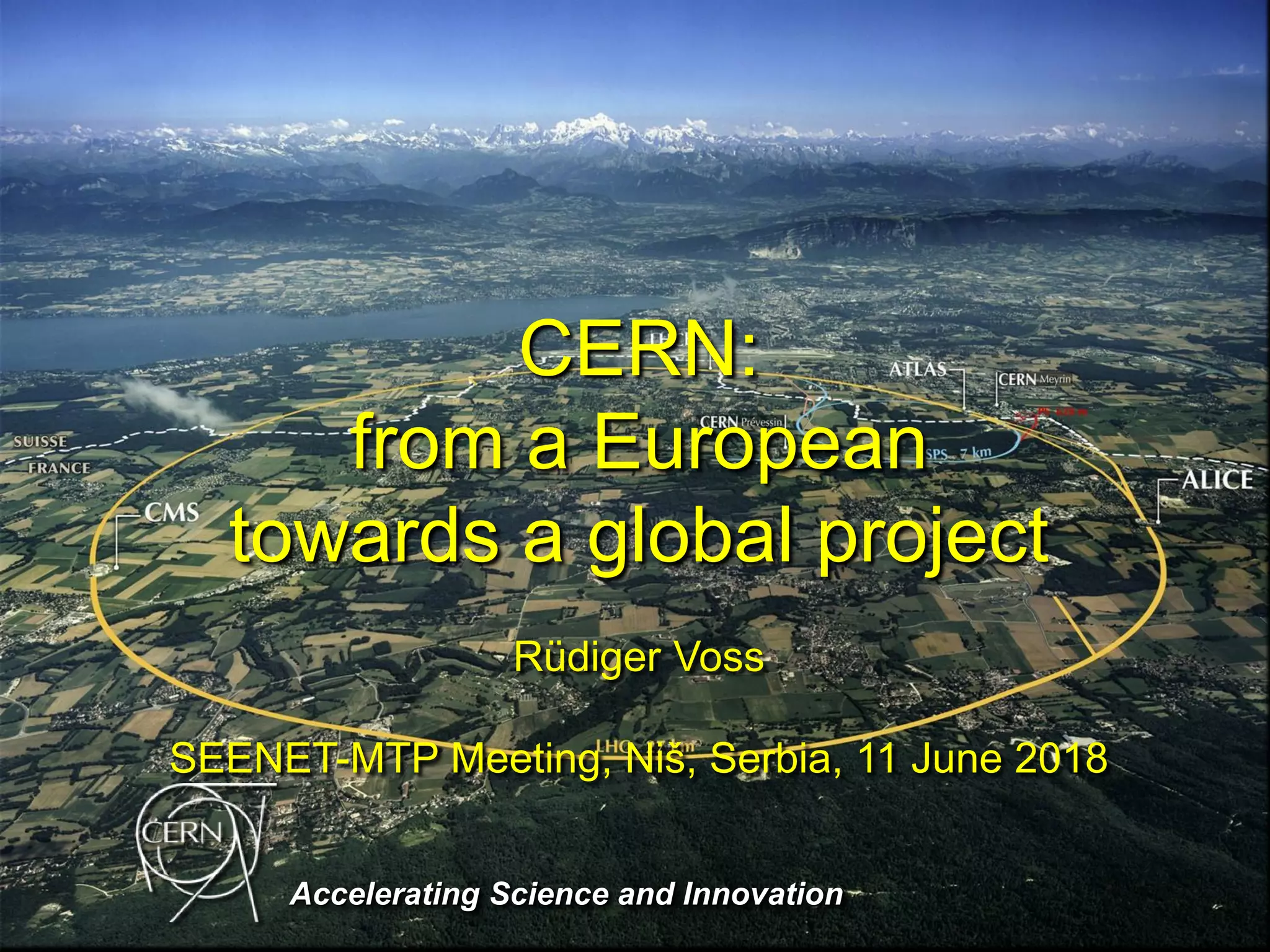
CERN:
from a European
towards a global project
Rüdiger Voss
SEENET-MTP Meeting, Niš, Serbia, 11 June 2018
Accelerating Science and Innovation
Key facts & figures
2 2
Founded 1954:
12 European States: “Science for Peace”
Today: 22 Member States
~ 2500 staff
~ 1800 other paid personnel
~ 13000 scientific users
Budget (2018) ~ 1100 MCHF
Member States: Austria, Belgium, Bulgaria, Czech Republic, Denmark, Finland, France,
Germany, Greece, Hungary, Israel, Italy, Netherlands, Norway, Poland, Portugal, Romania,
Slovak Republic, Spain, Sweden, Switzerland, United Kingdom
Associate Members in the Pre-Stage to Membership: Cyprus, Serbia, Slovenia
Associate Member States: India, Lithuania, Pakistan, Turkey, Ukraine
Applications for Membership or Associate Membership:
Brazil, Croatia
Observers to Council: Japan, Russia, United States of America;
European Union, JINR and UNESCO
A paradigm of the globalization of science
3
CERN and non-Member States
• The participation of scientists from non-Member
States (NMS) has been stable at ≲ 40% for a few
years now
• Past & present CERN managements have
exercised a policy of ‘open doors’, with no
discrimination between Member States and non-
Member States
• Expect this to continue…
• …but is it sustainable?
4
The historical perspective
• CERN’s policy of free access is rooted in the ICFA
policy of mutual free access of physicists from
different regions to laboratories in other regions
• Policy shaped at a time when
– three regions provided nearly all globally used
facilities (Europe, North America, Japan)
– the global HEP community was strongly dominated
by scientists from the same regions
– Exchange between different regions was healthy &
balanced
5
The landscape has changed
• The SSC has not happened
• Major facilities in the US have been shut down,
or converted to applied science facilities, and
have broken the symmetry of exchange between
Europe, the US, and Asia
• The LHC has developed into a global endeavour
• New actors have appeared on stage:
– Asia
– Latin America
– Africa
6
Where do we go from here?
• The LHC has convincingly demonstrated the
potential of global partnership in basic science,
and is widely perceived as a paradigm of
successful, global co-operation on megascience
projects
• To take this co-operation to the next-higher level,
and to fully exploit its potential to the benefit of
all stakeholders, CERN welcomes an enhanced
institutional participation of its partners, in the
framework of it’s new membership policy (aka
‘Geographical Enlargement’)
7
A twofold rationale
• Catch up, at a political and institutional level,
with the migration of the global particle physics
community to the LHC
• Anticipate the long-term (i.e. post-LHC) future of
CERN
– LHC experiments are truly global projects
– the LHC accelerator was a 90% European project
(~ 10% NMS contribution, mostly in-kind), born under
enormous labor pains
– A funding & governance model that is unlikely to
work for a future large facility (FCC, CLIC, ….)
8
CERN’s new enlargement policy
• For > 50 years, the CERN Council has repeatedly
interpreted the 1953 Convention as restricting
membership to European states
• In response to the strong global participation in
the LHC – and in anticipation of the post-LHC era
– the Council in 2010 approved the most
significant shift in CERN’s membership policy
thus far, opening CERN fully to non-European
states (CERN/2918/Rev.)
9
Dimensions of enlargement
• Full Membership open to non-European states
– Israel first non-European Member since 2014
• Associate Membership – membership “light” in
two flavours:
– Pre-stage to full membership: compulsory transition
period on the way to full membership (2–5 years)
– Regular (‘steady state’) Associate Membership
• “Observer” status to be phased out for states
10
The (wider) Eastern European Region
• Romania: most recent Member State (2016)
• Associate Members in pre-stage to Membership:
– Cyprus (2016)
– Serbia (2012, full Membership expected 2019)
– Slovenia (2017)
• Associate Members:
– Lithuania (2018)
– Turkey (2015)
– Ukraine (2016)
• Application for Associate Member status received
from Croatia in 2014
11
CERN-Serbia Agreement 2012
12
Signature of Associate
Membership Agreement,
CERN, January 10, 2012
Former President
Boris Tadić visiting
the CMS cavern
Looking beyond Europe
• “Regular” Associate Members:
– India (2017)
– Pakistan (2015)
• Pending application: Brazil
• In discussion with other countries…
• Most relations with non-European countries
regulated by International Cooperation
Agreements
13
Association Agreement with India
14
Mumbai, 21 November 2016
International Cooperation Agreements
• Instrument of International Co-operation
Agreements (ICAs) maintained
– ≲ 50 ICAs currently in force with non-Member States
• Interesting recent example: Palestine! (2015)
• New round of Agreements signed with the US in
2015:
– New ICA in May
• Three first-generation “Protocols” in December 2015
– US Participation in HL-LHC upgrades
– US Participation in ATLAS & CMS upgrades (ALICE in the pipeline)
– CERN participation in LBNP@Fermilab (“CERN Neutrino Platform”)
15
CERN-US Agreements 2015
16
ICA signature ceremony,
Washington DC, 7 May
2015
Protocol signature
ceremony, CERN,
18 December 2015
Conclusions
• The partnership between CERN, its Member
Sates and non-Member States in building and
operating the LHC has become a solid backbone
of a successful scientific and technological
collaboration of unprecedented, global
dimensions
• CERN wants this partnership to continue, to
expand and to flourish, while expanding its
institutional base through participation of non-
European countries
17
18
Reserve
Age distribution of CERN Users
19
> 3000 PhD students
in LHC experiments
26 y
Non-Member State Users
20
0
500
1000
1500
2000
2001 2002 2003 2004 2005 2006 2007 2008 2009 2010 2011 2012 2013 2014 2015 2016
Number
Year
Evolution of Non-Member State Users by region 2001-2016
European NMS
Canada and US
Latin America
Africa and Middle East
Asia-Pacific
Where do we stand?
• From a European perspective, the
unprecedented Non-Member State participation
in the LHC, spearheaded by the US, has brought
about substantial scientific, technical and
political benefits
• Helped to establish CERN firmly as world’s
leading center at the high energy frontier, in the
perception of governments, funding agencies,
and of the taxpayer
21
Towards a global roadmap?
• Three key regional roadmaps:
– The proposal of the Japanese community to host the
ILC
– The 2013 update of the European Strategy for
Particle Physics
– The P5 report of 2014
• For the first time, these three regions have
developed complementary and coherent
roadmaps
• CERN’s enlargement policy fits seamlessly into
the emerging global strategy of particle physics
22
Associate Membership
A simplified view of the ‘regular’ Associate
Membership:
• Obligations
– Annual contribution to CERN budget corresponding to
≥ 10% of ‘theoretical’ full Membership contribution
(minimum 1 MCHF/year)
• Benefits
– Participation in CERN governance through representation
in CERN Council and subordinate bodies (no voting rights)
– Access to employment and education programmes
(excluding tenured positions)
– Access to industrial contracts
23

Rüdiger Voss "CERN: from a European towards a global project"

  • 1.
    CERN: from a European towardsa global project Rüdiger Voss SEENET-MTP Meeting, Niš, Serbia, 11 June 2018 Accelerating Science and Innovation
  • 2.
    Key facts &figures 2 2 Founded 1954: 12 European States: “Science for Peace” Today: 22 Member States ~ 2500 staff ~ 1800 other paid personnel ~ 13000 scientific users Budget (2018) ~ 1100 MCHF Member States: Austria, Belgium, Bulgaria, Czech Republic, Denmark, Finland, France, Germany, Greece, Hungary, Israel, Italy, Netherlands, Norway, Poland, Portugal, Romania, Slovak Republic, Spain, Sweden, Switzerland, United Kingdom Associate Members in the Pre-Stage to Membership: Cyprus, Serbia, Slovenia Associate Member States: India, Lithuania, Pakistan, Turkey, Ukraine Applications for Membership or Associate Membership: Brazil, Croatia Observers to Council: Japan, Russia, United States of America; European Union, JINR and UNESCO
  • 3.
    A paradigm ofthe globalization of science 3
  • 4.
    CERN and non-MemberStates • The participation of scientists from non-Member States (NMS) has been stable at ≲ 40% for a few years now • Past & present CERN managements have exercised a policy of ‘open doors’, with no discrimination between Member States and non- Member States • Expect this to continue… • …but is it sustainable? 4
  • 5.
    The historical perspective •CERN’s policy of free access is rooted in the ICFA policy of mutual free access of physicists from different regions to laboratories in other regions • Policy shaped at a time when – three regions provided nearly all globally used facilities (Europe, North America, Japan) – the global HEP community was strongly dominated by scientists from the same regions – Exchange between different regions was healthy & balanced 5
  • 6.
    The landscape haschanged • The SSC has not happened • Major facilities in the US have been shut down, or converted to applied science facilities, and have broken the symmetry of exchange between Europe, the US, and Asia • The LHC has developed into a global endeavour • New actors have appeared on stage: – Asia – Latin America – Africa 6
  • 7.
    Where do wego from here? • The LHC has convincingly demonstrated the potential of global partnership in basic science, and is widely perceived as a paradigm of successful, global co-operation on megascience projects • To take this co-operation to the next-higher level, and to fully exploit its potential to the benefit of all stakeholders, CERN welcomes an enhanced institutional participation of its partners, in the framework of it’s new membership policy (aka ‘Geographical Enlargement’) 7
  • 8.
    A twofold rationale •Catch up, at a political and institutional level, with the migration of the global particle physics community to the LHC • Anticipate the long-term (i.e. post-LHC) future of CERN – LHC experiments are truly global projects – the LHC accelerator was a 90% European project (~ 10% NMS contribution, mostly in-kind), born under enormous labor pains – A funding & governance model that is unlikely to work for a future large facility (FCC, CLIC, ….) 8
  • 9.
    CERN’s new enlargementpolicy • For > 50 years, the CERN Council has repeatedly interpreted the 1953 Convention as restricting membership to European states • In response to the strong global participation in the LHC – and in anticipation of the post-LHC era – the Council in 2010 approved the most significant shift in CERN’s membership policy thus far, opening CERN fully to non-European states (CERN/2918/Rev.) 9
  • 10.
    Dimensions of enlargement •Full Membership open to non-European states – Israel first non-European Member since 2014 • Associate Membership – membership “light” in two flavours: – Pre-stage to full membership: compulsory transition period on the way to full membership (2–5 years) – Regular (‘steady state’) Associate Membership • “Observer” status to be phased out for states 10
  • 11.
    The (wider) EasternEuropean Region • Romania: most recent Member State (2016) • Associate Members in pre-stage to Membership: – Cyprus (2016) – Serbia (2012, full Membership expected 2019) – Slovenia (2017) • Associate Members: – Lithuania (2018) – Turkey (2015) – Ukraine (2016) • Application for Associate Member status received from Croatia in 2014 11
  • 12.
    CERN-Serbia Agreement 2012 12 Signatureof Associate Membership Agreement, CERN, January 10, 2012 Former President Boris Tadić visiting the CMS cavern
  • 13.
    Looking beyond Europe •“Regular” Associate Members: – India (2017) – Pakistan (2015) • Pending application: Brazil • In discussion with other countries… • Most relations with non-European countries regulated by International Cooperation Agreements 13
  • 14.
    Association Agreement withIndia 14 Mumbai, 21 November 2016
  • 15.
    International Cooperation Agreements •Instrument of International Co-operation Agreements (ICAs) maintained – ≲ 50 ICAs currently in force with non-Member States • Interesting recent example: Palestine! (2015) • New round of Agreements signed with the US in 2015: – New ICA in May • Three first-generation “Protocols” in December 2015 – US Participation in HL-LHC upgrades – US Participation in ATLAS & CMS upgrades (ALICE in the pipeline) – CERN participation in LBNP@Fermilab (“CERN Neutrino Platform”) 15
  • 16.
    CERN-US Agreements 2015 16 ICAsignature ceremony, Washington DC, 7 May 2015 Protocol signature ceremony, CERN, 18 December 2015
  • 17.
    Conclusions • The partnershipbetween CERN, its Member Sates and non-Member States in building and operating the LHC has become a solid backbone of a successful scientific and technological collaboration of unprecedented, global dimensions • CERN wants this partnership to continue, to expand and to flourish, while expanding its institutional base through participation of non- European countries 17
  • 18.
  • 19.
    Age distribution ofCERN Users 19 > 3000 PhD students in LHC experiments 26 y
  • 20.
    Non-Member State Users 20 0 500 1000 1500 2000 20012002 2003 2004 2005 2006 2007 2008 2009 2010 2011 2012 2013 2014 2015 2016 Number Year Evolution of Non-Member State Users by region 2001-2016 European NMS Canada and US Latin America Africa and Middle East Asia-Pacific
  • 21.
    Where do westand? • From a European perspective, the unprecedented Non-Member State participation in the LHC, spearheaded by the US, has brought about substantial scientific, technical and political benefits • Helped to establish CERN firmly as world’s leading center at the high energy frontier, in the perception of governments, funding agencies, and of the taxpayer 21
  • 22.
    Towards a globalroadmap? • Three key regional roadmaps: – The proposal of the Japanese community to host the ILC – The 2013 update of the European Strategy for Particle Physics – The P5 report of 2014 • For the first time, these three regions have developed complementary and coherent roadmaps • CERN’s enlargement policy fits seamlessly into the emerging global strategy of particle physics 22
  • 23.
    Associate Membership A simplifiedview of the ‘regular’ Associate Membership: • Obligations – Annual contribution to CERN budget corresponding to ≥ 10% of ‘theoretical’ full Membership contribution (minimum 1 MCHF/year) • Benefits – Participation in CERN governance through representation in CERN Council and subordinate bodies (no voting rights) – Access to employment and education programmes (excluding tenured positions) – Access to industrial contracts 23