ENGLISH
(12)
PT3
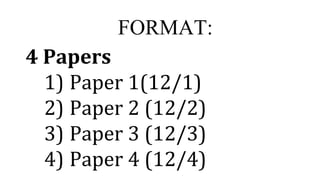
FORMAT:
4 Papers
1) Paper 1(12/1)
2) Paper 2 (12/2)
3) Paper 3 (12/3)
4) Paper 4 (12/4)
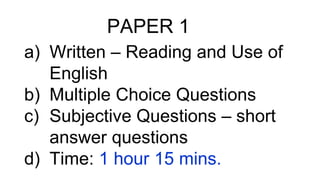
PAPER 1
a) Written – Reading and Use of
English
b) Multiple Choice Questions
c) Subjective Questions – short
answer questions
d) Time: 1 hour 15 mins.
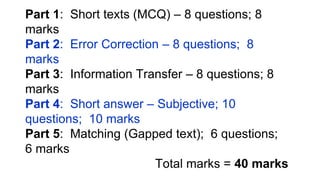
Part 1: Short texts (MCQ) – 8 questions; 8
marks
Part 2: Error Correction – 8 questions; 8
marks
Part 3: Information Transfer – 8 questions; 8
marks
Part 4: Short answer – Subjective; 10
questions; 10 marks
Part 5: Matching (Gapped text); 6 questions;
6 marks
Total marks = 40 marks
● SAMPLE PAPER 1
● PT3 Reading Sample Test_QP (2).pdf
● PT3 Reading Sample Test_Key (2).pdf
PAPER 2 - WRITING
PAPER 2
a) Written – Writing
b) Subjective Questions
•short answer question
•Essay-type question
c) Time: 1 hour
Part 1: Short communicative
message – 1 question (short
answers); 20 marks
Part 2: Notes expansion (essay-type
question)– 1 question; 20 marks
Total marks = 40 marks
● SAMPLE QUESTIONS
FOR PART 2
● PT3 Writing Sample
Test_QP (2).pdf
● kem pecutan prestasi
WRITING.pdf
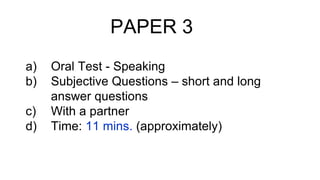
PAPER 3
PAPER 3
a) Oral Test - Speaking
b) Subjective Questions – short and long
answer questions
c) With a partner
d) Time: 11 mins. (approximately)
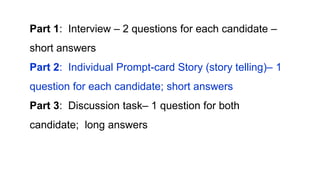
Part 1: Interview – 2 questions for each candidate –
short answers
Part 2: Individual Prompt-card Story (story telling)– 1
question for each candidate; short answers
Part 3: Discussion task– 1 question for both
candidate; long answers
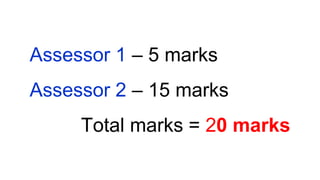
Assessor 1 – 5 marks
Assessor 2 – 15 marks
Total marks = 20 marks
● SAMPLE SPEAKING TEST
● PT3 Speaking Sample
Test_Candidate Booklet
(2).pdf
PAPER 4
PAPER 4
a) Oral Test - Listening
b) Multiple choice questions
c) Time: 35 mins.
Part 1: 3-option Visual MCQ; 5 questions; 5 marks
Part 2: Matching (Sequencing); 5 questions; 5 marks
Part 3: 3-option MCQ (with text); 5 questions; 5 marks
Part 4: Note completion – monologue; 5 questions; 5 marks
Part 5: Note completion – dialogue; 5 questions; 5 marks
Total marks = 25 marks
● SAMPLE LISTENING TEST
● PT3 Listening Sample
Test_QP (2).pdf
● PT3 Listening Sample
Test_Key (2).pdf
PAPER 2 - WRITING
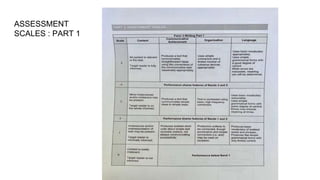
ASSESSMENT
SCALES : PART 1
CONTENT (C)
CONTENT
5 MARKS
All content is relevant to the task
(Content refers to the points /ideas)
- Ideas is related to task
• Target reader is fully informed
• - content elements/ task requirement
are completely addressed
(covered) and
• appropriately developed – suit the
context
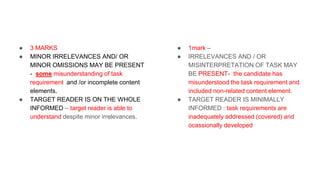
● 3 MARKS
● MINOR IRRELEVANCES AND/ OR
MINOR OMISSIONS MAY BE PRESENT
- some misunderstanding of task
requirement and /or incomplete content
elements.
● TARGET READER IS ON THE WHOLE
INFORMED – target reader is able to
understand despite minor irrelevances.
● 1mark –
● IRRELEVANCES AND / OR
MISINTERPRETATION OF TASK MAY
BE PRESENT- the candidate has
misunderstood the task requirement and
included non-related content element.
● TARGET READER IS MINIMALLY
INFORMED : task requirements are
inadequately addressed (covered) and
ocassionally developed
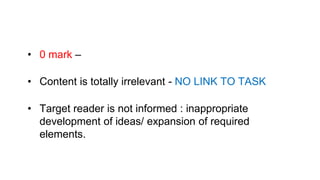
• 0 mark –
• Content is totally irrelevant - NO LINK TO TASK
• Target reader is not informed : inappropriate
development of ideas/ expansion of required
elements.
COMMUNICATIVE ACHIEVEMENT
COMMUNICATIVE
ACHIEVEMENT
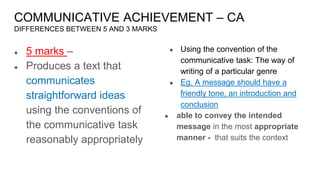
COMMUNICATIVE ACHIEVEMENT – CA
DIFFERENCES BETWEEN 5 AND 3 MARKS
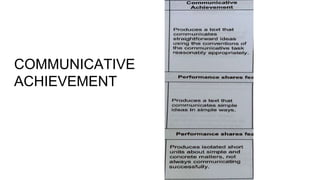
● 5 marks –
● Produces a text that
communicates
straightforward ideas
using the conventions of
the communicative task
reasonably appropriately
● Using the convention of the
communicative task: The way of
writing of a particular genre
● Eg. A message should have a
friendly tone, an introduction and
conclusion
● able to convey the intended
message in the most appropriate
manner - that suits the context
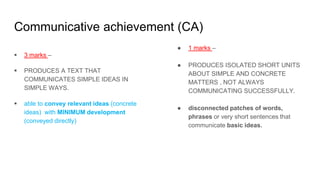
Communicative achievement (CA)
 3 marks –
 PRODUCES A TEXT THAT
COMMUNICATES SIMPLE IDEAS IN
SIMPLE WAYS.
 able to convey relevant ideas (concrete
ideas) with MINIMUM development
(conveyed directly)
● 1 marks –
● PRODUCES ISOLATED SHORT UNITS
ABOUT SIMPLE AND CONCRETE
MATTERS , NOT ALWAYS
COMMUNICATING SUCCESSFULLY.
● disconnected patches of words,
phrases or very short sentences that
communicate basic ideas.
ORGANISATION
ORGANISATION
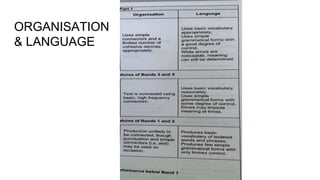
& LANGUAGE
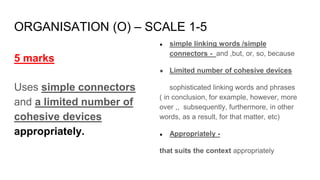
ORGANISATION (O) – SCALE 1-5
5 marks
Uses simple connectors
and a limited number of
cohesive devices
appropriately.
● simple linking words /simple
connectors - and ,but, or, so, because
● Limited number of cohesive devices
sophisticated linking words and phrases
( in conclusion, for example, however, more
over ,, subsequently, furthermore, in other
words, as a result, for that matter, etc)
● Appropriately -
that suits the context appropriately
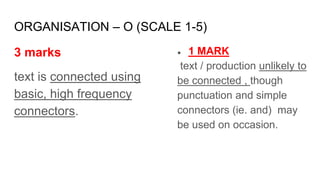
ORGANISATION – O (SCALE 1-5)
3 marks
text is connected using
basic, high frequency
connectors.
● 1 MARK
text / production unlikely to
be connected , though
punctuation and simple
connectors (ie. and) may
be used on occasion.
language
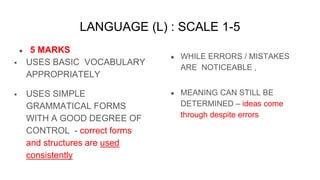
LANGUAGE (L) : SCALE 1-5
● 5 MARKS
 USES BASIC VOCABULARY
APPROPRIATELY
 USES SIMPLE
GRAMMATICAL FORMS
WITH A GOOD DEGREE OF
CONTROL - correct forms
and structures are used
consistently
● WHILE ERRORS / MISTAKES
ARE NOTICEABLE ,
● MEANING CAN STILL BE
DETERMINED – ideas come
through despite errors
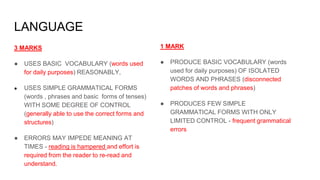
LANGUAGE
3 MARKS
● USES BASIC VOCABULARY (words used
for daily purposes) REASONABLY,
● USES SIMPLE GRAMMATICAL FORMS
(words , phrases and basic forms of tenses)
WITH SOME DEGREE OF CONTROL
(generally able to use the correct forms and
structures)
● ERRORS MAY IMPEDE MEANING AT
TIMES - reading is hampered and effort is
required from the reader to re-read and
understand.
1 MARK
● PRODUCE BASIC VOCABULARY (words
used for daily purposes) OF ISOLATED
WORDS AND PHRASES (disconnected
patches of words and phrases)
● PRODUCES FEW SIMPLE
GRAMMATICAL FORMS WITH ONLY
LIMITED CONTROL - frequent grammatical
errors
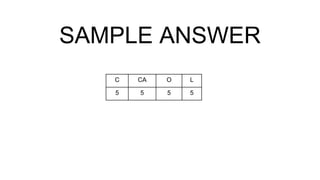
SAMPLE ANSWER
C CA O L
5 5 5 5
PAPER 2
a) Written – Writing
b) Subjective Questions
•short answer question
•Essay-type question
c) Time: 1 hour
Part 1: Short communicative message – 1
question (short answers); 20 marks
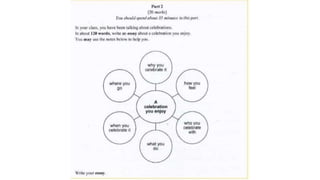
Part 2: Notes expansion (essay-type question)–
1 question; 20 marks
Total marks = 40 marks
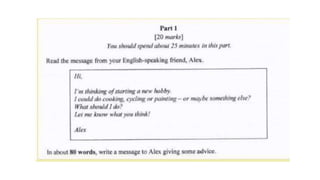
● ANSWER THE QUESTION GIVEN BELOW J
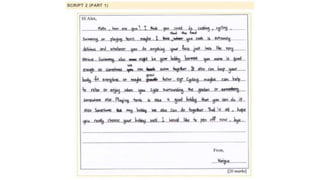
● PART 1
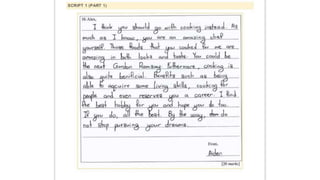
● SCR 1 COMMENT.jpg
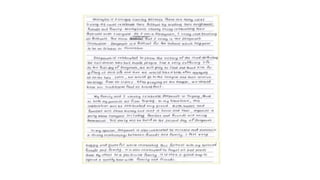
● SCR 2 COMMENT.jpg
● SCR 5 COMMENT.jpg
MORE ON LINKERS
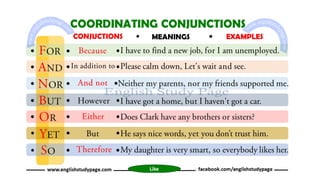
Using linkers -
● BASIC SENTENCE
CONNECTORS
Simple linking words
/Simple connectors -
and ,but, or, so,
because
● COHESIVE DEVICES
● A limited number of
sophisticated linking words
and phrases ( in conclusion,
for example, however, more
over ,, subsequently,
furthermore, in other words,
as a result, for that matter,
etc
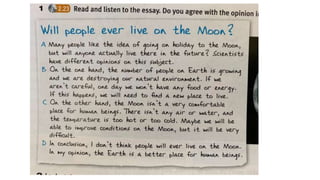
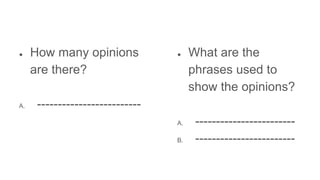
● How many opinions
are there?
A. -------------------------
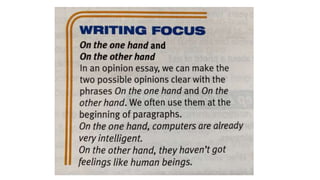
● What are the
phrases used to
show the opinions?
A. ------------------------
B. ------------------------
What are cohesion and cohesive devices.
● The term 'cohesive
devices' refers to the
conjunctions, connectives and
pronouns used to link the parts
of a piece of writing. Using the
same verb tense throughout a
text also offers 'cohesion'.
VIDEO
● http://www.mylessonz.blogspot.com
● https://mylessonz.blogspot.com/2019/08/frim-cohesive-devices.html
● https://mylessonz.blogspot.com/2019/08/frim-conjunction.html
● https://mylessonz.blogspot.com/2019/08/cohesive-devices.html
MORE
A. LINKING WORDS
B. PHRASES & CLAUSES
C. GIVING ADVICE Slide 72
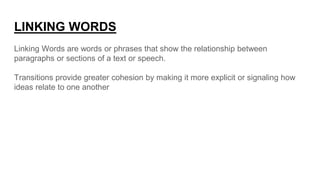
LINKING WORDS
Linking Words are words or phrases that show the relationship between
paragraphs or sections of a text or speech.
Transitions provide greater cohesion by making it more explicit or signaling how
ideas relate to one another
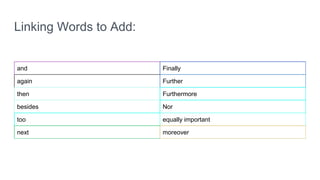
and Finally
again Further
then Furthermore
besides Nor
too equally important
next moreover
Linking Words to Add:
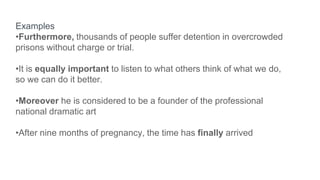
.Examples
•Furthermore, thousands of people suffer detention in overcrowded
prisons without charge or trial.
•It is equally important to listen to what others think of what we do,
so we can do it better.
•Moreover he is considered to be a founder of the professional
national dramatic art
•After nine months of pregnancy, the time has finally arrived
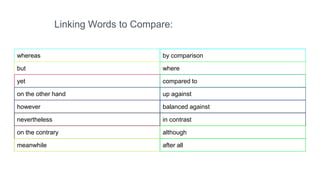
whereas by comparison
but where
yet compared to
on the other hand up against
however balanced against
nevertheless in contrast
on the contrary although
meanwhile after all
Linking Words to Compare:
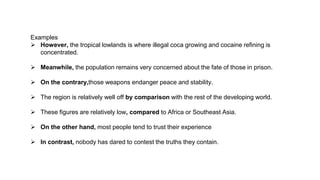
Examples
 However, the tropical lowlands is where illegal coca growing and cocaine refining is
concentrated.
 Meanwhile, the population remains very concerned about the fate of those in prison.
 On the contrary,those weapons endanger peace and stability.
 The region is relatively well off by comparison with the rest of the developing world.
 These figures are relatively low, compared to Africa or Southeast Asia.
 On the other hand, most people tend to trust their experience
 In contrast, nobody has dared to contest the truths they contain.
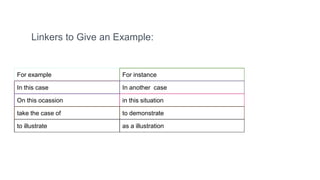
For example For instance
In this case In another case
On this ocassion in this situation
take the case of to demonstrate
to illustrate as a illustration
Linkers to Give an Example:
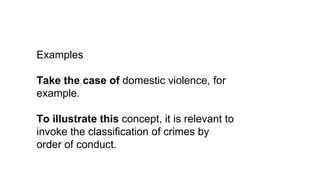
Examples
Take the case of domestic violence, for
example.
To illustrate this concept, it is relevant to
invoke the classification of crimes by
order of conduct.
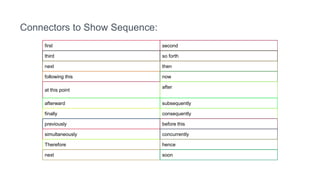
first second
third so forth
next then
following this now
at this point
after
afterward subsequently
finally consequently
previously before this
simultaneously concurrently
Therefore hence
next soon
Connectors to Show Sequence:
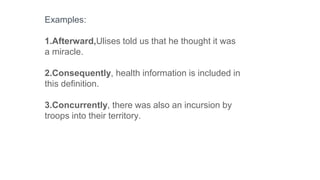
Examples:
1.Afterward,Ulises told us that he thought it was
a miracle.
2.Consequently, health information is included in
this definition.
3.Concurrently, there was also an incursion by
troops into their territory.
PHRASES &
CLAUSES
Clauses and phrases are the building blocks
of sentences.
Every sentence must have at least one clause to
be considered grammatically correct.
Understanding how clauses and phrases work
will help you better understand sentence
structure.
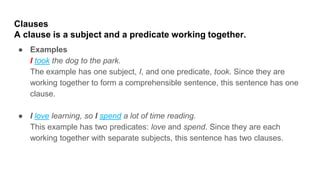
Clauses
A clause is a subject and a predicate working together.
● Examples
I took the dog to the park.
The example has one subject, I, and one predicate, took. Since they are
working together to form a comprehensible sentence, this sentence has one
clause.
● I love learning, so I spend a lot of time reading.
This example has two predicates: love and spend. Since they are each
working together with separate subjects, this sentence has two clauses.
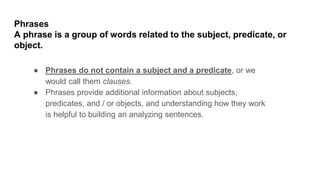
Phrases
A phrase is a group of words related to the subject, predicate, or
object.
● Phrases do not contain a subject and a predicate, or we
would call them clauses.
● Phrases provide additional information about subjects,
predicates, and / or objects, and understanding how they work
is helpful to building an analyzing sentences.
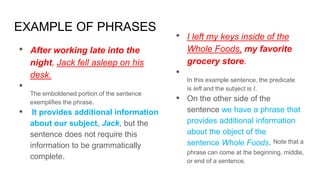
EXAMPLE OF PHRASES
● After working late into the
night, Jack fell asleep on his
desk.
●
The emboldened portion of the sentence
exemplifies the phrase.
● It provides additional information
about our subject, Jack, but the
sentence does not require this
information to be grammatically
complete.
● I left my keys inside of the
Whole Foods, my favorite
grocery store.
●
In this example sentence, the predicate
is left and the subject is I.
● On the other side of the
sentence we have a phrase that
provides additional information
about the object of the
sentence Whole Foods. Note that a
phrase can come at the beginning, middle,
or end of a sentence.
Giving advice in English.
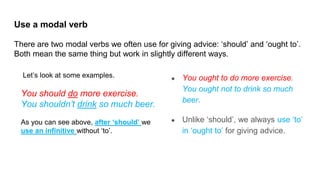
Let’s look at some examples.
You should do more exercise.
You shouldn’t drink so much beer.
As you can see above, after ‘should’ we
use an infinitive without ‘to’.
Use a modal verb
There are two modal verbs we often use for giving advice: ‘should’ and ‘ought to’.
Both mean the same thing but work in slightly different ways.
● You ought to do more exercise.
You ought not to drink so much
beer.
● Unlike ‘should’, we always use ‘to’
in ‘ought to’ for giving advice.
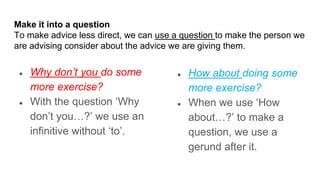
Make it into a question
To make advice less direct, we can use a question to make the person we
are advising consider about the advice we are giving them.
● Why don’t you do some
more exercise?
● With the question ‘Why
don’t you…?’ we use an
infinitive without ‘to’.
● How about doing some
more exercise?
● When we use ‘How
about…?’ to make a
question, we use a
gerund after it.
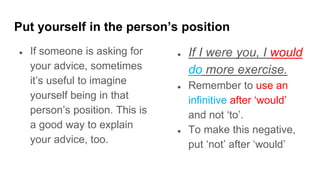
Put yourself in the person’s position
● If someone is asking for
your advice, sometimes
it’s useful to imagine
yourself being in that
person’s position. This is
a good way to explain
your advice, too.
● If I were you, I would
do more exercise.
● Remember to use an
infinitive after ‘would’
and not ‘to’.
● To make this negative,
put ‘not’ after ‘would’
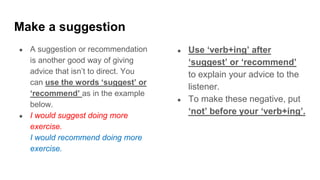
Make a suggestion
● A suggestion or recommendation
is another good way of giving
advice that isn’t to direct. You
can use the words ‘suggest’ or
‘recommend’ as in the example
below.
● I would suggest doing more
exercise.
I would recommend doing more
exercise.
● Use ‘verb+ing’ after
‘suggest’ or ‘recommend’
to explain your advice to the
listener.
● To make these negative, put
‘not’ before your ‘verb+ing’.
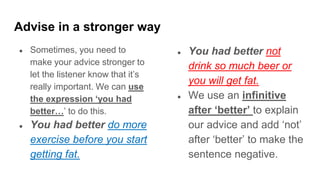
Advise in a stronger way
● Sometimes, you need to
make your advice stronger to
let the listener know that it’s
really important. We can use
the expression ‘you had
better…’ to do this.
● You had better do more
exercise before you start
getting fat.
● You had better not
drink so much beer or
you will get fat.
● We use an infinitive
after ‘better’ to explain
our advice and add ‘not’
after ‘better’ to make the
sentence negative.

ENGLISH FORM 2 PRESENTATION FRIM 6 -8 August 2019

  • 1.
  • 2.
    FORMAT: 4 Papers 1) Paper1(12/1) 2) Paper 2 (12/2) 3) Paper 3 (12/3) 4) Paper 4 (12/4)
  • 3.
    PAPER 1 a) Written– Reading and Use of English b) Multiple Choice Questions c) Subjective Questions – short answer questions d) Time: 1 hour 15 mins.
  • 4.
    Part 1: Shorttexts (MCQ) – 8 questions; 8 marks Part 2: Error Correction – 8 questions; 8 marks Part 3: Information Transfer – 8 questions; 8 marks Part 4: Short answer – Subjective; 10 questions; 10 marks Part 5: Matching (Gapped text); 6 questions; 6 marks Total marks = 40 marks
  • 5.
    ● SAMPLE PAPER1 ● PT3 Reading Sample Test_QP (2).pdf ● PT3 Reading Sample Test_Key (2).pdf
  • 6.
    PAPER 2 -WRITING
  • 7.
    PAPER 2 a) Written– Writing b) Subjective Questions •short answer question •Essay-type question c) Time: 1 hour
  • 8.
    Part 1: Shortcommunicative message – 1 question (short answers); 20 marks Part 2: Notes expansion (essay-type question)– 1 question; 20 marks Total marks = 40 marks
  • 9.
    ● SAMPLE QUESTIONS FORPART 2 ● PT3 Writing Sample Test_QP (2).pdf ● kem pecutan prestasi WRITING.pdf
  • 10.
  • 11.
    PAPER 3 a) OralTest - Speaking b) Subjective Questions – short and long answer questions c) With a partner d) Time: 11 mins. (approximately)
  • 12.
    Part 1: Interview– 2 questions for each candidate – short answers Part 2: Individual Prompt-card Story (story telling)– 1 question for each candidate; short answers Part 3: Discussion task– 1 question for both candidate; long answers
  • 13.
    Assessor 1 –5 marks Assessor 2 – 15 marks Total marks = 20 marks
  • 14.
    ● SAMPLE SPEAKINGTEST ● PT3 Speaking Sample Test_Candidate Booklet (2).pdf
  • 15.
  • 16.
    PAPER 4 a) OralTest - Listening b) Multiple choice questions c) Time: 35 mins.
  • 17.
    Part 1: 3-optionVisual MCQ; 5 questions; 5 marks Part 2: Matching (Sequencing); 5 questions; 5 marks Part 3: 3-option MCQ (with text); 5 questions; 5 marks Part 4: Note completion – monologue; 5 questions; 5 marks Part 5: Note completion – dialogue; 5 questions; 5 marks Total marks = 25 marks
  • 18.
    ● SAMPLE LISTENINGTEST ● PT3 Listening Sample Test_QP (2).pdf ● PT3 Listening Sample Test_Key (2).pdf
  • 19.
    PAPER 2 -WRITING
  • 20.
  • 21.
  • 22.
    CONTENT 5 MARKS All contentis relevant to the task (Content refers to the points /ideas) - Ideas is related to task • Target reader is fully informed • - content elements/ task requirement are completely addressed (covered) and • appropriately developed – suit the context
  • 23.
    ● 3 MARKS ●MINOR IRRELEVANCES AND/ OR MINOR OMISSIONS MAY BE PRESENT - some misunderstanding of task requirement and /or incomplete content elements. ● TARGET READER IS ON THE WHOLE INFORMED – target reader is able to understand despite minor irrelevances. ● 1mark – ● IRRELEVANCES AND / OR MISINTERPRETATION OF TASK MAY BE PRESENT- the candidate has misunderstood the task requirement and included non-related content element. ● TARGET READER IS MINIMALLY INFORMED : task requirements are inadequately addressed (covered) and ocassionally developed
  • 24.
    • 0 mark– • Content is totally irrelevant - NO LINK TO TASK • Target reader is not informed : inappropriate development of ideas/ expansion of required elements.
  • 25.
  • 26.
  • 27.
    COMMUNICATIVE ACHIEVEMENT –CA DIFFERENCES BETWEEN 5 AND 3 MARKS ● 5 marks – ● Produces a text that communicates straightforward ideas using the conventions of the communicative task reasonably appropriately ● Using the convention of the communicative task: The way of writing of a particular genre ● Eg. A message should have a friendly tone, an introduction and conclusion ● able to convey the intended message in the most appropriate manner - that suits the context
  • 28.
    Communicative achievement (CA) 3 marks –  PRODUCES A TEXT THAT COMMUNICATES SIMPLE IDEAS IN SIMPLE WAYS.  able to convey relevant ideas (concrete ideas) with MINIMUM development (conveyed directly) ● 1 marks – ● PRODUCES ISOLATED SHORT UNITS ABOUT SIMPLE AND CONCRETE MATTERS , NOT ALWAYS COMMUNICATING SUCCESSFULLY. ● disconnected patches of words, phrases or very short sentences that communicate basic ideas.
  • 29.
  • 30.
  • 31.
    ORGANISATION (O) –SCALE 1-5 5 marks Uses simple connectors and a limited number of cohesive devices appropriately. ● simple linking words /simple connectors - and ,but, or, so, because ● Limited number of cohesive devices sophisticated linking words and phrases ( in conclusion, for example, however, more over ,, subsequently, furthermore, in other words, as a result, for that matter, etc) ● Appropriately - that suits the context appropriately
  • 32.
    ORGANISATION – O(SCALE 1-5) 3 marks text is connected using basic, high frequency connectors. ● 1 MARK text / production unlikely to be connected , though punctuation and simple connectors (ie. and) may be used on occasion.
  • 33.
  • 34.
    LANGUAGE (L) :SCALE 1-5 ● 5 MARKS  USES BASIC VOCABULARY APPROPRIATELY  USES SIMPLE GRAMMATICAL FORMS WITH A GOOD DEGREE OF CONTROL - correct forms and structures are used consistently ● WHILE ERRORS / MISTAKES ARE NOTICEABLE , ● MEANING CAN STILL BE DETERMINED – ideas come through despite errors
  • 35.
    LANGUAGE 3 MARKS ● USESBASIC VOCABULARY (words used for daily purposes) REASONABLY, ● USES SIMPLE GRAMMATICAL FORMS (words , phrases and basic forms of tenses) WITH SOME DEGREE OF CONTROL (generally able to use the correct forms and structures) ● ERRORS MAY IMPEDE MEANING AT TIMES - reading is hampered and effort is required from the reader to re-read and understand. 1 MARK ● PRODUCE BASIC VOCABULARY (words used for daily purposes) OF ISOLATED WORDS AND PHRASES (disconnected patches of words and phrases) ● PRODUCES FEW SIMPLE GRAMMATICAL FORMS WITH ONLY LIMITED CONTROL - frequent grammatical errors
  • 36.
    SAMPLE ANSWER C CAO L 5 5 5 5
  • 37.
    PAPER 2 a) Written– Writing b) Subjective Questions •short answer question •Essay-type question c) Time: 1 hour
  • 38.
    Part 1: Shortcommunicative message – 1 question (short answers); 20 marks Part 2: Notes expansion (essay-type question)– 1 question; 20 marks Total marks = 40 marks
  • 39.
    ● ANSWER THEQUESTION GIVEN BELOW J ● PART 1
  • 42.
    ● SCR 1COMMENT.jpg
  • 44.
    ● SCR 2COMMENT.jpg
  • 47.
    ● SCR 5COMMENT.jpg
  • 48.
  • 49.
    Using linkers - ●BASIC SENTENCE CONNECTORS Simple linking words /Simple connectors - and ,but, or, so, because ● COHESIVE DEVICES ● A limited number of sophisticated linking words and phrases ( in conclusion, for example, however, more over ,, subsequently, furthermore, in other words, as a result, for that matter, etc
  • 51.
    ● How manyopinions are there? A. ------------------------- ● What are the phrases used to show the opinions? A. ------------------------ B. ------------------------
  • 54.
    What are cohesionand cohesive devices. ● The term 'cohesive devices' refers to the conjunctions, connectives and pronouns used to link the parts of a piece of writing. Using the same verb tense throughout a text also offers 'cohesion'.
  • 55.
    VIDEO ● http://www.mylessonz.blogspot.com ● https://mylessonz.blogspot.com/2019/08/frim-cohesive-devices.html ●https://mylessonz.blogspot.com/2019/08/frim-conjunction.html ● https://mylessonz.blogspot.com/2019/08/cohesive-devices.html
  • 56.
    MORE A. LINKING WORDS B.PHRASES & CLAUSES C. GIVING ADVICE Slide 72
  • 57.
    LINKING WORDS Linking Wordsare words or phrases that show the relationship between paragraphs or sections of a text or speech. Transitions provide greater cohesion by making it more explicit or signaling how ideas relate to one another
  • 58.
    and Finally again Further thenFurthermore besides Nor too equally important next moreover Linking Words to Add:
  • 59.
    .Examples •Furthermore, thousands ofpeople suffer detention in overcrowded prisons without charge or trial. •It is equally important to listen to what others think of what we do, so we can do it better. •Moreover he is considered to be a founder of the professional national dramatic art •After nine months of pregnancy, the time has finally arrived
  • 60.
    whereas by comparison butwhere yet compared to on the other hand up against however balanced against nevertheless in contrast on the contrary although meanwhile after all Linking Words to Compare:
  • 61.
    Examples  However, thetropical lowlands is where illegal coca growing and cocaine refining is concentrated.  Meanwhile, the population remains very concerned about the fate of those in prison.  On the contrary,those weapons endanger peace and stability.  The region is relatively well off by comparison with the rest of the developing world.  These figures are relatively low, compared to Africa or Southeast Asia.  On the other hand, most people tend to trust their experience  In contrast, nobody has dared to contest the truths they contain.
  • 62.
    For example Forinstance In this case In another case On this ocassion in this situation take the case of to demonstrate to illustrate as a illustration Linkers to Give an Example:
  • 63.
    Examples Take the caseof domestic violence, for example. To illustrate this concept, it is relevant to invoke the classification of crimes by order of conduct.
  • 64.
    first second third soforth next then following this now at this point after afterward subsequently finally consequently previously before this simultaneously concurrently Therefore hence next soon Connectors to Show Sequence:
  • 65.
    Examples: 1.Afterward,Ulises told usthat he thought it was a miracle. 2.Consequently, health information is included in this definition. 3.Concurrently, there was also an incursion by troops into their territory.
  • 66.
  • 67.
    Clauses and phrasesare the building blocks of sentences. Every sentence must have at least one clause to be considered grammatically correct. Understanding how clauses and phrases work will help you better understand sentence structure.
  • 68.
    Clauses A clause isa subject and a predicate working together. ● Examples I took the dog to the park. The example has one subject, I, and one predicate, took. Since they are working together to form a comprehensible sentence, this sentence has one clause. ● I love learning, so I spend a lot of time reading. This example has two predicates: love and spend. Since they are each working together with separate subjects, this sentence has two clauses.
  • 69.
    Phrases A phrase isa group of words related to the subject, predicate, or object. ● Phrases do not contain a subject and a predicate, or we would call them clauses. ● Phrases provide additional information about subjects, predicates, and / or objects, and understanding how they work is helpful to building an analyzing sentences.
  • 70.
    EXAMPLE OF PHRASES ●After working late into the night, Jack fell asleep on his desk. ● The emboldened portion of the sentence exemplifies the phrase. ● It provides additional information about our subject, Jack, but the sentence does not require this information to be grammatically complete. ● I left my keys inside of the Whole Foods, my favorite grocery store. ● In this example sentence, the predicate is left and the subject is I. ● On the other side of the sentence we have a phrase that provides additional information about the object of the sentence Whole Foods. Note that a phrase can come at the beginning, middle, or end of a sentence.
  • 72.
  • 73.
    Let’s look atsome examples. You should do more exercise. You shouldn’t drink so much beer. As you can see above, after ‘should’ we use an infinitive without ‘to’. Use a modal verb There are two modal verbs we often use for giving advice: ‘should’ and ‘ought to’. Both mean the same thing but work in slightly different ways. ● You ought to do more exercise. You ought not to drink so much beer. ● Unlike ‘should’, we always use ‘to’ in ‘ought to’ for giving advice.
  • 74.
    Make it intoa question To make advice less direct, we can use a question to make the person we are advising consider about the advice we are giving them. ● Why don’t you do some more exercise? ● With the question ‘Why don’t you…?’ we use an infinitive without ‘to’. ● How about doing some more exercise? ● When we use ‘How about…?’ to make a question, we use a gerund after it.
  • 75.
    Put yourself inthe person’s position ● If someone is asking for your advice, sometimes it’s useful to imagine yourself being in that person’s position. This is a good way to explain your advice, too. ● If I were you, I would do more exercise. ● Remember to use an infinitive after ‘would’ and not ‘to’. ● To make this negative, put ‘not’ after ‘would’
  • 76.
    Make a suggestion ●A suggestion or recommendation is another good way of giving advice that isn’t to direct. You can use the words ‘suggest’ or ‘recommend’ as in the example below. ● I would suggest doing more exercise. I would recommend doing more exercise. ● Use ‘verb+ing’ after ‘suggest’ or ‘recommend’ to explain your advice to the listener. ● To make these negative, put ‘not’ before your ‘verb+ing’.
  • 77.
    Advise in astronger way ● Sometimes, you need to make your advice stronger to let the listener know that it’s really important. We can use the expression ‘you had better…’ to do this. ● You had better do more exercise before you start getting fat. ● You had better not drink so much beer or you will get fat. ● We use an infinitive after ‘better’ to explain our advice and add ‘not’ after ‘better’ to make the sentence negative.