10 Key Elements of a
Research Paper:
A Writers Perspective
Dilum Bandara, PhD
University of Moratuwa
1 – Know Your Audience
• Review Phase  Reviewers
• Aware of domain & problem
• Few may be working on exactly the same problem
• Want to determine whether work is worthy of publishing
• Camera Ready  Researchers
• Novice
• Expert
• General interest on topic
• Few working on exactly the same problem
• Want to gain knowledge and/or want to solve a specific problem
“Every paper tells a story. Know your stor
- Jim Kurose
2 – Follow Template
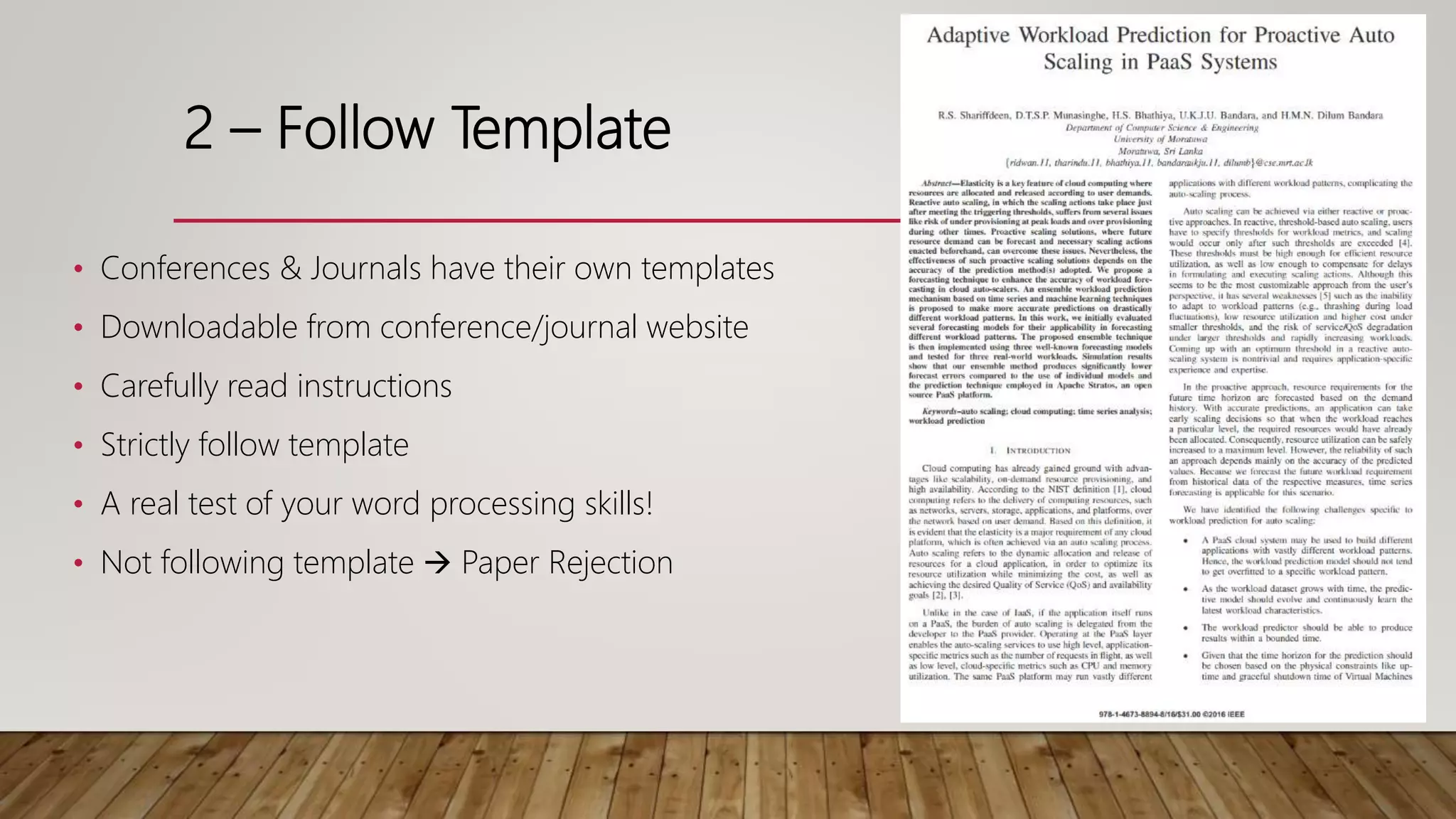
• Conferences & Journals have their own templates
• Downloadable from conference/journal website
• Carefully read instructions
• Strictly follow template
• A real test of your word processing skills!
• Not following template  Paper Rejection
3 – Paper Title
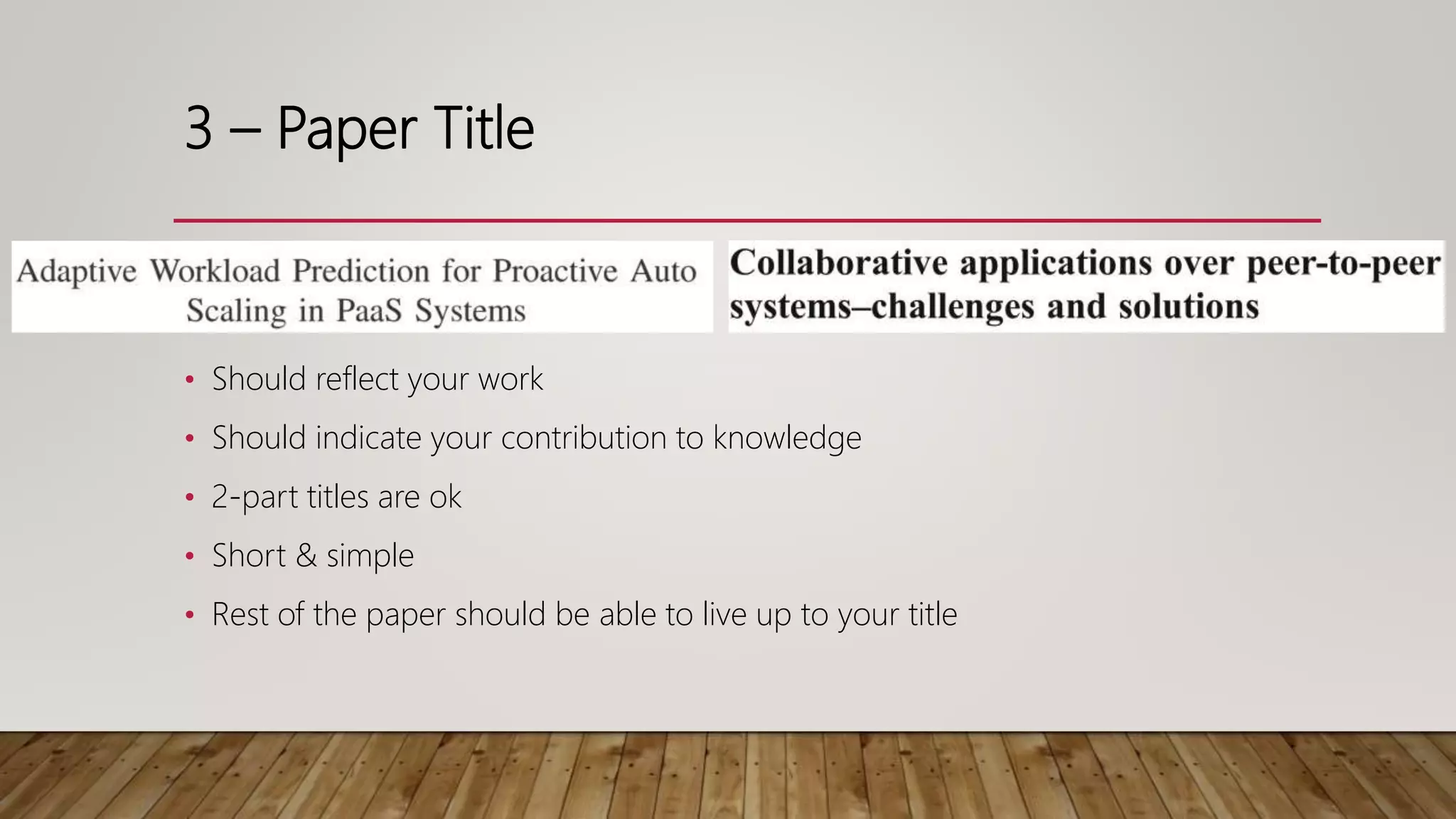
• Should reflect your work
• Should indicate your contribution to knowledge
• 2-part titles are ok
• Short & simple
• Rest of the paper should be able to live up to your title
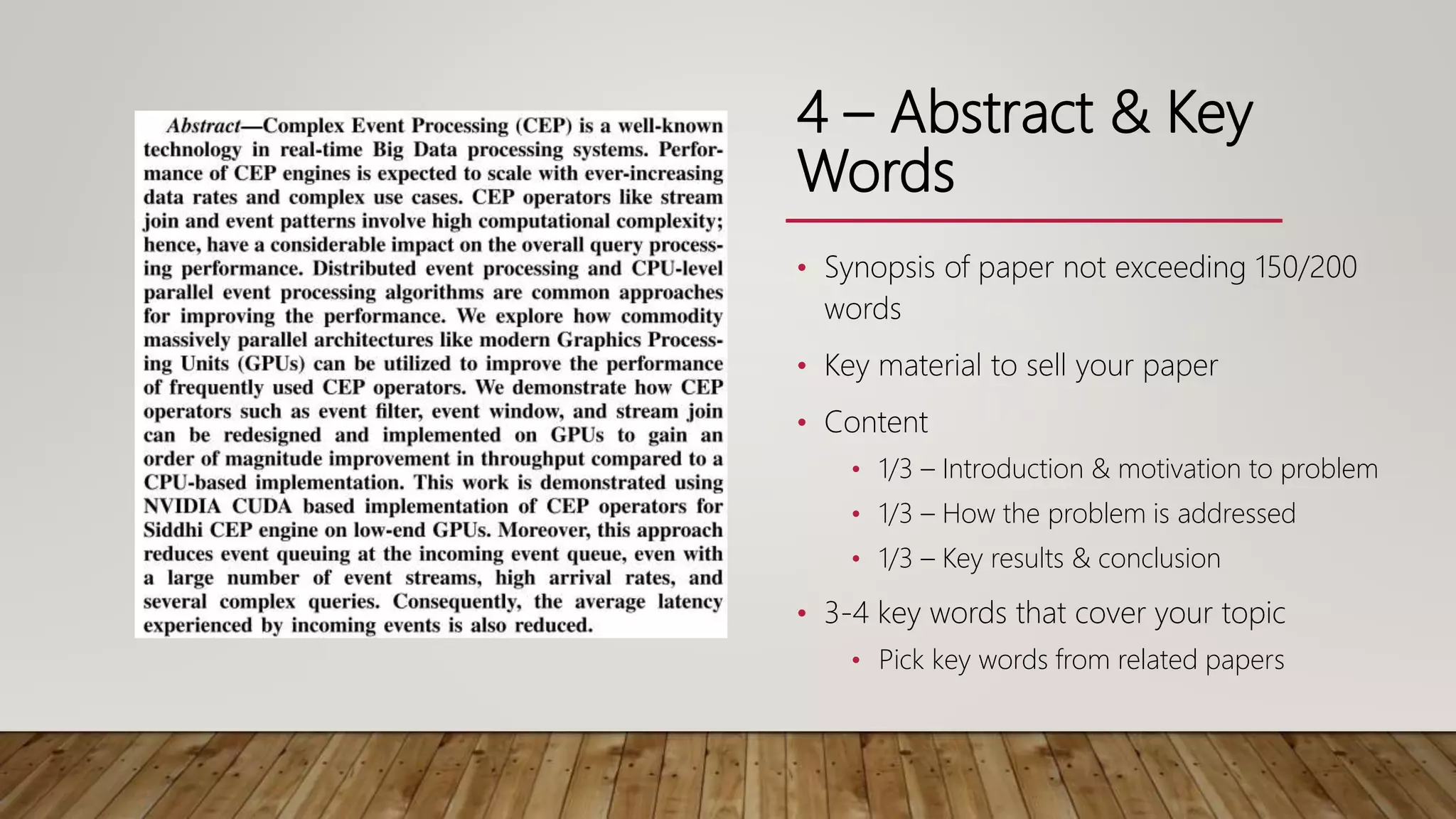
4 – Abstract & Key
Words
• Synopsis of paper not exceeding 150/200
words
• Key material to sell your paper
• Content
• 1/3 – Introduction & motivation to problem
• 1/3 – How the problem is addressed
• 1/3 – Key results & conclusion
• 3-4 key words that cover your topic
• Pick key words from related papers
5 – Introduction
• Minimum introduction to topic
• Most readers have an idea about topic & its significance
• Good motivation on “why” your problem is important
• Show gaps in what’s already around/known
• Clearly describe the paper’s contribution
• What & how you did it
• Key results
• Someone writing a literature survey should be able to just extract this para
• Briefly introduce rest of the paper
• Should use less than 20% of paper space
6 – Related Work
• Discuss all literature that’s related to your work
• Focus on seminal work & more recent work
• Critically evaluate them
• Illustrate missing pieces
• Don’t paraphrase  Leads to high similarity score
• Justify there is a place for your work too
• No more than 1-2 sentences
• No more than 10% of paper space
7 – Solution
• Explain your proposed solution
• Better if a formal problem can be formulated & then explain solution in line with that
• Tell how you came up with solution
• Clearly state assumptions
• Tell logic behind your solution
• Logically arrange your ideas
• Draw diagrams
• Give algorithms
• Compare your solution with related work
• Give credit to related work
• Give enough details s.t. one can replicate your solution
8 – Performance Evaluation
• Present experimental setup, emulator, simulator, etc.
• Give enough details s.t. one can run your solution
• Did you collect enough samples?
• Are results within an accuracy of ±5% and 95% confidence level?
• Present findings
• Logically ordered
• Simple to complex
• Explain your graphs, tables, & findings
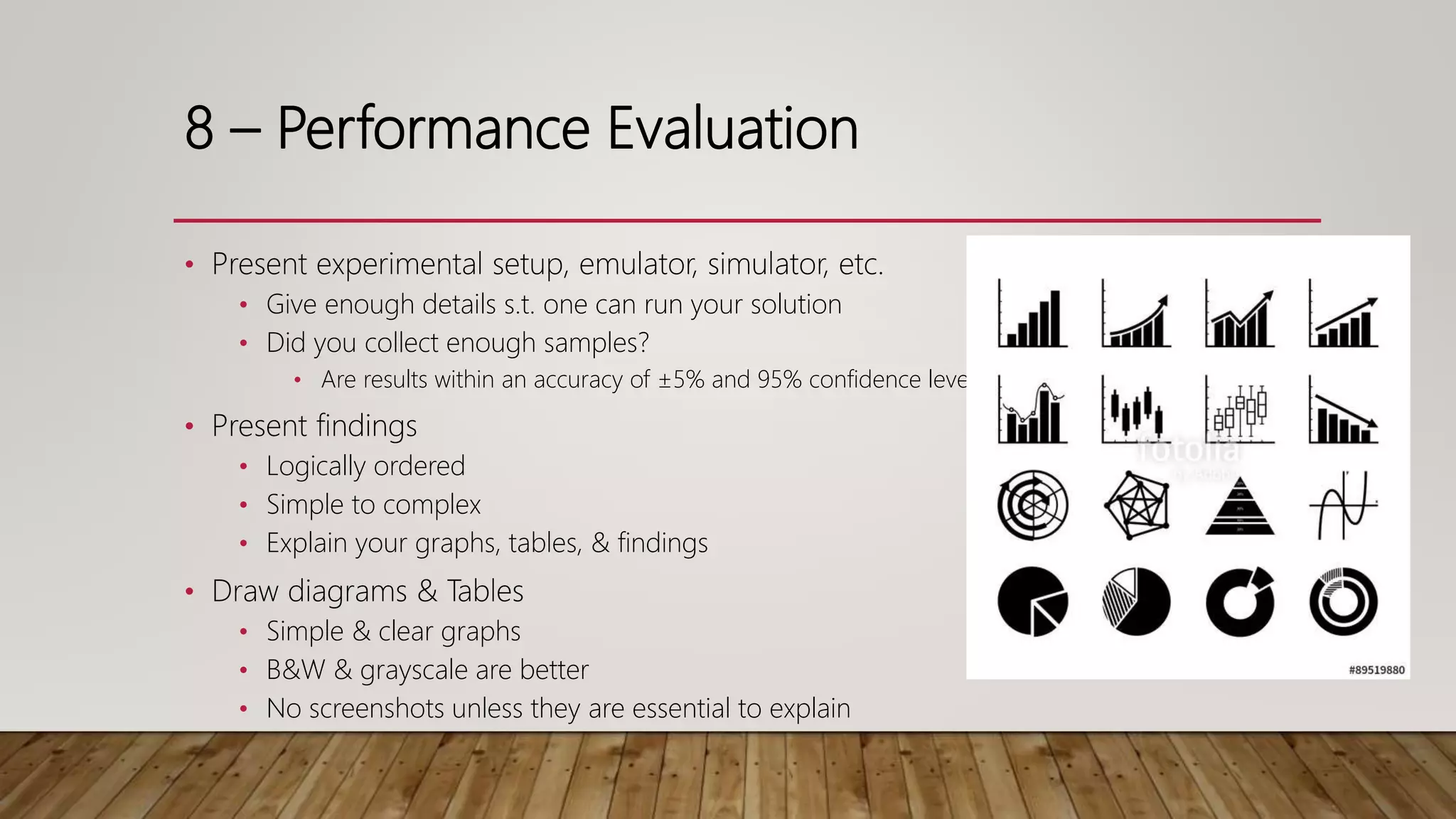
• Draw diagrams & Tables
• Simple & clear graphs
• B&W & grayscale are better
• No screenshots unless they are essential to explain
9 – Summary
• Know difference between Summary & Conclusion
• Summarize/conclude your work
• Don’t repeat abstract
• Tell why your findings are useful
• Recognize research limitations
• List possible future work
• Limitations could lead to future work
• No more than 5% of paper space
10 – Acknowledgement & References
• Strictly follow given format
• Indicate funding source
• Give credit to essential people who contributed to
idea or solution
• Don’t self acknowledge
• Use proper referring style
• Use tools to generate/convert citations
• Double check final output list of references
Do Repeat
• Spell & Grammar check
• Use special tools
• Choose words carefully
• Plagiarism Check
• Proof read
• Self review next day!
• Friend/colleague who is willing to give
“hard” feedback
• Supervisor
• For Camera Ready paper
• Address all reviewer comments
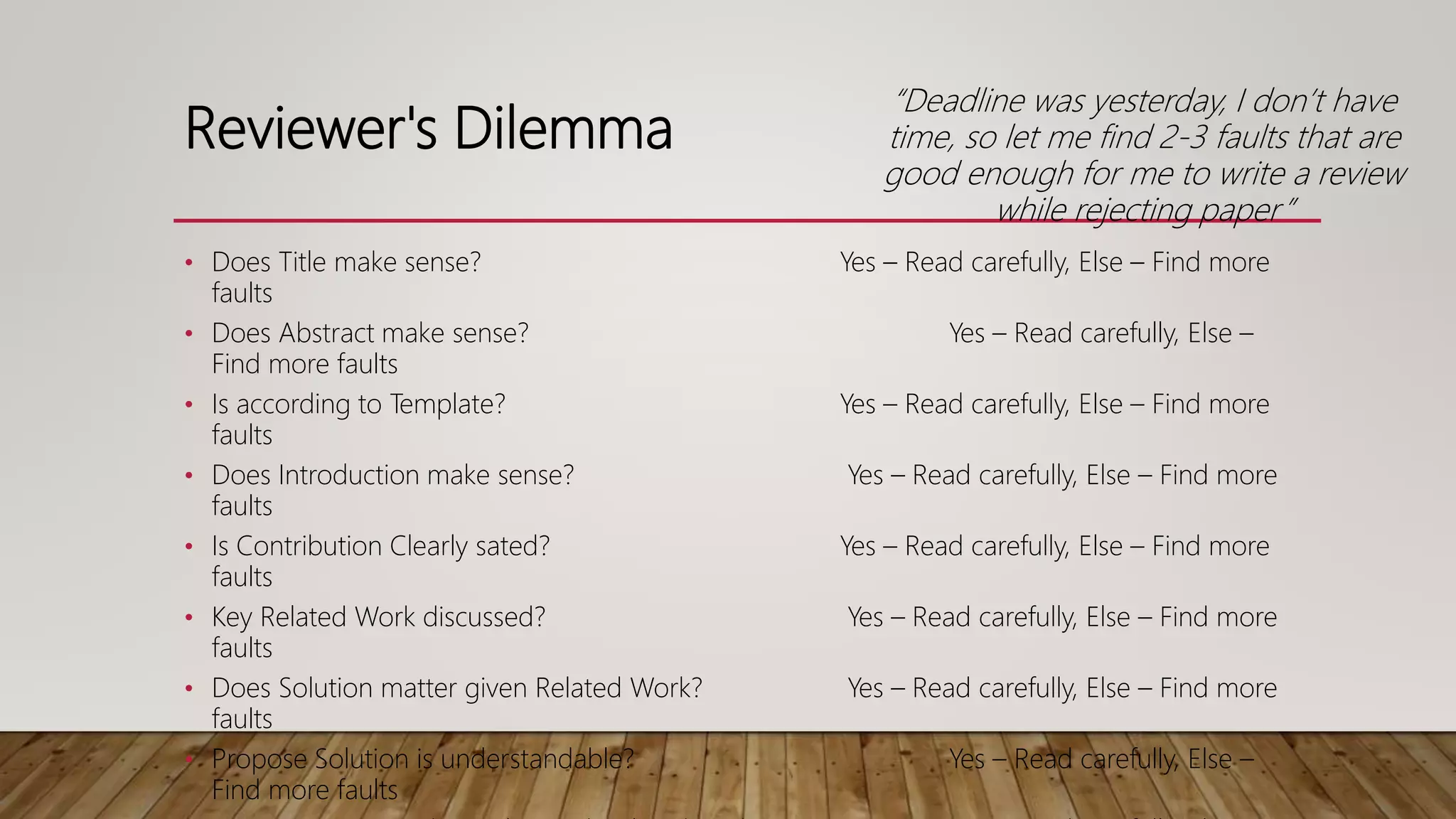
Reviewer's Dilemma
• Does Title make sense? Yes – Read carefully, Else – Find more
faults
• Does Abstract make sense? Yes – Read carefully, Else –
Find more faults
• Is according to Template? Yes – Read carefully, Else – Find more
faults
• Does Introduction make sense? Yes – Read carefully, Else – Find more
faults
• Is Contribution Clearly sated? Yes – Read carefully, Else – Find more
faults
• Key Related Work discussed? Yes – Read carefully, Else – Find more
faults
• Does Solution matter given Related Work? Yes – Read carefully, Else – Find more
faults
• Propose Solution is understandable? Yes – Read carefully, Else –
Find more faults
“Deadline was yesterday, I don’t have
time, so let me find 2-3 faults that are
good enough for me to write a review
while rejecting paper”
RESOURCES
• 10 Tips to Write a Paper (Jim Kurose)
• https://paperpicker.wordpress.com/2006/12/05/10-tips-to-write-a-paper-from-jim-
kurose/
• How to Write an Abstract (Philip Koopman)
• https://users.ece.cmu.edu/~koopman/essays/abstract.html

10 key elements of a research paper - A writers perspective

  • 1.
    10 Key Elementsof a Research Paper: A Writers Perspective Dilum Bandara, PhD University of Moratuwa
  • 2.
    1 – KnowYour Audience • Review Phase  Reviewers • Aware of domain & problem • Few may be working on exactly the same problem • Want to determine whether work is worthy of publishing • Camera Ready  Researchers • Novice • Expert • General interest on topic • Few working on exactly the same problem • Want to gain knowledge and/or want to solve a specific problem “Every paper tells a story. Know your stor - Jim Kurose
  • 3.
    2 – FollowTemplate • Conferences & Journals have their own templates • Downloadable from conference/journal website • Carefully read instructions • Strictly follow template • A real test of your word processing skills! • Not following template  Paper Rejection
  • 4.
    3 – PaperTitle • Should reflect your work • Should indicate your contribution to knowledge • 2-part titles are ok • Short & simple • Rest of the paper should be able to live up to your title
  • 5.
    4 – Abstract& Key Words • Synopsis of paper not exceeding 150/200 words • Key material to sell your paper • Content • 1/3 – Introduction & motivation to problem • 1/3 – How the problem is addressed • 1/3 – Key results & conclusion • 3-4 key words that cover your topic • Pick key words from related papers
  • 6.
    5 – Introduction •Minimum introduction to topic • Most readers have an idea about topic & its significance • Good motivation on “why” your problem is important • Show gaps in what’s already around/known • Clearly describe the paper’s contribution • What & how you did it • Key results • Someone writing a literature survey should be able to just extract this para • Briefly introduce rest of the paper • Should use less than 20% of paper space
  • 7.
    6 – RelatedWork • Discuss all literature that’s related to your work • Focus on seminal work & more recent work • Critically evaluate them • Illustrate missing pieces • Don’t paraphrase  Leads to high similarity score • Justify there is a place for your work too • No more than 1-2 sentences • No more than 10% of paper space
  • 8.
    7 – Solution •Explain your proposed solution • Better if a formal problem can be formulated & then explain solution in line with that • Tell how you came up with solution • Clearly state assumptions • Tell logic behind your solution • Logically arrange your ideas • Draw diagrams • Give algorithms • Compare your solution with related work • Give credit to related work • Give enough details s.t. one can replicate your solution
  • 9.
    8 – PerformanceEvaluation • Present experimental setup, emulator, simulator, etc. • Give enough details s.t. one can run your solution • Did you collect enough samples? • Are results within an accuracy of ±5% and 95% confidence level? • Present findings • Logically ordered • Simple to complex • Explain your graphs, tables, & findings • Draw diagrams & Tables • Simple & clear graphs • B&W & grayscale are better • No screenshots unless they are essential to explain
  • 10.
    9 – Summary •Know difference between Summary & Conclusion • Summarize/conclude your work • Don’t repeat abstract • Tell why your findings are useful • Recognize research limitations • List possible future work • Limitations could lead to future work • No more than 5% of paper space
  • 11.
    10 – Acknowledgement& References • Strictly follow given format • Indicate funding source • Give credit to essential people who contributed to idea or solution • Don’t self acknowledge • Use proper referring style • Use tools to generate/convert citations • Double check final output list of references
  • 12.
    Do Repeat • Spell& Grammar check • Use special tools • Choose words carefully • Plagiarism Check • Proof read • Self review next day! • Friend/colleague who is willing to give “hard” feedback • Supervisor • For Camera Ready paper • Address all reviewer comments
  • 13.
    Reviewer's Dilemma • DoesTitle make sense? Yes – Read carefully, Else – Find more faults • Does Abstract make sense? Yes – Read carefully, Else – Find more faults • Is according to Template? Yes – Read carefully, Else – Find more faults • Does Introduction make sense? Yes – Read carefully, Else – Find more faults • Is Contribution Clearly sated? Yes – Read carefully, Else – Find more faults • Key Related Work discussed? Yes – Read carefully, Else – Find more faults • Does Solution matter given Related Work? Yes – Read carefully, Else – Find more faults • Propose Solution is understandable? Yes – Read carefully, Else – Find more faults “Deadline was yesterday, I don’t have time, so let me find 2-3 faults that are good enough for me to write a review while rejecting paper”
  • 14.
    RESOURCES • 10 Tipsto Write a Paper (Jim Kurose) • https://paperpicker.wordpress.com/2006/12/05/10-tips-to-write-a-paper-from-jim- kurose/ • How to Write an Abstract (Philip Koopman) • https://users.ece.cmu.edu/~koopman/essays/abstract.html