Who The Hell Am I?
SEO Manager
@MarkSEOsborne
Real creative twitter handle right?
What Wonderful Agency Do I Work For?
What Dodgy Looking People Do I Have To Work With?
Why is this talk all about
the “seedy underbelly”?
1. Why am I still looking in the
same unreliable sources for
keyword data?
2. There must be ways to be
better aligned to how users
are actually searching and
how the main man Mr
Google ranks websites?
Probably More Like This Though
On A Dark Journey
SAFETY
FIRST!
Starting With Places Where I
Can Find More Keyword
Inspiration
I managed to
find some
sources that
weren’t just
other
keyword tools!
NEXT
Advanced Search
Also found loads of
questions and topics here
Loads of questions,
unsurprisingly!
Blogs as
well
Topic
Spaces
These little guys
can help as well
Wade passed all the
“dank” memes
And there is a subreddit for
everything full of interesting
keyword opportunities
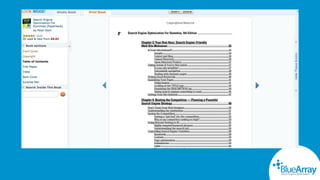
From This
/r/CrappyDesign
To more useful ones
like this
/r/PersonalFinance
Honorable Mentions!
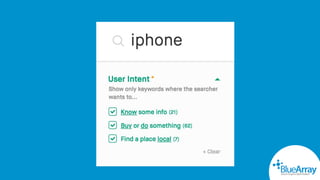
What is the search
intent behind the
keywords?
SEARCH INTENT
SEO BUZZ WORD OF 2019
But there is a problem
The old search intent
model is broken. As its
to narrow for modern
searches!
Old model
looks
something
like this
So what does the best
version of search intent
stages look like for
today's searches?
The perfect article came
out of the our amazing
Blue Array newsletter
Suttle plug for newsletter sign ups
Content Harmony had
broken this down into
9 stages
Link Link
1. Research
2. Answer
3. Transactional
4. Local
5. Visual
6. Video
7. Fresh/News
8. Branded
9. Split
So now we there are
more relevant stages to
intent, wonderful!
Kind of wonderful...
When deep in
the rabbit hole
of keyword
research you
can end up with
thousands of
keywords
And i’m way
too lazy to
assign 9
search intent
stages to
thousands of
keywords
Content Harmony are
working on this so keep
an eye out, but not
going to be anything for
a while :(
So I had to resort to
going further on this
seedy journey
I started looking beyond
the usual tool sets of
SEM Rush, Ahrefs, etc
For a tool which could
assign the intent
stages for me
I stumbled upon the
recently updated
Twinword Ideas tool
Twinword covers intent
but just not in depth
enough detail
It only gets
us about half
way on there!
So I went back
to Mr Google
To see how what I could
find on how Google is
deciding what ranks where
based on intent factors
After a bit of
digging I
found out
Google was
sharing the
information!
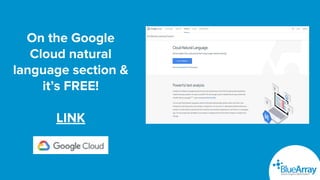
On the Google
Cloud natural
language section &
it’s FREE!
LINK
The magic
all
happens in
the try API
section
You can put any text in here and
it will give you details on how
Google is seeing the content
Entities is
initially quite
ugly looking and
rather unhelpful
Keep
scrolling
and you
get to the
good stuff
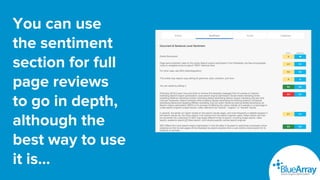
You can use
the sentiment
section for full
page reviews
to go in depth,
although the
best way to use
it is...
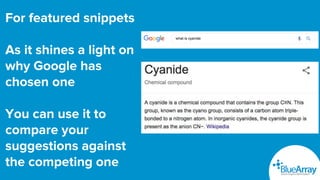
For featured snippets
As it shines a light on
why Google has
chosen one
You can use it to
compare your
suggestions against
the competing one
Syntax is also great for featured snippets, as
it shows how Google is understanding the
relationships between words
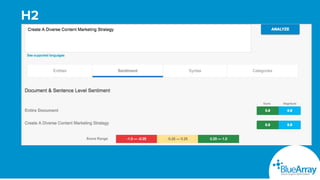
Sentiment is useful for
analysing important on pages
elements to compare against
competing articles
-H1,H2, H3 etc etc
-Opening paragraph
-Synopsis
Example:
Ranking
position 1
“Best ways
to do SEO?”
H1
Synopsis
H2
Use categories to find new
ways to group keywords
This is all great, but is
there a way to actually
see in practice how
intent can effect what
actually shows up in
Google’s SERPs?
Although i'm
fairly tired of
keywords and
intent at this
points it seems
worth exploring
more
Deciding there must be a
way to scrape Google’s
SERP results pages and pull
out the intent from there.
Off we go to everyone's
favorite frog...
Ok, second favorite
While searching to
see if there was a
way Screaming Frog,
could do it. I came
across an article that
explained exactly
what was needed
So a gold star goes to
Rory Truesdale from
Conductor for the main
steps on this -
Awesome article that
needed sharing!
LINK
These are the main steps
Ross gives
Generate Google search urls
EXAMPLE
Here is the link
to a template
that will
generate them
for you
You can get fancy with
the Google urls by
adding in the amount of
result you want to
scrape and different
countries, there is
more details in Ross’s
article
Once you have the urls for
the search terms that you
want to scrape, go to
Screaming Frog and change
the crawl mode to list
CHANGE SETTINGS TO:
● Configuration > Spider > Basic > Uncheck all boxes
● Configuration > Spider > Rendering > JavaScript
(from the dropdown – this is generally required to
scrape elements of a page that Google uses JS to
inject into the SERPs)
● Configuration > Speed > Max Threads = 1 (because
you don’t want Google to block your IP)
● Configuration > Speed > Limit URI/s = 1.2
Put in custom XPATH extractions for:
meta titles
//div/h3
meta descriptions
//ol/div/div/span
That extract TEXT
And Crawl Away...
Screaming Frog will then crawl
Google’s SERPs and pull out
the meta descriptions and
meta titles for the websites
that are rankings from position
1 and so on as specified
Don’t worry, you
won’t have the
same regrets as
pub crawl cat
Then go to
extraction all
the way down
at the bottom
of the side nav
and export the
results
This is where we add the
intent to all of this and
get an idea of how
Google is using intent
Time for
spreadsheet
number 2 link
where you
upload the
data you just
exported to
Ross provided a spreadsheet
which is similar to this one but
only covered 2 intent variable.
With some Regex help I’ve
expanded the sheet out to
cover up to 7 of the 9 Content
Harmony stages
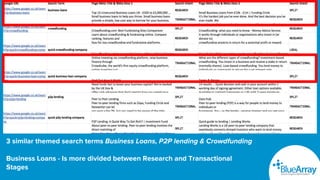
Once data added will looks something like this
Automatically puts in the intent stages for the
meta descriptions and meta titles screaming frog
pulled out
3 similar themed search terms Business Loans, P2P lending & Crowdfunding
Business Loans - Is more divided between Research and Transactional
Stages
3 similar themed search terms Business Loans, P2P lending & Crowdfunding
Crowdfunding - Mostly Research stage
3 similar themed search terms Business Loans, P2P lending & Crowdfunding
P2P lending - More Transactional on broad term but longer tail term goes more
research based
But how does this show how Google
interprets similar keywords
differently?
Well in this example...
Mainly Google classes intent as:
Business loans= Research/Transactional
Crowdfunding terms = Research
P2P lending terms = Transactional
Spreadsheet 2 tips:
- You can adjust Regex code with the different
modifiers depending on what you looking at
- If get stuck annoy me on twitter @MarkSEOsborne and
will help out
This is the end of my
“seedy” seo journey to
date :(
I’m still working on a way
to get all 9 stages into the
spreadsheet - follow me
on twitter for updates
@MarkSEOsborne
Sorry if it wasn’t that
seedy so here is some
tits to make up for it
OH! We are hiring for lots of
SEO roles if interested and
live around Reading area
www.bluearray.co.uk/jobs/
Will share full deck after
on Twitter
Thanks for listening to
me Waffle on

Mark Osborne - Brighton SEO April 2019 The Seedy Underbelly of Keyword Research And Search Intent