Charlie Meyerson
linkedin.com/in/cmeyerson
facebook.com/meyerson
@Meyerson on Twitter
C@ChicagoPublicSquare.com
News literacy
in a digital age
• R.I.P., The Age of Mass
Media
• How to spot ‘fake news’
• How to manage your
news flow
What’s to come
R.I.P.,

The Age

of

Mass Media
R.I.P., The Age of Mass Media*
“We have left behind the age of mass media, and so
large, national organizations–including and
especially television – can no longer offer one-stop-
shopping” … for advertisers or the audience.
—City University of New York’s Graduate School
of Journalism professor Jeff Jarvis, 2007
* Roughly 1955-1995, from the
rise of the major TV networks to
the arrival of the web browser.
R.I.P., The Age of Mass Media
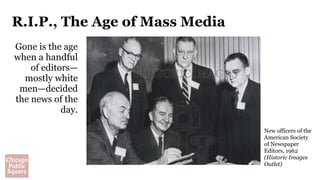
Gone is the age
when a handful
of editors—
mostly white
men—decided
the news of the
day.
New officers of the
American Society
of Newspaper
Editors, 1962
(Historic Images
Outlet)
R.I.P., The Age of Mass Media
And no one’s
sadder about it
than the giants
of that era.
U.S. newspaper ad revenue 

Newspaper Association of America)
R.I.P., The Age of Mass Media
Now, reporters
are more often
than not among
the last to learn
of—or at least
to report—
breaking news.
R.I.P., The Age of Mass Media
And now
everything is so
much faster:
The
competition,
the news
gathering, the
publication, the
follow-up
reporting …
R.I.P., The Age of Mass Media
… and what
used to be a
joke—the one-
man reporting
band—is now
reality.
R.I.P. also, The Age of ‘Objective’ Media
… when a
handful of large
news
organizations
aspired to grow
larger (and to
avoid ticking off
advertisers) by
serving—or at
least portraying
themselves as
serving—
everyone.
“Traditional media outlets’
intense desire to be perceived
as sober and objective, and
thus to be respected by
conservatives and liberals alike
[was] a business imperative
that has been transmuted into
an ethical injunction."
—Will Oremus in Slate, January 2017
R.I.P., The Age of ‘Objective’ Media
Often resulting
in what NYU
professor

Jay Rosen

has called …
“The View from Nowhere … a
bid for trust that advertises the
viewlessness of the news
producer. …
R.I.P., The Age of ‘Objective’ Media
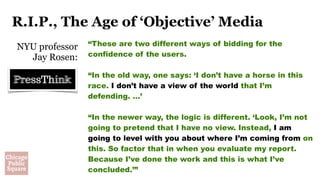
NYU professor
Jay Rosen:
“These are two different ways of bidding for the
confidence of the users. 
“In the old way, one says: ‘I don’t have a horse in this
race. I don’t have a view of the world that I’m
defending. …’
“In the newer way, the logic is different. ‘Look, I’m not
going to pretend that I have no view. Instead, I am
going to level with you about where I’m coming from on
this. So factor that in when you evaluate my report.
Because I’ve done the work and this is what I’ve
concluded.’” 
But this “new
way” is a return
to the way
things were
before the Age
of Mass Media.
Between 1930 and 1932,
for instance, Chicago had
no fewer than seven
newspapers, and you
probably got just the one
that most closely
matched your
perspective.
R.I.P., The Age of ‘Objective’ Media
So now you’re on your own…
You have more choices for news than ever before—more
great ones, and more terrible ones.
How do you know which are which?
How to spot
‘fake news’*
How to spot ‘fake news’
It’s not a thing.
It’s an oxymoron.
If it’s news, it happened.
If it’s fake, it’s not news.
*
*
How to spot fake not-news
How to spot not-news
Read, listen or watch the whole thing
before sharing—especially if you’re not
confident of the source.
How are you reacting to it? Are you intensely

hoping the information turns out to be true? False?
Check it out at sites like Snopes,

PolitiFact or FactCheck.
(If it seems too good to be true, it probably is.)
(Or in the immortal motto of 

the old Chicago City News Bureau:

“If your mother says she loves you, check it out.”)
Check it out.
Is there a byline? Who is the author?
Check it out.
Does the “Contact Us” email address

match the domain (not a Gmail or
Yahoo address)?
Does a search for the website name 

raise suspicions?
Consider the source.
Does it have or
follow 

a code of
ethics?

[Is it The
Onion?]
What about the source?
How did you find it?
Was it promoted on a website?

(Which website?)


Did it show up in a social media feed?

(Who shared it?)

(Was it sent by someone you know?)
Is the source reliable?
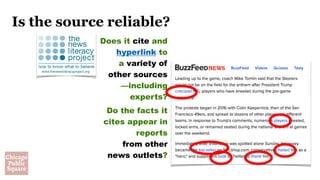
Does it cite and
hyperlink to

a variety of
other sources

—including
experts?
Do the facts it
cites appear in
reports 

from other
news outlets?
Is the source reliable?
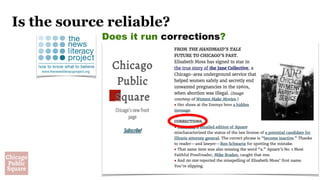
Does it run corrections?

Consider the headline or main message.
Does it use excessive punctuation?!?!
Does it use ALL CAPITAL LETTERS for
EMPHASIS?
Does it make a claim to reveal a secret 

or tell you something The Media 

don’t want you to know?
A note on headlines …
Know the difference:
Good headlines
and
Bad headlines
Good headlines
Connect content
with the maximum number of people
to whom it’s
useful and relevant.
They begin with the most interesting words.
They’re brief; they omit needless words.
They create—and reward—curiosity.
Bad headlines
Fail to connect content
with people who’d find it
useful and relevant.
They’re long, boring and irrelevant.
They don’t spotlight interesting words.
They generate little curiosity.
Or they …
Connect content
with people to whom it’s
neither useful nor relevant
(turning them off to future communication).
Are the images reliable?
Can you confirm, using a reverse image search,
that they haven’t been altered or taken from some
other context?
Phony sites often use a real image from an unrelated event.
But even if a source is reliable …
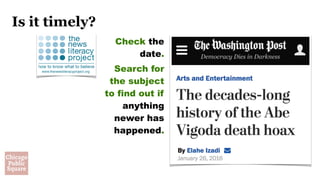
Is it timely?
Check the
date.
Search for
the subject
to find out if
anything
newer has
happened.
Remember …
Copying an existing
website 

and creating fake
tweets 

is easy.

Bots are active in social
media and they’re
designed to dominate
conversations and
spread propaganda.
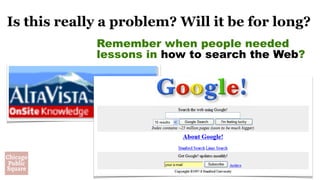
Is this really a problem? Will it be for long?
Remember when people needed
lessons in how to search the Web?
How to
manage your
news flow
(in and out)
How to manage your news flow
1. Follow smart people.
2. Let them power your
news intake and output.
Connect with (smart) friends relentlessly.
Follow
smart
people.
Twitter and Facebook
can help, especially
after you’ve entered
a few names.
Follow
smart
people.
… and the people they
follow!


Twitter and
Facebook can help,
especially after
you’ve entered a few
names.
Follow smart people.
Turn off alerts,

email advisories, etc.
Check when you want to, not when summoned.
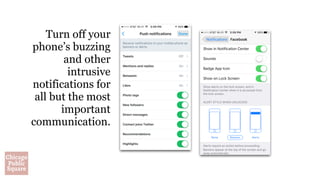
Turn off your
phone’s buzzing
and other
intrusive
notifications for
all but the most
important
communication.
And then …
Share smart.
Post
interesting
stuff from
your phone.
Share smart.
Not sure
what to
say?
Copy and
paste the
most
interesting
passage
from the
content
you’re
sharing.*
*But don’t forget
the quotation
marks.
Share smart.
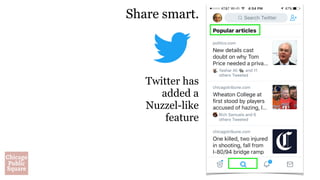
Twitter has
added a
Nuzzel-like
feature
Share smart.
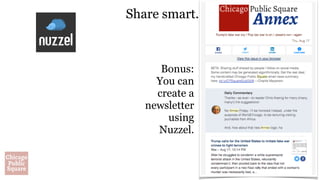
Bonus:
You can
create a
newsletter
using
Nuzzel.
Share smart.
Connect Facebook to Twitter, or Twitter to Facebook
(Note: You need to write something on
Facebook for this to work. Otherwise,
you just get a Twitter link without
context.)
Share smart.
But know the difference
between posting to the
public and posting to
just friends.


(Note: If you’ve linked
Facebook and Twitter,
only your public
Facebook posts will
share to Twitter.)
Share smart.
This is just the start. Social media companies have
created whole free courses to help you learn how to
use their tools. Or just Google.
Writing

counts.
Pro tips.
Style
counts.
Pro tips.
And feel
free to
critique
how I do
it!
Charlie Meyerson
linkedin.com/in/cmeyerson
facebook.com/meyerson
@Meyerson on Twitter
C@ChicagoPublicSquare.com
News literacy
in a digital age
Charlie Meyerson
linkedin.com/in/cmeyerson
facebook.com/meyerson
@Meyerson on Twitter
C@ChicagoPublicSquare.com

News Literacy in a Digital Age

  • 1.
    Charlie Meyerson linkedin.com/in/cmeyerson facebook.com/meyerson @Meyerson onTwitter C@ChicagoPublicSquare.com News literacy in a digital age
  • 2.
    • R.I.P., TheAge of Mass Media • How to spot ‘fake news’ • How to manage your news flow What’s to come
  • 3.
  • 4.
    R.I.P., The Ageof Mass Media* “We have left behind the age of mass media, and so large, national organizations–including and especially television – can no longer offer one-stop- shopping” … for advertisers or the audience. —City University of New York’s Graduate School of Journalism professor Jeff Jarvis, 2007 * Roughly 1955-1995, from the rise of the major TV networks to the arrival of the web browser.
  • 5.
    R.I.P., The Ageof Mass Media Gone is the age when a handful of editors— mostly white men—decided the news of the day. New officers of the American Society of Newspaper Editors, 1962 (Historic Images Outlet)
  • 6.
    R.I.P., The Ageof Mass Media And no one’s sadder about it than the giants of that era. U.S. newspaper ad revenue 
 Newspaper Association of America)
  • 7.
    R.I.P., The Ageof Mass Media Now, reporters are more often than not among the last to learn of—or at least to report— breaking news.
  • 8.
    R.I.P., The Ageof Mass Media And now everything is so much faster: The competition, the news gathering, the publication, the follow-up reporting …
  • 9.
    R.I.P., The Ageof Mass Media … and what used to be a joke—the one- man reporting band—is now reality.
  • 10.
    R.I.P. also, TheAge of ‘Objective’ Media … when a handful of large news organizations aspired to grow larger (and to avoid ticking off advertisers) by serving—or at least portraying themselves as serving— everyone. “Traditional media outlets’ intense desire to be perceived as sober and objective, and thus to be respected by conservatives and liberals alike [was] a business imperative that has been transmuted into an ethical injunction." —Will Oremus in Slate, January 2017
  • 11.
    R.I.P., The Ageof ‘Objective’ Media Often resulting in what NYU professor
 Jay Rosen
 has called … “The View from Nowhere … a bid for trust that advertises the viewlessness of the news producer. …
  • 12.
    R.I.P., The Ageof ‘Objective’ Media NYU professor Jay Rosen: “These are two different ways of bidding for the confidence of the users.  “In the old way, one says: ‘I don’t have a horse in this race. I don’t have a view of the world that I’m defending. …’ “In the newer way, the logic is different. ‘Look, I’m not going to pretend that I have no view. Instead, I am going to level with you about where I’m coming from on this. So factor that in when you evaluate my report. Because I’ve done the work and this is what I’ve concluded.’” 
  • 13.
    But this “new way”is a return to the way things were before the Age of Mass Media. Between 1930 and 1932, for instance, Chicago had no fewer than seven newspapers, and you probably got just the one that most closely matched your perspective. R.I.P., The Age of ‘Objective’ Media
  • 14.
    So now you’reon your own… You have more choices for news than ever before—more great ones, and more terrible ones. How do you know which are which?
  • 15.
  • 16.
    How to spot‘fake news’ It’s not a thing. It’s an oxymoron. If it’s news, it happened. If it’s fake, it’s not news. * *
  • 17.
    How to spotfake not-news
  • 18.
    How to spotnot-news Read, listen or watch the whole thing before sharing—especially if you’re not confident of the source. How are you reacting to it? Are you intensely
 hoping the information turns out to be true? False? Check it out at sites like Snopes,
 PolitiFact or FactCheck. (If it seems too good to be true, it probably is.) (Or in the immortal motto of 
 the old Chicago City News Bureau:
 “If your mother says she loves you, check it out.”)
  • 19.
    Check it out. Isthere a byline? Who is the author?
  • 20.
    Check it out. Doesthe “Contact Us” email address
 match the domain (not a Gmail or Yahoo address)? Does a search for the website name 
 raise suspicions?
  • 21.
    Consider the source. Doesit have or follow 
 a code of ethics?
 [Is it The Onion?]
  • 22.
    What about thesource? How did you find it? Was it promoted on a website?
 (Which website?) 
 Did it show up in a social media feed?
 (Who shared it?)
 (Was it sent by someone you know?)
  • 23.
    Is the sourcereliable? Does it cite and hyperlink to
 a variety of other sources
 —including experts? Do the facts it cites appear in reports 
 from other news outlets?
  • 24.
    Is the sourcereliable? Does it run corrections?

  • 25.
    Consider the headlineor main message. Does it use excessive punctuation?!?! Does it use ALL CAPITAL LETTERS for EMPHASIS? Does it make a claim to reveal a secret 
 or tell you something The Media 
 don’t want you to know? A note on headlines …
  • 26.
    Know the difference: Goodheadlines and Bad headlines
  • 27.
    Good headlines Connect content withthe maximum number of people to whom it’s useful and relevant. They begin with the most interesting words. They’re brief; they omit needless words. They create—and reward—curiosity.
  • 28.
    Bad headlines Fail toconnect content with people who’d find it useful and relevant. They’re long, boring and irrelevant. They don’t spotlight interesting words. They generate little curiosity. Or they … Connect content with people to whom it’s neither useful nor relevant (turning them off to future communication).
  • 29.
    Are the imagesreliable? Can you confirm, using a reverse image search, that they haven’t been altered or taken from some other context? Phony sites often use a real image from an unrelated event. But even if a source is reliable …
  • 30.
    Is it timely? Checkthe date. Search for the subject to find out if anything newer has happened.
  • 31.
    Remember … Copying anexisting website 
 and creating fake tweets 
 is easy.
 Bots are active in social media and they’re designed to dominate conversations and spread propaganda.
  • 32.
    Is this reallya problem? Will it be for long? Remember when people needed lessons in how to search the Web?
  • 33.
    How to manage your newsflow (in and out)
  • 34.
    How to manageyour news flow 1. Follow smart people. 2. Let them power your news intake and output.
  • 35.
    Connect with (smart)friends relentlessly.
  • 36.
    Follow smart people. Twitter and Facebook canhelp, especially after you’ve entered a few names.
  • 37.
    Follow smart people. … and thepeople they follow!
 
 Twitter and Facebook can help, especially after you’ve entered a few names.
  • 38.
  • 39.
  • 40.
    Turn off alerts,
 emailadvisories, etc. Check when you want to, not when summoned.
  • 41.
    Turn off your phone’sbuzzing and other intrusive notifications for all but the most important communication.
  • 42.
  • 43.
  • 44.
    Not sure what to say? Copyand paste the most interesting passage from the content you’re sharing.* *But don’t forget the quotation marks. Share smart.
  • 45.
  • 46.
  • 47.
    Connect Facebook toTwitter, or Twitter to Facebook (Note: You need to write something on Facebook for this to work. Otherwise, you just get a Twitter link without context.) Share smart.
  • 48.
    But know thedifference between posting to the public and posting to just friends.
 
 (Note: If you’ve linked Facebook and Twitter, only your public Facebook posts will share to Twitter.) Share smart.
  • 49.
    This is justthe start. Social media companies have created whole free courses to help you learn how to use their tools. Or just Google.
  • 50.
  • 51.
  • 52.
    And feel free to critique howI do it! Charlie Meyerson linkedin.com/in/cmeyerson facebook.com/meyerson @Meyerson on Twitter C@ChicagoPublicSquare.com
  • 53.
    News literacy in adigital age Charlie Meyerson linkedin.com/in/cmeyerson facebook.com/meyerson @Meyerson on Twitter C@ChicagoPublicSquare.com