Nucleic Acids Chemical Composition Elements: C, H, O, N, and P. There are 2 types of nucleic acids, deoxyribonucleic acid (DNA) and ribonucleic acid (RNA).
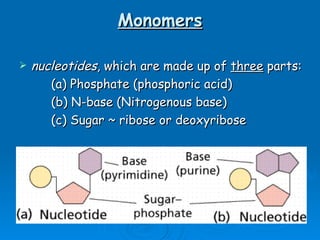
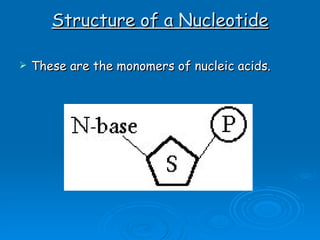
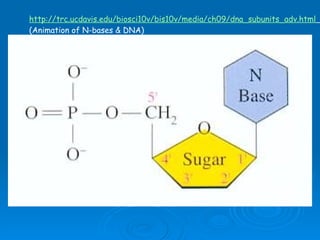
Monomers nucleotides , which are made up of  three  parts: (a) Phosphate (phosphoric acid) (b) N-base (Nitrogenous base) (c) Sugar ~ ribose or deoxyribose
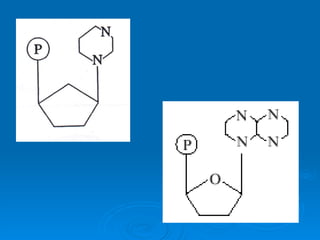
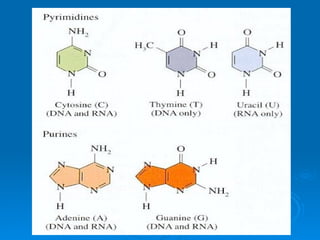
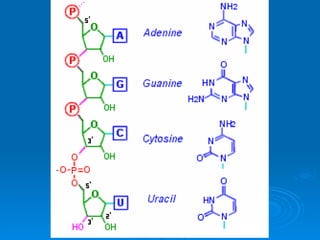
Nitrogenous bases (N-bases) are: A  –  A denine  (2 Rings =   Purine base ) G  –  G uanine C  –  C ytosine   (1 Ring =  Pyrimidine base ) T  –  T hymine U  –  U racil
Structure of a Nucleotide These are the monomers of nucleic acids.
 
 
http://trc.ucdavis.edu/biosci10v/bis10v/media/ch09/dna_subunits_adv.html   (Animation of N-bases & DNA)
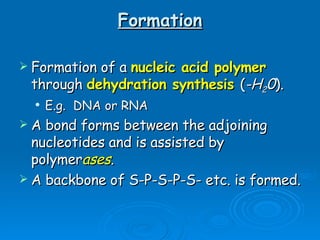
Formation Formation of a  nucleic acid polymer  through  dehydration synthesis   ( -H 2 0 ). E.g.  DNA or RNA A bond forms between the adjoining nucleotides and is assisted by polymer ases . A backbone of S-P-S-P-S- etc. is formed.
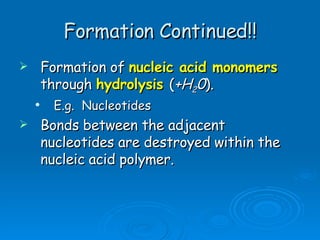
Formation Continued!! Formation of  nucleic acid monomers   through  hydrolysis   ( +H 2 0 ). E.g.  Nucleotides Bonds between the adjacent nucleotides are destroyed within the nucleic acid polymer.
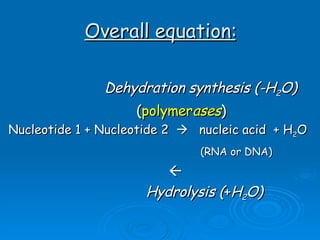
Overall equation: Dehydration synthesis (-H 2 O) ( polymer ases ) Nucleotide 1 + Nucleotide 2     nucleic acid  + H 2 O (RNA or DNA)        Hydrolysis ( + H 2 O)
Polymers of nucleic acids There are two types of nucleic acid polymers,  RNA  and  DNA
RNA Structure and Function Found in the nucleus and cytoplasm. Linear,  single strand  of nucleotides. Contains the sugar,  ribose . N-bases include  adenine ,  uracil ,  cytosine  and  guanine . Backbone of  sugar-phosphate .  3 types of RNA:  mRNA (messenger RNA), tRNA (transfer RNA), and rRNA (ribosomal RNA).
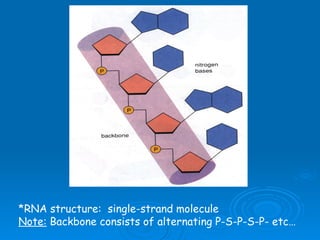
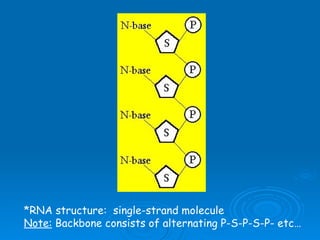
*RNA structure:  single-strand molecule Note:  Backbone consists of alternating P-S-P-S-P- etc…
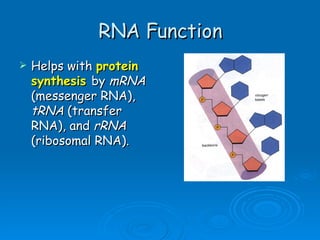
RNA Function Helps with  protein synthesis   by  mRNA  (messenger RNA),  tRNA  (transfer RNA), and  rRNA  (ribosomal RNA).
 
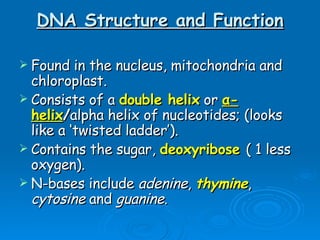
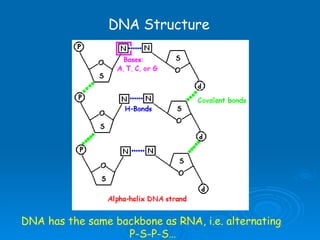
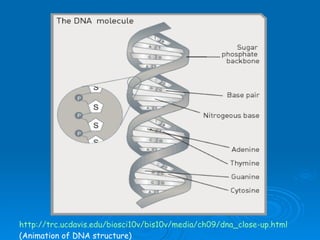
DNA Structure and Function Found in the nucleus, mitochondria and chloroplast. Consists of a  double helix  or  α-helix / alpha helix of nucleotides; (looks like a ‘twisted ladder’). Contains the sugar,  deoxyribose   ( 1 less oxygen). N-bases include  adenine ,  thymine ,  cytosine  and  guanine .
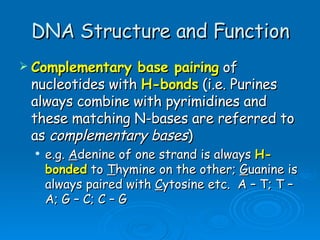
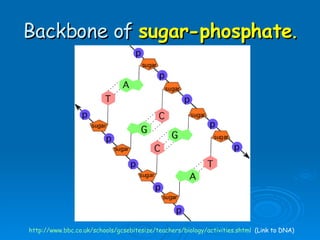
DNA Structure and Function Complementary base pairing  of nucleotides with  H-bonds  (i.e. Purines always combine with pyrimidines and these matching N-bases are referred to as  complementary bases )  e.g.  A denine of one strand is always  H-bonded  to  T hymine on the other;  G uanine is always paired with  C ytosine etc.  A – T; T – A; G – C; C – G
Backbone of  sugar-phosphate . http://www.bbc.co.uk/schools/gcsebitesize/teachers/biology/activities.shtml   (Link to DNA)
DNA Structure DNA has the same backbone as RNA, i.e. alternating  P-S-P-S…
http://trc.ucdavis.edu/biosci10v/bis10v/media/ch09/dna_close-up.html (Animation of DNA structure)
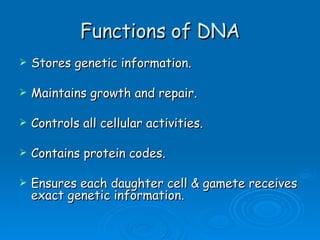
Functions of DNA Stores genetic information. Maintains growth and repair. Controls all cellular activities. Contains protein codes. Ensures each daughter cell & gamete receives exact genetic information.
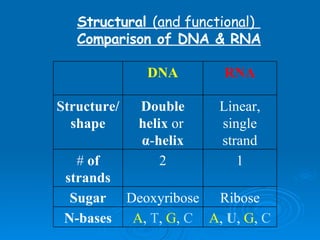
Structural  (and functional)  Comparison of DNA & RNA   Structural  (and functional)   Comparison of DNA & RNA   A ,  U ,  G ,  C A ,  T ,  G ,  C N-bases Ribose Deoxyribose Sugar 1 2 #  of strands Linear, single strand Double helix  or   α - helix Structure/shape RNA DNA
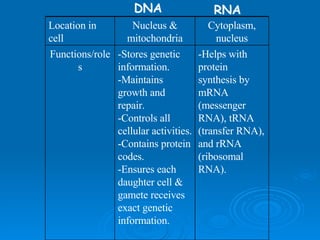
DNA RNA -Helps with protein synthesis by mRNA (messenger RNA), tRNA (transfer RNA), and rRNA (ribosomal RNA). -Stores genetic information. -Maintains growth and repair. -Controls all cellular activities. -Contains protein codes. -Ensures each daughter cell & gamete receives exact genetic information. Functions/roles Cytoplasm, nucleus Nucleus & mitochondria Location in cell
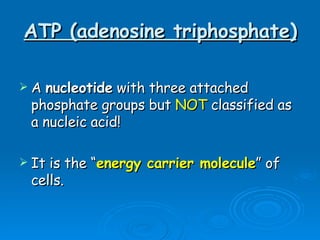
ATP (adenosine triphosphate) A  nucleotide  with three attached phosphate groups but  NOT  classified as a nucleic acid! It is the “ energy carrier molecule ” of cells.
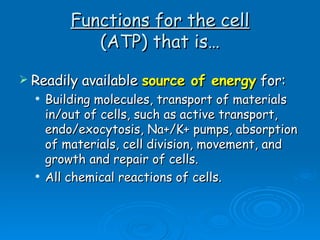
Functions for the cell (ATP) that is… Readily available  source of energy  for: Building molecules, transport of materials in/out of cells, such as active transport, endo/exocytosis, Na+/K+ pumps, absorption of materials, cell division, movement, and growth and repair of cells. All chemical reactions of cells.
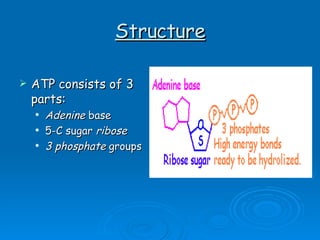
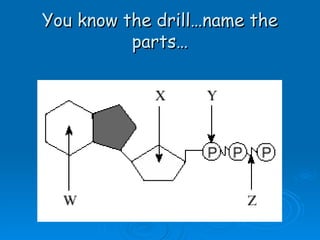
Structure ATP consists of 3 parts: Adenine  base 5-C sugar  ribose 3 phosphate  groups
You know the drill…name the parts…
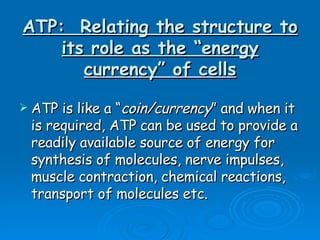
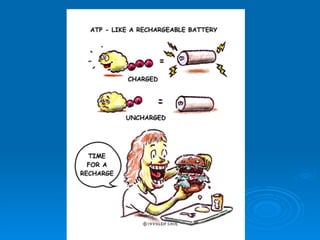
ATP:  Relating the structure to its role as the “energy currency” of cells ATP is like a “ coin/currency ” and when it is required, ATP can be used to provide a readily available source of energy for synthesis of molecules, nerve impulses, muscle contraction, chemical reactions, transport of molecules etc.
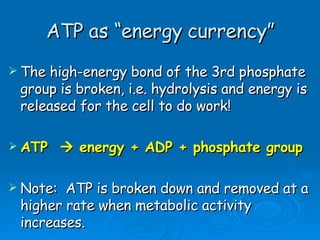
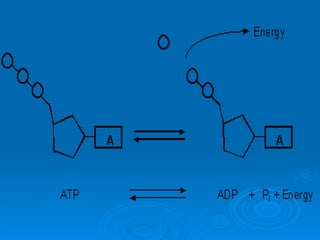
ATP as “energy currency” The high-energy bond of the 3rd phosphate group is broken, i.e. hydrolysis and energy is released for the cell to do work!  ATP    energy + ADP + phosphate group   Note:  ATP is broken down and removed at a higher rate when metabolic activity increases.
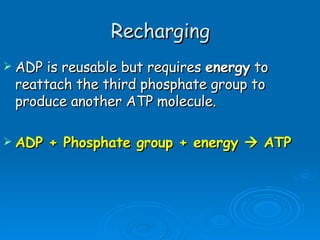
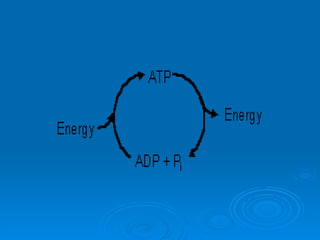
Recharging ADP is reusable but requires  energy  to reattach the third phosphate group to produce another ATP molecule. ADP + Phosphate group + energy    ATP


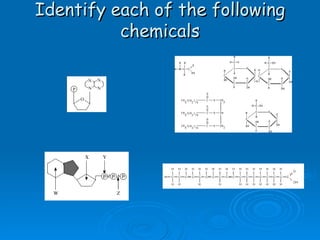
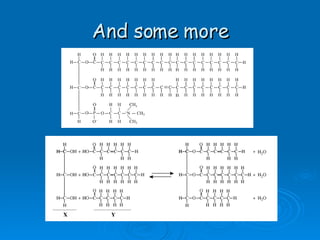
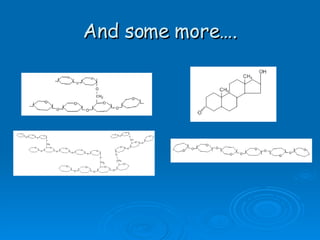
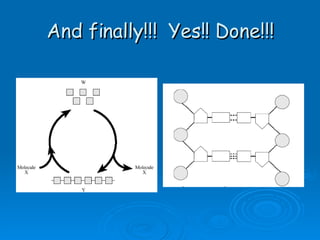
Identify each of the following chemicals
And some more
And some more….
And finally!!!  Yes!! Done!!!
 

Nucleic Acids

  • 1.
    Nucleic Acids ChemicalComposition Elements: C, H, O, N, and P. There are 2 types of nucleic acids, deoxyribonucleic acid (DNA) and ribonucleic acid (RNA).
  • 2.
    Monomers nucleotides ,which are made up of three parts: (a) Phosphate (phosphoric acid) (b) N-base (Nitrogenous base) (c) Sugar ~ ribose or deoxyribose
  • 3.
    Nitrogenous bases (N-bases)are: A – A denine (2 Rings = Purine base ) G – G uanine C – C ytosine (1 Ring = Pyrimidine base ) T – T hymine U – U racil
  • 4.
    Structure of aNucleotide These are the monomers of nucleic acids.
  • 5.
  • 6.
  • 7.
  • 8.
    Formation Formation ofa nucleic acid polymer through dehydration synthesis ( -H 2 0 ). E.g. DNA or RNA A bond forms between the adjoining nucleotides and is assisted by polymer ases . A backbone of S-P-S-P-S- etc. is formed.
  • 9.
    Formation Continued!! Formationof nucleic acid monomers through hydrolysis ( +H 2 0 ). E.g. Nucleotides Bonds between the adjacent nucleotides are destroyed within the nucleic acid polymer.
  • 10.
    Overall equation: Dehydrationsynthesis (-H 2 O) ( polymer ases ) Nucleotide 1 + Nucleotide 2  nucleic acid + H 2 O (RNA or DNA)  Hydrolysis ( + H 2 O)
  • 11.
    Polymers of nucleicacids There are two types of nucleic acid polymers, RNA and DNA
  • 12.
    RNA Structure andFunction Found in the nucleus and cytoplasm. Linear, single strand of nucleotides. Contains the sugar, ribose . N-bases include adenine , uracil , cytosine and guanine . Backbone of sugar-phosphate . 3 types of RNA: mRNA (messenger RNA), tRNA (transfer RNA), and rRNA (ribosomal RNA).
  • 13.
    *RNA structure: single-strand molecule Note: Backbone consists of alternating P-S-P-S-P- etc…
  • 14.
    *RNA structure: single-strand molecule Note: Backbone consists of alternating P-S-P-S-P- etc…
  • 15.
    RNA Function Helpswith protein synthesis by mRNA (messenger RNA), tRNA (transfer RNA), and rRNA (ribosomal RNA).
  • 16.
  • 17.
    DNA Structure andFunction Found in the nucleus, mitochondria and chloroplast. Consists of a double helix or α-helix / alpha helix of nucleotides; (looks like a ‘twisted ladder’). Contains the sugar, deoxyribose ( 1 less oxygen). N-bases include adenine , thymine , cytosine and guanine .
  • 18.
    DNA Structure andFunction Complementary base pairing of nucleotides with H-bonds (i.e. Purines always combine with pyrimidines and these matching N-bases are referred to as complementary bases ) e.g. A denine of one strand is always H-bonded to T hymine on the other; G uanine is always paired with C ytosine etc. A – T; T – A; G – C; C – G
  • 19.
    Backbone of sugar-phosphate . http://www.bbc.co.uk/schools/gcsebitesize/teachers/biology/activities.shtml (Link to DNA)
  • 20.
    DNA Structure DNAhas the same backbone as RNA, i.e. alternating P-S-P-S…
  • 21.
  • 22.
    Functions of DNAStores genetic information. Maintains growth and repair. Controls all cellular activities. Contains protein codes. Ensures each daughter cell & gamete receives exact genetic information.
  • 23.
    Structural (andfunctional) Comparison of DNA & RNA Structural (and functional) Comparison of DNA & RNA A , U , G , C A , T , G , C N-bases Ribose Deoxyribose Sugar 1 2 # of strands Linear, single strand Double helix or α - helix Structure/shape RNA DNA
  • 24.
    DNA RNA -Helpswith protein synthesis by mRNA (messenger RNA), tRNA (transfer RNA), and rRNA (ribosomal RNA). -Stores genetic information. -Maintains growth and repair. -Controls all cellular activities. -Contains protein codes. -Ensures each daughter cell & gamete receives exact genetic information. Functions/roles Cytoplasm, nucleus Nucleus & mitochondria Location in cell
  • 25.
    ATP (adenosine triphosphate)A nucleotide with three attached phosphate groups but NOT classified as a nucleic acid! It is the “ energy carrier molecule ” of cells.
  • 26.
    Functions for thecell (ATP) that is… Readily available source of energy for: Building molecules, transport of materials in/out of cells, such as active transport, endo/exocytosis, Na+/K+ pumps, absorption of materials, cell division, movement, and growth and repair of cells. All chemical reactions of cells.
  • 27.
    Structure ATP consistsof 3 parts: Adenine base 5-C sugar ribose 3 phosphate groups
  • 28.
    You know thedrill…name the parts…
  • 29.
    ATP: Relatingthe structure to its role as the “energy currency” of cells ATP is like a “ coin/currency ” and when it is required, ATP can be used to provide a readily available source of energy for synthesis of molecules, nerve impulses, muscle contraction, chemical reactions, transport of molecules etc.
  • 30.
    ATP as “energycurrency” The high-energy bond of the 3rd phosphate group is broken, i.e. hydrolysis and energy is released for the cell to do work! ATP  energy + ADP + phosphate group Note: ATP is broken down and removed at a higher rate when metabolic activity increases.
  • 31.
    Recharging ADP isreusable but requires energy to reattach the third phosphate group to produce another ATP molecule. ADP + Phosphate group + energy  ATP
  • 32.
  • 33.
  • 34.
  • 35.
    Identify each ofthe following chemicals
  • 36.
  • 37.
  • 38.
    And finally!!! Yes!! Done!!!
  • 39.