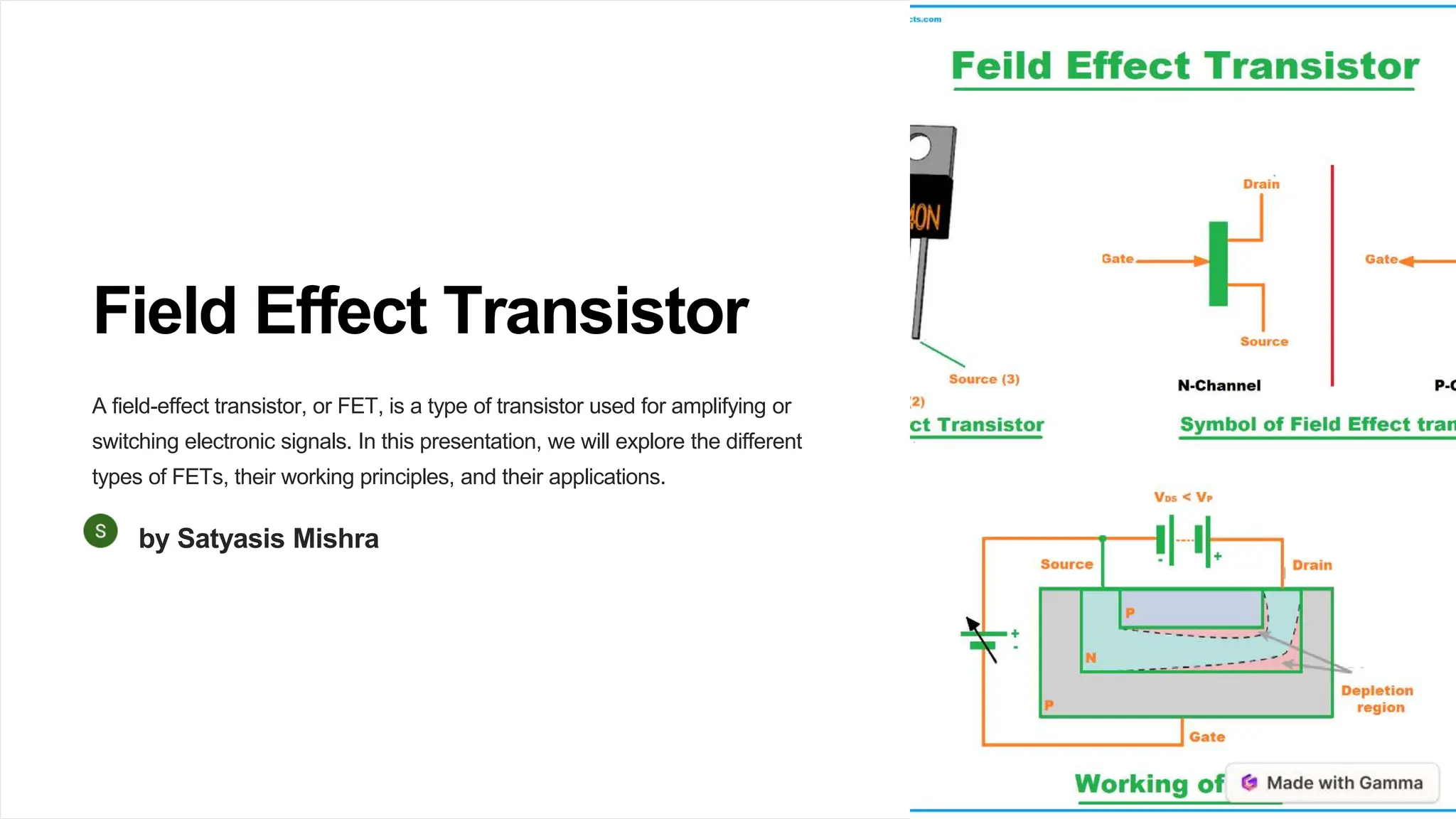
Field Effect Transistor
A field-effect transistor, or FET, is a type of transistor used for amplifying or
switching electronic signals. In this presentation, we will explore the different
types of FETs, their working principles, and their applications.
by Satyasis Mishra
MOSFET
Power MOSFETs
Used in power electronics, from electric vehicles to
power supplies.
CMOS transistors
Used in digital circuits, from processors to memory
chips.
Metal-Oxide-Semiconductor Field-Effect Transistors, or MOSFETs, come in many varieties for different
applications. They can be found in power electronics, such as electric vehicles and power supplies, as well as
in digital circuits, such as processors and memory chips.
JFET
Amplification
Used for signal amplification in audio and radio frequency (RF) circuits.
Sensitivity
Sensitive to voltage so can be used for touch switches and digital potentiometers.
Low-Noise performance
Used in low-noise high-impedance preamplifiers applications.
Junction Field-Effect Transistors, or JFETs, are used for signal amplification in audio and radio
frequency circuits because of their high input impedance. Due to their sensitivity to voltage, they are
also used for touch switches and digital potentiometers. Low-noise, high-impedance preamplifiers is
another application of JFETs.
MESFET
1 Analog Amplifiers
Used for microwave and millimeter-wave amplification.
2 Integrated Circuits
Used in integrated circuits, such as those made from gallium arsenide.
3 RF Switches
Used in microwave/millimeter-wave switches, such as those used in wireless devices.
Metal Semiconductor Field-Effect Transistors, or MESFETs, are used for microwave and millimeter-wave
amplification. They are also used in integrated circuits, such as those made from gallium arsenide, and in
microwave/millimeter-wave switches for wireless devices.
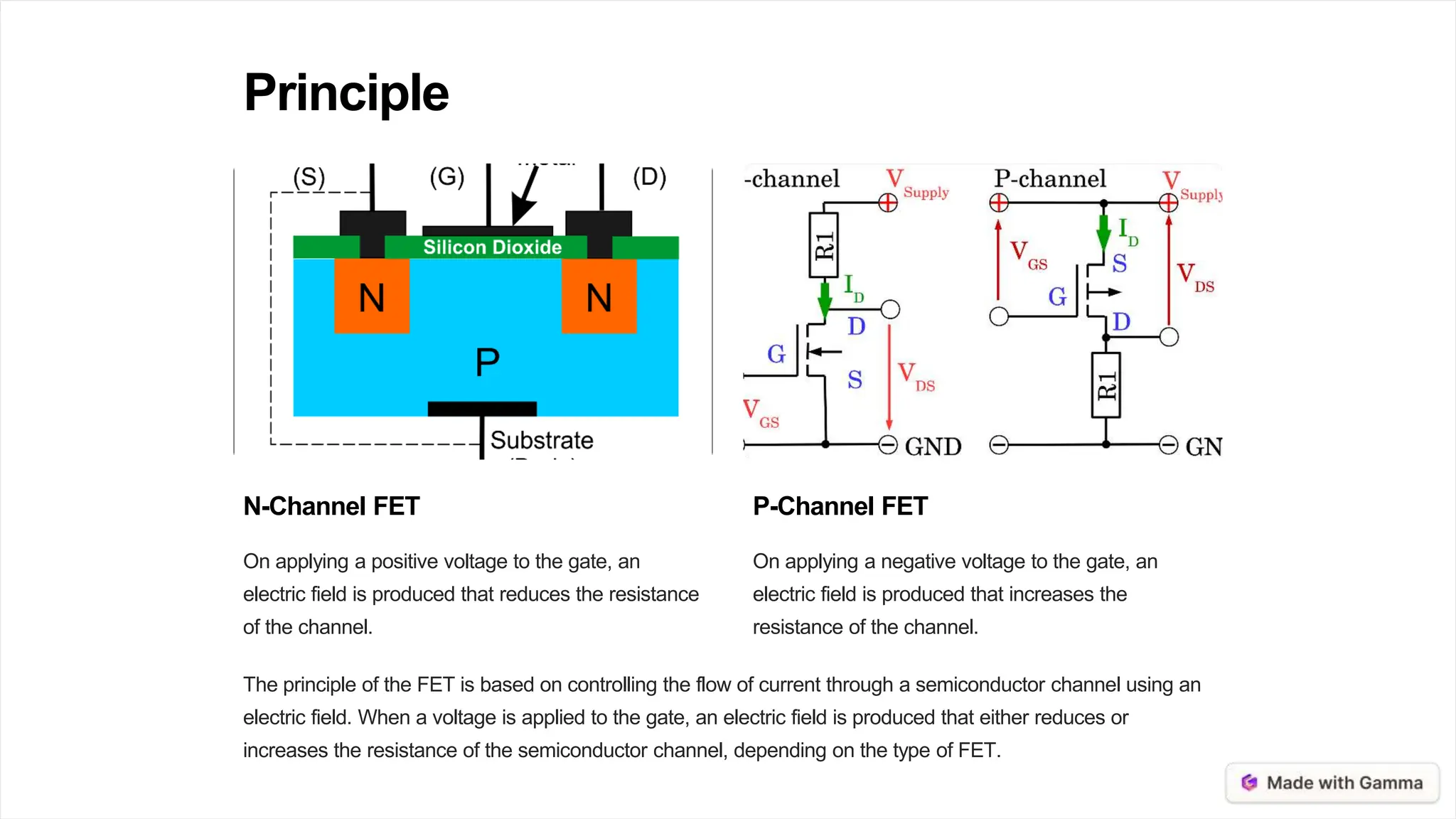
Principle
N-Channel FET
On applying a positive voltage to the gate, an
electric field is produced that reduces the resistance
of the channel.
P-Channel FET
On applying a negative voltage to the gate, an
electric field is produced that increases the
resistance of the channel.
The principle of the FET is based on controlling the flow of current through a semiconductor channel using an
electric field. When a voltage is applied to the gate, an electric field is produced that either reduces or
increases the resistance of the semiconductor channel, depending on the type of FET.
Applications
1 Amplifiers
FETs are used for signal
amplification in audio and
radio frequency circuits.
2 Switches
FETs are used as
switches in power
electronics and in
microwave/millimeter-
wave switches for
wireless devices.
3 Sensors
Due to their sensitivity to
voltage, FETs are used
as sensors for touch
switches and digital
potentiometers.
Field-effect transistors (FETs) have a wide range of applications, including signal amplification, power
electronics, microwave/millimeter-wave switches, and as sensors for touch switches and digital
potentiometers.
Advantages & Disadvantages
Advantages
• High input impedance - low loading effect
• High-frequency response
• Low noise
• No biasing needed
Disadvantages
• Sensitivity to temperature changes
• Less rugged than BJTs
• No beta - more susceptible to
variations in manufacturing
Field-Effect Transistors (FETs) have several advantages over bipolar junction transistors (BJTs), including
high input impedance, high-frequency response, low noise, and no biasing needed. However, FETs are
sensitive to temperature changes, less rugged than BJTs, and more susceptible to variations in
manufacturing.
Comparison with BJTs
Property Bipolar Junction Transistor
(BJT)
Field-Effect Transistor (FET)
Principle of operation Current controlled Voltage controlled
Input impedance Low High
Gain (beta) High No beta
Noise High Low
Switching speed Low to moderate High
FETs and Bipolar Junction Transistors (BJTs) have different principles of operation, with BJTs being current
controlled and FETs being voltage controlled. FETs have a higher input impedance, lower noise, and faster
switching speed than BJTs. However, BJTs have a high gain (beta) while FETs do not.
Future Prospects
1 Improving FET Performance
Research is focused on reducing power consumption, improving noise performance,
increasing the frequency range, and extending the lifetime of FETs.
2 New Applications
FETs are being explored for applications in quantum computing, terahertz-frequency
electronics, and energy efficiency in power electronics.
3 New FET Technologies
New materials, such as 2D materials and organic semiconductors, are being explored for
use in FETs.
The future of FET technology is bright, with research focused on improving performance, exploring new
applications, and developing new FET technologies using materials such as 2D materials and organic
semiconductors. FETs are being explored for use in quantum computing, terahertz-frequency electronics,
and for improving energy efficiency in power electronics.

Field-Effect-Transistor.pptx

  • 1.
    Field Effect Transistor Afield-effect transistor, or FET, is a type of transistor used for amplifying or switching electronic signals. In this presentation, we will explore the different types of FETs, their working principles, and their applications. by Satyasis Mishra
  • 2.
    MOSFET Power MOSFETs Used inpower electronics, from electric vehicles to power supplies. CMOS transistors Used in digital circuits, from processors to memory chips. Metal-Oxide-Semiconductor Field-Effect Transistors, or MOSFETs, come in many varieties for different applications. They can be found in power electronics, such as electric vehicles and power supplies, as well as in digital circuits, such as processors and memory chips.
  • 3.
    JFET Amplification Used for signalamplification in audio and radio frequency (RF) circuits. Sensitivity Sensitive to voltage so can be used for touch switches and digital potentiometers. Low-Noise performance Used in low-noise high-impedance preamplifiers applications. Junction Field-Effect Transistors, or JFETs, are used for signal amplification in audio and radio frequency circuits because of their high input impedance. Due to their sensitivity to voltage, they are also used for touch switches and digital potentiometers. Low-noise, high-impedance preamplifiers is another application of JFETs.
  • 4.
    MESFET 1 Analog Amplifiers Usedfor microwave and millimeter-wave amplification. 2 Integrated Circuits Used in integrated circuits, such as those made from gallium arsenide. 3 RF Switches Used in microwave/millimeter-wave switches, such as those used in wireless devices. Metal Semiconductor Field-Effect Transistors, or MESFETs, are used for microwave and millimeter-wave amplification. They are also used in integrated circuits, such as those made from gallium arsenide, and in microwave/millimeter-wave switches for wireless devices.
  • 5.
    Principle N-Channel FET On applyinga positive voltage to the gate, an electric field is produced that reduces the resistance of the channel. P-Channel FET On applying a negative voltage to the gate, an electric field is produced that increases the resistance of the channel. The principle of the FET is based on controlling the flow of current through a semiconductor channel using an electric field. When a voltage is applied to the gate, an electric field is produced that either reduces or increases the resistance of the semiconductor channel, depending on the type of FET.
  • 6.
    Applications 1 Amplifiers FETs areused for signal amplification in audio and radio frequency circuits. 2 Switches FETs are used as switches in power electronics and in microwave/millimeter- wave switches for wireless devices. 3 Sensors Due to their sensitivity to voltage, FETs are used as sensors for touch switches and digital potentiometers. Field-effect transistors (FETs) have a wide range of applications, including signal amplification, power electronics, microwave/millimeter-wave switches, and as sensors for touch switches and digital potentiometers.
  • 7.
    Advantages & Disadvantages Advantages •High input impedance - low loading effect • High-frequency response • Low noise • No biasing needed Disadvantages • Sensitivity to temperature changes • Less rugged than BJTs • No beta - more susceptible to variations in manufacturing Field-Effect Transistors (FETs) have several advantages over bipolar junction transistors (BJTs), including high input impedance, high-frequency response, low noise, and no biasing needed. However, FETs are sensitive to temperature changes, less rugged than BJTs, and more susceptible to variations in manufacturing.
  • 8.
    Comparison with BJTs PropertyBipolar Junction Transistor (BJT) Field-Effect Transistor (FET) Principle of operation Current controlled Voltage controlled Input impedance Low High Gain (beta) High No beta Noise High Low Switching speed Low to moderate High FETs and Bipolar Junction Transistors (BJTs) have different principles of operation, with BJTs being current controlled and FETs being voltage controlled. FETs have a higher input impedance, lower noise, and faster switching speed than BJTs. However, BJTs have a high gain (beta) while FETs do not.
  • 9.
    Future Prospects 1 ImprovingFET Performance Research is focused on reducing power consumption, improving noise performance, increasing the frequency range, and extending the lifetime of FETs. 2 New Applications FETs are being explored for applications in quantum computing, terahertz-frequency electronics, and energy efficiency in power electronics. 3 New FET Technologies New materials, such as 2D materials and organic semiconductors, are being explored for use in FETs. The future of FET technology is bright, with research focused on improving performance, exploring new applications, and developing new FET technologies using materials such as 2D materials and organic semiconductors. FETs are being explored for use in quantum computing, terahertz-frequency electronics, and for improving energy efficiency in power electronics.