Unit 5 (1) - Solutions
Discuss
1. What did you do last weekend? What do you usually do?
2. What kinds of things did you use to do on the weekends when
you were in high school/middle school/elementary school?
*use (never) used to / didn’t use to / would / wouldn’t if possible
3. What are some inventions or technologies that people used to
use in the past, but don’t any more?
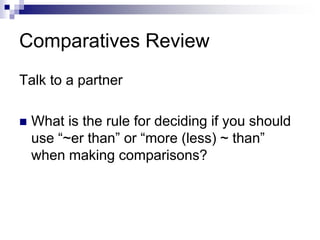
“James May’s 20th Century” (p. 56)
1. What is James May’s TV series about?
2. Would you like to watch this series? Why/why not?
3. Do you generally like watching documentaries? Why/why
not?
4. Check your answers to question 3A
5. Discuss 3B
Comparatives Review
Talk to a partner
 What is the rule for deciding if you should
use “~er than” or “more (less) ~ than”
when making comparisons?
Saskatoon & Seoul
Saskatoon
Population: 230,000
Climate
 Temperatures range from 25~30°C
on the warmest summer days, to
-20~30°C on the coldest winter
days.
 Humidity is typically quite low.
 There are more hours of sunshine
annually than any other major
Canadian city.
[Source: Tourism Saskatoon]
Make sentences comparing Saskatoon and Seoul:
1. In the winter, Saskatoon is ___ (cold) Seoul.
2. In the summer, Seoul is ___ (hot) and ___ (humid)
Saskatoon.
3. However, Saskatoon is generally ___ (sunny) Seoul.
4. In the winter, Seoul is ___ (cold) Saskatoon.
5. Saskatoon is ___ (humid) Seoul.
6. Saskatoon streets are ___ (crowded) those in Seoul.
7. Traffic in Seoul is ___ (crazy) traffic in Saskatoon.
8. Nightlife in Seoul is ___ (exciting) that in Saskatoon.
 What is the rule for deciding if you should
use “~er than” or “more (less) ~ than”
when making comparisons?
Hint:
Think about how many syllables there are.
 Are there any exceptions??
 What modifiers can you use to show a big or
small difference?
Big:
In the winter, Saskatoon is __ colder than Seoul.
In the summer, Seoul is __ more humid than Saskatoon.
far / a lot / much
Small:
Gyeongju is __ bigger than Saskatoon.
a little / a bit / slightly
 What about to emphasize a difference?
New York is much bigger than Saskatoon, but Seoul is
__ bigger (than New York).
even
Practice
Talk to your partner and make sentences
comparing the following. Use modifiers!
 Yonsei University / Korea University
 Sinchon campus / Songdo campus
 your life in high school / your life now
 Korea in the 1980s (guess, if necessary!) / Korea now
 beer / soju
 TV / computer games
 spring / summer (in Korea)
 Seoul / New York
Superlatives
Fill in the blanks:
Seoul is ___ (big) city in Korea.
Seoul is the biggest city in Korea.
Mumbai (India) is _____ (noisy) city in the world.
Mumbai is the noisiest city in the world.
Yonsei students are ________ (attractive and
intelligent) students in Korea.
Yonsei students are the most attractive and intelligent
students in Korea.
P. 57 – 4B & C
5A
Top Gear (BBC)
 P. 64 #1
- freerunning (~parkour) /ˈpɑːkˌɔː/
“the sport or activity of running through urban areas while performing various
gymnastic manoeuvres over or on man-made obstacles such as walls and
buildings” [Collins English Dictionary]
 Discuss #1-2 (Would you like to try this sport? Why/why not?)
 Read the article. Discuss #2 (Who do you think will win the race? Why?)
 Watch and see if you were right.
Vocabulary:
ginormous = giant + enormous (informal)
as the crow flies = by the shortest and most direct route
sluggish = lacking energy; slow-moving
combat trousers = loose casual trousers with large pockets on the legs
“For Pete’s sake!” = an expression of frustration, exasperation or annoyance (informal)
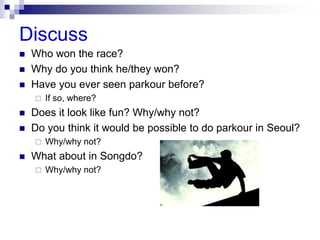
Discuss
 Who won the race?
 Why do you think he/they won?
 Have you ever seen parkour before?
 If so, where?
 Does it look like fun? Why/why not?
 Do you think it would be possible to do parkour in Seoul?
 Why/why not?
 What about in Songdo?
 Why/why not?

Speakout Intermediate Unit 5 - 1

  • 1.
    Unit 5 (1)- Solutions
  • 2.
    Discuss 1. What didyou do last weekend? What do you usually do? 2. What kinds of things did you use to do on the weekends when you were in high school/middle school/elementary school? *use (never) used to / didn’t use to / would / wouldn’t if possible 3. What are some inventions or technologies that people used to use in the past, but don’t any more? “James May’s 20th Century” (p. 56) 1. What is James May’s TV series about? 2. Would you like to watch this series? Why/why not? 3. Do you generally like watching documentaries? Why/why not? 4. Check your answers to question 3A 5. Discuss 3B
  • 3.
    Comparatives Review Talk toa partner  What is the rule for deciding if you should use “~er than” or “more (less) ~ than” when making comparisons?
  • 4.
    Saskatoon & Seoul Saskatoon Population:230,000 Climate  Temperatures range from 25~30°C on the warmest summer days, to -20~30°C on the coldest winter days.  Humidity is typically quite low.  There are more hours of sunshine annually than any other major Canadian city. [Source: Tourism Saskatoon] Make sentences comparing Saskatoon and Seoul: 1. In the winter, Saskatoon is ___ (cold) Seoul. 2. In the summer, Seoul is ___ (hot) and ___ (humid) Saskatoon. 3. However, Saskatoon is generally ___ (sunny) Seoul. 4. In the winter, Seoul is ___ (cold) Saskatoon. 5. Saskatoon is ___ (humid) Seoul. 6. Saskatoon streets are ___ (crowded) those in Seoul. 7. Traffic in Seoul is ___ (crazy) traffic in Saskatoon. 8. Nightlife in Seoul is ___ (exciting) that in Saskatoon.
  • 5.
     What isthe rule for deciding if you should use “~er than” or “more (less) ~ than” when making comparisons? Hint: Think about how many syllables there are.  Are there any exceptions??
  • 6.
     What modifierscan you use to show a big or small difference? Big: In the winter, Saskatoon is __ colder than Seoul. In the summer, Seoul is __ more humid than Saskatoon. far / a lot / much Small: Gyeongju is __ bigger than Saskatoon. a little / a bit / slightly  What about to emphasize a difference? New York is much bigger than Saskatoon, but Seoul is __ bigger (than New York). even
  • 7.
    Practice Talk to yourpartner and make sentences comparing the following. Use modifiers!  Yonsei University / Korea University  Sinchon campus / Songdo campus  your life in high school / your life now  Korea in the 1980s (guess, if necessary!) / Korea now  beer / soju  TV / computer games  spring / summer (in Korea)  Seoul / New York
  • 8.
    Superlatives Fill in theblanks: Seoul is ___ (big) city in Korea. Seoul is the biggest city in Korea. Mumbai (India) is _____ (noisy) city in the world. Mumbai is the noisiest city in the world. Yonsei students are ________ (attractive and intelligent) students in Korea. Yonsei students are the most attractive and intelligent students in Korea. P. 57 – 4B & C 5A
  • 9.
    Top Gear (BBC) P. 64 #1 - freerunning (~parkour) /ˈpɑːkˌɔː/ “the sport or activity of running through urban areas while performing various gymnastic manoeuvres over or on man-made obstacles such as walls and buildings” [Collins English Dictionary]  Discuss #1-2 (Would you like to try this sport? Why/why not?)  Read the article. Discuss #2 (Who do you think will win the race? Why?)  Watch and see if you were right. Vocabulary: ginormous = giant + enormous (informal) as the crow flies = by the shortest and most direct route sluggish = lacking energy; slow-moving combat trousers = loose casual trousers with large pockets on the legs “For Pete’s sake!” = an expression of frustration, exasperation or annoyance (informal)
  • 10.
    Discuss  Who wonthe race?  Why do you think he/they won?  Have you ever seen parkour before?  If so, where?  Does it look like fun? Why/why not?  Do you think it would be possible to do parkour in Seoul?  Why/why not?  What about in Songdo?  Why/why not?