BOOK BUILDING
PROCESS OF A
COMPANY
          FINANCIAL
          SERVICES

          COURTESY:
          PROF.MS. DIMPY
          GOKAL


          SYBFM
          SEMESTER 4
          SALONI SARVAIYA
          ROLL NO-46
ACKNOWLEDGEMENT:-
We would like to express our gratitude to Prof. Dimpy Gokal for giving me this
topic for my project as it gave me the opportunity to go beyond the book and look
at the topic from a more practical point of view. It broadened my horizons and
improved my understanding of this topic.

Thank You.
Index
SR. NO.                   TOPIC    PAGE NO.


  1.      WHAT IS BOOK BUILDING      04


  2.      BOOK BUILDING IN INDIA     05


  3.      GUIDELINES BY SEBI         06


  4.      TYPES OF BOOK BUILDING     08


  5.      ROLE OF INTERMEDIARIES     10

  6.                                 12
          CASE STUDY

  7.                                 16
          BIBLIOGRAPHY
WHAT IS BOOK BUILDING?

Book Building is the process of determining the price at which an Initial Public
Offering will be offered. SEBI guidelines, 1995 defined book-building as “a
process undertaken by which a demand for the securities proposed to be issued by
a body of corporate is elicited and built up and the price for such securities is
assessed for the determination of the quantum of such securities to be issued by
means of a notice, circular, advertisement, document or information memoranda or
offer document”.

In general, the word “Book building” is a method of marketing the shares of a
company whereby the quantum and the price of the securities to be issued will be
decided on the basis of the ‘bids’ received from the prospective shareholders by the
lead merchant bankers. According to this method, share prices are determined on
the basis of real demand for the shares at various price levels in the market.

Book building is a common practice in developed countries and has recently been
making inroads into emerging markets as well. When companies are on the look
out to raise money for their business operations, they use various means for the
same.

Two of the most popular means to raise money are Initial Public Offer (IPO) and
Follow on Public Offer (FPO).

During the IPO or FPO, the company offers its shares to the public either at fixed
price or offers a price range, so that the investors can decide on the right price. The
method of offering shares by providing a price range is called as book building
method.

Types of investors

There are three kinds of investors in a book-building issue.

The retail individual investor (RII),

The non-institutional investor (NII)

The Qualified Institutional Buyers (QIBs)
There are two types of Public Issues:
FIXED PRICE ISSUE: - When the issuer at the outset decides the issue price and
mentions it in the offer document, it is commonly known as fixed price issue.

BOOK BUILT ISSUE:-When the price of an issue is discovered on the basis of
demand received from the prospective investors at various price levels, it is called
as book built issue.


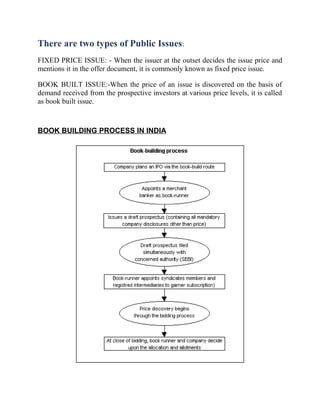
BOOK BUILDING PROCESS IN INDIA
Book Building is fundamentally a procedure utilized in IPOs for effective price
discovery. It’s a method where, during the time period for which the initial public
offer is open, bids are gathered from traders at different prices, which are higher or
equal to the ground price. The IPO offer price is decided following the bid ending
date.


GUIDELINES BY SEBI

   •   On the recommendations of Malegam committee, The concept of Book
       Building assumed significance in India as SEBI approved, with effect from
       November 1, 1995, the use of the process in pricing new issues.

   • SEBI issued the guidelines under which the option of 100%book-building
     was available to only those issuer companies which are to make an issue of
     capital of and above Rs. 100crore.

   • These guidelines were modified in 1998-99.The ceiling of
     issue size was reduced to Rs. 25crore.

   • SEBI modified book-building norms for public issues in 1999
     and allowed the issuer to choose either the existing or the
     modified mode of book building.

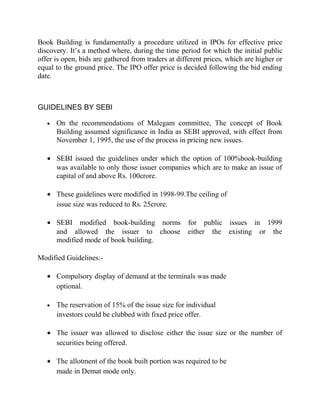
Modified Guidelines:-

   • Compulsory display of demand at the terminals was made
     optional.

   •   The reservation of 15% of the issue size for individual
       investors could be clubbed with fixed price offer.

   • The issuer was allowed to disclose either the issue size or the number of
     securities being offered.

   • The allotment of the book built portion was required to be
     made in Demat mode only.
•    In April 2000, SEBI modified guidelines for the 100% book-
         building process. i.e. a maximum of 60% of the issue was
         allowed to Institutional investors and atleast 15% to non-
         institutional investors who had applied for more than 1,000
         share


                              TYPES OF BOOK-BUILDING:

The Companies are bound to adhere to the SEBI’s guidelines for book building
offers in the following manner:

Ø       75% book building

Ø       100% book building

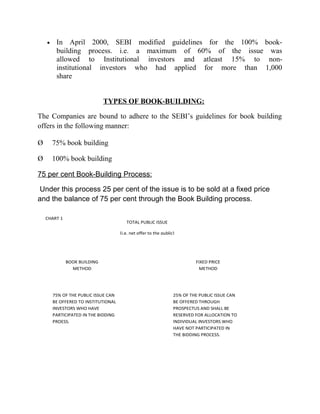
75 per cent Book-Building Process:

 Under this process 25 per cent of the issue is to be sold at a fixed price
and the balance of 75 per cent through the Book Building process.

    CHART 1
                                         TOTAL PUBLIC ISSUE

                                      (i.e. net offer to the public)


              BOOK BUILDING                                                 FIXED PRICE
                METHOD                                                        METHOD


        75% OF THE PUBLIC ISSUE CAN                                25% OF THE PUBLIC ISSUE CAN
        BE OFFERED TO INSTITUTIONAL                                BE OFFERED THROUGH
        INVESTORS WHO HAVE                                         PROSPECTUS AND SHALL BE
        PARTICIPATED IN THE BIDDING                                RESERVED FOR ALLOCATION TO
        PROESS.                                                    INDIVIDUAL INVESTORS WHO
                                                                   HAVE NOT PARTICIPATED IN
                                                                   THE BIDDING PROCESS.
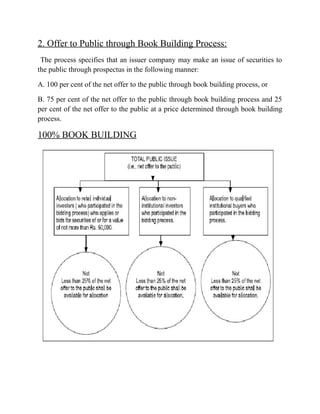
2. Offer to Public through Book Building Process:
 The process specifies that an issuer company may make an issue of securities to
the public through prospectus in the following manner:

A. 100 per cent of the net offer to the public through book building process, or

B. 75 per cent of the net offer to the public through book building process and 25
per cent of the net offer to the public at a price determined through book building
process.

100% BOOK BUILDING
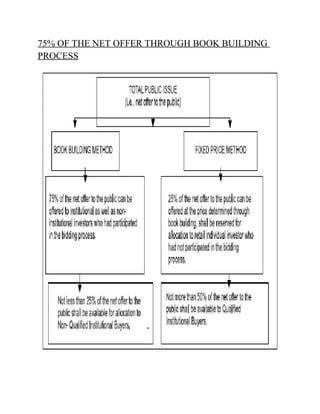
75% OF THE NET OFFER THROUGH BOOK BUILDING
PROCESS
ROLE OF INTERMEDIARIES


Who are the intermediaries in an issue?

Merchant Bankers to the issue or Book Running Lead Managers (BRLM),
syndicate members, Registrars to the issue, Bankers to the issue, Auditors of the
company, Underwriters to the issue, Solicitors, etc. are the intermediaries to an
issue. The issuer discloses the addresses, telephone/fax numbers and email
addresses of these intermediaries. In addition to this, the issuer also discloses the
details of the compliance officer appointed by the company for the purpose of the
issue.

Role of Merchant Bankers in Public Issues:

 (i) Deciding on the size and timing of a public issue in the light of the market
conditions.
(ii) Preparing the base of successful issue marketing from the initial documentation
to the preparation of the actual launch.
(iii) Optimum underwriting support.
(iv) Appointment of bankers and brokers as well as issue houses.
(v) Professional liaison with share market functionaries like brokers, portfolio
managers and financial press for pre-selling and media coverage.
(vi) Preparation of draft prospectus and other documents.
(vii) Wide coverage throughout the country for collection of applications.
(viii) Preparation of advertising and promotional material


Who is eligible to be a BRLM?

A Merchant banker possessing a valid SEBI registration in accordance with the
SEBI (Merchant Bankers) Regulations, 1992 is eligible to act as a Book Running
Lead Manager to an issue.

What is the role of a Lead Manager? (Pre and post issue)

In the pre-issue process, the Lead Manager (LM) takes up the due diligence of
company’s operations/ management/ business plans/ legal etc. Other activities of
the LM include drafting and design of Offer documents, Prospectus, statutory
advertisements and memorandum containing salient features of the Prospectus.
The BRLMs shall ensure compliance with stipulated requirements and completion
of prescribed formalities with the Stock Exchanges, RoC and SEBI including
finalization of Prospectus and RoC filing. Appointment of other intermediaries
viz., Registrar(s), Printers, Advertising Agency and Bankers to the Offer is also
included in the pre-issue processes.

The LM also draws up the various marketing strategies for the issue. The post issue
activities including management of escrow accounts, coordinate non-institutional
allocation, intimation of allocation and dispatch of refunds to bidders etc are
performed by the LM. The post Offer activities for the Offer will involve essential
follow-up steps, which include the finalization of trading and dealing of
instruments and dispatch of certificates and demat of delivery of shares, with the
various agencies connected with the work such as the Registrar(s) to the Offer and
Bankers to the Offer and the bank handling refund business. The merchant banker
shall be responsible for ensuring that these agencies fulfill their functions and
enable it to discharge this responsibility through suitable agreements with the
Company.

What is the role of a registrar?
The Registrar finalizes the list of eligible allottees after deleting the invalid
applications and ensures that the corporate action for crediting of shares to the
demat accounts of the applicants is done and the dispatch of refund orders to those
applicable are sent. The Lead manager coordinates with the Registrar to ensure
follow up so that that the flow of applications from collecting bank branches,
processing of the applications and other matters till the basis of allotment is
finalized, dispatch security certificates and refund orders completed and securities
listed.

Importance of Underwriting in book building.

Underwriting is a good technique of marketing the securities. The importance of
under-writing can be adjudged by the following advantages

   Assurance of Adequate Finance.
   Benefit of Expert Advice.
   Increase in Goodwill of the Company.
   Geographical Dispersion of Securities.
   Service to Prospective Buyers.
BOOK BUILDING- A PRICE DISCOVERY METHOD.

Book building is actually a price discovery method. In this method, the company
doesn't fix up a particular price for the shares, but instead gives a price range, e.g.
Rs 80-100.

When bidding for the shares, investors have to decide at which price they would
like to bid for the shares, for e.g. Rs 80, Rs 90 or Rs 100. They can bid for the
shares at any price within this range.

Based on the demand and supply of the shares, the final price is fixed. The lowest
price (Rs 80) is known as the floor price and the highest price (Rs 100) is known as
cap price.

The price at which the shares are allotted is known as cut off price.

The entire process begins with the selection of the lead manager, an investment
banker whose job is to bring the issue to the public.

Both the lead manager and the issuing company fix the price range and the issue
size. Next syndicate members are hired to obtain bids from the investors. Normally
the issue is kept open for 5 days.

Once the offer period is over, the lead manager and issuing company fix the price
at which the shares are sold to the investors. If the issue price is less than the cap
price, the investors who bid at the cap price will get a refund and those who bid at
the floor price will end up paying the additional money.

For e.g. if the cut off in the above example is fixed at Rs 90, those who bid at Rs
80, will have to pay Rs 10 per share and those who bid at Rs 100, will end up
getting the refund of Rs 10 per share. Once each investor pays the actual issue
price, the shares are allotted.
Introduction:

Incorporated in 2008, Birla Pacific Medspa Limited is an India based healthcare
provider. Birla Pacific Medspa is a joint venture of Yash Birla Group, a Rs 30
billion group of over 20 diversified companies and Pacific Healthcare, East Asia’s
leading healthcare provider, with healthcare facilities in Singapore, Hong Kong,
and China.

Birla Pacific Medspa provides beauty related medical procedures in India. Using
state-of-the-art equipments, the internationally qualified panel of doctors provides
patient centric solutions and offers the latest and safest treatments.

Company operates it healthcare centers under the brand name EVOLVE.
Company operates 3 healthcare centers in Mumbai and has 2 franchises in Thane
and Chennai. Company's expertise includes Cosmetic Dermatology, Cosmetic &
Plastic Surgery, General & Specialist Dentistry and Maxillo Facial Prosthesis. It
has introduced i-lipo, a non-surgical inch loss treatment, for the first time in India.

Company Promoters:
Company is promoted by Mr. Yashovardhan Birla and one of his group companies,
Birla Wellness & Healthcare Private Limited.
Objects of the Issue:
The objects of the issue are

1. To meet the capital expenditure towards establishing 55 outlets of Evolve Med
spa across various cities and places.
2. To meet expenses towards brand promotion.
3. To meet the working capital requirements for running the centers.
4. To meet Issue related expenses.
5. To enlist the Company's Shares on Bombay Stock Exchange Limited (BSE).

Issue Detail:

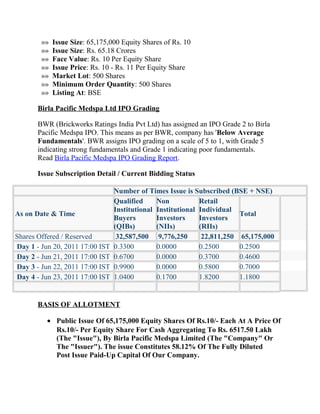
 »» Issue Open: Jun 20, 2011 - Jun 23, 2011
 »» Issue Type: 100% Book Built Issue IPO
»»   Issue Size: 65,175,000 Equity Shares of Rs. 10
        »»   Issue Size: Rs. 65.18 Crores
        »»   Face Value: Rs. 10 Per Equity Share
        »»   Issue Price: Rs. 10 - Rs. 11 Per Equity Share
        »»   Market Lot: 500 Shares
        »»   Minimum Order Quantity: 500 Shares
        »»   Listing At: BSE

       Birla Pacific Medspa Ltd IPO Grading

       BWR (Brickworks Ratings India Pvt Ltd) has assigned an IPO Grade 2 to Birla
       Pacific Medspa IPO. This means as per BWR, company has 'Below Average
       Fundamentals'. BWR assigns IPO grading on a scale of 5 to 1, with Grade 5
       indicating strong fundamentals and Grade 1 indicating poor fundamentals.
       Read Birla Pacific Medspa IPO Grading Report.

       Issue Subscription Detail / Current Bidding Status

                                 Number of Times Issue is Subscribed (BSE + NSE)
                                 Qualified     Non           Retail
                                 Institutional Institutional Individual
As on Date & Time                                                        Total
                                 Buyers        Investors     Investors
                                 (QIBs)        (NIIs)        (RIIs)
Shares Offered / Reserved         32,587,500 9,776,250        22,811,250 65,175,000
Day 1 - Jun 20, 2011 17:00 IST   0.3300        0.0000        0.2500      0.2500
Day 2 - Jun 21, 2011 17:00 IST   0.6700        0.0000        0.3700      0.4600
Day 3 - Jun 22, 2011 17:00 IST   0.9900        0.0000        0.5800      0.7000
Day 4 - Jun 23, 2011 17:00 IST   1.0400        0.1700        1.8200      1.1800


       BASIS OF ALLOTMENT

          • Public Issue Of 65,175,000 Equity Shares Of Rs.10/- Each At A Price Of
            Rs.10/- Per Equity Share For Cash Aggregating To Rs. 6517.50 Lakh
            (The "Issue"), By Birla Pacific Medspa Limited (The "Company" Or
            The "Issuer"). The issue Constitutes 58.12% Of The Fully Diluted
            Post Issue Paid-Up Capital Of Our Company.
• The Issue Price Is One Time Of The Face Value


    • The equity shares of the Company are proposed to be listed on Bombay
      Stock Exchange Limited
    • ("BSE") and Trading is expected to commence on 7th july 2011

ISSUE PRICE: RS. 10/- PER EQUITY SHARE OF THE FACE VALUE OF
RS. 10/- EACH

BID/ISSUE OPENED ON JUNE 20, 2011 CLOSED ON JUNE 23, 2011

This Issue was made through a 100% Book Building Process in terms of regulation
26(2)(a)(i) and b(i) of SEBI (ICDR) Regulations, 2009, as amended from time to
time, whereby at least 50% of the Issue was to be allocated to Qualified
Institutional Buyers (QIBs) on a proportionate basis, subject to valid bids being
received at or above the Issue Price. 5% of the QIB Portion was available for
allocation on proportionate basis to Mutual Funds only and the remaining Net QIB
portion was available for allocation on a proportionate basis to all Qualified
Institutional Buyers, including Mutual Funds, subject to valid bids being received
at or above Issue Price. Further, upto 15% of the Issue was available for allocation
on a proportionate basis to Non Institutional Bidders and upto 35% of the Issue
was available for allocation on a proportionate basis to Retail Individual Bidders,
subject to valid bids being received at or above the Issue Price.
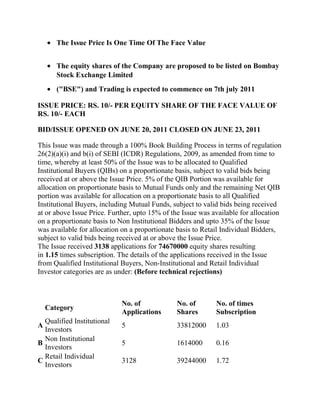
The Issue received 3138 applications for 74670000 equity shares resulting
in 1.15 times subscription. The details of the applications received in the Issue
from Qualified Institutional Buyers, Non-Institutional and Retail Individual
Investor categories are as under: (Before technical rejections)


                            No. of             No. of        No. of times
    Category
                            Applications       Shares        Subscription
  Qualified Institutional
A                           5                  33812000      1.03
  Investors
  Non Institutional
B                           5                  1614000       0.16
  Investors
  Retail Individual
C                           3128               39244000      1.72
  Investors
Total                  3138     74670000   1.15


                          BIBLIOGRAPHY


www.scribd.com

www.wiki.com

www.bseindia.com

www.ultimatestockportfolio.com

What is book building

  • 1.
    BOOK BUILDING PROCESS OFA COMPANY FINANCIAL SERVICES COURTESY: PROF.MS. DIMPY GOKAL SYBFM SEMESTER 4 SALONI SARVAIYA ROLL NO-46
  • 2.
    ACKNOWLEDGEMENT:- We would liketo express our gratitude to Prof. Dimpy Gokal for giving me this topic for my project as it gave me the opportunity to go beyond the book and look at the topic from a more practical point of view. It broadened my horizons and improved my understanding of this topic. Thank You.
  • 3.
    Index SR. NO. TOPIC PAGE NO. 1. WHAT IS BOOK BUILDING 04 2. BOOK BUILDING IN INDIA 05 3. GUIDELINES BY SEBI 06 4. TYPES OF BOOK BUILDING 08 5. ROLE OF INTERMEDIARIES 10 6. 12 CASE STUDY 7. 16 BIBLIOGRAPHY
  • 4.
    WHAT IS BOOKBUILDING? Book Building is the process of determining the price at which an Initial Public Offering will be offered. SEBI guidelines, 1995 defined book-building as “a process undertaken by which a demand for the securities proposed to be issued by a body of corporate is elicited and built up and the price for such securities is assessed for the determination of the quantum of such securities to be issued by means of a notice, circular, advertisement, document or information memoranda or offer document”. In general, the word “Book building” is a method of marketing the shares of a company whereby the quantum and the price of the securities to be issued will be decided on the basis of the ‘bids’ received from the prospective shareholders by the lead merchant bankers. According to this method, share prices are determined on the basis of real demand for the shares at various price levels in the market. Book building is a common practice in developed countries and has recently been making inroads into emerging markets as well. When companies are on the look out to raise money for their business operations, they use various means for the same. Two of the most popular means to raise money are Initial Public Offer (IPO) and Follow on Public Offer (FPO). During the IPO or FPO, the company offers its shares to the public either at fixed price or offers a price range, so that the investors can decide on the right price. The method of offering shares by providing a price range is called as book building method. Types of investors There are three kinds of investors in a book-building issue. The retail individual investor (RII), The non-institutional investor (NII) The Qualified Institutional Buyers (QIBs)
  • 5.
    There are twotypes of Public Issues: FIXED PRICE ISSUE: - When the issuer at the outset decides the issue price and mentions it in the offer document, it is commonly known as fixed price issue. BOOK BUILT ISSUE:-When the price of an issue is discovered on the basis of demand received from the prospective investors at various price levels, it is called as book built issue. BOOK BUILDING PROCESS IN INDIA
  • 6.
    Book Building isfundamentally a procedure utilized in IPOs for effective price discovery. It’s a method where, during the time period for which the initial public offer is open, bids are gathered from traders at different prices, which are higher or equal to the ground price. The IPO offer price is decided following the bid ending date. GUIDELINES BY SEBI • On the recommendations of Malegam committee, The concept of Book Building assumed significance in India as SEBI approved, with effect from November 1, 1995, the use of the process in pricing new issues. • SEBI issued the guidelines under which the option of 100%book-building was available to only those issuer companies which are to make an issue of capital of and above Rs. 100crore. • These guidelines were modified in 1998-99.The ceiling of issue size was reduced to Rs. 25crore. • SEBI modified book-building norms for public issues in 1999 and allowed the issuer to choose either the existing or the modified mode of book building. Modified Guidelines:- • Compulsory display of demand at the terminals was made optional. • The reservation of 15% of the issue size for individual investors could be clubbed with fixed price offer. • The issuer was allowed to disclose either the issue size or the number of securities being offered. • The allotment of the book built portion was required to be made in Demat mode only.
  • 7.
    In April 2000, SEBI modified guidelines for the 100% book- building process. i.e. a maximum of 60% of the issue was allowed to Institutional investors and atleast 15% to non- institutional investors who had applied for more than 1,000 share TYPES OF BOOK-BUILDING: The Companies are bound to adhere to the SEBI’s guidelines for book building offers in the following manner: Ø 75% book building Ø 100% book building 75 per cent Book-Building Process: Under this process 25 per cent of the issue is to be sold at a fixed price and the balance of 75 per cent through the Book Building process. CHART 1 TOTAL PUBLIC ISSUE (i.e. net offer to the public) BOOK BUILDING FIXED PRICE METHOD METHOD 75% OF THE PUBLIC ISSUE CAN 25% OF THE PUBLIC ISSUE CAN BE OFFERED TO INSTITUTIONAL BE OFFERED THROUGH INVESTORS WHO HAVE PROSPECTUS AND SHALL BE PARTICIPATED IN THE BIDDING RESERVED FOR ALLOCATION TO PROESS. INDIVIDUAL INVESTORS WHO HAVE NOT PARTICIPATED IN THE BIDDING PROCESS.
  • 8.
    2. Offer toPublic through Book Building Process: The process specifies that an issuer company may make an issue of securities to the public through prospectus in the following manner: A. 100 per cent of the net offer to the public through book building process, or B. 75 per cent of the net offer to the public through book building process and 25 per cent of the net offer to the public at a price determined through book building process. 100% BOOK BUILDING
  • 9.
    75% OF THENET OFFER THROUGH BOOK BUILDING PROCESS
  • 10.
    ROLE OF INTERMEDIARIES Whoare the intermediaries in an issue? Merchant Bankers to the issue or Book Running Lead Managers (BRLM), syndicate members, Registrars to the issue, Bankers to the issue, Auditors of the company, Underwriters to the issue, Solicitors, etc. are the intermediaries to an issue. The issuer discloses the addresses, telephone/fax numbers and email addresses of these intermediaries. In addition to this, the issuer also discloses the details of the compliance officer appointed by the company for the purpose of the issue. Role of Merchant Bankers in Public Issues: (i) Deciding on the size and timing of a public issue in the light of the market conditions. (ii) Preparing the base of successful issue marketing from the initial documentation to the preparation of the actual launch. (iii) Optimum underwriting support. (iv) Appointment of bankers and brokers as well as issue houses. (v) Professional liaison with share market functionaries like brokers, portfolio managers and financial press for pre-selling and media coverage. (vi) Preparation of draft prospectus and other documents. (vii) Wide coverage throughout the country for collection of applications. (viii) Preparation of advertising and promotional material Who is eligible to be a BRLM? A Merchant banker possessing a valid SEBI registration in accordance with the SEBI (Merchant Bankers) Regulations, 1992 is eligible to act as a Book Running Lead Manager to an issue. What is the role of a Lead Manager? (Pre and post issue) In the pre-issue process, the Lead Manager (LM) takes up the due diligence of company’s operations/ management/ business plans/ legal etc. Other activities of the LM include drafting and design of Offer documents, Prospectus, statutory
  • 11.
    advertisements and memorandumcontaining salient features of the Prospectus. The BRLMs shall ensure compliance with stipulated requirements and completion of prescribed formalities with the Stock Exchanges, RoC and SEBI including finalization of Prospectus and RoC filing. Appointment of other intermediaries viz., Registrar(s), Printers, Advertising Agency and Bankers to the Offer is also included in the pre-issue processes. The LM also draws up the various marketing strategies for the issue. The post issue activities including management of escrow accounts, coordinate non-institutional allocation, intimation of allocation and dispatch of refunds to bidders etc are performed by the LM. The post Offer activities for the Offer will involve essential follow-up steps, which include the finalization of trading and dealing of instruments and dispatch of certificates and demat of delivery of shares, with the various agencies connected with the work such as the Registrar(s) to the Offer and Bankers to the Offer and the bank handling refund business. The merchant banker shall be responsible for ensuring that these agencies fulfill their functions and enable it to discharge this responsibility through suitable agreements with the Company. What is the role of a registrar? The Registrar finalizes the list of eligible allottees after deleting the invalid applications and ensures that the corporate action for crediting of shares to the demat accounts of the applicants is done and the dispatch of refund orders to those applicable are sent. The Lead manager coordinates with the Registrar to ensure follow up so that that the flow of applications from collecting bank branches, processing of the applications and other matters till the basis of allotment is finalized, dispatch security certificates and refund orders completed and securities listed. Importance of Underwriting in book building. Underwriting is a good technique of marketing the securities. The importance of under-writing can be adjudged by the following advantages Assurance of Adequate Finance. Benefit of Expert Advice. Increase in Goodwill of the Company. Geographical Dispersion of Securities. Service to Prospective Buyers.
  • 12.
    BOOK BUILDING- APRICE DISCOVERY METHOD. Book building is actually a price discovery method. In this method, the company doesn't fix up a particular price for the shares, but instead gives a price range, e.g. Rs 80-100. When bidding for the shares, investors have to decide at which price they would like to bid for the shares, for e.g. Rs 80, Rs 90 or Rs 100. They can bid for the shares at any price within this range. Based on the demand and supply of the shares, the final price is fixed. The lowest price (Rs 80) is known as the floor price and the highest price (Rs 100) is known as cap price. The price at which the shares are allotted is known as cut off price. The entire process begins with the selection of the lead manager, an investment banker whose job is to bring the issue to the public. Both the lead manager and the issuing company fix the price range and the issue size. Next syndicate members are hired to obtain bids from the investors. Normally the issue is kept open for 5 days. Once the offer period is over, the lead manager and issuing company fix the price at which the shares are sold to the investors. If the issue price is less than the cap price, the investors who bid at the cap price will get a refund and those who bid at the floor price will end up paying the additional money. For e.g. if the cut off in the above example is fixed at Rs 90, those who bid at Rs 80, will have to pay Rs 10 per share and those who bid at Rs 100, will end up getting the refund of Rs 10 per share. Once each investor pays the actual issue price, the shares are allotted.
  • 13.
    Introduction: Incorporated in 2008,Birla Pacific Medspa Limited is an India based healthcare provider. Birla Pacific Medspa is a joint venture of Yash Birla Group, a Rs 30 billion group of over 20 diversified companies and Pacific Healthcare, East Asia’s leading healthcare provider, with healthcare facilities in Singapore, Hong Kong, and China. Birla Pacific Medspa provides beauty related medical procedures in India. Using state-of-the-art equipments, the internationally qualified panel of doctors provides patient centric solutions and offers the latest and safest treatments. Company operates it healthcare centers under the brand name EVOLVE. Company operates 3 healthcare centers in Mumbai and has 2 franchises in Thane and Chennai. Company's expertise includes Cosmetic Dermatology, Cosmetic & Plastic Surgery, General & Specialist Dentistry and Maxillo Facial Prosthesis. It has introduced i-lipo, a non-surgical inch loss treatment, for the first time in India. Company Promoters: Company is promoted by Mr. Yashovardhan Birla and one of his group companies, Birla Wellness & Healthcare Private Limited. Objects of the Issue: The objects of the issue are 1. To meet the capital expenditure towards establishing 55 outlets of Evolve Med spa across various cities and places. 2. To meet expenses towards brand promotion. 3. To meet the working capital requirements for running the centers. 4. To meet Issue related expenses. 5. To enlist the Company's Shares on Bombay Stock Exchange Limited (BSE). Issue Detail: »» Issue Open: Jun 20, 2011 - Jun 23, 2011 »» Issue Type: 100% Book Built Issue IPO
  • 14.
    »» Issue Size: 65,175,000 Equity Shares of Rs. 10 »» Issue Size: Rs. 65.18 Crores »» Face Value: Rs. 10 Per Equity Share »» Issue Price: Rs. 10 - Rs. 11 Per Equity Share »» Market Lot: 500 Shares »» Minimum Order Quantity: 500 Shares »» Listing At: BSE Birla Pacific Medspa Ltd IPO Grading BWR (Brickworks Ratings India Pvt Ltd) has assigned an IPO Grade 2 to Birla Pacific Medspa IPO. This means as per BWR, company has 'Below Average Fundamentals'. BWR assigns IPO grading on a scale of 5 to 1, with Grade 5 indicating strong fundamentals and Grade 1 indicating poor fundamentals. Read Birla Pacific Medspa IPO Grading Report. Issue Subscription Detail / Current Bidding Status Number of Times Issue is Subscribed (BSE + NSE) Qualified Non Retail Institutional Institutional Individual As on Date & Time Total Buyers Investors Investors (QIBs) (NIIs) (RIIs) Shares Offered / Reserved 32,587,500 9,776,250 22,811,250 65,175,000 Day 1 - Jun 20, 2011 17:00 IST 0.3300 0.0000 0.2500 0.2500 Day 2 - Jun 21, 2011 17:00 IST 0.6700 0.0000 0.3700 0.4600 Day 3 - Jun 22, 2011 17:00 IST 0.9900 0.0000 0.5800 0.7000 Day 4 - Jun 23, 2011 17:00 IST 1.0400 0.1700 1.8200 1.1800 BASIS OF ALLOTMENT • Public Issue Of 65,175,000 Equity Shares Of Rs.10/- Each At A Price Of Rs.10/- Per Equity Share For Cash Aggregating To Rs. 6517.50 Lakh (The "Issue"), By Birla Pacific Medspa Limited (The "Company" Or The "Issuer"). The issue Constitutes 58.12% Of The Fully Diluted Post Issue Paid-Up Capital Of Our Company.
  • 15.
    • The IssuePrice Is One Time Of The Face Value • The equity shares of the Company are proposed to be listed on Bombay Stock Exchange Limited • ("BSE") and Trading is expected to commence on 7th july 2011 ISSUE PRICE: RS. 10/- PER EQUITY SHARE OF THE FACE VALUE OF RS. 10/- EACH BID/ISSUE OPENED ON JUNE 20, 2011 CLOSED ON JUNE 23, 2011 This Issue was made through a 100% Book Building Process in terms of regulation 26(2)(a)(i) and b(i) of SEBI (ICDR) Regulations, 2009, as amended from time to time, whereby at least 50% of the Issue was to be allocated to Qualified Institutional Buyers (QIBs) on a proportionate basis, subject to valid bids being received at or above the Issue Price. 5% of the QIB Portion was available for allocation on proportionate basis to Mutual Funds only and the remaining Net QIB portion was available for allocation on a proportionate basis to all Qualified Institutional Buyers, including Mutual Funds, subject to valid bids being received at or above Issue Price. Further, upto 15% of the Issue was available for allocation on a proportionate basis to Non Institutional Bidders and upto 35% of the Issue was available for allocation on a proportionate basis to Retail Individual Bidders, subject to valid bids being received at or above the Issue Price. The Issue received 3138 applications for 74670000 equity shares resulting in 1.15 times subscription. The details of the applications received in the Issue from Qualified Institutional Buyers, Non-Institutional and Retail Individual Investor categories are as under: (Before technical rejections) No. of No. of No. of times Category Applications Shares Subscription Qualified Institutional A 5 33812000 1.03 Investors Non Institutional B 5 1614000 0.16 Investors Retail Individual C 3128 39244000 1.72 Investors
  • 16.
    Total 3138 74670000 1.15 BIBLIOGRAPHY www.scribd.com www.wiki.com www.bseindia.com www.ultimatestockportfolio.com