UNIT 1
The UNIVERSE is everything that exists. It
contains millions of galaxies. Galaxies contain
stars, planets and other astronomical objects.
Scientists believe that the Universe started
14000 million years ago with an explosion
called Big Bang.
Pieces of matter expanded in different
directions and they are the different
astronomical objects in the Universe.
GALAXIES
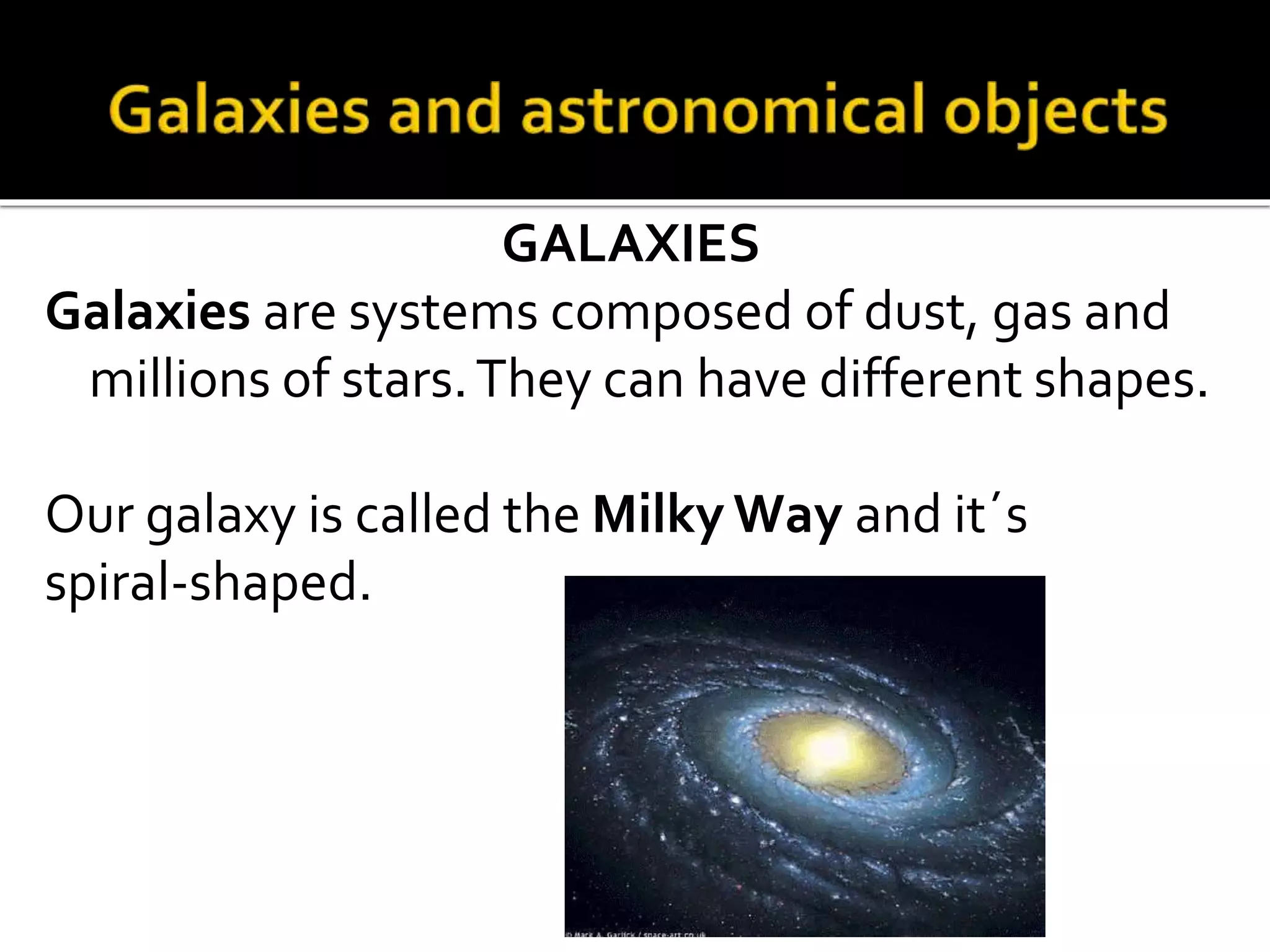
Galaxies are systems composed of dust, gas and
millions of stars.They can have different shapes.
Our galaxy is called the Milky Way and it´s
spiral-shaped.
ASTRONOMICAL OBJECTS
 STARS:They produce heat and light.They are
made up of gases.The Sun is the nearest star to
the Earth.
 PLANETS:They orbit a star.The Earth is our
planet.
 SATELLITES:They orbit planets.The Earth has
one satellinet, the Moon.
 ASTEROIDS:They are rocks that are small to be
considered planets.
 COMETS:They are balls of ice and dust that orbit
the Sun.
The Solar System is part of the MilkyWay galaxy.
The Sun is the star at the centre of the Solar
System.There are eight planets that orbit the
Sun.
-Mercury -Jupiter
-Venus - Saturn
-The Earth - Uranus
- Mars - Neptune
Made of rock Made of gas
The Earth moves in two different ways.
- It rotates on its imaginary axis: ROTATION
- It moves around the Sun: REVOLUTION
-This movement produces day and night in
different parts of the world.
- One rotation of the Earth takes 24 hours.
-This movement produces the different seasons .
-The Earth takes 365 days to complete one
revolution.
The Moon rotates on its axis and moves around
the Earth. It takes 28 days to complete one
revolution.
During these days we see the moon in different
shapes.These shapes are called the phases of
the Moon.
FULL MOON:
We can see
the full Moon.
NEW MOON:
We can´t see
the Moon.
FIRST QUARTER:
We can see the Moon in the shape of a D.
THIRD QUARTER:
We can see the Moon in the shape of a C.
WANING CRESCENT:
The Moon has almost disappeared.
WANING GIBBOUS:
The Moon starts to get smaller.
WAXING GIBBOUS:
We can see most of the Moon.
WAXING CRESCENT:
The Moon appears as a slim crescent.
The Earth is made up of different layers.
GEOSPHERE ATMOSPHERE
(solid part of the Earth) (gaseous)
The crust is made up
of rock. It contains
the continents,
oceans and islands.
The mantle
contains magma.
The outer core is made of melted
iron and other metals.
The inner core is solid and contains different metals.
The ionosphere has no
air.The artificial satellites
are in this layer.
The stratosphere contains
the ozone layer.The ozone
layer protects living things
from radiation.
The troposphere is the layer of the atmosphere in
which we live. It contains air and is where the
weather occurs.
There are different ways of representing the Earth.
A GLOBE
A PLAN A MAP
POLITICAL MAP PHYSICAL MAP
To understand maps we use scales and symbols.
SCALES
We use scales to
calculate real distances in
a map.
1:50000
SYMBOLS
Symbols represent
different elements of a
landscape.
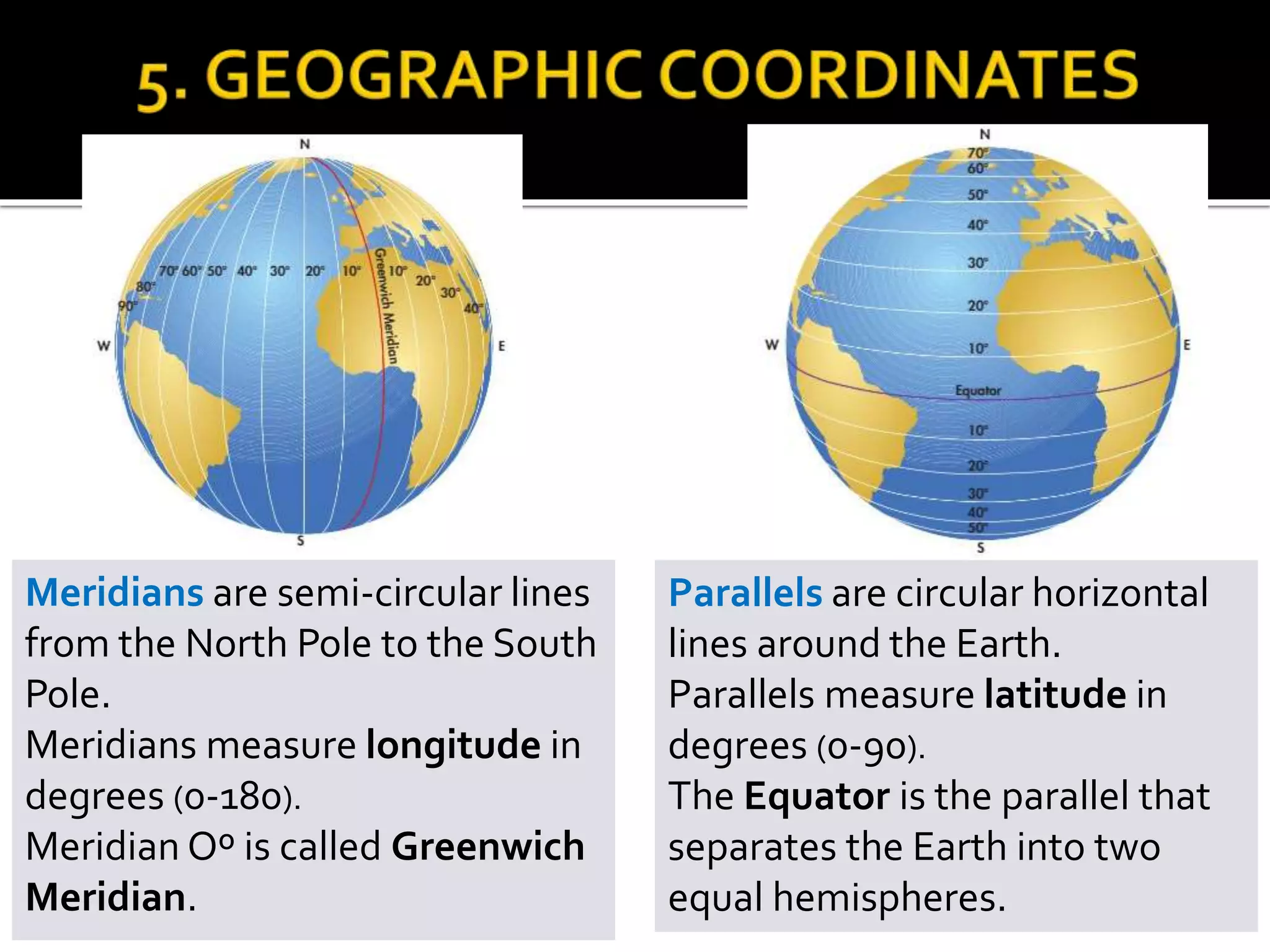
Meridians are semi-circular lines
from the North Pole to the South
Pole.
Meridians measure longitude in
degrees (0-180).
Meridian Oº is called Greenwich
Meridian.
Parallels are circular horizontal
lines around the Earth.
Parallels measure latitude in
degrees (0-90).
The Equator is the parallel that
separates the Earth into two
equal hemispheres.
Meridians are semi-circular lines
from the North Pole to the South
Pole.
Meridians measure longitude in
degrees (0-180).
Meridian Oº is called Greenwich
Meridian.
We use geographic coordinates when we want to
locate a point on the Earth.
Geographic coordinates are given in degrees (º).
Ex. 40ºN 74ºW

The Earth

  • 1.
  • 2.
    The UNIVERSE iseverything that exists. It contains millions of galaxies. Galaxies contain stars, planets and other astronomical objects.
  • 3.
    Scientists believe thatthe Universe started 14000 million years ago with an explosion called Big Bang. Pieces of matter expanded in different directions and they are the different astronomical objects in the Universe.
  • 4.
    GALAXIES Galaxies are systemscomposed of dust, gas and millions of stars.They can have different shapes. Our galaxy is called the Milky Way and it´s spiral-shaped.
  • 5.
    ASTRONOMICAL OBJECTS  STARS:Theyproduce heat and light.They are made up of gases.The Sun is the nearest star to the Earth.  PLANETS:They orbit a star.The Earth is our planet.  SATELLITES:They orbit planets.The Earth has one satellinet, the Moon.  ASTEROIDS:They are rocks that are small to be considered planets.  COMETS:They are balls of ice and dust that orbit the Sun.
  • 6.
    The Solar Systemis part of the MilkyWay galaxy. The Sun is the star at the centre of the Solar System.There are eight planets that orbit the Sun. -Mercury -Jupiter -Venus - Saturn -The Earth - Uranus - Mars - Neptune Made of rock Made of gas
  • 7.
    The Earth movesin two different ways. - It rotates on its imaginary axis: ROTATION - It moves around the Sun: REVOLUTION
  • 8.
    -This movement producesday and night in different parts of the world. - One rotation of the Earth takes 24 hours.
  • 9.
    -This movement producesthe different seasons . -The Earth takes 365 days to complete one revolution.
  • 10.
    The Moon rotateson its axis and moves around the Earth. It takes 28 days to complete one revolution. During these days we see the moon in different shapes.These shapes are called the phases of the Moon.
  • 11.
    FULL MOON: We cansee the full Moon. NEW MOON: We can´t see the Moon. FIRST QUARTER: We can see the Moon in the shape of a D. THIRD QUARTER: We can see the Moon in the shape of a C. WANING CRESCENT: The Moon has almost disappeared. WANING GIBBOUS: The Moon starts to get smaller. WAXING GIBBOUS: We can see most of the Moon. WAXING CRESCENT: The Moon appears as a slim crescent.
  • 12.
    The Earth ismade up of different layers. GEOSPHERE ATMOSPHERE (solid part of the Earth) (gaseous)
  • 13.
    The crust ismade up of rock. It contains the continents, oceans and islands. The mantle contains magma. The outer core is made of melted iron and other metals. The inner core is solid and contains different metals.
  • 14.
    The ionosphere hasno air.The artificial satellites are in this layer. The stratosphere contains the ozone layer.The ozone layer protects living things from radiation. The troposphere is the layer of the atmosphere in which we live. It contains air and is where the weather occurs.
  • 15.
    There are differentways of representing the Earth. A GLOBE A PLAN A MAP POLITICAL MAP PHYSICAL MAP
  • 16.
    To understand mapswe use scales and symbols. SCALES We use scales to calculate real distances in a map. 1:50000 SYMBOLS Symbols represent different elements of a landscape.
  • 17.
    Meridians are semi-circularlines from the North Pole to the South Pole. Meridians measure longitude in degrees (0-180). Meridian Oº is called Greenwich Meridian. Parallels are circular horizontal lines around the Earth. Parallels measure latitude in degrees (0-90). The Equator is the parallel that separates the Earth into two equal hemispheres. Meridians are semi-circular lines from the North Pole to the South Pole. Meridians measure longitude in degrees (0-180). Meridian Oº is called Greenwich Meridian.
  • 18.
    We use geographiccoordinates when we want to locate a point on the Earth. Geographic coordinates are given in degrees (º). Ex. 40ºN 74ºW