CHAPTER 6
TOOL SUPPORT FOR TESTING
REFERENCE GRAHAM ET.AL (2006)
Program Studi S1 Sistem Informasi
Fakultas Sains dan Teknologi
Universitas Islam Negeri Sultan Syarif Kasim Riau
2017
“TOOL SUPPORT FOR MANAGEMENT OF TESTING AND
TESTS”
Fitri Sarah Ariyani R
11453205556
TOOL
 What does 'test management' mean? It could be 'the
management of tests' or it could be 'managing the testing
process'. The tools in this broad category provide support for
either or both of these. The management of testing applies over
the whole of the software development life cycle, so a test
management tool could be among the first to be used in a
project. A test management tool may also manage the tests, which
would begin early in the project and would then continue to be
used throughout the project and also after the system had
been released. In practice, test management tools are typically
used by special- ist testers or test managers at system or
acceptance test level.
TOOLS
The features provided by test management tools include those listed below. Some
tools will provide all of these features; others may provide one or more of the
features, however such tools would still be classified as test management tools.
Features or characteristics of test management tools include support for:
• Management of tests (e.g. keeping track of the associated data for a given set of
tests, knowing which tests need to run in a common environment, number of tests
planned, written, run, passed or failed)
• Scheduling of tests to be executed (manually or by a test
execution tool)
• Management of testing activities (time spent in test design, test execution, whether
we are on schedule or on budget)
• interfaces to other tools
• Traceability of tests, test results and defects to requirements or other sources
• Logging test results (note that the test management tool does not run tests, but
could summarize results from test execution tools that the test manage- ment tool
interfaces with)
LANJ...
This information can be used to monitor the testing process and
decide what actions to take (test control), as described in Chapter
5. The tool also gives information about the component or system
being tested (the test object). Test management tools help to
gather, organize and communicate information about the testing
on a project.
Are requirements management tools really testing
tools? Some people may say they are not, but they do
provide some features that are very helpful to testing.
Because tests are based on requirements, the better
the quality of the require- ments, the easier it will be
to write tests from them. It is also important to be able
to trace tests to requirements and requirements to
tests, as we saw in Chapter 2.
LANJ...Some requirements
management tools are able to
find defects in the require-
ments, for example by
checking for ambiguous or
forbidden words, such as
'might', 'and/or', 'as needed'
or '(to be decided)'.
Features or characteristics of
requirements management
tools include support for:
 storing information about requirement
attributes;
 storing requirement statements;
 checking consistency of requirements;
 identifying undefined, missing or 'to be
defined later' requirements;
 prioritizing requirements for testing purposes;
 traceability of requirements to tests and tests
to requirements, functions or features;
 traceability through levels of requirements;
 interfacing to test management tools;
 coverage of requirements by a set of tests
(sometimes).
•
This type of tool is also known as a
defect-tracking tool, a defect-
management tool, a bug-tracking
tool or a bug-management tool.
However, 'incident management tool'
is probably a better name for it
because not all of the things tracked
are actually defects or bugs;
incidents may also be perceived
problems, anomalies (that aren't
necessarily defects) or enhancement
requests. Also what is normally
recorded is information about the
failure (not the defect) that was
generated during testing -
information about the defect that
Incident Management Tools
LANJ...
Features or characteristics of incident management tools
include support for:
 storing information about the attributes of incidents (e.g.
severity);
 storing attachments (e.g. a screen shot);
 prioritizing incidents;
 assigning actions to people (fix, confirmation test, etc.);
 status (e.g. open, rejected, duplicate, deferred, ready for
confirmation test, closed);
 reporting of statistics/metrics about incidents (e.g.
average time open, number of incidents with each status,
total number raised, open or closed).
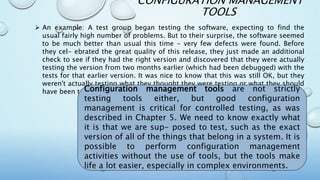
CONFIGURATION MANAGEMENT
TOOLS
 An example: A test group began testing the software, expecting to find the
usual fairly high number of problems. But to their surprise, the software seemed
to be much better than usual this time - very few defects were found. Before
they cel- ebrated the great quality of this release, they just made an additional
check to see if they had the right version and discovered that they were actually
testing the version from two months earlier (which had been debugged) with the
tests for that earlier version. It was nice to know that this was still OK, but they
weren't actually testing what they thought they were testing or what they should
have been testing.Configuration management tools are not strictly
testing tools either, but good configuration
management is critical for controlled testing, as was
described in Chapter 5. We need to know exactly what
it is that we are sup- posed to test, such as the exact
version of all of the things that belong in a system. It is
possible to perform configuration management
activities without the use of tools, but the tools make
life a lot easier, especially in complex environments.
•
•
•
•
•
•
•
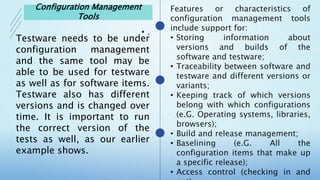
Testware needs to be under
configuration management
and the same tool may be
able to be used for testware
as well as for software items.
Testware also has different
versions and is changed over
time. It is important to run
the correct version of the
tests as well, as our earlier
example shows.
Configuration Management
Tools
Backlink Website Kampus
UIN Suska Riau
JL. H.R Soebrantas No.155 KM.35 Simpang
Baru Panam Pekanbaru-Riau.
http://sif.uin-suska.ac.id/
http://fst.uin-suska.ac.id/
http://uin-suska.ac.id/
Tool Support For Testing (Tool Support For Management Of Testing And Tests)

Tool Support For Testing (Tool Support For Management Of Testing And Tests)

  • 1.
    CHAPTER 6 TOOL SUPPORTFOR TESTING REFERENCE GRAHAM ET.AL (2006)
  • 2.
    Program Studi S1Sistem Informasi Fakultas Sains dan Teknologi Universitas Islam Negeri Sultan Syarif Kasim Riau 2017 “TOOL SUPPORT FOR MANAGEMENT OF TESTING AND TESTS” Fitri Sarah Ariyani R 11453205556
  • 3.
    TOOL  What does'test management' mean? It could be 'the management of tests' or it could be 'managing the testing process'. The tools in this broad category provide support for either or both of these. The management of testing applies over the whole of the software development life cycle, so a test management tool could be among the first to be used in a project. A test management tool may also manage the tests, which would begin early in the project and would then continue to be used throughout the project and also after the system had been released. In practice, test management tools are typically used by special- ist testers or test managers at system or acceptance test level.
  • 4.
    TOOLS The features providedby test management tools include those listed below. Some tools will provide all of these features; others may provide one or more of the features, however such tools would still be classified as test management tools. Features or characteristics of test management tools include support for: • Management of tests (e.g. keeping track of the associated data for a given set of tests, knowing which tests need to run in a common environment, number of tests planned, written, run, passed or failed) • Scheduling of tests to be executed (manually or by a test execution tool) • Management of testing activities (time spent in test design, test execution, whether we are on schedule or on budget) • interfaces to other tools • Traceability of tests, test results and defects to requirements or other sources • Logging test results (note that the test management tool does not run tests, but could summarize results from test execution tools that the test manage- ment tool interfaces with)
  • 5.
    LANJ... This information canbe used to monitor the testing process and decide what actions to take (test control), as described in Chapter 5. The tool also gives information about the component or system being tested (the test object). Test management tools help to gather, organize and communicate information about the testing on a project. Are requirements management tools really testing tools? Some people may say they are not, but they do provide some features that are very helpful to testing. Because tests are based on requirements, the better the quality of the require- ments, the easier it will be to write tests from them. It is also important to be able to trace tests to requirements and requirements to tests, as we saw in Chapter 2.
  • 6.
    LANJ...Some requirements management toolsare able to find defects in the require- ments, for example by checking for ambiguous or forbidden words, such as 'might', 'and/or', 'as needed' or '(to be decided)'. Features or characteristics of requirements management tools include support for:  storing information about requirement attributes;  storing requirement statements;  checking consistency of requirements;  identifying undefined, missing or 'to be defined later' requirements;  prioritizing requirements for testing purposes;  traceability of requirements to tests and tests to requirements, functions or features;  traceability through levels of requirements;  interfacing to test management tools;  coverage of requirements by a set of tests (sometimes).
  • 7.
    • This type oftool is also known as a defect-tracking tool, a defect- management tool, a bug-tracking tool or a bug-management tool. However, 'incident management tool' is probably a better name for it because not all of the things tracked are actually defects or bugs; incidents may also be perceived problems, anomalies (that aren't necessarily defects) or enhancement requests. Also what is normally recorded is information about the failure (not the defect) that was generated during testing - information about the defect that Incident Management Tools
  • 8.
    LANJ... Features or characteristicsof incident management tools include support for:  storing information about the attributes of incidents (e.g. severity);  storing attachments (e.g. a screen shot);  prioritizing incidents;  assigning actions to people (fix, confirmation test, etc.);  status (e.g. open, rejected, duplicate, deferred, ready for confirmation test, closed);  reporting of statistics/metrics about incidents (e.g. average time open, number of incidents with each status, total number raised, open or closed).
  • 9.
    CONFIGURATION MANAGEMENT TOOLS  Anexample: A test group began testing the software, expecting to find the usual fairly high number of problems. But to their surprise, the software seemed to be much better than usual this time - very few defects were found. Before they cel- ebrated the great quality of this release, they just made an additional check to see if they had the right version and discovered that they were actually testing the version from two months earlier (which had been debugged) with the tests for that earlier version. It was nice to know that this was still OK, but they weren't actually testing what they thought they were testing or what they should have been testing.Configuration management tools are not strictly testing tools either, but good configuration management is critical for controlled testing, as was described in Chapter 5. We need to know exactly what it is that we are sup- posed to test, such as the exact version of all of the things that belong in a system. It is possible to perform configuration management activities without the use of tools, but the tools make life a lot easier, especially in complex environments.
  • 10.
    • • • • • • • Testware needs tobe under configuration management and the same tool may be able to be used for testware as well as for software items. Testware also has different versions and is changed over time. It is important to run the correct version of the tests as well, as our earlier example shows. Configuration Management Tools
  • 11.
    Backlink Website Kampus UINSuska Riau JL. H.R Soebrantas No.155 KM.35 Simpang Baru Panam Pekanbaru-Riau. http://sif.uin-suska.ac.id/ http://fst.uin-suska.ac.id/ http://uin-suska.ac.id/