The process of designing the general structure of the
database:
• Logical Design – Deciding on the database schema.
Database design requires that we find a “good”
collection of relation schemas.
– Business decision – What attributes should we
record in the database?
– Computer Science decision – What relation
schemas should we have and how should the
attributes be distributed among the various
relation schemas?
Physical Design – Deciding on the physical layout
of the database
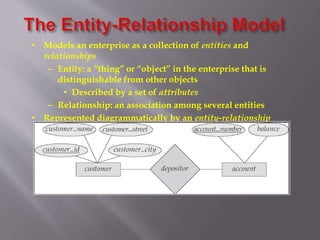
• Models an enterprise as a collection of entities and
relationships
– Entity: a “thing” or “object” in the enterprise that is
distinguishable from other objects
• Described by a set of attributes
– Relationship: an association among several entities
• Represented diagrammatically by an entity-relationship
diagram:
• Extend the relational data model by including
object orientation and constructs to deal with
added data types.
• Allow attributes of tuples to have complex types,
including non-atomic values such as nested
relations.
• Preserve relational foundations, in particular the
declarative access to data, while extending
modeling power.
• Provide upward compatibility with existing
relational languages.
• Defined by the WWW Consortium (W3C)
• Originally intended as a document markup
language not a database language
• The ability to specify new tags, and to create
nested tag structures made XML a great way to
exchange data, not just documents
• XML has become the basis for all new
generation data interchange formats.
• A wide variety of tools is available for parsing,
browsing and querying XML documents/data
• Storage manager is a program module that provides the
interface between the low-level data stored in the
database and the application programs and queries
submitted to the system.
• The storage manager is responsible to the following
tasks:
– Interaction with the file manager
– Efficient storing, retrieving and updating of data
• Issues:
– Storage access
– File organization
– Indexing and hashing
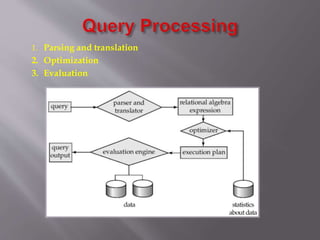
1. Parsing and translation
2. Optimization
3. Evaluation
• Alternative ways of evaluating a given query
– Equivalent expressions
– Different algorithms for each operation
• Cost difference between a good and a bad way of
evaluating a query can be enormous
• Need to estimate the cost of operations
– Depends critically on statistical information about
relations which the database must maintain
– Need to estimate statistics for intermediate results
to compute cost of complex expressions
• A transaction is a collection of operations that
performs a single logical function in a database
application
• Transaction-management component ensures
that the database remains in a consistent
(correct) state despite system failures (e.g.,
power failures and operating system crashes)
and transaction failures.
• Concurrency-control manager controls the
interaction among the concurrent transactions,
to ensure the consistency of the database.
10
 Data mining (knowledge discovery from data)
 Extraction of interesting (non-trivial, implicit,
previously unknown and potentially useful)
patterns or knowledge from huge amount of data
 Alternative name
 Knowledge discovery in databases (KDD)
 Watch out: Is everything “data mining”?
 Query processing
 Expert systems or statistical programs
11
 The Explosive Growth of Data: from terabytes to petabytes
 Data collection and data availability
 Automated data collection tools, database systems, Web,
computerized society
 Major sources of abundant data
 Business: Web, e-commerce, transactions, stocks, …
 Science: Remote sensing, bioinformatics, scientific simulation, …
 Society and everyone: news, digital cameras,
 We are drowning in data, but starving for knowledge!
 “Necessity is the mother of invention”—Data mining—Automated
analysis of massive data sets
12
 Data analysis and decision support
 Market analysis and management
 Target marketing, customer relationship management
(CRM), market basket analysis, market segmentation
 Risk analysis and management
 Forecasting, customer retention, quality control,
competitive analysis
 Fraud detection and detection of unusual patterns
(outliers)
13
 Other Applications
 Text mining (news group, email, documents) and
Web mining
 Stream data mining
 Bioinformatics and bio-data analysis
The architecture of a database systems is greatly
influenced by
the underlying computer system on which the
database is running:
• Centralized
• Client-server
• Parallel (multi-processor)
• Distributed
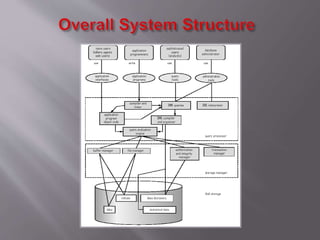
Users are differentiated by the way they expect to
interact with
the system
• Application programmers – interact with system
through DML calls
• Sophisticated users – form requests in a database
query language
• Specialized users – write specialized database
applications that do not fit into the traditional data
processing framework
• Naïve users – invoke one of the permanent
application programs that have been written
previously
– Examples, people accessing database over the
• Coordinates all the activities of the database system; the
database administrator has a good understanding of
the enterprise’s information resources and needs.
• Database administrator's duties include:
– Schema definition
– Storage structure and access method definition
– Schema and physical organization modification
– Granting user authority to access the database
– Specifying integrity constraints
– Acting as liaison with users
– Monitoring performance and responding to
changes in requirements
• 1950s and early 1960s:
– Data processing using magnetic tapes for storage
• Tapes provide only sequential access
– Punched cards for input
• Late 1960s and 1970s:
– Hard disks allow direct access to data
– Network and hierarchical data models in widespread use
– Ted Codd defines the relational data model
• Would win the ACM Turing Award for this work
• IBM Research begins System R prototype
• UC Berkeley begins Ingres prototype
– High-performance (for the era) transaction processing
• 1980s:
– Research relational prototypes evolve into commercial
systems
• SQL becomes industrial standard
– Parallel and distributed database systems
– Object-oriented database systems
• 1990s:
– Large decision support and data-mining applications
– Large multi-terabyte data warehouses
– Emergence of Web commerce
• 2000s:
– XML and XQuery standards
– Automated database administration

Database management system

  • 2.
    The process ofdesigning the general structure of the database: • Logical Design – Deciding on the database schema. Database design requires that we find a “good” collection of relation schemas. – Business decision – What attributes should we record in the database? – Computer Science decision – What relation schemas should we have and how should the attributes be distributed among the various relation schemas? Physical Design – Deciding on the physical layout of the database
  • 3.
    • Models anenterprise as a collection of entities and relationships – Entity: a “thing” or “object” in the enterprise that is distinguishable from other objects • Described by a set of attributes – Relationship: an association among several entities • Represented diagrammatically by an entity-relationship diagram:
  • 4.
    • Extend therelational data model by including object orientation and constructs to deal with added data types. • Allow attributes of tuples to have complex types, including non-atomic values such as nested relations. • Preserve relational foundations, in particular the declarative access to data, while extending modeling power. • Provide upward compatibility with existing relational languages.
  • 5.
    • Defined bythe WWW Consortium (W3C) • Originally intended as a document markup language not a database language • The ability to specify new tags, and to create nested tag structures made XML a great way to exchange data, not just documents • XML has become the basis for all new generation data interchange formats. • A wide variety of tools is available for parsing, browsing and querying XML documents/data
  • 6.
    • Storage manageris a program module that provides the interface between the low-level data stored in the database and the application programs and queries submitted to the system. • The storage manager is responsible to the following tasks: – Interaction with the file manager – Efficient storing, retrieving and updating of data • Issues: – Storage access – File organization – Indexing and hashing
  • 7.
    1. Parsing andtranslation 2. Optimization 3. Evaluation
  • 8.
    • Alternative waysof evaluating a given query – Equivalent expressions – Different algorithms for each operation • Cost difference between a good and a bad way of evaluating a query can be enormous • Need to estimate the cost of operations – Depends critically on statistical information about relations which the database must maintain – Need to estimate statistics for intermediate results to compute cost of complex expressions
  • 9.
    • A transactionis a collection of operations that performs a single logical function in a database application • Transaction-management component ensures that the database remains in a consistent (correct) state despite system failures (e.g., power failures and operating system crashes) and transaction failures. • Concurrency-control manager controls the interaction among the concurrent transactions, to ensure the consistency of the database.
  • 10.
    10  Data mining(knowledge discovery from data)  Extraction of interesting (non-trivial, implicit, previously unknown and potentially useful) patterns or knowledge from huge amount of data  Alternative name  Knowledge discovery in databases (KDD)  Watch out: Is everything “data mining”?  Query processing  Expert systems or statistical programs
  • 11.
    11  The ExplosiveGrowth of Data: from terabytes to petabytes  Data collection and data availability  Automated data collection tools, database systems, Web, computerized society  Major sources of abundant data  Business: Web, e-commerce, transactions, stocks, …  Science: Remote sensing, bioinformatics, scientific simulation, …  Society and everyone: news, digital cameras,  We are drowning in data, but starving for knowledge!  “Necessity is the mother of invention”—Data mining—Automated analysis of massive data sets
  • 12.
    12  Data analysisand decision support  Market analysis and management  Target marketing, customer relationship management (CRM), market basket analysis, market segmentation  Risk analysis and management  Forecasting, customer retention, quality control, competitive analysis  Fraud detection and detection of unusual patterns (outliers)
  • 13.
    13  Other Applications Text mining (news group, email, documents) and Web mining  Stream data mining  Bioinformatics and bio-data analysis
  • 14.
    The architecture ofa database systems is greatly influenced by the underlying computer system on which the database is running: • Centralized • Client-server • Parallel (multi-processor) • Distributed
  • 15.
    Users are differentiatedby the way they expect to interact with the system • Application programmers – interact with system through DML calls • Sophisticated users – form requests in a database query language • Specialized users – write specialized database applications that do not fit into the traditional data processing framework • Naïve users – invoke one of the permanent application programs that have been written previously – Examples, people accessing database over the
  • 16.
    • Coordinates allthe activities of the database system; the database administrator has a good understanding of the enterprise’s information resources and needs. • Database administrator's duties include: – Schema definition – Storage structure and access method definition – Schema and physical organization modification – Granting user authority to access the database – Specifying integrity constraints – Acting as liaison with users – Monitoring performance and responding to changes in requirements
  • 18.
    • 1950s andearly 1960s: – Data processing using magnetic tapes for storage • Tapes provide only sequential access – Punched cards for input • Late 1960s and 1970s: – Hard disks allow direct access to data – Network and hierarchical data models in widespread use – Ted Codd defines the relational data model • Would win the ACM Turing Award for this work • IBM Research begins System R prototype • UC Berkeley begins Ingres prototype – High-performance (for the era) transaction processing
  • 19.
    • 1980s: – Researchrelational prototypes evolve into commercial systems • SQL becomes industrial standard – Parallel and distributed database systems – Object-oriented database systems • 1990s: – Large decision support and data-mining applications – Large multi-terabyte data warehouses – Emergence of Web commerce • 2000s: – XML and XQuery standards – Automated database administration